FINGER TIP INJURY
Dr. Shivam Beniwal
Senior Resident
Plastic & Reconstructive Surgery
Army Hospital (Research & Referral), New Delhi
FINGER TIP INJURY
00002
Introduction
• Functional recovery: primary reconsideration
• Failure to appreciate the patient’s attitude and ability to adjust to the
injury compromise otherwise successful procedure.
• No gold standard technique
• Any amputation in a child whose ultimate role in life is yet undefined:
approach with conservative attitude.
• Adults: well defined functional roles: more definitve approach that
will accelerate their functional rehabilitation.
Goals of amputation surgery in finger tip injury
1. Preservation of functional length
2. Provision of durable skin coverage
3. Preservation of useful sensibility
4. Avoidance of asymptomatic neuromas
5. Prevention of adjacent joint contractures
6. Prevention of morbidity by minimising complications
7. Allowance of early return to work, play and activities of daily living
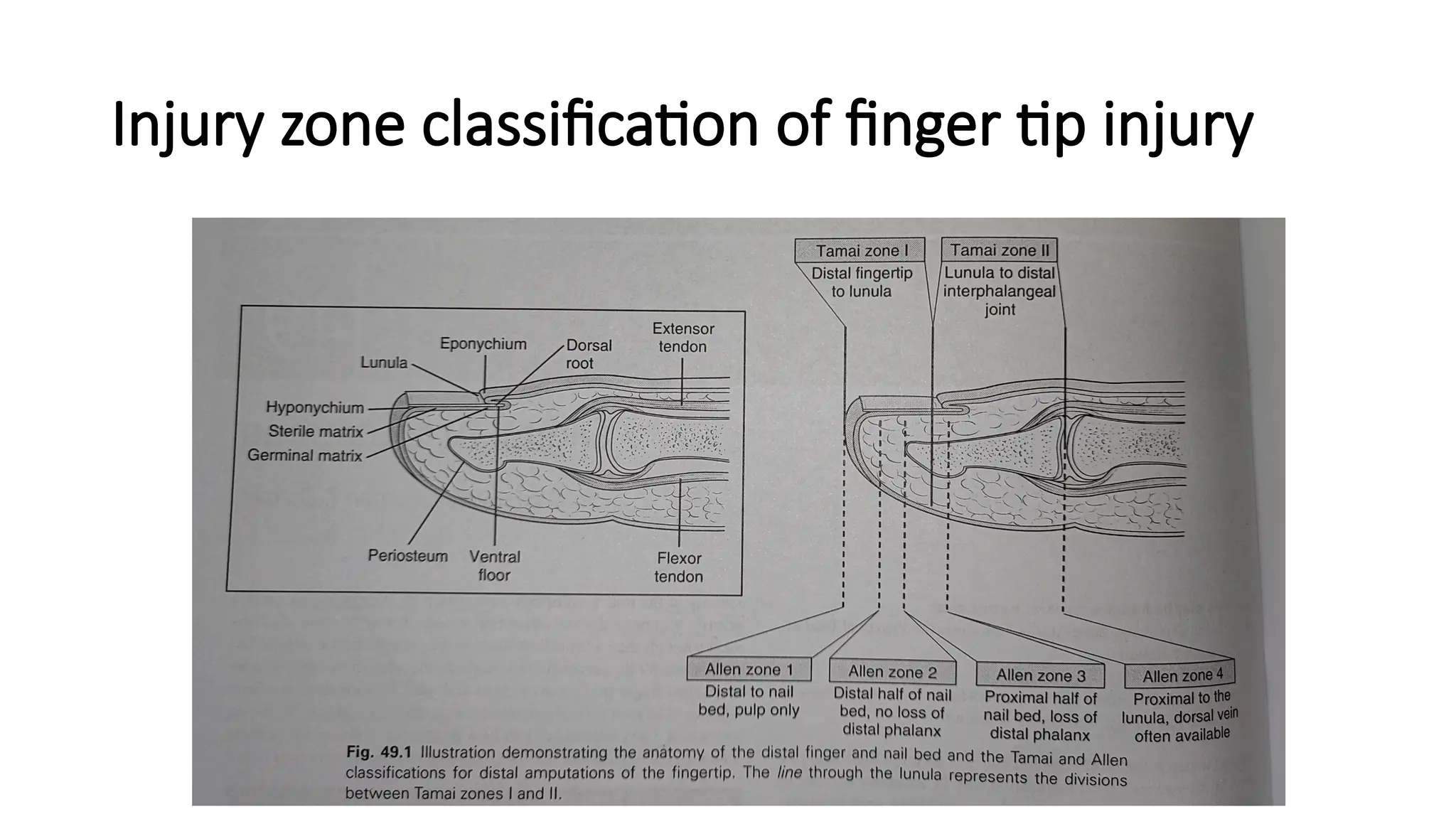
Injury zone classification of finger tip injury
Digital tip amputations with skin or pulp loss only
• Geometry of defect dictates the various treatment possibilities.
• Transverse or oblique,
• With more volar skin loss than dorsal skin loss or reverse may be true
• Slicing amputations resulting in skin loss primarily from the ulnar or radial side
of the digit sparing the distal tip
1. Non microsurgical reattachment or composite graft
2. Dressing and healing by secondary intention
3. Primary closure
4. Split thickness grafting
1. Non microsurgical reattachment or composite graft
• Amputated part is available and not highly contaminated: Cleansed and
reattached: effective app for children with injuries distal to DIP joint
• Reattached as a composite graft or defatted and sutured as FTSG
• Biological dressing: inappropriate in adults: Dead tissue in
contaminated field
• Bony involvement of composite graft: repair of amputated with
absorbable sutures, Krischner wires or a hypodermic needle
• Nail plate is removed and matrix repaired
• Repaired within 5 hours: 61% survival rate
1. Non microsurgical reattachment or composite graft
• Tip as biological dressing
• Age < 4 yrs: complete graft survival
• Hook nail deformity, Cold intolerance, Functional limitations
• Success rate: 43% for proximal to eponychium, 58% for distal to
eponychium
• Suboptimal results:, age > 18 yrs, alcohol, diabetes, crush injury
• Chen and colleagues technique: Distal amputated tip defatted and
deepithelialized, bone excised: Success rate higher than 93% with
A2PD 6.3mm/ 6mon, >90% happy cosmetically, 86% functionality
2. Dressing and healing by secondary intention
• One of the best option for a tip amputation without exposed bone
• Applicable when amputated part is unavailable or cannot be used
• Simple, inexpensive, effective, regardless of age
• M/A for wounds with skin loss ≤ 1.5 cm: wound contracture and
reepithelization over 3 to 4 weeks with Norm Sens, 2PD.(better than
other)
• Loss : 1 to 2 months
• Daily dress, care, splinting to protect healing
2. Dressing and healing by secondary intention
• MIST Ultrasound therapy: encourage granulation tissue form, ↓ bact
load, ↑ angiogenesis, ↑ growth factors, collagen deposition
• Distal phalanx exposed: trimmed
• Second surgery, nail growth , lack of ample soft tissue
• Work on ROM to avoid joint stiffness or contractures
• Bojsen- Moller et al.: No joint stiffness, 50% (10%) cold intol
• A2PD 6mm, Off work 4.3wks vs 2.9 wks (18 to 26 d)
3. Primary closure
• If repair is without tension across the wound edges
• Difficult: lack of sufficient mobile dermis
• 51% tenderness with some disability
• Shortness of bone allow primary closure
• Traction neurotomies: prevent symptomatic neuromas
3. Primary closure
• Nail bed ablation: injury at or through the Lunula
• Entire germinal and Sterile matrix is excised
• Curate to scrap dorsal cortex of distal phalanx
• Risk of symptomatic neuroma and bothersome nail horn
4. Split thickness grafting
• Pulp with well vascularized recipient bed: bone or tendon devoid of
paratenon
• Induration, tenderness, fissuring of the skin, Reduce sensibility, donor
site
• Cold insensitivity: 33% vs 39%
• Hypoesthesia: 67% versus 26%
• A2PD 5mm
• No advantage for fingertip coverage
Digital tip amputations with exposed bone
• Small areas of well vascularised bone support healing: if desicciation
prevented by wound care(semi occlusive )
• Larger areas: coverage vs revision amputation via skeletal shortening
& closure; dilemma
• Extent of nail matrix injury & hook nail deform: wound closure and
amount of bony support for nail bed
• Closure by pulling nail bed avoided
• Level of distal phalanx absent: nail bed trim to same level
• Nail bed ablation: Injury at or through the Lunula
Digital tip amputations with exposed bone
• Minimal exposed bone: heal secondarily + dressing
• Minimal skeletal shortening with a rasp or rongeur: allow adequate
soft tissue cover
• Absorbable sutures: Avoid pain during removal
• Wound heal by secondary intention: Adequate nail bed support
• Antibiotic not routinely prescribed: adequate debridement without
gross contamination
Digital tip amputations with exposed bone
• R/v in week, occupational therapy to work on edema control and
ROM
• Tip desensitization is started once the wound is healed.
• Return to duty within 6 to 8 weeks
• Skin to skin closure not necessary
• Flap coverage for considerable bone exposure
Semiocclusive dressings
• Self adhesive opsite or flexifix film
• Weekly dressing until epithelisation is completed
• Nail horn or neuroma formation
Bilayer matrix wound dressing
• Integra: acceptable alternative to flap coverage
• Acellular dermal matrix composed of bovine matrix covered by
silicone layer: scaffold
• Can placed directly on bone or tendon once wound is cleaned
• Autologous skin graft applied after 3 to 4 wks
• Single stage
• Expensive
Flap coverage
• Atasoy-Kleinert Volar “V-Y” Flap
• Kutler Lateral “V-Y” Flaps
• Volar Flap Advancement
• Cross Finger Pedicled Flap
• Thenar Flap
• Island Flaps
• Free Flaps
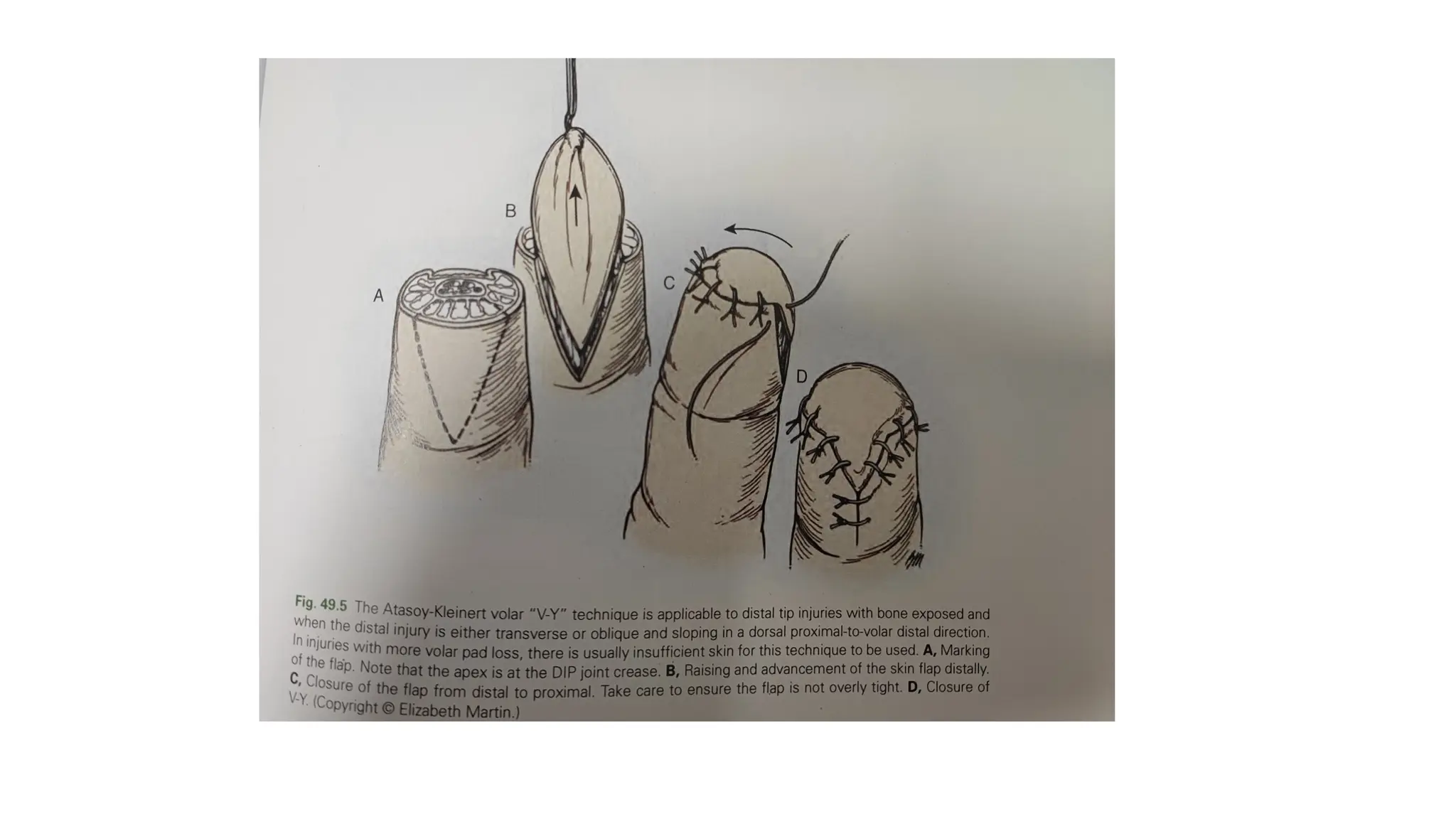
Atasoy-Kleinert Volar “V-Y” Flap
• Reconstruction of distal pad with preservation of length when bone is exposed
• Indicated: dorsal oblique or transverse distal fingertip amputations
• C/I: oblique amp inj with more palmar skin loss than dorsal skin, extensive skin loss
• Base- distal cut edge,
• Apex-DIP flexion crease,
• sides 1.5 times desired advancement
• Only full thickness of skin is cut
• Blood supply presumed to be axial
• Sep b/w flexor sheath and s/c tissue: dividing fibrous septae
anchoring s/c to bone
• Resulting V incision closed to make Y
• Mobilised upto 1 cm, defatted to facilitate tension free closure
• Persistent paraesthesia, impaired sensibility, cold intolerance
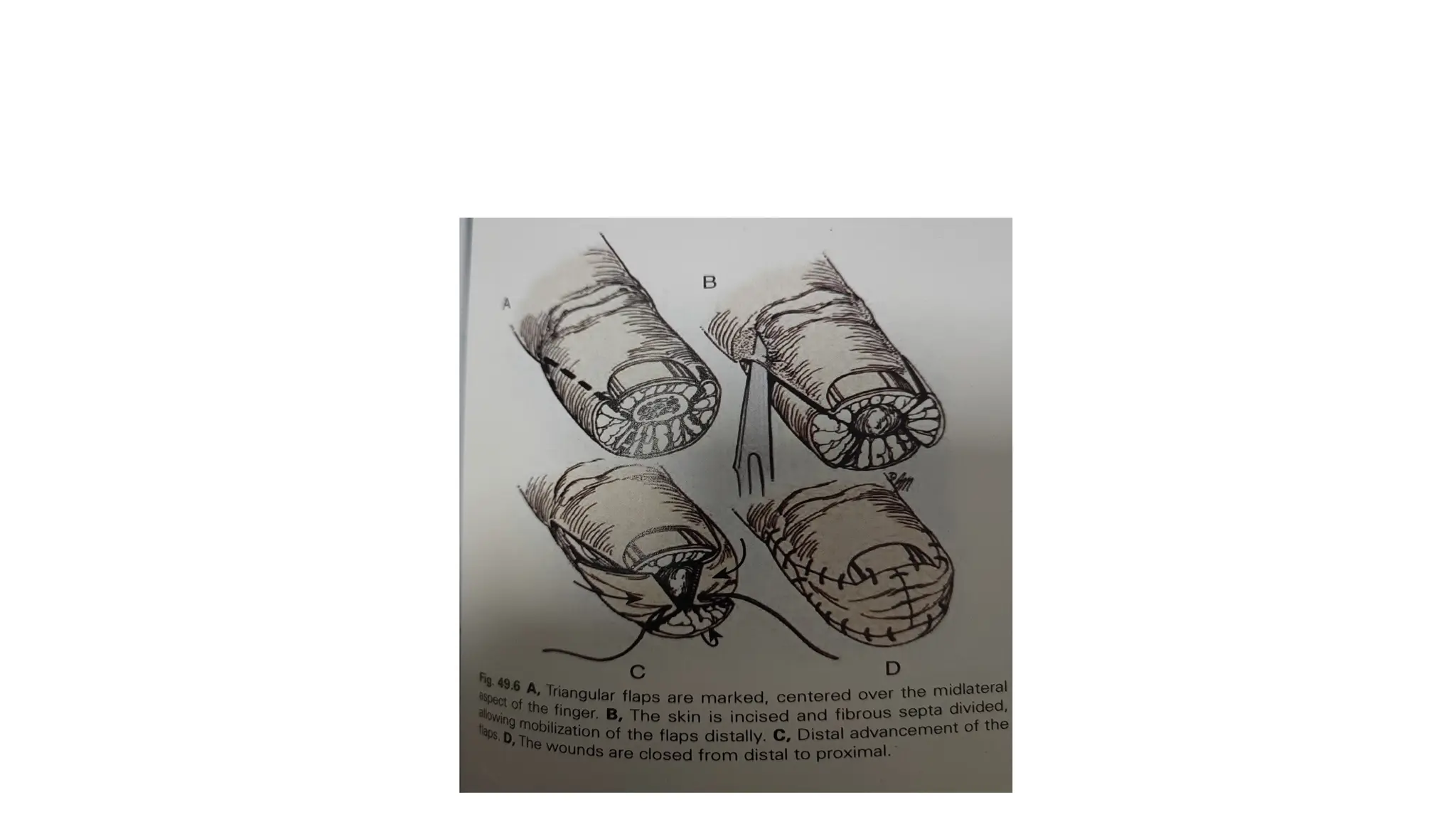
Kutler Lateral “V-Y” Flaps
• Advancing two triangular flaps from lateral positions to cover the tip
of digit
• Two triangular flaps developed: mid lateral aspect of each site of the
digit, Incisions just down through the dermis
• Similarly mobilised
• Advanced to the midline distally and suture together
• V apex closed in Y fashion, Surrounding edges and nail bed or nail
sutured to distal edges
• Advanced up to 3 to 4 mm
• Modifications:
• Shepard modification: dividing dorsal pedicle but preserved under palmar
skin, advancing upto 10-14 mm, applicable to oblique palmar or
transverse oriented amp
• Raising triangular flaps on its neurovascular pedicle
• Extending the flap to PIP joint crease to inc size and advancement ability
• Upto 2cm
• Cold intolerance, numbness, PIP joint flexion contractures, DIP joint
flexion contractures, risk of necrosis in tension, hook nail deformity,
prevent by causing proximal wound to heal by sec intention
Volar Flap advancement
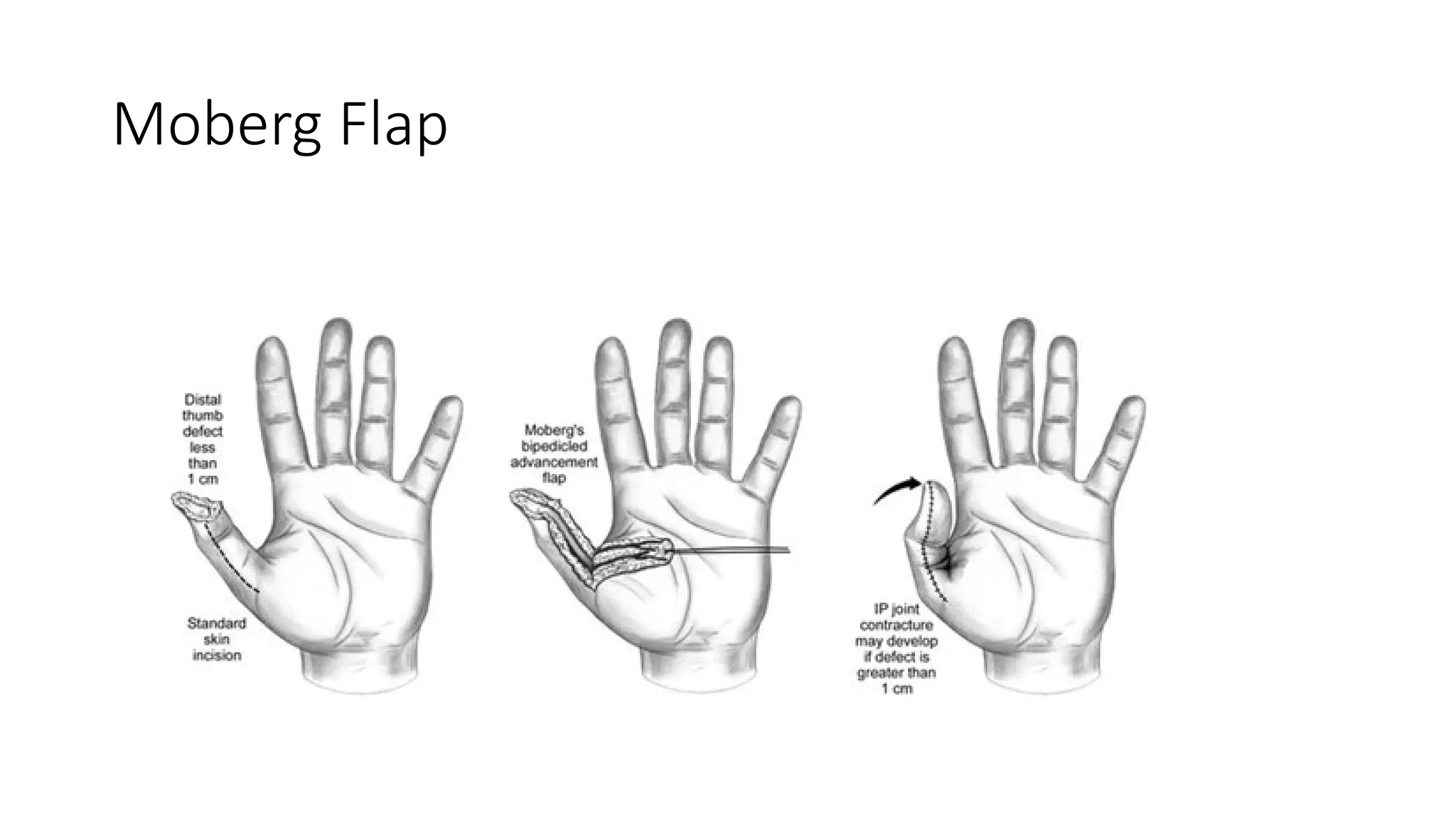
• Moberg tech: volar flap advancement for coverage of thumb tip
amputations
• Bipedicled, axial pattern, cutaneous advancement flap
• Snow: advocated technique for fingertip amputations when length is
to be maintained
• Advancing volar skin on its neurovascular pedicle provides the dermis
with sensibility without losing length
• Arons mod: terminal dermal graft for padding
• Skin graft may be added at the base of digit to gain length
• Mid axial incisions just dorsal to flexion crease at each of the
interphalangeal joints are made on both sides of the digit
• Completely separated from the underlying flexor tendon sheath,
Advanced to the distal tip and sutured to the nail bed and the adjacent
sites of digit
• Tip of the flap may need to be shaped to fit the distal defect
• Only appropriate for thumb as finger lacks the robust dorsal circulation
comp to thumb, thumb is able to tolerate mild IP flexion contraction
• Limited to wounds measuring 1 cm in longitudinal dimension
• Skin necrosis on dorsum of the finger
Moberg Flap
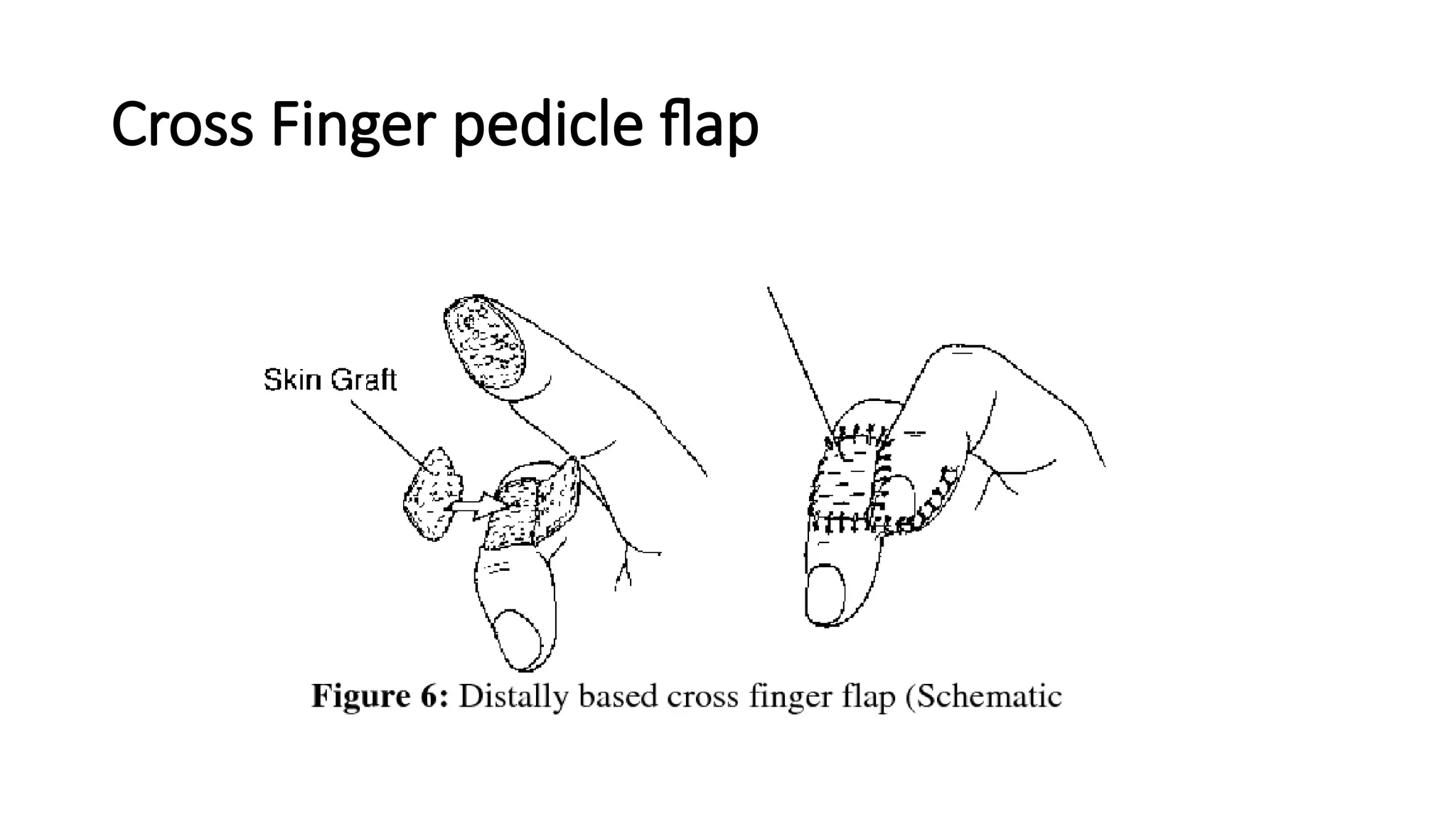
Cross Finger pedicle flap
• Gurdin and Pangman, indicated when other techn for local coverage are not
possible and maintainence of length is important
• Ass with stiffness, coverage for an oblique volar defect of the pulp region or
for extensive soft tissue loss on the volar fingertip with exposed bone and
tendon
• Flap should be 1 to 2 mm larger than the defect to allow for tissue
contracture and ensure tension free insetting of flap
• donor site on dorsum of the neighbouring digit, broad pedicle will be on the
side adjacent the digit with the wound
• Flap is reflected with preservation of its venous drainage at the base of flap
• Plane between the paratenon of extensor mechanism and s/c
• 3 margins of the flap are sutured in place on the recipient site and 4th
margin is to be
sutured at the time of flap detachment
• FTSG from ipsilateral UE i.e. hypothenar, antecubital, or medial forearm skin, without
hair
• Two fingers may be sewn together or a transdigital Kirschner wire
• Plaster splint
• 3 weeks detach
• Cohen and Cronin mod: a dorsal sensory br of digital nerve
• A2PD 3.6-4.8mm
• Cold intolerance
Cross Finger pedicle flap
Thenar flap
• Gatewood , expaned by Flatt, modified by Smith and Albin as thenar H
flap
• Ind: random pattern thenar flap similar to cross finger, when
preservation of length is important and other techniques are not
applicable
• Use in index and long fingers
• Adv:
• Better skin color, abudance of s/c, return of some sensibility
Principles:
• Design the flap near the MCP crease of the thumb and avoid the
midpalmar area
• Fully flex the MCP joint with whatever amount of flexion is required in
the IP joints of the recipient finger
• Detach the pedicle 10 to 14 days postop and begin immediate active
range of motion exercises
• The area of contact of injured digital tip with thenar eminence is outlined
• An “H” is drawn on the skin approx. 20% wider than the defect
• Transverse limb of incision is made at the most distal contact point of fingertip with
thenar eminence
• Square proximal and distal flaps are elevated including s/c
• Proximal flap sutured to fingertip and distal flap is sutured to proximal margin of
defect on volar side of injured finger]proximal flap advanced distally and distal flap
advanced proximally to close the donor defect
• Soft dressing, 2 weeks later flap detached
• Fingertip closed with proximal flap and distal flap is advanced into thenar defect
• Closes donor site , problem of scar solved
• Alternative technique:
• Proximal based flap sutured to injured tip similar but to use FTSG or
SSG or Limberg flap for thenar defect when flap is divided and inset
• Thanik et al used a combination of the thenar flap in combination
with a bone and split thickness nail bed grafts to reconstruct bony,
soft tissue and nail bed injuries
• Flexion contracture
Thenar H flap
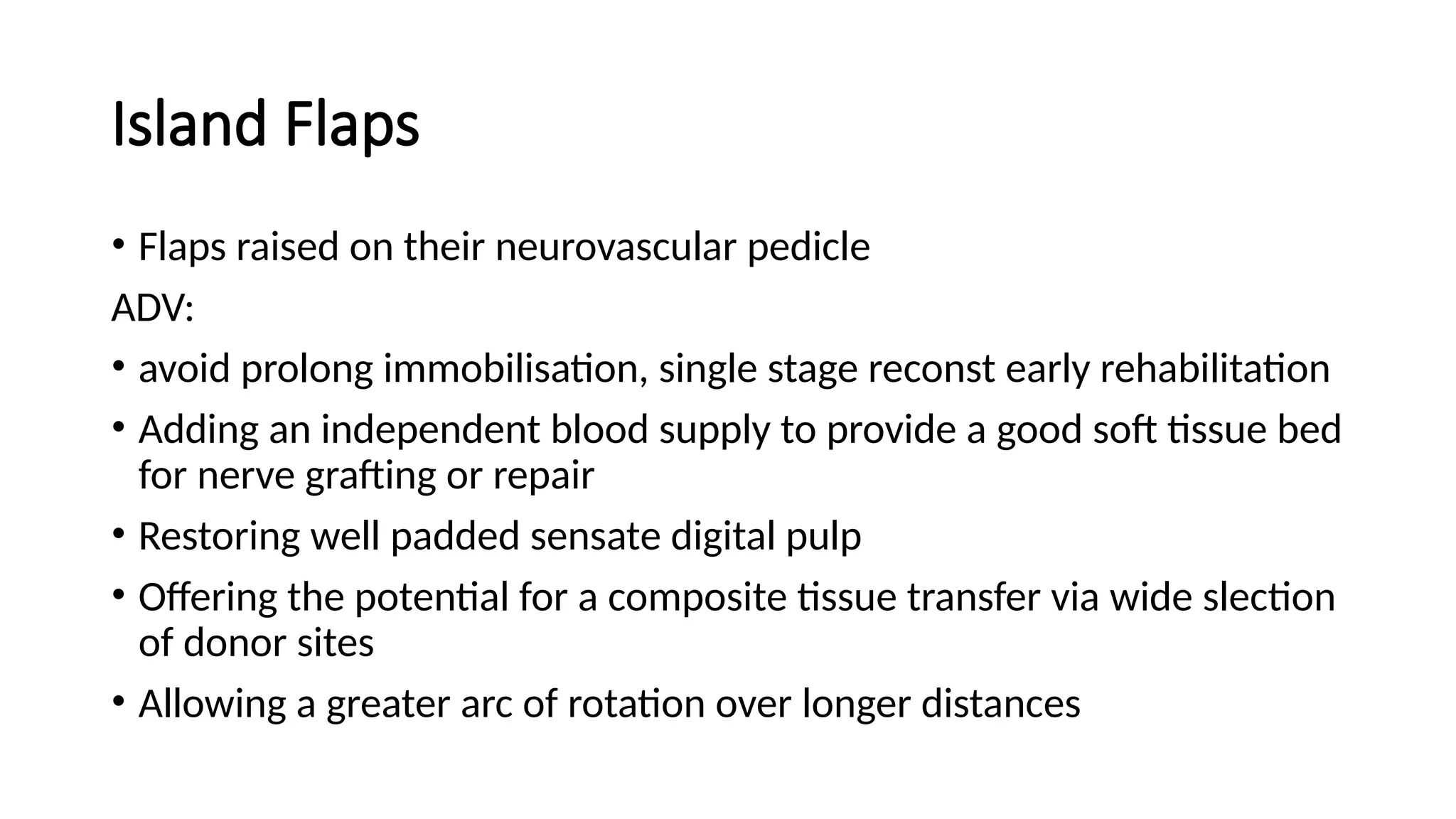
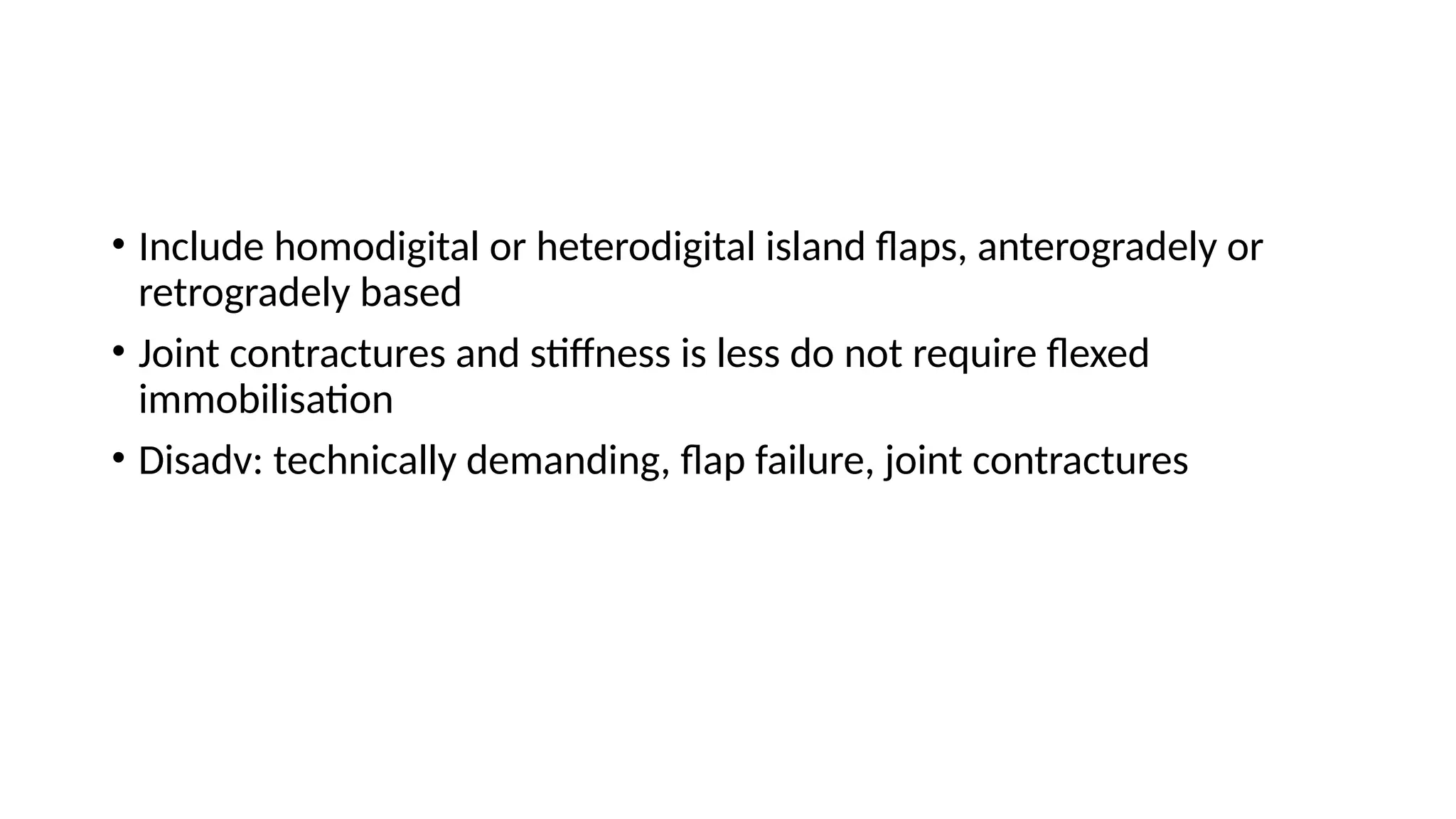
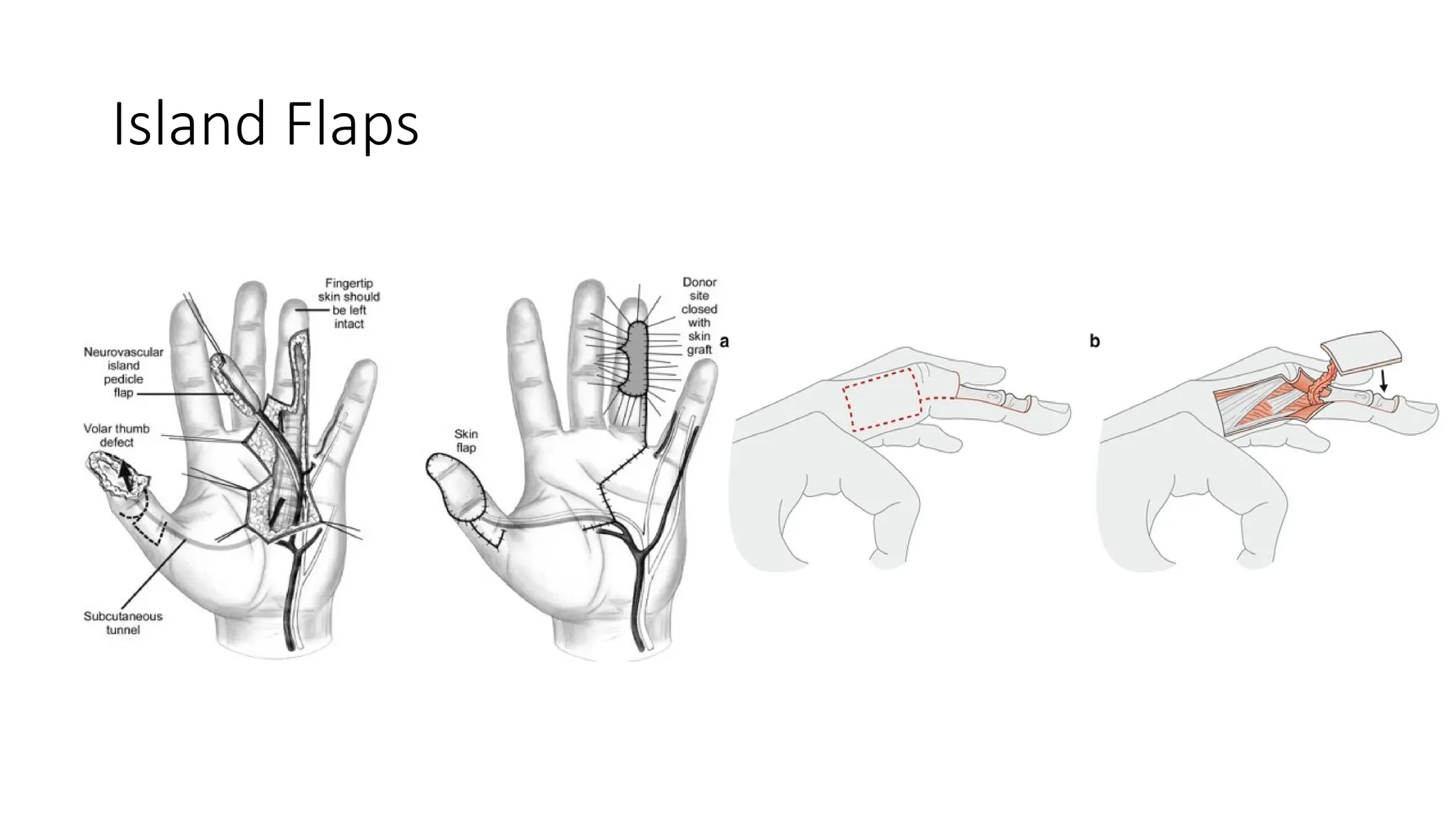
Island Flaps
• Flaps raised on their neurovascular pedicle
ADV:
• avoid prolong immobilisation, single stage reconst early rehabilitation
• Adding an independent blood supply to provide a good soft tissue bed
for nerve grafting or repair
• Restoring well padded sensate digital pulp
• Offering the potential for a composite tissue transfer via wide slection
of donor sites
• Allowing a greater arc of rotation over longer distances
• Include homodigital or heterodigital island flaps, anterogradely or
retrogradely based
• Joint contractures and stiffness is less do not require flexed
immobilisation
• Disadv: technically demanding, flap failure, joint contractures
Island Flaps
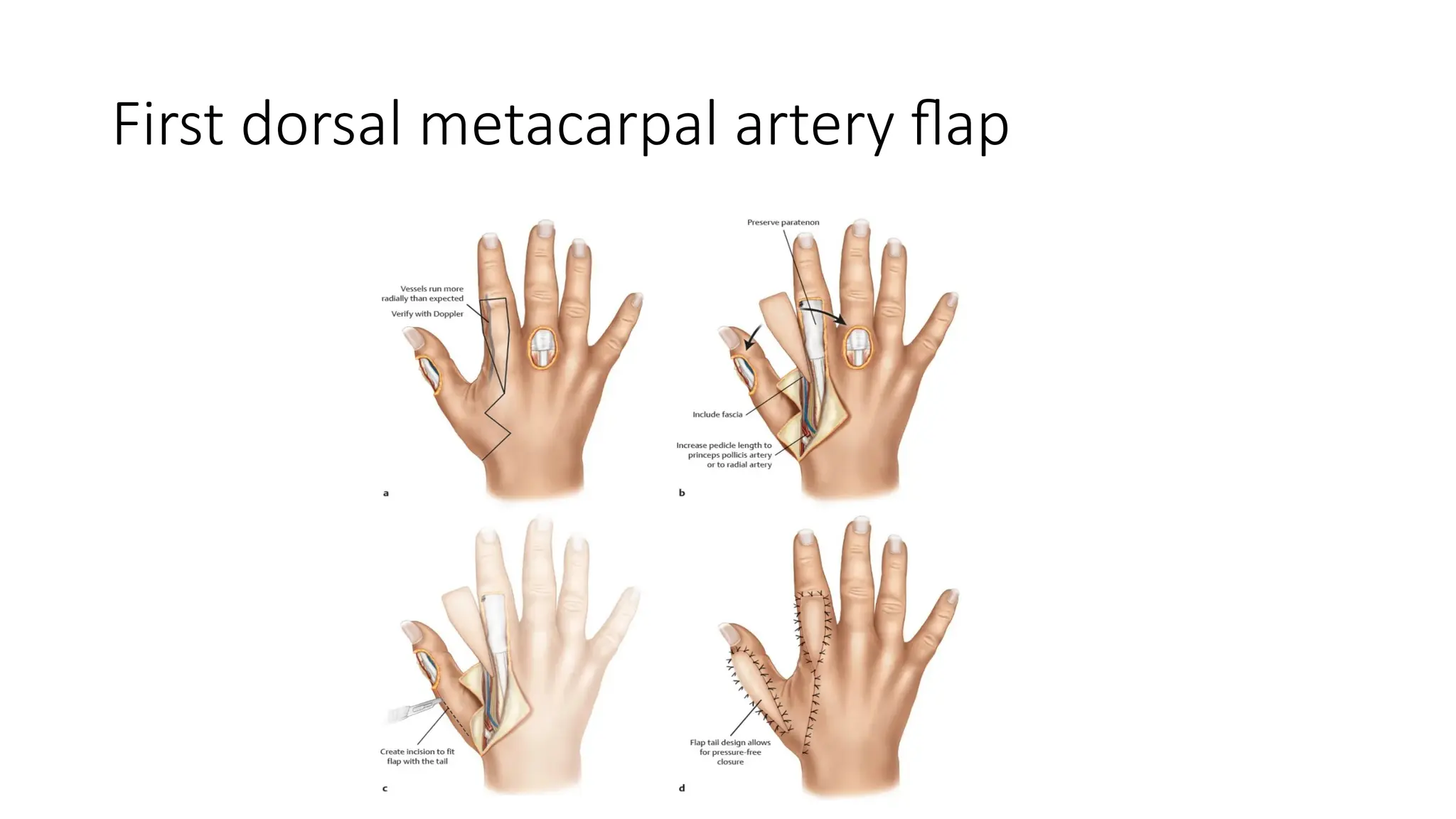
First dorsal metacarpal artery flap
Free flaps
• Treat complex digital defects
• Include medial arm free flaps, ALT flaps, wraparound toe flaps, arterialised venous flaps
• Complicated by bulky app req revision sx, donor site morbidity, unpredictable survival rates
• Fasicocutaneous flap based on superficial palmar br of radial art for medium to large volar soft tissue
defects including fingertip[ region
• Free thenar flap
• Proximal first dorsal metacarpal artery free flap when defect is large when digital flaps cannot be used
• Ulnar artery perforator free flaps : thin, aesthetic and texture similar to finger, free of hair: proximally
or distally based
• Distal ulnar artery perforator bilobed free flap: cosmetic similar to digital skin, donor and recipient in
same field, preservation of main trunk of ulnar artery, similar size v. to that of proper digital artery,
accompanying superficial veins, sensation via medial cut nerve of forearm or dorsal sensory br of ulnar
nerve
Greens author preferred
• Minimal areas of bone exposed : non-operatively with dressing to prevent dessication,
ultrasonic MIST therapy, ;
• Pictures of similar cases to gain trust
• Single digit inj with a small protruding portion of distal phalanx: trim bone and secondary
intention
• Smal V- Y flaps rarely indicated
• For large defect, volar oblique wounds: cros finger or homodigital island flaps
• Fow thumb wound, first dorsal metacarpal artery flap
• Not to favour thenar flap bcz of IPJ stiffness, consider in young index & long fingertip amp
• Large portion of volar tissues: neurovascular island flaps
• Bilayer matrix wound dressing increasing their use
References :
• Green's Operative Hand Surgery
• Google Scholars

00002 FINGER TIP INJURY.pptx. TRY TO EXPLAIN BASICS AND SHARE THE KNOWLEDGE

  • 1.
    FINGER TIP INJURY Dr.Shivam Beniwal Senior Resident Plastic & Reconstructive Surgery Army Hospital (Research & Referral), New Delhi FINGER TIP INJURY 00002
  • 2.
    Introduction • Functional recovery:primary reconsideration • Failure to appreciate the patient’s attitude and ability to adjust to the injury compromise otherwise successful procedure. • No gold standard technique • Any amputation in a child whose ultimate role in life is yet undefined: approach with conservative attitude. • Adults: well defined functional roles: more definitve approach that will accelerate their functional rehabilitation.
  • 3.
    Goals of amputationsurgery in finger tip injury 1. Preservation of functional length 2. Provision of durable skin coverage 3. Preservation of useful sensibility 4. Avoidance of asymptomatic neuromas 5. Prevention of adjacent joint contractures 6. Prevention of morbidity by minimising complications 7. Allowance of early return to work, play and activities of daily living
  • 4.
    Injury zone classificationof finger tip injury
  • 5.
    Digital tip amputationswith skin or pulp loss only • Geometry of defect dictates the various treatment possibilities. • Transverse or oblique, • With more volar skin loss than dorsal skin loss or reverse may be true • Slicing amputations resulting in skin loss primarily from the ulnar or radial side of the digit sparing the distal tip 1. Non microsurgical reattachment or composite graft 2. Dressing and healing by secondary intention 3. Primary closure 4. Split thickness grafting
  • 6.
    1. Non microsurgicalreattachment or composite graft • Amputated part is available and not highly contaminated: Cleansed and reattached: effective app for children with injuries distal to DIP joint • Reattached as a composite graft or defatted and sutured as FTSG • Biological dressing: inappropriate in adults: Dead tissue in contaminated field • Bony involvement of composite graft: repair of amputated with absorbable sutures, Krischner wires or a hypodermic needle • Nail plate is removed and matrix repaired • Repaired within 5 hours: 61% survival rate
  • 7.
    1. Non microsurgicalreattachment or composite graft • Tip as biological dressing • Age < 4 yrs: complete graft survival • Hook nail deformity, Cold intolerance, Functional limitations • Success rate: 43% for proximal to eponychium, 58% for distal to eponychium • Suboptimal results:, age > 18 yrs, alcohol, diabetes, crush injury • Chen and colleagues technique: Distal amputated tip defatted and deepithelialized, bone excised: Success rate higher than 93% with A2PD 6.3mm/ 6mon, >90% happy cosmetically, 86% functionality
  • 8.
    2. Dressing andhealing by secondary intention • One of the best option for a tip amputation without exposed bone • Applicable when amputated part is unavailable or cannot be used • Simple, inexpensive, effective, regardless of age • M/A for wounds with skin loss ≤ 1.5 cm: wound contracture and reepithelization over 3 to 4 weeks with Norm Sens, 2PD.(better than other) • Loss : 1 to 2 months • Daily dress, care, splinting to protect healing
  • 9.
    2. Dressing andhealing by secondary intention • MIST Ultrasound therapy: encourage granulation tissue form, ↓ bact load, ↑ angiogenesis, ↑ growth factors, collagen deposition • Distal phalanx exposed: trimmed • Second surgery, nail growth , lack of ample soft tissue • Work on ROM to avoid joint stiffness or contractures • Bojsen- Moller et al.: No joint stiffness, 50% (10%) cold intol • A2PD 6mm, Off work 4.3wks vs 2.9 wks (18 to 26 d)
  • 10.
    3. Primary closure •If repair is without tension across the wound edges • Difficult: lack of sufficient mobile dermis • 51% tenderness with some disability • Shortness of bone allow primary closure • Traction neurotomies: prevent symptomatic neuromas
  • 11.
    3. Primary closure •Nail bed ablation: injury at or through the Lunula • Entire germinal and Sterile matrix is excised • Curate to scrap dorsal cortex of distal phalanx • Risk of symptomatic neuroma and bothersome nail horn
  • 12.
    4. Split thicknessgrafting • Pulp with well vascularized recipient bed: bone or tendon devoid of paratenon • Induration, tenderness, fissuring of the skin, Reduce sensibility, donor site • Cold insensitivity: 33% vs 39% • Hypoesthesia: 67% versus 26% • A2PD 5mm • No advantage for fingertip coverage
  • 13.
    Digital tip amputationswith exposed bone • Small areas of well vascularised bone support healing: if desicciation prevented by wound care(semi occlusive ) • Larger areas: coverage vs revision amputation via skeletal shortening & closure; dilemma • Extent of nail matrix injury & hook nail deform: wound closure and amount of bony support for nail bed • Closure by pulling nail bed avoided • Level of distal phalanx absent: nail bed trim to same level • Nail bed ablation: Injury at or through the Lunula
  • 14.
    Digital tip amputationswith exposed bone • Minimal exposed bone: heal secondarily + dressing • Minimal skeletal shortening with a rasp or rongeur: allow adequate soft tissue cover • Absorbable sutures: Avoid pain during removal • Wound heal by secondary intention: Adequate nail bed support • Antibiotic not routinely prescribed: adequate debridement without gross contamination
  • 15.
    Digital tip amputationswith exposed bone • R/v in week, occupational therapy to work on edema control and ROM • Tip desensitization is started once the wound is healed. • Return to duty within 6 to 8 weeks • Skin to skin closure not necessary • Flap coverage for considerable bone exposure
  • 16.
    Semiocclusive dressings • Selfadhesive opsite or flexifix film • Weekly dressing until epithelisation is completed • Nail horn or neuroma formation
  • 17.
    Bilayer matrix wounddressing • Integra: acceptable alternative to flap coverage • Acellular dermal matrix composed of bovine matrix covered by silicone layer: scaffold • Can placed directly on bone or tendon once wound is cleaned • Autologous skin graft applied after 3 to 4 wks • Single stage • Expensive
  • 18.
    Flap coverage • Atasoy-KleinertVolar “V-Y” Flap • Kutler Lateral “V-Y” Flaps • Volar Flap Advancement • Cross Finger Pedicled Flap • Thenar Flap • Island Flaps • Free Flaps
  • 19.
    Atasoy-Kleinert Volar “V-Y”Flap • Reconstruction of distal pad with preservation of length when bone is exposed • Indicated: dorsal oblique or transverse distal fingertip amputations • C/I: oblique amp inj with more palmar skin loss than dorsal skin, extensive skin loss • Base- distal cut edge, • Apex-DIP flexion crease, • sides 1.5 times desired advancement
  • 20.
    • Only fullthickness of skin is cut • Blood supply presumed to be axial • Sep b/w flexor sheath and s/c tissue: dividing fibrous septae anchoring s/c to bone • Resulting V incision closed to make Y • Mobilised upto 1 cm, defatted to facilitate tension free closure • Persistent paraesthesia, impaired sensibility, cold intolerance
  • 22.
    Kutler Lateral “V-Y”Flaps • Advancing two triangular flaps from lateral positions to cover the tip of digit • Two triangular flaps developed: mid lateral aspect of each site of the digit, Incisions just down through the dermis • Similarly mobilised • Advanced to the midline distally and suture together • V apex closed in Y fashion, Surrounding edges and nail bed or nail sutured to distal edges • Advanced up to 3 to 4 mm
  • 23.
    • Modifications: • Shepardmodification: dividing dorsal pedicle but preserved under palmar skin, advancing upto 10-14 mm, applicable to oblique palmar or transverse oriented amp • Raising triangular flaps on its neurovascular pedicle • Extending the flap to PIP joint crease to inc size and advancement ability • Upto 2cm • Cold intolerance, numbness, PIP joint flexion contractures, DIP joint flexion contractures, risk of necrosis in tension, hook nail deformity, prevent by causing proximal wound to heal by sec intention
  • 25.
    Volar Flap advancement •Moberg tech: volar flap advancement for coverage of thumb tip amputations • Bipedicled, axial pattern, cutaneous advancement flap • Snow: advocated technique for fingertip amputations when length is to be maintained • Advancing volar skin on its neurovascular pedicle provides the dermis with sensibility without losing length • Arons mod: terminal dermal graft for padding • Skin graft may be added at the base of digit to gain length
  • 26.
    • Mid axialincisions just dorsal to flexion crease at each of the interphalangeal joints are made on both sides of the digit • Completely separated from the underlying flexor tendon sheath, Advanced to the distal tip and sutured to the nail bed and the adjacent sites of digit • Tip of the flap may need to be shaped to fit the distal defect • Only appropriate for thumb as finger lacks the robust dorsal circulation comp to thumb, thumb is able to tolerate mild IP flexion contraction • Limited to wounds measuring 1 cm in longitudinal dimension • Skin necrosis on dorsum of the finger
  • 27.
  • 28.
    Cross Finger pedicleflap • Gurdin and Pangman, indicated when other techn for local coverage are not possible and maintainence of length is important • Ass with stiffness, coverage for an oblique volar defect of the pulp region or for extensive soft tissue loss on the volar fingertip with exposed bone and tendon • Flap should be 1 to 2 mm larger than the defect to allow for tissue contracture and ensure tension free insetting of flap • donor site on dorsum of the neighbouring digit, broad pedicle will be on the side adjacent the digit with the wound • Flap is reflected with preservation of its venous drainage at the base of flap
  • 29.
    • Plane betweenthe paratenon of extensor mechanism and s/c • 3 margins of the flap are sutured in place on the recipient site and 4th margin is to be sutured at the time of flap detachment • FTSG from ipsilateral UE i.e. hypothenar, antecubital, or medial forearm skin, without hair • Two fingers may be sewn together or a transdigital Kirschner wire • Plaster splint • 3 weeks detach • Cohen and Cronin mod: a dorsal sensory br of digital nerve • A2PD 3.6-4.8mm • Cold intolerance
  • 30.
  • 31.
    Thenar flap • Gatewood, expaned by Flatt, modified by Smith and Albin as thenar H flap • Ind: random pattern thenar flap similar to cross finger, when preservation of length is important and other techniques are not applicable • Use in index and long fingers • Adv: • Better skin color, abudance of s/c, return of some sensibility
  • 32.
    Principles: • Design theflap near the MCP crease of the thumb and avoid the midpalmar area • Fully flex the MCP joint with whatever amount of flexion is required in the IP joints of the recipient finger • Detach the pedicle 10 to 14 days postop and begin immediate active range of motion exercises
  • 33.
    • The areaof contact of injured digital tip with thenar eminence is outlined • An “H” is drawn on the skin approx. 20% wider than the defect • Transverse limb of incision is made at the most distal contact point of fingertip with thenar eminence • Square proximal and distal flaps are elevated including s/c • Proximal flap sutured to fingertip and distal flap is sutured to proximal margin of defect on volar side of injured finger]proximal flap advanced distally and distal flap advanced proximally to close the donor defect • Soft dressing, 2 weeks later flap detached • Fingertip closed with proximal flap and distal flap is advanced into thenar defect • Closes donor site , problem of scar solved
  • 34.
    • Alternative technique: •Proximal based flap sutured to injured tip similar but to use FTSG or SSG or Limberg flap for thenar defect when flap is divided and inset • Thanik et al used a combination of the thenar flap in combination with a bone and split thickness nail bed grafts to reconstruct bony, soft tissue and nail bed injuries • Flexion contracture
  • 35.
  • 36.
    Island Flaps • Flapsraised on their neurovascular pedicle ADV: • avoid prolong immobilisation, single stage reconst early rehabilitation • Adding an independent blood supply to provide a good soft tissue bed for nerve grafting or repair • Restoring well padded sensate digital pulp • Offering the potential for a composite tissue transfer via wide slection of donor sites • Allowing a greater arc of rotation over longer distances
  • 37.
    • Include homodigitalor heterodigital island flaps, anterogradely or retrogradely based • Joint contractures and stiffness is less do not require flexed immobilisation • Disadv: technically demanding, flap failure, joint contractures
  • 38.
  • 39.
  • 40.
    Free flaps • Treatcomplex digital defects • Include medial arm free flaps, ALT flaps, wraparound toe flaps, arterialised venous flaps • Complicated by bulky app req revision sx, donor site morbidity, unpredictable survival rates • Fasicocutaneous flap based on superficial palmar br of radial art for medium to large volar soft tissue defects including fingertip[ region • Free thenar flap • Proximal first dorsal metacarpal artery free flap when defect is large when digital flaps cannot be used • Ulnar artery perforator free flaps : thin, aesthetic and texture similar to finger, free of hair: proximally or distally based • Distal ulnar artery perforator bilobed free flap: cosmetic similar to digital skin, donor and recipient in same field, preservation of main trunk of ulnar artery, similar size v. to that of proper digital artery, accompanying superficial veins, sensation via medial cut nerve of forearm or dorsal sensory br of ulnar nerve
  • 41.
    Greens author preferred •Minimal areas of bone exposed : non-operatively with dressing to prevent dessication, ultrasonic MIST therapy, ; • Pictures of similar cases to gain trust • Single digit inj with a small protruding portion of distal phalanx: trim bone and secondary intention • Smal V- Y flaps rarely indicated • For large defect, volar oblique wounds: cros finger or homodigital island flaps • Fow thumb wound, first dorsal metacarpal artery flap • Not to favour thenar flap bcz of IPJ stiffness, consider in young index & long fingertip amp • Large portion of volar tissues: neurovascular island flaps • Bilayer matrix wound dressing increasing their use
  • 42.
    References : • Green'sOperative Hand Surgery • Google Scholars

Editor's Notes

  • #2 Child: later reconstruction is generally preferred to any early ablative procedure.