Nail disorder
By: Aisha Al-Moosa
Nail Anatomy: Onycho = NAIL
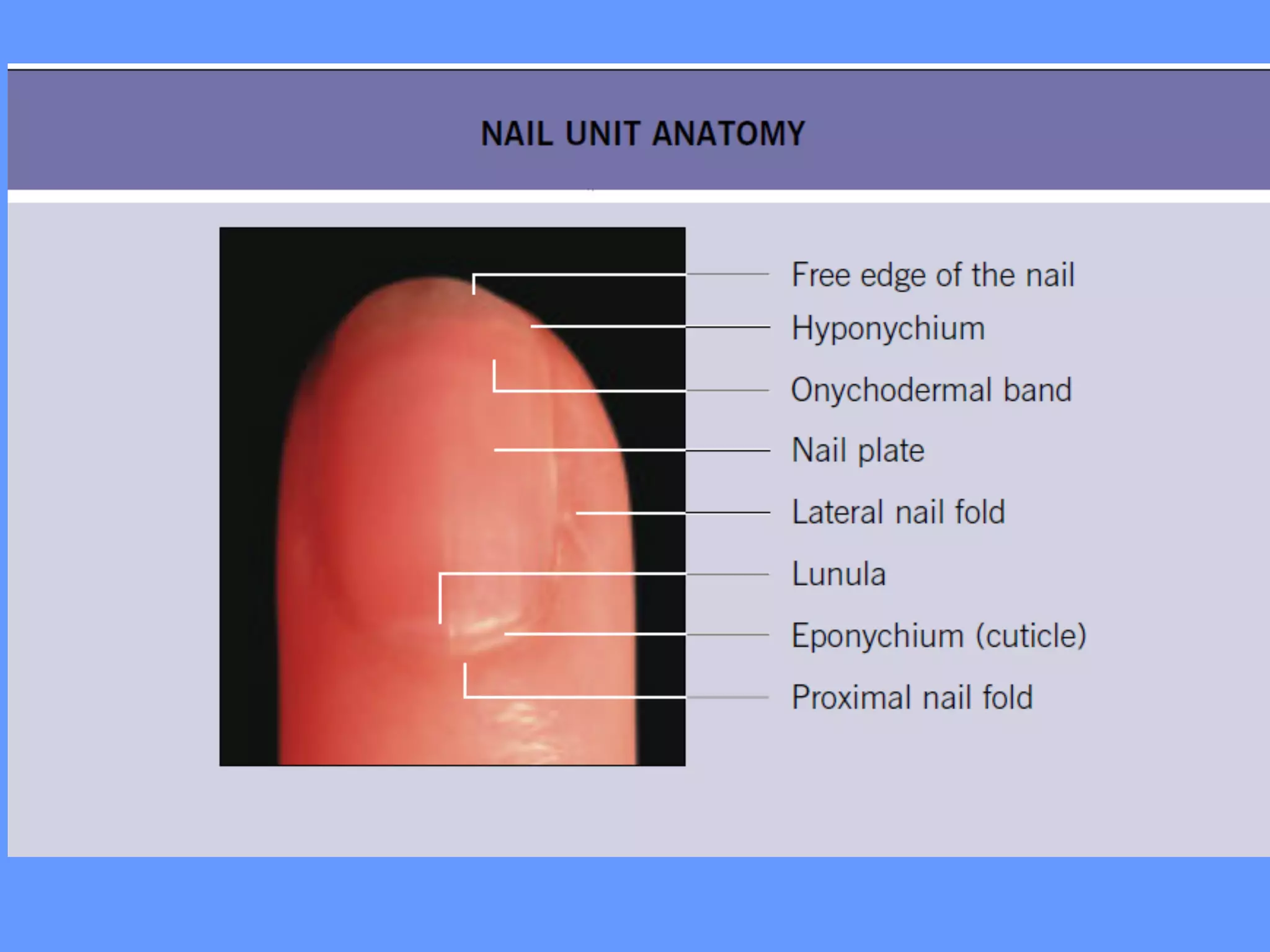
Nail Unit Anatomy
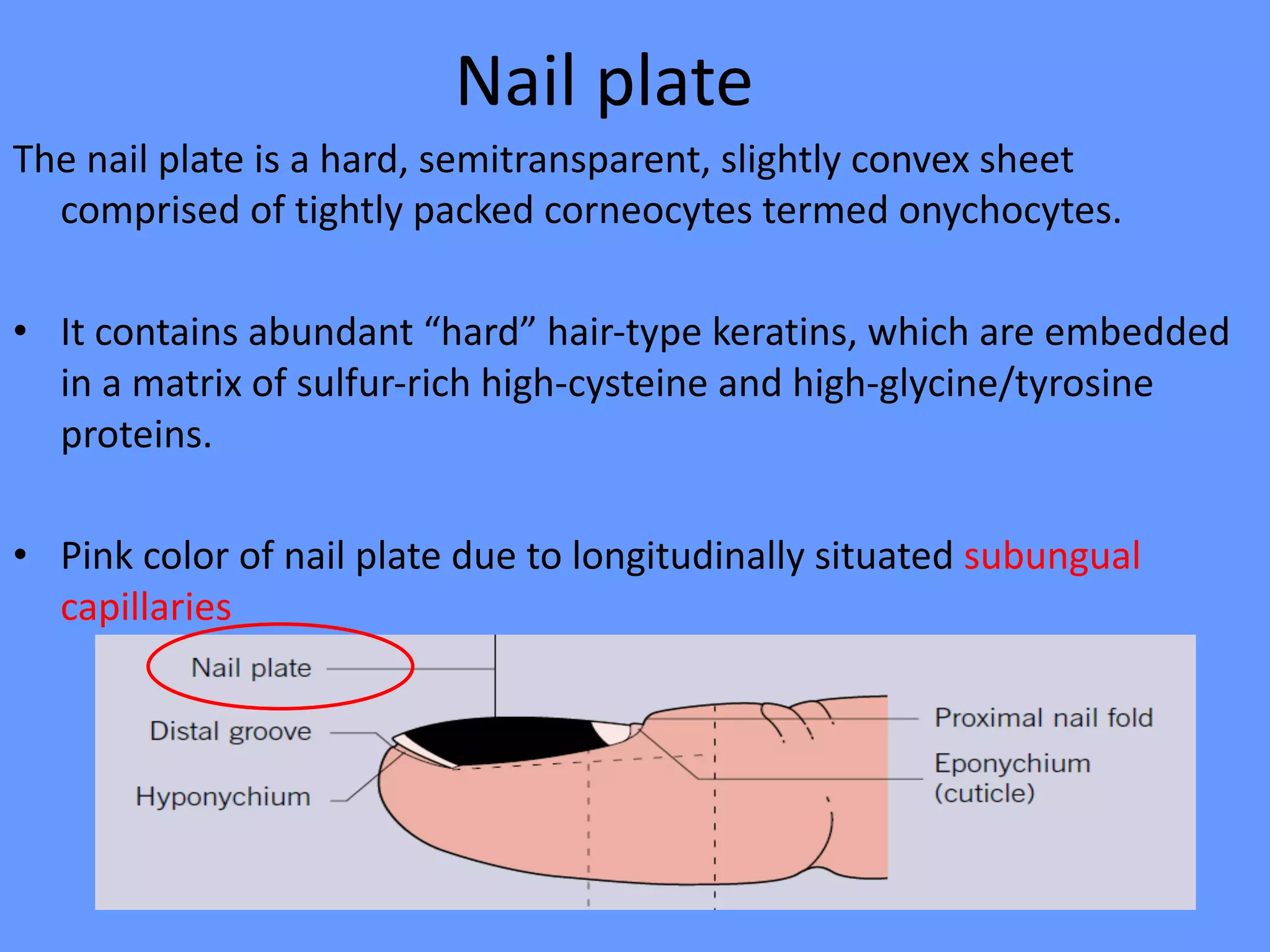
Nail plate
The nail plate is a hard, semitransparent, slightly convex sheet
comprised of tightly packed corneocytes termed onychocytes.
• It contains abundant “hard” hair-type keratins, which are embedded
in a matrix of sulfur-rich high-cysteine and high-glycine/tyrosine
proteins.
• Pink color of nail plate due to longitudinally situated subungual
capillaries
• The nail plate is surrounded on three edges by
nail folds (one proximal and two lateral).
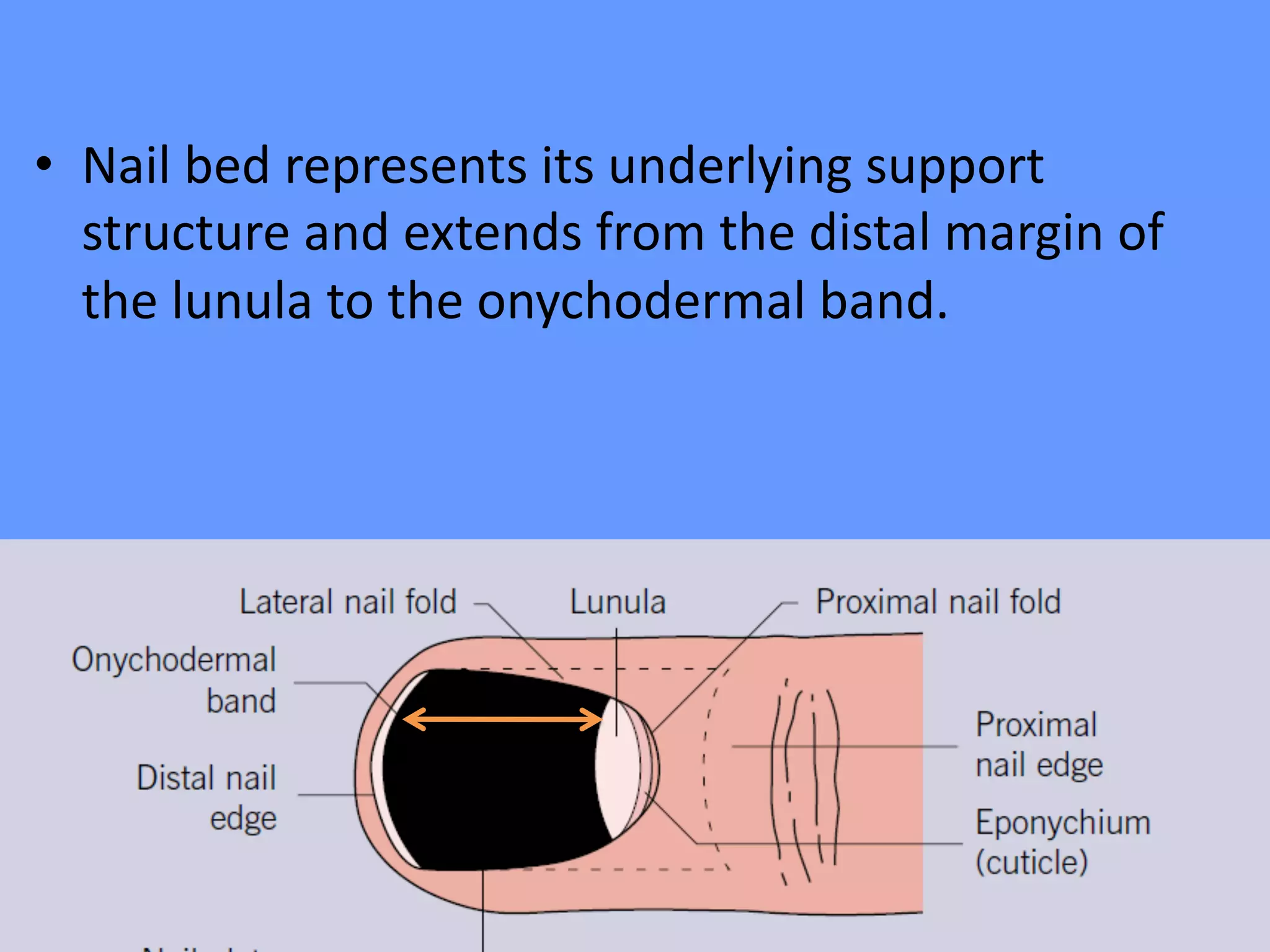
• Nail bed represents its underlying support
structure and extends from the distal margin of
the lunula to the onychodermal band.
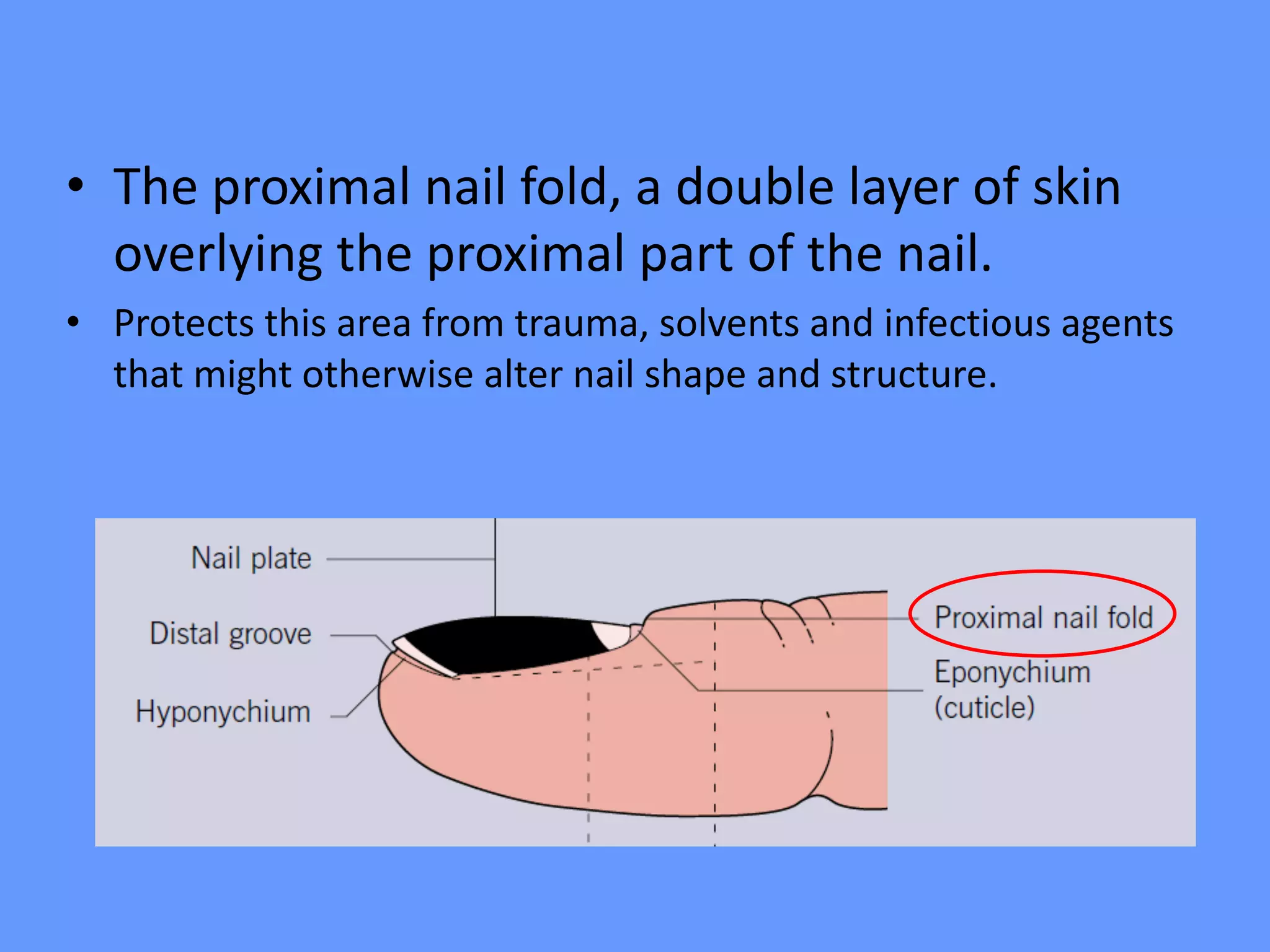
• The proximal nail fold, a double layer of skin
overlying the proximal part of the nail.
• Protects this area from trauma, solvents and infectious agents
that might otherwise alter nail shape and structure.
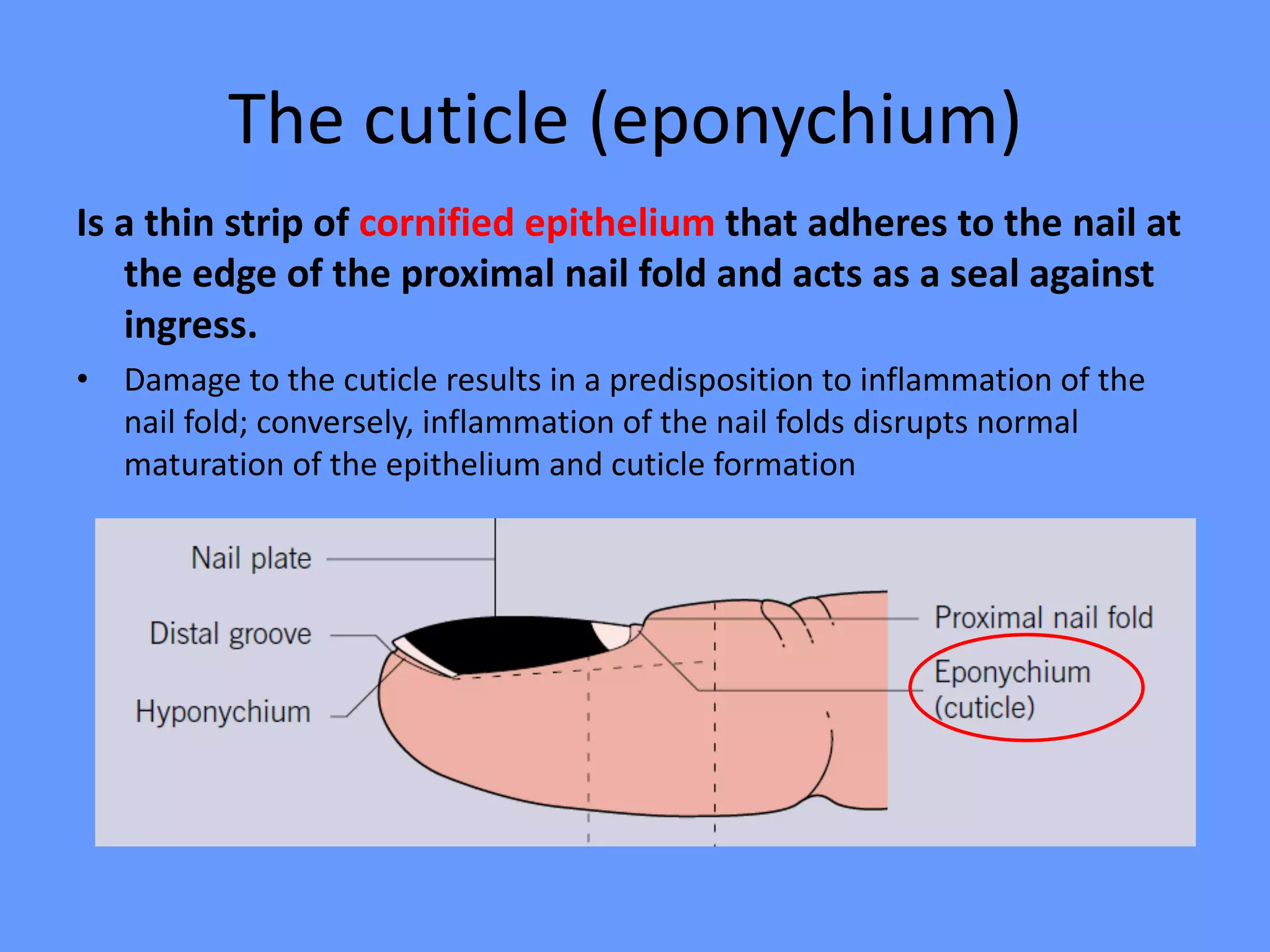
The cuticle (eponychium)
Is a thin strip of cornified epithelium that adheres to the nail at
the edge of the proximal nail fold and acts as a seal against
ingress.
• Damage to the cuticle results in a predisposition to inflammation of the
nail fold; conversely, inflammation of the nail folds disrupts normal
maturation of the epithelium and cuticle formation
The dermis of the nail apparatus
• Is a fibrocollagenous network that is “sandwiched” between
the hard tissues of the nail plate and the underlying bone,
lacking associated subcutaneous soft tissues or pilosebaceous
units.
• Bacterial infections in this region have a higher
risk of spread to the adjacent bone (i.e.
osteomyelitis of the distal phalanx) than in
most other sites of the body.
Lunula
• The half-moon-shaped lunula, which is most
prominent on the thumb, demarcates the
junction between the matrix and the nail bed.
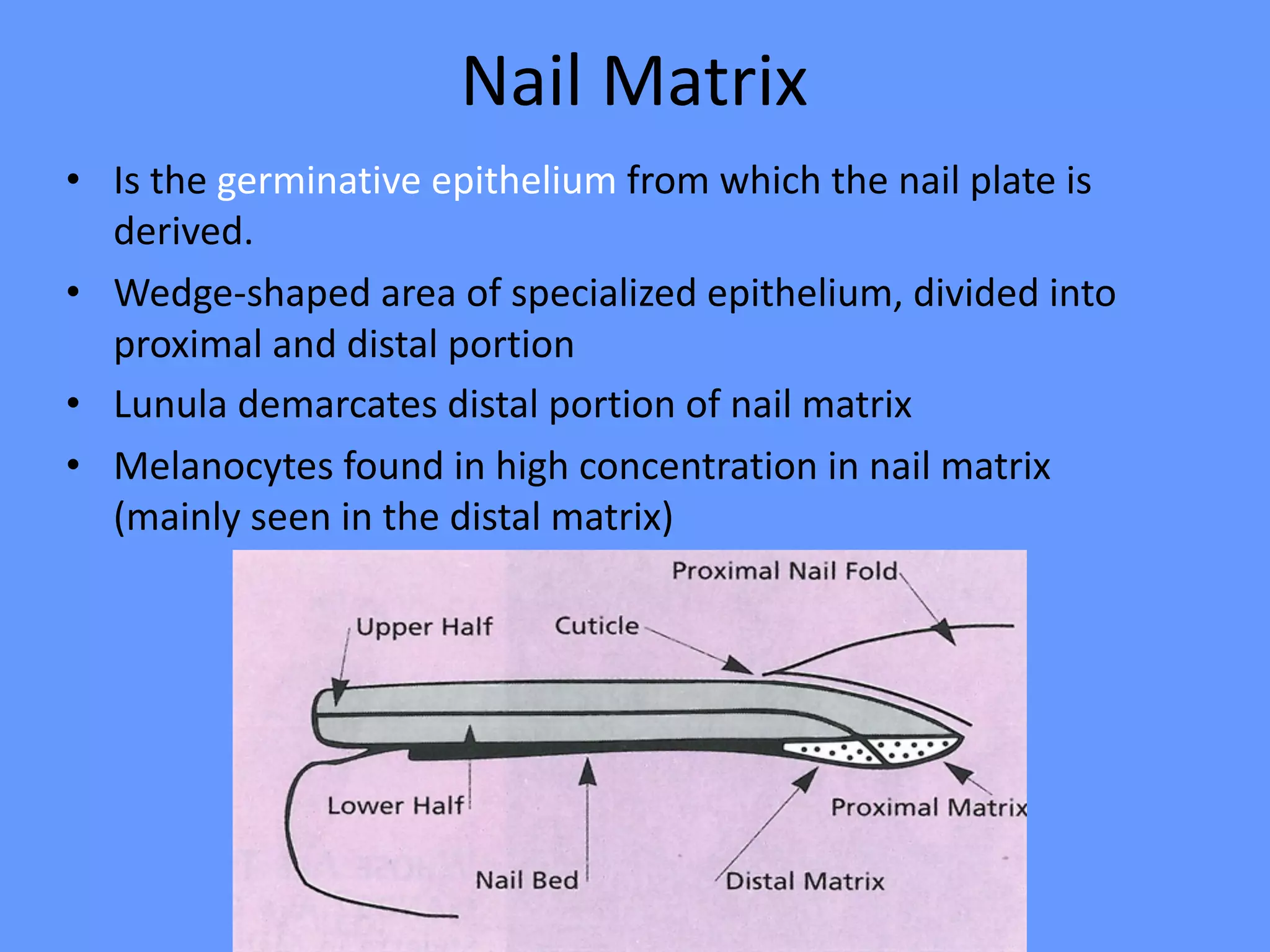
Nail Matrix
• Is the germinative epithelium from which the nail plate is
derived.
• Wedge-shaped area of specialized epithelium, divided into
proximal and distal portion
• Lunula demarcates distal portion of nail matrix
• Melanocytes found in high concentration in nail matrix
(mainly seen in the distal matrix)
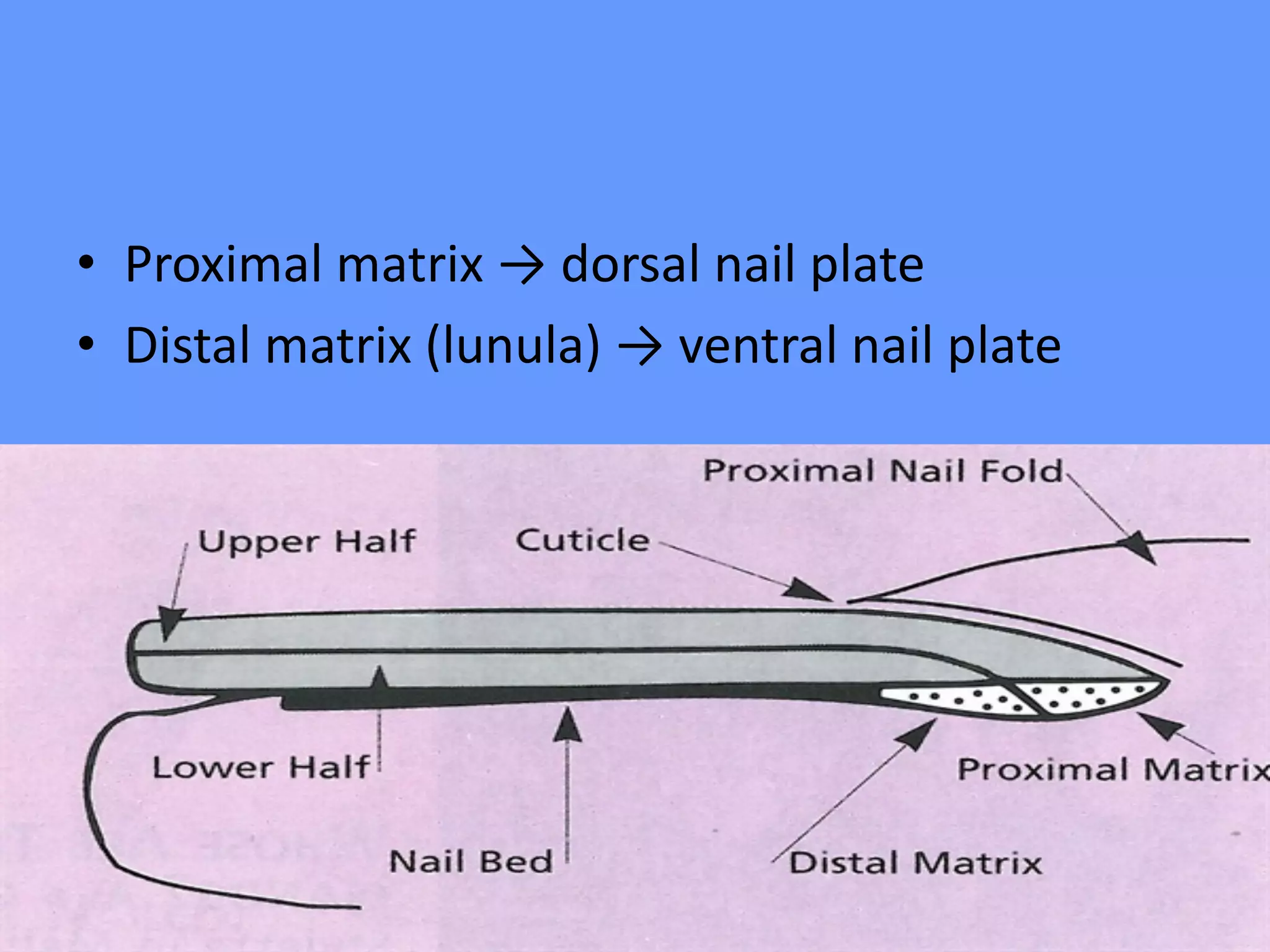
• Proximal matrix → dorsal nail plate
• Distal matrix (lunula) → ventral nail plate
Embryologic development of the nail
apparatus
Growth
• Fingernails usually grow faster than toenails
• Fingernails: 2–3 mm/month
• Toenails: 1 mm/month
• Complete replacement of a nail requires 6 (fingernails)
to 18 months (toenails)
• In children the growth is rapid 6 – 8 weeks
• Nail growth is quicker:
· During pregnancy
· In the summer than in the winter
· On the hands than the feet
CORRELATION OF NAIL FINDINGS
WITH ANATOMIC SITE OF NAIL
DAMAGE
Proximal matrix
Beau’s lines
Single horizontal ridge OR Transverse depressions
More evident in the central portion of the nail plate
Description
Mechanical trauma (e.g. manicures, onychotillomania)
Dermatologic disease of the proximal nail fold (e.g.
eczema, chronic paronychia).
The presence of Beau’s lines at the same level in all nails
suggests a systemic cause (e.g. severe or febrile illness,
erythroderma, drugs).
Causes
Onychomadesis (nail shedding)
Detachment of the nail plate from the
proximal nail fold
Description
•Traumatic
•Medications (i.e. chemo),
•Drug reaction (i.e. TEN),
•Systemic illness
Causes
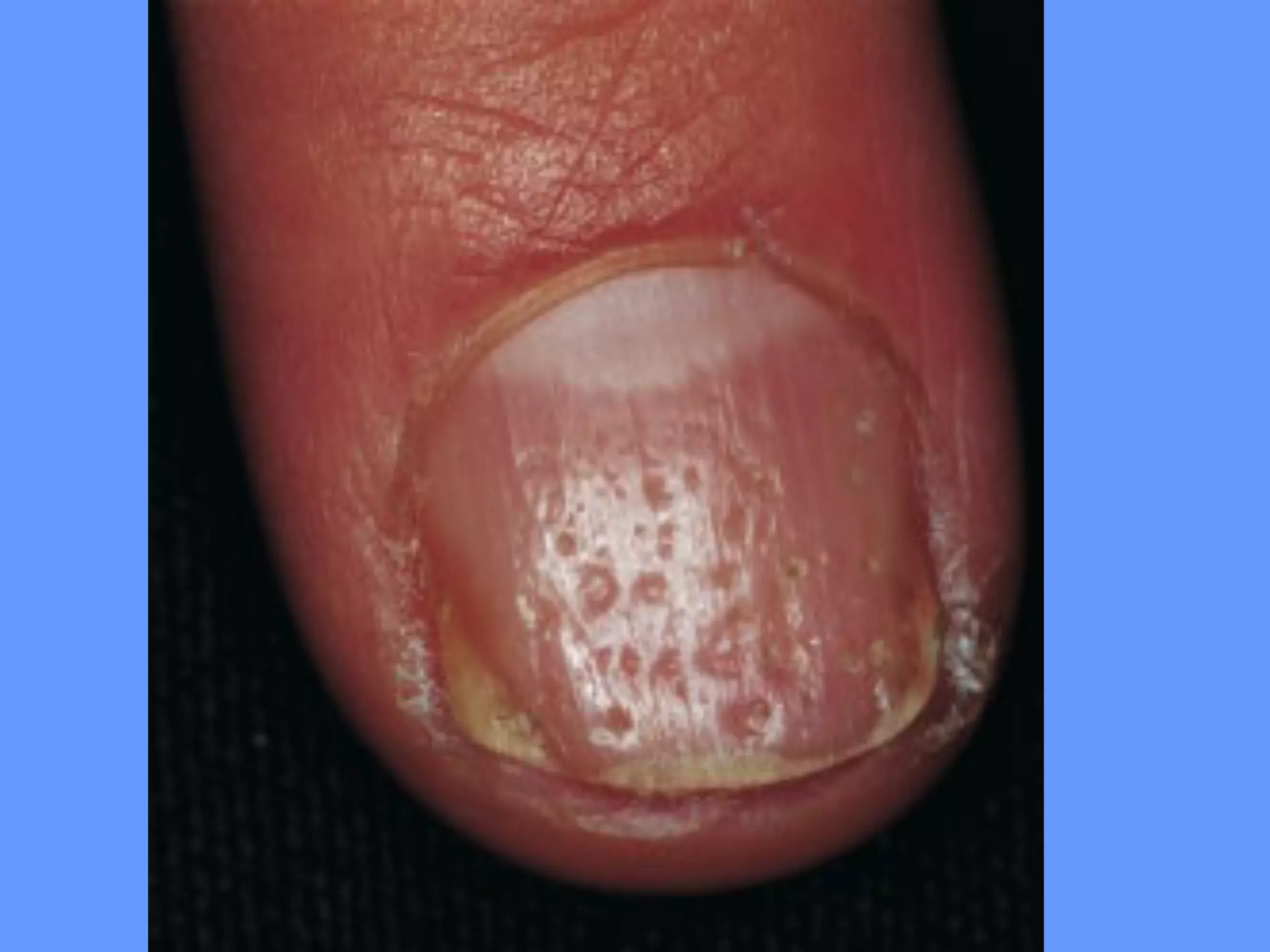
Pitting
Punctate depressions of the nail plate
surface
Elkonyxis: large 2-mm pits
Description
•Psoriasis
•Alopecia areata
•Eczema
Causes
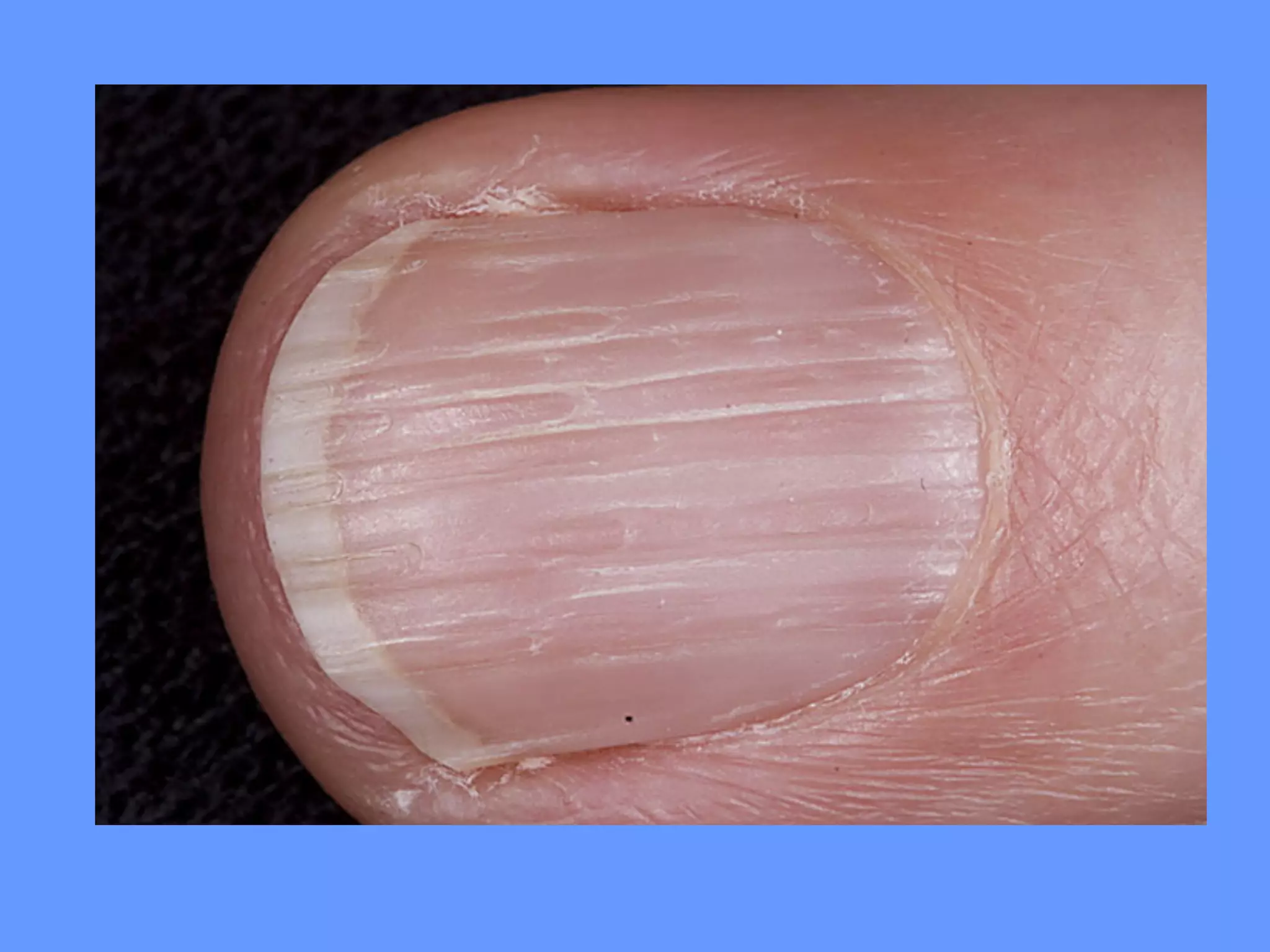
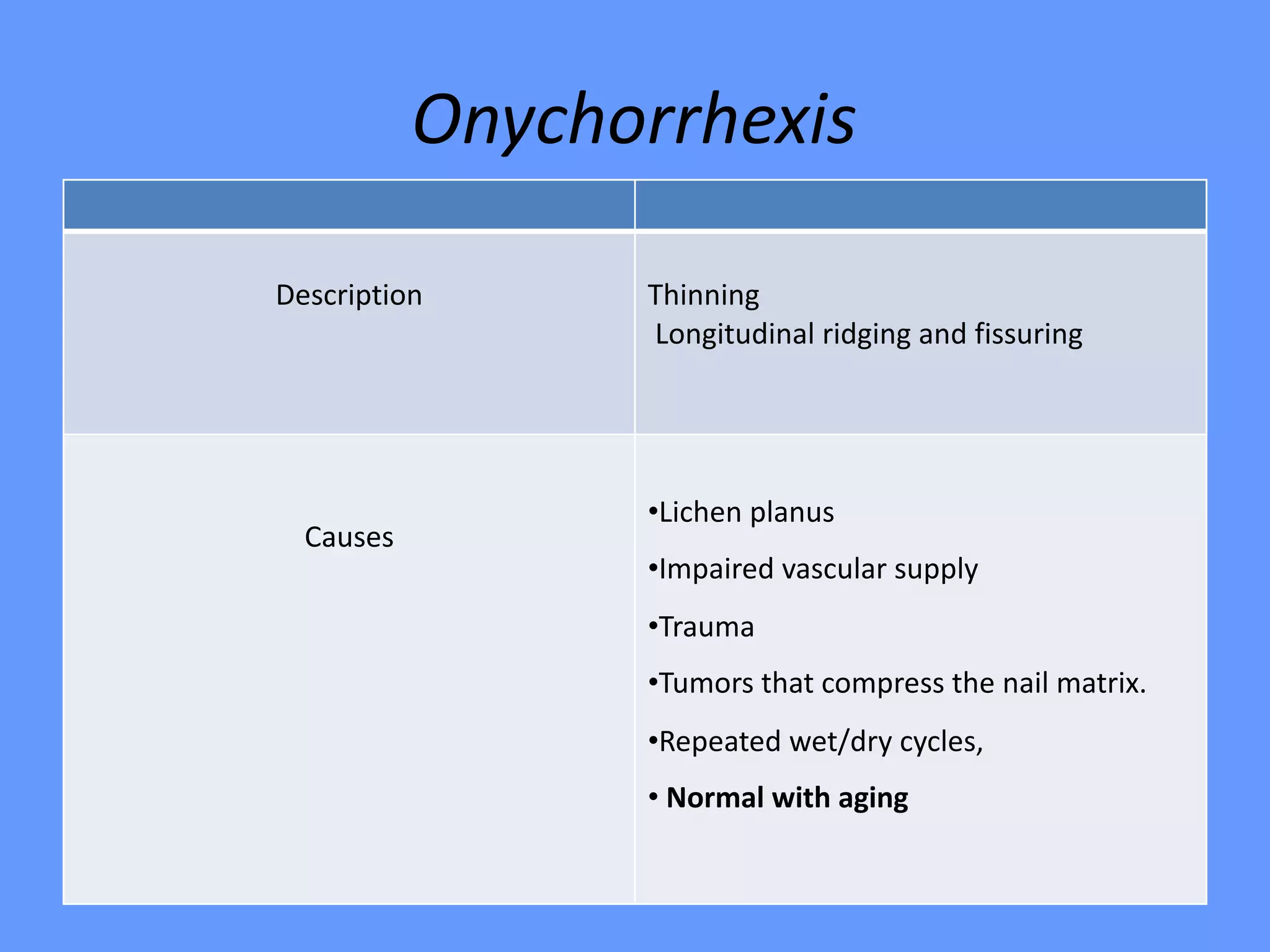
Onychorrhexis
Thinning
Longitudinal ridging and fissuring
Description
•Lichen planus
•Impaired vascular supply
•Trauma
•Tumors that compress the nail matrix.
•Repeated wet/dry cycles,
• Normal with aging
Causes
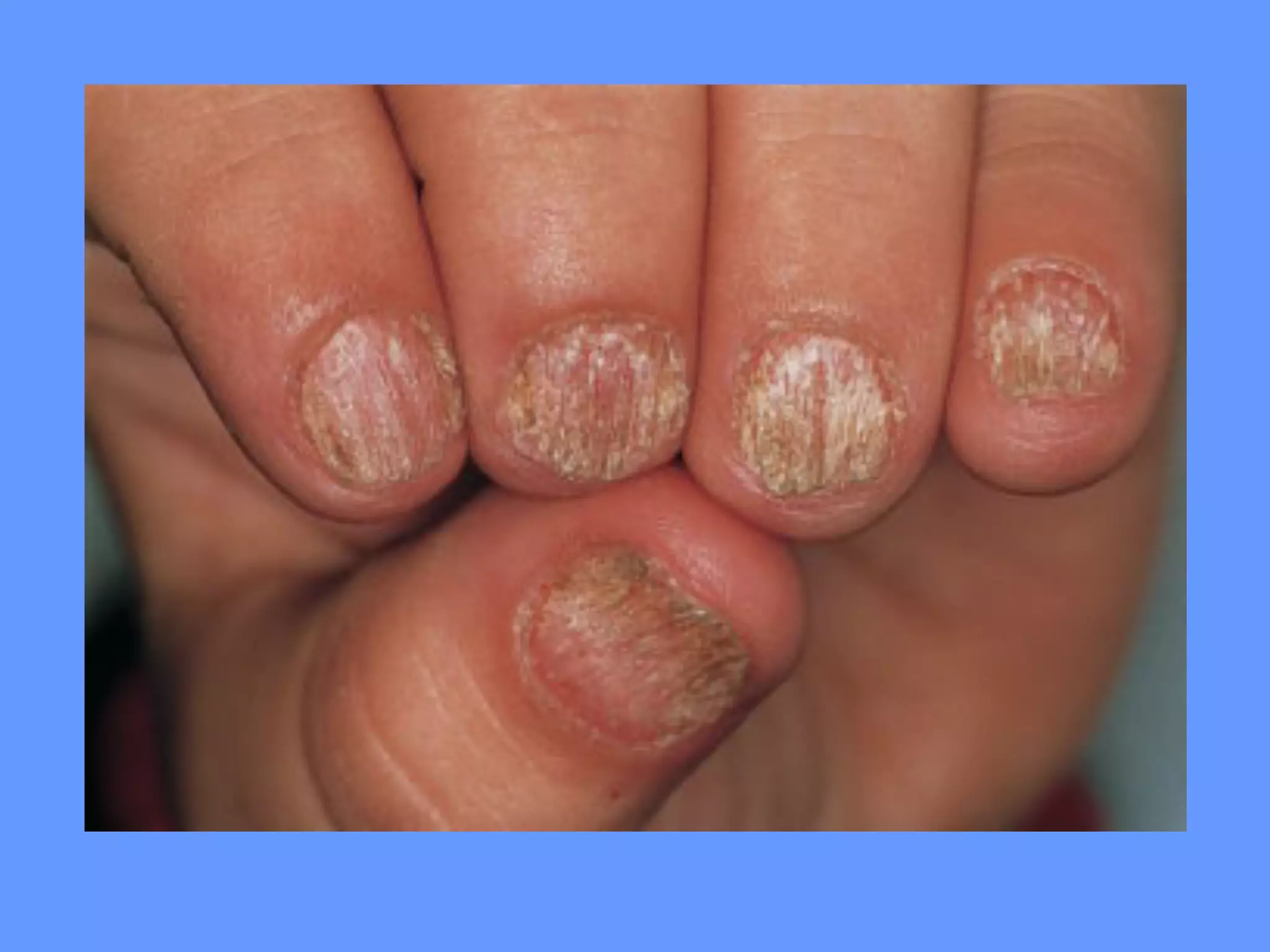
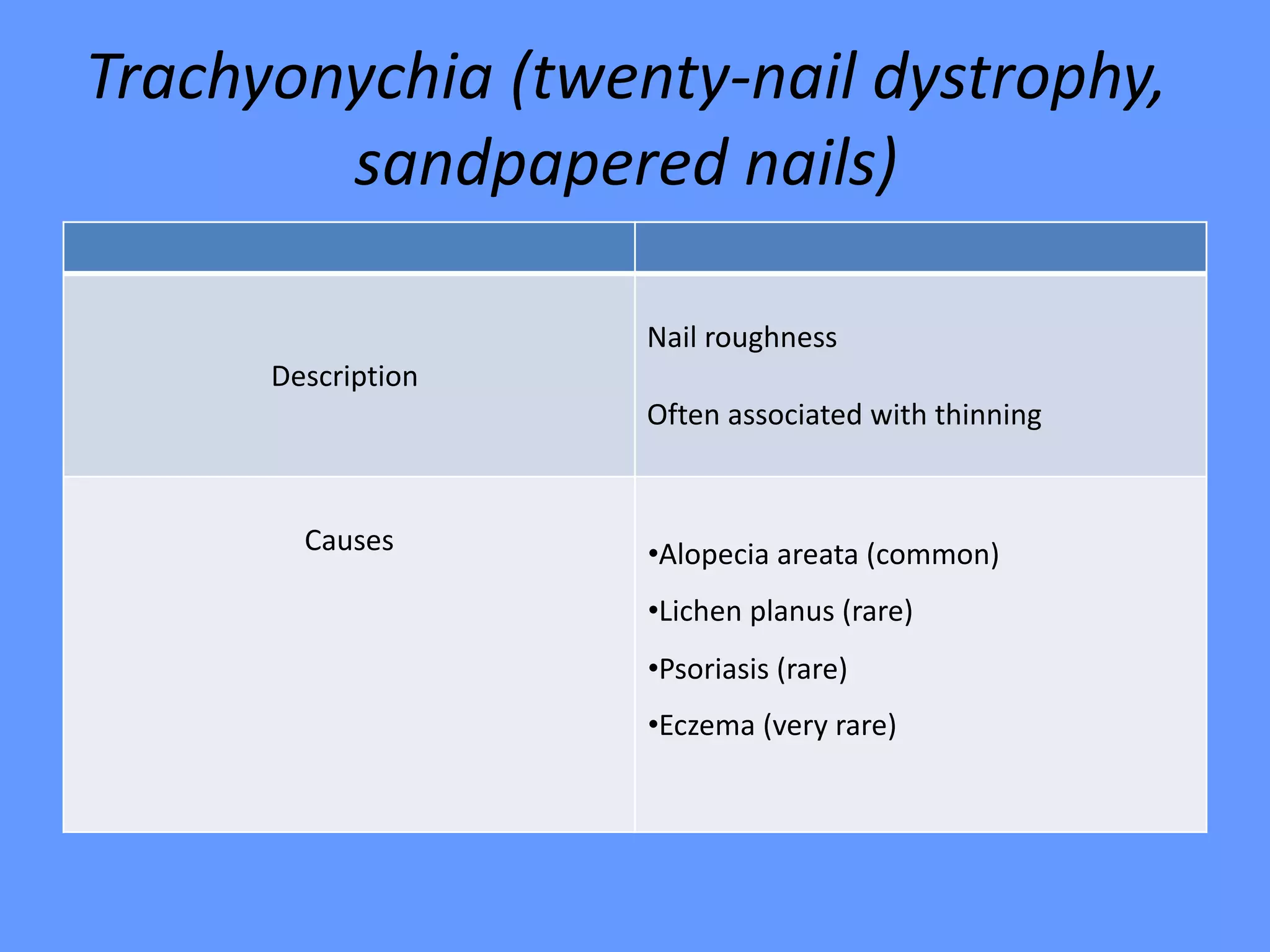
Trachyonychia (twenty-nail dystrophy,
sandpapered nails)
Nail roughness
Often associated with thinning
Description
•Alopecia areata (common)
•Lichen planus (rare)
•Psoriasis (rare)
•Eczema (very rare)
Causes
True leukonychia
White opaque discoloration
Distal nail matrix damage
Description
Most often traumaticCauses
TYPES
•Punctate
•Striate
•Diffuse
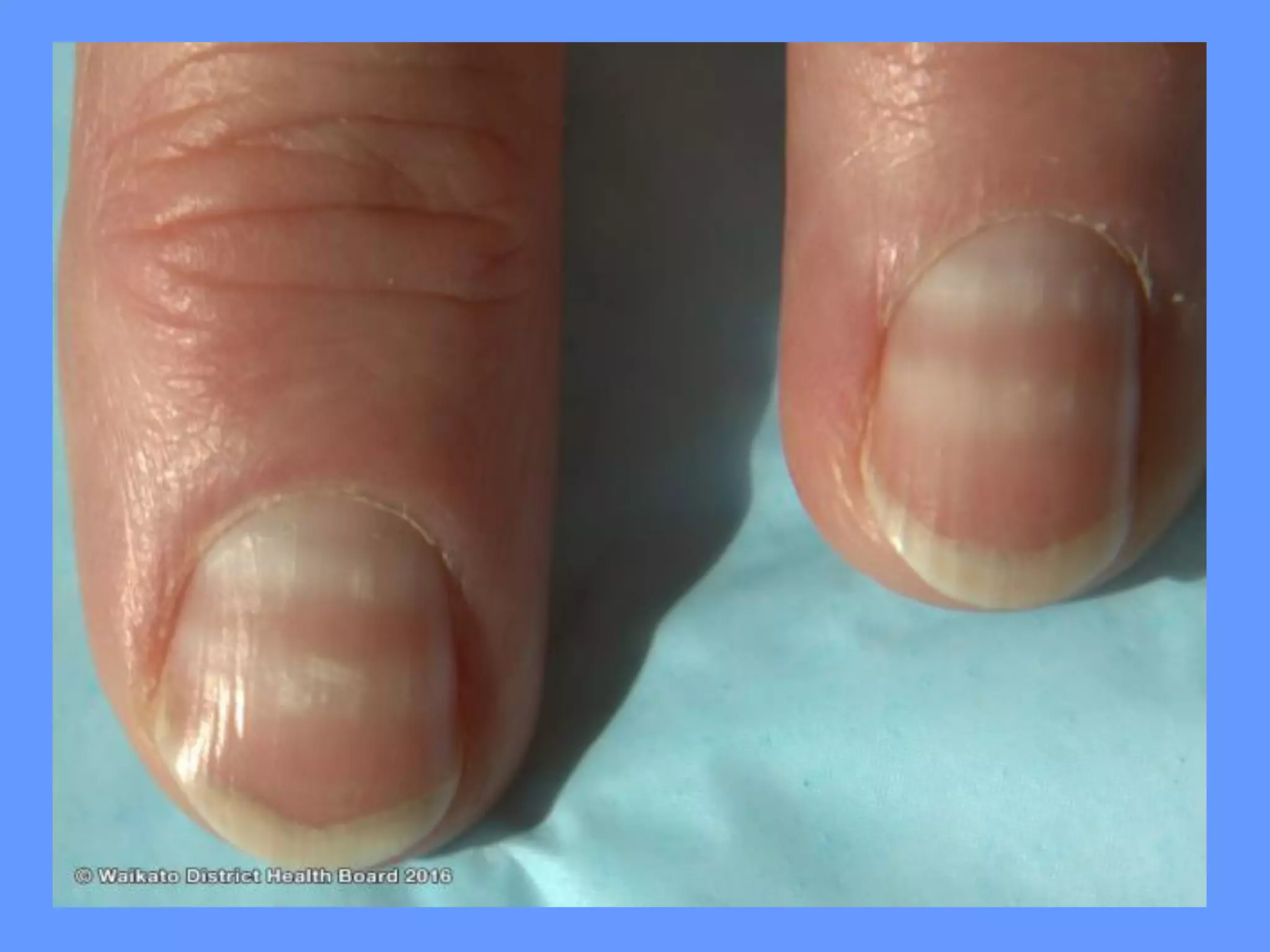
Punctate leukonychia
• The nail plate shows small opaque white
spots
• Move distally with nail growth and sometimes
disappear before reaching the distal nail.
• It is caused by trauma and is most commonly
observed in the fingernails of children.
Striate leukonychia
The nail plate shows one or more transverse
white opaque parallel lines.
• Observed in the fingernails of women, due to
matrix trauma secondary to manicures.
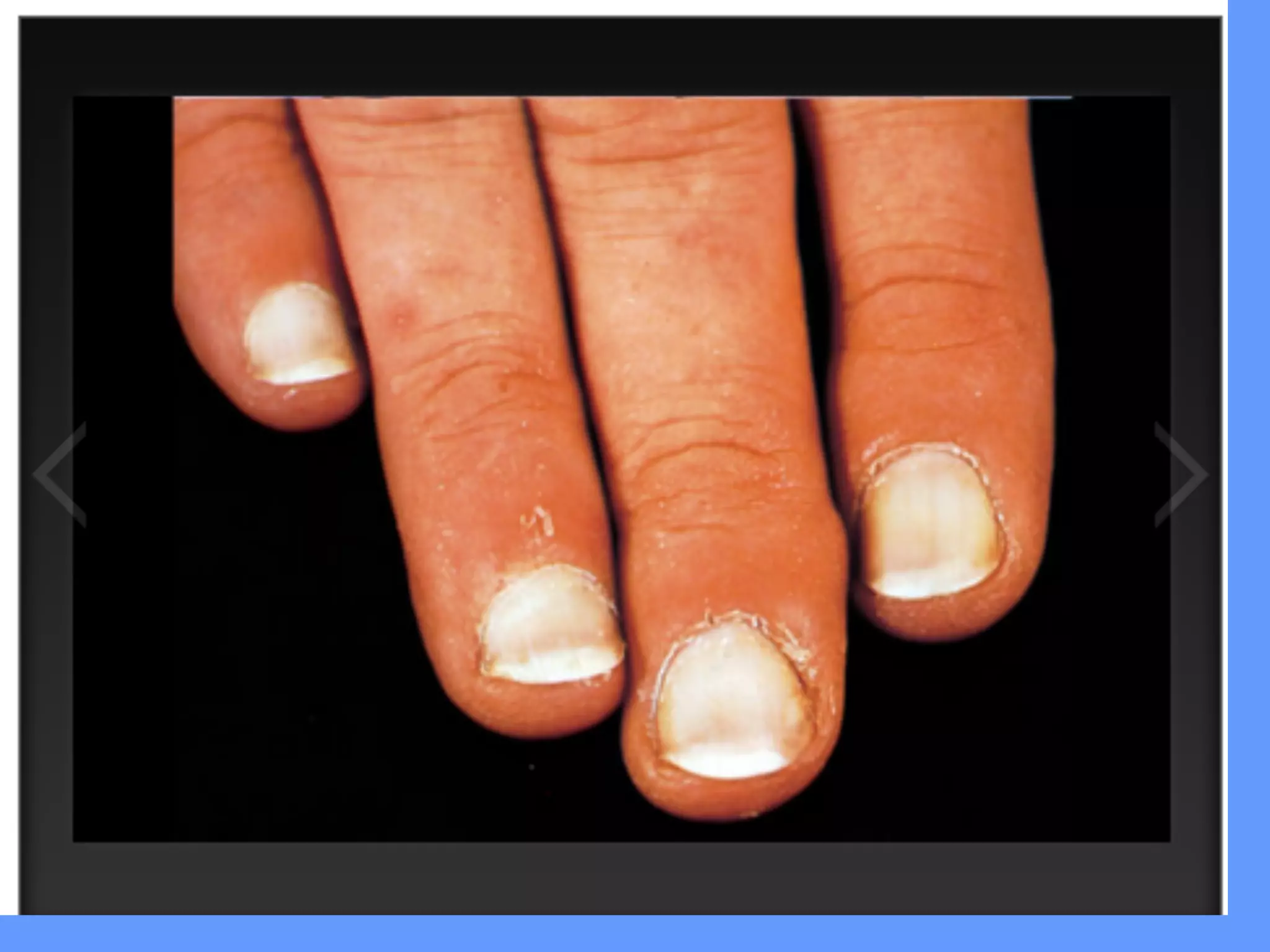
Diffuse leukonychia
• The nail plate is completely or almost
completely opaque and white.
• Chemotherapy
• White superficial onychomycosis
• Congenital disease
Needs to be distinguished
• Apparent leukonychia (nail bed discoloration)
( White discoloration (fades with pressure) nail plate
looks white but normal color)
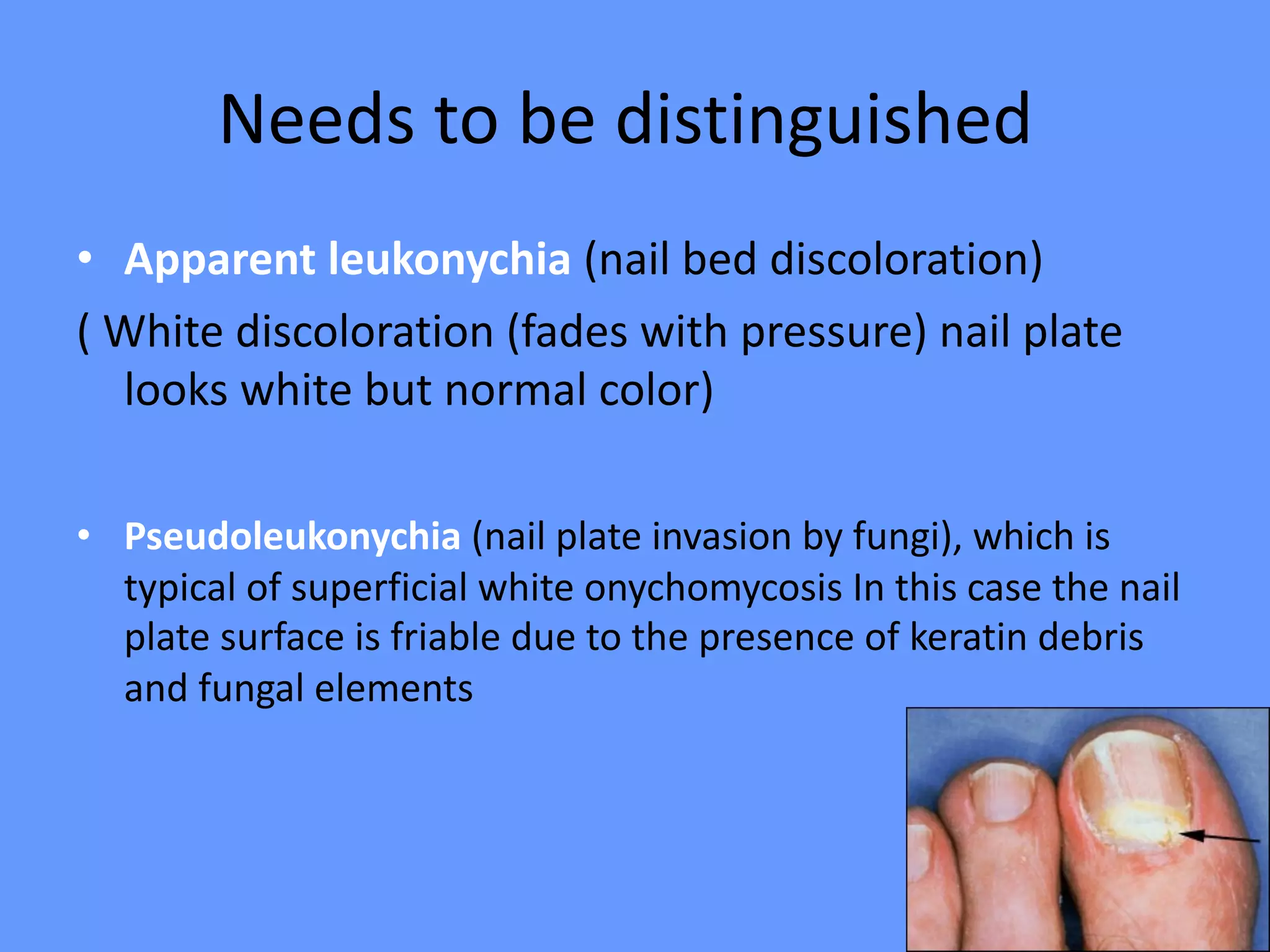
• Pseudoleukonychia (nail plate invasion by fungi), which is
typical of superficial white onychomycosis In this case the nail
plate surface is friable due to the presence of keratin debris
and fungal elements
Koilonychia (spoon nails)
Thinned concave nails
The nail plate is thinned, flat and
spoonshaped due to upward eversion
of its lateral edges.
Description
•Physiologic in the toenails of children
•Adults -- occupational
•Severe iron deficiency.
Causes
Nail Signs due to Nail Bed Disorders
Onycholysis
Distal nail plate detachment
Detached nail looks yellow–whiteDescription
•Environmental trauma
•Psoriasis
•Onychomycosis
•Photoonycholysis
•Hyperthyroidism
•Medications such as tetracycline.
•Tumors
•Subungual exostoses
•SCC
Causes
Onychauxis
The nail plate appears thickened due to
the presence of subungual scales.Description
•Psoriasis,
•Onychomycosis
•Eczema
Causes
Apparent leukonychia
The nails are white because of
abnormalities in the color of the nail
bed and this is usually due to nail bed
edema.
Apparent leukonychia
does not move distally with nail growth
and the white discoloration
fades with pressure
Description
Drugs (i.e. chemo agents) or systemic
diseaseCauses
Splinter hemorrhages
Thin, longitudinal red-brown lines along
nail plateDescription
•Trauma
•PSO
•fungal (distal)
•Endocarditis
•Vasculitis
•Trichinosis (proximal)
Causes
Nail color
Longitudinal melanonychia
Longitudinal brown to black band
Commonly seen in darkly pigmented
individuals
Description
•Nevus
•Lentigo
•Drugs
•Trauma
•Melanoma
Causes
Hutchinson’s sign
•Brown–black periungual pigmentation
• Needs to be distinguished from pseudo-
Hutchinson’s sign (dark bands producing
“illusory” pigmentation of the proximal
nail fold due to cuticle transparency)
Description
•Possible sign of nail melanomaCauses
Green nail syndrome
nail has a greenishblack or greenishblue
color due to the deposition of pyocyanin,
a blue–green pigment produced
by Pseudomonas aeruginosa,
Predisposing factors
• Prolonged exposure to water,
• Detergents and soaps,
• Nail trauma
in barbers, dishwashers, bakers and
medical personnel.
Description
•Pseudomonas aeruginosaCauses
Half and half nails
(Lindsay’s nails)
Proximal ½ with white zone, distal ½ with
red-brown zoneDescription
•Chronic renal diseaseCauses
Terry’s nails
Proximal 2/3 white nail color, distal
1/3 brown-pink bandDescription
•Cirrhosis,
•Hypoalbuminemia
•Diabetes
•cardiac disease
Causes
Muehrcke’s bands
Transverse white bands parallel to lunula
Description
•Hypoalbuminemia
•Chemotherapy
Causes
Color changes due
to drugs:
• Chloroquine may
produce blue-black
pigmentation of the nail
• Arsenic may produce
longitudinal bands of
pigment or transverse
white stripes (Mees'
stripes) across the nail
OTHERS
Racquet Thumbs (Brachyonychia)
• Distal phalanx short/wide
• Form of brachyonychia
• Rubinstein-Taybi syndrome,
Absent lunula
• No visible lunula
• Yellow nail syndrome,
• Renal failure,
• Trauma
Yellow nail syndrome
• The nails are yellow due to thickening, sometimes with a tinge of green
• The lunula is obscured and there is increased transverse and longitudinal
curvature and loss of cuticle
• It is usually accompanied by lymphoedema and pleural effusions
Anonychia
• Absence of nail
• Nail patella syndrome
• COIF (Congenital Onychodysplasia of the Index
Finger) scarring
Blue lunula
• Blue discoloration of lunula
• Wilson’s
• Drugs
• PUVA
• Argyria
Clubbing
• ↑ Nail curvature w/ bulbous growth of tip of
digit
Causes of clubbing
1-Primary (idiopathic) clubbing e.g. familial clubbing
2-Secondary clubbing include the following:
• Pulmonary disease e.g. Lung cancer, cystic fibrosis
• Cardiac disease e.g. Cyanotic congenital heart disease
• GIT disease e.g. inflammatory bowel disease
• Skin disease e.g. Pachydermoperiostosis
• Malignancies e.g. Thyroid cancer, Hodgkin disease, leukemia
• Miscellaneous conditions e.g. Acromegaly, pregnancy, and
hypoxemia possibly related to long-term smoking of cannabis
Dorsal pterygium
• Wing-like growth fusing PNF with nail bed/matrix
• Lichen planus ,
• epidermal bullosa,
• TEN,
• GVHD,
• Cicatricial pemphigoid
Ventral pterygium
(Pterygium inversum unguis)
• Fusion of hyponychium to distal nail plate
• Familial
• Trauma
• systemic sclerosis
• Lupus erythematosus
Habit tic deformity
• Parallel horizontal grooves Caused by
repetitive trauma to cuticle
Onycho-gryphosis: (gryphosis: thick)
• Thick, yellow and twisted great toenail in the
elderly
• Due to repetitive trauma by footwear
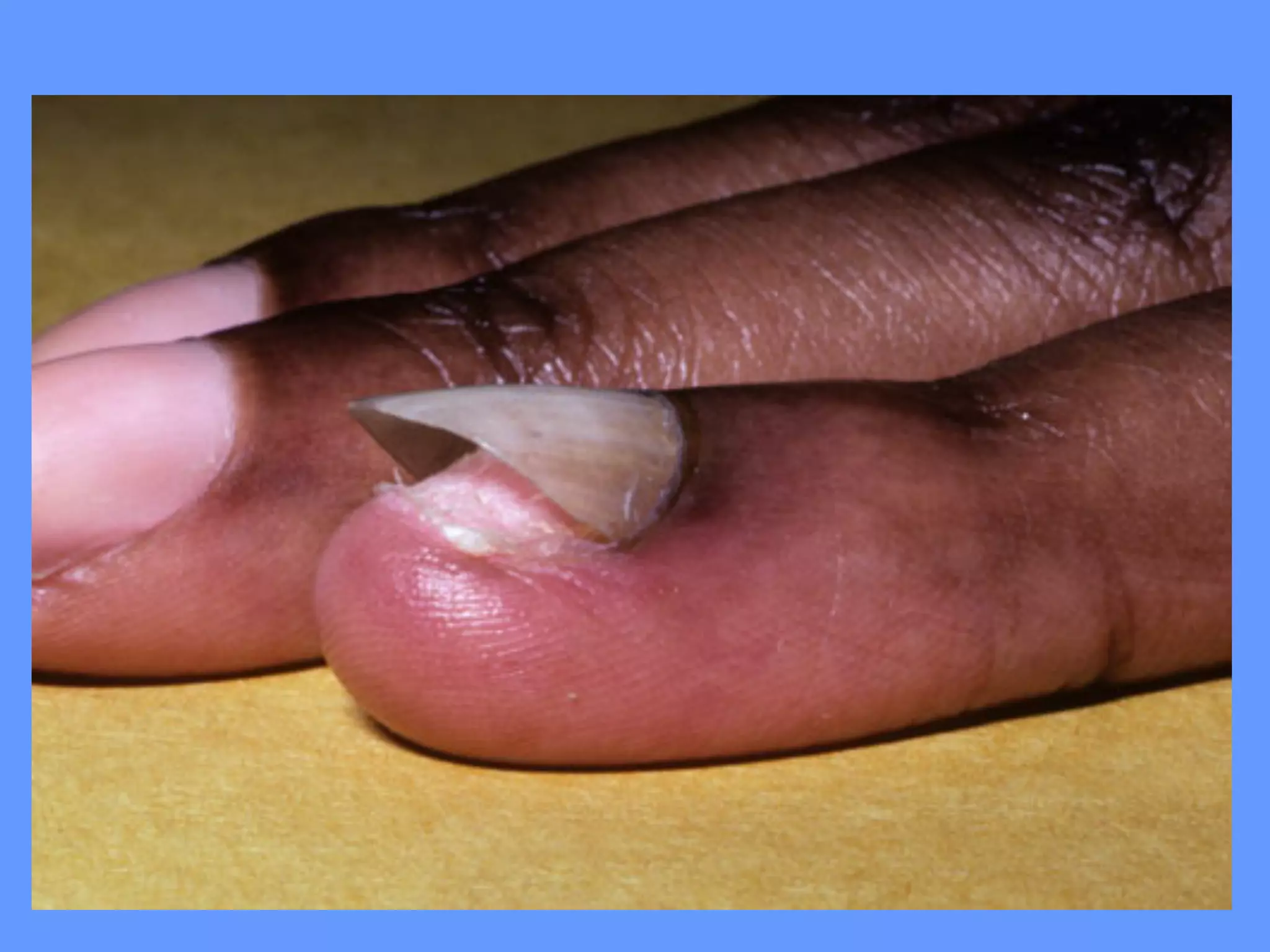
Ingrowing toenail (Onychocryptosis):
• The edge of the nail plate penetrates the
lateral nail fold
• Due to compression of the toe from the side
due to ill-fitting footwear
Pincer nails
• Overcurvature lateral portion Pressure (ill-fi
tting shoes),
• Hereditary
Triangular lunula
• Triangular shape of lunula
• Nail-patella syndrome
V-shaped nicking
• V-shaped nick at free margin
• Darier disease
Lets practice !
– Keratosis follicularis (Darier’s disease) is
associated with each of the following nail changes
EXCEPT:
A. “V-shaped” notch at the nail plate’s distal free
edge.
B. Splinter hemorrohages.
C. Proximal nail fold keratotic papules.
D. “V-shaped” lunula
E. Longitudinal dyschromic lunular bands.
• Nail changes in Pachyonychia congenita are
most consistent with Which of the following
descriptions?
A. Congenital malalignment
B. Leukonychia
C. Koilonychias
D. Subungual hyperkeratosis
E. Onychomadesis
• Hutchinson nail sign is periungual extension of
pigment to the proximal and lateral folds of
the nail and is noted in:
A. LP
B. Traumatic purpura
C. Onychomycosis
D. Subungual melanoma
E. Periungual fibroma
• Which One of the following definition about nail
changes is not true :
A. Roughened surface of the nail plate is
trachyonychia
B. Longitudinal striations of the nail plate is
onychmadesis
C. Ingrown nail is onychocryptosis
D. A traumatic, familial non- inflammatory nail
loss is onychoptosis
E. Superficial splitting of the nail plate or near the
free edge is onychoschizia
• The dorsal nail plate is produced by :
a. Proximal matrix
b. Nail bed
c. Nail fol
d. Hyponychium
e. Distal matrix
• Pitting of the nail plate in psoriasis is
associated with involvement of which portion
of the nail apparatus?
• A. Proximal nail matrix.
• B. Distal nail matrix.
• C. Cuticle.
• D. Nail bed.
• E. Nail plate.
• One of the following is not true about yellow
nail syndrome:
A. yellow thickened nails
B. Increased longitudinal and transverse
curvature
C. Triangular lunula
D. Decreased growth rate of nails
E. Lymphedema mostly in legs
• Transverse grooves on nail following systemic
disease are called:
• A. Mee’s line.
B. Coenen’s line.
C. Trachyonychia.
D. Beau’s line
E. Grove sign.
• The nail findings shown here are most
characteristic of what condition?
• A. Lichen planus.
• B. Lichen striatus.
• C. Darier’s disease.
• D. Dyskeratosis congenita.
• E. Pachyonychia congenita.
Thank u J
Nail infections
Paronychia: is a soft tissue infection around a fingernail
• is the most common hand infection
Acute paronychia
• nail biting breaks down the physical barrier between the nail bed and the nail
allowing the infiltration of infectious organisms
• S. aureus is the most common infecting organism.
• pain, tenderness, and swelling in the lateral folds of the nail
• erythematous and swollen, pus collects under the skin of the lateral fold
• Oral antibiotics
Chronic paronychia
• After 6 weeks or longer
• The nail folds are swollen, erythematous, and tender with pronounced
transverse ridges
• Cause is a mixture of C. albicans and bacteria
• Can be a complication of eczema
• In housekeepers, dishwashers, and swimmers
Pseudomonas infection
• It is always a complication of onycholysis or chronic paronychia
• The nail plate has a characteristic bluish-black or green color due to
accumulation of the pigment pyocyanin below the nail which may remain after
the organism has been removed
• Treatment is as for paronychia
ONYCHOMYCOSIS (TINEA UNGUIUM)
• An infectious fungal disease mainly seen as white spots that can be scraped off
the surface, or long yellowish streaks within the nail substance.
• attacks the free edge and moves its way to the matrix.
• The infected portion is thick and discoloured.
4-Tumors
Warts
Fibrokeratoma: periungual hyperkeratotic tip
Subungual exostosis: bony outgrowth of the distal part of the toe
Glomus tumour:
•is painful, (pain may be spontaneous or evoked by mild trauma or temperature
change)
•Nail-plate changes depend on the location of the tumour:
- Matrix tumours cause splitting and distortion of the nail plate.
- Nail bed lesions appear as bluish or red foci of 1-5mm diameter beneath
the nail
Squamous cell carcinoma: hyperkeratotic, warty changes, erosions and
fissuring, macerated cuticle, periungual swelling & erythema
Melanocytic nevi: longitudinal melanonychia
Malignant melanoma:
features suggest the possibility of malignant melanoma:
•75% will have Longitudinal melanonychia
•Brown-black periungual pigmentation in a single digit in adult life
•The pigmentation becomes darker and broader and has blurred edges

Nail disorder - Dr Aisha Almoosa

  • 1.
  • 2.
  • 3.
  • 4.
    Nail plate The nailplate is a hard, semitransparent, slightly convex sheet comprised of tightly packed corneocytes termed onychocytes. • It contains abundant “hard” hair-type keratins, which are embedded in a matrix of sulfur-rich high-cysteine and high-glycine/tyrosine proteins. • Pink color of nail plate due to longitudinally situated subungual capillaries
  • 5.
    • The nailplate is surrounded on three edges by nail folds (one proximal and two lateral).
  • 6.
    • Nail bedrepresents its underlying support structure and extends from the distal margin of the lunula to the onychodermal band.
  • 7.
    • The proximalnail fold, a double layer of skin overlying the proximal part of the nail. • Protects this area from trauma, solvents and infectious agents that might otherwise alter nail shape and structure.
  • 8.
    The cuticle (eponychium) Isa thin strip of cornified epithelium that adheres to the nail at the edge of the proximal nail fold and acts as a seal against ingress. • Damage to the cuticle results in a predisposition to inflammation of the nail fold; conversely, inflammation of the nail folds disrupts normal maturation of the epithelium and cuticle formation
  • 9.
    The dermis ofthe nail apparatus • Is a fibrocollagenous network that is “sandwiched” between the hard tissues of the nail plate and the underlying bone, lacking associated subcutaneous soft tissues or pilosebaceous units.
  • 10.
    • Bacterial infectionsin this region have a higher risk of spread to the adjacent bone (i.e. osteomyelitis of the distal phalanx) than in most other sites of the body.
  • 11.
    Lunula • The half-moon-shapedlunula, which is most prominent on the thumb, demarcates the junction between the matrix and the nail bed.
  • 12.
    Nail Matrix • Isthe germinative epithelium from which the nail plate is derived. • Wedge-shaped area of specialized epithelium, divided into proximal and distal portion • Lunula demarcates distal portion of nail matrix • Melanocytes found in high concentration in nail matrix (mainly seen in the distal matrix)
  • 13.
    • Proximal matrix→ dorsal nail plate • Distal matrix (lunula) → ventral nail plate
  • 14.
    Embryologic development ofthe nail apparatus
  • 15.
    Growth • Fingernails usuallygrow faster than toenails • Fingernails: 2–3 mm/month • Toenails: 1 mm/month • Complete replacement of a nail requires 6 (fingernails) to 18 months (toenails) • In children the growth is rapid 6 – 8 weeks • Nail growth is quicker: · During pregnancy · In the summer than in the winter · On the hands than the feet
  • 16.
    CORRELATION OF NAILFINDINGS WITH ANATOMIC SITE OF NAIL DAMAGE
  • 18.
  • 21.
    Beau’s lines Single horizontalridge OR Transverse depressions More evident in the central portion of the nail plate Description Mechanical trauma (e.g. manicures, onychotillomania) Dermatologic disease of the proximal nail fold (e.g. eczema, chronic paronychia). The presence of Beau’s lines at the same level in all nails suggests a systemic cause (e.g. severe or febrile illness, erythroderma, drugs). Causes
  • 23.
    Onychomadesis (nail shedding) Detachmentof the nail plate from the proximal nail fold Description •Traumatic •Medications (i.e. chemo), •Drug reaction (i.e. TEN), •Systemic illness Causes
  • 25.
    Pitting Punctate depressions ofthe nail plate surface Elkonyxis: large 2-mm pits Description •Psoriasis •Alopecia areata •Eczema Causes
  • 27.
    Onychorrhexis Thinning Longitudinal ridging andfissuring Description •Lichen planus •Impaired vascular supply •Trauma •Tumors that compress the nail matrix. •Repeated wet/dry cycles, • Normal with aging Causes
  • 29.
    Trachyonychia (twenty-nail dystrophy, sandpaperednails) Nail roughness Often associated with thinning Description •Alopecia areata (common) •Lichen planus (rare) •Psoriasis (rare) •Eczema (very rare) Causes
  • 31.
    True leukonychia White opaquediscoloration Distal nail matrix damage Description Most often traumaticCauses
  • 32.
  • 34.
    Punctate leukonychia • Thenail plate shows small opaque white spots • Move distally with nail growth and sometimes disappear before reaching the distal nail. • It is caused by trauma and is most commonly observed in the fingernails of children.
  • 36.
    Striate leukonychia The nailplate shows one or more transverse white opaque parallel lines. • Observed in the fingernails of women, due to matrix trauma secondary to manicures.
  • 38.
    Diffuse leukonychia • Thenail plate is completely or almost completely opaque and white. • Chemotherapy • White superficial onychomycosis • Congenital disease
  • 39.
    Needs to bedistinguished • Apparent leukonychia (nail bed discoloration) ( White discoloration (fades with pressure) nail plate looks white but normal color) • Pseudoleukonychia (nail plate invasion by fungi), which is typical of superficial white onychomycosis In this case the nail plate surface is friable due to the presence of keratin debris and fungal elements
  • 41.
    Koilonychia (spoon nails) Thinnedconcave nails The nail plate is thinned, flat and spoonshaped due to upward eversion of its lateral edges. Description •Physiologic in the toenails of children •Adults -- occupational •Severe iron deficiency. Causes
  • 42.
    Nail Signs dueto Nail Bed Disorders
  • 44.
    Onycholysis Distal nail platedetachment Detached nail looks yellow–whiteDescription •Environmental trauma •Psoriasis •Onychomycosis •Photoonycholysis •Hyperthyroidism •Medications such as tetracycline. •Tumors •Subungual exostoses •SCC Causes
  • 46.
    Onychauxis The nail plateappears thickened due to the presence of subungual scales.Description •Psoriasis, •Onychomycosis •Eczema Causes
  • 48.
    Apparent leukonychia The nailsare white because of abnormalities in the color of the nail bed and this is usually due to nail bed edema. Apparent leukonychia does not move distally with nail growth and the white discoloration fades with pressure Description Drugs (i.e. chemo agents) or systemic diseaseCauses
  • 50.
    Splinter hemorrhages Thin, longitudinalred-brown lines along nail plateDescription •Trauma •PSO •fungal (distal) •Endocarditis •Vasculitis •Trichinosis (proximal) Causes
  • 51.
  • 53.
    Longitudinal melanonychia Longitudinal brownto black band Commonly seen in darkly pigmented individuals Description •Nevus •Lentigo •Drugs •Trauma •Melanoma Causes
  • 55.
    Hutchinson’s sign •Brown–black periungualpigmentation • Needs to be distinguished from pseudo- Hutchinson’s sign (dark bands producing “illusory” pigmentation of the proximal nail fold due to cuticle transparency) Description •Possible sign of nail melanomaCauses
  • 57.
    Green nail syndrome nailhas a greenishblack or greenishblue color due to the deposition of pyocyanin, a blue–green pigment produced by Pseudomonas aeruginosa, Predisposing factors • Prolonged exposure to water, • Detergents and soaps, • Nail trauma in barbers, dishwashers, bakers and medical personnel. Description •Pseudomonas aeruginosaCauses
  • 59.
    Half and halfnails (Lindsay’s nails) Proximal ½ with white zone, distal ½ with red-brown zoneDescription •Chronic renal diseaseCauses
  • 61.
    Terry’s nails Proximal 2/3white nail color, distal 1/3 brown-pink bandDescription •Cirrhosis, •Hypoalbuminemia •Diabetes •cardiac disease Causes
  • 63.
    Muehrcke’s bands Transverse whitebands parallel to lunula Description •Hypoalbuminemia •Chemotherapy Causes
  • 64.
    Color changes due todrugs: • Chloroquine may produce blue-black pigmentation of the nail • Arsenic may produce longitudinal bands of pigment or transverse white stripes (Mees' stripes) across the nail
  • 65.
  • 67.
    Racquet Thumbs (Brachyonychia) •Distal phalanx short/wide • Form of brachyonychia • Rubinstein-Taybi syndrome,
  • 69.
    Absent lunula • Novisible lunula • Yellow nail syndrome, • Renal failure, • Trauma
  • 70.
    Yellow nail syndrome •The nails are yellow due to thickening, sometimes with a tinge of green • The lunula is obscured and there is increased transverse and longitudinal curvature and loss of cuticle • It is usually accompanied by lymphoedema and pleural effusions
  • 72.
    Anonychia • Absence ofnail • Nail patella syndrome • COIF (Congenital Onychodysplasia of the Index Finger) scarring
  • 74.
    Blue lunula • Bluediscoloration of lunula • Wilson’s • Drugs • PUVA • Argyria
  • 76.
    Clubbing • ↑ Nailcurvature w/ bulbous growth of tip of digit
  • 77.
    Causes of clubbing 1-Primary(idiopathic) clubbing e.g. familial clubbing 2-Secondary clubbing include the following: • Pulmonary disease e.g. Lung cancer, cystic fibrosis • Cardiac disease e.g. Cyanotic congenital heart disease • GIT disease e.g. inflammatory bowel disease • Skin disease e.g. Pachydermoperiostosis • Malignancies e.g. Thyroid cancer, Hodgkin disease, leukemia • Miscellaneous conditions e.g. Acromegaly, pregnancy, and hypoxemia possibly related to long-term smoking of cannabis
  • 79.
    Dorsal pterygium • Wing-likegrowth fusing PNF with nail bed/matrix • Lichen planus , • epidermal bullosa, • TEN, • GVHD, • Cicatricial pemphigoid
  • 80.
    Ventral pterygium (Pterygium inversumunguis) • Fusion of hyponychium to distal nail plate • Familial • Trauma • systemic sclerosis • Lupus erythematosus
  • 82.
    Habit tic deformity •Parallel horizontal grooves Caused by repetitive trauma to cuticle
  • 84.
    Onycho-gryphosis: (gryphosis: thick) •Thick, yellow and twisted great toenail in the elderly • Due to repetitive trauma by footwear
  • 86.
    Ingrowing toenail (Onychocryptosis): •The edge of the nail plate penetrates the lateral nail fold • Due to compression of the toe from the side due to ill-fitting footwear
  • 88.
    Pincer nails • Overcurvaturelateral portion Pressure (ill-fi tting shoes), • Hereditary
  • 90.
    Triangular lunula • Triangularshape of lunula • Nail-patella syndrome
  • 92.
    V-shaped nicking • V-shapednick at free margin • Darier disease
  • 93.
  • 94.
    – Keratosis follicularis(Darier’s disease) is associated with each of the following nail changes EXCEPT: A. “V-shaped” notch at the nail plate’s distal free edge. B. Splinter hemorrohages. C. Proximal nail fold keratotic papules. D. “V-shaped” lunula E. Longitudinal dyschromic lunular bands.
  • 95.
    • Nail changesin Pachyonychia congenita are most consistent with Which of the following descriptions? A. Congenital malalignment B. Leukonychia C. Koilonychias D. Subungual hyperkeratosis E. Onychomadesis
  • 96.
    • Hutchinson nailsign is periungual extension of pigment to the proximal and lateral folds of the nail and is noted in: A. LP B. Traumatic purpura C. Onychomycosis D. Subungual melanoma E. Periungual fibroma
  • 97.
    • Which Oneof the following definition about nail changes is not true : A. Roughened surface of the nail plate is trachyonychia B. Longitudinal striations of the nail plate is onychmadesis C. Ingrown nail is onychocryptosis D. A traumatic, familial non- inflammatory nail loss is onychoptosis E. Superficial splitting of the nail plate or near the free edge is onychoschizia
  • 98.
    • The dorsalnail plate is produced by : a. Proximal matrix b. Nail bed c. Nail fol d. Hyponychium e. Distal matrix
  • 99.
    • Pitting ofthe nail plate in psoriasis is associated with involvement of which portion of the nail apparatus? • A. Proximal nail matrix. • B. Distal nail matrix. • C. Cuticle. • D. Nail bed. • E. Nail plate.
  • 101.
    • One ofthe following is not true about yellow nail syndrome: A. yellow thickened nails B. Increased longitudinal and transverse curvature C. Triangular lunula D. Decreased growth rate of nails E. Lymphedema mostly in legs
  • 102.
    • Transverse grooveson nail following systemic disease are called: • A. Mee’s line. B. Coenen’s line. C. Trachyonychia. D. Beau’s line E. Grove sign.
  • 103.
    • The nailfindings shown here are most characteristic of what condition? • A. Lichen planus. • B. Lichen striatus. • C. Darier’s disease. • D. Dyskeratosis congenita. • E. Pachyonychia congenita.
  • 104.
  • 105.
    Nail infections Paronychia: isa soft tissue infection around a fingernail • is the most common hand infection Acute paronychia • nail biting breaks down the physical barrier between the nail bed and the nail allowing the infiltration of infectious organisms • S. aureus is the most common infecting organism. • pain, tenderness, and swelling in the lateral folds of the nail • erythematous and swollen, pus collects under the skin of the lateral fold • Oral antibiotics Chronic paronychia • After 6 weeks or longer • The nail folds are swollen, erythematous, and tender with pronounced transverse ridges • Cause is a mixture of C. albicans and bacteria • Can be a complication of eczema • In housekeepers, dishwashers, and swimmers
  • 106.
    Pseudomonas infection • Itis always a complication of onycholysis or chronic paronychia • The nail plate has a characteristic bluish-black or green color due to accumulation of the pigment pyocyanin below the nail which may remain after the organism has been removed • Treatment is as for paronychia ONYCHOMYCOSIS (TINEA UNGUIUM) • An infectious fungal disease mainly seen as white spots that can be scraped off the surface, or long yellowish streaks within the nail substance. • attacks the free edge and moves its way to the matrix. • The infected portion is thick and discoloured.
  • 107.
    4-Tumors Warts Fibrokeratoma: periungual hyperkeratotictip Subungual exostosis: bony outgrowth of the distal part of the toe Glomus tumour: •is painful, (pain may be spontaneous or evoked by mild trauma or temperature change) •Nail-plate changes depend on the location of the tumour: - Matrix tumours cause splitting and distortion of the nail plate. - Nail bed lesions appear as bluish or red foci of 1-5mm diameter beneath the nail
  • 108.
    Squamous cell carcinoma:hyperkeratotic, warty changes, erosions and fissuring, macerated cuticle, periungual swelling & erythema Melanocytic nevi: longitudinal melanonychia Malignant melanoma: features suggest the possibility of malignant melanoma: •75% will have Longitudinal melanonychia •Brown-black periungual pigmentation in a single digit in adult life •The pigmentation becomes darker and broader and has blurred edges