BISECTION METHOD
&
IT’S APPLICATIONS
A Presentation by:
150110120060: TIRTH PARMAR
150110120061: ABHIJIT TRIVEDI
150110120062: VAIBHAV SOLANKI
150110120063: NIRAV VASOYA
Topics to be Covered
 Introduction of Bisection method
 Graphical Representation Of Bisection Method
 Finding Roots of Equations
 Classification of Equations
 Algorithm
 Flowchart
 C program
 Examples
Finding Roots of Equations
• In this topic we are examining equations with one
independent variable.
• These equations may be linear or non-linear
• Non-linear equations may be polynomials or
generally non-linear equations
• A root of the equation is simply a value of the
independent variable that satisfies the equation
Classification of Equations
• Linear: independent variable appears to the first
power only, either alone or multiplied by a
constant
• Nonlinear:
– Polynomial: independent variable appears
raised to powers of positive integers only
– General non-linear: all other equations
BISECTION METHOD
 The bisection method in mathematics is a root-finding method that
repeatedly bisects an interval and then selects a subinterval in
which a root must lie for further processing.
 It is a very simple and robust method, but it is also relatively slow.
 Because of this, it is often used to obtain a rough approximation to
a solution which is then used as a starting point for more rapidly
converging methods.
 The method is also called “The Interval Halving Method”.
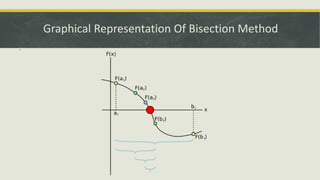
Graphical Representation Of Bisection Method
.
 The method is applicable for numerically solving the
equation f(x) = 0 for the real variable x, where f is a
continuous function defined on an interval [a, b] and
where f(a) and f(b) have opposite signs. In this case a and
b are said to bracket a root since, by the intermediate
value theorem, the continuous function f must have at
least one root in the interval (a, b).
C Program For Bisection Method
#include<stdio.h>
#include<conio.h>
# define eqn x*x-5
float f(float x)
{
float ans;
ans=eqn;
return(ans);}
Continue…
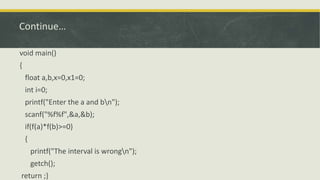
void main()
{
float a,b,x=0,x1=0;
int i=0;
printf("Enter the a and bn");
scanf("%f%f",&a,&b);
if(f(a)*f(b)>=0)
{
printf("The interval is wrongn");
getch();
return ;}
Continue...
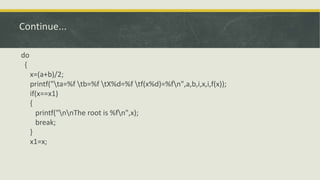
do
{
x=(a+b)/2;
printf("ta=%f tb=%f tX%d=%f tf(x%d)=%fn",a,b,i,x,i,f(x));
if(x==x1)
{
printf("nnThe root is %fn",x);
break;
}
x1=x;
Continue...
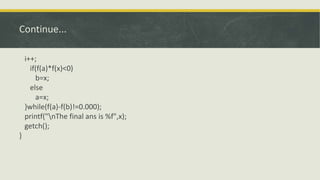
i++;
if(f(a)*f(x)<0)
b=x;
else
a=x;
}while(f(a)-f(b)!=0.000);
printf("nThe final ans is %f",x);
getch();
}
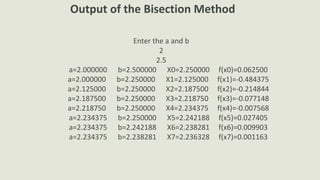
Enter the a and b
2
2.5
a=2.000000 b=2.500000 X0=2.250000 f(x0)=0.062500
a=2.000000 b=2.250000 X1=2.125000 f(x1)=-0.484375
a=2.125000 b=2.250000 X2=2.187500 f(x2)=-0.214844
a=2.187500 b=2.250000 X3=2.218750 f(x3)=-0.077148
a=2.218750 b=2.250000 X4=2.234375 f(x4)=-0.007568
a=2.234375 b=2.250000 X5=2.242188 f(x5)=0.027405
a=2.234375 b=2.242188 X6=2.238281 f(x6)=0.009903
a=2.234375 b=2.238281 X7=2.236328 f(x7)=0.001163
Output of the Bisection Method
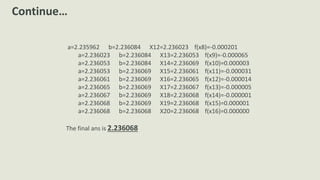
a=2.235962 b=2.236084 X12=2.236023 f(x8)=-0.000201
a=2.236023 b=2.236084 X13=2.236053 f(x9)=-0.000065
a=2.236053 b=2.236084 X14=2.236069 f(x10)=0.000003
a=2.236053 b=2.236069 X15=2.236061 f(x11)=-0.000031
a=2.236061 b=2.236069 X16=2.236065 f(x12)=-0.000014
a=2.236065 b=2.236069 X17=2.236067 f(x13)=-0.000005
a=2.236067 b=2.236069 X18=2.236068 f(x14)=-0.000001
a=2.236068 b=2.236069 X19=2.236068 f(x15)=0.000001
a=2.236068 b=2.236068 X20=2.236068 f(x16)=0.000000
The final ans is 2.236068
Continue…
Bisection Method Example - Polynomial
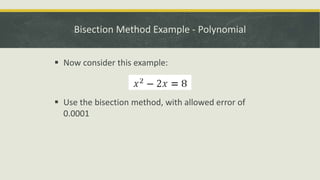
 Now consider this example:
 Use the bisection method, with allowed error of
0.0001
Bisection Method Example - Polynomial
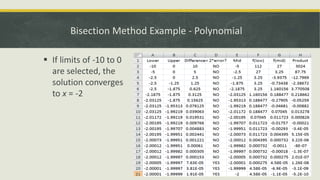
 If limits of -10 to 0
are selected, the
solution converges
to x = -2
Bisection Method Example - Polynomial
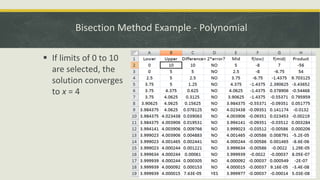
 If limits of 0 to 10
are selected, the
solution converges
to x = 4
Bisection Method Example - Polynomial
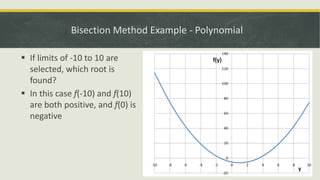
 If limits of -10 to 10 are
selected, which root is
found?
 In this case f(-10) and f(10)
are both positive, and f(0) is
negative
Bisection Method Example - Polynomial
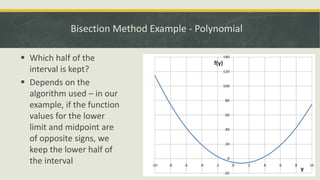
 Which half of the
interval is kept?
 Depends on the
algorithm used – in our
example, if the function
values for the lower
limit and midpoint are
of opposite signs, we
keep the lower half of
the interval
Bisection Method Example - Polynomial
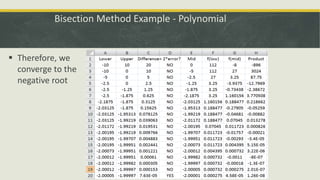
 Therefore, we
converge to the
negative root
Example 2
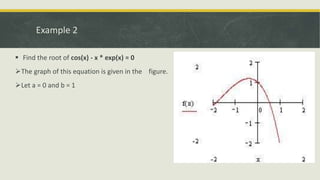
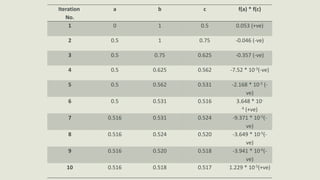
 Find the root of cos(x) - x * exp(x) = 0
The graph of this equation is given in the figure.
Let a = 0 and b = 1
.
Iteration
No.
a b c f(a) * f(c)
1 0 1 0.5 0.053 (+ve)
2 0.5 1 0.75 -0.046 (-ve)
3 0.5 0.75 0.625 -0.357 (-ve)
4 0.5 0.625 0.562 -7.52 * 10-3(-ve)
5 0.5 0.562 0.531 -2.168 * 10-3 (-
ve)
6 0.5 0.531 0.516 3.648 * 10-
4 (+ve)
7 0.516 0.531 0.524 -9.371 * 10-5(-
ve)
8 0.516 0.524 0.520 -3.649 * 10-5(-
ve)
9 0.516 0.520 0.518 -3.941 * 10-6(-
ve)
10 0.516 0.518 0.517 1.229 * 10-5(+ve)
.
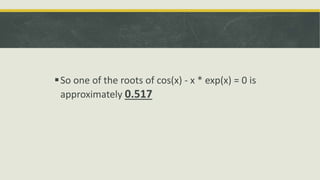
So one of the roots of cos(x) - x * exp(x) = 0 is
approximately 0.517
Example 3
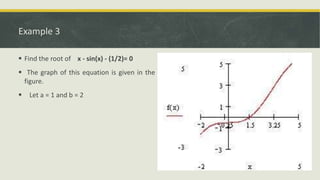
 Find the root of x - sin(x) - (1/2)= 0
 The graph of this equation is given in the
figure.
 Let a = 1 and b = 2
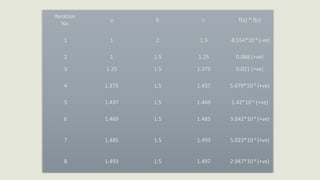
Iteration
No.
a b c f(a) * f(c)
1 1 2 1.5 -8.554*10-4 (-ve)
2 1 1.5 1.25 0.068 (+ve)
3 1.25 1.5 1.375 0.021 (+ve)
4 1.375 1.5 1.437 5.679*10-3 (+ve)
5 1.437 1.5 1.469 1.42*10-3 (+ve)
6 1.469 1.5 1.485 3.042*10-4 (+ve)
7 1.485 1.5 1.493 5.023*10-5 (+ve)
8 1.493 1.5 1.497 2.947*10-6 (+ve)
.
 So one of the roots of x-sin(x)-(1/2) = 0 is
approximately 1.497.
Bisection method

Bisection method

  • 1.
    BISECTION METHOD & IT’S APPLICATIONS APresentation by: 150110120060: TIRTH PARMAR 150110120061: ABHIJIT TRIVEDI 150110120062: VAIBHAV SOLANKI 150110120063: NIRAV VASOYA
  • 2.
    Topics to beCovered  Introduction of Bisection method  Graphical Representation Of Bisection Method  Finding Roots of Equations  Classification of Equations  Algorithm  Flowchart  C program  Examples
  • 3.
    Finding Roots ofEquations • In this topic we are examining equations with one independent variable. • These equations may be linear or non-linear • Non-linear equations may be polynomials or generally non-linear equations • A root of the equation is simply a value of the independent variable that satisfies the equation
  • 4.
    Classification of Equations •Linear: independent variable appears to the first power only, either alone or multiplied by a constant • Nonlinear: – Polynomial: independent variable appears raised to powers of positive integers only – General non-linear: all other equations
  • 5.
    BISECTION METHOD  Thebisection method in mathematics is a root-finding method that repeatedly bisects an interval and then selects a subinterval in which a root must lie for further processing.  It is a very simple and robust method, but it is also relatively slow.  Because of this, it is often used to obtain a rough approximation to a solution which is then used as a starting point for more rapidly converging methods.  The method is also called “The Interval Halving Method”.
  • 6.
    Graphical Representation OfBisection Method .
  • 7.
     The methodis applicable for numerically solving the equation f(x) = 0 for the real variable x, where f is a continuous function defined on an interval [a, b] and where f(a) and f(b) have opposite signs. In this case a and b are said to bracket a root since, by the intermediate value theorem, the continuous function f must have at least one root in the interval (a, b).
  • 8.
    C Program ForBisection Method #include<stdio.h> #include<conio.h> # define eqn x*x-5 float f(float x) { float ans; ans=eqn; return(ans);}
  • 9.
    Continue… void main() { float a,b,x=0,x1=0; inti=0; printf("Enter the a and bn"); scanf("%f%f",&a,&b); if(f(a)*f(b)>=0) { printf("The interval is wrongn"); getch(); return ;}
  • 10.
    Continue... do { x=(a+b)/2; printf("ta=%f tb=%f tX%d=%ftf(x%d)=%fn",a,b,i,x,i,f(x)); if(x==x1) { printf("nnThe root is %fn",x); break; } x1=x;
  • 11.
  • 12.
    Enter the aand b 2 2.5 a=2.000000 b=2.500000 X0=2.250000 f(x0)=0.062500 a=2.000000 b=2.250000 X1=2.125000 f(x1)=-0.484375 a=2.125000 b=2.250000 X2=2.187500 f(x2)=-0.214844 a=2.187500 b=2.250000 X3=2.218750 f(x3)=-0.077148 a=2.218750 b=2.250000 X4=2.234375 f(x4)=-0.007568 a=2.234375 b=2.250000 X5=2.242188 f(x5)=0.027405 a=2.234375 b=2.242188 X6=2.238281 f(x6)=0.009903 a=2.234375 b=2.238281 X7=2.236328 f(x7)=0.001163 Output of the Bisection Method
  • 13.
    a=2.235962 b=2.236084 X12=2.236023f(x8)=-0.000201 a=2.236023 b=2.236084 X13=2.236053 f(x9)=-0.000065 a=2.236053 b=2.236084 X14=2.236069 f(x10)=0.000003 a=2.236053 b=2.236069 X15=2.236061 f(x11)=-0.000031 a=2.236061 b=2.236069 X16=2.236065 f(x12)=-0.000014 a=2.236065 b=2.236069 X17=2.236067 f(x13)=-0.000005 a=2.236067 b=2.236069 X18=2.236068 f(x14)=-0.000001 a=2.236068 b=2.236069 X19=2.236068 f(x15)=0.000001 a=2.236068 b=2.236068 X20=2.236068 f(x16)=0.000000 The final ans is 2.236068 Continue…
  • 14.
    Bisection Method Example- Polynomial  Now consider this example:  Use the bisection method, with allowed error of 0.0001
  • 15.
    Bisection Method Example- Polynomial  If limits of -10 to 0 are selected, the solution converges to x = -2
  • 16.
    Bisection Method Example- Polynomial  If limits of 0 to 10 are selected, the solution converges to x = 4
  • 17.
    Bisection Method Example- Polynomial  If limits of -10 to 10 are selected, which root is found?  In this case f(-10) and f(10) are both positive, and f(0) is negative
  • 18.
    Bisection Method Example- Polynomial  Which half of the interval is kept?  Depends on the algorithm used – in our example, if the function values for the lower limit and midpoint are of opposite signs, we keep the lower half of the interval
  • 19.
    Bisection Method Example- Polynomial  Therefore, we converge to the negative root
  • 20.
    Example 2  Findthe root of cos(x) - x * exp(x) = 0 The graph of this equation is given in the figure. Let a = 0 and b = 1
  • 21.
    . Iteration No. a b cf(a) * f(c) 1 0 1 0.5 0.053 (+ve) 2 0.5 1 0.75 -0.046 (-ve) 3 0.5 0.75 0.625 -0.357 (-ve) 4 0.5 0.625 0.562 -7.52 * 10-3(-ve) 5 0.5 0.562 0.531 -2.168 * 10-3 (- ve) 6 0.5 0.531 0.516 3.648 * 10- 4 (+ve) 7 0.516 0.531 0.524 -9.371 * 10-5(- ve) 8 0.516 0.524 0.520 -3.649 * 10-5(- ve) 9 0.516 0.520 0.518 -3.941 * 10-6(- ve) 10 0.516 0.518 0.517 1.229 * 10-5(+ve)
  • 22.
    . So one ofthe roots of cos(x) - x * exp(x) = 0 is approximately 0.517
  • 23.
    Example 3  Findthe root of x - sin(x) - (1/2)= 0  The graph of this equation is given in the figure.  Let a = 1 and b = 2
  • 24.
    Iteration No. a b cf(a) * f(c) 1 1 2 1.5 -8.554*10-4 (-ve) 2 1 1.5 1.25 0.068 (+ve) 3 1.25 1.5 1.375 0.021 (+ve) 4 1.375 1.5 1.437 5.679*10-3 (+ve) 5 1.437 1.5 1.469 1.42*10-3 (+ve) 6 1.469 1.5 1.485 3.042*10-4 (+ve) 7 1.485 1.5 1.493 5.023*10-5 (+ve) 8 1.493 1.5 1.497 2.947*10-6 (+ve)
  • 25.
    .  So oneof the roots of x-sin(x)-(1/2) = 0 is approximately 1.497.