Chapter 14: Acids and Bases
        Properties of Acids and Bases
              What is an acid?
Some examples of common items containing acids:


  Vinegar contains acetic acid; lemons and citrus fruits
 contain citric acid; many sodas contain phosphoric acid.
        Q- What do all of these have in common?
                       A- Sour tastes
Properties of Acids and Bases
               What is a base?
Some examples of common items containing bases:


Many cleaning products contain bases, as do treatments for
upset stomach and indigestion. Edible items that are basic
  have a distinct taste- think of baking soda and tums.
Acids
   Acids were first recognized as a distinct class of compounds
  because of the common properties of their aqueous solutions:
•    Aqueous solutions of acids have a sour taste.
•    Acids change the color of acid-base indicators. When pH
     paper is used as an indicator, the paper turns certain colors
     in acidic solution.
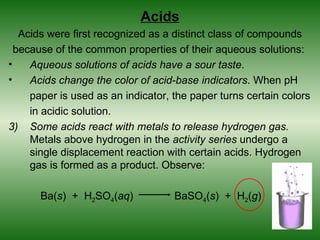
3) Some acids react with metals to release hydrogen gas.
     Metals above hydrogen in the activity series undergo a
     single displacement reaction with certain acids. Hydrogen
     gas is formed as a product. Observe:

      Ba(s) + H2SO4(aq)             BaSO4(s) + H2(g)
Acids
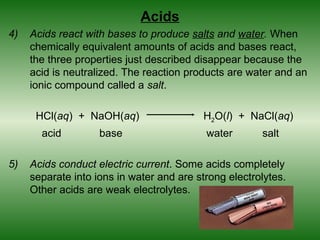
4)   Acids react with bases to produce salts and water. When
     chemically equivalent amounts of acids and bases react,
     the three properties just described disappear because the
     acid is neutralized. The reaction products are water and an
     ionic compound called a salt.

      HCl(aq) + NaOH(aq)                  H2O(l) + NaCl(aq)
       acid         base                   water       salt

5)   Acids conduct electric current. Some acids completely
     separate into ions in water and are strong electrolytes.
     Other acids are weak electrolytes.
Acid Nomenclature (2 types)
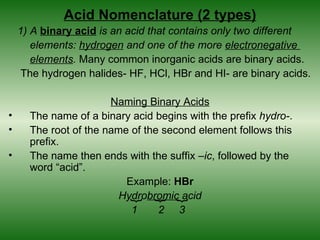
    1) A binary acid is an acid that contains only two different
       elements: hydrogen and one of the more electronegative
       elements. Many common inorganic acids are binary acids.
     The hydrogen halides- HF, HCl, HBr and HI- are binary acids.

                       Naming Binary Acids
•     The name of a binary acid begins with the prefix hydro-.
•     The root of the name of the second element follows this
      prefix.
•     The name then ends with the suffix –ic, followed by the
      word “acid”.
                          Example: HBr
                         Hydrobromic acid
                           {
                                {
                                    {

                           1     2 3
Acid Nomenclature
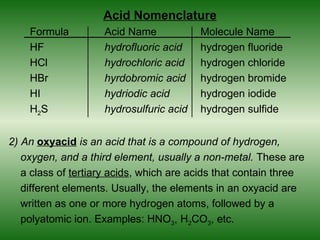
    Formula         Acid Name            Molecule Name
    HF              hydrofluoric acid    hydrogen fluoride
    HCl             hydrochloric acid    hydrogen chloride
    HBr             hyrdobromic acid     hydrogen bromide
    HI              hydriodic acid       hydrogen iodide
    H2S             hydrosulfuric acid   hydrogen sulfide


2) An oxyacid is an acid that is a compound of hydrogen,
   oxygen, and a third element, usually a non-metal. These are
   a class of tertiary acids, which are acids that contain three
   different elements. Usually, the elements in an oxyacid are
   written as one or more hydrogen atoms, followed by a
   polyatomic ion. Examples: HNO3, H2CO3, etc.
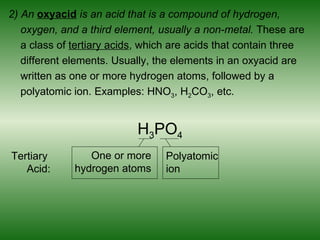
2) An oxyacid is an acid that is a compound of hydrogen,
   oxygen, and a third element, usually a non-metal. These are
   a class of tertiary acids, which are acids that contain three
   different elements. Usually, the elements in an oxyacid are
   written as one or more hydrogen atoms, followed by a
   polyatomic ion. Examples: HNO3, H2CO3, etc.


                           H3PO4
Tertiary         One or more      Polyatomic
   Acid:      hydrogen atoms      ion
Acid Nomenclature
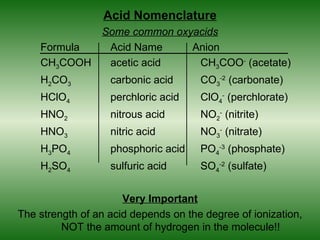
            Some common oxyacids
    Formula  Acid Name     Anion
    CH3COOH  acetic acid    CH3COO- (acetate)
    H2CO3          carbonic acid      CO3-2 (carbonate)
    HClO4          perchloric acid    ClO4- (perchlorate)
    HNO2           nitrous acid       NO2- (nitrite)
    HNO3           nitric acid        NO3- (nitrate)
    H3PO4          phosphoric acid    PO4-3 (phosphate)
    H2SO4          sulfuric acid      SO4-2 (sulfate)


                      Very Important
The strength of an acid depends on the degree of ionization,
         NOT the amount of hydrogen in the molecule!!
Bases
How do bases differ from acids? Let’s compare the properties of
                               the two:
•  Aqueous solutions of bases taste bitter. You will know this if
   you have ever gotten soap (a basic substance) in your
   mouth. Many bases are caustic: they attack the skin and
   tissues, causing severe burns.
2) Bases change the color of acid-base indicators.
•  Dilute aqueous solutions of bases feel slippery. Again with
   soap and many cleaning products.
•  Bases react with acids to produce salts and water. The
   properties of a base disappear with the addition of an
   equivalent amount of acid. “Neutralization” of the base
   occurs, just as it does with the acid.
•  Bases conduct electric current. Like acids, bases form ions
   in aqueous solutions and are thus electrolytes.
Arrhenius Acids and Bases
 An Arrhenius acid is a chemical compound that increases the
   concentration of hydrogen ions, H+, in aqueous solution. In
  other words, an acid will ionize in solution, producing H+ ions.

                 HCl (hydrochloric acid)


                                           [H+] = hydrogen ion
                                                  concentration
                       H+       H+
free hydrogen                        Cl-   [H+] = strong acid
     ions                Cl-
                    Cl- +       H+ H+
                        H                         solution
                          Cl-    H+ Cl-
                     H +                   [H+] = weak acid
                                  - H
                                     +
                          H+    Cl                solution
Arrhenius Acids and Bases
 An Arrhenius base is a chemical compound that increases the
  concentration of hydroxide ions,OH-, in aqueous solution. In
 other words, a base will ionize in solution, producing OH- ions.

                  NaOH (sodium hydroxide)


                                         [OH-] = hydroxide ion
                                                 concentration
                       OH- OH +
                                -
free hydroxide                            [OH-] = strong base
                        Na+    Na
      ions           Na+ - OH- OH-
                        OH OH- Na+                solution
                      OH- Na
                             +
                               OH-
                                          [OH-] = weak base
                         OH- Na+                  solution
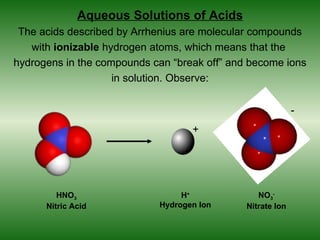
Aqueous Solutions of Acids
 The acids described by Arrhenius are molecular compounds
   with ionizable hydrogen atoms, which means that the
hydrogens in the compounds can “break off” and become ions
                    in solution. Observe:


                                                            -
                                   +


         HNO3                    H+              NO3-
      Nitric Acid           Hydrogen Ion      Nitrate Ion
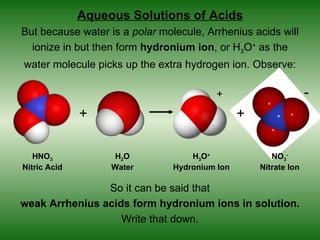
Aqueous Solutions of Acids
But because water is a polar molecule, Arrhenius acids will
  ionize in but then form hydronium ion, or H3O+ as the
water molecule picks up the extra hydrogen ion. Observe:

                                         +                        -
              +                                 +

   HNO3             H2O             H3O+               NO3-
Nitric Acid        Water        Hydronium Ion       Nitrate Ion

                So it can be said that
weak Arrhenius acids form hydronium ions in solution.
                   Write that down.
Strength of Acids
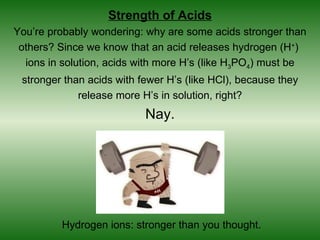
You’re probably wondering: why are some acids stronger than
 others? Since we know that an acid releases hydrogen (H+)
  ions in solution, acids with more H’s (like H3PO4) must be
 stronger than acids with fewer H’s (like HCl), because they
             release more H’s in solution, right?
                           Nay.


         Hydrogen ions: stronger than you thought.
Strength of Acids
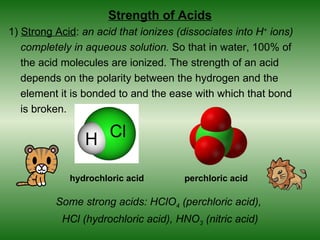
1) Strong Acid: an acid that ionizes (dissociates into H+ ions)
   completely in aqueous solution. So that in water, 100% of
   the acid molecules are ionized. The strength of an acid
   depends on the polarity between the hydrogen and the
   element it is bonded to and the ease with which that bond
   is broken.


             hydrochloric acid        perchloric acid

          Some strong acids: HClO4 (perchloric acid),
           HCl (hydrochloric acid), HNO3 (nitric acid)
Strength of Acids
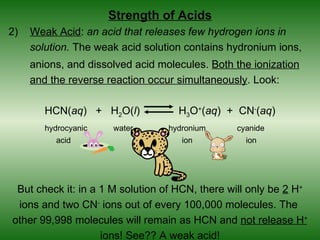
2)   Weak Acid: an acid that releases few hydrogen ions in
     solution. The weak acid solution contains hydronium ions,
     anions, and dissolved acid molecules. Both the ionization
     and the reverse reaction occur simultaneously. Look:

        HCN(aq) + H2O(l)            H3O+(aq) + CN-(aq)
        hydrocyanic   water       hydronium     cyanide
          acid                       ion          ion


 But check it: in a 1 M solution of HCN, there will only be 2 H+
 ions and two CN- ions out of every 100,000 molecules. The
other 99,998 molecules will remain as HCN and not release H+
                    ions! See?? A weak acid!
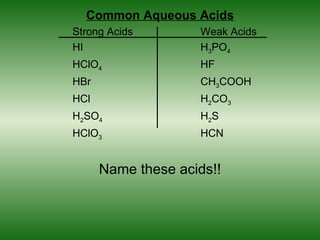
Common Aqueous Acids
Strong Acids        Weak Acids
HI                  H3PO4
HClO4               HF
HBr                 CH3COOH
HCl                 H2CO3
H2SO4               H2S
HClO3               HCN


      Name these acids!!
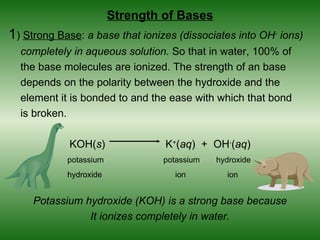
Strength of Bases
1) Strong Base: a base that ionizes (dissociates into OH- ions)
  completely in aqueous solution. So that in water, 100% of
  the base molecules are ionized. The strength of an base
  depends on the polarity between the hydroxide and the
  element it is bonded to and the ease with which that bond
  is broken.

             KOH(s)              K+(aq) + OH-(aq)
            potassium            potassium   hydroxide
            hydroxide              ion         ion


     Potassium hydroxide (KOH) is a strong base because
                It ionizes completely in water.
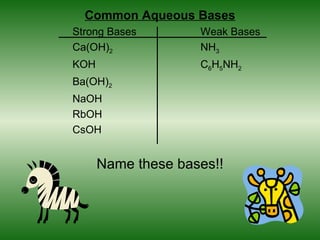
Common Aqueous Bases
Strong Bases        Weak Bases
Ca(OH)2             NH3
KOH                 C6H5NH2
Ba(OH)2
NaOH
RbOH
CsOH


      Name these bases!!
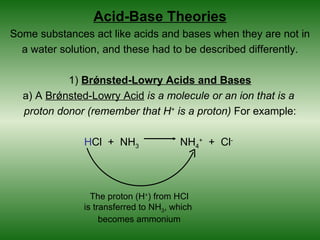
Acid-Base Theories
Some substances act like acids and bases when they are not in
  a water solution, and these had to be described differently.

           1) Brǿnsted-Lowry Acids and Bases
  a) A Brǿnsted-Lowry Acid is a molecule or an ion that is a
  proton donor (remember that H+ is a proton) For example:

               HCl + NH3               NH4+ + Cl-


                 The proton (H+) from HCl
               is transferred to NH3, which
                    becomes ammonium
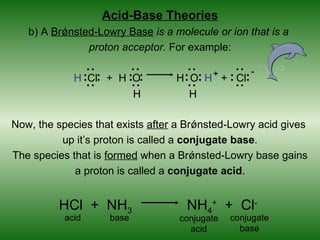
Acid-Base Theories
   b) A Brǿnsted-Lowry Base is a molecule or ion that is a
               proton acceptor. For example:

                                                         -


                                : :


                                                  : :
                  : :


                                        : :
                                              +
             H :Cl: + H :O:           H : O: H + : Cl:
                                H       H

Now, the species that exists after a Brǿnsted-Lowry acid gives
          up it’s proton is called a conjugate base.
The species that is formed when a Brǿnsted-Lowry base gains
             a proton is called a conjugate acid.


         HCl + NH3                      NH4+ + Cl-
           acid          base         conjugate   conjugate
                                        acid        base
Lewis Acids and Bases
  Lewis acids and bases apply to any species that can accept
 an electron pair to form a covalent bond with another species.

1) Lewis Acid: is an atom, ion, or molecule that accepts an
   electron pair in the form of a covalent bond. The Lewis
   definition is the broadest of the three acid definitions.


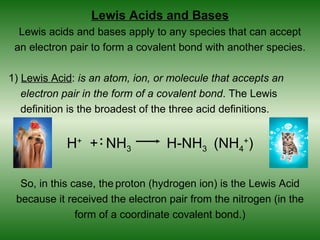
            H+ + : NH3            H-NH3 (NH4+)

  So, in this case, the proton (hydrogen ion) is the Lewis Acid
 because it received the electron pair from the nitrogen (in the
               form of a coordinate covalent bond.)

Chapter 14

  • 1.
    Chapter 14: Acidsand Bases Properties of Acids and Bases What is an acid? Some examples of common items containing acids: Vinegar contains acetic acid; lemons and citrus fruits contain citric acid; many sodas contain phosphoric acid. Q- What do all of these have in common? A- Sour tastes
  • 2.
    Properties of Acidsand Bases What is a base? Some examples of common items containing bases: Many cleaning products contain bases, as do treatments for upset stomach and indigestion. Edible items that are basic have a distinct taste- think of baking soda and tums.
  • 3.
    Acids Acids were first recognized as a distinct class of compounds because of the common properties of their aqueous solutions: • Aqueous solutions of acids have a sour taste. • Acids change the color of acid-base indicators. When pH paper is used as an indicator, the paper turns certain colors in acidic solution. 3) Some acids react with metals to release hydrogen gas. Metals above hydrogen in the activity series undergo a single displacement reaction with certain acids. Hydrogen gas is formed as a product. Observe: Ba(s) + H2SO4(aq) BaSO4(s) + H2(g)
  • 4.
    Acids 4) Acids react with bases to produce salts and water. When chemically equivalent amounts of acids and bases react, the three properties just described disappear because the acid is neutralized. The reaction products are water and an ionic compound called a salt. HCl(aq) + NaOH(aq) H2O(l) + NaCl(aq) acid base water salt 5) Acids conduct electric current. Some acids completely separate into ions in water and are strong electrolytes. Other acids are weak electrolytes.
  • 5.
    Acid Nomenclature (2types) 1) A binary acid is an acid that contains only two different elements: hydrogen and one of the more electronegative elements. Many common inorganic acids are binary acids. The hydrogen halides- HF, HCl, HBr and HI- are binary acids. Naming Binary Acids • The name of a binary acid begins with the prefix hydro-. • The root of the name of the second element follows this prefix. • The name then ends with the suffix –ic, followed by the word “acid”. Example: HBr Hydrobromic acid { { { 1 2 3
  • 6.
    Acid Nomenclature Formula Acid Name Molecule Name HF hydrofluoric acid hydrogen fluoride HCl hydrochloric acid hydrogen chloride HBr hyrdobromic acid hydrogen bromide HI hydriodic acid hydrogen iodide H2S hydrosulfuric acid hydrogen sulfide 2) An oxyacid is an acid that is a compound of hydrogen, oxygen, and a third element, usually a non-metal. These are a class of tertiary acids, which are acids that contain three different elements. Usually, the elements in an oxyacid are written as one or more hydrogen atoms, followed by a polyatomic ion. Examples: HNO3, H2CO3, etc.
  • 7.
    2) An oxyacidis an acid that is a compound of hydrogen, oxygen, and a third element, usually a non-metal. These are a class of tertiary acids, which are acids that contain three different elements. Usually, the elements in an oxyacid are written as one or more hydrogen atoms, followed by a polyatomic ion. Examples: HNO3, H2CO3, etc. H3PO4 Tertiary One or more Polyatomic Acid: hydrogen atoms ion
  • 8.
    Acid Nomenclature Some common oxyacids Formula Acid Name Anion CH3COOH acetic acid CH3COO- (acetate) H2CO3 carbonic acid CO3-2 (carbonate) HClO4 perchloric acid ClO4- (perchlorate) HNO2 nitrous acid NO2- (nitrite) HNO3 nitric acid NO3- (nitrate) H3PO4 phosphoric acid PO4-3 (phosphate) H2SO4 sulfuric acid SO4-2 (sulfate) Very Important The strength of an acid depends on the degree of ionization, NOT the amount of hydrogen in the molecule!!
  • 9.
    Bases How do basesdiffer from acids? Let’s compare the properties of the two: • Aqueous solutions of bases taste bitter. You will know this if you have ever gotten soap (a basic substance) in your mouth. Many bases are caustic: they attack the skin and tissues, causing severe burns. 2) Bases change the color of acid-base indicators. • Dilute aqueous solutions of bases feel slippery. Again with soap and many cleaning products. • Bases react with acids to produce salts and water. The properties of a base disappear with the addition of an equivalent amount of acid. “Neutralization” of the base occurs, just as it does with the acid. • Bases conduct electric current. Like acids, bases form ions in aqueous solutions and are thus electrolytes.
  • 10.
    Arrhenius Acids andBases An Arrhenius acid is a chemical compound that increases the concentration of hydrogen ions, H+, in aqueous solution. In other words, an acid will ionize in solution, producing H+ ions. HCl (hydrochloric acid) [H+] = hydrogen ion concentration H+ H+ free hydrogen Cl- [H+] = strong acid ions Cl- Cl- + H+ H+ H solution Cl- H+ Cl- H + [H+] = weak acid - H + H+ Cl solution
  • 11.
    Arrhenius Acids andBases An Arrhenius base is a chemical compound that increases the concentration of hydroxide ions,OH-, in aqueous solution. In other words, a base will ionize in solution, producing OH- ions. NaOH (sodium hydroxide) [OH-] = hydroxide ion concentration OH- OH + - free hydroxide [OH-] = strong base Na+ Na ions Na+ - OH- OH- OH OH- Na+ solution OH- Na + OH- [OH-] = weak base OH- Na+ solution
  • 12.
    Aqueous Solutions ofAcids The acids described by Arrhenius are molecular compounds with ionizable hydrogen atoms, which means that the hydrogens in the compounds can “break off” and become ions in solution. Observe: - + HNO3 H+ NO3- Nitric Acid Hydrogen Ion Nitrate Ion
  • 13.
    Aqueous Solutions ofAcids But because water is a polar molecule, Arrhenius acids will ionize in but then form hydronium ion, or H3O+ as the water molecule picks up the extra hydrogen ion. Observe: + - + + HNO3 H2O H3O+ NO3- Nitric Acid Water Hydronium Ion Nitrate Ion So it can be said that weak Arrhenius acids form hydronium ions in solution. Write that down.
  • 14.
    Strength of Acids You’reprobably wondering: why are some acids stronger than others? Since we know that an acid releases hydrogen (H+) ions in solution, acids with more H’s (like H3PO4) must be stronger than acids with fewer H’s (like HCl), because they release more H’s in solution, right? Nay. Hydrogen ions: stronger than you thought.
  • 15.
    Strength of Acids 1)Strong Acid: an acid that ionizes (dissociates into H+ ions) completely in aqueous solution. So that in water, 100% of the acid molecules are ionized. The strength of an acid depends on the polarity between the hydrogen and the element it is bonded to and the ease with which that bond is broken. hydrochloric acid perchloric acid Some strong acids: HClO4 (perchloric acid), HCl (hydrochloric acid), HNO3 (nitric acid)
  • 16.
    Strength of Acids 2) Weak Acid: an acid that releases few hydrogen ions in solution. The weak acid solution contains hydronium ions, anions, and dissolved acid molecules. Both the ionization and the reverse reaction occur simultaneously. Look: HCN(aq) + H2O(l) H3O+(aq) + CN-(aq) hydrocyanic water hydronium cyanide acid ion ion But check it: in a 1 M solution of HCN, there will only be 2 H+ ions and two CN- ions out of every 100,000 molecules. The other 99,998 molecules will remain as HCN and not release H+ ions! See?? A weak acid!
  • 17.
    Common Aqueous Acids StrongAcids Weak Acids HI H3PO4 HClO4 HF HBr CH3COOH HCl H2CO3 H2SO4 H2S HClO3 HCN Name these acids!!
  • 18.
    Strength of Bases 1)Strong Base: a base that ionizes (dissociates into OH- ions) completely in aqueous solution. So that in water, 100% of the base molecules are ionized. The strength of an base depends on the polarity between the hydroxide and the element it is bonded to and the ease with which that bond is broken. KOH(s) K+(aq) + OH-(aq) potassium potassium hydroxide hydroxide ion ion Potassium hydroxide (KOH) is a strong base because It ionizes completely in water.
  • 19.
    Common Aqueous Bases StrongBases Weak Bases Ca(OH)2 NH3 KOH C6H5NH2 Ba(OH)2 NaOH RbOH CsOH Name these bases!!
  • 20.
    Acid-Base Theories Some substancesact like acids and bases when they are not in a water solution, and these had to be described differently. 1) Brǿnsted-Lowry Acids and Bases a) A Brǿnsted-Lowry Acid is a molecule or an ion that is a proton donor (remember that H+ is a proton) For example: HCl + NH3 NH4+ + Cl- The proton (H+) from HCl is transferred to NH3, which becomes ammonium
  • 21.
    Acid-Base Theories b) A Brǿnsted-Lowry Base is a molecule or ion that is a proton acceptor. For example: - : : : : : : : : + H :Cl: + H :O: H : O: H + : Cl: H H Now, the species that exists after a Brǿnsted-Lowry acid gives up it’s proton is called a conjugate base. The species that is formed when a Brǿnsted-Lowry base gains a proton is called a conjugate acid. HCl + NH3 NH4+ + Cl- acid base conjugate conjugate acid base
  • 22.
    Lewis Acids andBases Lewis acids and bases apply to any species that can accept an electron pair to form a covalent bond with another species. 1) Lewis Acid: is an atom, ion, or molecule that accepts an electron pair in the form of a covalent bond. The Lewis definition is the broadest of the three acid definitions. H+ + : NH3 H-NH3 (NH4+) So, in this case, the proton (hydrogen ion) is the Lewis Acid because it received the electron pair from the nitrogen (in the form of a coordinate covalent bond.)