Lewis acid Lewis Bases
by: Dr. Robert D.Craig, Ph.D.
Will finish chapter 3…..
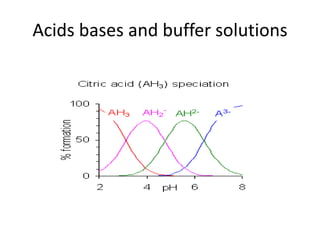
Acids bases and buffer solutions
Strong Acids and Bases

• Give the names and formulas of some strong
  acids and bases.
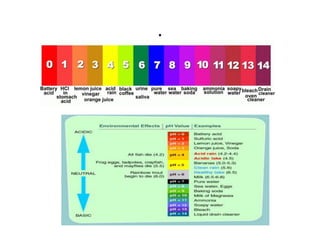
• Explain the pH scale, and convert pH to
  concentration (will do later)
• Evaluate solution pH and pOH of strong acids
  or bases.
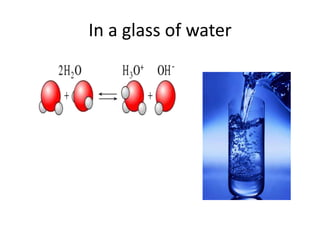
In a glass of water
Autoionization of Water

• Autoionization of Water
The equilibrium product Kw = [H+] [OH-]
is a constant at a definite temperature due to the
   autoionization of water,
               H2O = H+ + OH-.
• At 298 K, Kw = 10-14 and the following relationship
  in any aqueous solution is obvious,
• ***pOH + pH = 14 at 298 K.
Will need this soon

• ***pOH + pH = 14 at 298 K.
pH = -log[H+]
We say
• The pH scale is defined as the negative log of
  the concentration of H+: pH = -log[H+]

• The pOH scale is defined as the negative log of
  the concentration of OH-, [OH-]:

• pOH = -log[OH-] With this scale, calculating
  the pOH can be done in the same manner as
  the pH scale.
.
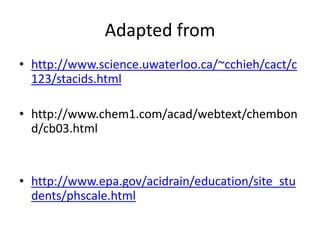
Adapted from
• http://www.science.uwaterloo.ca/~cchieh/cact/c
  123/stacids.html

• http://www.chem1.com/acad/webtext/chembon
  d/cb03.html


• http://www.epa.gov/acidrain/education/site_stu
  dents/phscale.html
Arrhenius Acids and Bases

• Arrhenius Acids and Bases
• The Arrhenius definition of acids
  and bases is one of the oldest. An
  Arrhenius acid is a substance that
  when added to water increases the
  concentration of H1+ ions present.
Arrhenius Acids and Bases

• The chemical formulas of Arrhenius acids are
  written with the acidic hydrogens first. An
  Arrhenius base is a substance that when
  added to water increases the concentration of
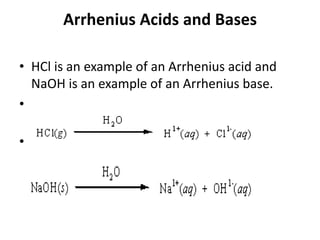
  OH1- ions present. HCl is an example of an
  Arrhenius acid and NaOH is an example of an
  Arrhenius base.
Arrhenius Acids and Bases

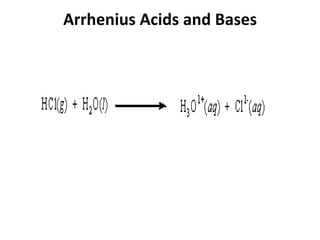
• HCl is an example of an Arrhenius acid and
  NaOH is an example of an Arrhenius base.
•

•
Arrhenius Acids and Bases

• The H1+ ion produced by an Arrhenius acid is
  always associated with a water molecule to
  form the hydronium ion, H3O1+(aq).
Arrhenius acids
• Arrhenius acids are frequently referred to as
  proton donors, hydrogen ion donors, or
  hydronium ion donors,
Arrhenius Acids and Bases

• To represent the transfer of the H1+ ion to
  water to form the hydronium ion, we must
  include H2O in the chemical equation for acid
  ionization.
Arrhenius Acids and Bases
Brønsted–Lowry concept
• It follows that, if a compound is to behave as an acid,
  donating a proton, there must be a base to accept
  the proton. So the Brønsted–Lowry concept can be
  defined by the reaction:

• acid + base <-> conjugate base +
  conjugate acid.
Brønsted-Lowry Style
• Sample Equations written in the Brønsted-
  Lowry Style
• A. Reactions that proceed to a large extent:
• HCl + H2O <==> H3O+ + Cl¯
• HCl - this is an acid, because it has a proton
  available to be transfered.
• H2O - this is a base, since it gets the proton
  that the acid lost.
Brønsted–Lowry concept
• The conjugate base is the ion or molecule remaining
  after the acid has lost a proton, and the conjugate
  acid is the species created when the base accepts the
  proton.
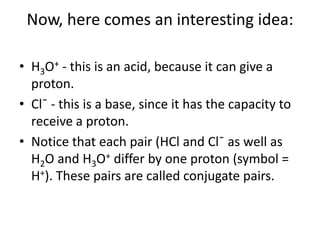
Now, here comes an interesting idea:

• H3O+ - this is an acid, because it can give a
  proton.
• Cl¯ - this is a base, since it has the capacity to
  receive a proton.
• Notice that each pair (HCl and Cl¯ as well as
  H2O and H3O+ differ by one proton (symbol =
  H+). These pairs are called conjugate pairs.
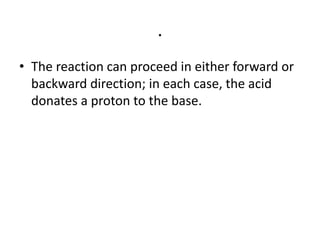
.
• The reaction can proceed in either forward or
  backward direction; in each case, the acid
  donates a proton to the base.
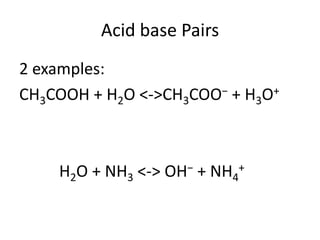
Acid base Pairs
2 examples:
CH3COOH + H2O <->CH3COO− + H3O+


    H2O + NH3 <-> OH− + NH4+
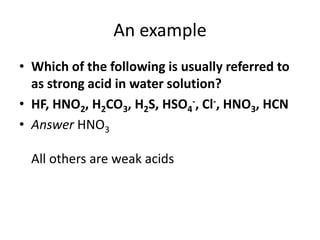
An example
• Which of the following is usually referred to
  as strong acid in water solution?
• HF, HNO2, H2CO3, H2S, HSO4-, Cl-, HNO3, HCN
• Answer HNO3

  All others are weak acids
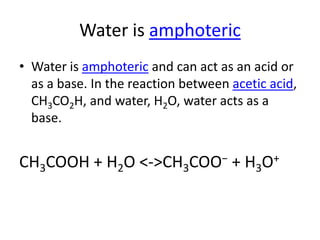
Water is amphoteric
• Water is amphoteric and can act as an acid or
  as a base. In the reaction between acetic acid,
  CH3CO2H, and water, H2O, water acts as a
  base.


CH3COOH + H2O <->CH3COO− + H3O+
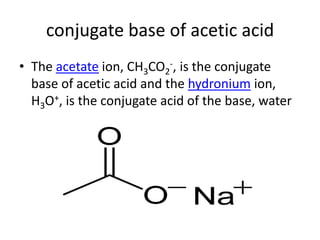
conjugate base of acetic acid
• The acetate ion, CH3CO2-, is the conjugate
  base of acetic acid and the hydronium ion,
  H3O+, is the conjugate acid of the base, water
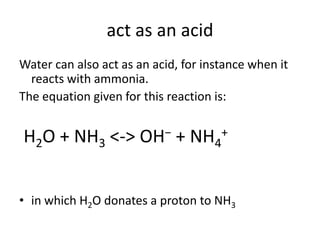
act as an acid
Water can also act as an acid, for instance when it
  reacts with ammonia.
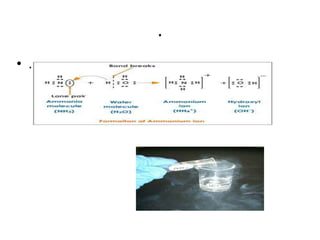
The equation given for this reaction is:


H2O + NH3 <->         OH−    + NH4    +


• in which H2O donates a proton to NH3
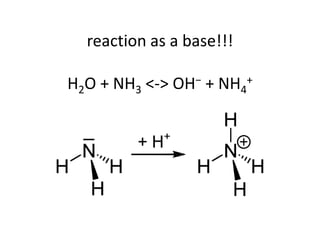
reaction as a base!!!

H2O + NH3 <-> OH− + NH4+
Strong acid weak acid
• A strong acid, such as hydrochloric acid,
  dissociates completely.
• A weak acid, such as acetic acid, may be
  partially dissociated; the acid dissociation
  constant, pKa, is a quantitative measure of the
  strength of the acid.
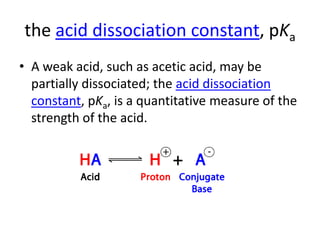
the acid dissociation constant, pKa
• A weak acid, such as acetic acid, may be
  partially dissociated; the acid dissociation
  constant, pKa, is a quantitative measure of the
  strength of the acid.
Brønsted–Lowry framework
• A wide range of compounds can be classified
  in the Brønsted–Lowry framework: mineral
  acids and derivatives such as sulfonates,
  phosphonates, etc., carboxylic acids, amines,
  carbon acids, and many more
Solvent –Not Water????
• Brønsted–Lowry base as the pair of electrons
  can be donated to a proton.
• This means that the Brønsted–Lowry concept
  is not limited to aqueous solutions.
• Any donor solvent S can act as a proton
  acceptor.

•AH + S: <->          A −   +   SH +
donor solvents
• Typical donor solvents used in acid-base
  chemistry, such as dimethyl sulfoxide or liquid
  ammonia have an oxygen or nitrogen atom
  with a lone pair of electrons that can be used
  to form a bond with a proton.
Do it here Rob
• 87. Most naturally occurring acids are weak
  acids. Lactic acid is one example.

• CH3COOH + H2O <->CH3COO− + H3O+
Buffer solutions
• If you place some lactic acid in water, it will
  ionize to a small extent, and an equilibrium
  will be established.

• Suggest an experiment???
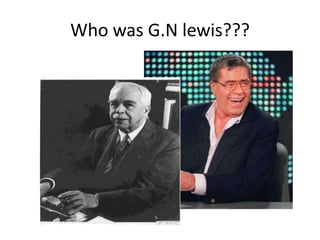
Who was G.N lewis???
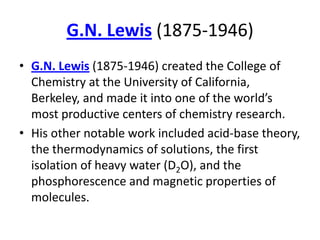
G.N. Lewis (1875-1946)
• G.N. Lewis (1875-1946) created the College of
  Chemistry at the University of California,
  Berkeley, and made it into one of the world’s
  most productive centers of chemistry research.
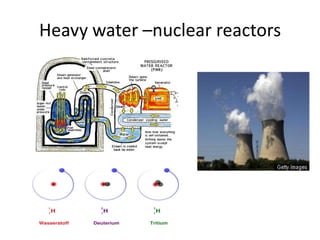
• His other notable work included acid-base theory,
  the thermodynamics of solutions, the first
  isolation of heavy water (D2O), and the
  phosphorescence and magnetic properties of
  molecules.
Lewis definition
Heavy water –nuclear reactors
.
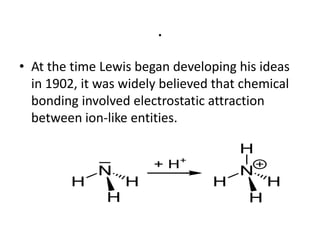
• At the time Lewis began developing his ideas
  in 1902, it was widely believed that chemical
  bonding involved electrostatic attraction
  between ion-like entities.
Could not explain
• This seemed satisfactory for compounds such
  as NaCl that were known to dissociate into
  ions when dissolved in water, but it failed to
  explain the bonding in non-electrolytes such
  as CH4
.
• .
The ammonium ion-an acid!!!
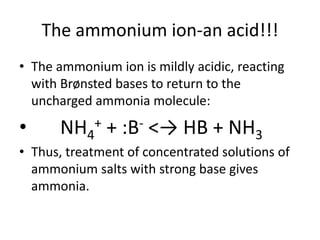
• The ammonium ion is mildly acidic, reacting
  with Brønsted bases to return to the
  uncharged ammonia molecule:

•     NH4    + + :B- <→ HB + NH
                                        3
• Thus, treatment of concentrated solutions of
  ammonium salts with strong base gives
  ammonia.
.
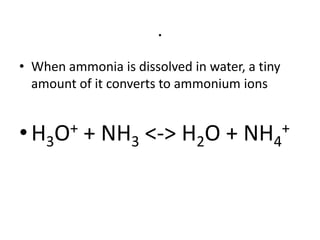
• When ammonia is dissolved in water, a tiny
  amount of it converts to ammonium ions


• H3O+    + NH3 <-> H2O +            NH4+
depends on the pH
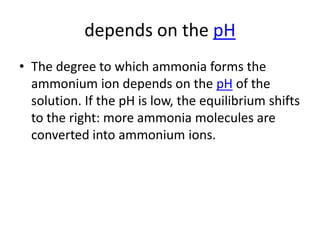
• The degree to which ammonia forms the
  ammonium ion depends on the pH of the
  solution. If the pH is low, the equilibrium shifts
  to the right: more ammonia molecules are
  converted into ammonium ions.
Just look –last time
Strong Acids and Bases

• Acids and bases that are completely ionized
  when dissolved in water are called strong
  acids and strong bases There are only a few
  strong acids and bases, and everyone should
  know their names and properties. These acids
  are often used in industry and everyday life
concentrations of acids and bases
• The concentrations of acids and bases are
  often expressed in terms of pH, and as an
  educated person, you should have the skill to
  convert concentrations into pH and pOH. The
  pH is an indication of the hydrogen ion
  concentration, [H+].
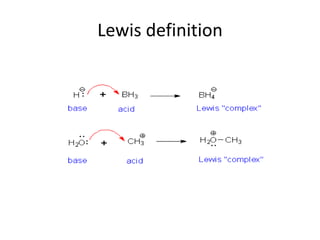
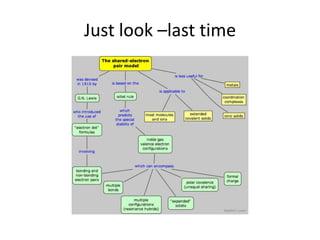
The term Lewis acid
• The term Lewis acid refers to a definition of
  acid published by Gilbert N. Lewis in 1923,
  specifically: An acid substance is one which
  can employ a lone pair from another molecule
  in completing the stable group of one of its
  own atoms.[1] Thus, H+ is a Lewis acid, since it
  can accept a lone pair, completing its stable
  form, which requires two electrons
Just look – do not write . . .
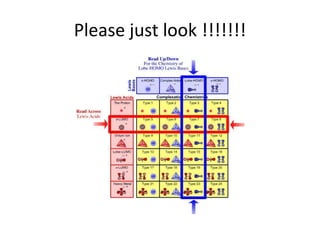
A Lewis base,
• A Lewis base, then, is any species that
  donates a pair electrons to a Lewis acid to
  form a Lewis adduct. For example, OH− and
  NH3 are Lewis bases, because they can donate
  a lone pair of electrons
Please just look !!!!!!!
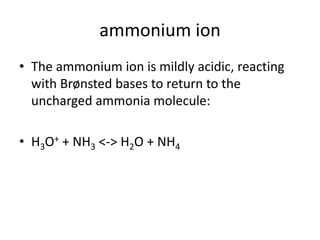
ammonium ion
• The ammonium ion is mildly acidic, reacting
  with Brønsted bases to return to the
  uncharged ammonia molecule:

• H3O+ + NH3 <-> H2O + NH4
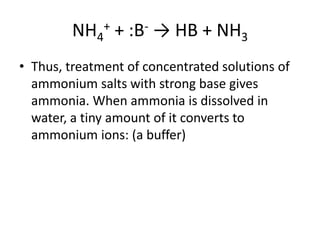
NH4+ + :B- → HB + NH3
• Thus, treatment of concentrated solutions of
  ammonium salts with strong base gives
  ammonia. When ammonia is dissolved in
  water, a tiny amount of it converts to
  ammonium ions: (a buffer)
How do buffer solutions work?

• A buffer solution has to contain things which
  will remove any hydrogen ions or hydroxide
  ions that you might add to it - otherwise the
  pH will change. Acidic and alkaline buffer
  solutions achieve this in different ways.
.

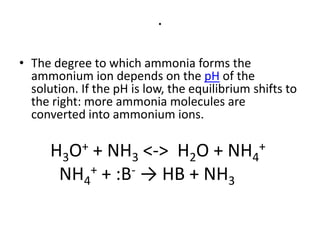
• The degree to which ammonia forms the
  ammonium ion depends on the pH of the
  solution. If the pH is low, the equilibrium shifts to
  the right: more ammonia molecules are
  converted into ammonium ions.

      H3O+ + NH3 <-> H2O + NH4+
       NH4 + + :B- → HB + NH
                            3
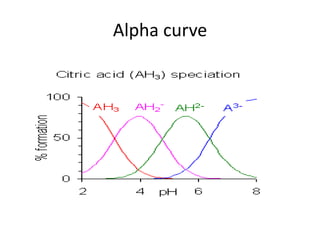
Alpha curve
Buffer solutions
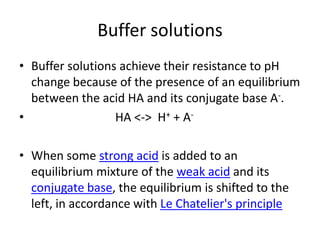
• Buffer solutions achieve their resistance to pH
  change because of the presence of an equilibrium
  between the acid HA and its conjugate base A-.
•                 HA <-> H+ + A-

• When some strong acid is added to an
  equilibrium mixture of the weak acid and its
  conjugate base, the equilibrium is shifted to the
  left, in accordance with Le Chatelier's principle
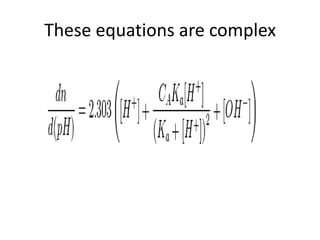
These equations are complex
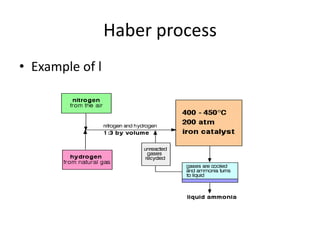
Haber process
• Example of l
Le Chatelier's Principle

• In 1884 the French chemist and engineer
  Henry-Louis Le Chatelier proposed one of the
  central concepts of chemical equilibria. Le
  Chatelier's principle can be stated as follows:
  A change in one of the variables that describe
  a system at equilibrium produces a shift in
  the position of the equilibrium that
  counteracts the effect of this change.
Le Chatelier's principle
• Le Chatelier's principle describes what
  happens to a system when something
  momentarily takes it away from equilibrium.
• (1) changing the concentration of one of the
  components of the reaction
• (2) changing the pressure on the system
• (3) changing the temperature at which the
  reaction is run

Acidandbase chm141 thursday[1]goodday

  • 1.
    Lewis acid LewisBases by: Dr. Robert D.Craig, Ph.D.
  • 2.
  • 3.
    Acids bases andbuffer solutions
  • 4.
    Strong Acids andBases • Give the names and formulas of some strong acids and bases. • Explain the pH scale, and convert pH to concentration (will do later) • Evaluate solution pH and pOH of strong acids or bases.
  • 5.
    In a glassof water
  • 6.
    Autoionization of Water •Autoionization of Water The equilibrium product Kw = [H+] [OH-] is a constant at a definite temperature due to the autoionization of water, H2O = H+ + OH-. • At 298 K, Kw = 10-14 and the following relationship in any aqueous solution is obvious, • ***pOH + pH = 14 at 298 K.
  • 7.
    Will need thissoon • ***pOH + pH = 14 at 298 K. pH = -log[H+]
  • 8.
    We say • ThepH scale is defined as the negative log of the concentration of H+: pH = -log[H+] • The pOH scale is defined as the negative log of the concentration of OH-, [OH-]: • pOH = -log[OH-] With this scale, calculating the pOH can be done in the same manner as the pH scale.
  • 9.
  • 10.
    Adapted from • http://www.science.uwaterloo.ca/~cchieh/cact/c 123/stacids.html • http://www.chem1.com/acad/webtext/chembon d/cb03.html • http://www.epa.gov/acidrain/education/site_stu dents/phscale.html
  • 11.
    Arrhenius Acids andBases • Arrhenius Acids and Bases • The Arrhenius definition of acids and bases is one of the oldest. An Arrhenius acid is a substance that when added to water increases the concentration of H1+ ions present.
  • 12.
    Arrhenius Acids andBases • The chemical formulas of Arrhenius acids are written with the acidic hydrogens first. An Arrhenius base is a substance that when added to water increases the concentration of OH1- ions present. HCl is an example of an Arrhenius acid and NaOH is an example of an Arrhenius base.
  • 13.
    Arrhenius Acids andBases • HCl is an example of an Arrhenius acid and NaOH is an example of an Arrhenius base. • •
  • 14.
    Arrhenius Acids andBases • The H1+ ion produced by an Arrhenius acid is always associated with a water molecule to form the hydronium ion, H3O1+(aq).
  • 15.
    Arrhenius acids • Arrheniusacids are frequently referred to as proton donors, hydrogen ion donors, or hydronium ion donors,
  • 16.
    Arrhenius Acids andBases • To represent the transfer of the H1+ ion to water to form the hydronium ion, we must include H2O in the chemical equation for acid ionization.
  • 17.
  • 18.
    Brønsted–Lowry concept • Itfollows that, if a compound is to behave as an acid, donating a proton, there must be a base to accept the proton. So the Brønsted–Lowry concept can be defined by the reaction: • acid + base <-> conjugate base + conjugate acid.
  • 19.
    Brønsted-Lowry Style • SampleEquations written in the Brønsted- Lowry Style • A. Reactions that proceed to a large extent: • HCl + H2O <==> H3O+ + Cl¯ • HCl - this is an acid, because it has a proton available to be transfered. • H2O - this is a base, since it gets the proton that the acid lost.
  • 20.
    Brønsted–Lowry concept • Theconjugate base is the ion or molecule remaining after the acid has lost a proton, and the conjugate acid is the species created when the base accepts the proton.
  • 21.
    Now, here comesan interesting idea: • H3O+ - this is an acid, because it can give a proton. • Cl¯ - this is a base, since it has the capacity to receive a proton. • Notice that each pair (HCl and Cl¯ as well as H2O and H3O+ differ by one proton (symbol = H+). These pairs are called conjugate pairs.
  • 22.
    . • The reactioncan proceed in either forward or backward direction; in each case, the acid donates a proton to the base.
  • 23.
    Acid base Pairs 2examples: CH3COOH + H2O <->CH3COO− + H3O+ H2O + NH3 <-> OH− + NH4+
  • 24.
    An example • Whichof the following is usually referred to as strong acid in water solution? • HF, HNO2, H2CO3, H2S, HSO4-, Cl-, HNO3, HCN • Answer HNO3 All others are weak acids
  • 25.
    Water is amphoteric •Water is amphoteric and can act as an acid or as a base. In the reaction between acetic acid, CH3CO2H, and water, H2O, water acts as a base. CH3COOH + H2O <->CH3COO− + H3O+
  • 26.
    conjugate base ofacetic acid • The acetate ion, CH3CO2-, is the conjugate base of acetic acid and the hydronium ion, H3O+, is the conjugate acid of the base, water
  • 27.
    act as anacid Water can also act as an acid, for instance when it reacts with ammonia. The equation given for this reaction is: H2O + NH3 <-> OH− + NH4 + • in which H2O donates a proton to NH3
  • 28.
    reaction as abase!!! H2O + NH3 <-> OH− + NH4+
  • 29.
    Strong acid weakacid • A strong acid, such as hydrochloric acid, dissociates completely. • A weak acid, such as acetic acid, may be partially dissociated; the acid dissociation constant, pKa, is a quantitative measure of the strength of the acid.
  • 30.
    the acid dissociationconstant, pKa • A weak acid, such as acetic acid, may be partially dissociated; the acid dissociation constant, pKa, is a quantitative measure of the strength of the acid.
  • 31.
    Brønsted–Lowry framework • Awide range of compounds can be classified in the Brønsted–Lowry framework: mineral acids and derivatives such as sulfonates, phosphonates, etc., carboxylic acids, amines, carbon acids, and many more
  • 32.
    Solvent –Not Water???? •Brønsted–Lowry base as the pair of electrons can be donated to a proton. • This means that the Brønsted–Lowry concept is not limited to aqueous solutions. • Any donor solvent S can act as a proton acceptor. •AH + S: <-> A − + SH +
  • 33.
    donor solvents • Typicaldonor solvents used in acid-base chemistry, such as dimethyl sulfoxide or liquid ammonia have an oxygen or nitrogen atom with a lone pair of electrons that can be used to form a bond with a proton.
  • 34.
    Do it hereRob • 87. Most naturally occurring acids are weak acids. Lactic acid is one example. • CH3COOH + H2O <->CH3COO− + H3O+
  • 35.
    Buffer solutions • Ifyou place some lactic acid in water, it will ionize to a small extent, and an equilibrium will be established. • Suggest an experiment???
  • 36.
    Who was G.Nlewis???
  • 37.
    G.N. Lewis (1875-1946) •G.N. Lewis (1875-1946) created the College of Chemistry at the University of California, Berkeley, and made it into one of the world’s most productive centers of chemistry research. • His other notable work included acid-base theory, the thermodynamics of solutions, the first isolation of heavy water (D2O), and the phosphorescence and magnetic properties of molecules.
  • 38.
  • 39.
  • 40.
    . • At thetime Lewis began developing his ideas in 1902, it was widely believed that chemical bonding involved electrostatic attraction between ion-like entities.
  • 41.
    Could not explain •This seemed satisfactory for compounds such as NaCl that were known to dissociate into ions when dissolved in water, but it failed to explain the bonding in non-electrolytes such as CH4
  • 42.
  • 43.
    The ammonium ion-anacid!!! • The ammonium ion is mildly acidic, reacting with Brønsted bases to return to the uncharged ammonia molecule: • NH4 + + :B- <→ HB + NH 3 • Thus, treatment of concentrated solutions of ammonium salts with strong base gives ammonia.
  • 44.
    . • When ammoniais dissolved in water, a tiny amount of it converts to ammonium ions • H3O+ + NH3 <-> H2O + NH4+
  • 45.
    depends on thepH • The degree to which ammonia forms the ammonium ion depends on the pH of the solution. If the pH is low, the equilibrium shifts to the right: more ammonia molecules are converted into ammonium ions.
  • 46.
  • 47.
    Strong Acids andBases • Acids and bases that are completely ionized when dissolved in water are called strong acids and strong bases There are only a few strong acids and bases, and everyone should know their names and properties. These acids are often used in industry and everyday life
  • 48.
    concentrations of acidsand bases • The concentrations of acids and bases are often expressed in terms of pH, and as an educated person, you should have the skill to convert concentrations into pH and pOH. The pH is an indication of the hydrogen ion concentration, [H+].
  • 49.
    The term Lewisacid • The term Lewis acid refers to a definition of acid published by Gilbert N. Lewis in 1923, specifically: An acid substance is one which can employ a lone pair from another molecule in completing the stable group of one of its own atoms.[1] Thus, H+ is a Lewis acid, since it can accept a lone pair, completing its stable form, which requires two electrons
  • 50.
    Just look –do not write . . .
  • 51.
    A Lewis base, •A Lewis base, then, is any species that donates a pair electrons to a Lewis acid to form a Lewis adduct. For example, OH− and NH3 are Lewis bases, because they can donate a lone pair of electrons
  • 52.
  • 53.
    ammonium ion • Theammonium ion is mildly acidic, reacting with Brønsted bases to return to the uncharged ammonia molecule: • H3O+ + NH3 <-> H2O + NH4
  • 54.
    NH4+ + :B-→ HB + NH3 • Thus, treatment of concentrated solutions of ammonium salts with strong base gives ammonia. When ammonia is dissolved in water, a tiny amount of it converts to ammonium ions: (a buffer)
  • 55.
    How do buffersolutions work? • A buffer solution has to contain things which will remove any hydrogen ions or hydroxide ions that you might add to it - otherwise the pH will change. Acidic and alkaline buffer solutions achieve this in different ways.
  • 56.
    . • The degreeto which ammonia forms the ammonium ion depends on the pH of the solution. If the pH is low, the equilibrium shifts to the right: more ammonia molecules are converted into ammonium ions. H3O+ + NH3 <-> H2O + NH4+ NH4 + + :B- → HB + NH 3
  • 57.
  • 58.
    Buffer solutions • Buffersolutions achieve their resistance to pH change because of the presence of an equilibrium between the acid HA and its conjugate base A-. • HA <-> H+ + A- • When some strong acid is added to an equilibrium mixture of the weak acid and its conjugate base, the equilibrium is shifted to the left, in accordance with Le Chatelier's principle
  • 59.
  • 60.
  • 61.
    Le Chatelier's Principle •In 1884 the French chemist and engineer Henry-Louis Le Chatelier proposed one of the central concepts of chemical equilibria. Le Chatelier's principle can be stated as follows: A change in one of the variables that describe a system at equilibrium produces a shift in the position of the equilibrium that counteracts the effect of this change.
  • 62.
    Le Chatelier's principle •Le Chatelier's principle describes what happens to a system when something momentarily takes it away from equilibrium.
  • 63.
    • (1) changingthe concentration of one of the components of the reaction • (2) changing the pressure on the system • (3) changing the temperature at which the reaction is run