The document summarizes the OWASP Top 10 security threats. It describes each of the top 10 threats, including injection, broken authentication, cross-site scripting, insecure direct object references, security misconfiguration, sensitive data exposure, missing access controls, cross-site request forgery, use of vulnerable components, and unsafe redirects/forwards. For each threat, it provides a brief explanation of the meaning and potential impacts, such as data loss, account compromise, or full host takeover. The document encourages implementing people, process, and technology measures to address application security issues.
About OWASP
The OWASPFoundation came online on December 1st 2001 it was established
as a not-for-profit charitable organization in the United States on April 21,
2004. OWASP is an open community dedicated to enabling organizations to
conceive, develop, acquire, operate, and maintain applications that can be
trusted. All of the OWASP tools, documents, forums, and chapters are free
and open to anyone interested in improving application security. OWASP
advocate approaching application security as a people, process, and technology
problem because the most effective approaches to application security include
improvements in all of these areas. OWASP can be found at www.owasp.org.
OWASP is not affiliated with any technology company. Similar to many open-
source software projects, OWASP produces many types of materials in a
collaborative and open way. The OWASP Foundation is a not-for-profit entity
that ensures the project's long-term success.
3.
A1-Injection
Injection means “toinput something in
somewhere” the attacker use the tricks
to the interpreter into executing
unintended (malicious) commands or
accessing data without authority. The
types are: SQL, OS, and LDAP, injection
occur when important data is sent to an
interpreter (attacker) as part of a
command or query.
Injection can result in
data loss or corruption,
lack of accountability,
or denial of access.
Injection can
sometimes lead to
complete host
takeover.
Meaning
Impact
4.
A2-Broken
Authentication and
Session Management
Applicationfunctions related to
authentication and session
management are often not
implemented correctly, allowing
attackers to compromise passwords,
keys, or session tokens, or to exploit
other implementation flaws to assume
other users’ identities.
Such flaws may allow
some or
even all accounts to be
attacked. Once
successful, the
attacker can do
anything the victim
could do.
Meaning
Impact
SERVER
5.
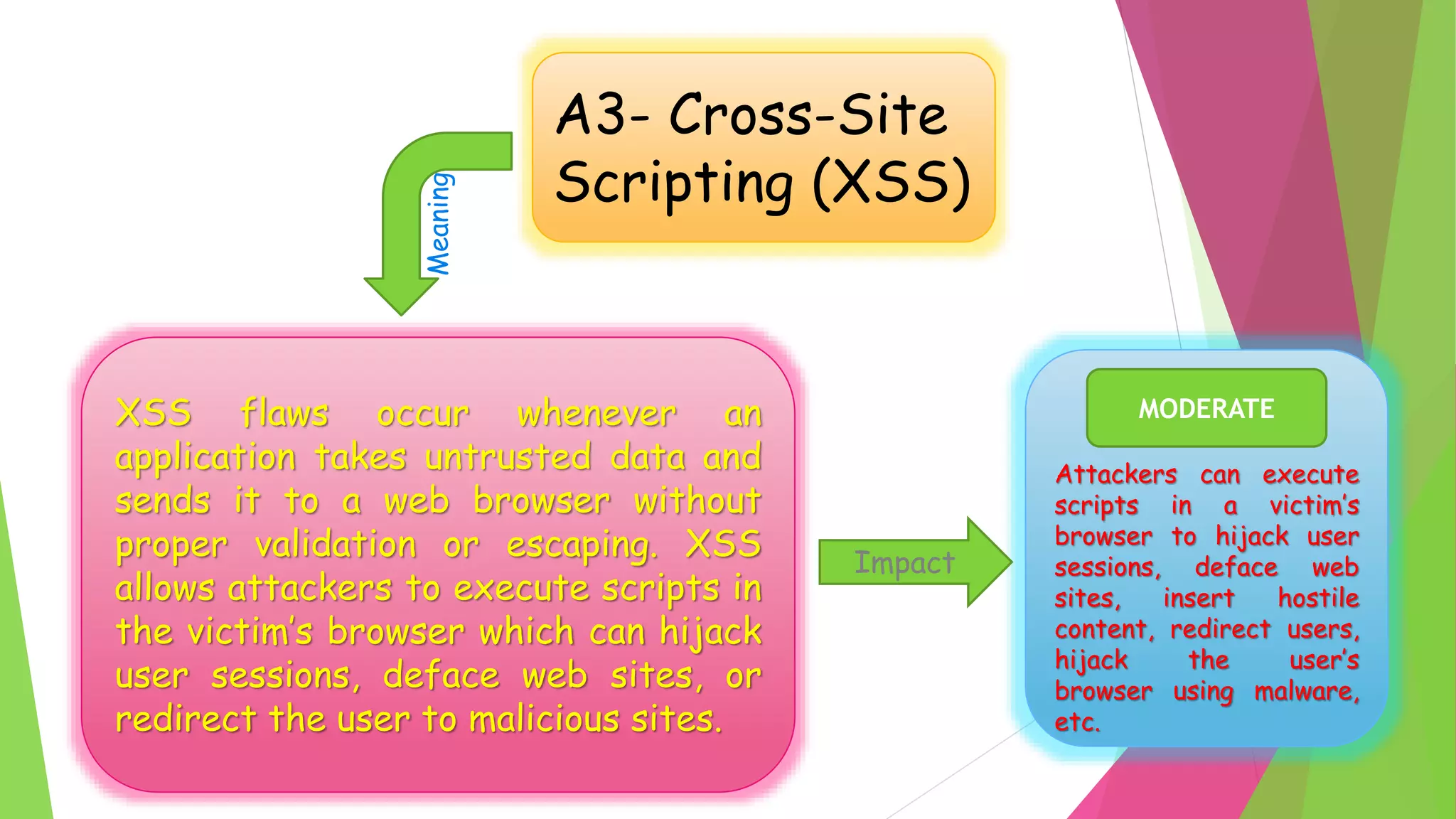
A3- Cross-Site
Scripting (XSS)
XSSflaws occur whenever an
application takes untrusted data and
sends it to a web browser without
proper validation or escaping. XSS
allows attackers to execute scripts in
the victim’s browser which can hijack
user sessions, deface web sites, or
redirect the user to malicious sites.
Attackers can execute
scripts in a victim’s
browser to hijack user
sessions, deface web
sites, insert hostile
content, redirect users,
hijack the user’s
browser using malware,
etc.
Meaning
Impact
MODERATE
6.
A4-Insecure
Direct Object
Reference
A directobject reference also
called “Parameter Tempering” occurs
when a developer exposes a
reference to an internal
implementation object, such as a file,
directory, or database key. Without
an access control check or other
protection, attackers can manipulate
these references to access
unauthorized data.
Such flaws can
compromise all the
data that can be
referenced by the
parameter. it’s easy
for an attacker to
access all available
data of that type.
Meaning
Impact
MODERATE
7.
A5-Security
Misconfiguration
Good security requireshaving a
secure configuration defined and
deployed for the application,
frameworks, application server, web
server, database server, and
platform. Secure settings should be
defined, implemented, and
maintained, as defaults are often
insecure. Additionally, software
should be kept up to date.
The system could be
completely compromised
without you knowing it.
All of your data could be
stolen or modified slowly
over time.
Recovery costs could be
expensive.
Meaning
Impact
MODERATE
8.
A6- Sensitive
Data Exposer
Manyweb applications do not properly
protect sensitive data, such as credit
cards, tax IDs, and authentication
credentials. Attackers may steal or
modify such weakly protected data to
conduct credit card fraud, identity
theft, or other crimes. Sensitive data
deserves extra protection such as
encryption at rest or in transit, as well
as special precautions when exchanged
with the browser.
compromises all data
that should have been
protected. Typically,
this information
includes sensitive data
such as health records,
credentials, personal
data, credit cards, etc.
Meaning
Impact
SERVER
9.
A7-Missing
Functional Level
Access Control
Mostweb applications verify function
level access rights before making that
functionality visible in the UI.
However, applications need to perform
the same access control checks on the
server when each function is accessed.
If requests are not verified, attackers
will be able to forge requests in order
to access functionality without proper
authorization.
Such flaws allow
attackers to access
unauthorized
functionality.
Administrative
functions are key
targets for this type
of attack.
Meaning
Impact
MODERATOR
10.
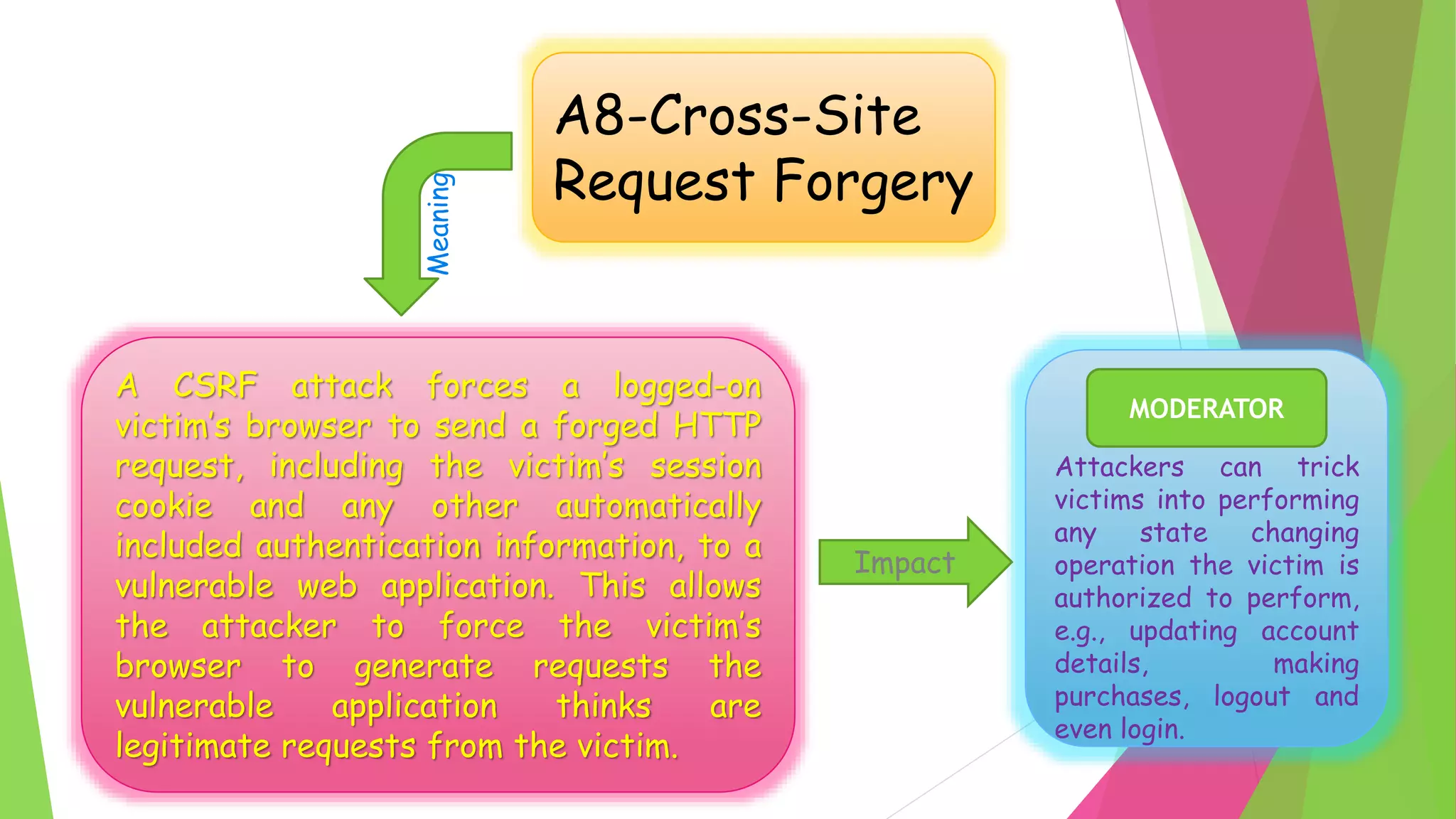
A8-Cross-Site
Request Forgery
A CSRFattack forces a logged-on
victim’s browser to send a forged HTTP
request, including the victim’s session
cookie and any other automatically
included authentication information, to a
vulnerable web application. This allows
the attacker to force the victim’s
browser to generate requests the
vulnerable application thinks are
legitimate requests from the victim.
Attackers can trick
victims into performing
any state changing
operation the victim is
authorized to perform,
e.g., updating account
details, making
purchases, logout and
even login.
Meaning
Impact
MODERATOR
11.
A9- Using
Components with
KnownVulnerabilities
Components, such as libraries,
frameworks, and other software
modules, almost always run with full
privileges. If a vulnerable component is
exploited, such an attack can facilitate
serious data loss or server takeover.
Applications using components with
known vulnerabilities may undermine
application defenses and enable a range
of possible attacks and impacts.
The full range of
weaknesses is possible,
including injection,
broken access control,
XSS, etc. The impact
could range from
minimal to complete
host takeover and data
compromise.
Meaning
Impact
MODERATOR
12.
A10-Unvalidated
Redirects and
Forwards
Web applicationsfrequently redirect
and forward users to other pages and
websites, and use untrusted data to
determine the destination pages.
Without proper validation, attackers
can redirect victims to phishing or
malware sites, or use forwards to
access unauthorized pages.
Such redirects may
attempt to install
malware or trick victims
into disclosing passwords
or other sensitive
information. Unsafe
forwards may allow
access control bypass.
Meaning
Impact
MODERATOR
13.
Please Like andShare this presentation and please subscribe my YouTube
channel for more videos.
www.prohackers.in
https://www.youtube.com/channel/UCcyYSi1sh1SmyMlGfB-Vq6A
https://www.facebook.com/theprohackers2017/
For any suggestion and query please write us on:
Theprohackers2017@gmail.com
Thanking You…!!!