AANNAATTOOMMYY OOFF 
LLUUMMBBOO--SSAACCRRAALL PPLLEEXXUUSS 
By: Syed Irshad Murtaza 
Technologist. 
Neurophysiology Dept. 
AKUH Karachi. 
12-08-2014 
L.S Plexus by IM
OOuuttlliinnee 
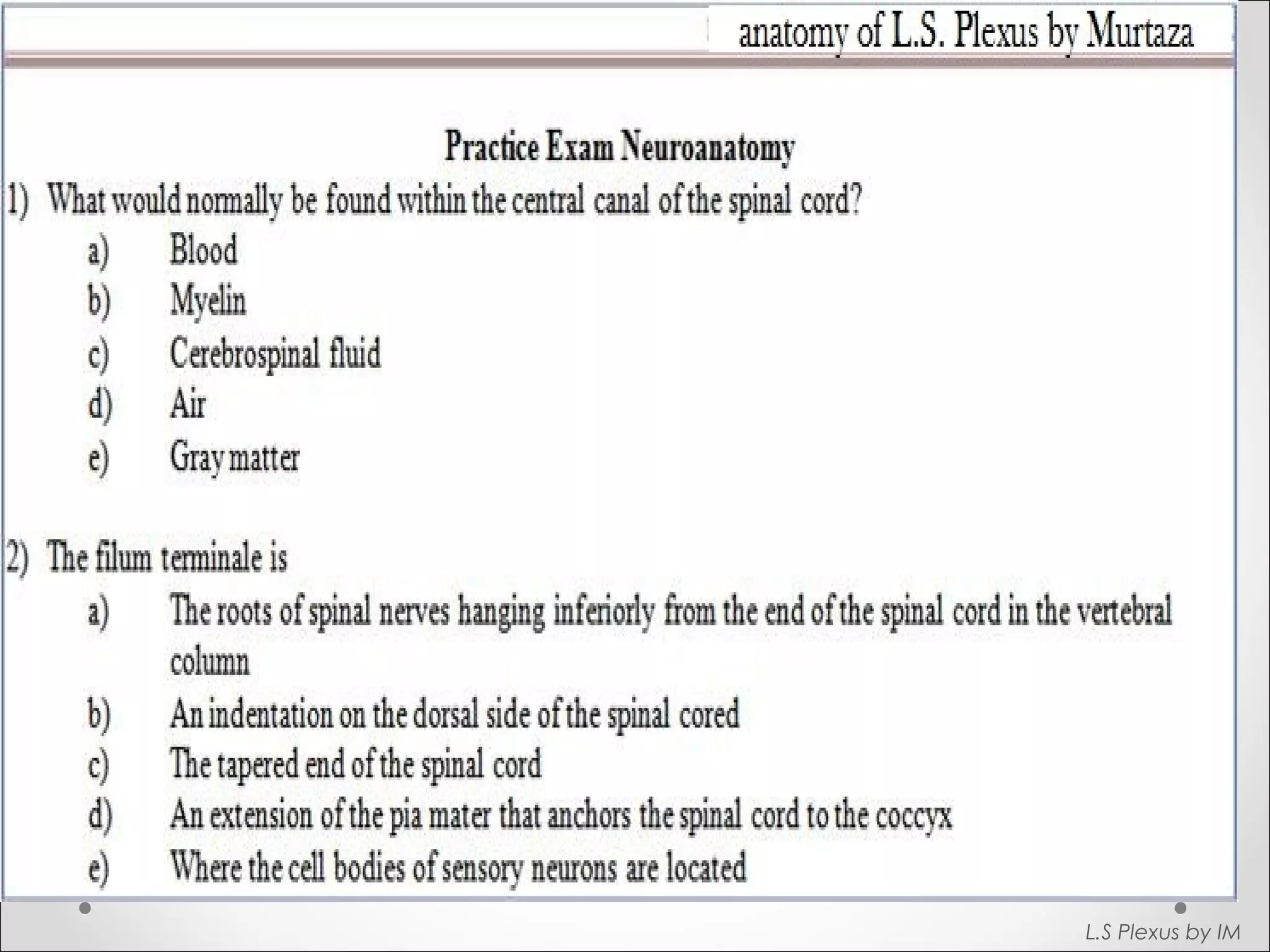
• Spinal cord. 
• Lumbar plexus anatomy 
• Sacral plexus anatomy 
• Components of lumbosacral plexus 
• Key for the L.S Plexus 
• Key to draw L.S Plexus. 
• Terminal Branches of L.S plexus. 
• Motor and Sensory Distribution. 
• Questions. 
• References 
L.S Plexus by IM
SSppiinnaall ccoorrdd 
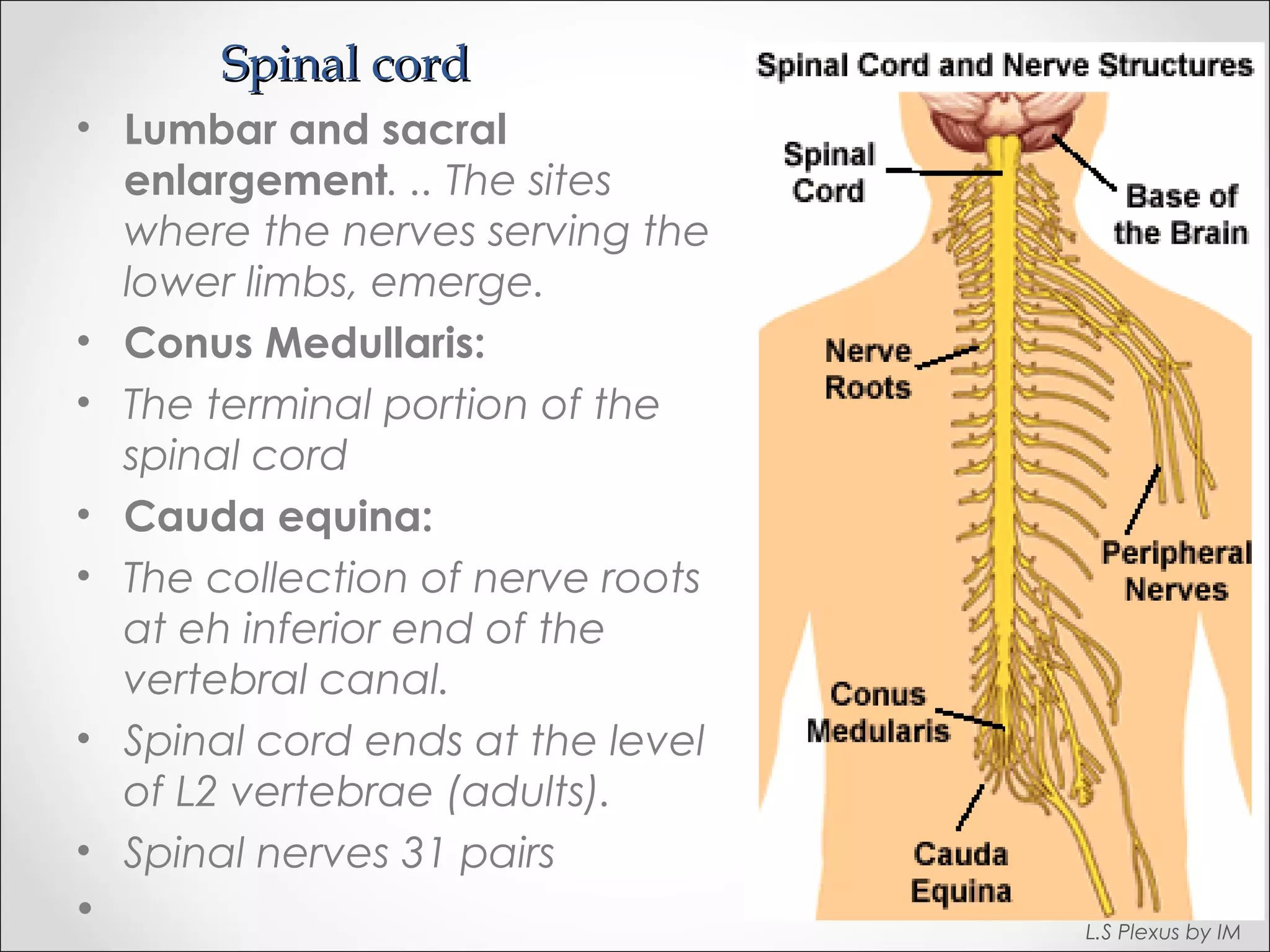
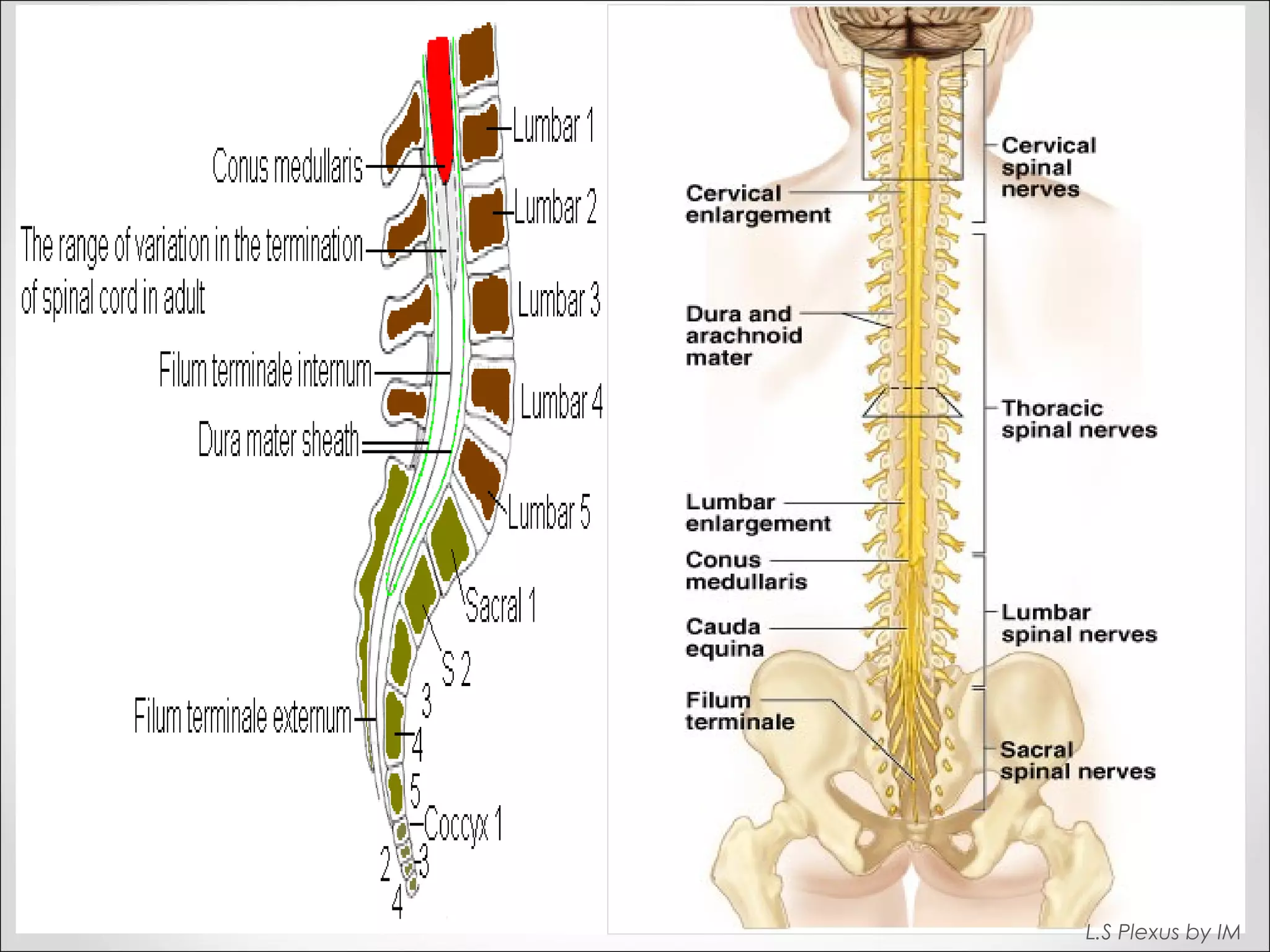
• Lumbar and sacral 
enlargement. .. The sites 
where the nerves serving the 
lower limbs, emerge. 
• Conus Medullaris: 
• The terminal portion of the 
spinal cord 
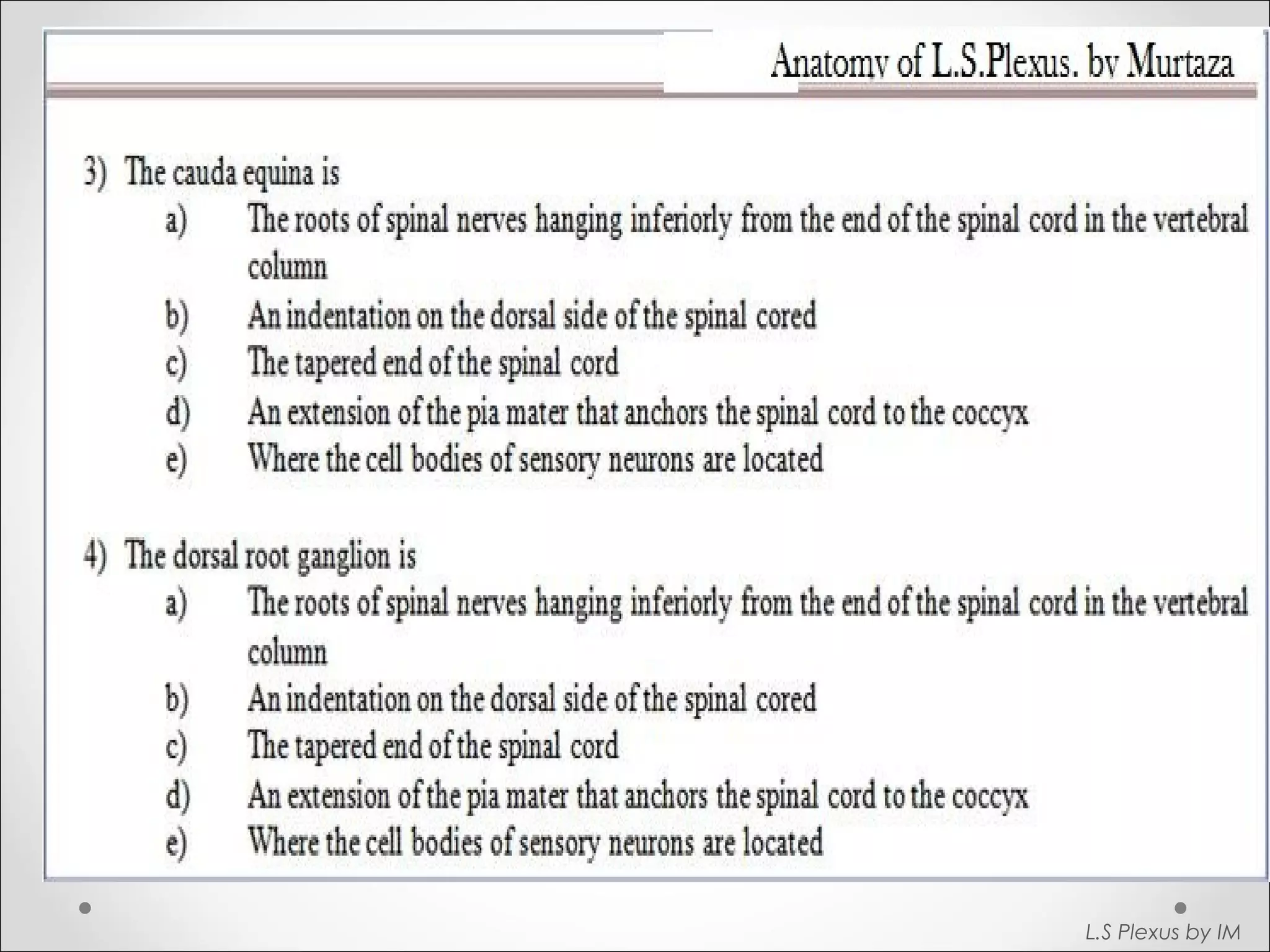
• Cauda equina: 
• The collection of nerve roots 
at eh inferior end of the 
vertebral canal. 
• Spinal cord ends at the level 
of L2 vertebrae (adults). 
• Spinal nerves 31 pairs 
L.S Plexus by IM
L.S Plexus by IM
L.S Plexus by IM
LLuummbboossaaccrraall pplleexxuuss 
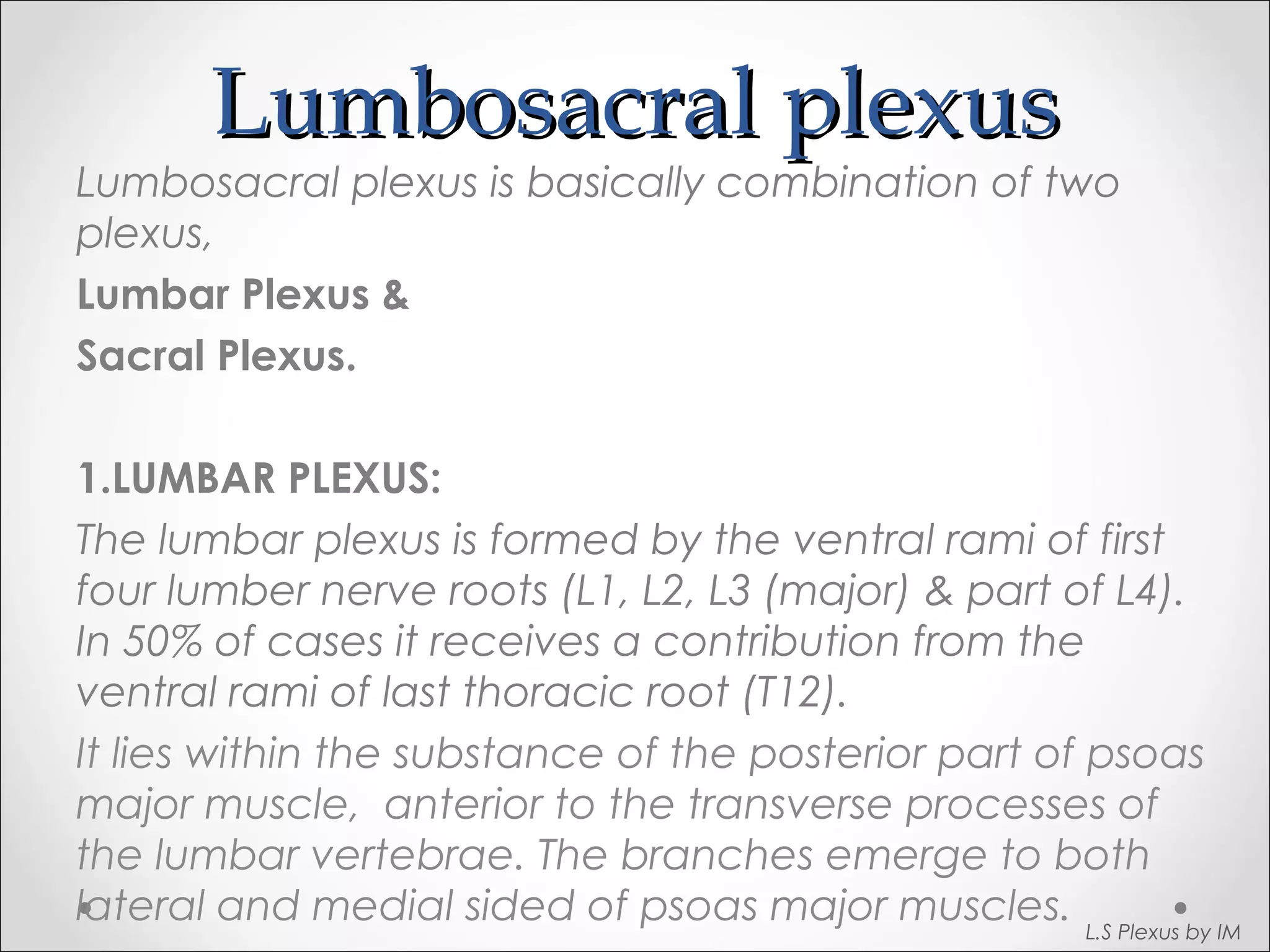
Lumbosacral plexus is basically combination of two 
plexus, 
Lumbar Plexus & 
Sacral Plexus. 
1.LUMBAR PLEXUS: 
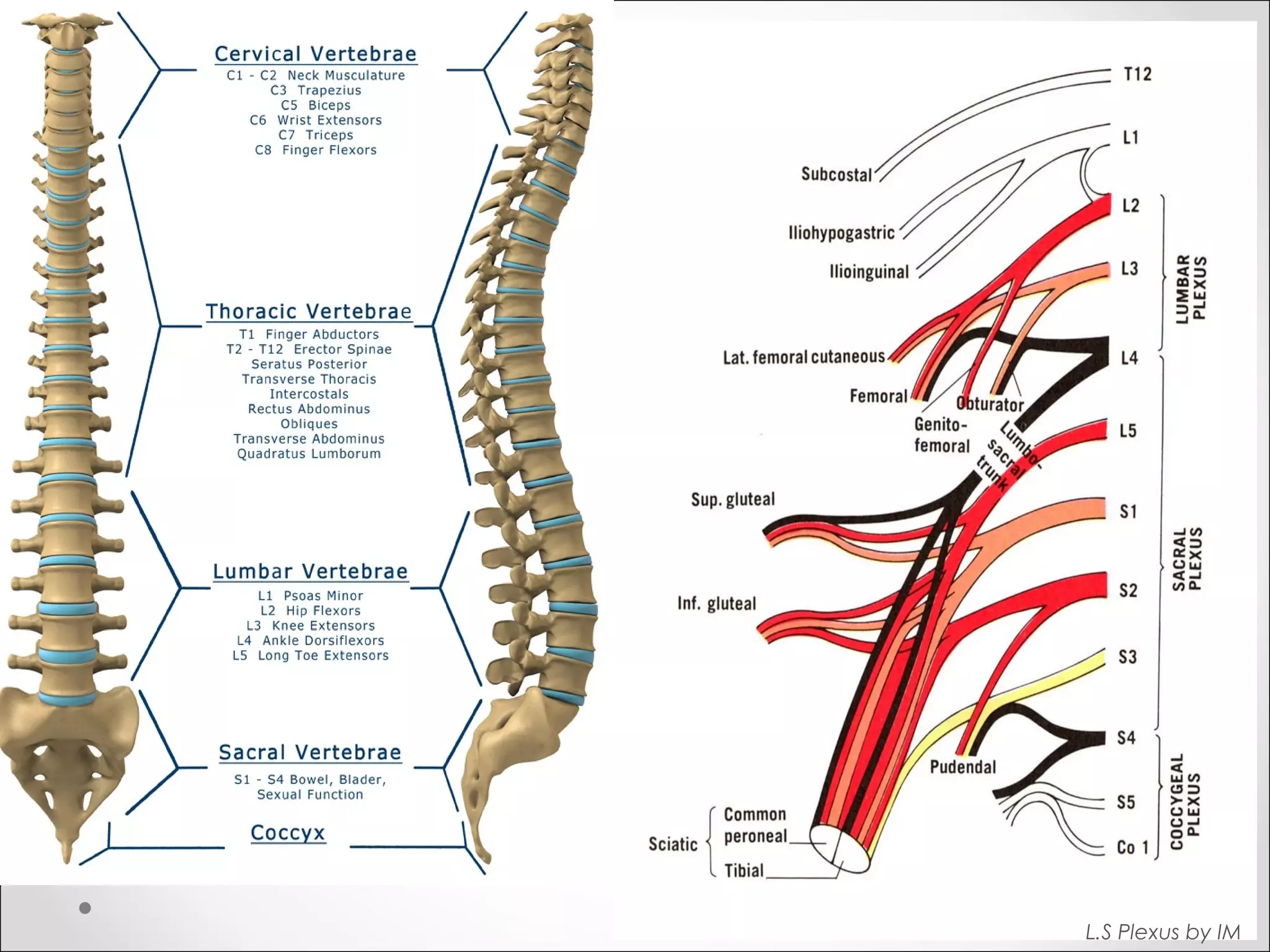
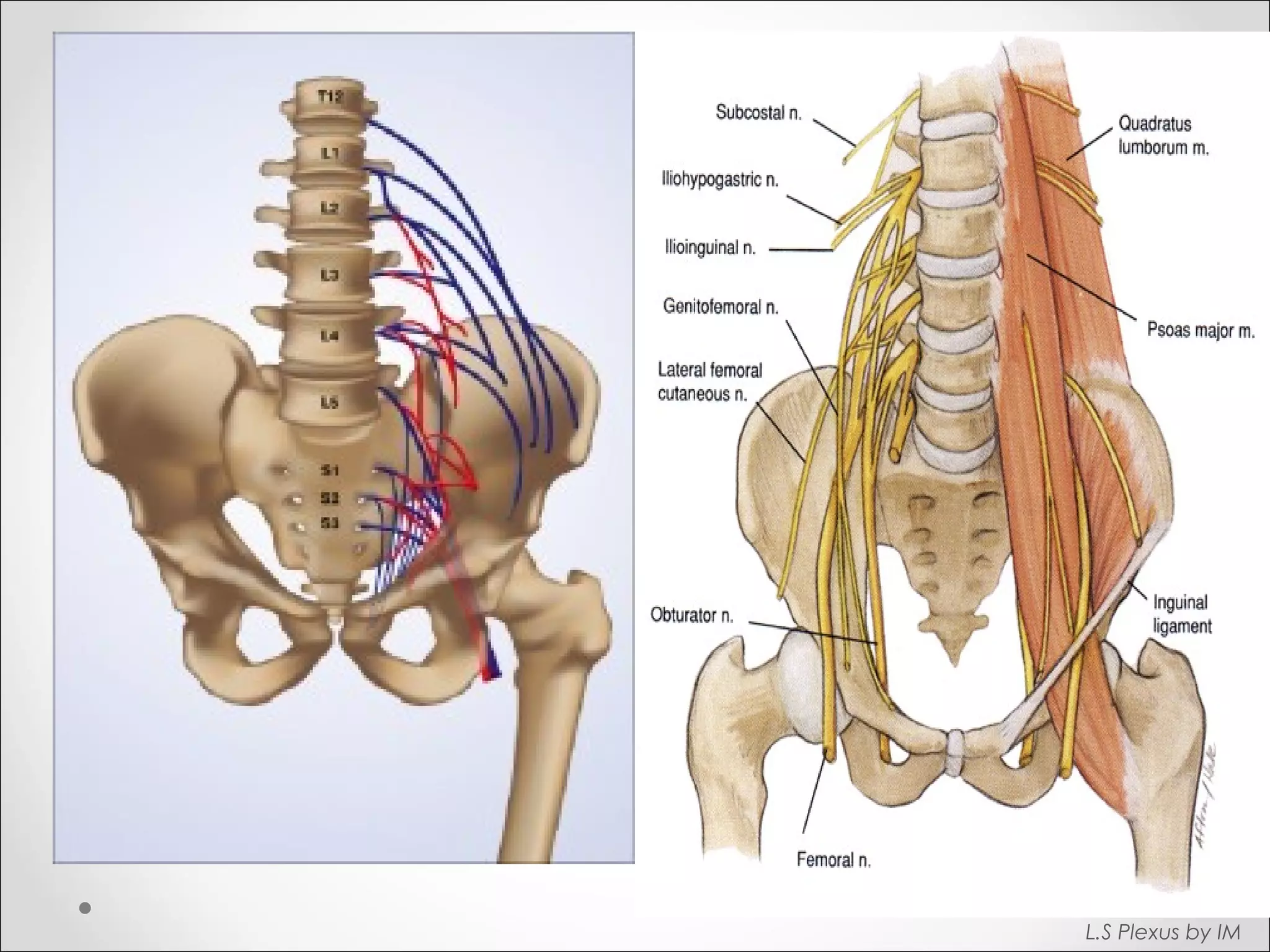
The lumbar plexus is formed by the ventral rami of first 
four lumber nerve roots (L1, L2, L3 (major) & part of L4). 
In 50% of cases it receives a contribution from the 
ventral rami of last thoracic root (T12). 
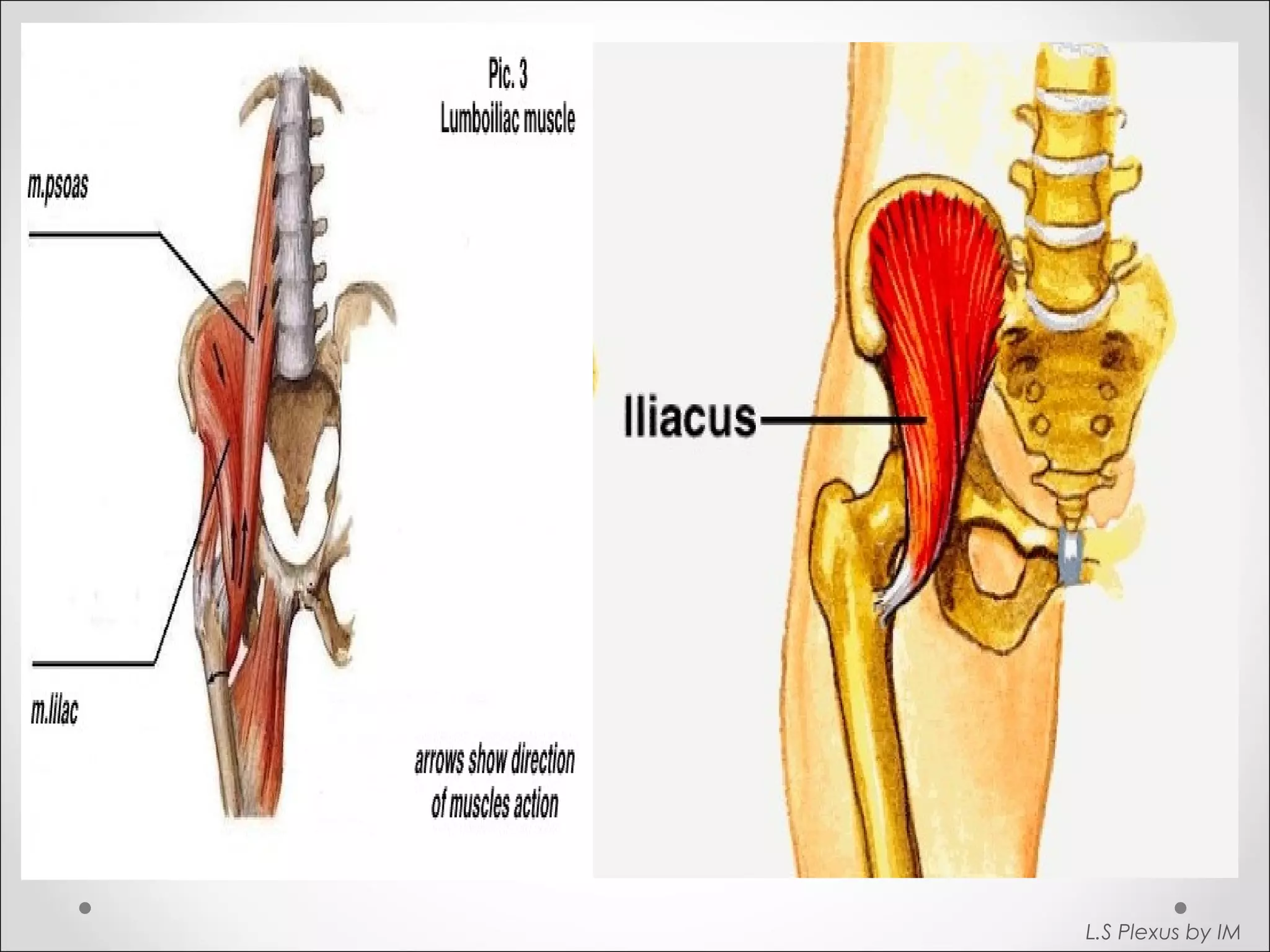
It lies within the substance of the posterior part of psoas 
major muscle, anterior to the transverse processes of 
the lumbar vertebrae. The branches emerge to both 
lateral and medial sided of psoas major muscles. L.S Plexus by IM
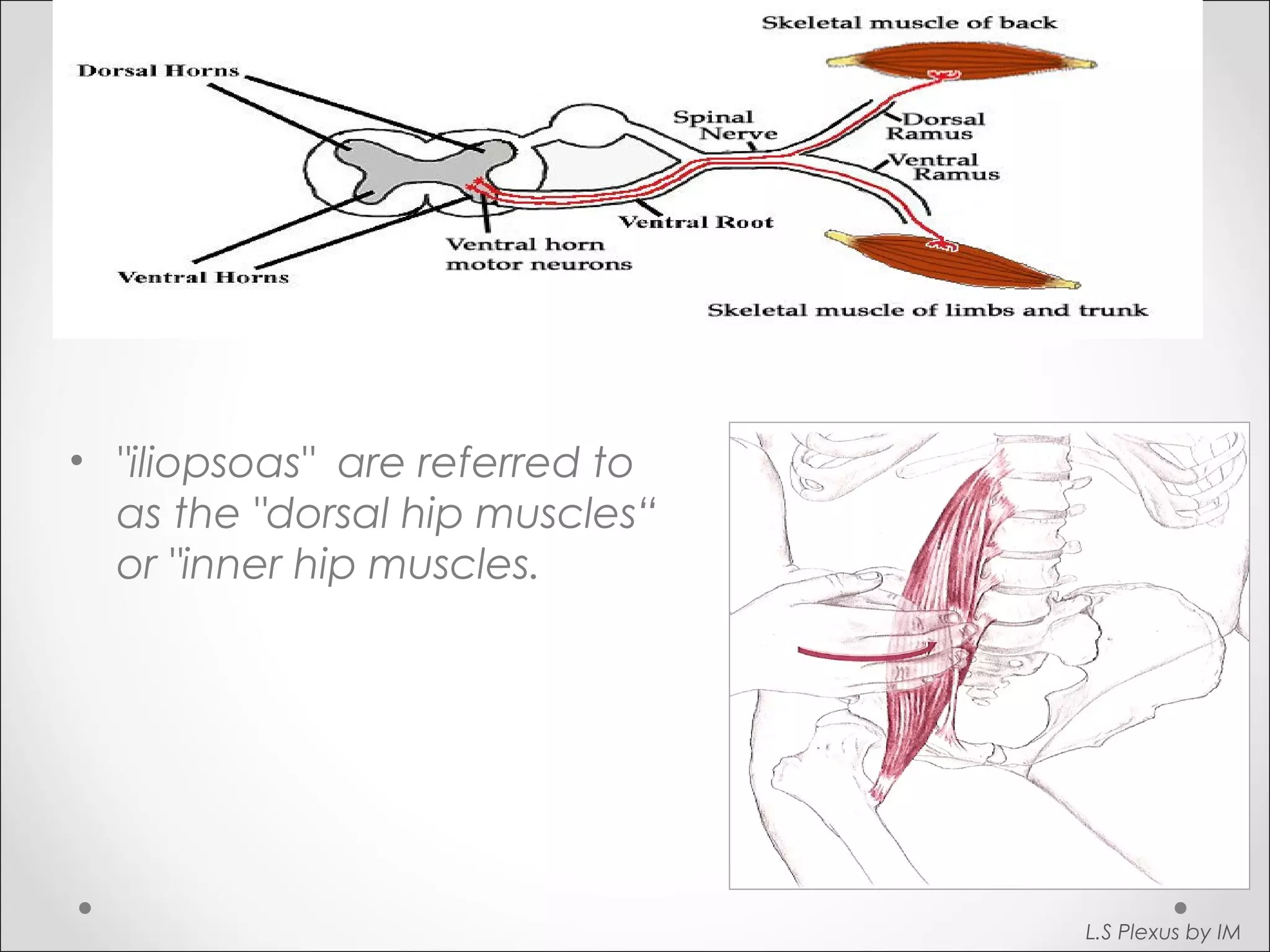
• "iliopsoas" are referred to 
as the "dorsal hip muscles“ 
or "inner hip muscles. 
L.S Plexus by IM
Components ooff lluummbboossaaccrraall pplleexxuuss 
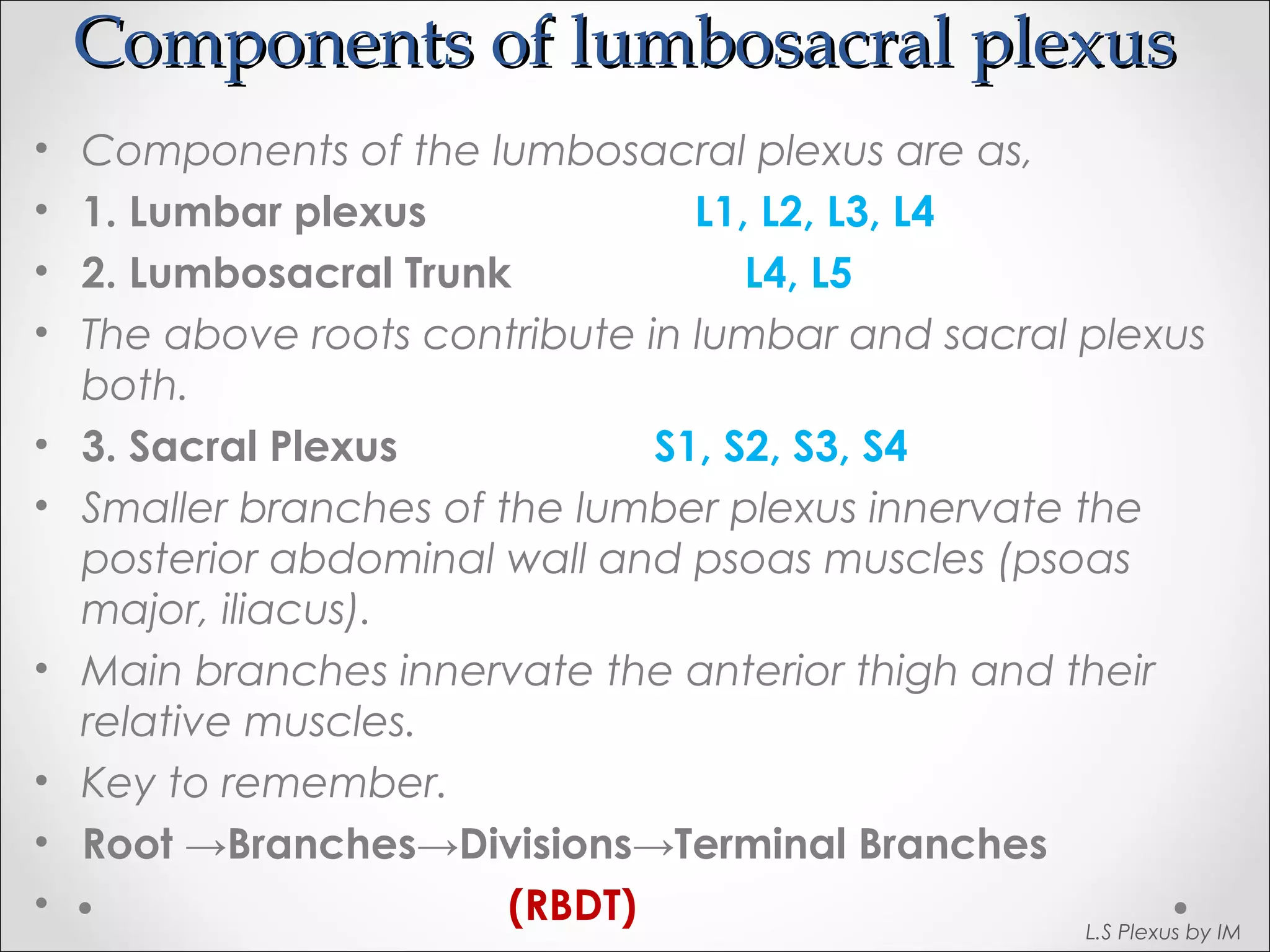
• Components of the lumbosacral plexus are as, 
• 1. Lumbar plexus L1, L2, L3, L4 
• 2. Lumbosacral Trunk L4, L5 
• The above roots contribute in lumbar and sacral plexus 
both. 
• 3. Sacral Plexus S1, S2, S3, S4 
• Smaller branches of the lumber plexus innervate the 
posterior abdominal wall and psoas muscles (psoas 
major, iliacus). 
• Main branches innervate the anterior thigh and their 
relative muscles. 
• Key to remember. 
• Root →Branches→Divisions→Terminal Branches 
• (RBDT) L.S Plexus by IM
L.S Plexus by IM
L.S Plexus by IM
L.S Plexus by IM
RRBBDDTT 
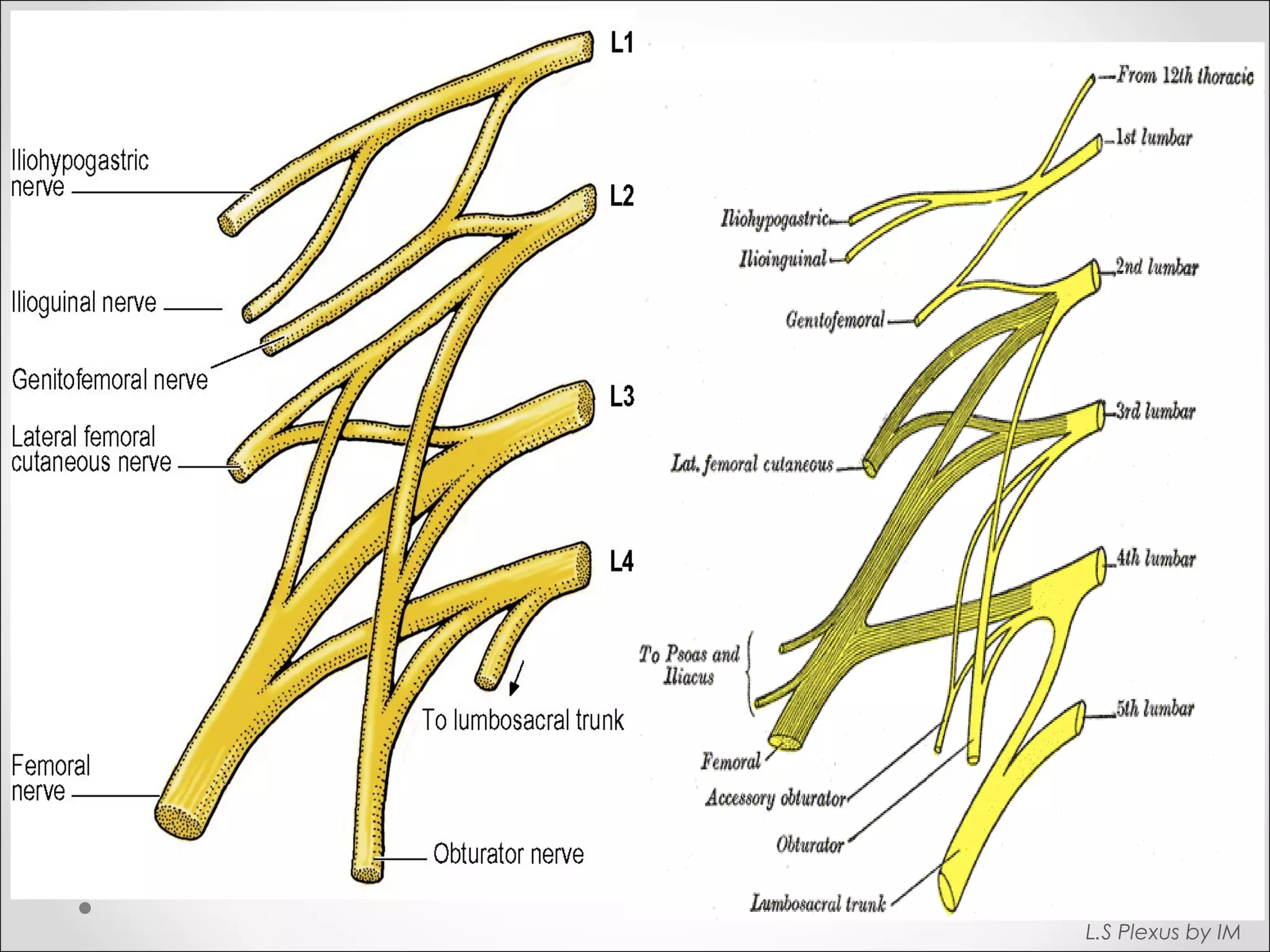
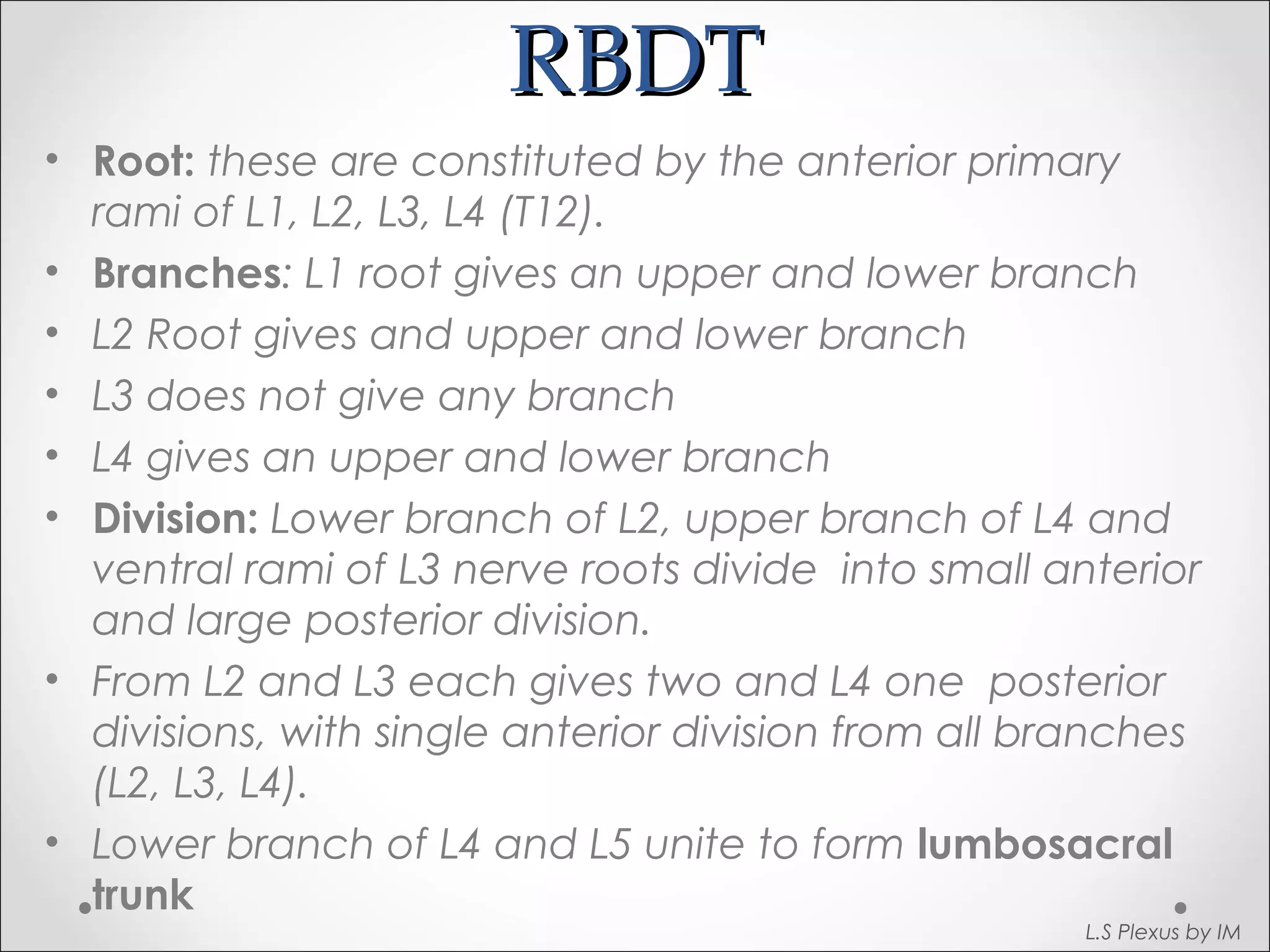
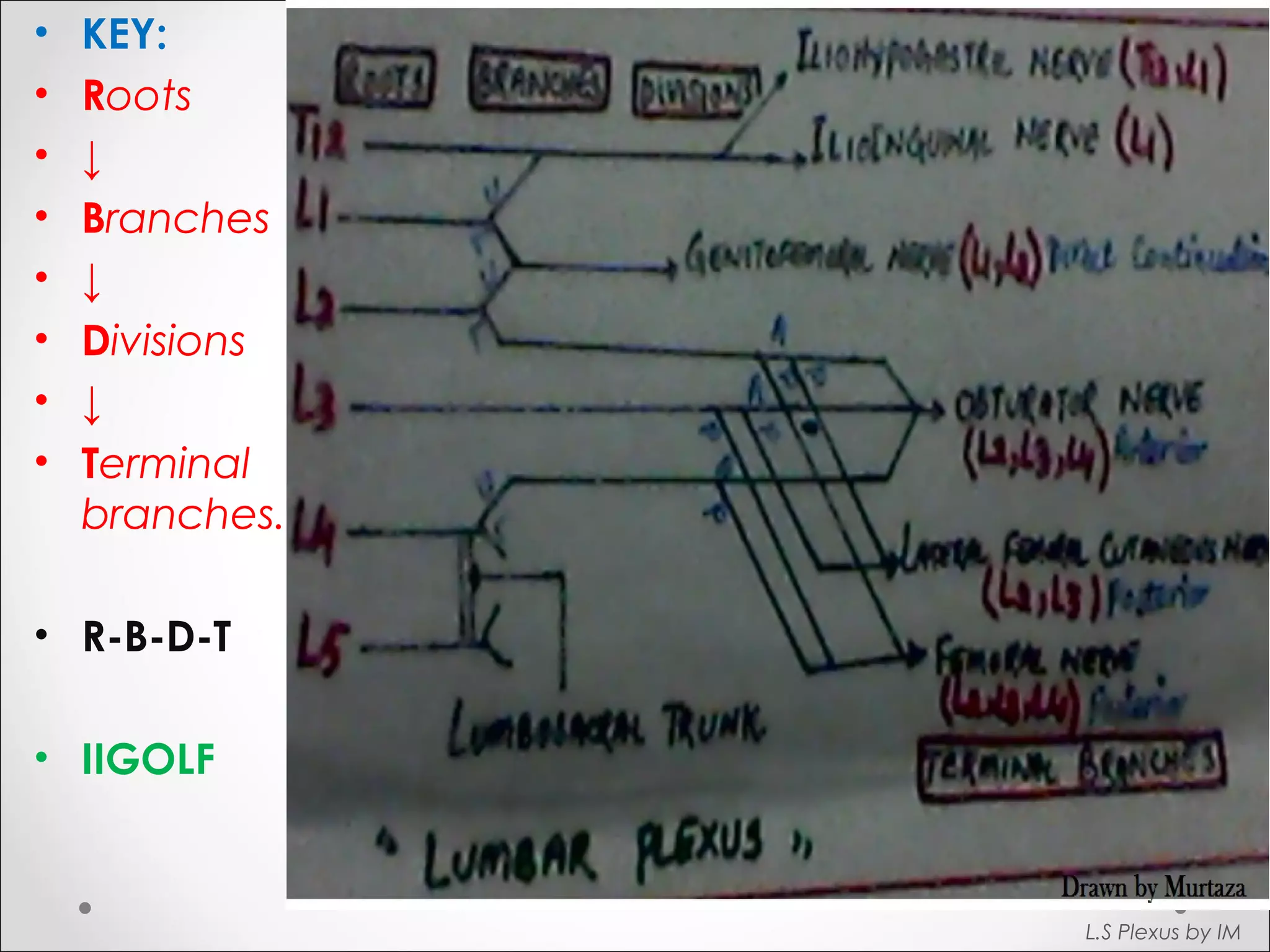
• Root: these are constituted by the anterior primary 
rami of L1, L2, L3, L4 (T12). 
• Branches: L1 root gives an upper and lower branch 
• L2 Root gives and upper and lower branch 
• L3 does not give any branch 
• L4 gives an upper and lower branch 
• Division: Lower branch of L2, upper branch of L4 and 
ventral rami of L3 nerve roots divide into small anterior 
and large posterior division. 
• From L2 and L3 each gives two and L4 one posterior 
divisions, with single anterior division from all branches 
(L2, L3, L4). 
• Lower branch of L4 and L5 unite to form lumbosacral 
trunk 
L.S Plexus by IM
Terminal BBrraanncchheess ooff LLuummbbaarr PPlleexxuuss 
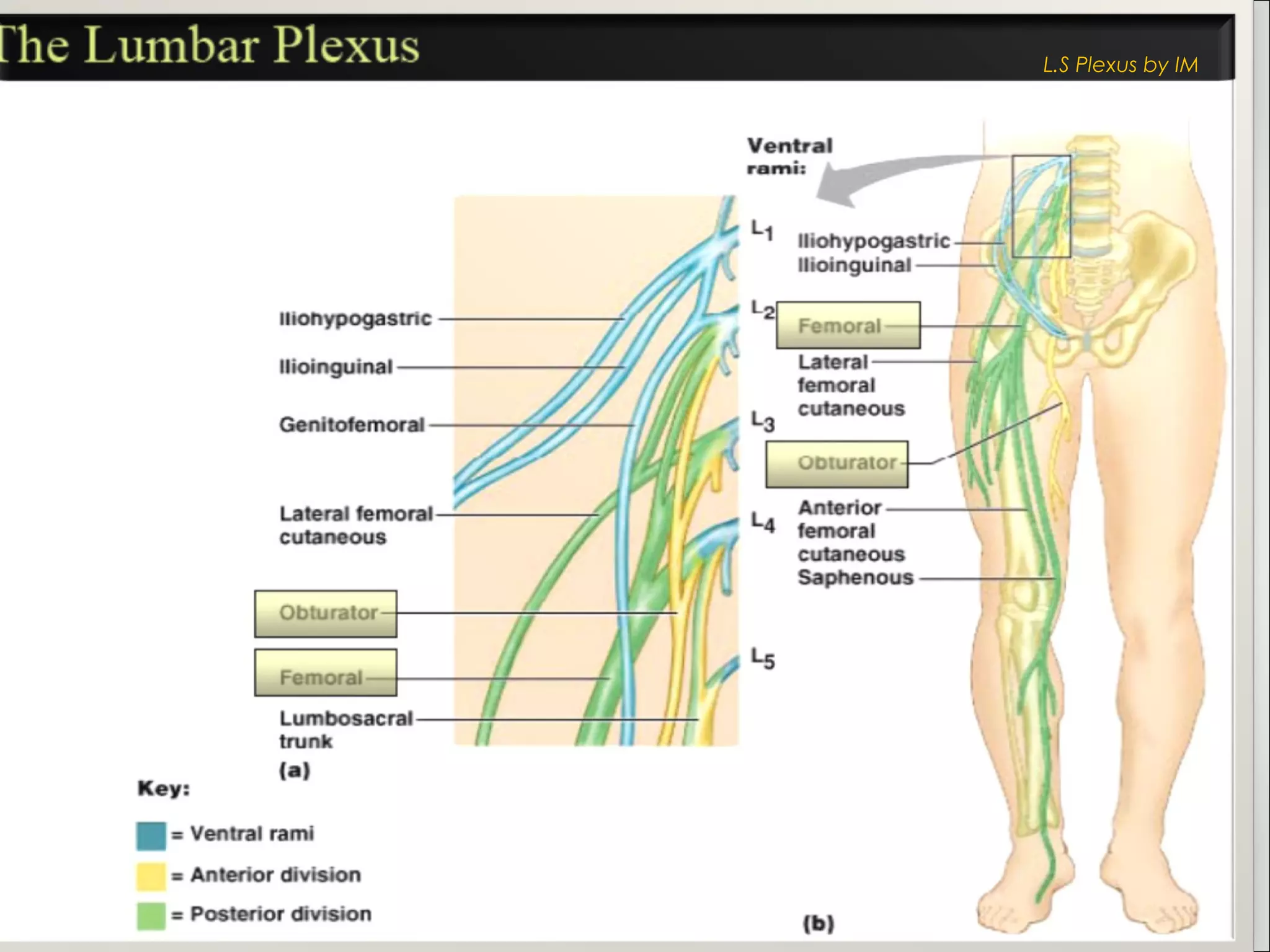
• L1 unites with a small branch from T12 and splits into an upper and 
lower branches. 
• The upper larger branch divides into two: 
• iliohypogastric (T12, L1) and ilioinguinal nerves (L1). 
• The lower smaller branch of L1 unites with a branch from L2 to form 
the genitofemoral nerve. 
• The remainders of L2, L3 and L4 divide into ventral and dorsal 
branches. Ventral (Anterior) divisions of L2, L3, L4 unite to form 
obturator nerve. 
• The dorsal (posterior) divisions of L2 and L3 divide into small and 
larger parts. Smaller parts of dorsal divisions of L2 and L3 unite to 
form the lateral femoral cutaneous nerve. 
• Larger parts of dorsal divisions of L2 and L3 unite with L4 to form 
femoral nerve. 
L.S Plexus by IM
L.S Plexus by IM
FFEEMMOORRAALL NNEERRVVEE 
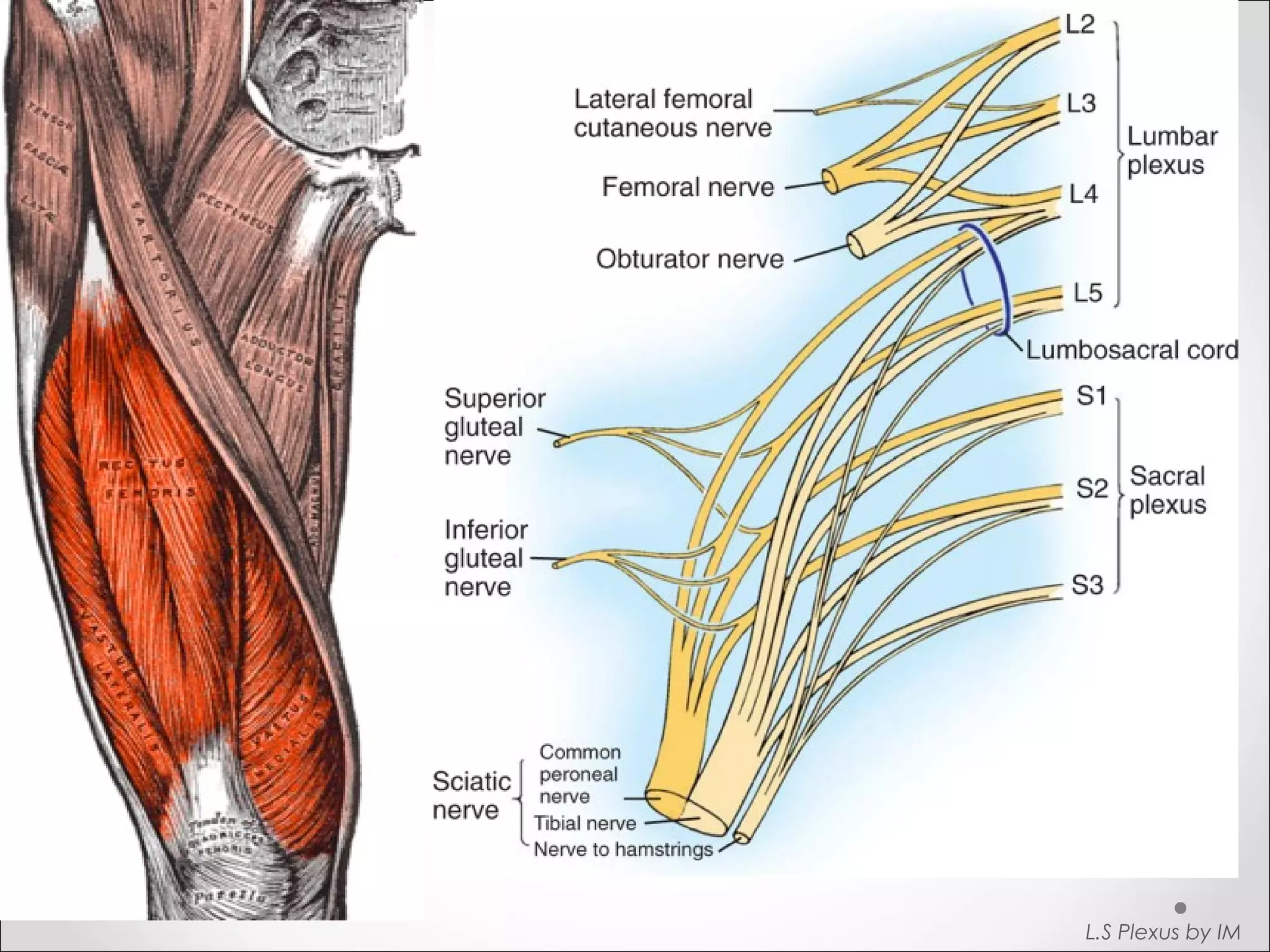
• It is formed by the dorsal or posterior division of the 
anterior rami of L2,L3, & L4 roots. 
• The femoral nerve is the largest branch of the lumbar 
plexus. It mainly supplies the extensors muscles of the 
knee (quadriceps) (VL, VI, VM, RF). 
• The Saphenous Nerve is a purely sensory nerve 
which the largest and longest cutaneous branch of 
the femoral nerve. 
• Lateral femoral cutaneous nerve of the thigh 
The lateral femoral cutaneous nerve of the thigh 
emerges from the lateral border of psoas major 
which is formed by the posterior divisions of L2 and 
L3. 
. It gives cutaneous supply to the lateral part of the 
L.S Plexus by IM
L.S Plexus by IM
• KEY: 
• Roots 
• ↓ 
• Branches 
• ↓ 
• Divisions 
• ↓ 
• Terminal 
branches. 
• R-B-D-T 
• IIGOLF 
L.S Plexus by IM
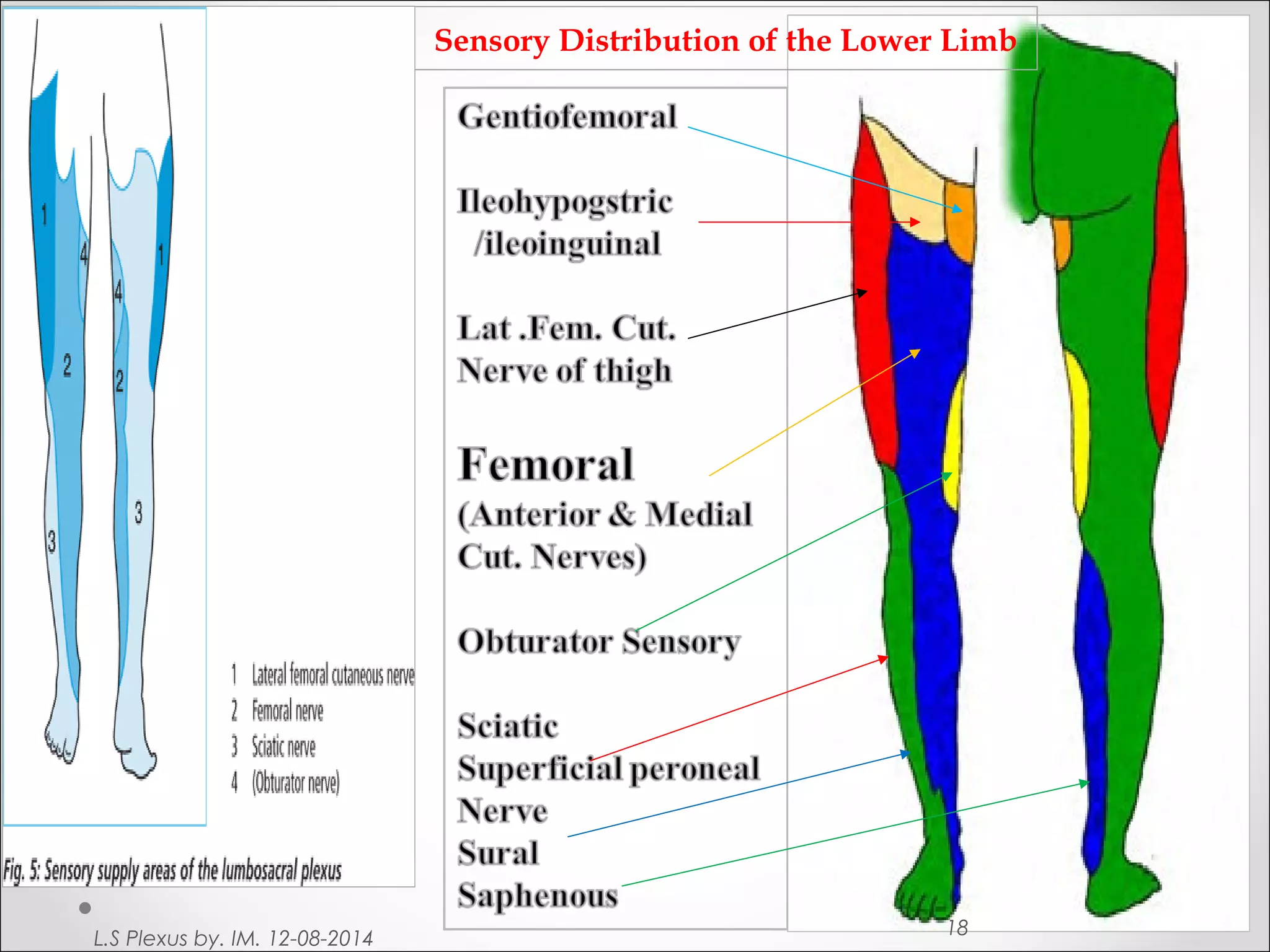
Sensory Distribution of the Lower Limb 
L.S Plexus by. IM. 12-08-2014 18
L.S Plexus by IM
Lumbosacral Trunk & sacral plexus. 
• The sacral plexus is formed by the lumbosacral trunk 
(L4 ,L5 ), & ventral rami of S1, S2, S3, S4 . 
• Contribution of the fourth sacral ventral rami is partial & 
the remainder of the last (S5 ) joins the coccygeal plexus. 
• Key to remember sacral plexus: 
• Root  Divisions Terminal Branches (R.D.T/B) 
• Roots: These are constituted by the anterior primary 
rami of L4 , L5, S1, S2, S3, & S4 
• Divisions: The lower branch of L4 ventral rami & ventral 
rami of L5 , S1 & S2 give anterior and posterior divisions. 
While S3 forms & shares only anterior division . 
• Terminal Branches: These anterior and posterior 
divisions unite to form the terminal nerve branches. 
L.S Plexus by IM
TTeerrmmiinnaall BBrraanncchheess 
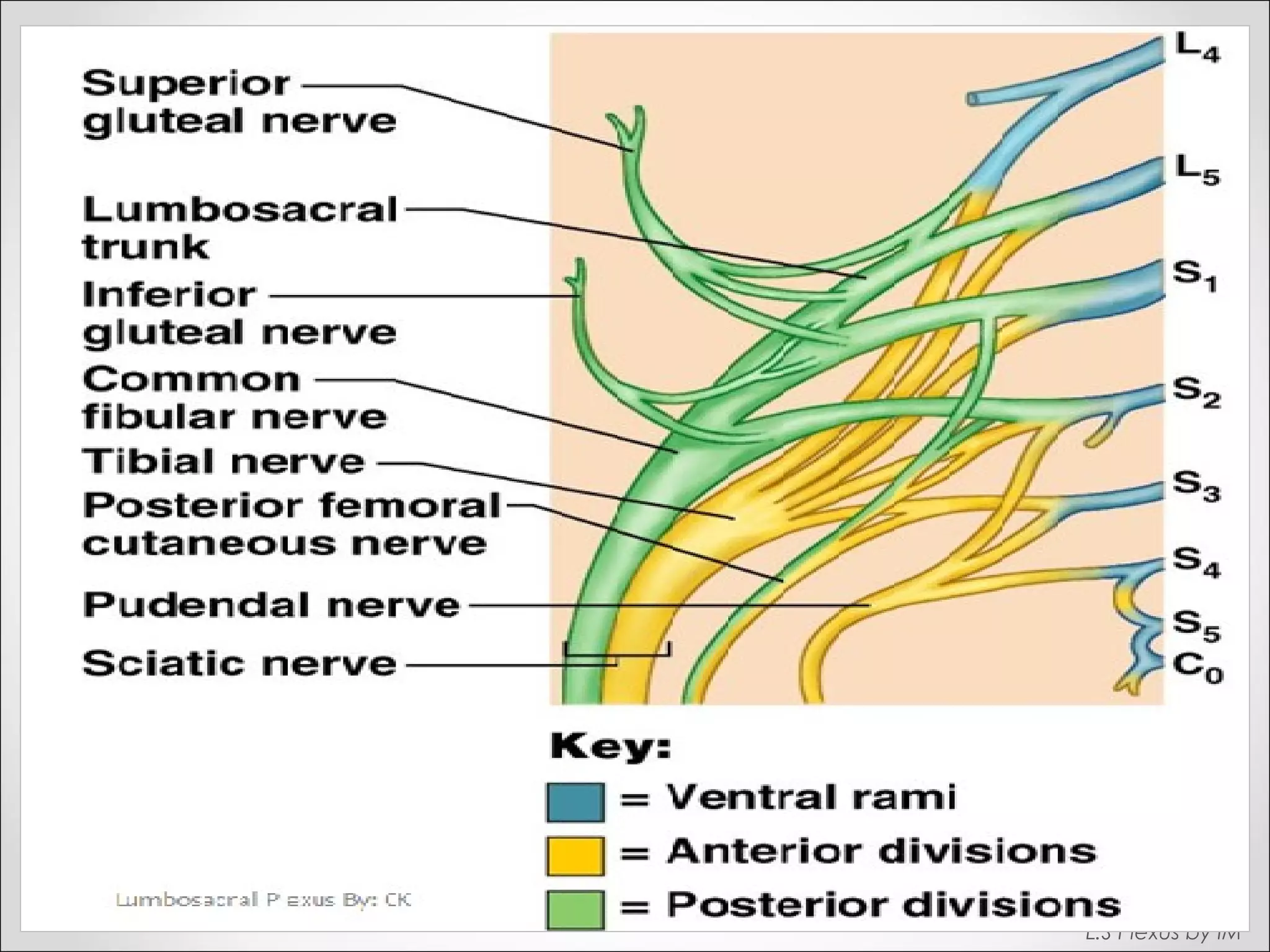
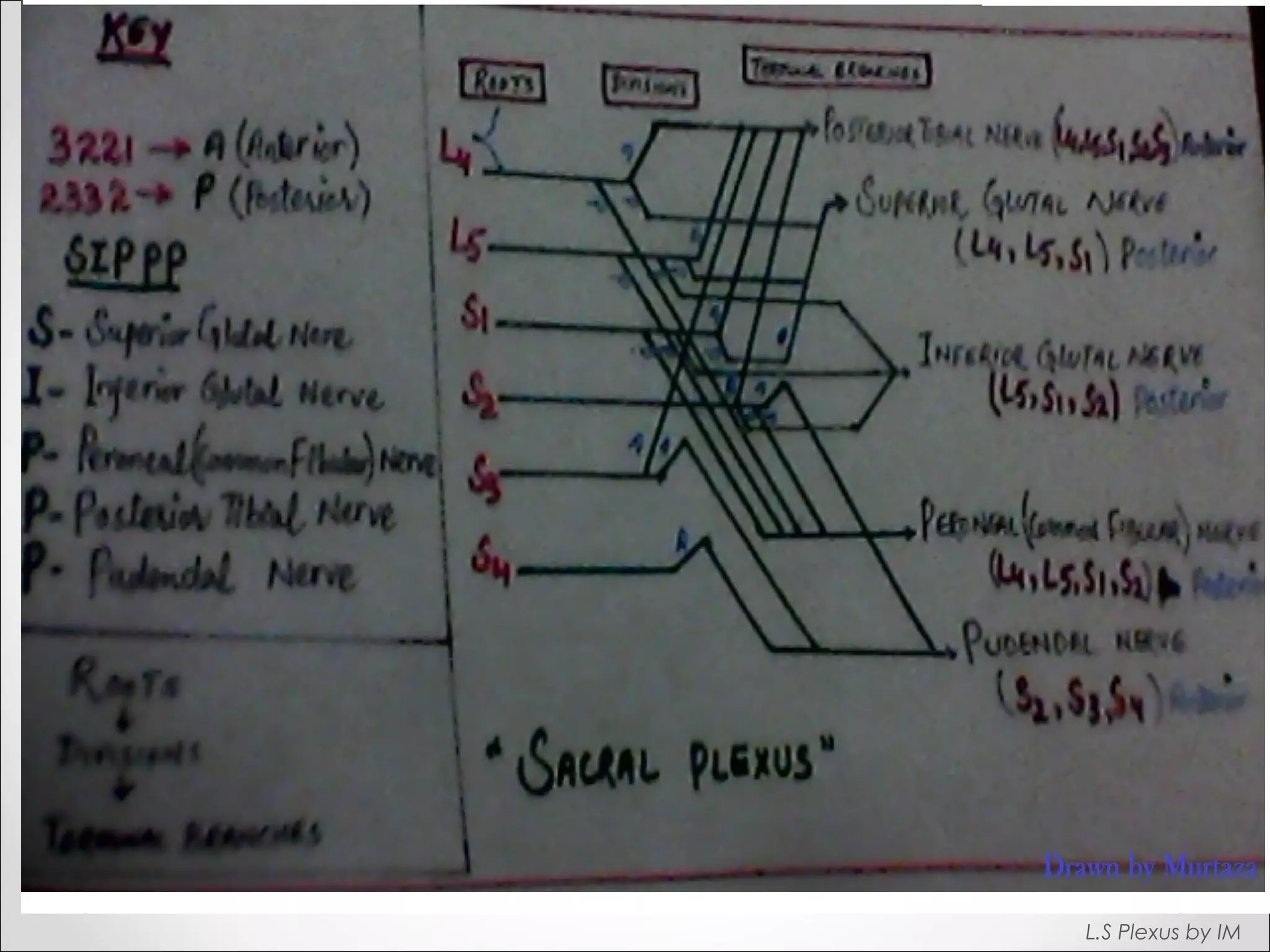
• The posterior division of L4 ,L5 & S1 joins to form Superior Gluteal 
Nerve . 
• The posterior divisions of L5,S1 & S2 unites to form the Inferior Gluteal 
Nerve. 
• The posterior divisions of L4 ,L5 ,S1 & S2 joins to form Common fibular 
or Peroneal Nerve. It’s the about one-half the size of the tibial 
nerve. 
• The anterior divisions of L4 ,L5 ,S1,S2 & S3 unites to form Poterior Tibial 
Nerve. 
• The anterior divisions of S2,S3& S4 unites to form Pudendal Nerve. 
• So both these nerves i.e. Tibial and peroneal run in a single 
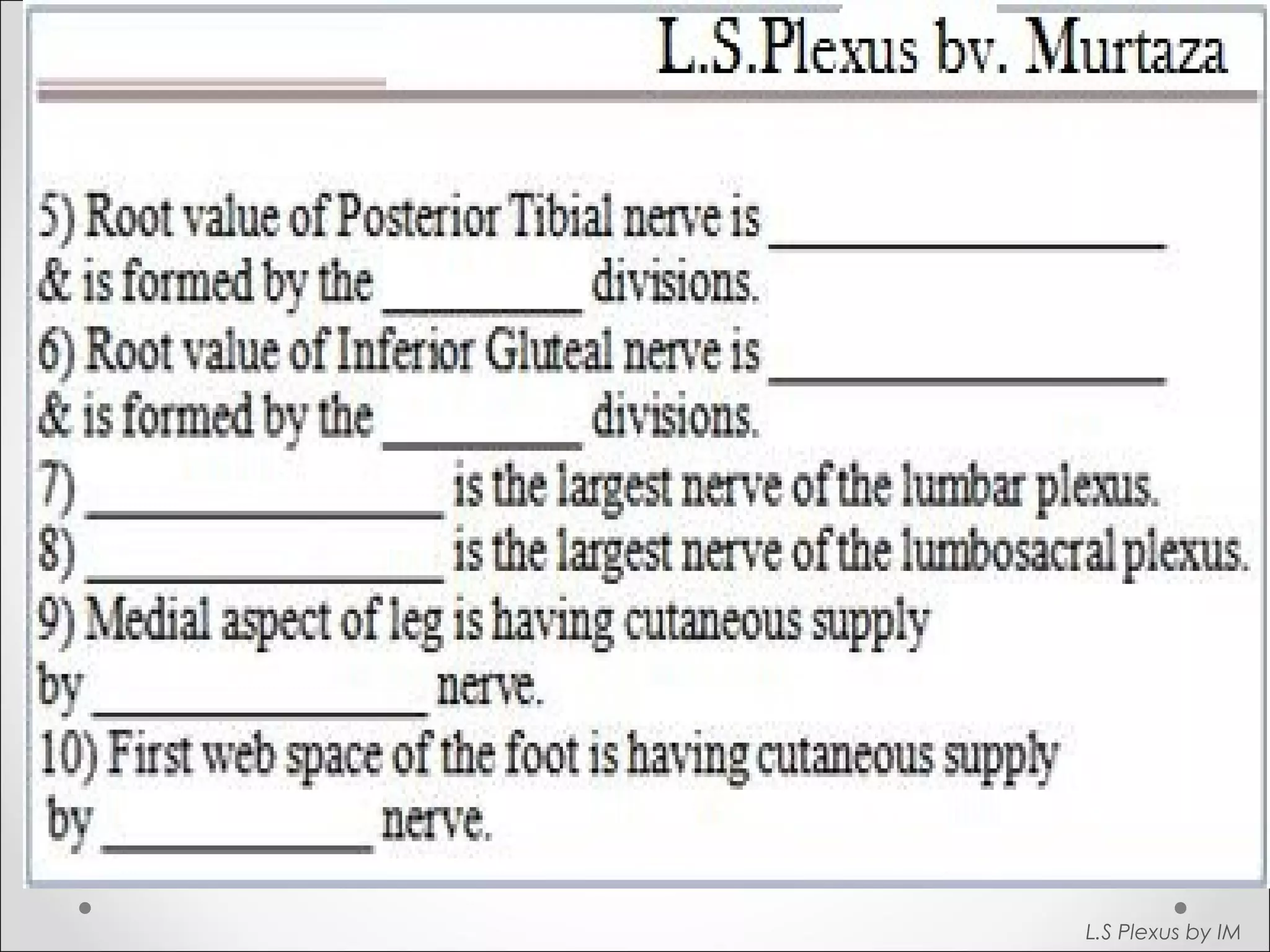
covering of sheath and called as Sciatic Nerve (L4 ,L5,S1,S2 &S3) . 
Which is the largest nerve of the body. 
• L.S Plexus by IM
SScciiaattiicc NNeerrvvee 
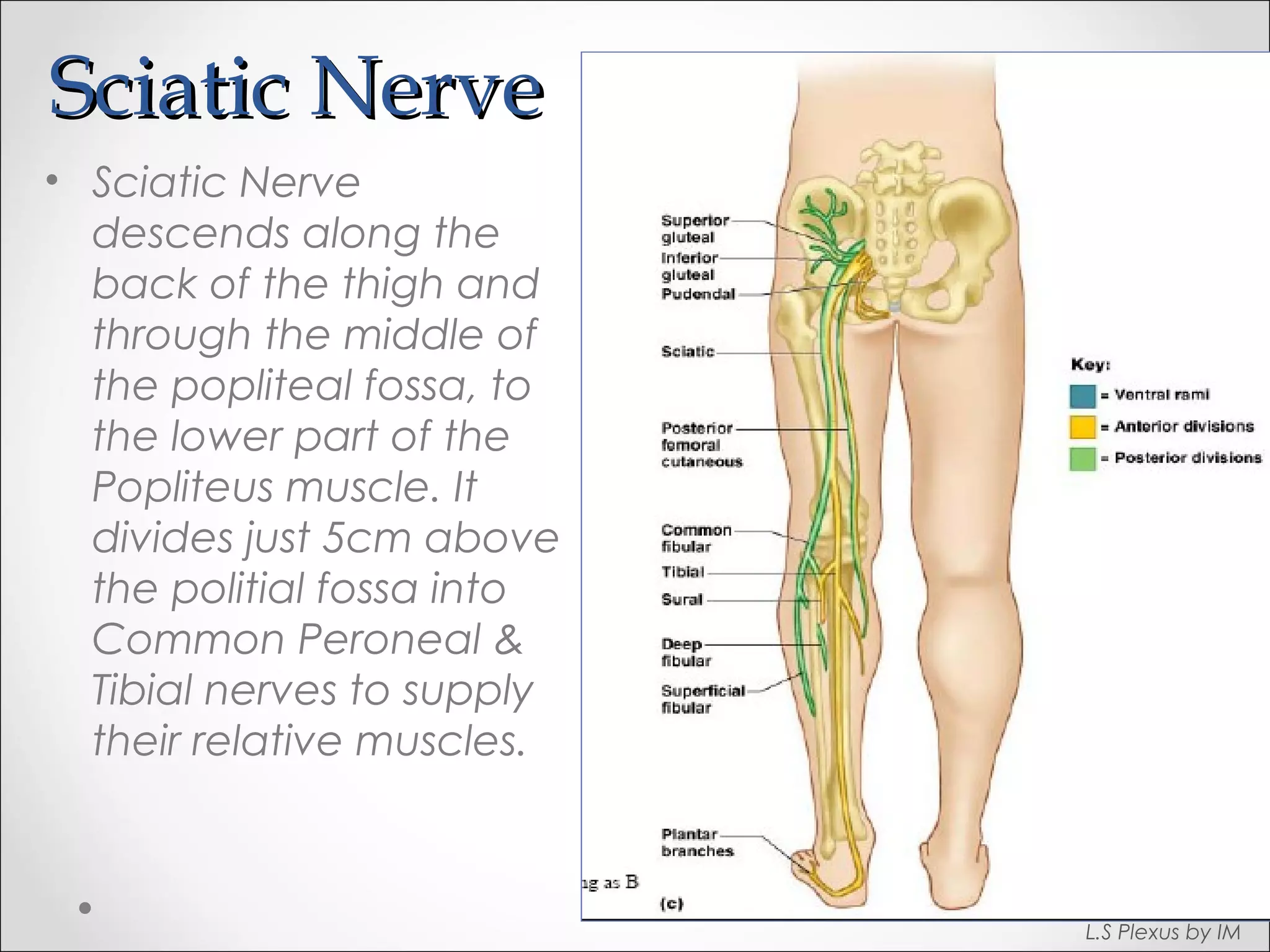
• Sciatic Nerve 
descends along the 
back of the thigh and 
through the middle of 
the popliteal fossa, to 
the lower part of the 
Popliteus muscle. It 
divides just 5cm above 
the politial fossa into 
Common Peroneal & 
Tibial nerves to supply 
their relative muscles. 
L.S Plexus by IM
KKeeyy ttoo DDrraaww ssaaccrraall PPlleexxuuss 
111221 Anterior 
2332 Posterior 
• SIPPP 
• S. Superior Glutal Nerve (L4, L4, S1) Posterior 
• I. Inferior Glutal Nerve (L5, S1, S2) Posterior 
• P. Peroneal (common fibular) Nerve (L4,L5,S1,S2) Posterior 
• P. Posterior Tibial Nerve (L4,L5,S1,S2,S3 )Anterior 
• P. Pudendal Nerve. (S2, S3, S4) Anterior
L.S Plexus by IM
L.S Plexus by IM
Sensory DDiissttrriibbuuttiioonn ttoo tthhee LLeeggss:: 
• Superficial Peroneal: it’s the cutaneous branch from 
the common peroneal nerve which supplies to the 
anterio-lateral aspect of leg upto dorsum of the foot. 
• Sural nerve formed by the junction of the medial 
sural cutaneous (it is the sensory branch of tibial 
nerve) with the peroneal anastomotic branch (its 
branch of lateral sural cutaneous nerve), passes 
downward near the lateral margin of the tendo-calcaneous, 
lying close to the small saphenous vein, 
to the interval between the lateral malleolus and the 
calcaneous. 
• It supplies to the posterio-lateral aspect of the leg 
upto lateral malleolus. 
L.S Plexus by IM
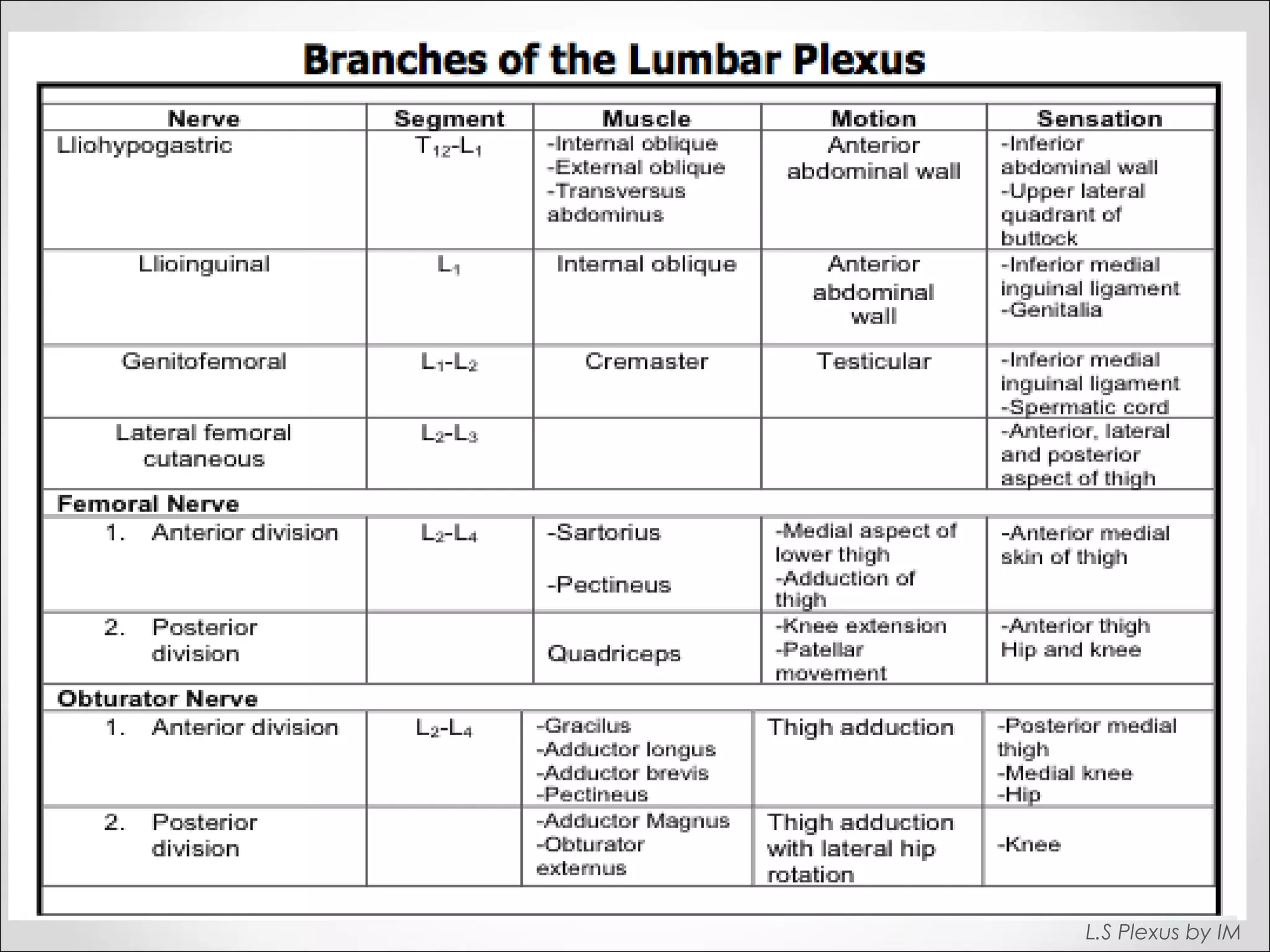
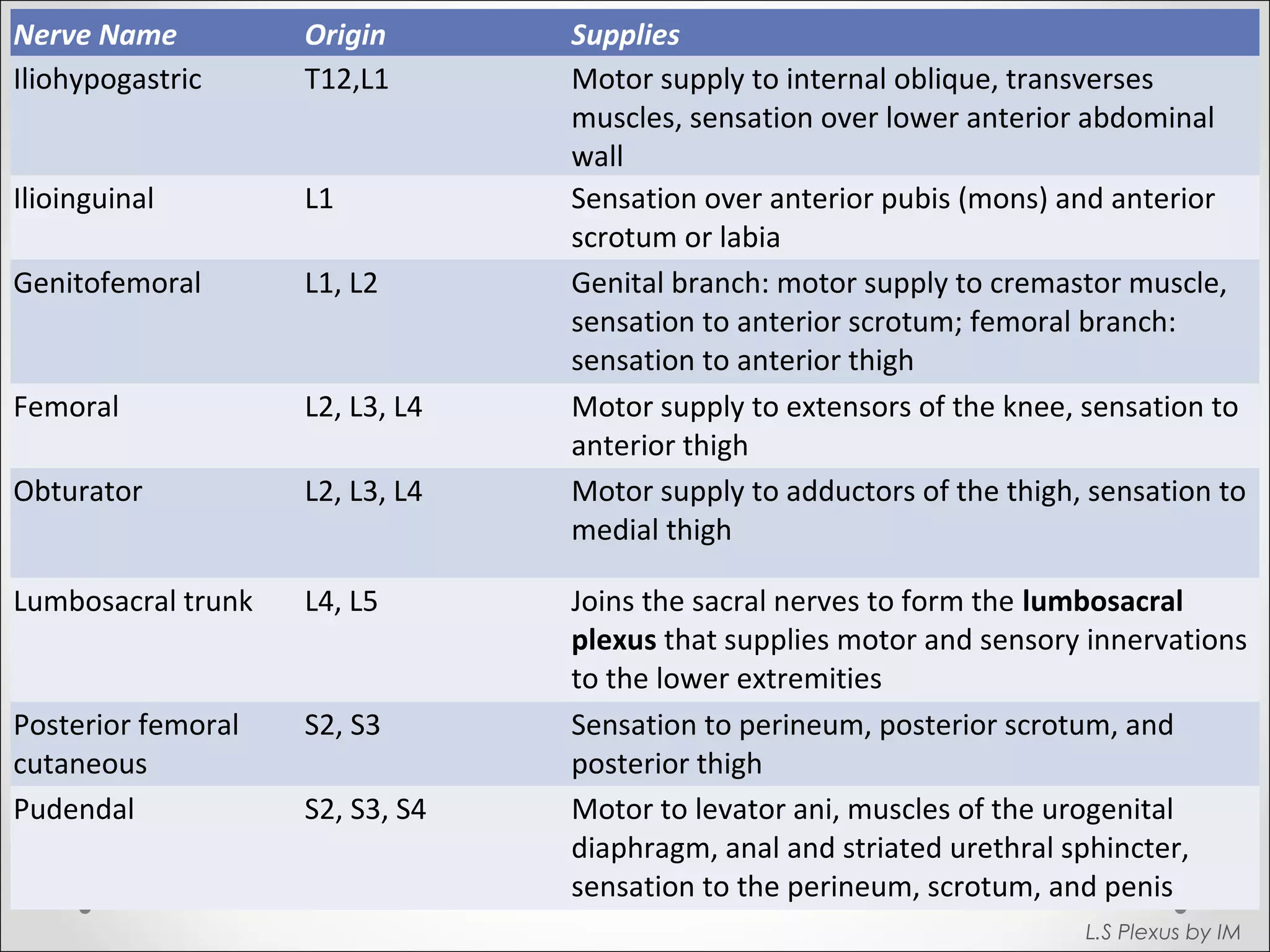
Nerve Name Origin Supplies 
Iliohypogastric T12,L1 Motor supply to internal oblique, transverses 
muscles, sensation over lower anterior abdominal 
wall 
Ilioinguinal L1 Sensation over anterior pubis (mons) and anterior 
scrotum or labia 
Genitofemoral L1, L2 Genital branch: motor supply to cremastor muscle, 
sensation to anterior scrotum; femoral branch: 
sensation to anterior thigh 
Femoral L2, L3, L4 Motor supply to extensors of the knee, sensation to 
anterior thigh 
Obturator L2, L3, L4 Motor supply to adductors of the thigh, sensation to 
medial thigh 
Lumbosacral trunk L4, L5 Joins the sacral nerves to form the lumbosacral 
plexus that supplies motor and sensory innervations 
to the lower extremities 
Posterior femoral 
cutaneous 
S2, S3 Sensation to perineum, posterior scrotum, and 
posterior thigh 
Pudendal S2, S3, S4 Motor to levator ani, muscles of the urogenital 
diaphragm, anal and striated urethral sphincter, 
sensation to the perineum, scrotum, and penis 
L.S Plexus by IM
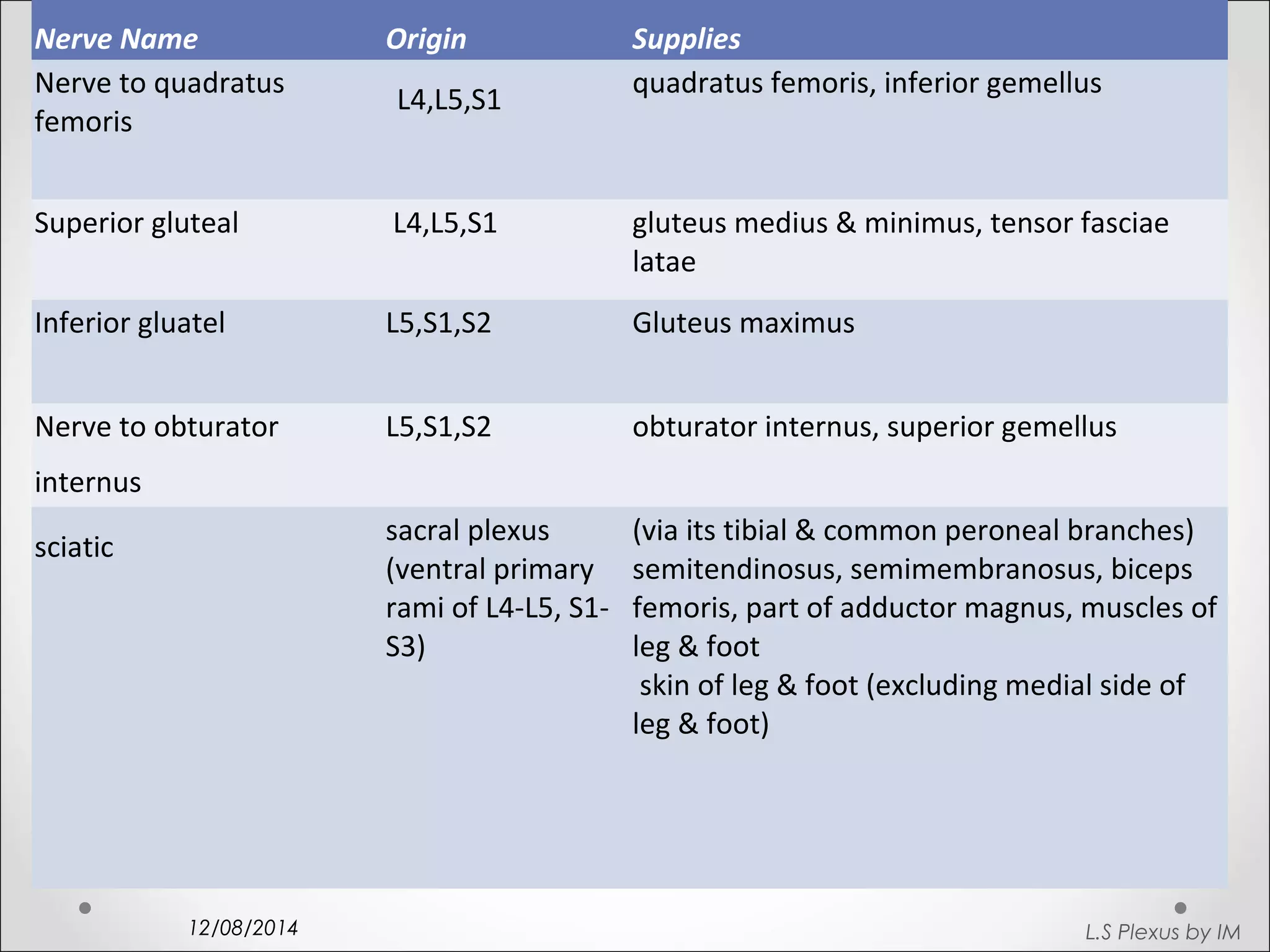
Nerve Name Origin Supplies 
Nerve to quadratus 
femoris 
12/08/2014 
L4,L5,S1 quadratus femoris, inferior gemellus 
Superior gluteal L4,L5,S1 gluteus medius & minimus, tensor fasciae 
latae 
Inferior gluatel L5,S1,S2 Gluteus maximus 
Nerve to obturator 
internus 
L5,S1,S2 obturator internus, superior gemellus 
sciatic sacral plexus 
(ventral primary 
rami of L4-L5, S1- 
S3) 
(via its tibial & common peroneal branches) 
semitendinosus, semimembranosus, biceps 
femoris, part of adductor magnus, muscles of 
leg & foot 
skin of leg & foot (excluding medial side of 
leg & foot) 
L.S Plexus by IM
L.S Plexus by IM
L.S Plexus by IM
L.S Plexus by IM
RReeffeerreenncceess 
• Electromyography and neuromuscular disorders 
• By David C. Preston 
• Snell's Clinical Anatomy 9th Edi 
• By Richard S. Snell 
• Electrodiagnosis in Diseases of Nerve and Muscle: 
Principles and Practice 
• By Jun Kimura 
• http://en.wikipedia.org/wiki/Sural_nerve 
• http://en.wikipedia.org/wiki/Quadriceps_femoris_muscle 
TThhaannkkss ffoorr tthhee ppaattiieennccee 
L.S Plexus by IM

Anatomy of lumbosacral plexus (by Murtaza Syed)

  • 1.
    AANNAATTOOMMYY OOFF LLUUMMBBOO--SSAACCRRAALLPPLLEEXXUUSS By: Syed Irshad Murtaza Technologist. Neurophysiology Dept. AKUH Karachi. 12-08-2014 L.S Plexus by IM
  • 2.
    OOuuttlliinnee • Spinalcord. • Lumbar plexus anatomy • Sacral plexus anatomy • Components of lumbosacral plexus • Key for the L.S Plexus • Key to draw L.S Plexus. • Terminal Branches of L.S plexus. • Motor and Sensory Distribution. • Questions. • References L.S Plexus by IM
  • 3.
    SSppiinnaall ccoorrdd •Lumbar and sacral enlargement. .. The sites where the nerves serving the lower limbs, emerge. • Conus Medullaris: • The terminal portion of the spinal cord • Cauda equina: • The collection of nerve roots at eh inferior end of the vertebral canal. • Spinal cord ends at the level of L2 vertebrae (adults). • Spinal nerves 31 pairs L.S Plexus by IM
  • 4.
  • 5.
  • 6.
    LLuummbboossaaccrraall pplleexxuuss Lumbosacralplexus is basically combination of two plexus, Lumbar Plexus & Sacral Plexus. 1.LUMBAR PLEXUS: The lumbar plexus is formed by the ventral rami of first four lumber nerve roots (L1, L2, L3 (major) & part of L4). In 50% of cases it receives a contribution from the ventral rami of last thoracic root (T12). It lies within the substance of the posterior part of psoas major muscle, anterior to the transverse processes of the lumbar vertebrae. The branches emerge to both lateral and medial sided of psoas major muscles. L.S Plexus by IM
  • 7.
    • "iliopsoas" arereferred to as the "dorsal hip muscles“ or "inner hip muscles. L.S Plexus by IM
  • 8.
    Components ooff lluummbboossaaccrraallpplleexxuuss • Components of the lumbosacral plexus are as, • 1. Lumbar plexus L1, L2, L3, L4 • 2. Lumbosacral Trunk L4, L5 • The above roots contribute in lumbar and sacral plexus both. • 3. Sacral Plexus S1, S2, S3, S4 • Smaller branches of the lumber plexus innervate the posterior abdominal wall and psoas muscles (psoas major, iliacus). • Main branches innervate the anterior thigh and their relative muscles. • Key to remember. • Root →Branches→Divisions→Terminal Branches • (RBDT) L.S Plexus by IM
  • 9.
  • 10.
  • 11.
  • 12.
    RRBBDDTT • Root:these are constituted by the anterior primary rami of L1, L2, L3, L4 (T12). • Branches: L1 root gives an upper and lower branch • L2 Root gives and upper and lower branch • L3 does not give any branch • L4 gives an upper and lower branch • Division: Lower branch of L2, upper branch of L4 and ventral rami of L3 nerve roots divide into small anterior and large posterior division. • From L2 and L3 each gives two and L4 one posterior divisions, with single anterior division from all branches (L2, L3, L4). • Lower branch of L4 and L5 unite to form lumbosacral trunk L.S Plexus by IM
  • 13.
    Terminal BBrraanncchheess ooffLLuummbbaarr PPlleexxuuss • L1 unites with a small branch from T12 and splits into an upper and lower branches. • The upper larger branch divides into two: • iliohypogastric (T12, L1) and ilioinguinal nerves (L1). • The lower smaller branch of L1 unites with a branch from L2 to form the genitofemoral nerve. • The remainders of L2, L3 and L4 divide into ventral and dorsal branches. Ventral (Anterior) divisions of L2, L3, L4 unite to form obturator nerve. • The dorsal (posterior) divisions of L2 and L3 divide into small and larger parts. Smaller parts of dorsal divisions of L2 and L3 unite to form the lateral femoral cutaneous nerve. • Larger parts of dorsal divisions of L2 and L3 unite with L4 to form femoral nerve. L.S Plexus by IM
  • 14.
  • 15.
    FFEEMMOORRAALL NNEERRVVEE •It is formed by the dorsal or posterior division of the anterior rami of L2,L3, & L4 roots. • The femoral nerve is the largest branch of the lumbar plexus. It mainly supplies the extensors muscles of the knee (quadriceps) (VL, VI, VM, RF). • The Saphenous Nerve is a purely sensory nerve which the largest and longest cutaneous branch of the femoral nerve. • Lateral femoral cutaneous nerve of the thigh The lateral femoral cutaneous nerve of the thigh emerges from the lateral border of psoas major which is formed by the posterior divisions of L2 and L3. . It gives cutaneous supply to the lateral part of the L.S Plexus by IM
  • 16.
  • 17.
    • KEY: •Roots • ↓ • Branches • ↓ • Divisions • ↓ • Terminal branches. • R-B-D-T • IIGOLF L.S Plexus by IM
  • 18.
    Sensory Distribution ofthe Lower Limb L.S Plexus by. IM. 12-08-2014 18
  • 19.
  • 20.
    Lumbosacral Trunk &sacral plexus. • The sacral plexus is formed by the lumbosacral trunk (L4 ,L5 ), & ventral rami of S1, S2, S3, S4 . • Contribution of the fourth sacral ventral rami is partial & the remainder of the last (S5 ) joins the coccygeal plexus. • Key to remember sacral plexus: • Root  Divisions Terminal Branches (R.D.T/B) • Roots: These are constituted by the anterior primary rami of L4 , L5, S1, S2, S3, & S4 • Divisions: The lower branch of L4 ventral rami & ventral rami of L5 , S1 & S2 give anterior and posterior divisions. While S3 forms & shares only anterior division . • Terminal Branches: These anterior and posterior divisions unite to form the terminal nerve branches. L.S Plexus by IM
  • 21.
    TTeerrmmiinnaall BBrraanncchheess •The posterior division of L4 ,L5 & S1 joins to form Superior Gluteal Nerve . • The posterior divisions of L5,S1 & S2 unites to form the Inferior Gluteal Nerve. • The posterior divisions of L4 ,L5 ,S1 & S2 joins to form Common fibular or Peroneal Nerve. It’s the about one-half the size of the tibial nerve. • The anterior divisions of L4 ,L5 ,S1,S2 & S3 unites to form Poterior Tibial Nerve. • The anterior divisions of S2,S3& S4 unites to form Pudendal Nerve. • So both these nerves i.e. Tibial and peroneal run in a single covering of sheath and called as Sciatic Nerve (L4 ,L5,S1,S2 &S3) . Which is the largest nerve of the body. • L.S Plexus by IM
  • 22.
    SScciiaattiicc NNeerrvvee •Sciatic Nerve descends along the back of the thigh and through the middle of the popliteal fossa, to the lower part of the Popliteus muscle. It divides just 5cm above the politial fossa into Common Peroneal & Tibial nerves to supply their relative muscles. L.S Plexus by IM
  • 23.
    KKeeyy ttoo DDrraawwssaaccrraall PPlleexxuuss 111221 Anterior 2332 Posterior • SIPPP • S. Superior Glutal Nerve (L4, L4, S1) Posterior • I. Inferior Glutal Nerve (L5, S1, S2) Posterior • P. Peroneal (common fibular) Nerve (L4,L5,S1,S2) Posterior • P. Posterior Tibial Nerve (L4,L5,S1,S2,S3 )Anterior • P. Pudendal Nerve. (S2, S3, S4) Anterior
  • 24.
  • 25.
  • 26.
    Sensory DDiissttrriibbuuttiioonn ttootthhee LLeeggss:: • Superficial Peroneal: it’s the cutaneous branch from the common peroneal nerve which supplies to the anterio-lateral aspect of leg upto dorsum of the foot. • Sural nerve formed by the junction of the medial sural cutaneous (it is the sensory branch of tibial nerve) with the peroneal anastomotic branch (its branch of lateral sural cutaneous nerve), passes downward near the lateral margin of the tendo-calcaneous, lying close to the small saphenous vein, to the interval between the lateral malleolus and the calcaneous. • It supplies to the posterio-lateral aspect of the leg upto lateral malleolus. L.S Plexus by IM
  • 27.
    Nerve Name OriginSupplies Iliohypogastric T12,L1 Motor supply to internal oblique, transverses muscles, sensation over lower anterior abdominal wall Ilioinguinal L1 Sensation over anterior pubis (mons) and anterior scrotum or labia Genitofemoral L1, L2 Genital branch: motor supply to cremastor muscle, sensation to anterior scrotum; femoral branch: sensation to anterior thigh Femoral L2, L3, L4 Motor supply to extensors of the knee, sensation to anterior thigh Obturator L2, L3, L4 Motor supply to adductors of the thigh, sensation to medial thigh Lumbosacral trunk L4, L5 Joins the sacral nerves to form the lumbosacral plexus that supplies motor and sensory innervations to the lower extremities Posterior femoral cutaneous S2, S3 Sensation to perineum, posterior scrotum, and posterior thigh Pudendal S2, S3, S4 Motor to levator ani, muscles of the urogenital diaphragm, anal and striated urethral sphincter, sensation to the perineum, scrotum, and penis L.S Plexus by IM
  • 28.
    Nerve Name OriginSupplies Nerve to quadratus femoris 12/08/2014 L4,L5,S1 quadratus femoris, inferior gemellus Superior gluteal L4,L5,S1 gluteus medius & minimus, tensor fasciae latae Inferior gluatel L5,S1,S2 Gluteus maximus Nerve to obturator internus L5,S1,S2 obturator internus, superior gemellus sciatic sacral plexus (ventral primary rami of L4-L5, S1- S3) (via its tibial & common peroneal branches) semitendinosus, semimembranosus, biceps femoris, part of adductor magnus, muscles of leg & foot skin of leg & foot (excluding medial side of leg & foot) L.S Plexus by IM
  • 29.
  • 30.
  • 31.
  • 32.
    RReeffeerreenncceess • Electromyographyand neuromuscular disorders • By David C. Preston • Snell's Clinical Anatomy 9th Edi • By Richard S. Snell • Electrodiagnosis in Diseases of Nerve and Muscle: Principles and Practice • By Jun Kimura • http://en.wikipedia.org/wiki/Sural_nerve • http://en.wikipedia.org/wiki/Quadriceps_femoris_muscle TThhaannkkss ffoorr tthhee ppaattiieennccee L.S Plexus by IM