ME 6604 – GAS DYNAMICS AND JET PROPULSION
UNIT – III SHOCK WAVES
Mrs. N. PREMALATHA
ASSOCIATE PROFESSOR
DEPARTMENT OF MECHANICAL ENGG
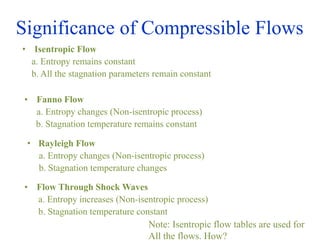
Significance of Compressible Flows
• Isentropic Flow
a. Entropy remains constant
b. All the stagnation parameters remain constant
• Fanno Flow
a. Entropy changes (Non-isentropic process)
b. Stagnation temperature remains constant
• Rayleigh Flow
a. Entropy changes (Non-isentropic process)
b. Stagnation temperature changes
• Flow Through Shock Waves
a. Entropy increases (Non-isentropic process)
b. Stagnation temperature constant
Note: Isentropic flow tables are used for
All the flows. How?
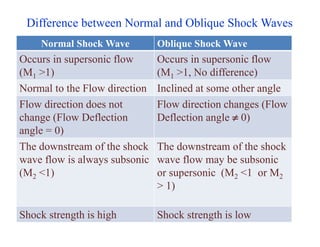
Difference between Normal and Oblique Shock Waves
Normal Shock Wave Oblique Shock Wave
Occurs in supersonic flow
(M1 >1)
Occurs in supersonic flow
(M1 >1, No difference)
Normal to the Flow direction Inclined at some other angle
Flow direction does not
change (Flow Deflection
angle = 0)
Flow direction changes (Flow
Deflection angle  0)
The downstream of the shock
wave flow is always subsonic
(M2 <1)
The downstream of the shock
wave flow may be subsonic
or supersonic (M2 <1 or M2
> 1)
Shock strength is high Shock strength is low
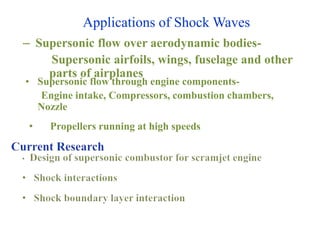
Applications of Shock Waves
– Supersonic flow over aerodynamic bodies-
Supersonic airfoils, wings, fuselage and other
parts of airplanes
• Supersonic flow through engine components-
Engine intake, Compressors, combustion chambers,
Nozzle
• Propellers running at high speeds
Supersonic Flow Turning
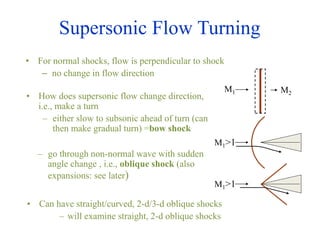
• For normal shocks, flow is perpendicular to shock
– no change in flow direction
• How does supersonic flow change direction,
i.e., make a turn
– either slow to subsonic ahead of turn (can
then make gradual turn) =bow shock
M1 M2
M1>1
M1>1
– go through non-normal wave with sudden
angle change , i.e., oblique shock (also
expansions: see later)
• Can have straight/curved, 2-d/3-d oblique shocks
– will examine straight, 2-d oblique shocks
Oblique Shock Waves
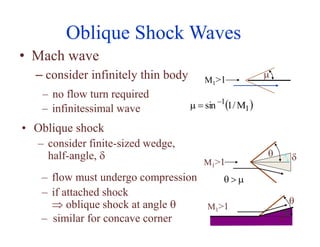
• Mach wave
– consider infinitely thin body M1>1

• Oblique shock
– consider finite-sized wedge,
half-angle, 
M1>1

– no flow turn required

 1
1
M/1sin 
– infinitessimal wave

– flow must undergo compression
– if attached shock
 oblique shock at angle 
– similar for concave corner

M1>1

Equations of Motion
• Governing equations
– same approach as for normal shocks
– use conservation equations and state equations
• Conservation Equations
– mass, energy and momentum
– this time 2 momentum equations - 2 velocity
components for a 2-d oblique shock
• Assumptions
– steady flow (stationary shock), inviscid except
inside shock, adiabatic, no work but flow work
Control Volume
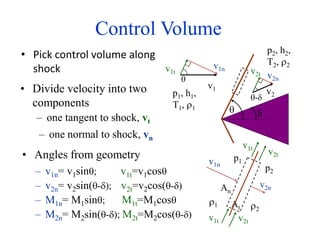
• Pick control volume along
shock
p1, h1,
T1, 1
v1
 
p2, h2,
T2, 2
v2

-
• Divide velocity into two
components
– one tangent to shock, vt
– one normal to shock, vn
• Angles from geometry
v1n
v2n
v1n
v2nAn
At
p1
p2
1 2
v1t v2t
v1t v2t
v1t
v2t
– v1n= v1sin; v1t=v1cos
– v2n= v2sin(-); v2t=v2cos(-)
– M1n= M1sin; M1t=M1cos
– M2n= M2sin(-); M2t=M2cos(-)
Conservation Equations
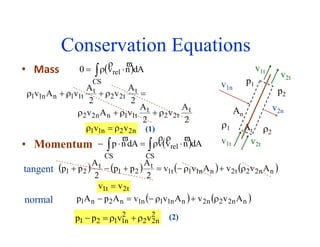
• Mass
v1n
v2nAn
At
p1
p2
1 2
v1t v2t
v1t
v2t
  Adnv0 rel
CS

 
2
A
v
2
A
vAv
2
A
v
2
A
vAv
t
t22
t
t11nn22
t
t22
t
t11nn11


• Momentum   
CS
rel
CS
AdnvvAdnp

tangent        nn22t2nn11t1
t
21
t
21 AvvAvv
2
A
pp
2
A
pp 
t2t1 vv 
normal    nn22n2nn11n1n2n1 AvvAvvApAp 
n22n11 vv  (1)
2
n22
2
n1121 vvpp  (2)
Conservation Equations (con’t)
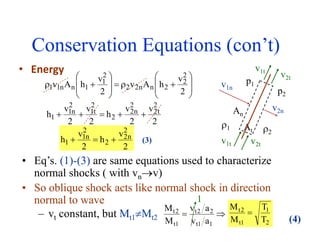
• Energy
v1n
v2nAn
At
p1
p2
1 2
v1t v2t
v1t
v2t


















2
v
hAv
2
v
hAv
2
2
2nn22
2
1
1nn11
2
v
2
v
h
2
v
2
v
h
2
t2
2
n2
2
2
t1
2
n1
1 
2
v
h
2
v
h
2
n2
2
2
n1
1  (3)
• Eq’s. (1)-(3) are same equations used to characterize
normal shocks ( with vnv)
• So oblique shock acts like normal shock in direction
normal to wave
– vt constant, but Mt1Mt2 
11t
22t
1t
2t
av
av
M
M
(4)2
1
1t
2t
T
T
M
M

1
Oblique Shock Relations
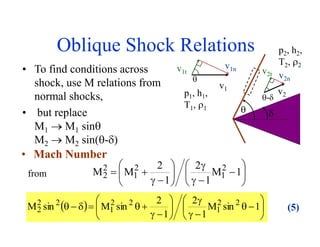
• To find conditions across
shock, use M relations from
normal shocks,
• but replace
M1  M1 sin
M2  M2 sin(-)
• Mach Number
  1sinM
1
2
1
2
sinMsinM 22
1
22
1
22
2 
















1M
1
2
1
2
MM 2
1
2
1
2
2 















from
p1, h1,
T1, 1
v1
 
p2, h2,
T2, 2
v2

-
v1n
v2n
v1t v2t
(5)
Oblique Shock Relations (con’t)
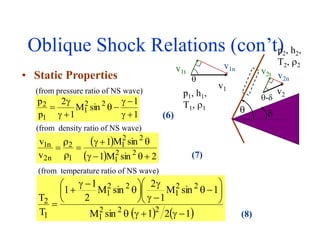
• Static Properties
p1, h1,
T1, 1
v1
 
p2, h2,
T2, 2
v2

-
v1n
v2n
v1t v2t
(6)1
1
sinM
1
2
p
p 22
1
1
2






(from pressure ratio of NS wave)
(7)
 
  2sinM1
sinM1
v
v
22
1
22
1
1
2
n2
n1






(from density ratio of NS wave)
   121sinM
1sinM
1
2
sinM
2
1
1
T
T
222
1
22
1
22
1
1
2




















(8)
(from temperature ratio of NS wave)
Oblique Shock Relations (con’t)
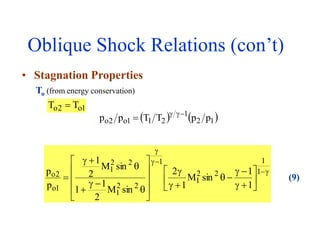
• Stagnation Properties
1o2o TT 
To (from energy conservation)
   12
1
211o2o ppTTpp 































1
1
22
1
1
22
1
22
1
1o
2o
1
1
sinM
1
2
sinM
2
1
1
sinM
2
1
p
p
(9)
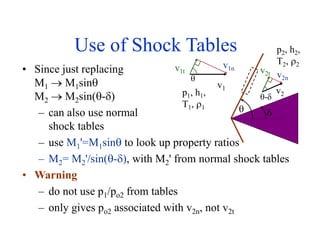
Use of Shock Tables
• Since just replacing
M1  M1sin
M2  M2sin(-)
– can also use normal
shock tables
– use M1'=M1sin to look up property ratios
– M2= M2'/sin(-), with M2' from normal shock tables
• Warning
– do not use p1/po2 from tables
– only gives po2 associated with v2n, not v2t
p1, h1,
T1, 1
v1
 
p2, h2,
T2, 2
v2

-
v1n
v2n
v1t v2t
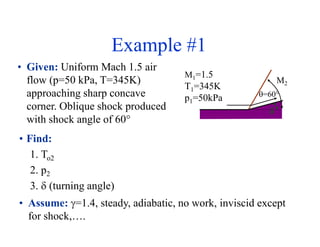
Example #1
• Given: Uniform Mach 1.5 air
flow (p=50 kPa, T=345K)
approaching sharp concave
corner. Oblique shock produced
with shock angle of 60°
• Find:
1. To2
2. p2
3.  (turning angle)
• Assume: =1.4, steady, adiabatic, no work, inviscid except
for shock,….
=60°
M1=1.5
T1=345K
p1=50kPa

M2
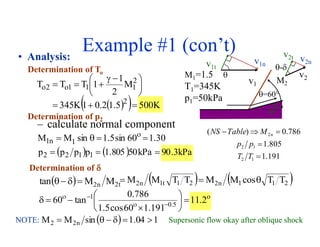
Example #1 (con’t)• Analysis:
Determination of To
30.160sin5.1sinMM 1n1  
191.1
805.1
786.0)(
12
12
2



TT
pp
MTableNS n
– calculate normal component
   K5005.12.01K345
M
2
1
1TTT
2
2
111o2o






 

Determination of p2
    kPa3.90kPa50805.1pppp 1122 
Determination of 



2.11
191.160cos5.1
786.0
tan60 5.0
1







 

  t2n2 MMtan     211n221t1n2 TTcosMMTTMM 

v1t
v1
v1n
-
v2
v2n
v2t
  104.1sinMM n22 NOTE: Supersonic flow okay after oblique shock
=60°
M1=1.5
T1=345K
p1=50kPa

M2
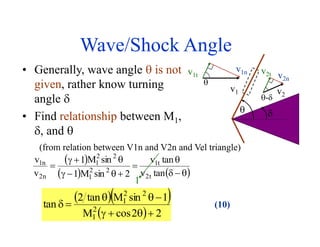
Wave/Shock Angle
• Generally, wave angle  is not
given, rather know turning
angle 
• Find relationship between M1,
, and 
  
  22cosM
1sinMtan2
tan 2
1
22
1



 
v2
-
v2n
v1

v1nv1t
v2t
 
  2sinM1
sinM1
v
v
22
1
22
1
n2
n1



(from relation between V1n and V2n and Vel triangle)
 


tanv
tanv
t2
t1
1
(10)
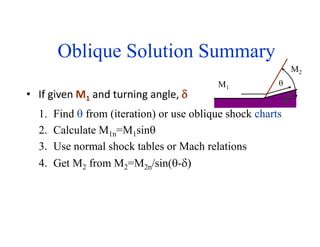
Oblique Solution Summary
• If given M1 and turning angle, 
1. Find  from (iteration) or use oblique shock charts
2. Calculate M1n=M1sin
3. Use normal shock tables or Mach relations
4. Get M2 from M2=M2n/sin(-)
M1

M2
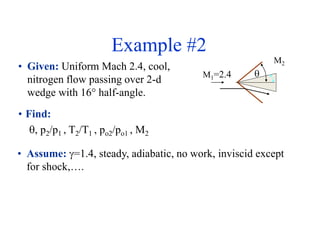
Example #2
• Given: Uniform Mach 2.4, cool,
nitrogen flow passing over 2-d
wedge with 16° half-angle.
• Find:
, p2/p1 , T2/T1 , po2/po1 , M2
• Assume: =1.4, steady, adiabatic, no work, inviscid except
for shock,….
M1=2.4 
M2
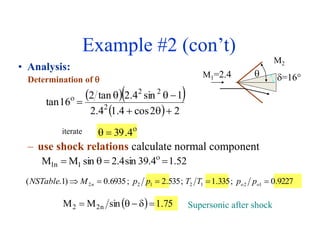
Example #2 (con’t)
• Analysis:
Determination of 
52.14.39sin4.2sinMM 1n1  
9227.0;335.1;535.2;6935.0)1.( 1212122  oon ppTTppMNSTable
– use shock relations calculate normal component
  75.1sinMM n22  Supersonic after shock
  
  22cos4.14.2
1sin4.2tan2
16tan 2
22



=16°M1=2.4 
M2
iterate 
4.39
Example #2 (con’t)
• Analysis (con’t):
38.21.82sin4.2sinMM 1n1  
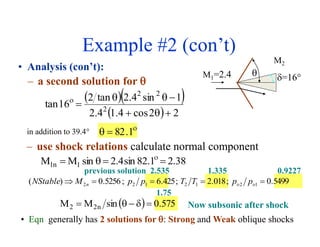
5499.0;018.2;425.6;5256.0)( 1212122  oon ppTTppMNStable
– use shock relations calculate normal component
  575.0sinMM n22 
=16°M1=2.4 
M2
– a second solution for 
  
  22cos4.14.2
1sin4.2tan2
16tan 2
22



in addition to 39.4 
1.82
• Eqn generally has 2 solutions for : Strong and Weak oblique shocks
Now subsonic after shock
previous solution 2.535 1.335 0.9227
1.75
Strong and Weak Oblique Shocks
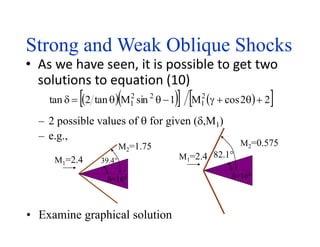
• As we have seen, it is possible to get two
solutions to equation (10)
– 2 possible values of  for given (,M1)
– e.g.,
      22cosM1sinMtan2tan 2
1
22
1 
M1=2.4 39.4°
M2=1.75
=16°
M1=2.4 82.1°
M2=0.575
=16°
• Examine graphical solution
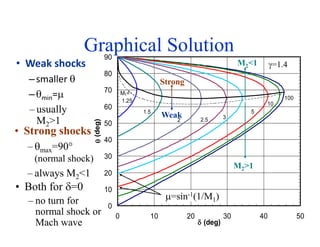
Graphical Solution
• Weak shocks
–smaller 
–min=
0
10
20
30
40
50
60
70
80
90
0 10 20 30 40 50
 (deg)
(deg)
0
10
20
30
40
50
60
70
80
90
M1=
1.25
1.5
2 2.5 3
5
10
100
=1.4M2<1
M2>1
Strong
Weak
=sin-1(1/M1)
– usually
M2>1
• Strong shocks
– max=90°
(normal shock)
– always M2<1
• Both for =0
– no turn for
normal shock or
Mach wave
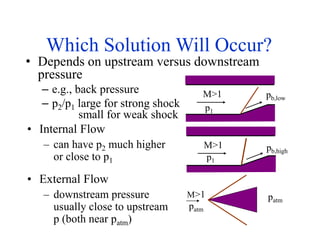
Which Solution Will Occur?
• Depends on upstream versus downstream
pressure
– e.g., back pressure
– p2/p1 large for strong shock
small for weak shock
• Internal Flow
– can have p2 much higher
or close to p1
M>1
p1
pb,high
M>1
p1
pb,low
• External Flow
– downstream pressure
usually close to upstream
p (both near patm)
M>1
patm
patm
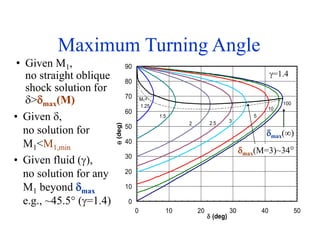
Maximum Turning Angle
• Given M1,
no straight oblique
shock solution for
>max(M)
0
10
20
30
40
50
60
70
80
90
0 10 20 30 40 50
 (deg)
(deg)
0
10
20
30
40
50
60
70
80
90
M1=
1.25
1.5
2 2.5 3
5
10
100
=1.4
max(M=3)~34°
• Given ,
no solution for
M1<M1,min
• Given fluid (),
no solution for any
M1 beyond max
e.g., ~45.5° (=1.4)
max()
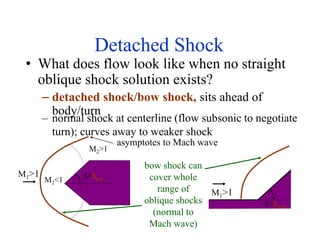
Detached Shock
• What does flow look like when no straight
oblique shock solution exists?
– detached shock/bow shock, sits ahead of
body/turn
M1>1
>max
bow shock can
cover whole
range of
oblique shocks
(normal to
Mach wave)
– normal shock at centerline (flow subsonic to negotiate
turn); curves away to weaker shock
asymptotes to Mach wave
M2<1
M2>1
M1>1 >ma
x
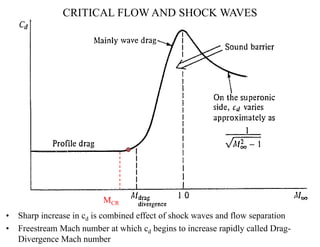
CRITICAL FLOW AND SHOCK WAVES
0.1 DivergenceDragCR MM
MCR
• Sharp increase in cd is combined effect of shock waves and flow separation
• Freestream Mach number at which cd begins to increase rapidly called Drag-
Divergence Mach number

UNIT - III NORMAL & OBLIQUE SHOCKS

  • 1.
    ME 6604 –GAS DYNAMICS AND JET PROPULSION UNIT – III SHOCK WAVES Mrs. N. PREMALATHA ASSOCIATE PROFESSOR DEPARTMENT OF MECHANICAL ENGG
  • 2.
    Significance of CompressibleFlows • Isentropic Flow a. Entropy remains constant b. All the stagnation parameters remain constant • Fanno Flow a. Entropy changes (Non-isentropic process) b. Stagnation temperature remains constant • Rayleigh Flow a. Entropy changes (Non-isentropic process) b. Stagnation temperature changes • Flow Through Shock Waves a. Entropy increases (Non-isentropic process) b. Stagnation temperature constant Note: Isentropic flow tables are used for All the flows. How?
  • 3.
    Difference between Normaland Oblique Shock Waves Normal Shock Wave Oblique Shock Wave Occurs in supersonic flow (M1 >1) Occurs in supersonic flow (M1 >1, No difference) Normal to the Flow direction Inclined at some other angle Flow direction does not change (Flow Deflection angle = 0) Flow direction changes (Flow Deflection angle  0) The downstream of the shock wave flow is always subsonic (M2 <1) The downstream of the shock wave flow may be subsonic or supersonic (M2 <1 or M2 > 1) Shock strength is high Shock strength is low
  • 4.
    Applications of ShockWaves – Supersonic flow over aerodynamic bodies- Supersonic airfoils, wings, fuselage and other parts of airplanes • Supersonic flow through engine components- Engine intake, Compressors, combustion chambers, Nozzle • Propellers running at high speeds
  • 5.
    Supersonic Flow Turning •For normal shocks, flow is perpendicular to shock – no change in flow direction • How does supersonic flow change direction, i.e., make a turn – either slow to subsonic ahead of turn (can then make gradual turn) =bow shock M1 M2 M1>1 M1>1 – go through non-normal wave with sudden angle change , i.e., oblique shock (also expansions: see later) • Can have straight/curved, 2-d/3-d oblique shocks – will examine straight, 2-d oblique shocks
  • 6.
    Oblique Shock Waves •Mach wave – consider infinitely thin body M1>1  • Oblique shock – consider finite-sized wedge, half-angle,  M1>1  – no flow turn required   1 1 M/1sin  – infinitessimal wave  – flow must undergo compression – if attached shock  oblique shock at angle  – similar for concave corner  M1>1 
  • 7.
    Equations of Motion •Governing equations – same approach as for normal shocks – use conservation equations and state equations • Conservation Equations – mass, energy and momentum – this time 2 momentum equations - 2 velocity components for a 2-d oblique shock • Assumptions – steady flow (stationary shock), inviscid except inside shock, adiabatic, no work but flow work
  • 8.
    Control Volume • Pickcontrol volume along shock p1, h1, T1, 1 v1   p2, h2, T2, 2 v2  - • Divide velocity into two components – one tangent to shock, vt – one normal to shock, vn • Angles from geometry v1n v2n v1n v2nAn At p1 p2 1 2 v1t v2t v1t v2t v1t v2t – v1n= v1sin; v1t=v1cos – v2n= v2sin(-); v2t=v2cos(-) – M1n= M1sin; M1t=M1cos – M2n= M2sin(-); M2t=M2cos(-)
  • 9.
    Conservation Equations • Mass v1n v2nAn At p1 p2 12 v1t v2t v1t v2t   Adnv0 rel CS    2 A v 2 A vAv 2 A v 2 A vAv t t22 t t11nn22 t t22 t t11nn11   • Momentum    CS rel CS AdnvvAdnp  tangent        nn22t2nn11t1 t 21 t 21 AvvAvv 2 A pp 2 A pp  t2t1 vv  normal    nn22n2nn11n1n2n1 AvvAvvApAp  n22n11 vv  (1) 2 n22 2 n1121 vvpp  (2)
  • 10.
    Conservation Equations (con’t) •Energy v1n v2nAn At p1 p2 1 2 v1t v2t v1t v2t                   2 v hAv 2 v hAv 2 2 2nn22 2 1 1nn11 2 v 2 v h 2 v 2 v h 2 t2 2 n2 2 2 t1 2 n1 1  2 v h 2 v h 2 n2 2 2 n1 1  (3) • Eq’s. (1)-(3) are same equations used to characterize normal shocks ( with vnv) • So oblique shock acts like normal shock in direction normal to wave – vt constant, but Mt1Mt2  11t 22t 1t 2t av av M M (4)2 1 1t 2t T T M M  1
  • 11.
    Oblique Shock Relations •To find conditions across shock, use M relations from normal shocks, • but replace M1  M1 sin M2  M2 sin(-) • Mach Number   1sinM 1 2 1 2 sinMsinM 22 1 22 1 22 2                  1M 1 2 1 2 MM 2 1 2 1 2 2                 from p1, h1, T1, 1 v1   p2, h2, T2, 2 v2  - v1n v2n v1t v2t (5)
  • 12.
    Oblique Shock Relations(con’t) • Static Properties p1, h1, T1, 1 v1   p2, h2, T2, 2 v2  - v1n v2n v1t v2t (6)1 1 sinM 1 2 p p 22 1 1 2       (from pressure ratio of NS wave) (7)     2sinM1 sinM1 v v 22 1 22 1 1 2 n2 n1       (from density ratio of NS wave)    121sinM 1sinM 1 2 sinM 2 1 1 T T 222 1 22 1 22 1 1 2                     (8) (from temperature ratio of NS wave)
  • 13.
    Oblique Shock Relations(con’t) • Stagnation Properties 1o2o TT  To (from energy conservation)    12 1 211o2o ppTTpp                                 1 1 22 1 1 22 1 22 1 1o 2o 1 1 sinM 1 2 sinM 2 1 1 sinM 2 1 p p (9)
  • 14.
    Use of ShockTables • Since just replacing M1  M1sin M2  M2sin(-) – can also use normal shock tables – use M1'=M1sin to look up property ratios – M2= M2'/sin(-), with M2' from normal shock tables • Warning – do not use p1/po2 from tables – only gives po2 associated with v2n, not v2t p1, h1, T1, 1 v1   p2, h2, T2, 2 v2  - v1n v2n v1t v2t
  • 15.
    Example #1 • Given:Uniform Mach 1.5 air flow (p=50 kPa, T=345K) approaching sharp concave corner. Oblique shock produced with shock angle of 60° • Find: 1. To2 2. p2 3.  (turning angle) • Assume: =1.4, steady, adiabatic, no work, inviscid except for shock,…. =60° M1=1.5 T1=345K p1=50kPa  M2
  • 16.
    Example #1 (con’t)•Analysis: Determination of To 30.160sin5.1sinMM 1n1   191.1 805.1 786.0)( 12 12 2    TT pp MTableNS n – calculate normal component    K5005.12.01K345 M 2 1 1TTT 2 2 111o2o          Determination of p2     kPa3.90kPa50805.1pppp 1122  Determination of     2.11 191.160cos5.1 786.0 tan60 5.0 1             t2n2 MMtan     211n221t1n2 TTcosMMTTMM   v1t v1 v1n - v2 v2n v2t   104.1sinMM n22 NOTE: Supersonic flow okay after oblique shock =60° M1=1.5 T1=345K p1=50kPa  M2
  • 17.
    Wave/Shock Angle • Generally,wave angle  is not given, rather know turning angle  • Find relationship between M1, , and       22cosM 1sinMtan2 tan 2 1 22 1      v2 - v2n v1  v1nv1t v2t     2sinM1 sinM1 v v 22 1 22 1 n2 n1    (from relation between V1n and V2n and Vel triangle)     tanv tanv t2 t1 1 (10)
  • 18.
    Oblique Solution Summary •If given M1 and turning angle,  1. Find  from (iteration) or use oblique shock charts 2. Calculate M1n=M1sin 3. Use normal shock tables or Mach relations 4. Get M2 from M2=M2n/sin(-) M1  M2
  • 19.
    Example #2 • Given:Uniform Mach 2.4, cool, nitrogen flow passing over 2-d wedge with 16° half-angle. • Find: , p2/p1 , T2/T1 , po2/po1 , M2 • Assume: =1.4, steady, adiabatic, no work, inviscid except for shock,…. M1=2.4  M2
  • 20.
    Example #2 (con’t) •Analysis: Determination of  52.14.39sin4.2sinMM 1n1   9227.0;335.1;535.2;6935.0)1.( 1212122  oon ppTTppMNSTable – use shock relations calculate normal component   75.1sinMM n22  Supersonic after shock      22cos4.14.2 1sin4.2tan2 16tan 2 22    =16°M1=2.4  M2 iterate  4.39
  • 21.
    Example #2 (con’t) •Analysis (con’t): 38.21.82sin4.2sinMM 1n1   5499.0;018.2;425.6;5256.0)( 1212122  oon ppTTppMNStable – use shock relations calculate normal component   575.0sinMM n22  =16°M1=2.4  M2 – a second solution for       22cos4.14.2 1sin4.2tan2 16tan 2 22    in addition to 39.4  1.82 • Eqn generally has 2 solutions for : Strong and Weak oblique shocks Now subsonic after shock previous solution 2.535 1.335 0.9227 1.75
  • 22.
    Strong and WeakOblique Shocks • As we have seen, it is possible to get two solutions to equation (10) – 2 possible values of  for given (,M1) – e.g.,       22cosM1sinMtan2tan 2 1 22 1  M1=2.4 39.4° M2=1.75 =16° M1=2.4 82.1° M2=0.575 =16° • Examine graphical solution
  • 23.
    Graphical Solution • Weakshocks –smaller  –min= 0 10 20 30 40 50 60 70 80 90 0 10 20 30 40 50  (deg) (deg) 0 10 20 30 40 50 60 70 80 90 M1= 1.25 1.5 2 2.5 3 5 10 100 =1.4M2<1 M2>1 Strong Weak =sin-1(1/M1) – usually M2>1 • Strong shocks – max=90° (normal shock) – always M2<1 • Both for =0 – no turn for normal shock or Mach wave
  • 24.
    Which Solution WillOccur? • Depends on upstream versus downstream pressure – e.g., back pressure – p2/p1 large for strong shock small for weak shock • Internal Flow – can have p2 much higher or close to p1 M>1 p1 pb,high M>1 p1 pb,low • External Flow – downstream pressure usually close to upstream p (both near patm) M>1 patm patm
  • 25.
    Maximum Turning Angle •Given M1, no straight oblique shock solution for >max(M) 0 10 20 30 40 50 60 70 80 90 0 10 20 30 40 50  (deg) (deg) 0 10 20 30 40 50 60 70 80 90 M1= 1.25 1.5 2 2.5 3 5 10 100 =1.4 max(M=3)~34° • Given , no solution for M1<M1,min • Given fluid (), no solution for any M1 beyond max e.g., ~45.5° (=1.4) max()
  • 26.
    Detached Shock • Whatdoes flow look like when no straight oblique shock solution exists? – detached shock/bow shock, sits ahead of body/turn M1>1 >max bow shock can cover whole range of oblique shocks (normal to Mach wave) – normal shock at centerline (flow subsonic to negotiate turn); curves away to weaker shock asymptotes to Mach wave M2<1 M2>1 M1>1 >ma x
  • 27.
    CRITICAL FLOW ANDSHOCK WAVES 0.1 DivergenceDragCR MM MCR • Sharp increase in cd is combined effect of shock waves and flow separation • Freestream Mach number at which cd begins to increase rapidly called Drag- Divergence Mach number