Normal shock waves
Definition of shock wave
Formation of normal shock wave
Governing equations
Shock in the nozzle
3.
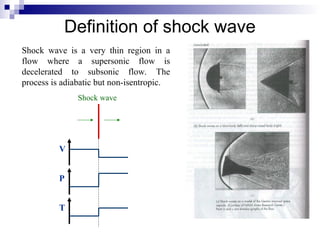
Definition of shockwave
Shock wave is a very thin region in a
flow where a supersonic flow is
decelerated to subsonic flow. The
process is adiabatic but non-isentropic.
Shock wave
V
P
T
4.
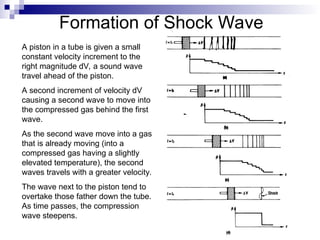
Formation of ShockWave
A piston in a tube is given a small
constant velocity increment to the
right magnitude dV, a sound wave
travel ahead of the piston.
A second increment of velocity dV
causing a second wave to move into
the compressed gas behind the first
wave.
As the second wave move into a gas
that is already moving (into a
compressed gas having a slightly
elevated temperature), the second
waves travels with a greater velocity.
The wave next to the piston tend to
overtake those father down the tube.
As time passes, the compression
wave steepens.
5.
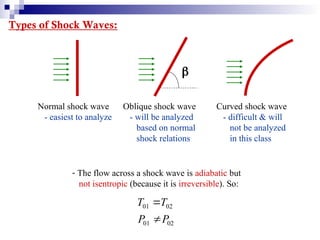
Types of ShockWaves:
Normal shock wave
- easiest to analyze
Oblique shock wave
- will be analyzed
based on normal
shock relations
Curved shock wave
- difficult & will
not be analyzed
in this class
- The flow across a shock wave is adiabatic but
not isentropic (because it is irreversible). So:
02
01
02
01
P
P
T
T
6.
Governing Equations
1
1
1
1
T
P
V
2
2
2
2
T
P
V
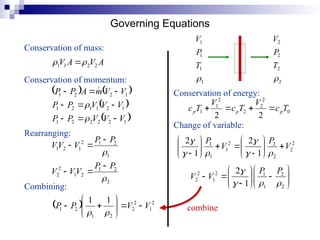
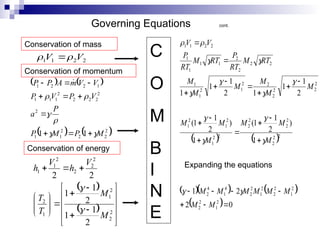
Conservation ofmass:
Conservation of momentum:
Rearranging:
Combining:
A
V
A
V 2
2
1
1
1
2
2
2
2
1
1
2
1
1
2
1
1
2
2
1
V
V
V
P
P
V
V
V
P
P
V
V
m
A
P
P
2
2
1
2
1
2
2
1
2
1
2
1
2
1
P
P
V
V
V
P
P
V
V
V
2
1
2
2
2
1
2
1
1
1
V
V
P
P
Conservation of energy:
Change of variable:
0
2
2
2
2
1
1
2
2
T
c
V
T
c
V
T
c p
p
p
2
2
1
1
2
1
2
2
1
2
P
P
V
V
combine
2
2
2
2
2
1
1
1
1
2
1
2
V
P
V
P
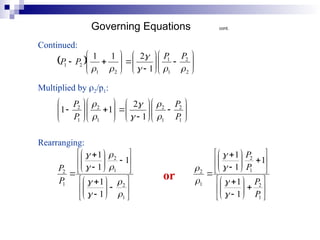
Governing Equations cont.
2
2
1
1V
V
2
2
2
2
1
1
2
2
2
2
2
2
1
1
1
1
2
2
1
1
1 M
P
M
P
P
a
V
P
V
P
V
V
m
A
P
P
2
2
2
1
1
2
2
2
2
2
1
1
2
1
1
2
1
1
2
2
M
M
T
T
V
h
V
h
C
O
M
B
I
N
E
Conservation of mass
Conservation of momentum
Conservation of energy
0
2
2
1
1
)
2
1
1
(
1
)
2
1
1
(
2
1
1
1
2
1
1
1
2
1
2
2
2
1
2
2
2
1
2
2
4
1
4
2
2
2
2
2
2
2
2
2
2
1
2
1
2
1
2
2
2
2
2
2
1
2
1
1
2
2
2
2
1
1
1
1
2
2
1
1
M
M
M
M
M
M
M
M
M
M
M
M
M
M
M
M
M
M
M
M
RT
M
RT
P
RT
M
RT
P
V
V
Expanding the equations
10.
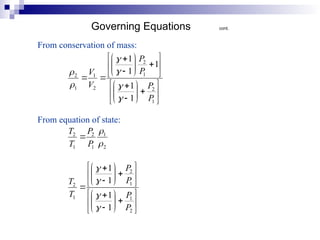
Governing Equations cont.
1
2
2
1
2
1
2
1
2
M
M
M
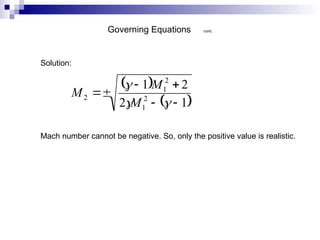
Solution:
Mach number cannot be negative. So, only the positive value is realistic.
11.
Governing Equations cont.
1
1
1
2
1
1
1
2
1
1
1
2
2
1
1
2
1
1
2
1
1
2
1
1
2
2
2
2
1
1
2
2
1
2
2
1
2
1
1
2
2
2
2
1
1
2
M
P
P
M
M
P
P
M
M
M
T
T
M
M
T
T
2
)
1
(
)
1
(
1
2
1
1
1
2
2
1
1
1
2
2
1
2
1
2
1
1
2
2
1
2
2
1
2
1
2
1
2
1
1
1
2
2
1
2
1
2
1
1
2
M
M
M
M
M
M
M
M
T
T
M
M
V
V
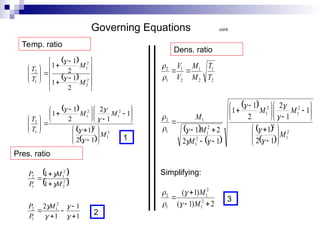
Temp. ratio
Pres. ratio
Dens. ratio
Simplifying:
1
2
3
12.
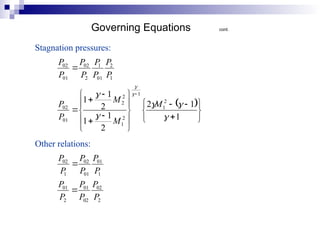
Stagnation pressures:
Other relations:
1
1
2
2
1
1
2
1
1 2
1
1
2
1
2
2
01
02
1
2
01
1
2
02
01
02
M
M
M
P
P
P
P
P
P
P
P
P
P
2
02
02
01
2
01
1
01
01
02
1
02
P
P
P
P
P
P
P
P
P
P
P
P
Governing Equations cont.
13.
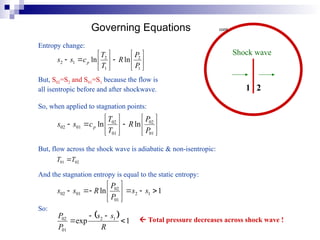
Entropy change:
But, S02=S2and S01=S1 because the flow is
all isentropic before and after shockwave.
So, when applied to stagnation points:
But, flow across the shock wave is adiabatic & non-isentropic:
And the stagnation entropy is equal to the static entropy:
So:
Shock wave
1 2
1
2
1
2
1
2 ln
ln
P
P
R
T
T
c
s
s p
01
02
01
02
01
02 ln
ln
P
P
R
T
T
c
s
s p
02
01 T
T
1
ln 1
2
01
02
01
02
s
s
P
P
R
s
s
1
exp 1
2
01
02
R
s
s
P
P Total pressure decreases across shock wave !
Governing Equations cont.
14.
Group Exercises 3
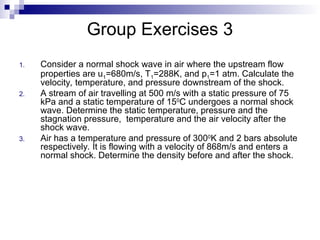
1.Consider a normal shock wave in air where the upstream flow
properties are u1=680m/s, T1=288K, and p1=1 atm. Calculate the
velocity, temperature, and pressure downstream of the shock.
2. A stream of air travelling at 500 m/s with a static pressure of 75
kPa and a static temperature of 150
C undergoes a normal shock
wave. Determine the static temperature, pressure and the
stagnation pressure, temperature and the air velocity after the
shock wave.
3. Air has a temperature and pressure of 3000
K and 2 bars absolute
respectively. It is flowing with a velocity of 868m/s and enters a
normal shock. Determine the density before and after the shock.
15.
0
s
M
1
1
M 1
2
M
01
01
1
1
1
T
P
T
P
01
02
01
02
1
2
1
2
1
2
T
T
P
P
T
T
P
P
1
M 2
M
1
2
P
P
1
2
T
T
1
2
1
2
a
a
01
02
P
P
1
02
P
P
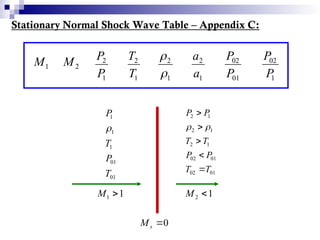
Stationary Normal Shock Wave Table – Appendix C: