Supervised By
Md. Amzad Hossain
Lecturer
Department of Mechanical Engineering
Khulna University of Engineering & Technology
Khulna-9203.
Submitted By
Md. Abrar Amin
Md. Asif Uddin
Md. Hasan Ikbal
Md. Tanver Ahmed
Md. Shahjahan Mahmud
Department of Mechanical Engineering ,
KHULNA UNIVERSITY OF ENGINEERING & TECHNOLOGY,
KHULNA– 9203 .
Course No: ME 3113
 To define shock wave phenomena.
 To study the properties of shock wave.
 To discuss about different types of shock wave &
their properties.
 To discuss about the formation of shock wave.
 To discuss about over expanded flow & under
expanded flow.
 To know the application of different types of shock
wave.
 A shock wave is a type of propagating disturbance. An
alternative name for the shock wave is shock front.
 Like an ordinary wave, it carries energy and can propagate
through a medium (solid, liquid, gas or plasma) or in some
cases in the absence of a material medium, through a field
such as the electromagnetic field.
 Shock wave is a very thin region in a flow where
supersonic flow is decelerated to subsonic flow. The
process is adiabatic but non-isentropic.
 Across the shock there is always an extremely rapid rise in
pressure, temperature and density of the flow.
 Shock wave are characterized by an abrupt nearly
discontinuous change in the characteristics of the medium.
Continued ……
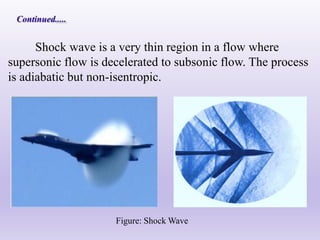
Shock wave is a very thin region in a flow where
supersonic flow is decelerated to subsonic flow. The process
is adiabatic but non-isentropic.
Figure: Shock Wave
 Shock wave is not a conventional sound wave.
 A Shock wave travels through most media at a higher
speed than an ordinary wave.
 When a shock wave passes through matter the total
energy is preserved.
 Shock wave is a large amplitude compressibility wave .
 A shock wave takes the form of a very sharp change in the
gas properties.
 Shock wave form when the speed of a fluid changes by
more than the speed of sound.
 Over larger distances a shock wave can change from a non
linear wave into a linear wave.
 Shock wave is a strong wave, i.e. property changes across
it are finite.
 Shock waves can be stationary or moving.
 Shock waves are very thin, in the order of 10−7 m.
 In a shock wave the properties of the fluid (density,
pressure, temperature, velocity, Mach number) changes
almost instantaneous.
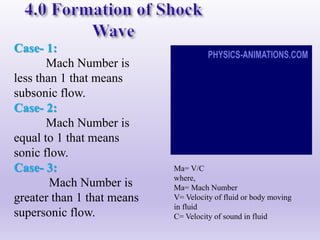
Case- 1:
Mach Number is
less than 1 that means
subsonic flow.
Case- 2:
Mach Number is
equal to 1 that means
sonic flow.
Case- 3:
Mach Number is
greater than 1 that means
supersonic flow.
Ma= V/C
where,
Ma= Mach Number
V= Velocity of fluid or body moving
in fluid
C= Velocity of sound in fluid
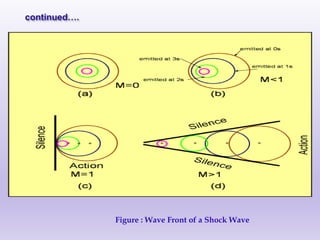
Figure : Wave Front of a Shock Wave
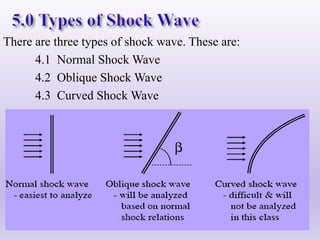
There are three types of shock wave. These are:
4.1 Normal Shock Wave
4.2 Oblique Shock Wave
4.3 Curved Shock Wave
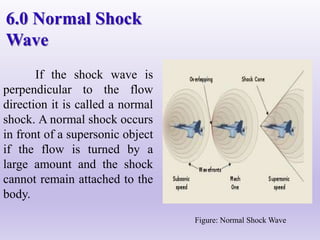
6.0 Normal Shock
Wave
If the shock wave is
perpendicular to the flow
direction it is called a normal
shock. A normal shock occurs
in front of a supersonic object
if the flow is turned by a
large amount and the shock
cannot remain attached to the
body.
Figure: Normal Shock Wave
 Perpendicular to the flow.
 Always decelerate flow to subsonic flow.
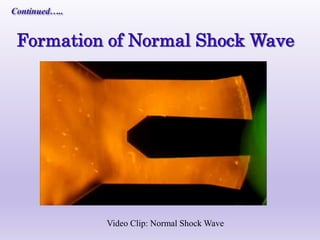
Video Clip: Normal Shock Wave
Formation of Normal Shock Wave
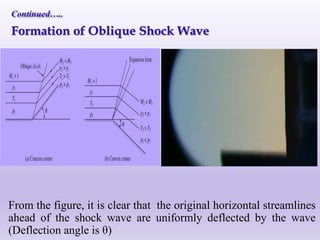
An oblique shock wave is one that is not perpendicular
to the direction of fluid flow. Such a shock wave arises when
a fluid stream flowing at a supersonic speed moves along a
convergent or divergent boundary.
Properties
 The oblique shock wave is not perpendicular to the
direction of flow.
 Oblique shock wave always decreases Mach number.
 Properties of oblique shock wave can be obtained by
modification & manipulation of the normal shock wave.
From the figure, it is clear that the original horizontal streamlines
ahead of the shock wave are uniformly deflected by the wave
(Deflection angle is θ)
Formation of Oblique Shock Wave
 Oblique shock waves are used predominantly in
engineering applications. This can be attributed to the fact
that using one or a combination of oblique shock waves
results in more favorable post-shock conditions when
compared to utilizing a single normal shock.
 One example is that many supersonic aircraft wings are
designed around a thin diamond shape. Placing a
diamond-shaped object at an angle of attack relative to
the supersonic flow streamlines will result in two oblique
shocks which could generate lift.
Application of Oblique Shock Wave:
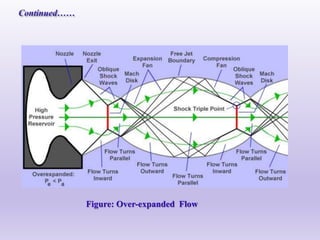
For non-isentropic chocked flows through
convergence-divergence duct if the pressure rises
downstream of the duct exit, the flow is considered as
over expanded.
Properties
 This type of flow occurs for non-isentropic chocked
flow.
 Pressure must be rises downstream of the duct exit.
Figure: Over-expanded Flow
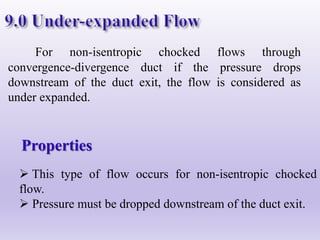
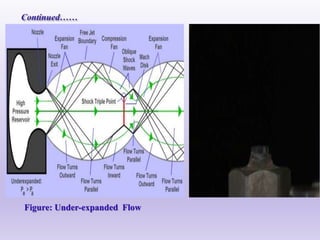
For non-isentropic chocked flows through
convergence-divergence duct if the pressure drops
downstream of the duct exit, the flow is considered as
under expanded.
Properties
 This type of flow occurs for non-isentropic chocked
flow.
 Pressure must be dropped downstream of the duct exit.
Figure: Under-expanded Flow
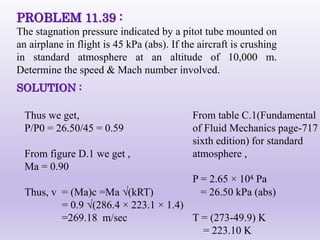
PROBLEM 11.39 :
The stagnation pressure indicated by a pitot tube mounted on
an airplane in flight is 45 kPa (abs). If the aircraft is crushing
in standard atmosphere at an altitude of 10,000 m.
Determine the speed & Mach number involved.
From table C.1(Fundamental
of Fluid Mechanics page-717
sixth edition) for standard
atmosphere ,
P = 2.65 × 10 Pa
= 26.50 kPa (abs)
T = (273-49.9) K
= 223.10 K
SOLUTION :
Thus we get,
P/P0 = 26.50/45 = 0.59
From figure D.1 we get ,
Ma = 0.90
Thus, v = (Ma)c =Ma √(kRT)
= 0.9 √(286.4 × 223.1 × 1.4)
=269.18 m/sec
shock wave

shock wave

  • 1.
    Supervised By Md. AmzadHossain Lecturer Department of Mechanical Engineering Khulna University of Engineering & Technology Khulna-9203. Submitted By Md. Abrar Amin Md. Asif Uddin Md. Hasan Ikbal Md. Tanver Ahmed Md. Shahjahan Mahmud Department of Mechanical Engineering , KHULNA UNIVERSITY OF ENGINEERING & TECHNOLOGY, KHULNA– 9203 . Course No: ME 3113
  • 3.
     To defineshock wave phenomena.  To study the properties of shock wave.  To discuss about different types of shock wave & their properties.  To discuss about the formation of shock wave.  To discuss about over expanded flow & under expanded flow.  To know the application of different types of shock wave.
  • 4.
     A shockwave is a type of propagating disturbance. An alternative name for the shock wave is shock front.  Like an ordinary wave, it carries energy and can propagate through a medium (solid, liquid, gas or plasma) or in some cases in the absence of a material medium, through a field such as the electromagnetic field.  Shock wave is a very thin region in a flow where supersonic flow is decelerated to subsonic flow. The process is adiabatic but non-isentropic.
  • 5.
     Across theshock there is always an extremely rapid rise in pressure, temperature and density of the flow.  Shock wave are characterized by an abrupt nearly discontinuous change in the characteristics of the medium. Continued ……
  • 6.
    Shock wave isa very thin region in a flow where supersonic flow is decelerated to subsonic flow. The process is adiabatic but non-isentropic. Figure: Shock Wave
  • 7.
     Shock waveis not a conventional sound wave.  A Shock wave travels through most media at a higher speed than an ordinary wave.  When a shock wave passes through matter the total energy is preserved.  Shock wave is a large amplitude compressibility wave .  A shock wave takes the form of a very sharp change in the gas properties.
  • 8.
     Shock waveform when the speed of a fluid changes by more than the speed of sound.  Over larger distances a shock wave can change from a non linear wave into a linear wave.  Shock wave is a strong wave, i.e. property changes across it are finite.  Shock waves can be stationary or moving.  Shock waves are very thin, in the order of 10−7 m.  In a shock wave the properties of the fluid (density, pressure, temperature, velocity, Mach number) changes almost instantaneous.
  • 9.
    Case- 1: Mach Numberis less than 1 that means subsonic flow. Case- 2: Mach Number is equal to 1 that means sonic flow. Case- 3: Mach Number is greater than 1 that means supersonic flow. Ma= V/C where, Ma= Mach Number V= Velocity of fluid or body moving in fluid C= Velocity of sound in fluid
  • 10.
    Figure : WaveFront of a Shock Wave
  • 11.
    There are threetypes of shock wave. These are: 4.1 Normal Shock Wave 4.2 Oblique Shock Wave 4.3 Curved Shock Wave
  • 12.
    6.0 Normal Shock Wave Ifthe shock wave is perpendicular to the flow direction it is called a normal shock. A normal shock occurs in front of a supersonic object if the flow is turned by a large amount and the shock cannot remain attached to the body. Figure: Normal Shock Wave
  • 13.
     Perpendicular tothe flow.  Always decelerate flow to subsonic flow.
  • 14.
    Video Clip: NormalShock Wave Formation of Normal Shock Wave
  • 15.
    An oblique shockwave is one that is not perpendicular to the direction of fluid flow. Such a shock wave arises when a fluid stream flowing at a supersonic speed moves along a convergent or divergent boundary. Properties  The oblique shock wave is not perpendicular to the direction of flow.  Oblique shock wave always decreases Mach number.  Properties of oblique shock wave can be obtained by modification & manipulation of the normal shock wave.
  • 16.
    From the figure,it is clear that the original horizontal streamlines ahead of the shock wave are uniformly deflected by the wave (Deflection angle is θ) Formation of Oblique Shock Wave
  • 17.
     Oblique shockwaves are used predominantly in engineering applications. This can be attributed to the fact that using one or a combination of oblique shock waves results in more favorable post-shock conditions when compared to utilizing a single normal shock.  One example is that many supersonic aircraft wings are designed around a thin diamond shape. Placing a diamond-shaped object at an angle of attack relative to the supersonic flow streamlines will result in two oblique shocks which could generate lift. Application of Oblique Shock Wave:
  • 18.
    For non-isentropic chockedflows through convergence-divergence duct if the pressure rises downstream of the duct exit, the flow is considered as over expanded. Properties  This type of flow occurs for non-isentropic chocked flow.  Pressure must be rises downstream of the duct exit.
  • 19.
  • 20.
    For non-isentropic chockedflows through convergence-divergence duct if the pressure drops downstream of the duct exit, the flow is considered as under expanded. Properties  This type of flow occurs for non-isentropic chocked flow.  Pressure must be dropped downstream of the duct exit.
  • 21.
  • 22.
    PROBLEM 11.39 : Thestagnation pressure indicated by a pitot tube mounted on an airplane in flight is 45 kPa (abs). If the aircraft is crushing in standard atmosphere at an altitude of 10,000 m. Determine the speed & Mach number involved. From table C.1(Fundamental of Fluid Mechanics page-717 sixth edition) for standard atmosphere , P = 2.65 × 10 Pa = 26.50 kPa (abs) T = (273-49.9) K = 223.10 K SOLUTION : Thus we get, P/P0 = 26.50/45 = 0.59 From figure D.1 we get , Ma = 0.90 Thus, v = (Ma)c =Ma √(kRT) = 0.9 √(286.4 × 223.1 × 1.4) =269.18 m/sec