HIGH SPEED
AERODYNAMICS
By Suhail Ahmed
BSAMT02161001
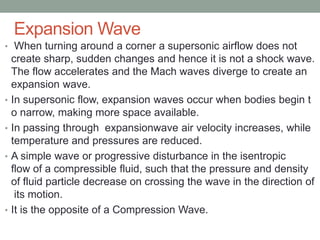
Expansion Wave
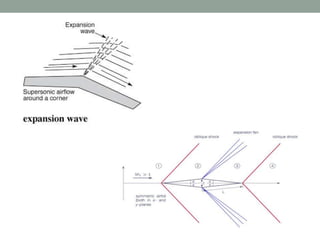
• When turning around a corner a supersonic airflow does not
create sharp, sudden changes and hence it is not a shock wave.
The flow accelerates and the Mach waves diverge to create an
expansion wave.
• In supersonic flow, expansion waves occur when bodies begin t
o narrow, making more space available.
• In passing through expansionwave air velocity increases, while
temperature and pressures are reduced.
• A simple wave or progressive disturbance in the isentropic
flow of a compressible fluid, such that the pressure and density
of fluid particle decrease on crossing the wave in the direction of
its motion.
• It is the opposite of a Compression Wave.
Sections in Supersonic Flow
• The effect of these various waveforms on the aerodynamic
characteristics in supersonic flow
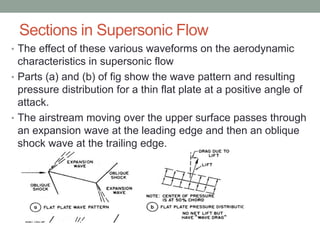
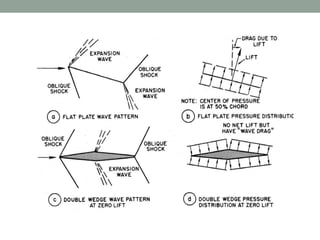
• Parts (a) and (b) of fig show the wave pattern and resulting
pressure distribution for a thin flat plate at a positive angle of
attack.
• The airstream moving over the upper surface passes through
an expansion wave at the leading edge and then an oblique
shock wave at the trailing edge.
• Thus, a uniform suction pressure exists over the upper surface.
The airstream moving underneath the flat plate passes through
an oblique shock wave at the leading edge then an expansion
wave at the trailing edge.
• This produces a uniform positive pressure on the underside of
the section.
• This distribution of pressure on the surface will produce a net
lift and incur a subsequent drag due to lift from the inclination
of the resultant lift from a perpendicular to the free stream.
• Parts (c) and (d) of Figure show the wave pattern and
resulting pressure distribution for a double wedge airfoil at
zero lift.
• The air stream moving over the surface passes through an
oblique shock, an expansion wave, and another oblique
shock.
• The resulting pressure distribution on the surfaces produces
no net lift, but the increased pressure on the forward half of
the chord along with the decreased pressure on the aft half of
the chord produces a "wave" drag.
• This wave drag is caused by the components of pressure
forces, which are parallel to the free stream direction.
Critical Mach Number
• The critical Mach number Mcrit is the free stream Mach
number at which the local flow Mach number just reaches
unity at some point on the airframe. In general, Mcrit≤1.0 and
is typically in the order of 0.9.
• Therefore, shock waves, buffet, airflow separation, etc., take
place above critical Mach number.
COMPRESSIBILITY MACH NUMBER
• The compressibility Mach number is that Mach number at
which, because of compressibility effects, control of an aircraft
becomes difficult and beyond which loss of control is
probable.
• Those with good transonic characteristics have no
compressibility mach number; but on those that eventually
lose control, or suffer a serious drop in stability and control
this mach number is important.
SHOCKWAVE DEVELOPMENT IN TRANSONIC
FLIGHT
• Transonic refers to the condition of flight in which a range
of velocities of airflow exist surrounding and flowing past
an air vehicle or an airfoil that are concurrently below, at,
and above the speed of sound in the range of Mach 0.8 to
1.2.
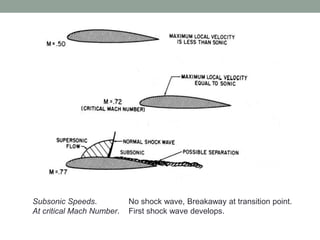
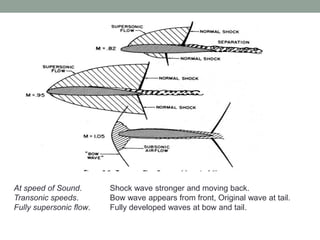
• As critical Mach number is exceeded an area of
supersonic airflow is created and a normal shock wave
forms as the boundary between the supersonic flow and
the subsonic flow on the aft portion of the airfoil surface.
Subsonic Speeds. No shock wave, Breakaway at transition point.
At critical Mach Number. First shock wave develops.
At speed of Sound. Shock wave stronger and moving back.
Transonic speeds. Bow wave appears from front, Original wave at tail.
Fully supersonic flow. Fully developed waves at bow and tail.
FORCE DIVERGENCE
• At a speed above M-Crit, airflow will begin to separate from
the wing similarly to during a stall.
• This separation will happen even at zero angles of
attack. When this separation begins, the aerodynamic drag
on the airfoil will begin to increase rapidly.
• The Mach number when this rapid drag increase begins is
called the drag divergence Mach number.
• The force divergence tends to move the center of pressure
even farther rearward.
• The rearward moving center of pressure causes the center of
lift to move rearward which could cause a downward pitching
moment, especially on swept wing aircraft.
• As the drag increases sharply, the lift also decreases
drastically, sometimes causing the aircraft to drop. The loss in
lift reduces the downwash caused by the wings.
• This rapid reduction of downwash flowing over the tail can
reduce the downward force from the horizontal stabilizer on
conventional aircraft and also cause the nose to pitch down
more.
• T-Tail design is used to reduce these effects by keeping the tail
out of the way of downwash.

High Speed Aerodynamics

  • 1.
  • 2.
    Expansion Wave • Whenturning around a corner a supersonic airflow does not create sharp, sudden changes and hence it is not a shock wave. The flow accelerates and the Mach waves diverge to create an expansion wave. • In supersonic flow, expansion waves occur when bodies begin t o narrow, making more space available. • In passing through expansionwave air velocity increases, while temperature and pressures are reduced. • A simple wave or progressive disturbance in the isentropic flow of a compressible fluid, such that the pressure and density of fluid particle decrease on crossing the wave in the direction of its motion. • It is the opposite of a Compression Wave.
  • 4.
    Sections in SupersonicFlow • The effect of these various waveforms on the aerodynamic characteristics in supersonic flow • Parts (a) and (b) of fig show the wave pattern and resulting pressure distribution for a thin flat plate at a positive angle of attack. • The airstream moving over the upper surface passes through an expansion wave at the leading edge and then an oblique shock wave at the trailing edge.
  • 5.
    • Thus, auniform suction pressure exists over the upper surface. The airstream moving underneath the flat plate passes through an oblique shock wave at the leading edge then an expansion wave at the trailing edge. • This produces a uniform positive pressure on the underside of the section. • This distribution of pressure on the surface will produce a net lift and incur a subsequent drag due to lift from the inclination of the resultant lift from a perpendicular to the free stream.
  • 7.
    • Parts (c)and (d) of Figure show the wave pattern and resulting pressure distribution for a double wedge airfoil at zero lift. • The air stream moving over the surface passes through an oblique shock, an expansion wave, and another oblique shock. • The resulting pressure distribution on the surfaces produces no net lift, but the increased pressure on the forward half of the chord along with the decreased pressure on the aft half of the chord produces a "wave" drag. • This wave drag is caused by the components of pressure forces, which are parallel to the free stream direction.
  • 8.
    Critical Mach Number •The critical Mach number Mcrit is the free stream Mach number at which the local flow Mach number just reaches unity at some point on the airframe. In general, Mcrit≤1.0 and is typically in the order of 0.9. • Therefore, shock waves, buffet, airflow separation, etc., take place above critical Mach number.
  • 9.
    COMPRESSIBILITY MACH NUMBER •The compressibility Mach number is that Mach number at which, because of compressibility effects, control of an aircraft becomes difficult and beyond which loss of control is probable. • Those with good transonic characteristics have no compressibility mach number; but on those that eventually lose control, or suffer a serious drop in stability and control this mach number is important.
  • 10.
    SHOCKWAVE DEVELOPMENT INTRANSONIC FLIGHT • Transonic refers to the condition of flight in which a range of velocities of airflow exist surrounding and flowing past an air vehicle or an airfoil that are concurrently below, at, and above the speed of sound in the range of Mach 0.8 to 1.2. • As critical Mach number is exceeded an area of supersonic airflow is created and a normal shock wave forms as the boundary between the supersonic flow and the subsonic flow on the aft portion of the airfoil surface.
  • 11.
    Subsonic Speeds. Noshock wave, Breakaway at transition point. At critical Mach Number. First shock wave develops.
  • 12.
    At speed ofSound. Shock wave stronger and moving back. Transonic speeds. Bow wave appears from front, Original wave at tail. Fully supersonic flow. Fully developed waves at bow and tail.
  • 13.
    FORCE DIVERGENCE • Ata speed above M-Crit, airflow will begin to separate from the wing similarly to during a stall. • This separation will happen even at zero angles of attack. When this separation begins, the aerodynamic drag on the airfoil will begin to increase rapidly. • The Mach number when this rapid drag increase begins is called the drag divergence Mach number. • The force divergence tends to move the center of pressure even farther rearward. • The rearward moving center of pressure causes the center of lift to move rearward which could cause a downward pitching moment, especially on swept wing aircraft. • As the drag increases sharply, the lift also decreases drastically, sometimes causing the aircraft to drop. The loss in lift reduces the downwash caused by the wings.
  • 14.
    • This rapidreduction of downwash flowing over the tail can reduce the downward force from the horizontal stabilizer on conventional aircraft and also cause the nose to pitch down more. • T-Tail design is used to reduce these effects by keeping the tail out of the way of downwash.