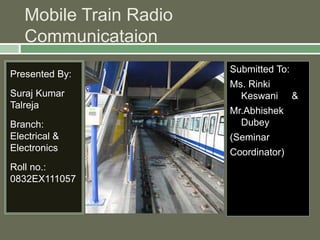
Mobile Train Radio 
Communicataion 
Presented By: 
Suraj Kumar 
Talreja 
Branch: 
Electrical & 
Electronics 
Roll no.: 
0832EX111057 
Submitted To: 
Ms. Rinki 
Keswani & 
Mr.Abhishek 
Dubey 
(Seminar 
Coordinator)
Contents 
 Introduction 
 Background & Origin 
 Main Features 
 Main applications & Benefits 
 Risks 
 Architecture 
 Projects 
 Mobile Train Radio Communications in India.
Introduction 
 Mobile Train Radio Communication(MRTC) is 
a railway signaling system that makes use of the 
telecommunications between the train and track 
equipment for the traffic management and 
infrastructure control. 
 By means of the CBTC systems, the exact 
position of a train is known more accurately than 
with the traditional signaling systems. 
 This results in a more efficient and safe way to 
manage the railway traffic 
Contnd……………….
Background & Origin 
 The main aim of this MRTC system is to 
increase capacity by reducing the time 
interval(headway) between train travelling 
along the line. 
 In Signal System based in the detection of the 
trains in discrete sections of the track called 
'blocks. 
 Each block is protected by signals that prevent 
a train entering an occupied block. 
 Since every block is fixed by the infrastructure, 
these systems are referred to as fixed 
block systems.
 Now a days, Moving Block is used. Unlike, 
traditional Fixed Block each block is not 
traditionally defined by the infrastructure. 
 Besides, the trains themselves are 
continuously communicating their exact 
position to the equipment in the track by 
means of a bi-directional link through Radio 
Communication. 
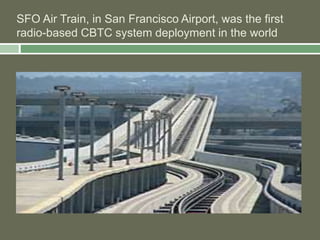
 Bombardier opened the world's first radio-based 
CBTC system at San Francisco 
airport's Automated People Mover (APM) in 
February 2003.
 A few months later, in June 
2003, Alstom introduced the railway 
application of its radio technology on 
the Singapore North East Line.
SFO Air Train, in San Francisco Airport, was the first 
radio-based CBTC system deployment in the world
Main Features 
 In the modern CBTC systems the trains 
continuously calculate and communicate their 
status via radio to the wayside equipment 
distributed along the line. 
 This status includes, among other parameters, 
the exact position, speed, travel direction 
and braking distance. 
 It also enables the wayside equipment to 
define the points on the line that must never be 
passed by the other trains on the same track.
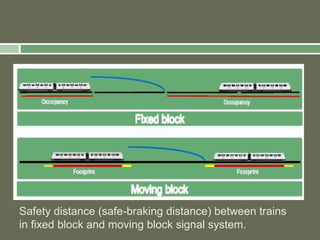
Safety distance (safe-braking distance) between trains 
in fixed block and moving block signal system.
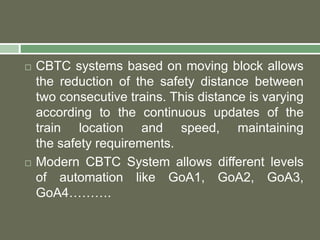
 CBTC systems based on moving block allows 
the reduction of the safety distance between 
two consecutive trains. This distance is varying 
according to the continuous updates of the 
train location and speed, maintaining 
the safety requirements. 
 Modern CBTC System allows different levels 
of automation like GoA1, GoA2, GoA3, 
GoA4……….
Main Applications & Benefits 
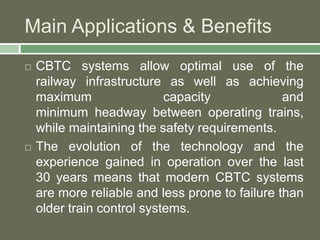
 CBTC systems allow optimal use of the 
railway infrastructure as well as achieving 
maximum capacity and 
minimum headway between operating trains, 
while maintaining the safety requirements. 
 The evolution of the technology and the 
experience gained in operation over the last 
30 years means that modern CBTC systems 
are more reliable and less prone to failure than 
older train control systems.
Risks 
 The primary risk of a CBTC system is that if the 
communications link between any of the trains is 
disrupted then all or part of the system might have 
to enter a failsafe state until the problem is 
remedied. 
 Communications failures can result from 
equipment malfunction, electromagnetic 
interference, weak signal strength or saturation of 
the communications medium. 
 In this case, an interruption can result in a service 
brake or emergency brake application as real time 
situational awareness is a critical safety 
requirement for CBTC
 CBTC systems that make use of wireless 
communications link have a much larger attack 
surface and can be subject to various types 
of hacking. 
 With the increasing application of CBTC system, 
there is an immense pressure over the 
international community to reserve a frequency 
band especially for Train Radio Communication. 
Such decision would help to standarize the CBTC 
systems across the market and ensure availability 
for those critical systems.
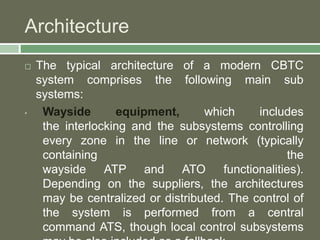
Architecture 
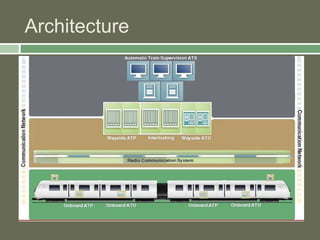
 The typical architecture of a modern CBTC 
system comprises the following main sub 
systems: 
• Wayside equipment, which includes 
the interlocking and the subsystems controlling 
every zone in the line or network (typically 
containing the 
wayside ATP and ATO functionalities). 
Depending on the suppliers, the architectures 
may be centralized or distributed. The control of 
the system is performed from a central 
command ATS, though local control subsystems 
may be also included as a fallback.
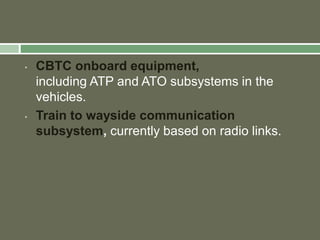
• CBTC onboard equipment, 
including ATP and ATO subsystems in the 
vehicles. 
• Train to wayside communication 
subsystem, currently based on radio links.
Architecture
 The following logical components may be 
found generally in a typical CBTC architecture: 
 Onboard ATP system. This subsystem is in 
charge of the continuous control of the train 
speed according to the safety profile, and 
applying the brake if it is necessary. 
 Onboard ATO system. It is responsible for the 
automatic control of the traction and braking 
effort in order to keep the train under the 
threshold established by the ATP subsystem.
• Wayside ATP system. This subsystem 
undertakes the management of all the 
communications with the trains in its area. 
Additionally, it calculates the limits of 
movement authority that every train must 
respect while operating in the mentioned area. 
• Wayside ATO system. It is in charge of 
controlling the destination and regulation 
targets of every train. The wayside ATO 
functionality provides all the trains in the 
system with their destination as well as with 
other data such as the dwell time in the 
stations
• Communication system. The CBTC systems 
integrate a digital networked radio system by 
means of antennas or leaky feeder cable for the 
bi-directional communication between the track 
equipment and the trains. The 2,4GHz band is 
commonly used in these systems (same as Wi- 
Fi). 
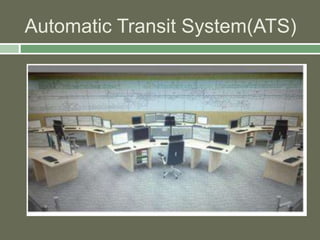
• ATS system. The ATS system is commonly 
integrated within most of the CBTC solutions. Its 
main task is to act as the interface between the 
operator and the system, managing the traffic 
according to the specific regulation criteria.
Automatic Transit System(ATS)
Projects
Mobile Train Rodio Communication 
In India 
 Mobile Train Radio Communication (MTRC) 
over IR was introduced during 1980’s in 
Nagpur – Durg, Nagpur – Itarsi and Nagpur – 
Bhusawal sections of SER and CR zones of 
IR. 
 Although the system met, the requirements of 
MTRC, yet bulky handsets provided to drivers 
and guards and logistic for it’s charging made 
this system very un-popular.
 GSM(R) based MTRC works were sanctioned 
during 2005 and deployed over NFR, ER, 
NCR and NR zones purely for train control 
communication purpose. 
 The investment of around 975 million INR 
remains gainfully unutilised.
 As per report published on Nov. 10, 2013 in Times of India 
 "We are implementing Mobile Train Radio Communication 
(MTRC) system which would provide better communication 
between the control room and the driver in speeding 
trains," said a senior Railway Ministry official involved with 
the project. 
 The system will provide control rooms with emergency 
brake for trains which can be used in case of signal 
violation by drivers. 
 While the MRTC system is currently being installed in the 
2264-km route including Delhi-Ludhiana, Howrah- 
Mughalsarai and Kolkata Metro sections, 2235-km-long 
route including the New Delhi-Howrah and New Delhi- 
Jammu will be equipped with the modern communication 
system by March next year.
Literature Survey 
 CBTC Radios- What to DO? Which way to go? 
By Tom sullivan asses that Continuous bi-directional 
communications forms the heart of 
CBTC technology. By using two-way 
communications instead of traditional fixed 
block track circuits some transit operators 
have been able to realize significant 
performance improvements while at the same 
time increasing safety and lowering operating 
costs.
References 
 Semi-automatic, driverless, and unattended 
operation of trains .IRSE-ITC, 2010. Accessed 
through www.irse-itc.net in June 2011. 
 CBTC: más trenes en hora punta. Comunidad de 
Madrid, www.madrig.org, 2010. Accessed June 
2011 
 Busiest Subways. Matt Rosenberg for About.com, 
Part of the New York Times Company. Accessed 
July 2011 
 CBTC radios: What to do? Which way to go?Tom 
Sullivan, 2005.
Communication Based Train Control (Mobile Train Radio Communication)

Communication Based Train Control (Mobile Train Radio Communication)

  • 1.
    Mobile Train Radio Communicataion Presented By: Suraj Kumar Talreja Branch: Electrical & Electronics Roll no.: 0832EX111057 Submitted To: Ms. Rinki Keswani & Mr.Abhishek Dubey (Seminar Coordinator)
  • 2.
    Contents  Introduction  Background & Origin  Main Features  Main applications & Benefits  Risks  Architecture  Projects  Mobile Train Radio Communications in India.
  • 3.
    Introduction  MobileTrain Radio Communication(MRTC) is a railway signaling system that makes use of the telecommunications between the train and track equipment for the traffic management and infrastructure control.  By means of the CBTC systems, the exact position of a train is known more accurately than with the traditional signaling systems.  This results in a more efficient and safe way to manage the railway traffic Contnd……………….
  • 4.
    Background & Origin  The main aim of this MRTC system is to increase capacity by reducing the time interval(headway) between train travelling along the line.  In Signal System based in the detection of the trains in discrete sections of the track called 'blocks.  Each block is protected by signals that prevent a train entering an occupied block.  Since every block is fixed by the infrastructure, these systems are referred to as fixed block systems.
  • 5.
     Now adays, Moving Block is used. Unlike, traditional Fixed Block each block is not traditionally defined by the infrastructure.  Besides, the trains themselves are continuously communicating their exact position to the equipment in the track by means of a bi-directional link through Radio Communication.  Bombardier opened the world's first radio-based CBTC system at San Francisco airport's Automated People Mover (APM) in February 2003.
  • 6.
     A fewmonths later, in June 2003, Alstom introduced the railway application of its radio technology on the Singapore North East Line.
  • 7.
    SFO Air Train,in San Francisco Airport, was the first radio-based CBTC system deployment in the world
  • 8.
    Main Features In the modern CBTC systems the trains continuously calculate and communicate their status via radio to the wayside equipment distributed along the line.  This status includes, among other parameters, the exact position, speed, travel direction and braking distance.  It also enables the wayside equipment to define the points on the line that must never be passed by the other trains on the same track.
  • 9.
    Safety distance (safe-brakingdistance) between trains in fixed block and moving block signal system.
  • 10.
     CBTC systemsbased on moving block allows the reduction of the safety distance between two consecutive trains. This distance is varying according to the continuous updates of the train location and speed, maintaining the safety requirements.  Modern CBTC System allows different levels of automation like GoA1, GoA2, GoA3, GoA4……….
  • 11.
    Main Applications &Benefits  CBTC systems allow optimal use of the railway infrastructure as well as achieving maximum capacity and minimum headway between operating trains, while maintaining the safety requirements.  The evolution of the technology and the experience gained in operation over the last 30 years means that modern CBTC systems are more reliable and less prone to failure than older train control systems.
  • 12.
    Risks  Theprimary risk of a CBTC system is that if the communications link between any of the trains is disrupted then all or part of the system might have to enter a failsafe state until the problem is remedied.  Communications failures can result from equipment malfunction, electromagnetic interference, weak signal strength or saturation of the communications medium.  In this case, an interruption can result in a service brake or emergency brake application as real time situational awareness is a critical safety requirement for CBTC
  • 13.
     CBTC systemsthat make use of wireless communications link have a much larger attack surface and can be subject to various types of hacking.  With the increasing application of CBTC system, there is an immense pressure over the international community to reserve a frequency band especially for Train Radio Communication. Such decision would help to standarize the CBTC systems across the market and ensure availability for those critical systems.
  • 14.
    Architecture  Thetypical architecture of a modern CBTC system comprises the following main sub systems: • Wayside equipment, which includes the interlocking and the subsystems controlling every zone in the line or network (typically containing the wayside ATP and ATO functionalities). Depending on the suppliers, the architectures may be centralized or distributed. The control of the system is performed from a central command ATS, though local control subsystems may be also included as a fallback.
  • 15.
    • CBTC onboardequipment, including ATP and ATO subsystems in the vehicles. • Train to wayside communication subsystem, currently based on radio links.
  • 16.
  • 17.
     The followinglogical components may be found generally in a typical CBTC architecture:  Onboard ATP system. This subsystem is in charge of the continuous control of the train speed according to the safety profile, and applying the brake if it is necessary.  Onboard ATO system. It is responsible for the automatic control of the traction and braking effort in order to keep the train under the threshold established by the ATP subsystem.
  • 18.
    • Wayside ATPsystem. This subsystem undertakes the management of all the communications with the trains in its area. Additionally, it calculates the limits of movement authority that every train must respect while operating in the mentioned area. • Wayside ATO system. It is in charge of controlling the destination and regulation targets of every train. The wayside ATO functionality provides all the trains in the system with their destination as well as with other data such as the dwell time in the stations
  • 19.
    • Communication system.The CBTC systems integrate a digital networked radio system by means of antennas or leaky feeder cable for the bi-directional communication between the track equipment and the trains. The 2,4GHz band is commonly used in these systems (same as Wi- Fi). • ATS system. The ATS system is commonly integrated within most of the CBTC solutions. Its main task is to act as the interface between the operator and the system, managing the traffic according to the specific regulation criteria.
  • 20.
  • 21.
  • 22.
    Mobile Train RodioCommunication In India  Mobile Train Radio Communication (MTRC) over IR was introduced during 1980’s in Nagpur – Durg, Nagpur – Itarsi and Nagpur – Bhusawal sections of SER and CR zones of IR.  Although the system met, the requirements of MTRC, yet bulky handsets provided to drivers and guards and logistic for it’s charging made this system very un-popular.
  • 23.
     GSM(R) basedMTRC works were sanctioned during 2005 and deployed over NFR, ER, NCR and NR zones purely for train control communication purpose.  The investment of around 975 million INR remains gainfully unutilised.
  • 24.
     As perreport published on Nov. 10, 2013 in Times of India  "We are implementing Mobile Train Radio Communication (MTRC) system which would provide better communication between the control room and the driver in speeding trains," said a senior Railway Ministry official involved with the project.  The system will provide control rooms with emergency brake for trains which can be used in case of signal violation by drivers.  While the MRTC system is currently being installed in the 2264-km route including Delhi-Ludhiana, Howrah- Mughalsarai and Kolkata Metro sections, 2235-km-long route including the New Delhi-Howrah and New Delhi- Jammu will be equipped with the modern communication system by March next year.
  • 25.
    Literature Survey CBTC Radios- What to DO? Which way to go? By Tom sullivan asses that Continuous bi-directional communications forms the heart of CBTC technology. By using two-way communications instead of traditional fixed block track circuits some transit operators have been able to realize significant performance improvements while at the same time increasing safety and lowering operating costs.
  • 26.
    References  Semi-automatic,driverless, and unattended operation of trains .IRSE-ITC, 2010. Accessed through www.irse-itc.net in June 2011.  CBTC: más trenes en hora punta. Comunidad de Madrid, www.madrig.org, 2010. Accessed June 2011  Busiest Subways. Matt Rosenberg for About.com, Part of the New York Times Company. Accessed July 2011  CBTC radios: What to do? Which way to go?Tom Sullivan, 2005.