1
Communication-Based Train Control or CBTC
Student’s name
Instructor’s name
Course name and number
Instructor name
Assignment due date
2
Communication-Based Train Control or CBTC
Introduction
A modern signaling system utilized in the rail sector is called communication-based
train control (CBTC). In order to manage train movements with great accuracy, safety, and
efficiency, it uses wireless communication technology and advanced algorithms. In recent
years, the demand for better train control systems has increased as a result of the desire for
more dependable and effective public transportation. CBTC systems have gained popularity,
and various studies have been conducted to assess their potential (Pascoe & Eichorn, 2009).
Prior to the development of CBTC, the traditional signaling systems in use were built
on fixed-block signaling. These systems divided trains using blocks of the predetermined
track and controlled train motion with signals. The limitations of this train control method
include a limited carrying capacity, slow speeds, and an increased risk of collisions.
Modern CBTC systems, on the other hand, connect trains to a centralized control
system using radio signals. This makes it possible for flexible railroad operations and more
precise train tracking. Several research initiatives have been conducted to investigate the
potential of CBTC systems. This research discusses that CBTC systems could enhance train
safety, reduce travel times, and increase passenger capacity.
Explain why you chose the topic. Why is it important to you?
Because CBTC is a new technology that has the potential to change the modern train
industry completely, we decided to focus on it. Moreover, CBTC is a vital topic for
academics, transportation planners, and decision-makers. CBTC can assist in enhancing the
caliber and dependability of railway services in response to the rising need for effective and
sustainable public transportation (Morar, 2012).
3
CBTC systems have the ability to increase passenger capacity, decrease travel time,
and improve railway safety, according to recent studies. According to research by the
International Association of Public Transport (UITP), CBTC systems can shorten train
headways, allowing for more trains to operate on a single track at once and minimizing
delays. CBTC systems can increase train safety by giving real-time information about train
movements and avoiding collisions, according to a different study by the European Union
Agency for Railways (ERA).
Sources that you're going to use. Explain what each source is.
1. Morar, S. (2012). Evolution of communication-based train control worldwide: This
source is a conference paper published by the Institution of Engineering and Technology
(IET). The author discusses the evolution of communication-based train control (CBTC)
systems worldwide and provides an overview of various CBTC systems used globally.
2. Pascoe, R. D., & Eichorn, T. N. (2009). What is communication-based train control?.
IEEE Vehicular Technology Magazine, 4(4), 16-21: This source is an article published
in IEEE Vehicular Technology Magazine. The authors explain the concept of CBTC and
how it differs from conventional train control systems. They also discuss the advantages
and challenges of CBTC systems.
3. Wang, X., Liu, L., Tang, T., & Sun, W. (2018). Enhancing communication-based train
control systems through train-to-train communications. IEEE Transactions on Intelligent
Transportation Systems, 20(4), 1544-1561: This source is a research paper published in
IEEE Transactions on Intelligent Transportation Systems. The authors propose a train-
to-train communication-based approach to enhance the performance of CBTC systems.
4. Wang, H., Yu, F. R., Zhu, L., Tang, T., & Ning, B. (2015). A cognitive control approach
to communication-based train control systems. IEEE Transactions on Intelligent
Transportation Systems, 16(4), 1676-1689: This source is a research paper published in
4
IEEE Transactions on Intelligent Transportation Systems. The authors propose a
cognitive control approach to CBTC systems that considers human factors and enhances
the safety and reliability of the system.
5. Zhu, L., Yu, F. R., Ning, B., & Tang, T. (2013). Communication-based train control
(CBTC) systems with cooperative relaying: Design and performance analysis. IEEE
Transactions on Vehicular Technology, 63(5), 2162-2172: This source is a research
paper published in IEEE Transactions on Vehicular Technology. The authors propose a
cooperative relaying approach to CBTC systems to improve communication
performance and reduce the impact of fading.
6. Zhu, L., Yu, F. R., Ning, B., & Tang, T. (2012). Handoff performance improvements in
MIMO-enabled communication-based train control systems. IEEE Transactions on
Intelligent Transportation Systems, 13(2), 582-593: This source is a research paper
published in IEEE Transactions on Intelligent Transportation Systems. The authors
propose a multiple-input multiple-output (MIMO)-enabled approach to improving the
handoff performance of CBTC systems.
What do you expect to learn from this research?
We expect to learn more about the origins and advancement of communication-based
train control (CBTC) systems, as well as about how they are now being used in global public
transportation networks and the promise they have for revolutionizing the rail sector.
We also want to learn more about how CBTC systems are now applied in
international public transportation networks. We will look at successful case studies of CBTC
projects, like the extension of the 7 lines in New York City and the Beijing Metro Line 10.
We will also look at challenges public transit systems face when implementing CBTC
technology, like system compatibility issues.
5
The final portion will cover the most recent research on CBTC systems and their
potential to transform the rail sector completely. In order to better understand the potential
benefits and challenges of CBTC systems, we will look at the findings of recent studies,
including those by the European Union Agency for Railways (ERA) and the International
Association of Public Transport (UITP). We hope that our study will contribute to the body
of knowledge on CBTC systems and their potential to improve the efficiency and safety of
public transportation..
Communication-Based Train Control
Talk about before CBTC how trains operated
Before the development of Communication-based train control (CBTC) systems,
fixed block signaling was the primary method of operation for trains. Trains could only enter
a block in this arrangement if it were vacant. Tracks were separated into portions called
blocks. Driver training information was communicated to new drivers using signals like
colored lights to indicate when to accelerate, decelerate, or stop.
This technique, however, had significant drawbacks. Secondly, because only one train
could be in a block at a time, the number of blocks restricted the railway's capacity. Due to
the reduced number of trains that could run on a particular section of track, there was
congestion and delay during peak hours.
Second, the track's maximum train speed was constrained because of the fixed block
signaling system's requirement for a specific gap between trains. As a result, trains could not
operate at full speed, severely limiting the railway's capacity.
The fixed block signaling system also relied on human operators, who could make
mistakes and cause delays when deciding how to move trains. For instance, a signal operator
6
can overlook a signal change or signal incorrectly, which could cause confusion and
accidents.
Talk about modern CBTC and how it is used(such as NYC subways)
Wireless communication technologies are used by modern Communication-based
train control (CBTC) systems to enable real-time train tracking and control. Instead of using
fixed blocks, CBTC divides the track into virtual blocks that are electronically relayed to the
train control center and constantly monitored by sensors. Allowing for closer train spacing
and faster speeds enables more precise control of train operations and boosts the railway's
capacity.
The New York City Subway system is one of the most well-known uses of CBTC. In
2012, the Metropolitan Transportation Authority (MTA) began using CBTC on the L line;
since then, it has also been used on the Queens Boulevard line and the extension of the 7-line.
The Communications-Based Train Control System (CBTC) has contributed to fewer delays,
faster trains, and increased safety.
Technology components used by the CBTC system in the NYC subway include
trackside transmitters, onboard computers, and wireless communication devices. The onboard
computers determine each train's location and speed, which also communicate with the train
control center using data from trackside sensors. The system uses algorithms to simplify train
movements, increasing capacity and efficiency.
CBTC has been deployed in other public transportation systems outside the NYC
subway system, such as the Beijing Subway's Line 10 and the London Underground's Jubilee
Line. Efficiency, safety, and passenger experience have all considerably improved because of
these measures.
7
There are various advantages to CBTC. CBTC systems offer more precise train
movements, which reduces the likelihood of crashes and other accidents by enabling real-
time train tracking and control. Because more trains now operate on the same track due to the
railway's increased capacity, there is less congestion and less waiting for passengers. Also,
when train speeds rise, travel times decrease, enhancing the overall passenger experience.
Include them as ideas, jobs or discoveries that people made about CBTC.
The following are some concepts, tasks, or discoveries related to communication-
based train control (CBTC):
1. Creation of the first CBTC system: In the 1980s, Siemens Transportation Systems created
the first CBTC system for the Toronto Subway system.
2. The introduction of CBTC in the New York City Subway: In 2009, the L Line of the New
York City Subway became the first subway system in North America to adopt CBTC.
3. CBTC for high-speed rail: To increase safety and train speeds, CBTC technology has been
included in high-speed rail systems, such as the Shanghai Maglev Train.
4. Combining CBTC with positive train control (PTC): PTC is a safety feature that instantly
stops a train if it exceeds a speed limit or violates a red signal. Adding CBTC to PTC can
boost operational effectiveness and increase safety (Wang et al., 2018).
5. Careers involving CBTC: As the need for CBTC technology rises, more positions for
CBTC engineers, technicians, and project managers have become available in the rail transit
sector.
6. The development of predictive maintenance for CBTC systems reduces downtime and
maintenance costs by using data analytics to predict when the repair is required. CBTC
systems can use this technology to increase their dependability and lower maintenance costs
(Wang et al., 2015).
8
7. Usage of CBTC in driverless trains: Systems like the Dubai Metro and Vancouver
SkyTrain that use driverless trains heavily depend on CBTC technology.
Overall, these innovations, jobs, and discoveries show how CBTC technology has
significantly impacted the rail transit sector and its potential for future innovation and
expansion.
Talk about the future of CBTC
With the ongoing development of technology and the growing use of communication-
based train control (CBTC) in public transportation systems worldwide, the future of CBTC
appears bright. Some of the trends and advancements influencing CBTC's future include the
ones listed below:
1. Technology integration: To increase the capabilities of CBTC systems, more and more
technologies are being combined with them, including artificial intelligence, machine
learning, and the Internet of Things (IoT). In order to increase efficiency and decrease delays,
CBTC systems, for instance, could apply machine learning algorithms to improve train
timetables based on real-time passenger demand data.
2. Expansion to railway systems: As the advantages of CBTC become more obvious, more
public transit systems are anticipated to implement the technology. For instance, the Los
Angeles County Metropolitan Transportation Authority is contemplating CBTC for its
subway and light rail systems. The Chicago Transit Authority plans to adopt CBTC on its
Red and Purple lines (Zhu et al., 2012).
3. Enhanced cybersecurity measures: With CBTC systems becoming more interconnected
and dependent on technology, cybersecurity becomes crucial. Strong cybersecurity
protections must be incorporated into the architecture of CBTC systems to guard against
unauthorized access and any assaults that might interfere with train operations.
9
4. Improvement of the passenger experience will also impact how CBTC develops in the
future. These include functions like mobile ticketing, real-time train information displays, and
enhanced accessibility for people with disabilities.
5. Possibility of autonomous trains: As CBTC technology becomes more advanced,
automated trains that can operate without a human driver may one day be developed. The
efficiency and cost savings for public transportation systems could increase as a result. (Zhu
et al., 2013).
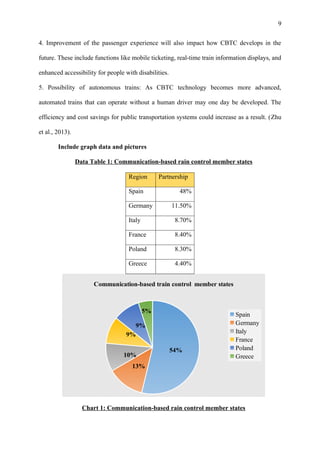
Include graph data and pictures
Data Table 1: Communication-based rain control member states
Region Partnership
Spain 48%
Germany 11.50%
Italy 8.70%
France 8.40%
Poland 8.30%
Greece 4.40%
54%
13%
10%
9%
9%
5%
Communication-based train control member states
Spain
Germany
Italy
France
Poland
Greece
Chart 1: Communication-based rain control member states
10
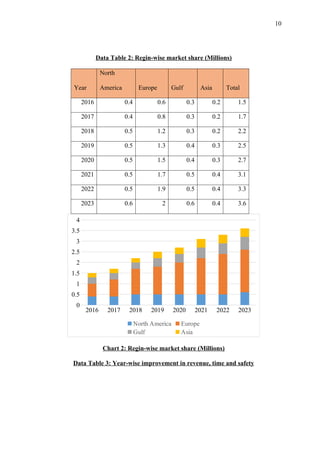
Data Table 2: Regin-wise market share (Millions)
Year
North
America Europe Gulf Asia Total
2016 0.4 0.6 0.3 0.2 1.5
2017 0.4 0.8 0.3 0.2 1.7
2018 0.5 1.2 0.3 0.2 2.2
2019 0.5 1.3 0.4 0.3 2.5
2020 0.5 1.5 0.4 0.3 2.7
2021 0.5 1.7 0.5 0.4 3.1
2022 0.5 1.9 0.5 0.4 3.3
2023 0.6 2 0.6 0.4 3.6
2016 2017 2018 2019 2020 2021 2022 2023
0
0.5
1
1.5
2
2.5
3
3.5
4
North America Europe
Gulf Asia
Chart 2: Regin-wise market share (Millions)
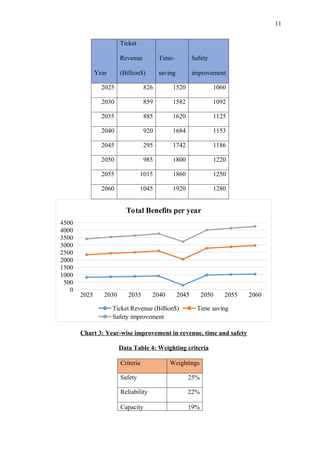
Data Table 3: Year-wise improvement in revenue, time and safety
11
Year
Ticket
Revenue
(Billion$)
Time-
saving
Safety
improvement
2025 826 1520 1060
2030 859 1582 1092
2035 885 1620 1125
2040 920 1684 1153
2045 295 1742 1186
2050 985 1800 1220
2055 1015 1860 1250
2060 1045 1920 1280
2025 2030 2035 2040 2045 2050 2055 2060
0
500
1000
1500
2000
2500
3000
3500
4000
4500
Total Benefits per year
Ticket Revenue (Billion$) Time saving
Safety improvement
Chart 3: Year-wise improvement in revenue, time and safety
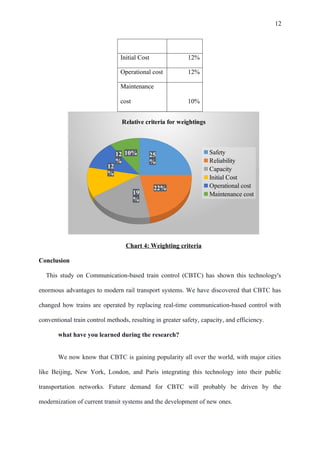
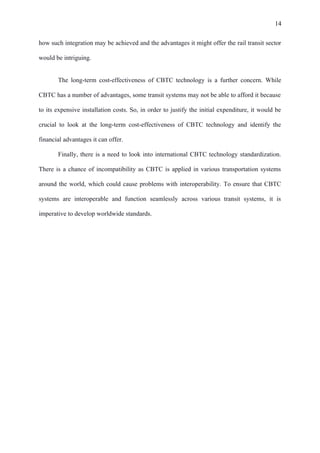
Data Table 4: Weighting criteria
Criteria Weightings
Safety 25%
Reliability 22%
Capacity 19%
12
Initial Cost 12%
Operational cost 12%
Maintenance
cost 10%
25
%
22%
19
%
12
%
12
%
10%
Relative criteria for weightings
Safety
Reliability
Capacity
Initial Cost
Operational cost
Maintenance cost
Chart 4: Weighting criteria
Conclusion
This study on Communication-based train control (CBTC) has shown this technology's
enormous advantages to modern rail transport systems. We have discovered that CBTC has
changed how trains are operated by replacing real-time communication-based control with
conventional train control methods, resulting in greater safety, capacity, and efficiency.
what have you learned during the research?
We now know that CBTC is gaining popularity all over the world, with major cities
like Beijing, New York, London, and Paris integrating this technology into their public
transportation networks. Future demand for CBTC will probably be driven by the
modernization of current transit systems and the development of new ones.
13
CBTC implementation might have difficulties, such as high installation costs,
interoperability issues, and cybersecurity worries. The proper methods, such as phased
adoption and engagement with industry partners, can overcome these difficulties.
Overall, this study on CBTC has shown how important it is to keep supporting
modernization and innovation in order to raise the dependability, efficiency, and safety of rail
transportation systems.
how does it apply to the real world?
Communication-based train control, or CBTC, has several real-world uses in modern
rail transit systems. Some advantages of CBTC technology include higher capacity, improved
safety, lower maintenance costs, and increased operational effectiveness.
For instance, the New York City Subway's implementation of CBTC has enabled the
system to run more trains during peak hours, reducing wait times and enhancing the customer
experience. Moreover, CBTC technology allows real-time monitoring and modifications,
lowering the possibility of train crashes and other safety concerns.
Furthermore, CBTC technology can result in lower maintenance costs and greater
operational effectiveness. Operators may quickly identify problems with real-time
monitoring, which decreases the need for unforeseen maintenance and improves overall
system reliability. Additionally, CBTC technology can deliver accurate location data,
enabling more precise tracking of train timetables, enhancing system functionality, and
minimizing delays.
Any lingering questions you may have
How CBTC may be incorporated with other cutting-edge technologies, including
artificial intelligence and the Internet of Things (IoT). By enabling real-time data analytics
and predictive maintenance, these technologies can improve CBTC's efficiency. Investigating
14
how such integration may be achieved and the advantages it might offer the rail transit sector
would be intriguing.
The long-term cost-effectiveness of CBTC technology is a further concern. While
CBTC has a number of advantages, some transit systems may not be able to afford it because
to its expensive installation costs. So, in order to justify the initial expenditure, it would be
crucial to look at the long-term cost-effectiveness of CBTC technology and identify the
financial advantages it can offer.
Finally, there is a need to look into international CBTC technology standardization.
There is a chance of incompatibility as CBTC is applied in various transportation systems
around the world, which could cause problems with interoperability. To ensure that CBTC
systems are interoperable and function seamlessly across various transit systems, it is
imperative to develop worldwide standards.
15
References
Morar, S. (2012). Evolution of communication based train control worldwide. https://digital-
library.theiet.org/content/conferences/10.1049/ic.2012.0054
Pascoe, R. D., & Eichorn, T. N. (2009). What is communication-based train control?. IEEE
Vehicular Technology Magazine, 4(4), 16-21.
https://ieeexplore.ieee.org/abstract/document/5338991
Wang, X., Liu, L., Tang, T., & Sun, W. (2018). Enhancing communication-based train
control systems through train-to-train communications. IEEE Transactions on
Intelligent Transportation Systems, 20(4), 1544-1561.
https://ieeexplore.ieee.org/abstract/document/8438960
Wang, H., Yu, F. R., Zhu, L., Tang, T., & Ning, B. (2015). A cognitive control approach to
communication-based train control systems. IEEE Transactions on Intelligent
Transportation Systems,. https://ieeexplore.ieee.org/abstract/document/7006768
Zhu, L., Yu, F. R., Ning, B., & Tang, T. (2013). Communication-based train control (CBTC)
systems with cooperative relaying: Design and performance analysis. IEEE
Transactions on vehicular Technology, 63(5), 2162-2172.
https://ieeexplore.ieee.org/abstract/document/6670083
Zhu, L., Yu, F. R., Ning, B., & Tang, T. (2012). Handoff performance improvements in
MIMO-enabled communication-based train control systems. IEEE Transactions on
intelligent transportation systems,
https://ieeexplore.ieee.org/abstract/document/6183515
16

390294267 - Communication-Based Train Control or CBTC (1).docx

  • 1.
    1 Communication-Based Train Controlor CBTC Student’s name Instructor’s name Course name and number Instructor name Assignment due date
  • 2.
    2 Communication-Based Train Controlor CBTC Introduction A modern signaling system utilized in the rail sector is called communication-based train control (CBTC). In order to manage train movements with great accuracy, safety, and efficiency, it uses wireless communication technology and advanced algorithms. In recent years, the demand for better train control systems has increased as a result of the desire for more dependable and effective public transportation. CBTC systems have gained popularity, and various studies have been conducted to assess their potential (Pascoe & Eichorn, 2009). Prior to the development of CBTC, the traditional signaling systems in use were built on fixed-block signaling. These systems divided trains using blocks of the predetermined track and controlled train motion with signals. The limitations of this train control method include a limited carrying capacity, slow speeds, and an increased risk of collisions. Modern CBTC systems, on the other hand, connect trains to a centralized control system using radio signals. This makes it possible for flexible railroad operations and more precise train tracking. Several research initiatives have been conducted to investigate the potential of CBTC systems. This research discusses that CBTC systems could enhance train safety, reduce travel times, and increase passenger capacity. Explain why you chose the topic. Why is it important to you? Because CBTC is a new technology that has the potential to change the modern train industry completely, we decided to focus on it. Moreover, CBTC is a vital topic for academics, transportation planners, and decision-makers. CBTC can assist in enhancing the caliber and dependability of railway services in response to the rising need for effective and sustainable public transportation (Morar, 2012).
  • 3.
    3 CBTC systems havethe ability to increase passenger capacity, decrease travel time, and improve railway safety, according to recent studies. According to research by the International Association of Public Transport (UITP), CBTC systems can shorten train headways, allowing for more trains to operate on a single track at once and minimizing delays. CBTC systems can increase train safety by giving real-time information about train movements and avoiding collisions, according to a different study by the European Union Agency for Railways (ERA). Sources that you're going to use. Explain what each source is. 1. Morar, S. (2012). Evolution of communication-based train control worldwide: This source is a conference paper published by the Institution of Engineering and Technology (IET). The author discusses the evolution of communication-based train control (CBTC) systems worldwide and provides an overview of various CBTC systems used globally. 2. Pascoe, R. D., & Eichorn, T. N. (2009). What is communication-based train control?. IEEE Vehicular Technology Magazine, 4(4), 16-21: This source is an article published in IEEE Vehicular Technology Magazine. The authors explain the concept of CBTC and how it differs from conventional train control systems. They also discuss the advantages and challenges of CBTC systems. 3. Wang, X., Liu, L., Tang, T., & Sun, W. (2018). Enhancing communication-based train control systems through train-to-train communications. IEEE Transactions on Intelligent Transportation Systems, 20(4), 1544-1561: This source is a research paper published in IEEE Transactions on Intelligent Transportation Systems. The authors propose a train- to-train communication-based approach to enhance the performance of CBTC systems. 4. Wang, H., Yu, F. R., Zhu, L., Tang, T., & Ning, B. (2015). A cognitive control approach to communication-based train control systems. IEEE Transactions on Intelligent Transportation Systems, 16(4), 1676-1689: This source is a research paper published in
  • 4.
    4 IEEE Transactions onIntelligent Transportation Systems. The authors propose a cognitive control approach to CBTC systems that considers human factors and enhances the safety and reliability of the system. 5. Zhu, L., Yu, F. R., Ning, B., & Tang, T. (2013). Communication-based train control (CBTC) systems with cooperative relaying: Design and performance analysis. IEEE Transactions on Vehicular Technology, 63(5), 2162-2172: This source is a research paper published in IEEE Transactions on Vehicular Technology. The authors propose a cooperative relaying approach to CBTC systems to improve communication performance and reduce the impact of fading. 6. Zhu, L., Yu, F. R., Ning, B., & Tang, T. (2012). Handoff performance improvements in MIMO-enabled communication-based train control systems. IEEE Transactions on Intelligent Transportation Systems, 13(2), 582-593: This source is a research paper published in IEEE Transactions on Intelligent Transportation Systems. The authors propose a multiple-input multiple-output (MIMO)-enabled approach to improving the handoff performance of CBTC systems. What do you expect to learn from this research? We expect to learn more about the origins and advancement of communication-based train control (CBTC) systems, as well as about how they are now being used in global public transportation networks and the promise they have for revolutionizing the rail sector. We also want to learn more about how CBTC systems are now applied in international public transportation networks. We will look at successful case studies of CBTC projects, like the extension of the 7 lines in New York City and the Beijing Metro Line 10. We will also look at challenges public transit systems face when implementing CBTC technology, like system compatibility issues.
  • 5.
    5 The final portionwill cover the most recent research on CBTC systems and their potential to transform the rail sector completely. In order to better understand the potential benefits and challenges of CBTC systems, we will look at the findings of recent studies, including those by the European Union Agency for Railways (ERA) and the International Association of Public Transport (UITP). We hope that our study will contribute to the body of knowledge on CBTC systems and their potential to improve the efficiency and safety of public transportation.. Communication-Based Train Control Talk about before CBTC how trains operated Before the development of Communication-based train control (CBTC) systems, fixed block signaling was the primary method of operation for trains. Trains could only enter a block in this arrangement if it were vacant. Tracks were separated into portions called blocks. Driver training information was communicated to new drivers using signals like colored lights to indicate when to accelerate, decelerate, or stop. This technique, however, had significant drawbacks. Secondly, because only one train could be in a block at a time, the number of blocks restricted the railway's capacity. Due to the reduced number of trains that could run on a particular section of track, there was congestion and delay during peak hours. Second, the track's maximum train speed was constrained because of the fixed block signaling system's requirement for a specific gap between trains. As a result, trains could not operate at full speed, severely limiting the railway's capacity. The fixed block signaling system also relied on human operators, who could make mistakes and cause delays when deciding how to move trains. For instance, a signal operator
  • 6.
    6 can overlook asignal change or signal incorrectly, which could cause confusion and accidents. Talk about modern CBTC and how it is used(such as NYC subways) Wireless communication technologies are used by modern Communication-based train control (CBTC) systems to enable real-time train tracking and control. Instead of using fixed blocks, CBTC divides the track into virtual blocks that are electronically relayed to the train control center and constantly monitored by sensors. Allowing for closer train spacing and faster speeds enables more precise control of train operations and boosts the railway's capacity. The New York City Subway system is one of the most well-known uses of CBTC. In 2012, the Metropolitan Transportation Authority (MTA) began using CBTC on the L line; since then, it has also been used on the Queens Boulevard line and the extension of the 7-line. The Communications-Based Train Control System (CBTC) has contributed to fewer delays, faster trains, and increased safety. Technology components used by the CBTC system in the NYC subway include trackside transmitters, onboard computers, and wireless communication devices. The onboard computers determine each train's location and speed, which also communicate with the train control center using data from trackside sensors. The system uses algorithms to simplify train movements, increasing capacity and efficiency. CBTC has been deployed in other public transportation systems outside the NYC subway system, such as the Beijing Subway's Line 10 and the London Underground's Jubilee Line. Efficiency, safety, and passenger experience have all considerably improved because of these measures.
  • 7.
    7 There are variousadvantages to CBTC. CBTC systems offer more precise train movements, which reduces the likelihood of crashes and other accidents by enabling real- time train tracking and control. Because more trains now operate on the same track due to the railway's increased capacity, there is less congestion and less waiting for passengers. Also, when train speeds rise, travel times decrease, enhancing the overall passenger experience. Include them as ideas, jobs or discoveries that people made about CBTC. The following are some concepts, tasks, or discoveries related to communication- based train control (CBTC): 1. Creation of the first CBTC system: In the 1980s, Siemens Transportation Systems created the first CBTC system for the Toronto Subway system. 2. The introduction of CBTC in the New York City Subway: In 2009, the L Line of the New York City Subway became the first subway system in North America to adopt CBTC. 3. CBTC for high-speed rail: To increase safety and train speeds, CBTC technology has been included in high-speed rail systems, such as the Shanghai Maglev Train. 4. Combining CBTC with positive train control (PTC): PTC is a safety feature that instantly stops a train if it exceeds a speed limit or violates a red signal. Adding CBTC to PTC can boost operational effectiveness and increase safety (Wang et al., 2018). 5. Careers involving CBTC: As the need for CBTC technology rises, more positions for CBTC engineers, technicians, and project managers have become available in the rail transit sector. 6. The development of predictive maintenance for CBTC systems reduces downtime and maintenance costs by using data analytics to predict when the repair is required. CBTC systems can use this technology to increase their dependability and lower maintenance costs (Wang et al., 2015).
  • 8.
    8 7. Usage ofCBTC in driverless trains: Systems like the Dubai Metro and Vancouver SkyTrain that use driverless trains heavily depend on CBTC technology. Overall, these innovations, jobs, and discoveries show how CBTC technology has significantly impacted the rail transit sector and its potential for future innovation and expansion. Talk about the future of CBTC With the ongoing development of technology and the growing use of communication- based train control (CBTC) in public transportation systems worldwide, the future of CBTC appears bright. Some of the trends and advancements influencing CBTC's future include the ones listed below: 1. Technology integration: To increase the capabilities of CBTC systems, more and more technologies are being combined with them, including artificial intelligence, machine learning, and the Internet of Things (IoT). In order to increase efficiency and decrease delays, CBTC systems, for instance, could apply machine learning algorithms to improve train timetables based on real-time passenger demand data. 2. Expansion to railway systems: As the advantages of CBTC become more obvious, more public transit systems are anticipated to implement the technology. For instance, the Los Angeles County Metropolitan Transportation Authority is contemplating CBTC for its subway and light rail systems. The Chicago Transit Authority plans to adopt CBTC on its Red and Purple lines (Zhu et al., 2012). 3. Enhanced cybersecurity measures: With CBTC systems becoming more interconnected and dependent on technology, cybersecurity becomes crucial. Strong cybersecurity protections must be incorporated into the architecture of CBTC systems to guard against unauthorized access and any assaults that might interfere with train operations.
  • 9.
    9 4. Improvement ofthe passenger experience will also impact how CBTC develops in the future. These include functions like mobile ticketing, real-time train information displays, and enhanced accessibility for people with disabilities. 5. Possibility of autonomous trains: As CBTC technology becomes more advanced, automated trains that can operate without a human driver may one day be developed. The efficiency and cost savings for public transportation systems could increase as a result. (Zhu et al., 2013). Include graph data and pictures Data Table 1: Communication-based rain control member states Region Partnership Spain 48% Germany 11.50% Italy 8.70% France 8.40% Poland 8.30% Greece 4.40% 54% 13% 10% 9% 9% 5% Communication-based train control member states Spain Germany Italy France Poland Greece Chart 1: Communication-based rain control member states
  • 10.
    10 Data Table 2:Regin-wise market share (Millions) Year North America Europe Gulf Asia Total 2016 0.4 0.6 0.3 0.2 1.5 2017 0.4 0.8 0.3 0.2 1.7 2018 0.5 1.2 0.3 0.2 2.2 2019 0.5 1.3 0.4 0.3 2.5 2020 0.5 1.5 0.4 0.3 2.7 2021 0.5 1.7 0.5 0.4 3.1 2022 0.5 1.9 0.5 0.4 3.3 2023 0.6 2 0.6 0.4 3.6 2016 2017 2018 2019 2020 2021 2022 2023 0 0.5 1 1.5 2 2.5 3 3.5 4 North America Europe Gulf Asia Chart 2: Regin-wise market share (Millions) Data Table 3: Year-wise improvement in revenue, time and safety
  • 11.
    11 Year Ticket Revenue (Billion$) Time- saving Safety improvement 2025 826 15201060 2030 859 1582 1092 2035 885 1620 1125 2040 920 1684 1153 2045 295 1742 1186 2050 985 1800 1220 2055 1015 1860 1250 2060 1045 1920 1280 2025 2030 2035 2040 2045 2050 2055 2060 0 500 1000 1500 2000 2500 3000 3500 4000 4500 Total Benefits per year Ticket Revenue (Billion$) Time saving Safety improvement Chart 3: Year-wise improvement in revenue, time and safety Data Table 4: Weighting criteria Criteria Weightings Safety 25% Reliability 22% Capacity 19%
  • 12.
    12 Initial Cost 12% Operationalcost 12% Maintenance cost 10% 25 % 22% 19 % 12 % 12 % 10% Relative criteria for weightings Safety Reliability Capacity Initial Cost Operational cost Maintenance cost Chart 4: Weighting criteria Conclusion This study on Communication-based train control (CBTC) has shown this technology's enormous advantages to modern rail transport systems. We have discovered that CBTC has changed how trains are operated by replacing real-time communication-based control with conventional train control methods, resulting in greater safety, capacity, and efficiency. what have you learned during the research? We now know that CBTC is gaining popularity all over the world, with major cities like Beijing, New York, London, and Paris integrating this technology into their public transportation networks. Future demand for CBTC will probably be driven by the modernization of current transit systems and the development of new ones.
  • 13.
    13 CBTC implementation mighthave difficulties, such as high installation costs, interoperability issues, and cybersecurity worries. The proper methods, such as phased adoption and engagement with industry partners, can overcome these difficulties. Overall, this study on CBTC has shown how important it is to keep supporting modernization and innovation in order to raise the dependability, efficiency, and safety of rail transportation systems. how does it apply to the real world? Communication-based train control, or CBTC, has several real-world uses in modern rail transit systems. Some advantages of CBTC technology include higher capacity, improved safety, lower maintenance costs, and increased operational effectiveness. For instance, the New York City Subway's implementation of CBTC has enabled the system to run more trains during peak hours, reducing wait times and enhancing the customer experience. Moreover, CBTC technology allows real-time monitoring and modifications, lowering the possibility of train crashes and other safety concerns. Furthermore, CBTC technology can result in lower maintenance costs and greater operational effectiveness. Operators may quickly identify problems with real-time monitoring, which decreases the need for unforeseen maintenance and improves overall system reliability. Additionally, CBTC technology can deliver accurate location data, enabling more precise tracking of train timetables, enhancing system functionality, and minimizing delays. Any lingering questions you may have How CBTC may be incorporated with other cutting-edge technologies, including artificial intelligence and the Internet of Things (IoT). By enabling real-time data analytics and predictive maintenance, these technologies can improve CBTC's efficiency. Investigating
  • 14.
    14 how such integrationmay be achieved and the advantages it might offer the rail transit sector would be intriguing. The long-term cost-effectiveness of CBTC technology is a further concern. While CBTC has a number of advantages, some transit systems may not be able to afford it because to its expensive installation costs. So, in order to justify the initial expenditure, it would be crucial to look at the long-term cost-effectiveness of CBTC technology and identify the financial advantages it can offer. Finally, there is a need to look into international CBTC technology standardization. There is a chance of incompatibility as CBTC is applied in various transportation systems around the world, which could cause problems with interoperability. To ensure that CBTC systems are interoperable and function seamlessly across various transit systems, it is imperative to develop worldwide standards.
  • 15.
    15 References Morar, S. (2012).Evolution of communication based train control worldwide. https://digital- library.theiet.org/content/conferences/10.1049/ic.2012.0054 Pascoe, R. D., & Eichorn, T. N. (2009). What is communication-based train control?. IEEE Vehicular Technology Magazine, 4(4), 16-21. https://ieeexplore.ieee.org/abstract/document/5338991 Wang, X., Liu, L., Tang, T., & Sun, W. (2018). Enhancing communication-based train control systems through train-to-train communications. IEEE Transactions on Intelligent Transportation Systems, 20(4), 1544-1561. https://ieeexplore.ieee.org/abstract/document/8438960 Wang, H., Yu, F. R., Zhu, L., Tang, T., & Ning, B. (2015). A cognitive control approach to communication-based train control systems. IEEE Transactions on Intelligent Transportation Systems,. https://ieeexplore.ieee.org/abstract/document/7006768 Zhu, L., Yu, F. R., Ning, B., & Tang, T. (2013). Communication-based train control (CBTC) systems with cooperative relaying: Design and performance analysis. IEEE Transactions on vehicular Technology, 63(5), 2162-2172. https://ieeexplore.ieee.org/abstract/document/6670083 Zhu, L., Yu, F. R., Ning, B., & Tang, T. (2012). Handoff performance improvements in MIMO-enabled communication-based train control systems. IEEE Transactions on intelligent transportation systems, https://ieeexplore.ieee.org/abstract/document/6183515
  • 16.