By
M.Prashastha Babu
11AT1A0464
 INTRODUCTION
 SOUT
 LINK DESIGN
 GENERIC OPTICAL TERMINAL
 OVERVIEW OF SOUT TERMINAL
 OPTICAL ANTENNA
 INTEGRATED TRANSMITTER
 FINE POINTING LOOP
 OPTICAL BENCH
 STRUCTURAL CONFIGURATION
 CONCLUSION
 Communication links between space crafts is an important element
of space infrastructure
 Reduction in the number of earth stations needed to service the
system.
 The link from the GEO Satellite to ground is implemented using
microwaves because of the need to communicate under all weather
conditions, interorbit link (IOL) can employ either microwave or
optical technology.
 Advantages of optical over microwaves
 The antenna can be much smaller
 Optical beam widths are much less than for microwaves, leading to
very high antenna gains on both transmit and receive
 The European Space Agency (ESA) has programmes underway to
place Satellites carrying optical terminals in GEO orbit within the
next decade.
 The first is the ARTEMIS technology demonstration satellite which
carries both microwave and SILEX optical interorbit
communications terminal.
 SILEX employs direct detection and GaAIAs diode laser
technology
 Bit rate of 50Mbps
 optical communications terminals on LEO satellites which are
capable of transmitting data to the GEO terminals
 LEO Terminal is referred to as a user terminal
 SMALL OPTICAL USER TERMINALS (SOUT) has features low
mass, small size and compatibility with SILEX
 The SOUT RIOL data rate is specified as any data rate upto 2 Mbps
 The forward interorbit link (FIOL) from ground to LEO was a
nominal data rate
Wavelength and polarisation:-
 Circular polarisation is used over the link so that the received power
does not depend upon the orientation of the satellite.
 The transmit and receive beams inside the terminal are arranged to
have orthogonal linear polarisation and are separated in wave length
 The transmit and receive wavelengths are based on GaAlAs laser
diodes
Link budgets for an asymmetric link
 Requirements, RIOL data rate must be high
 FIOL data rate minimum than RIOL
 large telescope diameter at GEO and small telescope diameter at
LEO
Pointing, Acquisition and Tracking
Pointing:- depends on
 accuracy to which one satellite knows the location of the other
 accuracy to which it knows its own attitude and
 accuracy to which it can aim its beam knowing the required
direction
Acquisition
 Before communication can commence, a high power beam laser
located on LEO end has to scan over the region of uncertainty until
it illuminates the GEO terminal and is detected.
 Once the GEO terminal receives the LEO communication beam it
switches from the beacon to the forward link communication beam.
 communication link between the LEO and GEO space craft
Tracking:-
 In this mode the on-board disturbances which introduce pointing
fitter into the communication beam are alternated by means of a fine
pointing control loop (FPL) to enable acceptable communications
to be obtained.
 These disturbances are due to thruster firings, solar arrays drive
mechanisms, instrument harmonics and other effects.
Point ahead angle:-
 This is needed because of the relative orbital motion between the
satellites which calls for the transmitted beam to be aimed at a point
in space where the receiving terminal will be at the time of arrival of
the beam
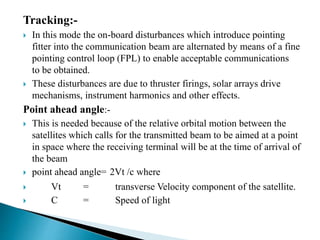
 point ahead angle= 2Vt /c where
 Vt = transverse Velocity component of the satellite.
 C = Speed of light
Intersatellite links permit the
following:
 The use of a geostationary satellite as a relay for permanent
links between low orbit satellites and a network of a small
number of earth stations.
 An increase in system capacity by combining the capacities of
several geostationary satellites.
 The planning of systems with a higher degree of flexibility.
 Consideration of systems providing a permanent link and
worldwide coverage
 using low orbit satellites as an alternative to systems using
geostationary satellites.
 Optical technology is more advantageous in terms of mass and
power consumption for high capacity links.
 In this system a nested pair of mechanism which perform the course
pointing and fine pointing functions is used.
 The former is the coarse pointing assembly (CPA) and has a large
angular range but a small band width .
 The latter, the fine pointing assembly (FPA) has a small angular
range and large band width.
 These form elements of control loops in conjuction with acquisition
and tracking sensors which detect the line of sight of the incoming
optical beam
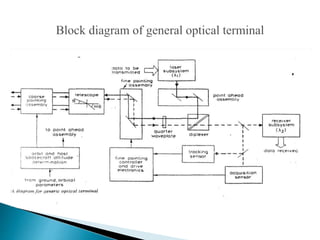
 The SOUT terminal consists of two main parts: a terminal head unit
and a remote electronics module (REM).
 The REM contains the digital processing electronics for the pointing
acquisition and tracking (PAT) and terminal control functions.
 Dimensions 200 by 200 by 150mm
 The REM will have the advantage of advanced packaging ASIC
 The terminal head performs the critical functions of generating and
pointing
 Key elements of the head unit are the integrated transmitter, point
ahead assembly (PAA) optical antenna comprising telescope and
coarse pointing assembly, fine pointing loop comprising acquisition
and tracking sensor (ATDU) and optical bench.
 The optical antenna comprises the telescope and coarse pointing
assembly.
 The telescope is a refractive keplerian design.
 The CPA uses stepping motors together with a conventional spur
gear and planetary gear.
 The total height of the optical antenna is a major contributor to the
height of the CPA
 This consists of a prime/redundant pair of laser modules, a
redundancy switch, and a point ahead assembly (PAA)
 Each laser module contains a laser diode, collimating lenses,
cylindrical lens and focusing lens for coupling light into the fiber.
 Coupling effieciency into the fiber is expected to exceed 70%.
 Modulation can be internal or external.
 Internal modulation implies direct modification .
 External modulation is a modification of the light beam after its
emission by the laser.
 The intensity, the frequency, the phase and the polarisation can be
modulated. Phase and polarisation modulation are external. Intensity
and frequency modulation can be internal or external.
 The fine pointing loop (FPL) is required to attenuate external
pointing disturbances so that the residual mispoint angle is a small
fraction of the optical beam width
 The closed loop tracking subsystem consists of a tracking sensor.
 The duplexer, quarter wave plate and other lens system, acquisition
and tracking are all placed in the optical bench.
 The duplexer has a dielectric multilayer coating which provides
efficient transmission of one type polarised light at the transmit
wavelength (848 nm) and rejects another type poiarised light at the
receive wavelength (800 nm).
 A quarter wave plate (QWP) converts the transmit light to circular
polarisation state prior to the telescope.
 The PAA, lasers, and redundancy switching mechanisms are on one
side while the diplexer, receive paths and calibration path are on the
other side of the optical bench.
General optical satellite
communication links
 Optical intersatellite communications promises to become an
important element in future space infrastructure and considerable
development effort is currently underway in Europe and elsewhere.
 Editorial: IEEE Processing - Optoelectronics - Vol 141 - Dec 1994
 GATENBY, P and GRANT.M : Optical intersatellite links for space
interconnectivity
 ROBERT GAGUADE: Sattelite Communication
 WITTIG.M and OPEN HAUSER.G: Performance of optical
intersatellite links.
 http://www.entecollege.com
Optical satellite communication

Optical satellite communication

  • 1.
  • 2.
     INTRODUCTION  SOUT LINK DESIGN  GENERIC OPTICAL TERMINAL  OVERVIEW OF SOUT TERMINAL  OPTICAL ANTENNA  INTEGRATED TRANSMITTER  FINE POINTING LOOP  OPTICAL BENCH  STRUCTURAL CONFIGURATION  CONCLUSION
  • 3.
     Communication linksbetween space crafts is an important element of space infrastructure  Reduction in the number of earth stations needed to service the system.  The link from the GEO Satellite to ground is implemented using microwaves because of the need to communicate under all weather conditions, interorbit link (IOL) can employ either microwave or optical technology.  Advantages of optical over microwaves  The antenna can be much smaller  Optical beam widths are much less than for microwaves, leading to very high antenna gains on both transmit and receive
  • 5.
     The EuropeanSpace Agency (ESA) has programmes underway to place Satellites carrying optical terminals in GEO orbit within the next decade.  The first is the ARTEMIS technology demonstration satellite which carries both microwave and SILEX optical interorbit communications terminal.  SILEX employs direct detection and GaAIAs diode laser technology  Bit rate of 50Mbps  optical communications terminals on LEO satellites which are capable of transmitting data to the GEO terminals
  • 6.
     LEO Terminalis referred to as a user terminal  SMALL OPTICAL USER TERMINALS (SOUT) has features low mass, small size and compatibility with SILEX  The SOUT RIOL data rate is specified as any data rate upto 2 Mbps  The forward interorbit link (FIOL) from ground to LEO was a nominal data rate
  • 7.
    Wavelength and polarisation:- Circular polarisation is used over the link so that the received power does not depend upon the orientation of the satellite.  The transmit and receive beams inside the terminal are arranged to have orthogonal linear polarisation and are separated in wave length  The transmit and receive wavelengths are based on GaAlAs laser diodes Link budgets for an asymmetric link  Requirements, RIOL data rate must be high  FIOL data rate minimum than RIOL  large telescope diameter at GEO and small telescope diameter at LEO
  • 8.
    Pointing, Acquisition andTracking Pointing:- depends on  accuracy to which one satellite knows the location of the other  accuracy to which it knows its own attitude and  accuracy to which it can aim its beam knowing the required direction Acquisition  Before communication can commence, a high power beam laser located on LEO end has to scan over the region of uncertainty until it illuminates the GEO terminal and is detected.  Once the GEO terminal receives the LEO communication beam it switches from the beacon to the forward link communication beam.  communication link between the LEO and GEO space craft
  • 9.
    Tracking:-  In thismode the on-board disturbances which introduce pointing fitter into the communication beam are alternated by means of a fine pointing control loop (FPL) to enable acceptable communications to be obtained.  These disturbances are due to thruster firings, solar arrays drive mechanisms, instrument harmonics and other effects. Point ahead angle:-  This is needed because of the relative orbital motion between the satellites which calls for the transmitted beam to be aimed at a point in space where the receiving terminal will be at the time of arrival of the beam  point ahead angle= 2Vt /c where  Vt = transverse Velocity component of the satellite.  C = Speed of light
  • 10.
    Intersatellite links permitthe following:  The use of a geostationary satellite as a relay for permanent links between low orbit satellites and a network of a small number of earth stations.  An increase in system capacity by combining the capacities of several geostationary satellites.  The planning of systems with a higher degree of flexibility.  Consideration of systems providing a permanent link and worldwide coverage  using low orbit satellites as an alternative to systems using geostationary satellites.  Optical technology is more advantageous in terms of mass and power consumption for high capacity links.
  • 12.
     In thissystem a nested pair of mechanism which perform the course pointing and fine pointing functions is used.  The former is the coarse pointing assembly (CPA) and has a large angular range but a small band width .  The latter, the fine pointing assembly (FPA) has a small angular range and large band width.  These form elements of control loops in conjuction with acquisition and tracking sensors which detect the line of sight of the incoming optical beam
  • 14.
     The SOUTterminal consists of two main parts: a terminal head unit and a remote electronics module (REM).  The REM contains the digital processing electronics for the pointing acquisition and tracking (PAT) and terminal control functions.  Dimensions 200 by 200 by 150mm  The REM will have the advantage of advanced packaging ASIC  The terminal head performs the critical functions of generating and pointing  Key elements of the head unit are the integrated transmitter, point ahead assembly (PAA) optical antenna comprising telescope and coarse pointing assembly, fine pointing loop comprising acquisition and tracking sensor (ATDU) and optical bench.
  • 16.
     The opticalantenna comprises the telescope and coarse pointing assembly.  The telescope is a refractive keplerian design.  The CPA uses stepping motors together with a conventional spur gear and planetary gear.  The total height of the optical antenna is a major contributor to the height of the CPA
  • 17.
     This consistsof a prime/redundant pair of laser modules, a redundancy switch, and a point ahead assembly (PAA)  Each laser module contains a laser diode, collimating lenses, cylindrical lens and focusing lens for coupling light into the fiber.  Coupling effieciency into the fiber is expected to exceed 70%.  Modulation can be internal or external.  Internal modulation implies direct modification .  External modulation is a modification of the light beam after its emission by the laser.  The intensity, the frequency, the phase and the polarisation can be modulated. Phase and polarisation modulation are external. Intensity and frequency modulation can be internal or external.
  • 19.
     The finepointing loop (FPL) is required to attenuate external pointing disturbances so that the residual mispoint angle is a small fraction of the optical beam width  The closed loop tracking subsystem consists of a tracking sensor.
  • 20.
     The duplexer,quarter wave plate and other lens system, acquisition and tracking are all placed in the optical bench.  The duplexer has a dielectric multilayer coating which provides efficient transmission of one type polarised light at the transmit wavelength (848 nm) and rejects another type poiarised light at the receive wavelength (800 nm).  A quarter wave plate (QWP) converts the transmit light to circular polarisation state prior to the telescope.  The PAA, lasers, and redundancy switching mechanisms are on one side while the diplexer, receive paths and calibration path are on the other side of the optical bench.
  • 22.
  • 23.
     Optical intersatellitecommunications promises to become an important element in future space infrastructure and considerable development effort is currently underway in Europe and elsewhere.
  • 24.
     Editorial: IEEEProcessing - Optoelectronics - Vol 141 - Dec 1994  GATENBY, P and GRANT.M : Optical intersatellite links for space interconnectivity  ROBERT GAGUADE: Sattelite Communication  WITTIG.M and OPEN HAUSER.G: Performance of optical intersatellite links.  http://www.entecollege.com