A VOCATIONAL TRAINING REPORT ON-Presented 
RAILWAY COMMUNICATION SYSTEM 
UNDER THE SUPERVISION OF-H. 
O.D. MR YOGESH BAHENDWAR 
by: 
VIKASH KUMAR ANSHU KUMAR 
RAKESH KUMAR HARSH
CONTENTS: 
• INTRODUCTION 
• PARTS OF RAILWAY COMMUNICATION- 
1.RAILNET 
2.FOIS 
• COMMUNICATION 
• METHOD OF COMMUNICATION IN RAILWAYS 
• TRANSMISSION METHOD 
• NETWORK COMPONENTS
INTRODUCTION TO RAILWAYS 
 Indian Railway is certainly the 'Lifeline of the Nation' with its commendable 
performance since the last 150 years having 11270 trains each day on a 
total rail route of 62,480km. 
 Indian Railways is known to be the largest railway network in Asia and 
world's largest railway system under a single management with 16 zones. 
 IR employs about 1.6 million people, making itself the second largest 
commercial or utility employer in the world. 
 The Durg-Bhilai area comes under the South East Central Railway whose 
headquarters is at Bilaspur. It started functioning as a separate zone from 
5th April 2003. 
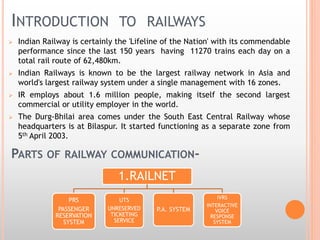
1.RAILNET 
PRS 
PASSENGER 
RESERVATION 
SYSTEM 
UTS 
UNRESERVED 
TICKETING 
SERVICE 
P.A. SYSTEM 
IVRS 
INTERACTIVE 
VOICE 
RESPONSE 
SYSTEM 
PARTS OF RAILWAY COMMUNICATION-
RAILNET-Railnet 
is a network which is run by the Indian Railway for its customer service 
purpose. Passengers can access Railnet through internet and can get user 
required data about train schedule, ticketing, reservation, train running 
information etc. 
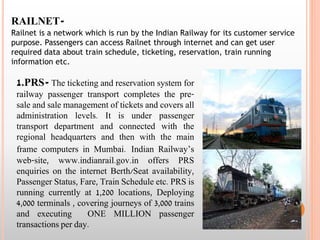
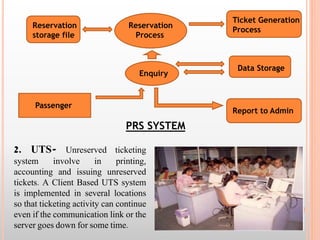
1.PRS- The ticketing and reservation system for 
railway passenger transport completes the pre-sale 
and sale management of tickets and covers all 
administration levels. It is under passenger 
transport department and connected with the 
regional headquarters and then with the main 
frame computers in Mumbai. Indian Railway’s 
web-site, www.indianrail.gov.in offers PRS 
enquiries on the internet Berth/Seat availability, 
Passenger Status, Fare, Train Schedule etc. PRS is 
running currently at 1,200 locations, Deploying 
4,000 terminals , covering journeys of 3,000 trains 
and executing ONE MILLION passenger 
transactions per day.
Reservation 
storage file 
Passenger 
Reservation 
Process 
Enquiry 
Ticket Generation 
Process 
Data Storage 
Report to Admin 
PRS SYSTEM 
2. UTS- Unreserved ticketing 
system involve in printing, 
accounting and issuing unreserved 
tickets. A Client Based UTS system 
is implemented in several locations 
so that ticketing activity can continue 
even if the communication link or the 
server goes down for some time.
3. P.A. SYSTEM- Announcements of train arrivals, departure, delays, etc. 
through preprogrammed messages are stored on data voice recorders on 
stations along the railway line. 
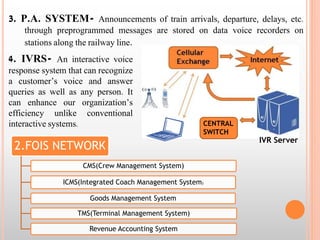
4. IVRS- An interactive voice 
response system that can recognize 
a customer’s voice and answer 
queries as well as any person. It 
can enhance our organization’s 
efficiency unlike conventional 
interactive systems. 
IVR Server 
2.FOIS NETWORK 
CMS(Crew Management System) 
ICMS(Integrated Coach Management System) 
Goods Management System 
TMS(Terminal Management System) 
Revenue Accounting System 
CENTRAL 
SWITCH
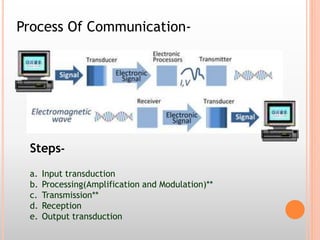
Process Of Communication- 
Steps-a. 
Input transduction 
b. Processing(Amplification and Modulation)** 
c. Transmission** 
d. Reception 
e. Output transduction
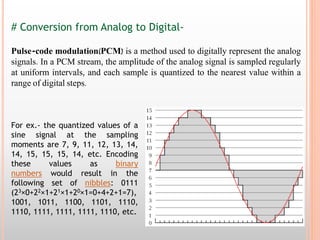
# Conversion from Analog to Digital- 
Pulse-code modulation(PCM) is a method used to digitally represent the analog 
signals. In a PCM stream, the amplitude of the analog signal is sampled regularly 
at uniform intervals, and each sample is quantized to the nearest value within a 
range of digital steps. 
For ex.- the quantized values of a 
sine signal at the sampling 
moments are 7, 9, 11, 12, 13, 14, 
14, 15, 15, 15, 14, etc. Encoding 
these values as binary 
numbers would result in the 
following set of nibbles: 0111 
(23×0+22×1+21×1+20×1=0+4+2+1=7), 
1001, 1011, 1100, 1101, 1110, 
1110, 1111, 1111, 1111, 1110, etc.
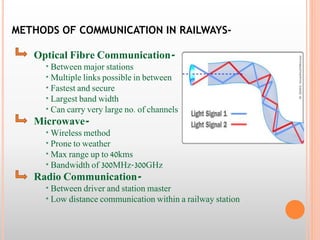
METHODS OF COMMUNICATION IN RAILWAYS-Optical 
Fibre Communication- 
* Between major stations 
* Multiple links possible in between 
* Fastest and secure 
* Largest band width 
* Can carry very large no. of channels 
Microwave- 
* Wireless method 
* Prone to weather 
* Max range up to 40kms 
* Bandwidth of 300MHz-300GHz 
Radio Communication- 
* Between driver and station master 
* Low distance communication within a railway station
LAN- 
* Wired communication between different computers at a station 
* Internet or Intranet access may be there 
* RJ-45(8 pin connection) cable or coaxial cable 
is used. 
* Works within a station 
Telephonic communication- 
* Connects different offices, loco-sheds, homes 
of officials 
* Works via a telephone line 
* Often single channel is used 
* Separate Railway Telecom. Exchange is set 
up for this purpose
Transmission Methods- 
1. PDH- The Plesiochronous Digital Hierarchy is a technology used 
in telecommunications networks to transport large quantities of data over 
digital transport equipment such as fibre optic and microwave radio systems 
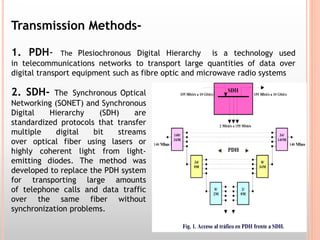
2. SDH- The Synchronous Optical 
Networking (SONET) and Synchronous 
Digital Hierarchy (SDH) are 
standardized protocols that transfer 
multiple digital bit streams 
over optical fiber using lasers or 
highly coherent light from light-emitting 
diodes. The method was 
developed to replace the PDH system 
for transporting large amounts 
of telephone calls and data traffic 
over the same fiber without 
synchronization problems.
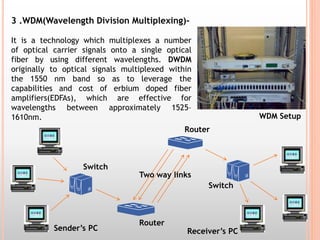
3 .WDM(Wavelength Division Multiplexing)- 
It is a technology which multiplexes a number 
of optical carrier signals onto a single optical 
fiber by using different wavelengths. DWDM 
originally to optical signals multiplexed within 
the 1550 nm band so as to leverage the 
capabilities and cost of erbium doped fiber 
amplifiers(EDFAs), which are effective for 
wavelengths between approximately 1525– 
1610nm. WDM Setup 
Switch 
Sender’s PC 
Two way links 
Router 
Router 
Switch 
Receiver’s PC
Network Components- 
1. Router 
2. Switch 
3. Firewall 
4. Network Interface Card 
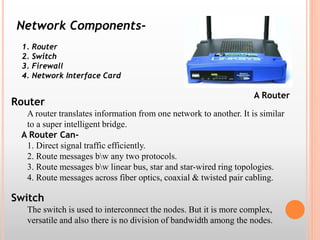
Router 
A Router 
A router translates information from one network to another. It is similar 
to a super intelligent bridge. 
A Router Can- 
1. Direct signal traffic efficiently. 
2. Route messages bw any two protocols. 
3. Route messages bw linear bus, star and star-wired ring topologies. 
4. Route messages across fiber optics, coaxial & twisted pair cabling. 
Switch 
The switch is used to interconnect the nodes. But it is more complex, 
versatile and also there is no division of bandwidth among the nodes.
Firewall 
It is security purpose software, which is used to secure the server contents, 
so the outside user could not temper the information; the user can read the 
information but can not write any thing. 
Network Interface Card 
It is a device having intelligence to control access to the networks and 
enable communication across the network. Through NIC the nodes are 
connected functionally and physically to the network. It is also called 
network adapter. 
___________________________________
QUERIES PLEASE… Thank You..
Queries???

communication system in railways

  • 1.
    A VOCATIONAL TRAININGREPORT ON-Presented RAILWAY COMMUNICATION SYSTEM UNDER THE SUPERVISION OF-H. O.D. MR YOGESH BAHENDWAR by: VIKASH KUMAR ANSHU KUMAR RAKESH KUMAR HARSH
  • 2.
    CONTENTS: • INTRODUCTION • PARTS OF RAILWAY COMMUNICATION- 1.RAILNET 2.FOIS • COMMUNICATION • METHOD OF COMMUNICATION IN RAILWAYS • TRANSMISSION METHOD • NETWORK COMPONENTS
  • 3.
    INTRODUCTION TO RAILWAYS  Indian Railway is certainly the 'Lifeline of the Nation' with its commendable performance since the last 150 years having 11270 trains each day on a total rail route of 62,480km.  Indian Railways is known to be the largest railway network in Asia and world's largest railway system under a single management with 16 zones.  IR employs about 1.6 million people, making itself the second largest commercial or utility employer in the world.  The Durg-Bhilai area comes under the South East Central Railway whose headquarters is at Bilaspur. It started functioning as a separate zone from 5th April 2003. 1.RAILNET PRS PASSENGER RESERVATION SYSTEM UTS UNRESERVED TICKETING SERVICE P.A. SYSTEM IVRS INTERACTIVE VOICE RESPONSE SYSTEM PARTS OF RAILWAY COMMUNICATION-
  • 4.
    RAILNET-Railnet is anetwork which is run by the Indian Railway for its customer service purpose. Passengers can access Railnet through internet and can get user required data about train schedule, ticketing, reservation, train running information etc. 1.PRS- The ticketing and reservation system for railway passenger transport completes the pre-sale and sale management of tickets and covers all administration levels. It is under passenger transport department and connected with the regional headquarters and then with the main frame computers in Mumbai. Indian Railway’s web-site, www.indianrail.gov.in offers PRS enquiries on the internet Berth/Seat availability, Passenger Status, Fare, Train Schedule etc. PRS is running currently at 1,200 locations, Deploying 4,000 terminals , covering journeys of 3,000 trains and executing ONE MILLION passenger transactions per day.
  • 5.
    Reservation storage file Passenger Reservation Process Enquiry Ticket Generation Process Data Storage Report to Admin PRS SYSTEM 2. UTS- Unreserved ticketing system involve in printing, accounting and issuing unreserved tickets. A Client Based UTS system is implemented in several locations so that ticketing activity can continue even if the communication link or the server goes down for some time.
  • 6.
    3. P.A. SYSTEM-Announcements of train arrivals, departure, delays, etc. through preprogrammed messages are stored on data voice recorders on stations along the railway line. 4. IVRS- An interactive voice response system that can recognize a customer’s voice and answer queries as well as any person. It can enhance our organization’s efficiency unlike conventional interactive systems. IVR Server 2.FOIS NETWORK CMS(Crew Management System) ICMS(Integrated Coach Management System) Goods Management System TMS(Terminal Management System) Revenue Accounting System CENTRAL SWITCH
  • 7.
    Process Of Communication- Steps-a. Input transduction b. Processing(Amplification and Modulation)** c. Transmission** d. Reception e. Output transduction
  • 8.
    # Conversion fromAnalog to Digital- Pulse-code modulation(PCM) is a method used to digitally represent the analog signals. In a PCM stream, the amplitude of the analog signal is sampled regularly at uniform intervals, and each sample is quantized to the nearest value within a range of digital steps. For ex.- the quantized values of a sine signal at the sampling moments are 7, 9, 11, 12, 13, 14, 14, 15, 15, 15, 14, etc. Encoding these values as binary numbers would result in the following set of nibbles: 0111 (23×0+22×1+21×1+20×1=0+4+2+1=7), 1001, 1011, 1100, 1101, 1110, 1110, 1111, 1111, 1111, 1110, etc.
  • 9.
    METHODS OF COMMUNICATIONIN RAILWAYS-Optical Fibre Communication- * Between major stations * Multiple links possible in between * Fastest and secure * Largest band width * Can carry very large no. of channels Microwave- * Wireless method * Prone to weather * Max range up to 40kms * Bandwidth of 300MHz-300GHz Radio Communication- * Between driver and station master * Low distance communication within a railway station
  • 10.
    LAN- * Wiredcommunication between different computers at a station * Internet or Intranet access may be there * RJ-45(8 pin connection) cable or coaxial cable is used. * Works within a station Telephonic communication- * Connects different offices, loco-sheds, homes of officials * Works via a telephone line * Often single channel is used * Separate Railway Telecom. Exchange is set up for this purpose
  • 11.
    Transmission Methods- 1.PDH- The Plesiochronous Digital Hierarchy is a technology used in telecommunications networks to transport large quantities of data over digital transport equipment such as fibre optic and microwave radio systems 2. SDH- The Synchronous Optical Networking (SONET) and Synchronous Digital Hierarchy (SDH) are standardized protocols that transfer multiple digital bit streams over optical fiber using lasers or highly coherent light from light-emitting diodes. The method was developed to replace the PDH system for transporting large amounts of telephone calls and data traffic over the same fiber without synchronization problems.
  • 12.
    3 .WDM(Wavelength DivisionMultiplexing)- It is a technology which multiplexes a number of optical carrier signals onto a single optical fiber by using different wavelengths. DWDM originally to optical signals multiplexed within the 1550 nm band so as to leverage the capabilities and cost of erbium doped fiber amplifiers(EDFAs), which are effective for wavelengths between approximately 1525– 1610nm. WDM Setup Switch Sender’s PC Two way links Router Router Switch Receiver’s PC
  • 13.
    Network Components- 1.Router 2. Switch 3. Firewall 4. Network Interface Card Router A Router A router translates information from one network to another. It is similar to a super intelligent bridge. A Router Can- 1. Direct signal traffic efficiently. 2. Route messages bw any two protocols. 3. Route messages bw linear bus, star and star-wired ring topologies. 4. Route messages across fiber optics, coaxial & twisted pair cabling. Switch The switch is used to interconnect the nodes. But it is more complex, versatile and also there is no division of bandwidth among the nodes.
  • 14.
    Firewall It issecurity purpose software, which is used to secure the server contents, so the outside user could not temper the information; the user can read the information but can not write any thing. Network Interface Card It is a device having intelligence to control access to the networks and enable communication across the network. Through NIC the nodes are connected functionally and physically to the network. It is also called network adapter. ___________________________________
  • 15.
  • 16.