APPROACH TO A PALE OPTIC DISC
OVERVIEW
• INTRODUCTION
• IMPORTANT POINTS IN HISTORY
• IMPORTANT POINTS IN EXAMINATION
• RELEVANT INVESTIGATIONS
• MANAGEMENT
• CASE EXAMPLE
• Rule out the mimics
• Clinical diagnosis
• Classify
– Pattern of optic disc appearance
– Etiology
• Investigations to confirm diagnosis
• Assess visual prognosis (progressive / static)
• Management (if needed)
INTRODUCTION
• End result of a number of pathologic
processes leading to loss of axonal fibres and
their replacement by glial tissue
• Normal color is salmon pink
– Vascularity
– Proportional glial and axonal elements
• Pale appearance due to
– Decreased vascularity
– Capillary dropout
– Gliosis
– Increased visibility of scleral laminae
AIM OF CLINICAL EVALUATION
• To determine the possible cause of the disc pallor
and whether this is due to
– An ongoing process which is likely to progress
• Ischemic / compressive
– Result of a previous one time insult
• Inflammatory / toxic / traumatic
• Visual prognosis
• Any intervention needed at present
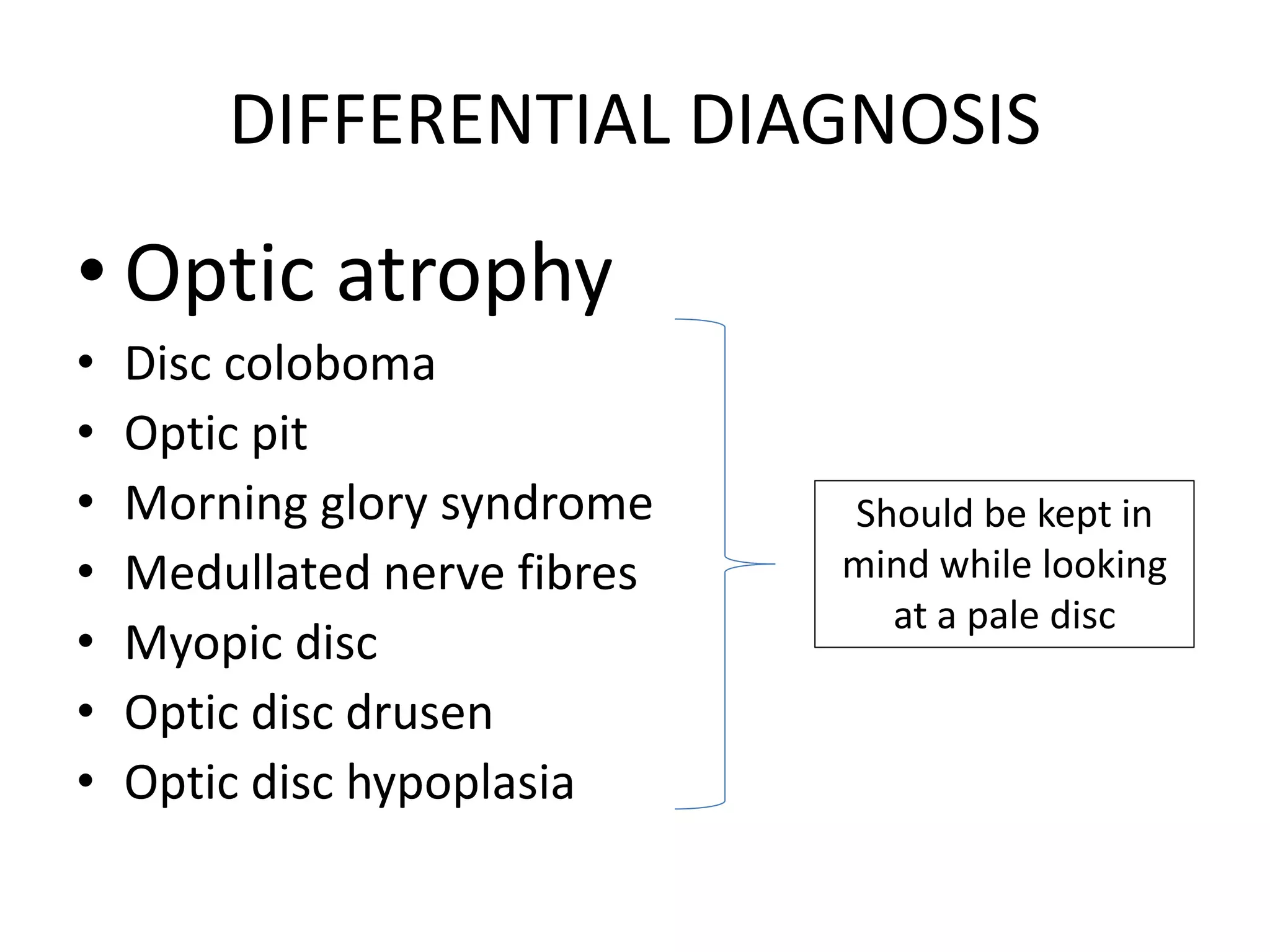
DIFFERENTIAL DIAGNOSIS
• Optic atrophy
• Disc coloboma
• Optic pit
• Morning glory syndrome
• Medullated nerve fibres
• Myopic disc
• Optic disc drusen
• Optic disc hypoplasia
Should be kept in
mind while looking
at a pale disc
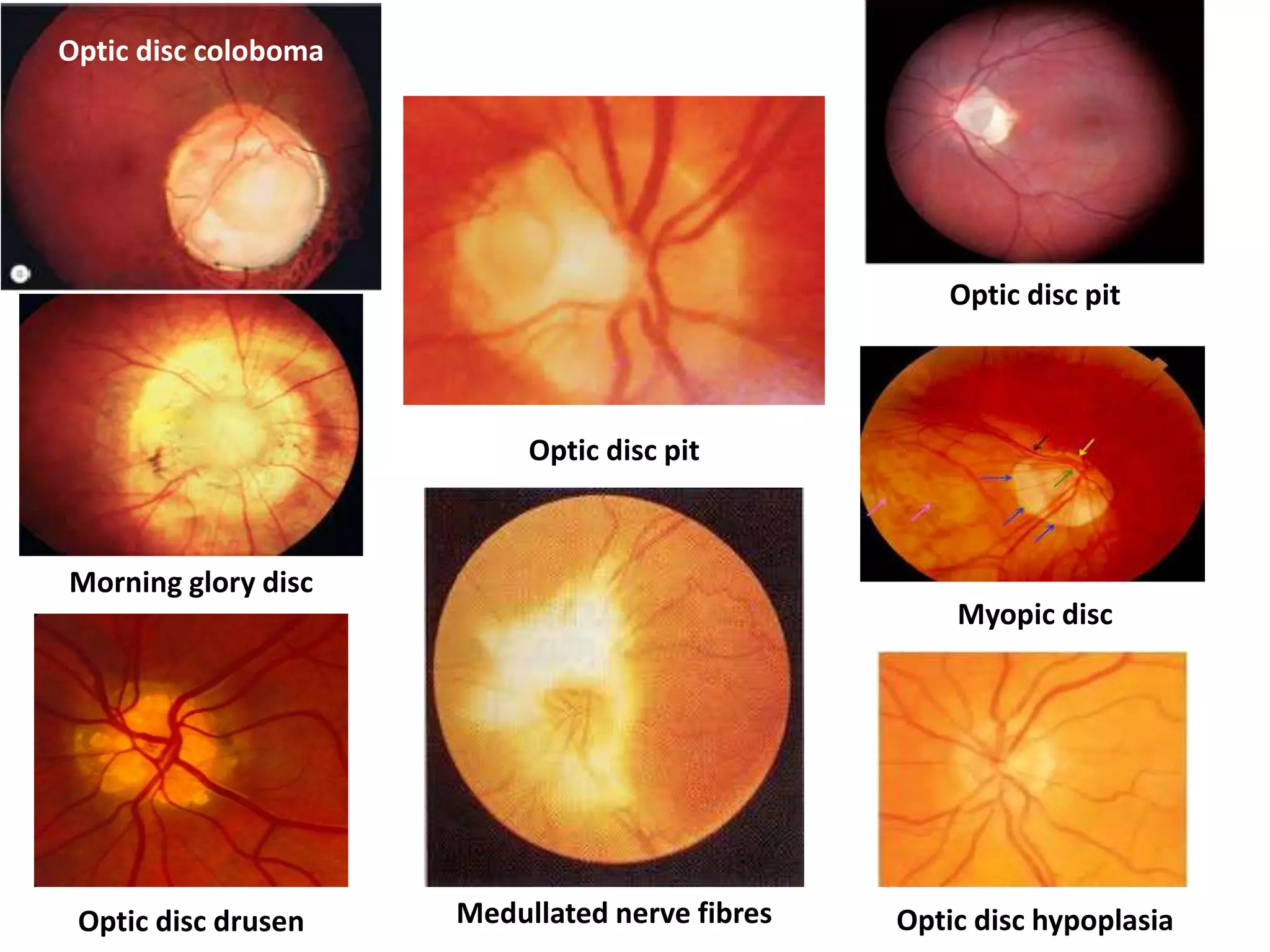
Morning glory disc
Optic disc drusen Medullated nerve fibres
Optic disc pit
Optic disc hypoplasia
Myopic disc
Optic disc coloboma
Optic disc pit
PATTERNS
• Ischemic (anterior ischemic optic neuropathy)
• Inflammatory
• Toxic/ nutritional
• Compressive
• Traumatic
• Hereditary
• Main complain is usually a decrease in visual
acuity
• Observant patients will tell about color
desaturation and field defects
IMPORTANT POINTS TO ELICIT IN THE
HISTORY
• Unilateral or bilateral
• Children / young adults / elderly population
• Acute sudden loss / gradual diminution
• Precipitating factors (fever / trauma / neurologic
symptoms)
• Associated symptoms
– Jaw claudication / scalp tenderness / headache
– Proptosis
– Diplopia
• Exposure to
– Drugs (ethambutol / isoniazid / chloroquine / amiodarone)
– Toxins (alcohol / methanol /tobacco)
– Radiation
• Possibility of malnourishment
• Systemic illness
– Atherosclerosis
– Hypertension
– Diabetes mellitus
– Sleep apnea
– Thyroid disorder
• Symptoms of B12 deficiency
• Family history
IMPORTANT EXAMINATION
POINTS
• GENERAL PHYSICAL
– Pallor
– Pulse
• Rate / rhythm / volume / symmetrical
– Blood pressure (both arms)
– Bruit at common carotid (upper border of thyroid
cartilage)
– Signs of nutritional deficiency / chronic alcohol
use / chronic smoking
– Gait (tunnel vision / ataxia)
• Best corrected visual acuity
• Color vision / saturation
• Pupillary reaction / RAPD
• Squint / ocular movements / nystagmus
• Proptosis
• Confrontation fields
• Anterior segment
– Neovascularisation of iris / angle
• Ocular ischemic syndrome
• IOP
• Optic disc appearance
– Pallor :
• Diffuse
• Sectoral (wedge shaped / temporal / altitudinal/ bow tie)
– Patterns
• Primary
• Secondary
• Consecutive
• Glaucomatous
TEMPORAL PALLOR
• Carries papillomacular bundle
• Most active fibres with high metabolic activity
• Travel through the centre of the optic nerve
– Others report them being scattered throughout
the nerve
• Vulnerable to ischemic insult
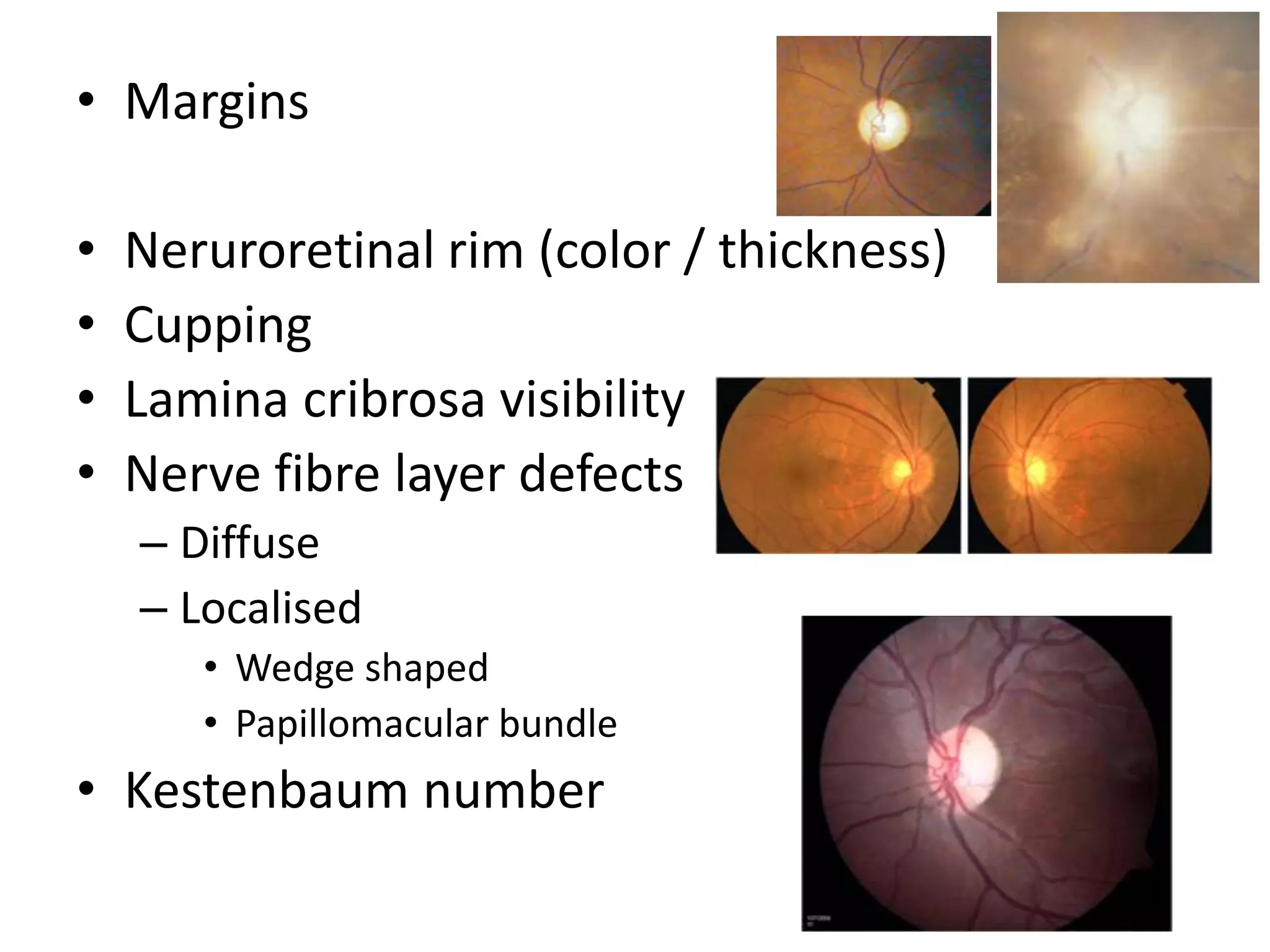
• Margins
• Neruroretinal rim (color / thickness)
• Cupping
• Lamina cribrosa visibility
• Nerve fibre layer defects
– Diffuse
– Localised
• Wedge shaped
• Papillomacular bundle
• Kestenbaum number
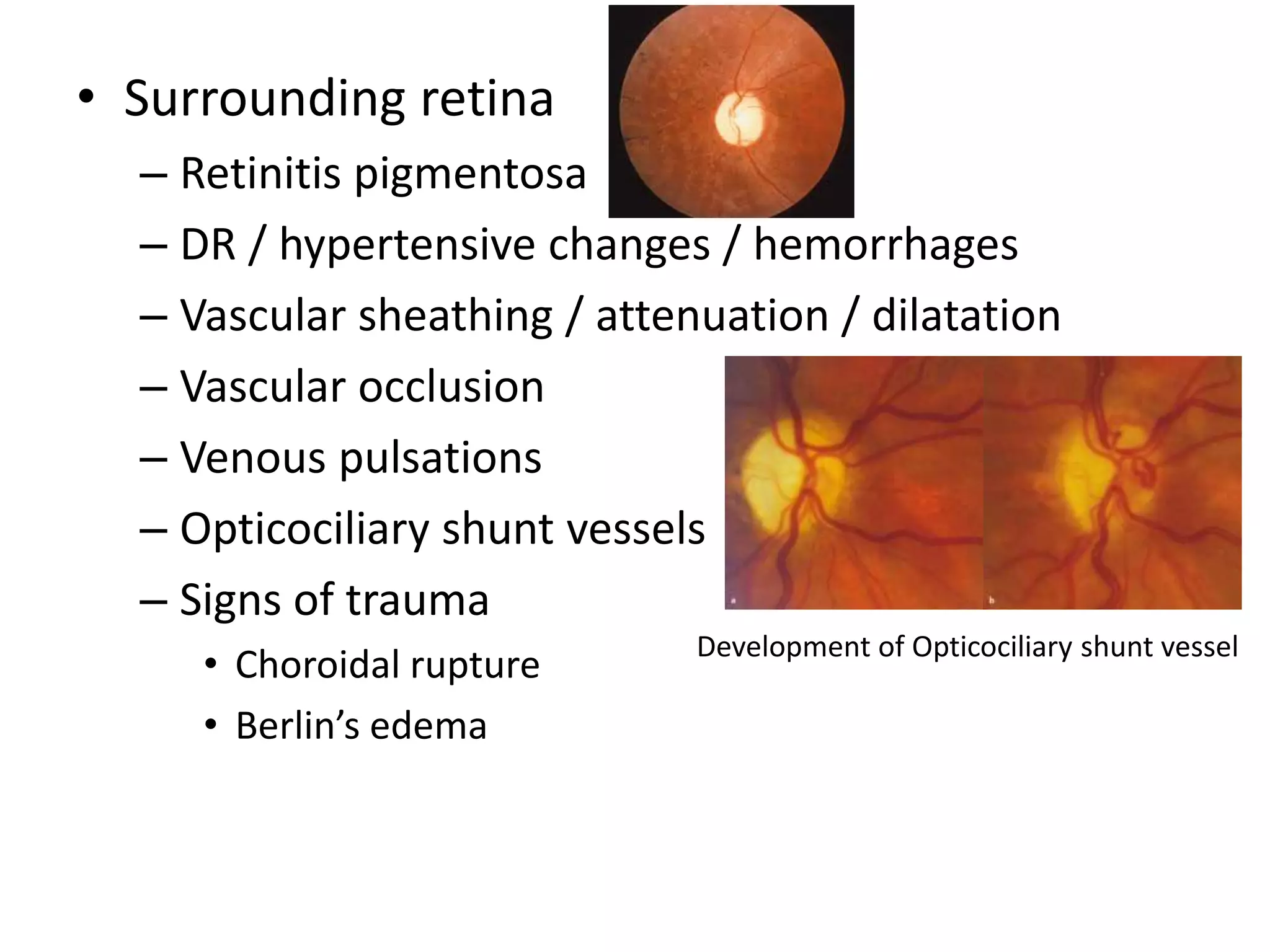
• Surrounding retina
– Retinitis pigmentosa
– DR / hypertensive changes / hemorrhages
– Vascular sheathing / attenuation / dilatation
– Vascular occlusion
– Venous pulsations
– Opticociliary shunt vessels
– Signs of trauma
• Choroidal rupture
• Berlin’s edema
Development of Opticociliary shunt vessel
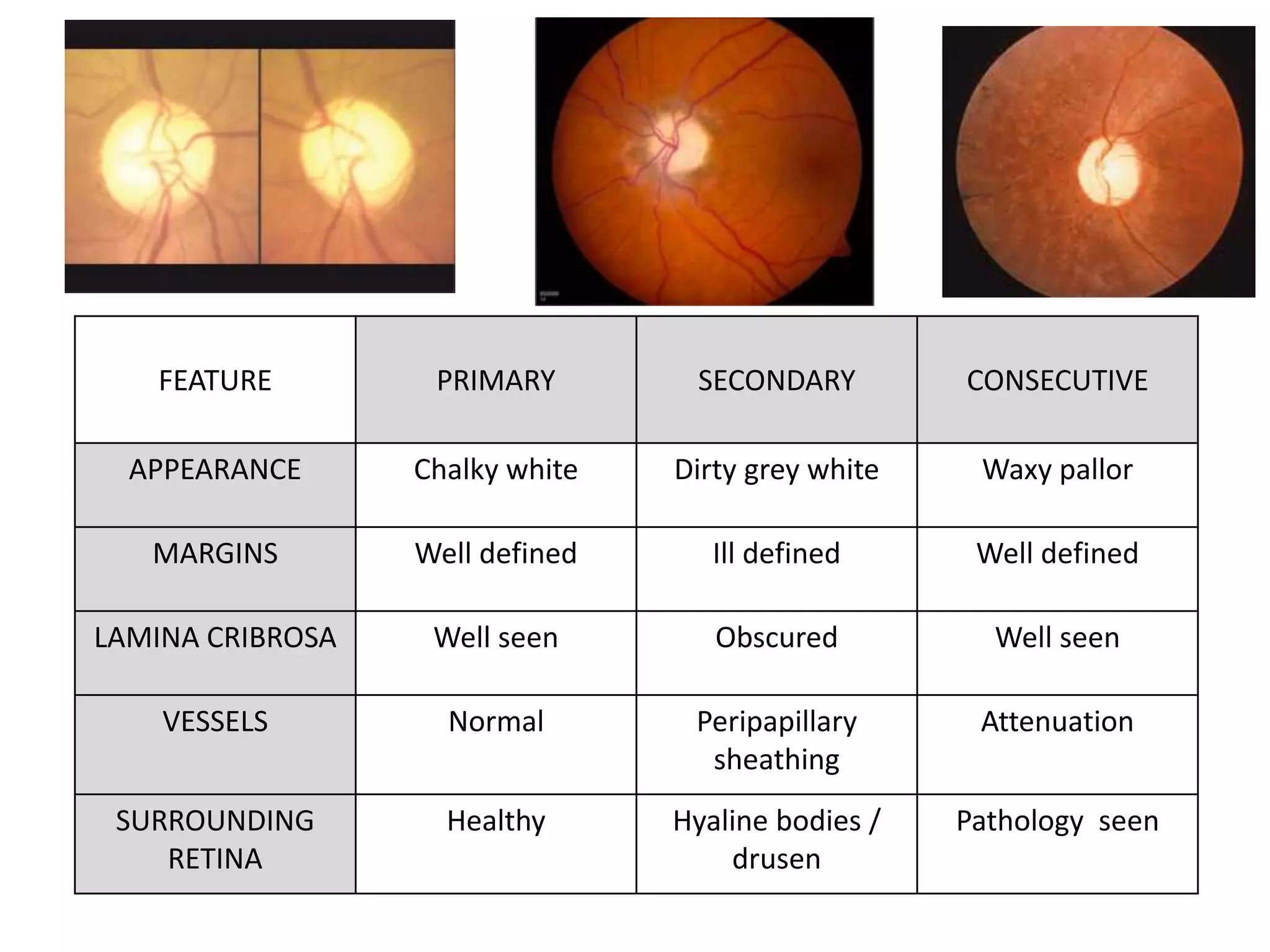
FEATURE PRIMARY SECONDARY CONSECUTIVE
APPEARANCE Chalky white Dirty grey white Waxy pallor
MARGINS Well defined Ill defined Well defined
LAMINA CRIBROSA Well seen Obscured Well seen
VESSELS Normal Peripapillary
sheathing
Attenuation
SURROUNDING
RETINA
Healthy Hyaline bodies /
drusen
Pathology seen
INVESTIGATIONS
• Blood investigations
– Hemogram
– ESR / CRP
– Liver and kidney
function
– Lipid profile
– Blood sugar
– Thyroid profile
– Nutritional indicators
– Hypercoagulale states
• Other investigations
– Carotid Doppler
– Postural hypotension
– Temporal artery biopsy
• SARCOID
• COLLAGEN VASCULAR DISEASE
• HEAVY METAL screen
• LHON mutation screen
• VISUAL FIELD
• IMAGING
– MRI BRAIN plus ORBIT
• Suspected chiasmal compression
• Suspected compressive neuropathy
– CECT ORBIT
• Suspected traumatic neuropathy
– USG ORBIT
• Suspected compressive neuropathy
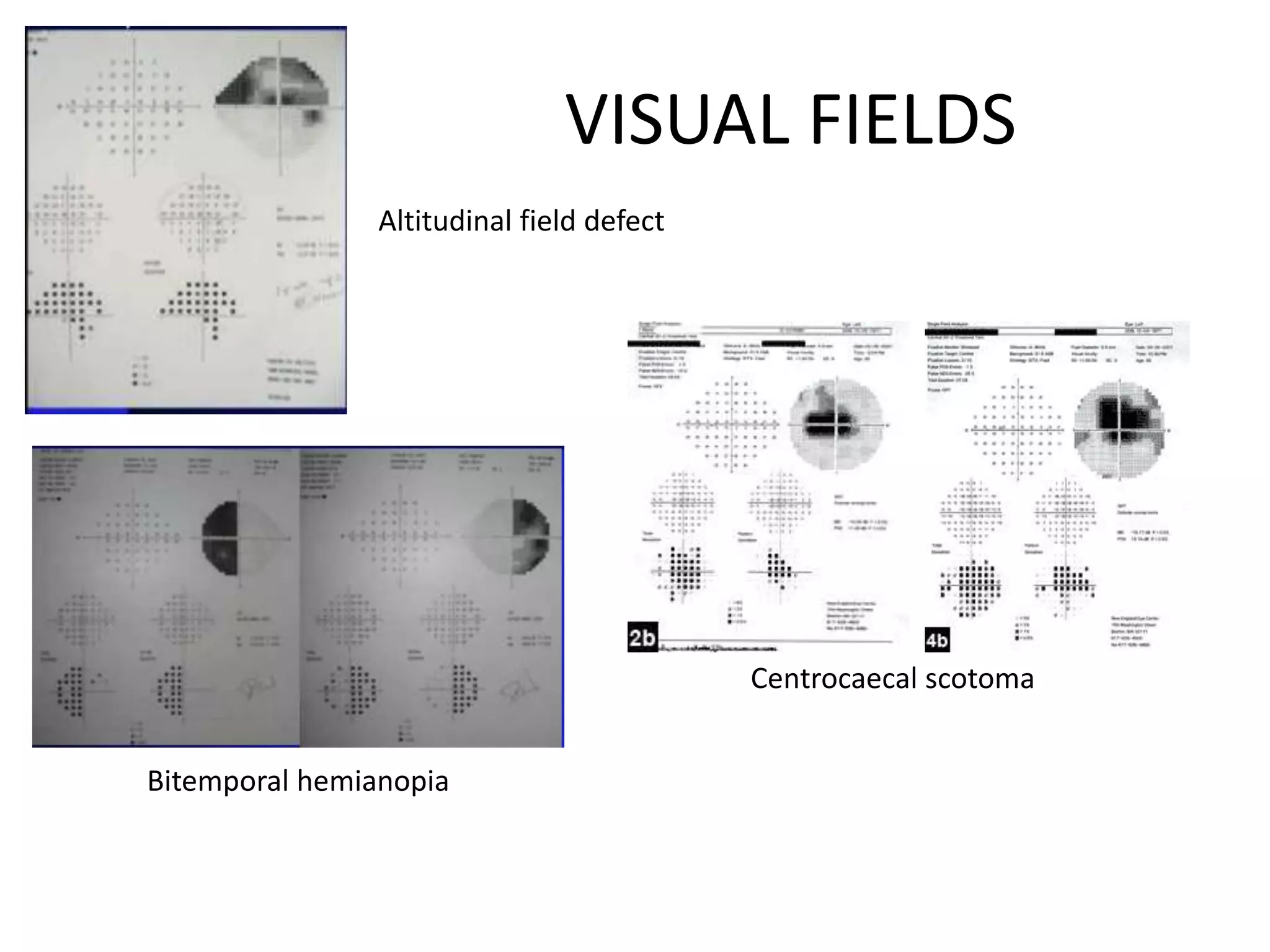
VISUAL FIELDS
Altitudinal field defect
Centrocaecal scotoma
Bitemporal hemianopia
MANAGEMENT
• Irreversible loss of acuity / field
• ISCHEMIC :
– Hypercholesterolemia
– Low dose aspirin
– Vascular surgery
– Pentoxifylline
– Steroids in acute stage (not recommended)
• INFLAMMATORY
– Immunosuppressants
– Prognosticate for MS
• COMPRESSIVE
– According to the lesion
– Thyroid
• TRAUMATIC
– Pale disc is indicator of irreversible damage
• TOXIC / NUTRITIONAL
– Avoid exposure
– Vitamin supplementation
CASE
• 35-year-old man with diabetes (5 yrs ; on
insulin)
• 2 months of blurred vision in his left eye with
near work
• No ocular history and never used spectacles
• No family history
• No history of trauma
• Non smoker / alcohol user
Ocular Surgery News U.S. Edition, September 15, 2007
Isabel M. Balderas, MD; Thomas R. Hedges, MD
• Vision (best corrected)
– Right 6/6 left 6/60
– No anisometropia
• Impaired color vision left
eye
• Anterior segment normal
• Circumpapillary
telangiectatic vessels
• No evidence of DR
• MRI BRAIN : normal study
• NUTRITIONAL INIDCES : normal
• Suspected LHON
• 11778 glycine to alanine mutation
DISC PALLOR IS NOT TO BE
IGNORED
THANK YOU

Approach to a pale optic disc

  • 1.
    APPROACH TO APALE OPTIC DISC
  • 2.
    OVERVIEW • INTRODUCTION • IMPORTANTPOINTS IN HISTORY • IMPORTANT POINTS IN EXAMINATION • RELEVANT INVESTIGATIONS • MANAGEMENT • CASE EXAMPLE
  • 3.
    • Rule outthe mimics • Clinical diagnosis • Classify – Pattern of optic disc appearance – Etiology • Investigations to confirm diagnosis • Assess visual prognosis (progressive / static) • Management (if needed)
  • 4.
    INTRODUCTION • End resultof a number of pathologic processes leading to loss of axonal fibres and their replacement by glial tissue • Normal color is salmon pink – Vascularity – Proportional glial and axonal elements
  • 5.
    • Pale appearancedue to – Decreased vascularity – Capillary dropout – Gliosis – Increased visibility of scleral laminae
  • 6.
    AIM OF CLINICALEVALUATION • To determine the possible cause of the disc pallor and whether this is due to – An ongoing process which is likely to progress • Ischemic / compressive – Result of a previous one time insult • Inflammatory / toxic / traumatic • Visual prognosis • Any intervention needed at present
  • 7.
    DIFFERENTIAL DIAGNOSIS • Opticatrophy • Disc coloboma • Optic pit • Morning glory syndrome • Medullated nerve fibres • Myopic disc • Optic disc drusen • Optic disc hypoplasia Should be kept in mind while looking at a pale disc
  • 8.
    Morning glory disc Opticdisc drusen Medullated nerve fibres Optic disc pit Optic disc hypoplasia Myopic disc Optic disc coloboma Optic disc pit
  • 9.
    PATTERNS • Ischemic (anteriorischemic optic neuropathy) • Inflammatory • Toxic/ nutritional • Compressive • Traumatic • Hereditary
  • 10.
    • Main complainis usually a decrease in visual acuity • Observant patients will tell about color desaturation and field defects
  • 11.
    IMPORTANT POINTS TOELICIT IN THE HISTORY • Unilateral or bilateral • Children / young adults / elderly population • Acute sudden loss / gradual diminution • Precipitating factors (fever / trauma / neurologic symptoms) • Associated symptoms – Jaw claudication / scalp tenderness / headache – Proptosis – Diplopia
  • 12.
    • Exposure to –Drugs (ethambutol / isoniazid / chloroquine / amiodarone) – Toxins (alcohol / methanol /tobacco) – Radiation • Possibility of malnourishment • Systemic illness – Atherosclerosis – Hypertension – Diabetes mellitus – Sleep apnea – Thyroid disorder • Symptoms of B12 deficiency • Family history
  • 13.
    IMPORTANT EXAMINATION POINTS • GENERALPHYSICAL – Pallor – Pulse • Rate / rhythm / volume / symmetrical – Blood pressure (both arms) – Bruit at common carotid (upper border of thyroid cartilage) – Signs of nutritional deficiency / chronic alcohol use / chronic smoking – Gait (tunnel vision / ataxia)
  • 14.
    • Best correctedvisual acuity • Color vision / saturation • Pupillary reaction / RAPD • Squint / ocular movements / nystagmus • Proptosis • Confrontation fields
  • 15.
    • Anterior segment –Neovascularisation of iris / angle • Ocular ischemic syndrome • IOP • Optic disc appearance – Pallor : • Diffuse • Sectoral (wedge shaped / temporal / altitudinal/ bow tie) – Patterns • Primary • Secondary • Consecutive • Glaucomatous
  • 16.
    TEMPORAL PALLOR • Carriespapillomacular bundle • Most active fibres with high metabolic activity • Travel through the centre of the optic nerve – Others report them being scattered throughout the nerve • Vulnerable to ischemic insult
  • 17.
    • Margins • Neruroretinalrim (color / thickness) • Cupping • Lamina cribrosa visibility • Nerve fibre layer defects – Diffuse – Localised • Wedge shaped • Papillomacular bundle • Kestenbaum number
  • 18.
    • Surrounding retina –Retinitis pigmentosa – DR / hypertensive changes / hemorrhages – Vascular sheathing / attenuation / dilatation – Vascular occlusion – Venous pulsations – Opticociliary shunt vessels – Signs of trauma • Choroidal rupture • Berlin’s edema Development of Opticociliary shunt vessel
  • 19.
    FEATURE PRIMARY SECONDARYCONSECUTIVE APPEARANCE Chalky white Dirty grey white Waxy pallor MARGINS Well defined Ill defined Well defined LAMINA CRIBROSA Well seen Obscured Well seen VESSELS Normal Peripapillary sheathing Attenuation SURROUNDING RETINA Healthy Hyaline bodies / drusen Pathology seen
  • 20.
    INVESTIGATIONS • Blood investigations –Hemogram – ESR / CRP – Liver and kidney function – Lipid profile – Blood sugar – Thyroid profile – Nutritional indicators – Hypercoagulale states • Other investigations – Carotid Doppler – Postural hypotension – Temporal artery biopsy
  • 21.
    • SARCOID • COLLAGENVASCULAR DISEASE • HEAVY METAL screen • LHON mutation screen • VISUAL FIELD • IMAGING – MRI BRAIN plus ORBIT • Suspected chiasmal compression • Suspected compressive neuropathy – CECT ORBIT • Suspected traumatic neuropathy – USG ORBIT • Suspected compressive neuropathy
  • 22.
    VISUAL FIELDS Altitudinal fielddefect Centrocaecal scotoma Bitemporal hemianopia
  • 23.
    MANAGEMENT • Irreversible lossof acuity / field • ISCHEMIC : – Hypercholesterolemia – Low dose aspirin – Vascular surgery – Pentoxifylline – Steroids in acute stage (not recommended)
  • 24.
    • INFLAMMATORY – Immunosuppressants –Prognosticate for MS • COMPRESSIVE – According to the lesion – Thyroid • TRAUMATIC – Pale disc is indicator of irreversible damage • TOXIC / NUTRITIONAL – Avoid exposure – Vitamin supplementation
  • 25.
    CASE • 35-year-old manwith diabetes (5 yrs ; on insulin) • 2 months of blurred vision in his left eye with near work • No ocular history and never used spectacles • No family history • No history of trauma • Non smoker / alcohol user Ocular Surgery News U.S. Edition, September 15, 2007 Isabel M. Balderas, MD; Thomas R. Hedges, MD
  • 26.
    • Vision (bestcorrected) – Right 6/6 left 6/60 – No anisometropia • Impaired color vision left eye • Anterior segment normal • Circumpapillary telangiectatic vessels • No evidence of DR
  • 27.
    • MRI BRAIN: normal study • NUTRITIONAL INIDCES : normal • Suspected LHON • 11778 glycine to alanine mutation DISC PALLOR IS NOT TO BE IGNORED
  • 28.