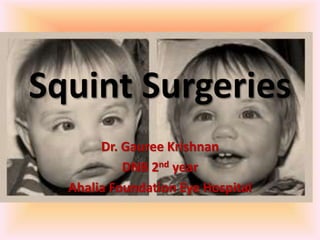
Squint Surgeries
Dr. Gauree Krishnan
DNB 2nd year
Ahalia Foundation Eye Hospital
Indications
• Nearly equal VA post orthoptic Rx, BSV improved
To correct squint cosmetically as well as functionally
• Untreatable deep amblyopia in one eye, persistent ARC, absence of power of
fusion
• Sensory squint sec to organic disorders
To correct squint only cosmetically
• Assumed to relieve diplopia (SO or LR palsy) or improve vision (nystagmus or
eccentric null point)
To correct abnormal head posture
• Hypertrophied conjunctiva or Tenon’s capsule from prior muscle surgery
To relieve mechanical restriction or to improve appearance
Optimal time for squint surgery
• Depends on
– Type of squint
– Age of the patient
– Various sensory adaptations
 In children too young for orthoptic treatment
(<4 to 5 yrs)
a) Constant squint-
b) Intermittent squint –
Observed and
refracted every six
months
Orthoptic
treatments
tried
Last option
surgery
Concomitant Squint
present after
wearing glasses for
a month
alternating,
almost equal
vision
operate asap
if visual axes
are put within
few degrees of
parallelism
BSV may
develop
 In children old enough for orthoptic
treatment (>4 to 5 yrs)
a) Initially all optical & orthoptic treatments tried
to treat the associated sensory adaptation
(supression , amblyopia, ARC)
b) In the presence of ARC  early surgery  good
cosmetic & functional results
c) In the absence of true fusion  early surgery for
cosmetic reasons  fusion may develop
In older children (>12yrs) and adults
Can be decided at leisure as only cosmetic prognosis
Paralytic Squint
• Timing :
– Not too early (as may resolve spontaneously)
– Not too late ( may keep detoriating)
– Ideally after 3 to 6 months
COMMON SURGICAL TECHNIQUES
Muscle Weakening Procedures
• most common
• changes the arc of contact with the globe
Recession
of EOM
• weakens muscle by educing the no. of contractile fibres
• Effective post recession
• Indicated where recession is c/I as in scleral buckled
globe, thin sclera
Marginal
myotomy
• Seldom done
• Inferior obliqueMyectomy
Muscle Weakening Procedures
• Disinsertion of rectus muscle
Free
tenotomy
• Posterior fixation sutures
• Retropexy of an EOM
• Doesn’t affect deviation in primary position
• Weakens the muscle action in patients who are
already orthtropic
Faden’s
operation
Muscle Weakening Procedures
• May help in augmenting the weakening
effect of rectus muscle
• For large deviations
• Specially after previous surgeries
Recession of
conjunctiva and
tenon’s capsule
•Controlled weakening
procedure for
superior oblique
Muscle lengthening
by insertion of a
silicone expander
or a non
absorbable suture
material
Muscle Strengthening Procedures
• Most common
• strengthens by shortening the length of
muscle
• Excessive should be avoided , since this may
restrict eye movements in opposite direction
Resection
• Not a primary procedure
• Can be done on resected muscles
• Or in over- recessed muscle
Advancement
• Not preferred for recti
• Superior Oblique when tucked, improves
depression in adducted eye and
Tucking
Procedures that change direction of
muscle action
• For A- or V- pattern without associated
oblique muscle dysfunction
Vertical
transpositioning of
horizontal recti
• For correction of A- or V- pattern
Horizontal
transpositioning of
the vertical recti
• For correction of A- or V- pattern
Slanting of the rectus
muscle insertion
• Hummelshein, Knapp, Jensen
Transplantation of
muscles in paralytic
squint
General Considerations
•Surgery should be delayed till after all possible amblyopic exercises
•If still untreatable , surgery should be preferred in the worse eyeAmblyopia
•While planning surgery for horizontal strabismusVertical Incomitancy
•In case of unequal deviations in right and left gazes
Horizontal
Incomitancy
•Prefer unoperated muscle
•In presence of excessive restriction, reoperation on the involved
muscle gives better results
•In multiple surgeries, at least one rectus muscle should be
unoperated in each eye
Previous surgery
•Esodeviation- basic, con ex, div ins
•Exodeviations- basic, con ins, div ex
Distance and near
measurements and AC/A
ratio
•Succinylcholine (GA) may cause sustained contraction of EOM for
20 mins, so use non depolarizing drugFDT
Guidelines
Surgeon factor
Degree of squint – same amount of muscle surgery may give
different results in smaller or larger deviation
Age of patient and duration of squint
Effect of Recession > resection
Intractable amblyopia
Effect of MR > LR
Effect of vt> hz recession
Combined recess resect> individual muscle
Anaesthesia
Topical
• Cooperative
patients only
• Only for simple
recession surgeries
• Allows
readjustment of
muscle position
during surgery to
effect cosmetic or
functional results
Local
• Surface + nerve /
peribulbar block
General
• c/I succinylcholine
 false FDT
• Risk of
oculocardiac reflex,
oculodepressor
reflex,
oculorespiratory
reflex
• Relative position of
eye may
changeleading to
undercorrection
SURGICAL STEPS
Fixation of globe
• For Hz rectus – 6 or 12 o’ clock
• For Vt rectus – 9 or 3 o’ clock
• For IO muscle- 4 ½ o’ clock in left eye
• 7 ½ o’ clock in right eye
• After fixing eyeball is rotated away from the
muscle being operated
Conjunctival incision and exposure of
the globe
Limbal incision or von
Noorden’s approach
• Adv:
• very little dissection
of Tenon’s capsule
required
• Maintains normal
anatomic relations
• Easy and quick
• Disadvan:
• Dellen
• Retraction of
conjunctival flap
Over the muscle (Swan
approach)
• Adv:
• No limbal
disturbance
• No dellen formation
• Disadv:
• Fibrosis
• scarring
Cul-de-sac (fornix)
incision ( Park’s
aaproach)
• Adv:
• No suture required
• No visible scars
• Can be used for hz ,
vt, obliques
• Disadv:
• Difficult
Complete exposure
of muscle
Passing of sutures
through muscle
Cutting the muscle
Securing of muscle
at the new
insertion site on
the sclera
Closure of
conjunctival
incision
Recession of medial rectus
Limits: 3mm to 7-8
mm
Recession of lateral rectus
• LR should be preferably hooked from the
superior border side
• Close proximity of the inferior oblique
insertion to the inferior border LR
• Limits: 5mm to 8-10 mm
Recession of superior rectus
• Care should be taken to avoid accidental
hooking of superior oblique muscle
Recession of inferior rectus
• Careful dissection of intermuscular septum
and all fascial connections between IR and
Lockwood’s ligament as far posteriorly as
possible
• Avoid injury to nerve to inferior oblique, which
enters the muscle just as it passes lateral
border of IR muscle
Hang back recession of rectus muscle
• Type of non adjustable suspension recession
technique
• Performed for up to 7 mm of recessions
• Comparatively safer and equally effective
Hang back recession of rectus muscle
Isolation of muscles
Passing of suture
through the muscle
Disinsertion of muscle
Placing of sutures on
the sclera for hang
back
(Potter and Nelson)
Conjunctival closure
Hemi Hang back recession of rectus
muscle
Advantages of hangback and hemi
hangback
Less risk of perforation since more anterior site than conventional
recession
HHB minimizes awkward needle placement in the sclera
Technique avoids excessive manipulation of eye
No risk to vortex veins as no post equatorial exposure
Less risk of post surgical induced cyclovertical deviations
Resection of medial rectus
Conjunctival
incision
Exposure of
muscle (Only uptil
req resection)
Passing of sutures
through the
muscle
Cutting of the
muscle/ crushing
with hemostat
Securing of
muscle to the
insertion site – 2
techniques
Spring back
balance test of
Jampolsky
If
undercorrected
advancement of
MR
If overcorrected
 recession of
MR
Closure of
conjunctiva
Limits of rectus muscle resection
Rectus Maximal (mm) Minimal (mm)
Medial 8-10 4
Lateral 12- 14 4- 5
Superior 5- 6 2- 3
Inferior 5- 6 2- 3
Marginal Myotomy
Faden’s Operation
Exposure of muscle
Rotation of globe in
opposite sirection
Placing of posterior
fixation sutures
Conjunctival
closure
Indications of Faden’s operation
• To correct DVD
• Patients having incomitant strabismus with orthotropia
in primary position
• To treat upshoot and downshoot of the adducted eye
in patients with Duanne’s retraction syndrome Type 1
• Near Esotropia with high AC/A ratio
• Persistent eso after max recession and resection
surgery
• To dampen nystagmus in
• Nystagmus blockage syndrome
Efficacy {MR > Vertical recti > LR}
Faden’s Operation
Advantages
• Decreased chances of over
adduction ( sp in non
accommodative
convergence excess)
• Post-op FDT is free
• Saves the ciliary vessels
from damage
Disadvantages
• Needs vigorous traction for
suture application
• Vortex vein injury
• Higher globe perforation
chances
• Variable results
Inferior Oblique weakening procedures
Indications
• Primary IO overaction
• Secondary overaction of IO
following SO palsy
• Double elevator palsy – IO
weakening indicated in the
other eye
• Upshoots in Duanne’s
retraction syndrome
Types of procedures
• Disinsertion
• Myectomy- excision of a
segment of muscle belly
• Extirpation- almost complete
removal of muscle
• Recession
– Park
– Fink
– Elliot and Nankin
• Recession with anterior
transposition- disinsertion and
reinsertion near the IR
insertion
Superior Oblique weakening
procedure
Indications
• Unilateral weakening:
– Brown’s Syndrome
– Isolated IO muscle weakness
• Bilateral weakening :
– With/ without hz muscle
surgeryfor A- pattern
deviations
– Causes eso shift of 30-40
prism dioptres in downgaze,
little change in primary
position and almost no effect
in upgaze
Procedures
• Tenotomy
• Split lengthening of tendon
• Recession
• Translational recession of
Prieto-Diaz
• Posterior tenectomy of SO
Superior Oblique Tenotomy
Translational recession of Prieto-Diaz
Posterior tenectomy of SO
Superior Oblique strengthening
procedure
Harada Ito
procedure
Superior
Oblique Tuck
Harada Ito procedure
Selective strengthening of the
anterior fibres of SO muscle
Considered responsible for torsional
action of SO
Anterior and lateral displacement of
the anterior fibres
enhances incyclotropic action
corrects excyclotropia
Harada Ito procedure
Superior Oblique Tuck
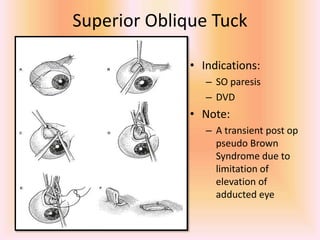
• Indications:
– SO paresis
– DVD
• Note:
– A transient post op
pseudo Brown
Syndrome due to
limitation of
elevation of
adducted eye
Muscle Transposition Procedures
• Moving the EOM out of their original planes of
action
• Generally for paralytic strabismus
• Indications:
– III, VI and double elevator palsies
– A- , V- patterns
– Cyclodeviations
– Small hz and vt deviations
Knapp procedure
Transposition
of LR and MR
To IR or SR
Jensen’s Procedure
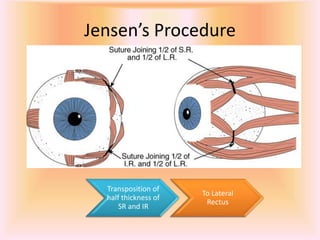
Transposition of
half thickness of
SR and IR
To Lateral
Rectus
Hummelsheim procedure
Total
transplant
of SR and IR
To Lateral
Rectus
COMPLICATIONS
Complications of anaesthesia
• Cardiac arrest
• Malignant hyperthermia
• Hepatic porphyria and suxamethonium
sensitivity
• Oculorespiratory reflexes
• Succinyl choline induced apnea
Intraoperative complications
• Mild – conjunctival
• Moderate- muscle
• Profuse- vortex veins
Haemorhage
• Most frequent- MR
• Intraop or post op
Lost muscle
• During disinsertion of muscle
• During placement of needles for reinsertionof the muscle
Perforation of globe
• Excessively rotated globe
• During re operation , modified anatomy
• Myectomy of IR during myectomy of IO
Operation of wrong muscle
• Disinsertion of IO during LR surgery
• Complete severance of SO tendon or sheath while attempting to
hook SR
Inadvertent injury to other muscles
Operation in the wrong eye
Post operative complications
1) Infections
– Endophthalmitisorbital cellulitis
– Localized suture abcess
2) Suture reaction
3) Conjunctival granuloma
4) Conjunctival cyst
– Due to inadvertent closure of conjunctiva in the
wound
5) Anterior segment ischaemia
• Cause
– Disruption of blood supply to the anterior segment from anterior
ciliary arteries
• Signs
– Corneal oedema
– Stromal swelling
– DM folds
– Heavy AC reaction
– Cataractous lens
• Prevention
– All 4 recti should never be disinserted simultaneously
– Period of 6 months bewteen hz and vt muscle surgeries
– Muscle slpitting procedures
– Modified tucking procedures
Post operative complications
6) Dellen
– Localised area of conjunctival thinning
– Commonly due to limbal approach
7) Necrotizing scleritis
8) Refractive error
– Most commonly astigmatism
9) Diplopia
10)RD
11)Scarring
11)Adhesive syndrome
– Inferior oblique surgery
12)Under or over- corrections
13)Gaze incomitance
14)Alteration in palpebral fissure
– Narrowing due to vt muscle resections
– Large recess resect procedures of hz recti
– Widening with large vertical recessions
15)Psychological complications
Post operative care after strabismus
surgery
• Immediate general care
• Dressing
• Topical antibiotic and steroid
• Oral antibiotics
• Oral inflammatory
• Restrictions for the patients
• Follow up examination
• Orthoptic treatment
Conclusion
Squint Surgeries
Weakening
Recession
Marginal myotomy
Myectomy
Free tenotomy
Faden’s
Conjunctival
recession
Strengthening
Resection
Advancement
Tucking
Harada- Ito
Transposition
Vertical
transposition of
horizontal muscles
Horizontal transposition of
vertical muscles
Knapp
Hummelsheim
Jensen
Refrences
• Management of squint and Amblyopia
– John A. Pratt-Johnson
– Geraldine Tillson
• Strabismus and paediatric ophthalmology
– Gary R. Diamond
– Howard M. Eggers
• Squint and orthoptics
– A.K. Khurana
Thank You

Squint surgeries

  • 1.
    Squint Surgeries Dr. GaureeKrishnan DNB 2nd year Ahalia Foundation Eye Hospital
  • 2.
    Indications • Nearly equalVA post orthoptic Rx, BSV improved To correct squint cosmetically as well as functionally • Untreatable deep amblyopia in one eye, persistent ARC, absence of power of fusion • Sensory squint sec to organic disorders To correct squint only cosmetically • Assumed to relieve diplopia (SO or LR palsy) or improve vision (nystagmus or eccentric null point) To correct abnormal head posture • Hypertrophied conjunctiva or Tenon’s capsule from prior muscle surgery To relieve mechanical restriction or to improve appearance
  • 3.
    Optimal time forsquint surgery • Depends on – Type of squint – Age of the patient – Various sensory adaptations
  • 4.
     In childrentoo young for orthoptic treatment (<4 to 5 yrs) a) Constant squint- b) Intermittent squint – Observed and refracted every six months Orthoptic treatments tried Last option surgery Concomitant Squint present after wearing glasses for a month alternating, almost equal vision operate asap if visual axes are put within few degrees of parallelism BSV may develop
  • 5.
     In childrenold enough for orthoptic treatment (>4 to 5 yrs) a) Initially all optical & orthoptic treatments tried to treat the associated sensory adaptation (supression , amblyopia, ARC) b) In the presence of ARC  early surgery  good cosmetic & functional results c) In the absence of true fusion  early surgery for cosmetic reasons  fusion may develop
  • 6.
    In older children(>12yrs) and adults Can be decided at leisure as only cosmetic prognosis
  • 7.
    Paralytic Squint • Timing: – Not too early (as may resolve spontaneously) – Not too late ( may keep detoriating) – Ideally after 3 to 6 months
  • 8.
  • 9.
    Muscle Weakening Procedures •most common • changes the arc of contact with the globe Recession of EOM • weakens muscle by educing the no. of contractile fibres • Effective post recession • Indicated where recession is c/I as in scleral buckled globe, thin sclera Marginal myotomy • Seldom done • Inferior obliqueMyectomy
  • 10.
    Muscle Weakening Procedures •Disinsertion of rectus muscle Free tenotomy • Posterior fixation sutures • Retropexy of an EOM • Doesn’t affect deviation in primary position • Weakens the muscle action in patients who are already orthtropic Faden’s operation
  • 11.
    Muscle Weakening Procedures •May help in augmenting the weakening effect of rectus muscle • For large deviations • Specially after previous surgeries Recession of conjunctiva and tenon’s capsule •Controlled weakening procedure for superior oblique Muscle lengthening by insertion of a silicone expander or a non absorbable suture material
  • 12.
    Muscle Strengthening Procedures •Most common • strengthens by shortening the length of muscle • Excessive should be avoided , since this may restrict eye movements in opposite direction Resection • Not a primary procedure • Can be done on resected muscles • Or in over- recessed muscle Advancement • Not preferred for recti • Superior Oblique when tucked, improves depression in adducted eye and Tucking
  • 13.
    Procedures that changedirection of muscle action • For A- or V- pattern without associated oblique muscle dysfunction Vertical transpositioning of horizontal recti • For correction of A- or V- pattern Horizontal transpositioning of the vertical recti • For correction of A- or V- pattern Slanting of the rectus muscle insertion • Hummelshein, Knapp, Jensen Transplantation of muscles in paralytic squint
  • 14.
    General Considerations •Surgery shouldbe delayed till after all possible amblyopic exercises •If still untreatable , surgery should be preferred in the worse eyeAmblyopia •While planning surgery for horizontal strabismusVertical Incomitancy •In case of unequal deviations in right and left gazes Horizontal Incomitancy •Prefer unoperated muscle •In presence of excessive restriction, reoperation on the involved muscle gives better results •In multiple surgeries, at least one rectus muscle should be unoperated in each eye Previous surgery •Esodeviation- basic, con ex, div ins •Exodeviations- basic, con ins, div ex Distance and near measurements and AC/A ratio •Succinylcholine (GA) may cause sustained contraction of EOM for 20 mins, so use non depolarizing drugFDT
  • 15.
    Guidelines Surgeon factor Degree ofsquint – same amount of muscle surgery may give different results in smaller or larger deviation Age of patient and duration of squint Effect of Recession > resection Intractable amblyopia Effect of MR > LR Effect of vt> hz recession Combined recess resect> individual muscle
  • 16.
    Anaesthesia Topical • Cooperative patients only •Only for simple recession surgeries • Allows readjustment of muscle position during surgery to effect cosmetic or functional results Local • Surface + nerve / peribulbar block General • c/I succinylcholine  false FDT • Risk of oculocardiac reflex, oculodepressor reflex, oculorespiratory reflex • Relative position of eye may changeleading to undercorrection
  • 17.
  • 18.
    Fixation of globe •For Hz rectus – 6 or 12 o’ clock • For Vt rectus – 9 or 3 o’ clock • For IO muscle- 4 ½ o’ clock in left eye • 7 ½ o’ clock in right eye • After fixing eyeball is rotated away from the muscle being operated
  • 19.
    Conjunctival incision andexposure of the globe Limbal incision or von Noorden’s approach • Adv: • very little dissection of Tenon’s capsule required • Maintains normal anatomic relations • Easy and quick • Disadvan: • Dellen • Retraction of conjunctival flap Over the muscle (Swan approach) • Adv: • No limbal disturbance • No dellen formation • Disadv: • Fibrosis • scarring Cul-de-sac (fornix) incision ( Park’s aaproach) • Adv: • No suture required • No visible scars • Can be used for hz , vt, obliques • Disadv: • Difficult
  • 20.
    Complete exposure of muscle Passingof sutures through muscle Cutting the muscle Securing of muscle at the new insertion site on the sclera Closure of conjunctival incision Recession of medial rectus Limits: 3mm to 7-8 mm
  • 21.
    Recession of lateralrectus • LR should be preferably hooked from the superior border side • Close proximity of the inferior oblique insertion to the inferior border LR • Limits: 5mm to 8-10 mm
  • 22.
    Recession of superiorrectus • Care should be taken to avoid accidental hooking of superior oblique muscle
  • 23.
    Recession of inferiorrectus • Careful dissection of intermuscular septum and all fascial connections between IR and Lockwood’s ligament as far posteriorly as possible • Avoid injury to nerve to inferior oblique, which enters the muscle just as it passes lateral border of IR muscle
  • 24.
    Hang back recessionof rectus muscle • Type of non adjustable suspension recession technique • Performed for up to 7 mm of recessions • Comparatively safer and equally effective
  • 25.
    Hang back recessionof rectus muscle
  • 26.
    Hang back recessionof rectus muscle Isolation of muscles Passing of suture through the muscle Disinsertion of muscle Placing of sutures on the sclera for hang back (Potter and Nelson) Conjunctival closure
  • 27.
    Hemi Hang backrecession of rectus muscle
  • 28.
    Advantages of hangbackand hemi hangback Less risk of perforation since more anterior site than conventional recession HHB minimizes awkward needle placement in the sclera Technique avoids excessive manipulation of eye No risk to vortex veins as no post equatorial exposure Less risk of post surgical induced cyclovertical deviations
  • 29.
    Resection of medialrectus Conjunctival incision Exposure of muscle (Only uptil req resection) Passing of sutures through the muscle Cutting of the muscle/ crushing with hemostat Securing of muscle to the insertion site – 2 techniques Spring back balance test of Jampolsky If undercorrected advancement of MR If overcorrected  recession of MR Closure of conjunctiva
  • 30.
    Limits of rectusmuscle resection Rectus Maximal (mm) Minimal (mm) Medial 8-10 4 Lateral 12- 14 4- 5 Superior 5- 6 2- 3 Inferior 5- 6 2- 3
  • 31.
  • 32.
    Faden’s Operation Exposure ofmuscle Rotation of globe in opposite sirection Placing of posterior fixation sutures Conjunctival closure
  • 33.
    Indications of Faden’soperation • To correct DVD • Patients having incomitant strabismus with orthotropia in primary position • To treat upshoot and downshoot of the adducted eye in patients with Duanne’s retraction syndrome Type 1 • Near Esotropia with high AC/A ratio • Persistent eso after max recession and resection surgery • To dampen nystagmus in • Nystagmus blockage syndrome Efficacy {MR > Vertical recti > LR}
  • 34.
    Faden’s Operation Advantages • Decreasedchances of over adduction ( sp in non accommodative convergence excess) • Post-op FDT is free • Saves the ciliary vessels from damage Disadvantages • Needs vigorous traction for suture application • Vortex vein injury • Higher globe perforation chances • Variable results
  • 35.
    Inferior Oblique weakeningprocedures Indications • Primary IO overaction • Secondary overaction of IO following SO palsy • Double elevator palsy – IO weakening indicated in the other eye • Upshoots in Duanne’s retraction syndrome Types of procedures • Disinsertion • Myectomy- excision of a segment of muscle belly • Extirpation- almost complete removal of muscle • Recession – Park – Fink – Elliot and Nankin • Recession with anterior transposition- disinsertion and reinsertion near the IR insertion
  • 36.
    Superior Oblique weakening procedure Indications •Unilateral weakening: – Brown’s Syndrome – Isolated IO muscle weakness • Bilateral weakening : – With/ without hz muscle surgeryfor A- pattern deviations – Causes eso shift of 30-40 prism dioptres in downgaze, little change in primary position and almost no effect in upgaze Procedures • Tenotomy • Split lengthening of tendon • Recession • Translational recession of Prieto-Diaz • Posterior tenectomy of SO
  • 37.
  • 38.
  • 39.
  • 40.
    Superior Oblique strengthening procedure HaradaIto procedure Superior Oblique Tuck
  • 41.
    Harada Ito procedure Selectivestrengthening of the anterior fibres of SO muscle Considered responsible for torsional action of SO Anterior and lateral displacement of the anterior fibres enhances incyclotropic action corrects excyclotropia
  • 42.
  • 43.
    Superior Oblique Tuck •Indications: – SO paresis – DVD • Note: – A transient post op pseudo Brown Syndrome due to limitation of elevation of adducted eye
  • 44.
    Muscle Transposition Procedures •Moving the EOM out of their original planes of action • Generally for paralytic strabismus • Indications: – III, VI and double elevator palsies – A- , V- patterns – Cyclodeviations – Small hz and vt deviations
  • 45.
  • 46.
    Jensen’s Procedure Transposition of halfthickness of SR and IR To Lateral Rectus
  • 47.
  • 48.
  • 49.
    Complications of anaesthesia •Cardiac arrest • Malignant hyperthermia • Hepatic porphyria and suxamethonium sensitivity • Oculorespiratory reflexes • Succinyl choline induced apnea
  • 50.
    Intraoperative complications • Mild– conjunctival • Moderate- muscle • Profuse- vortex veins Haemorhage • Most frequent- MR • Intraop or post op Lost muscle • During disinsertion of muscle • During placement of needles for reinsertionof the muscle Perforation of globe
  • 51.
    • Excessively rotatedglobe • During re operation , modified anatomy • Myectomy of IR during myectomy of IO Operation of wrong muscle • Disinsertion of IO during LR surgery • Complete severance of SO tendon or sheath while attempting to hook SR Inadvertent injury to other muscles Operation in the wrong eye
  • 52.
    Post operative complications 1)Infections – Endophthalmitisorbital cellulitis – Localized suture abcess 2) Suture reaction 3) Conjunctival granuloma 4) Conjunctival cyst – Due to inadvertent closure of conjunctiva in the wound
  • 53.
    5) Anterior segmentischaemia • Cause – Disruption of blood supply to the anterior segment from anterior ciliary arteries • Signs – Corneal oedema – Stromal swelling – DM folds – Heavy AC reaction – Cataractous lens • Prevention – All 4 recti should never be disinserted simultaneously – Period of 6 months bewteen hz and vt muscle surgeries – Muscle slpitting procedures – Modified tucking procedures
  • 54.
    Post operative complications 6)Dellen – Localised area of conjunctival thinning – Commonly due to limbal approach 7) Necrotizing scleritis 8) Refractive error – Most commonly astigmatism 9) Diplopia 10)RD 11)Scarring
  • 55.
    11)Adhesive syndrome – Inferioroblique surgery 12)Under or over- corrections 13)Gaze incomitance 14)Alteration in palpebral fissure – Narrowing due to vt muscle resections – Large recess resect procedures of hz recti – Widening with large vertical recessions 15)Psychological complications
  • 56.
    Post operative careafter strabismus surgery • Immediate general care • Dressing • Topical antibiotic and steroid • Oral antibiotics • Oral inflammatory • Restrictions for the patients • Follow up examination • Orthoptic treatment
  • 57.
    Conclusion Squint Surgeries Weakening Recession Marginal myotomy Myectomy Freetenotomy Faden’s Conjunctival recession Strengthening Resection Advancement Tucking Harada- Ito Transposition Vertical transposition of horizontal muscles Horizontal transposition of vertical muscles Knapp Hummelsheim Jensen
  • 58.
    Refrences • Management ofsquint and Amblyopia – John A. Pratt-Johnson – Geraldine Tillson • Strabismus and paediatric ophthalmology – Gary R. Diamond – Howard M. Eggers • Squint and orthoptics – A.K. Khurana
  • 59.