PHACOEMULSIFICATION IN
MYOPIC EYES
Sumeet Agrawal
PG 3
UCMS and GTB Hospital
Delhi
HOW IS IT DIFFERENT FROM A
ROUTINE CATARACT SURGERY ?
PREOPERATIVE
INTRAOPERATIVE
POSTOPERATIVE
WHEN TO BE CONCERNED ?
• Degree of myopia
– High myopia (2%)
• ( Spherical equivalent -6.00 D or more; Axial length 26.5
mm or more)
– Pathological myopia (0.5%)
• ( Spherical equivalent -8.00 D or more; Axial length 32.5
or more)
UNILATERAL / BILATERAL
Keep the possibility of amblyopia, specially if unilateral
Visual acuity before onset of cataract
History of spectacle use; History of trauma
PATIENT EXPECTATIONS (informed consent)
Use of reading glasses
Refractive surprises
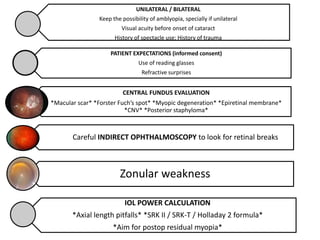
CENTRAL FUNDUS EVALUATION
*Macular scar* *Forster Fuch’s spot* *Myopic degeneration* *Epiretinal membrane*
*CNV* *Posterior staphyloma*
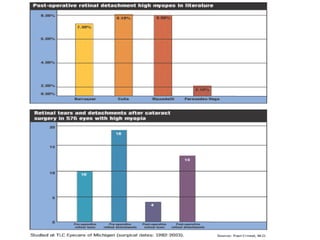
Careful INDIRECT OPHTHALMOSCOPY to look for retinal breaks
Zonular weakness
IOL POWER CALCULATION
*Axial length pitfalls* *SRK II / SRK-T / Holladay 2 formula*
*Aim for postop residual myopia*
INTRAOPERATIVE CONSIDERATIONS
• Peribulbar / Retrobulbar block : chances of globe
perforation ; topical / subtenon anaesthesia
• Clear corneal incisions with a short tunnel
– Limbal / scleral incisions heal poorly due to low scleral
rigidity
– Suture if in doubt
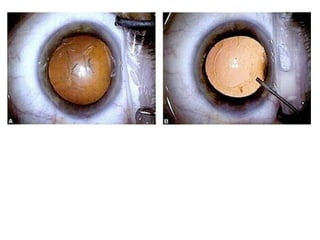
• High elasticity of anterior capsule
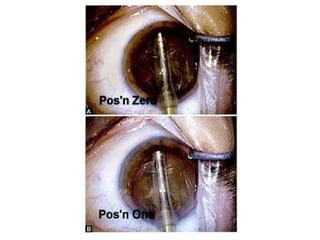
• Deep AC
– Difficult instrumentation
– Stretching of iris - > pain (intracameral lignocaine)
– Reverse pupillary block (Lens-Iris-Diaphragm
Retrodisplacement Syndrome (LIDRS))
– (Low bottle height with low vacuum)
• Avoid traction to vitreous base
– Abrupt collapse of anterior chamber
– Inject viscoelastic before removing probe
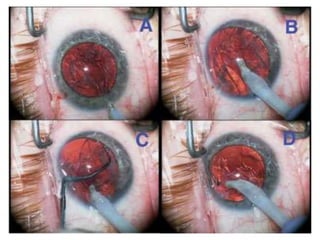
• Posterior capulorrhexis (to avoid future need for
YAG capsulotomy); controversial
• IOL
– To implant or not
– Abbott Medical Optics Sensar AR40M acrylic IOL (as
low as –10 D)
– Alcon AcrySof acrylic IOL (as low as –5 D)
– Bausch & Lomb Crystalens AO (as low as +4 D)
– Hoya Surgical Optics iSymm (as low as +6 D)
– Avoid silicon IOLs
POSTOPERATIVE
• Refraction takes longer to stabilize
• Check for retinal breaks
• Closer and more frequent follow ups
• Operate the other eye earlier if high
anisometropia
THANK YOU

Phacoemulsification in myopic eyes

  • 1.
    PHACOEMULSIFICATION IN MYOPIC EYES SumeetAgrawal PG 3 UCMS and GTB Hospital Delhi
  • 2.
    HOW IS ITDIFFERENT FROM A ROUTINE CATARACT SURGERY ? PREOPERATIVE INTRAOPERATIVE POSTOPERATIVE
  • 3.
    WHEN TO BECONCERNED ? • Degree of myopia – High myopia (2%) • ( Spherical equivalent -6.00 D or more; Axial length 26.5 mm or more) – Pathological myopia (0.5%) • ( Spherical equivalent -8.00 D or more; Axial length 32.5 or more)
  • 4.
    UNILATERAL / BILATERAL Keepthe possibility of amblyopia, specially if unilateral Visual acuity before onset of cataract History of spectacle use; History of trauma PATIENT EXPECTATIONS (informed consent) Use of reading glasses Refractive surprises CENTRAL FUNDUS EVALUATION *Macular scar* *Forster Fuch’s spot* *Myopic degeneration* *Epiretinal membrane* *CNV* *Posterior staphyloma* Careful INDIRECT OPHTHALMOSCOPY to look for retinal breaks Zonular weakness IOL POWER CALCULATION *Axial length pitfalls* *SRK II / SRK-T / Holladay 2 formula* *Aim for postop residual myopia*
  • 6.
    INTRAOPERATIVE CONSIDERATIONS • Peribulbar/ Retrobulbar block : chances of globe perforation ; topical / subtenon anaesthesia • Clear corneal incisions with a short tunnel – Limbal / scleral incisions heal poorly due to low scleral rigidity – Suture if in doubt • High elasticity of anterior capsule
  • 8.
    • Deep AC –Difficult instrumentation – Stretching of iris - > pain (intracameral lignocaine) – Reverse pupillary block (Lens-Iris-Diaphragm Retrodisplacement Syndrome (LIDRS)) – (Low bottle height with low vacuum) • Avoid traction to vitreous base – Abrupt collapse of anterior chamber – Inject viscoelastic before removing probe
  • 11.
    • Posterior capulorrhexis(to avoid future need for YAG capsulotomy); controversial • IOL – To implant or not – Abbott Medical Optics Sensar AR40M acrylic IOL (as low as –10 D) – Alcon AcrySof acrylic IOL (as low as –5 D) – Bausch & Lomb Crystalens AO (as low as +4 D) – Hoya Surgical Optics iSymm (as low as +6 D) – Avoid silicon IOLs
  • 12.
    POSTOPERATIVE • Refraction takeslonger to stabilize • Check for retinal breaks • Closer and more frequent follow ups • Operate the other eye earlier if high anisometropia
  • 13.