DIABETIC MACULAR EDEMA
OVERVIEW
• Most common cause of visual loss in DM
• Prevelance 11.1% (2-10%)
• Incidence (10 year rate: 20.1%; 25.4%; 13.9%)
CLINICAL ASSOCIATONS
•
•
•
•
•
•
•
•

Severity of DR
Duration of diabetes and glycemic control
Proteinuria,
Hypertension,
Dyslipidemia
Pregnancy,
Intraocular surgery
Pan retinal photocoagulation
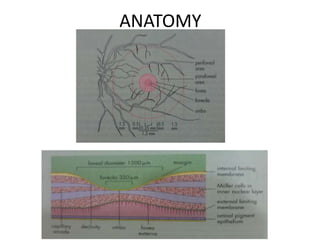
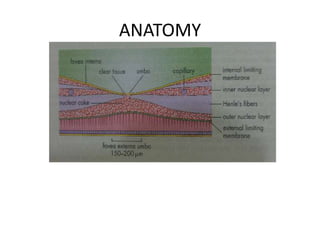
ANATOMY
ANATOMY
PATHOPHYSIOLOGY
• ALDOSE REDUCTASE
• VASOPROLFERATIVE FACTORS
• PLATELET DYSFUNCTION
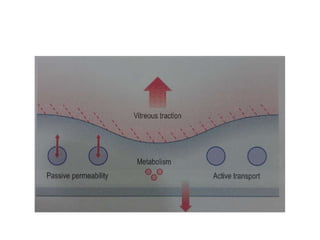
PATHOPHYSIOLOGY
• Capillary damage and raised permeability
(breakdown of inner blood retinal barrier)
– Pericyte loss (oxidative damage and AGEs)
– Disorganisation of tight junctions
– Increased transcelluar endocytosis
– VEGF
– Protein kinase cβ

• Microaneurysms
• IRMAs
PATHOPHYSIOLOGY
•
•
•
•
•

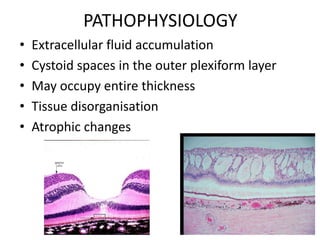
Extracellular fluid accumulation
Cystoid spaces in the outer plexiform layer
May occupy entire thickness
Tissue disorganisation
Atrophic changes
PATHOPHYSIOLOGY
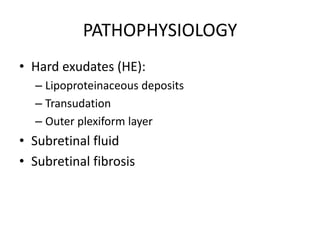
• Hard exudates (HE):
– Lipoproteinaceous deposits
– Transudation
– Outer plexiform layer

• Subretinal fluid
• Subretinal fibrosis
PRESENTATION
• Depends on central macular involvement
– Paracentral scotomas
– Gradual progressive loss of vision (weeks to
months)
– Color vision loss
– Metamorphopsia
– Fluctuation of vision
– Contrast sensitivity
– Prolonged adaptation
EXAMINATION
•
•
•
•

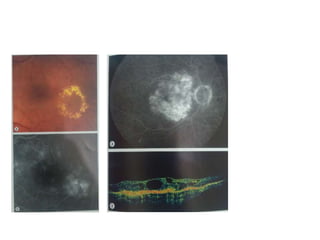
Clinically best detected by 60 D, 78 D lenses
Decreased translucency
Loss of foveolar reflex
Patterns :
– Diffuse
– Focal; circinate pattern
– Ischemic
– Mixed
EXAMINATION
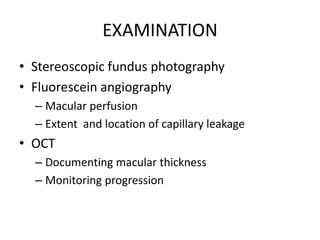
• Stereoscopic fundus photography
• Fluorescein angiography
– Macular perfusion
– Extent and location of capillary leakage

• OCT
– Documenting macular thickness
– Monitoring progression
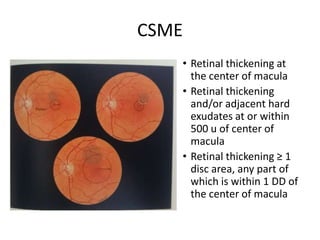
CSME
• Retinal thickening at
the center of macula
• Retinal thickening
and/or adjacent hard
exudates at or within
500 u of center of
macula
• Retinal thickening ≥ 1
disc area, any part of
which is within 1 DD of
the center of macula
THERAPY
•
•
•
•
•
•

Medical
LASER photocoagulation
Triancinolone acetonide
Anti-VEGF therapy
Protein kinase c inhibtion
Vitrectomy
LASER photocoagulation
• ETDRS gave conclusive supporting proof
• Focal laser for leaking microaneurysm atleast
500 u from the fovea
– (aim : closure of leak)

• Grid laser for diffuse retinal thickening/ areas
of ischemia
– (aim : stimulate retinochoroidal pump)
Treatable lesions
• Focal leaks >500 u from center of macula
causing thickening/exudation
• Focal leaks 300-500 u from center if t/t is not
likely to damage perifoveal capillary network
• Areas of diffuse leakage
• Abnormal avasular zone
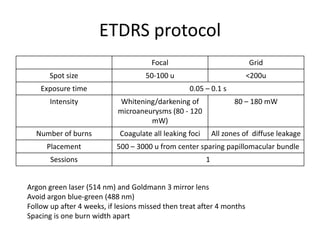
ETDRS protocol
Focal
Spot size
Exposure time

Grid

50-100 u

<200u
0.05 – 0.1 s

Intensity

Whitening/darkening of
microaneurysms (80 - 120
mW)

80 – 180 mW

Number of burns

Coagulate all leaking foci

All zones of diffuse leakage

Placement

500 – 3000 u from center sparing papillomacular bundle

Sessions

1

Argon green laser (514 nm) and Goldmann 3 mirror lens
Avoid argon blue-green (488 nm)
Follow up after 4 weeks, if lesions missed then treat after 4 months
Spacing is one burn width apart
LASER photocoagulation
• Adverse effects
– Foveal burns
– Subretinal hemorrhage
– Vitreous hemorrhage
– RPE creep
– CNV
– Paradoxically increased HE
TRIANCINOLONE ACETONIDE
•
•
•
•

Intravitreal route
Needs repeated injections
Duration of effect : 2-3 months with 4mg
Complications
– Raised iop
– Endophthalmitis
– Cataracts

• Peribulbar route
ANTI-VEGF therapy
• Bevacizumab (Avastin)
• Ranibizumab (Lucentis)
–
–
–
–

Fusion proteins with human antibody backbone
Bind all VEGF subtypes
Intravitreal route
No definite schedule

• Pegaptinib (Macugen)
– Engineered RNA fragment
– Specific sites for VEGF binding
PROTEIN KINASE C Inhibitors
• PKCβ
– Ruboxistaurin
– Oral administration

Diabetic Macular Edema