PSYCHOLOGY SOCIAL DEVELOPMENT
SOCIAL DEVELOPMENT The process in which a man creates his sources together with the help of the natural resources is called social development. Social development means the growing ability of an individual to live, move and work as a member of the society, to learn social forms of good behaviour, etiquette, manners, traditions and customs and to work with others for the benefit and happiness of others and himself  .
FACTORS AFFECTING SOCIAL DEVELOPMENT Socialisation  Imitation Suggestion  Sympathy  Social facilitation and inhabitation Competition and co-operation Kinds of groups  Social structure  Group mind  Studying inter-personal relation   Educational application
SOCIALISATION This is the process wherein a child learns about social values and behaviour while passing through the different stages of his life and continues till his death.  The culture, customs, traditions and education of his family, neighbourhood and community largely determine and play an important role in this process of social learning of the child.
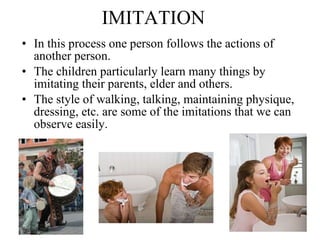
IMITATION In this process one person follows the actions of another person.  The children particularly learn many things by imitating their parents, elder and others.  The style of walking, talking, maintaining physique, dressing, etc. are some of the imitations that we can observe easily.
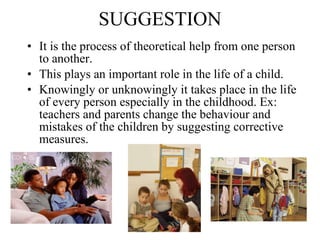
SUGGESTION It is the process of theoretical help from one person to another.  This plays an important role in the life of a child.  Knowingly or unknowingly it takes place in the life of every person especially in the childhood. Ex: teachers and parents change the behaviour and mistakes of the children by suggesting corrective measures.
SYMPATHY It is a feeling of togetherness and  sharing emotions involving two or  more persons.  It helps in the social development of the child through  emotional  development.
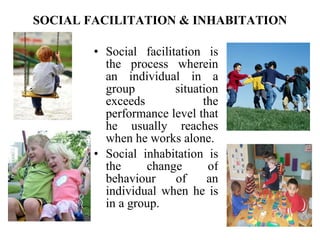
SOCIAL FACILITATION & INHABITATION Social facilitation is the process   wherein an individual in a group situation exceeds the performance level that he usually reaches when he works alone.  Social inhabitation is the change of behaviour of an individual when he is in a group.
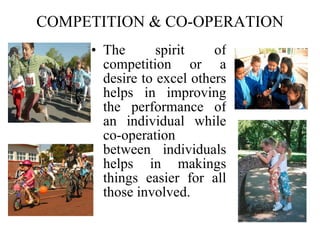
COMPETITION & CO-OPERATION The spirit of competition or a desire to excel others helps in improving the performance of an individual while co-operation between individuals helps in makings things easier for all those involved.
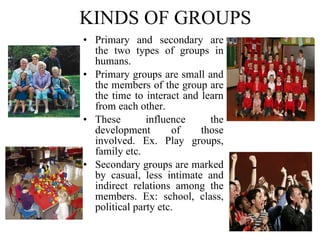
KINDS OF GROUPS Primary and secondary are the two types of groups in humans.  Primary groups are small and the members of the group are the time to interact and learn from each other.  These influence the development of those involved. Ex. Play groups, family etc.  Secondary groups are marked by casual, less intimate and indirect relations among the members. Ex: school, class, political party etc.
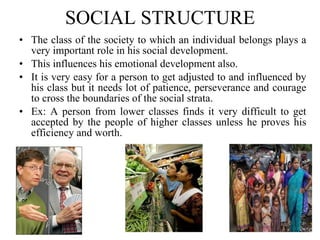
SOCIAL STRUCTURE The class of the society to which an individual belongs plays a very important role in his social development.  This influences his emotional development also.  It is very easy for a person to get adjusted to and influenced by his class but it needs lot of patience, perseverance and courage to cross the boundaries of the social strata.  Ex: A person from lower classes finds it very difficult to get accepted by the people of higher classes unless he proves his efficiency and worth.
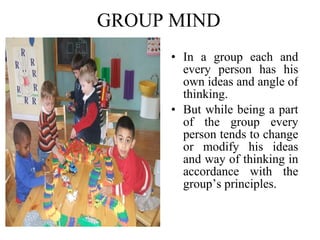
GROUP MIND In a group each and every person has his own ideas and angle of thinking.  But while being a part of the group every person tends to change or modify his ideas and way of thinking in accordance with the group’s principles.
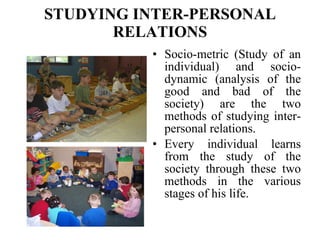
STUDYING INTER-PERSONAL RELATIONS Socio-metric (Study of an individual) and socio-dynamic (analysis of the good and bad of the society) are the two methods of studying inter-personal relations.  Every individual learns from the study of the society through these two methods in the various stages of his life.
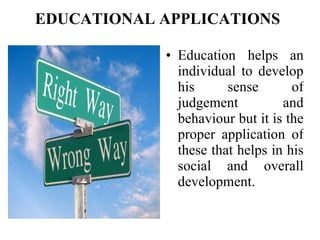
EDUCATIONAL APPLICATIONS   Education helps an individual to develop his sense of judgement and behaviour but it is the proper application of these that helps in his social and overall development.
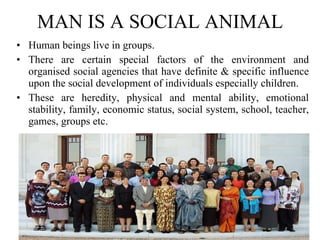
MAN IS A SOCIAL ANIMAL Human beings live in groups.  There are certain special factors of the environment and organised social agencies that have definite & specific influence upon the social development of individuals especially children.  These are heredity, physical and mental ability, emotional stability, family, economic status, social system, school, teacher, games, groups etc.
PROCESS OF SOCIALISATION The process of getting assimilated in the society is called socialisation. This starts in the family where he learns the basic social manners and later in the school and in the society. Parents’ occupation, social and economic status of the family, education of the parents, freedom etc play an important role in socialisation.
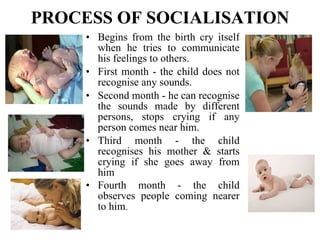
PROCESS OF SOCIALISATION Begins from the birth cry itself when he tries to communicate his feelings to others. First month - the child does not recognise any sounds. Second month - he can recognise the sounds made by different persons, stops crying if any person comes near him. Third month - the child recognises his mother & starts crying if she goes away from him Fourth month - the child observes people coming nearer to him .
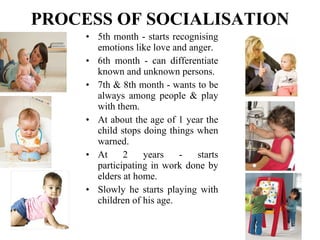
PROCESS OF SOCIALISATION 5th month - starts recognising emotions like love and anger. 6th month - can differentiate known and unknown persons. 7th & 8th month - wants to be always among people & play with them. At about the age of 1 year the child stops doing things when warned. At 2 years - starts participating in work done by elders at home. Slowly he starts playing with children of his age.
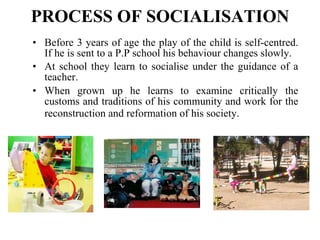
PROCESS OF SOCIALISATION Before 3 years of age the play of the child is self-centred. If he is sent to a P.P school his behaviour changes slowly. At school they learn to socialise under the guidance of a teacher. When grown up he learns to examine critically the customs and traditions of his community and work for the reconstruction and reformation of his society.     

8.social development

  • 1.
  • 2.
    SOCIAL DEVELOPMENT Theprocess in which a man creates his sources together with the help of the natural resources is called social development. Social development means the growing ability of an individual to live, move and work as a member of the society, to learn social forms of good behaviour, etiquette, manners, traditions and customs and to work with others for the benefit and happiness of others and himself .
  • 3.
    FACTORS AFFECTING SOCIALDEVELOPMENT Socialisation Imitation Suggestion Sympathy Social facilitation and inhabitation Competition and co-operation Kinds of groups Social structure Group mind Studying inter-personal relation Educational application
  • 4.
    SOCIALISATION This isthe process wherein a child learns about social values and behaviour while passing through the different stages of his life and continues till his death. The culture, customs, traditions and education of his family, neighbourhood and community largely determine and play an important role in this process of social learning of the child.
  • 5.
    IMITATION In thisprocess one person follows the actions of another person. The children particularly learn many things by imitating their parents, elder and others. The style of walking, talking, maintaining physique, dressing, etc. are some of the imitations that we can observe easily.
  • 6.
    SUGGESTION It isthe process of theoretical help from one person to another. This plays an important role in the life of a child. Knowingly or unknowingly it takes place in the life of every person especially in the childhood. Ex: teachers and parents change the behaviour and mistakes of the children by suggesting corrective measures.
  • 7.
    SYMPATHY It isa feeling of togetherness and sharing emotions involving two or more persons. It helps in the social development of the child through emotional development.
  • 8.
    SOCIAL FACILITATION &INHABITATION Social facilitation is the process wherein an individual in a group situation exceeds the performance level that he usually reaches when he works alone. Social inhabitation is the change of behaviour of an individual when he is in a group.
  • 9.
    COMPETITION & CO-OPERATIONThe spirit of competition or a desire to excel others helps in improving the performance of an individual while co-operation between individuals helps in makings things easier for all those involved.
  • 10.
    KINDS OF GROUPSPrimary and secondary are the two types of groups in humans. Primary groups are small and the members of the group are the time to interact and learn from each other. These influence the development of those involved. Ex. Play groups, family etc. Secondary groups are marked by casual, less intimate and indirect relations among the members. Ex: school, class, political party etc.
  • 11.
    SOCIAL STRUCTURE Theclass of the society to which an individual belongs plays a very important role in his social development. This influences his emotional development also. It is very easy for a person to get adjusted to and influenced by his class but it needs lot of patience, perseverance and courage to cross the boundaries of the social strata. Ex: A person from lower classes finds it very difficult to get accepted by the people of higher classes unless he proves his efficiency and worth.
  • 12.
    GROUP MIND Ina group each and every person has his own ideas and angle of thinking. But while being a part of the group every person tends to change or modify his ideas and way of thinking in accordance with the group’s principles.
  • 13.
    STUDYING INTER-PERSONAL RELATIONSSocio-metric (Study of an individual) and socio-dynamic (analysis of the good and bad of the society) are the two methods of studying inter-personal relations. Every individual learns from the study of the society through these two methods in the various stages of his life.
  • 14.
    EDUCATIONAL APPLICATIONS Education helps an individual to develop his sense of judgement and behaviour but it is the proper application of these that helps in his social and overall development.
  • 15.
    MAN IS ASOCIAL ANIMAL Human beings live in groups. There are certain special factors of the environment and organised social agencies that have definite & specific influence upon the social development of individuals especially children. These are heredity, physical and mental ability, emotional stability, family, economic status, social system, school, teacher, games, groups etc.
  • 16.
    PROCESS OF SOCIALISATIONThe process of getting assimilated in the society is called socialisation. This starts in the family where he learns the basic social manners and later in the school and in the society. Parents’ occupation, social and economic status of the family, education of the parents, freedom etc play an important role in socialisation.
  • 17.
    PROCESS OF SOCIALISATIONBegins from the birth cry itself when he tries to communicate his feelings to others. First month - the child does not recognise any sounds. Second month - he can recognise the sounds made by different persons, stops crying if any person comes near him. Third month - the child recognises his mother & starts crying if she goes away from him Fourth month - the child observes people coming nearer to him .
  • 18.
    PROCESS OF SOCIALISATION5th month - starts recognising emotions like love and anger. 6th month - can differentiate known and unknown persons. 7th & 8th month - wants to be always among people & play with them. At about the age of 1 year the child stops doing things when warned. At 2 years - starts participating in work done by elders at home. Slowly he starts playing with children of his age.
  • 19.
    PROCESS OF SOCIALISATIONBefore 3 years of age the play of the child is self-centred. If he is sent to a P.P school his behaviour changes slowly. At school they learn to socialise under the guidance of a teacher. When grown up he learns to examine critically the customs and traditions of his community and work for the reconstruction and reformation of his society.