SOCIOLIASATION
• Socialization isthe process through
which people are taught to be
proficient members of a society. It
describes the ways that people come
to understand societal norms and
expectations, to accept society’s
beliefs, and to be aware of societal
values.
• Socialization is not the same as
socializing (interacting with others, like
family and friends); to be precise, it is
a sociological process that occurs
through socializing.
• socialization is crucial for early
childhood. Even the most basic of
human activities are learned.
3.
SOCIOLIASATION
• Learning tocrawl and then
walk are major milestones, but
as any parent, guardian, or
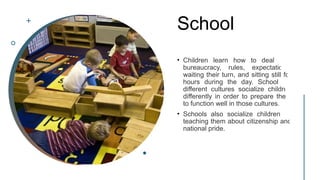
family member of a toddler
knows, other minor
accomplishments can be life-
altering for the child: climbing
stairs, safely getting out of
bed, sitting in a regular chair,
and drinking from a regular
cup.
• Likewise, family behaviors
and values must be learned,
sometimes through
observation and sometimes
through active instruction.
4.
Why
Socialization
Matters
• Socialization iscritical both to
individuals and to the societies in
which they live. It illustrates how
completely intertwined human beings
and their social worlds are.
• First, it is through teaching culture to
new members that a society
perpetuates itself. If new generations
of a society don’t learn its way of life, it
ceases to exist. Whatever is distinctive
about a culture must be transmitted to
those who join it in order for a society
to survive.
• Socialization is just as essential to us
as individuals. Social interaction
provides the means via which we
gradually become able to see
ourselves through the eyes of others,
and how we learn who we are and how
we fit into the world around us.
5.
Why
Socialization
Matters
• In addition,to function successfully in
society, we have to learn the basics of
both material and nonmaterial culture,
everything from how to dress ourselves
to what’s suitable attire for a specific
occasion; from when we sleep to what
we sleep on; and from what’s
considered appropriate to eat for dinner
to how to use the stove to prepare it.
• Most importantly, we have to learn
language—whether it’s the dominant
language or one common in a
subculture, whether it’s verbal or
through signs—in order to
communicate and to think.
6.
Nature
versus
Nurture
• Some expertsassert that who we are is
a result of nurture—the relationships
and caring that surround us. Others
argue that who we are is based entirely
in genetics. According to this belief, our
temperaments, interests, and talents are
set before birth. From this perspective,
then, who we are depends on nature.
• One way researchers attempt to
measure the impact of nature is by
studying twins. Some studies have
followed identical twins who were raised
separately. The pairs shared the same
genetics but in some cases were
socialized in different ways.
7.
Nature versus
Nurture
• Thoughgenetics and hormones play an
important role in human behavior,
sociology’s larger concern is the effect
society has on human behavior, the
“nurture” side of the nature versus nurture
debate.
• What race were the twins?
• From what social class were their
parents?
• What about gender?
• Religion?
• All these factors affected the lives of the
twins as much as their genetic makeup
and are critical to consider as we look at
life through the sociological lens
8.
Theories of
Self-
Development
• Whenwe are born, we have a
genetic makeup and biological
traits. However, who we are as
human beings develops through
social interaction. Many scholars,
both in the fields of psychology and
in sociology, have described the
process of self-development as a
precursor to understanding how
that “self” becomes socialized.
9.
Psychological
Perspectives
on Self-
Development
• PsychoanalystSigmund Freud
(1856–1939) was one of the
most influential modern
scientists to put forth a theory
about how people develop a
sense of self. He divided the
maturation process into stages,
and posited that people’s self-
development is closely linked to
their early stages of
development.
• According to Freud, failure to
properly engage in or
disengage from a specific stage
results in emotional and
psychological consequences
throughout adulthood.
10.
Psychological
Perspectives
on Self-
Development
• PsychologistErik Erikson (1902–1994) created
a theory of personality development based, in
part, on the work of Freud. However, Erikson
believed the personality continued to change
over time and was never truly finished. His
theory includes eight stages of development,
beginning with birth and ending with death.
• According to Erikson, people move through
these stages throughout their lives. In contrast
to Freud’s focus on psychosexual stages and
basic human urges, Erikson’s view of self-
development gave credit to more social
aspects, like the way we negotiate between our
own base desires and what is socially accepted
(Erikson 1982).
11.
Sociological
Theories of
Self-
Development
• Oneof the pioneering contributors to
sociological perspectives was Charles
Cooley (1864–1929). He asserted that
people’s self understanding is constructed, in
part, by their perception of how others
view them—a process termed “the
looking glass self” (Cooley 1902).
• Later, George Herbert Mead (1863–1931)
studied the self, a person’s distinct identity
that is developed through social
interaction. In order to engage in this
process of “self,” an individual has to be able
to view him or herself through the eyes of
others.
• That’s not an ability that we are born with
(Mead 1934). Through socialization we learn
to put ourselves in someone else's shoes
and look at the world through their
perspective.
12.
Sociological
Theories of
Self-
Development
• Duringthe preparatory stage, children are only
capable of imitation: they have no ability to
imagine how others see things. They copy the
actions of people with whom they regularly
interact, such as their caregivers. This is
followed by the play stage, during which
children begin to take on the role that one other
person might have. Thus, children might try on
a parent’s point of view by acting out “grownup”
behavior, like playing dress-up and acting out
the “mom” role or talking on a toy telephone the
way they see adults do.
• Finally, children develop, understand, and learn
the idea of the generalized other, the common
behavioral expectations of general society.
13.
Kohlberg’s Theory ofMoral Development
Moral development is an important part of the
socialization process. The term refers to the way
people learn what society considered to be “good” and
“bad,” which is important for a smoothly functioning
society. Moral development prevents people from
acting on unchecked urges, instead considering what is
right for society and good for others.
Lawrence Kohlberg (1927–1987) was interested in how
people learn to decide what is right and what is wrong.
To understand this topic, he developed a theory of
moral development that includes three levels:
preconventional, conventional, and postconventional.
14.
Kohlberg’s Theory ofMoral Development
• In the preconventional stage, young children, who lack a higher
level of cognitive ability, experience the world around them only
through their senses.
• Conventional theory develops, when youngsters become
increasingly aware of others’ feelings and take those into
consideration when determining what’s “good” and “bad.”
• The final stage, called postconventional, is when people begin to
think of morality in abstract terms, such as Americans believing that
everyone has the right to life, liberty, and the pursuit of happiness. At
this stage, people also recognize that legality and morality do not
always match up evenly (Kohlberg 1981).
15.
Agents of
Socialization
• Socializationhelps people learn to function
successfully in their social worlds.
• How does the process of socialization
occur?
• How do we learn to use the objects of our
society’s material culture?
• How do we come to adopt the beliefs,
values, and norms that represent its
nonmaterial culture?
• This learning takes place through interaction
with various agents of socialization, like peer
groups and families, plus both formal and
informal social institutions
16.
Social Group Agents
•Social groups often provide the first
experiences of socialization. Families,
and later peer groups, communicate
expectations and reinforce norms.
People first learn to use the tangible
objects of material culture in these
settings, as well as being introduced
to the beliefs and values of society.
• Family
• Peer Groups
17.
Family
• Family isthe first agent of socialization. Mothers
and fathers, siblings and grandparents, plus
members of an extended family, all teach a child
what he or she needs to know. For example,
they show the child how to use objects (such as
clothes, computers, eating utensils, books,
bikes); how to relate to others (some as “family,”
others as “friends,” still others as “strangers” or
“teachers” or “neighbors”); and how the world
works (what is “real” and what is “imagined”).
• As you are aware, either from your own
experience as a child or from your role in
helping to raise one, socialization includes
teaching and learning about an unending array
of objects and ideas.
18.
Family
• Keep inmind, however, that
families do not socialize
children in a vacuum. Many
social factors affect the way a
family raises its children.
19.
Peer Groups
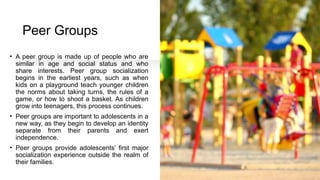
• Apeer group is made up of people who are
similar in age and social status and who
share interests. Peer group socialization
begins in the earliest years, such as when
kids on a playground teach younger children
the norms about taking turns, the rules of a
game, or how to shoot a basket. As children
grow into teenagers, this process continues.
• Peer groups are important to adolescents in a
new way, as they begin to develop an identity
separate from their parents and exert
independence.
• Peer groups provide adolescents’ first major
socialization experience outside the realm of
their families.
20.
Institutional
Agents
• The socialinstitutions of our culture also
inform our socialization. Formal institutions
—like schools, workplaces, and the
government—teach people how to behave
in and navigate these systems. Other
institutions, like the media, contribute to
socialization by inundating us with
messages about norms and expectations.
• School
• The Workplace
• Religion
• Government
• Mass Media
21.
School
• Most U.S.children spend about seven
hours a day, 180 days a year, in school,
which makes it hard to deny the importance
school has on their socialization (U.S.
Department of Education 2004).
• Schools also serve a latent function in
society by socializing children into
behaviors like practicing teamwork,
following a schedule, and using textbooks.
• School and classroom rituals, led by
teachers serving as role models and
leaders, regularly reinforce what society
expects from children. Sociologists
describe this aspect of schools as the
hidden curriculum, the informal teaching
done by schools.
22.
School
• Children learnhow to deal with
bureaucracy, rules, expectations,
waiting their turn, and sitting still for
hours during the day. Schools in
different cultures socialize children
differently in order to prepare them
to function well in those cultures.
• Schools also socialize children by
teaching them about citizenship and
national pride.
23.
The Workplace
• Justas children spend much of their day at school, many
adults at some point invest a significant amount of time at a
place of employment. Although socialized into their culture
since birth, workers require new socialization into a
workplace, in terms of both material culture (such as how to
operate the copy machine) and nonmaterial culture (such as
whether it’s okay to speak directly to the boss or how to
share the refrigerator).
• Different jobs require different types of socialization.
24.
Religion
• While somereligions are informal institutions,
here we focus on practices followed by formal
institutions. Religion is an important avenue of
socialization for many people.
• Like other institutions, these places teach
participants how to interact with the religion’s
material culture (like a mezuzah, a prayer rug, or
a communion wafer). For some people, important
ceremonies related to family structure—like
marriage and birth—are connected to religious
celebrations. Many religious institutions also
uphold gender norms and contribute to their
enforcement through socialization.
25.
Government
• Although wedo not think about it,
many of the rites of passage people
go through today are based on age
norms established by the government.
To be defined as an “adult” usually
means being eighteen years old, the
age at which a person becomes
legally responsible for him- or herself.
And sixty-five years old is the start of
“old age” since most people become
eligible for senior benefits at that point.
• Each time we embark on one of these
new categories—senior, adult,
taxpayer—we must be socialized into
our new role. Seniors must learn the
ropes of Medicare, Social Security
benefits, and senior shopping
discounts.
26.
Mass Media
• Massmedia distribute impersonal
information to a wide audience, via
television, newspapers, radio, and the
Internet. With the average person spending
over four hours a day in front of the
television (and children averaging even
more screen time), media greatly influences
social norms (Roberts, Foehr, and Rideout
2005).
• People learn about objects of material
culture (like new technology and
transportation options), as well as
nonmaterial culture—what is true (beliefs),
what is important (values), and what is
expected (norms).
27.
Socializatio
n Across
the Life
Course
•Socialization isn’t a one-time or even a
short-term event. We aren’t “stamped” by
some socialization machine as we move
along a conveyor belt and thereby
socialized once and for all. In fact,
socialization is a lifelong process.
• Many of life’s social expectations are
made clear and enforced on a cultural
level. Through interacting with others
and watching others interact, the
expectation to fulfill roles becomes clear.
28.
Types of socialization
Resocialization
•In the process of resocialization, old behaviors that were
helpful in a previous role are removed because they are
no longer of use. Resocialization is necessary when a
person moves to a senior care center, goes to boarding
school, or serves a sentence in the prison system. In the
new environment, the old rules no longer apply.
• The process of resocialization is typically more stressful
than normal socialization because people have to
unlearn behaviors that have become customary to them.
While resocialization has a specific meaning, many
organizations consider their training or retraining
processes to embody elements of resocialization.
29.
Types of
socialization
Degradation
• Manyindividuals are resocialized into an
institution through a two-part process.
First, members entering an institution must
leave behind their old identity through what
is known as a degradation ceremony.
• In a degradation ceremony, new members
lose the aspects of their old identity and
are given new identities. The process is
sometimes gentle. To enter a senior care
home, an elderly person often must leave
a family home and give up many
belongings which were part of his or her
long-standing identity.
30.
Types of socialization
DevelopmentalSocialization
Developmental socialization is the
process of learning behavior in a
social institution or developing your
social skills.
New learning is added to and
blended with old in a relatively
smooth and continuous process of
development
Anticipatory Socialization
• The processes of
socialization in which a
person "rehearses" for future
positions, occupations, and
social relationships.
• Anticipatory socialization may
not be adequate when the
nature and scope of life
transition is complex.
31.
Developmenta
l Socialization
• Developmentalsocialization is the
process of learning behavior in a social
institution or developing your social skills.
• New learning is added to and blended
with old in a relatively smooth and
continuous process of development