
Basic premises
 Emile Durkheim was interested to know:
how societies maintain order in the systems of
hierarchies?
how to deal with society’s disorder and chaos?
what are those processes that help in keeping people
together?
 He discussed Social Phenomenon as Sui Generis(which
has its own unique being) to understand the structure of
society
 Social phenomenon is an outcome of our interaction that
happens in our day to day life
Social phenomenon
 Social phenomenon is external to oneself; it is not derived from
our biological or psychological understandings
 They endure over time
 Coercive endowment on a society; will of an individual is not
important
through laws, policies and legal actions
Durkheim has divided his theory into two themes
Themes
There are two main themes in the work of Emile Durkheim
so that sociology is distinguished from psychology:
1. the priority of the social over the individual ,
2. the idea that society can be studied scientifically
 society gradually influence how you think , what to think
 Society institutionalize the idea , thus, individuals think
accordingly
 society is supreme ; it governs the behaviour
 Durkheim argued that sociology should be oriented toward
empirical research
 threatened by a philosophical school within sociology itself
Theory of Social facts
 Durkheim proposed the distinctive subject of matter of
sociology: the study of social facts
 A social fact can hence be defined as ‘’every way of
acting, fix or not, capable of exercising on the
individual an external constraint’’
 they are internalized in the consciousness of individuals
 These constraints provide us moral obligation and thus,
social facts control us
 In this sense society is ‘’something beyond us and
something in ourselves’’.
 Social facts are such facts that the actor and the social
scientist come to know through social phenomenon
Contd…
 social facts exceed our intuitive understanding and must be investigated
through observations and measurements
 These ideas are so central to sociology that Durkheim is often seen as
“Father of Sociology”.
 Social facts are the social structures and cultural norms and values that
are external to, and coercive of, actors
for example: students are constrained by university rules and laws,
where , university is a social structure that provides us certain values
 A social fact is every way of acting which is general throughout a given
society, while at the same time existing in its own right independent of its
individual manifestations
Language: a Social Fact
 He refers to language as a social fact in three ways:
 First, language is a social fact that can be studied
scientifically. It can be studied more than a
philosophical idea; consisting of some rules and
grammar.
 Second, language is not something that originates
from us, rather we only use it depending on our
context.
 Third, language is very complicated in its use
 And finally, the change in language cannot be
traced to a person. The changes occurring in social
structure bring change in the structure of language.
Types of social facts
 Durkheim differentiated between two different types of social
facts: Material and Non-Material
 Material social facts: such as styles of architecture, forms of
technology, and legal codes,
 they are directly observable
 More, importantly these material social facts often express a far
larger and more powerful realm of moral forces
 Durkheim saw social facts along a continuum of materiality. The
most material facts are; population size and density, channels of
communication , and housing arrangements . Durkheim called
these facts morphological and they figure most importantly in his
first book, The Division of Labor in Society (1893/1964)
Non- material social facts
 Durkheim recognized that non material social facts are, to a
certain extent, found in the minds of individuals, that is, when
people begin to interact in complex ways, their interactions will “
obey laws all their own”.
 Durkheim understood non-material social facts , through
materiality bureaucracy, for example, which is a mixture of
morphological components and non material social facts such
as: the bureaucratic norms
 Durkheim focused more on non-material social facts
 He has given four types of non-material facts:
Morality, Collective Conscience, Collective Representation,
Social Currents
Types of non-material social facts
1. Morality : Durkheim was a sociologist of morality in the broadest
sense of the word. Morality was at the foundation of sociology as a
discipline. Durkheim’s view of morality had two aspects :
a. Durkheim was convinced that morality is a social fact; that can be
empirically studied, is external to the individual , is coercive of the
individual , and is explained by other social facts
b. His studies were driven by his concern about the moral “health” of
modern society
 much of Durkheim's sociology can be seen as a by-product of his
concern with moral issues
 Durkheim viewed that people were in danger of a “pathological”
loosening of moral bonds
 What the morality should be was of less interest to him
Collective Conscience
 Durkheim developed the idea of collective conscience, in
French the word conscience means both “consciousness”
and “moral conscience”
 “ the totality of beliefs and sentiments common to average citizens of the same society forms a determinate
system which has its own life; one may call it the collective or common conscience… it is, thus, an entirely
different thing from particular consciences, although it can be realized only through them”
(Durkheim, 1893/1964:79-80)
 it is not just a reflection of a material base as Marx sometimes
suggested
 It refers to the general structure of shared understandings,
Durkheim employ this concept to argue that primitive societies
had a stronger collective conscience that is more shared
understandings, norms and beliefs than modern.
Collective Representation
 Durkheim’s dissatisfaction about broad and amorphous concept
of collective conscience led him to work on more concrete
concept; Collective Represenation
 In French, word representation mean idea
 Durkheim used the term to refer to both a collective concept
and social force
 For example : religious symbols, myths and popular legends
represent collective beliefs, norms and values and they
motivate us to conform to these collective claims
Abraham Lincoln (1945) functions in American society as
collective representation. That allow people to think about
themselves as Americans
Social Currents
 The social facts “which do not present themselves in the
crystallized form” , Durkheim called them Social Current
for example: the great waves of enthusiasm,
indignation and pity
 they are less concrete than other social facts
 They have coercive power upon us
 Social currents can be seen as sets of meanings that are
shared by members of a collectivity
 They can only be explained intersubjectively, that is, in
terms of interactions between individuals
 Social currents are ‘moods’ that vary from one collectivity
to another
The Division of Labor in Society
 The Division of Labor in Society has been called sociology’s first
classic
 Durkheim traced the development of modern relation between
individuals and society
 The book is contradiction to August Comte’s analysis of division of
labor
 Durkheim argues that division of labor does not represent the
disappearance of social morality
 People are dependent on each other due to this hierarchy of labor
 Durkheim argued while saying” the economic services that it can
render are insignificant compared with the moral effect that it
produces and its true function is to create between two or more
people a feeling of solidarity”
Social Solidarity
 Durkheim was interested how societies are held together, how its
members see themselves as part of that whole
 Durkheim gave two types of social solidarity: mechanical and
organic
1. Mechanical Solidarity : the bond among people is that they are all
engaged in similar activities and have similar responsibilities. It has
more collective conscience. Strong system of common belief
characterizes mechanical solidarity in primitive society.
2. Organic Solidarity: differences among people hold them together ,
by the fact that all have different tasks and responsibilities. Organic
societies have weak collective conscience.
Contd…
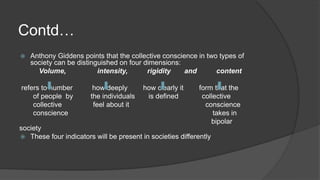
 Anthony Giddens points that the collective conscience in two types of
society can be distinguished on four dimensions:
Volume, intensity, rigidity and content
refers to number how deeply how clearly it form that the
of people by the individuals is defined collective
collective feel about it conscience
conscience takes in
bipolar
society
 These four indicators will be present in societies differently
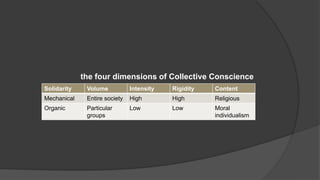
the four dimensions of Collective Conscience
Solidarity Volume Intensity Rigidity Content
Mechanical Entire society High High Religious
Organic Particular
groups
Low Low Moral
individualism
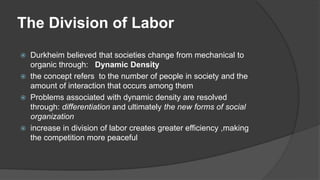
The Division of Labor
 Durkheim believed that societies change from mechanical to
organic through: Dynamic Density
 the concept refers to the number of people in society and the
amount of interaction that occurs among them
 Problems associated with dynamic density are resolved
through: differentiation and ultimately the new forms of social
organization
 increase in division of labor creates greater efficiency ,making
the competition more peaceful
Contd…
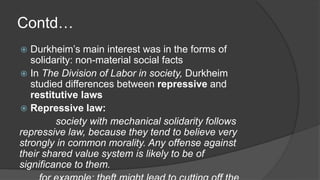
 Durkheim’s main interest was in the forms of
solidarity: non-material social facts
 In The Division of Labor in society, Durkheim
studied differences between repressive and
restitutive laws
 Repressive law:
society with mechanical solidarity follows
repressive law, because they tend to believe very
strongly in common morality. Any offense against
their shared value system is likely to be of
significance to them.
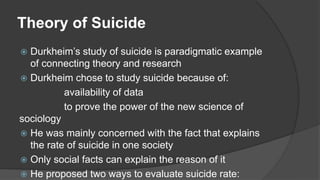
Theory of Suicide
 Durkheim’s study of suicide is paradigmatic example
of connecting theory and research
 Durkheim chose to study suicide because of:
availability of data
to prove the power of the new science of
sociology
 He was mainly concerned with the fact that explains
the rate of suicide in one society
 Only social facts can explain the reason of it
 He proposed two ways to evaluate suicide rate:
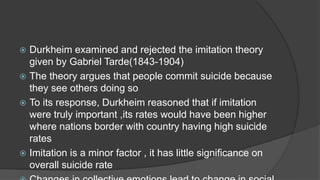
 Durkheim examined and rejected the imitation theory
given by Gabriel Tarde(1843-1904)
 The theory argues that people commit suicide because
they see others doing so
 To its response, Durkheim reasoned that if imitation
were truly important ,its rates would have been higher
where nations border with country having high suicide
rates
 Imitation is a minor factor , it has little significance on
overall suicide rate
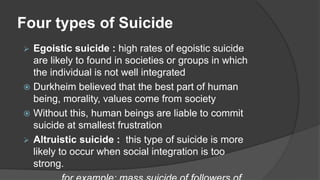
Four types of Suicide
 Egoistic suicide : high rates of egoistic suicide
are likely to found in societies or groups in which
the individual is not well integrated
 Durkheim believed that the best part of human
being, morality, values come from society
 Without this, human beings are liable to commit
suicide at smallest frustration
 Altruistic suicide : this type of suicide is more
likely to occur when social integration is too
strong.
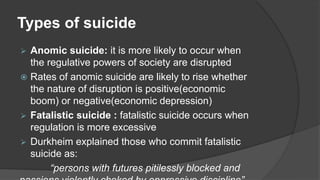
Types of suicide
 Anomic suicide: it is more likely to occur when
the regulative powers of society are disrupted
 Rates of anomic suicide are likely to rise whether
the nature of disruption is positive(economic
boom) or negative(economic depression)
 Fatalistic suicide : fatalistic suicide occurs when
regulation is more excessive
 Durkheim explained those who commit fatalistic
suicide as:
“persons with futures pitilessly blocked and
Theory of Religion
 Raymond Aron said of the Elementary Forms of
Religious Life of Emile Durkheim as most
profound and original
 In this book, Durkheim put forward both a
sociology of religion and a theory of knowledge
 He found the enduring essence of religion in the
setting apart of sacred from all that is profane
 Durkheim could not believe that anything
supernatural was the source of these religious
feelings
Beliefs, Rituals and Church
 Three conditions are necessary for development
of religion
1. Developing religious beliefs: beliefs are “the
representations which express the nature of
sacred things and the relations which they
sustain, either with each other or with profane
things”
2. Religious rituals: “the rules of conduct which
prescribe how a man should comport himself in
the presence of these sacred objects”
3. A church: religion requires a church or a single
Totemism: a case study
 Durkheim was interested in totemism among the Australian
Arunta
 Totemism is a primitive religious system in which certain things,
particularly animals and plants, considered as sacred and
emblems of clan
 totems are material representations of non-material force , that
is, society
 They are not a series of mythical animals , plants , personalities
or gods but they represent the collective morality of society

Emile Durkheim, Sociologist ppt

  • 2.
    Basic premises  EmileDurkheim was interested to know: how societies maintain order in the systems of hierarchies? how to deal with society’s disorder and chaos? what are those processes that help in keeping people together?  He discussed Social Phenomenon as Sui Generis(which has its own unique being) to understand the structure of society  Social phenomenon is an outcome of our interaction that happens in our day to day life
  • 3.
    Social phenomenon  Socialphenomenon is external to oneself; it is not derived from our biological or psychological understandings  They endure over time  Coercive endowment on a society; will of an individual is not important through laws, policies and legal actions Durkheim has divided his theory into two themes
  • 4.
    Themes There are twomain themes in the work of Emile Durkheim so that sociology is distinguished from psychology: 1. the priority of the social over the individual , 2. the idea that society can be studied scientifically  society gradually influence how you think , what to think  Society institutionalize the idea , thus, individuals think accordingly  society is supreme ; it governs the behaviour  Durkheim argued that sociology should be oriented toward empirical research  threatened by a philosophical school within sociology itself
  • 5.
    Theory of Socialfacts  Durkheim proposed the distinctive subject of matter of sociology: the study of social facts  A social fact can hence be defined as ‘’every way of acting, fix or not, capable of exercising on the individual an external constraint’’  they are internalized in the consciousness of individuals  These constraints provide us moral obligation and thus, social facts control us  In this sense society is ‘’something beyond us and something in ourselves’’.  Social facts are such facts that the actor and the social scientist come to know through social phenomenon
  • 6.
    Contd…  social factsexceed our intuitive understanding and must be investigated through observations and measurements  These ideas are so central to sociology that Durkheim is often seen as “Father of Sociology”.  Social facts are the social structures and cultural norms and values that are external to, and coercive of, actors for example: students are constrained by university rules and laws, where , university is a social structure that provides us certain values  A social fact is every way of acting which is general throughout a given society, while at the same time existing in its own right independent of its individual manifestations
  • 7.
    Language: a SocialFact  He refers to language as a social fact in three ways:  First, language is a social fact that can be studied scientifically. It can be studied more than a philosophical idea; consisting of some rules and grammar.  Second, language is not something that originates from us, rather we only use it depending on our context.  Third, language is very complicated in its use  And finally, the change in language cannot be traced to a person. The changes occurring in social structure bring change in the structure of language.
  • 8.
    Types of socialfacts  Durkheim differentiated between two different types of social facts: Material and Non-Material  Material social facts: such as styles of architecture, forms of technology, and legal codes,  they are directly observable  More, importantly these material social facts often express a far larger and more powerful realm of moral forces  Durkheim saw social facts along a continuum of materiality. The most material facts are; population size and density, channels of communication , and housing arrangements . Durkheim called these facts morphological and they figure most importantly in his first book, The Division of Labor in Society (1893/1964)
  • 9.
    Non- material socialfacts  Durkheim recognized that non material social facts are, to a certain extent, found in the minds of individuals, that is, when people begin to interact in complex ways, their interactions will “ obey laws all their own”.  Durkheim understood non-material social facts , through materiality bureaucracy, for example, which is a mixture of morphological components and non material social facts such as: the bureaucratic norms  Durkheim focused more on non-material social facts  He has given four types of non-material facts: Morality, Collective Conscience, Collective Representation, Social Currents
  • 10.
    Types of non-materialsocial facts 1. Morality : Durkheim was a sociologist of morality in the broadest sense of the word. Morality was at the foundation of sociology as a discipline. Durkheim’s view of morality had two aspects : a. Durkheim was convinced that morality is a social fact; that can be empirically studied, is external to the individual , is coercive of the individual , and is explained by other social facts b. His studies were driven by his concern about the moral “health” of modern society  much of Durkheim's sociology can be seen as a by-product of his concern with moral issues  Durkheim viewed that people were in danger of a “pathological” loosening of moral bonds  What the morality should be was of less interest to him
  • 11.
    Collective Conscience  Durkheimdeveloped the idea of collective conscience, in French the word conscience means both “consciousness” and “moral conscience”  “ the totality of beliefs and sentiments common to average citizens of the same society forms a determinate system which has its own life; one may call it the collective or common conscience… it is, thus, an entirely different thing from particular consciences, although it can be realized only through them” (Durkheim, 1893/1964:79-80)  it is not just a reflection of a material base as Marx sometimes suggested  It refers to the general structure of shared understandings, Durkheim employ this concept to argue that primitive societies had a stronger collective conscience that is more shared understandings, norms and beliefs than modern.
  • 12.
    Collective Representation  Durkheim’sdissatisfaction about broad and amorphous concept of collective conscience led him to work on more concrete concept; Collective Represenation  In French, word representation mean idea  Durkheim used the term to refer to both a collective concept and social force  For example : religious symbols, myths and popular legends represent collective beliefs, norms and values and they motivate us to conform to these collective claims Abraham Lincoln (1945) functions in American society as collective representation. That allow people to think about themselves as Americans
  • 13.
    Social Currents  Thesocial facts “which do not present themselves in the crystallized form” , Durkheim called them Social Current for example: the great waves of enthusiasm, indignation and pity  they are less concrete than other social facts  They have coercive power upon us  Social currents can be seen as sets of meanings that are shared by members of a collectivity  They can only be explained intersubjectively, that is, in terms of interactions between individuals  Social currents are ‘moods’ that vary from one collectivity to another
  • 14.
    The Division ofLabor in Society  The Division of Labor in Society has been called sociology’s first classic  Durkheim traced the development of modern relation between individuals and society  The book is contradiction to August Comte’s analysis of division of labor  Durkheim argues that division of labor does not represent the disappearance of social morality  People are dependent on each other due to this hierarchy of labor  Durkheim argued while saying” the economic services that it can render are insignificant compared with the moral effect that it produces and its true function is to create between two or more people a feeling of solidarity”
  • 15.
    Social Solidarity  Durkheimwas interested how societies are held together, how its members see themselves as part of that whole  Durkheim gave two types of social solidarity: mechanical and organic 1. Mechanical Solidarity : the bond among people is that they are all engaged in similar activities and have similar responsibilities. It has more collective conscience. Strong system of common belief characterizes mechanical solidarity in primitive society. 2. Organic Solidarity: differences among people hold them together , by the fact that all have different tasks and responsibilities. Organic societies have weak collective conscience.
  • 16.
    Contd…  Anthony Giddenspoints that the collective conscience in two types of society can be distinguished on four dimensions: Volume, intensity, rigidity and content refers to number how deeply how clearly it form that the of people by the individuals is defined collective collective feel about it conscience conscience takes in bipolar society  These four indicators will be present in societies differently
  • 17.
    the four dimensionsof Collective Conscience Solidarity Volume Intensity Rigidity Content Mechanical Entire society High High Religious Organic Particular groups Low Low Moral individualism
  • 18.
    The Division ofLabor  Durkheim believed that societies change from mechanical to organic through: Dynamic Density  the concept refers to the number of people in society and the amount of interaction that occurs among them  Problems associated with dynamic density are resolved through: differentiation and ultimately the new forms of social organization  increase in division of labor creates greater efficiency ,making the competition more peaceful
  • 19.
    Contd…  Durkheim’s maininterest was in the forms of solidarity: non-material social facts  In The Division of Labor in society, Durkheim studied differences between repressive and restitutive laws  Repressive law: society with mechanical solidarity follows repressive law, because they tend to believe very strongly in common morality. Any offense against their shared value system is likely to be of significance to them.
  • 20.
    Theory of Suicide Durkheim’s study of suicide is paradigmatic example of connecting theory and research  Durkheim chose to study suicide because of: availability of data to prove the power of the new science of sociology  He was mainly concerned with the fact that explains the rate of suicide in one society  Only social facts can explain the reason of it  He proposed two ways to evaluate suicide rate:
  • 21.
     Durkheim examinedand rejected the imitation theory given by Gabriel Tarde(1843-1904)  The theory argues that people commit suicide because they see others doing so  To its response, Durkheim reasoned that if imitation were truly important ,its rates would have been higher where nations border with country having high suicide rates  Imitation is a minor factor , it has little significance on overall suicide rate
  • 22.
    Four types ofSuicide  Egoistic suicide : high rates of egoistic suicide are likely to found in societies or groups in which the individual is not well integrated  Durkheim believed that the best part of human being, morality, values come from society  Without this, human beings are liable to commit suicide at smallest frustration  Altruistic suicide : this type of suicide is more likely to occur when social integration is too strong.
  • 23.
    Types of suicide Anomic suicide: it is more likely to occur when the regulative powers of society are disrupted  Rates of anomic suicide are likely to rise whether the nature of disruption is positive(economic boom) or negative(economic depression)  Fatalistic suicide : fatalistic suicide occurs when regulation is more excessive  Durkheim explained those who commit fatalistic suicide as: “persons with futures pitilessly blocked and
  • 24.
    Theory of Religion Raymond Aron said of the Elementary Forms of Religious Life of Emile Durkheim as most profound and original  In this book, Durkheim put forward both a sociology of religion and a theory of knowledge  He found the enduring essence of religion in the setting apart of sacred from all that is profane  Durkheim could not believe that anything supernatural was the source of these religious feelings
  • 25.
    Beliefs, Rituals andChurch  Three conditions are necessary for development of religion 1. Developing religious beliefs: beliefs are “the representations which express the nature of sacred things and the relations which they sustain, either with each other or with profane things” 2. Religious rituals: “the rules of conduct which prescribe how a man should comport himself in the presence of these sacred objects” 3. A church: religion requires a church or a single
  • 26.
    Totemism: a casestudy  Durkheim was interested in totemism among the Australian Arunta  Totemism is a primitive religious system in which certain things, particularly animals and plants, considered as sacred and emblems of clan  totems are material representations of non-material force , that is, society  They are not a series of mythical animals , plants , personalities or gods but they represent the collective morality of society