NSNG 209
SOCIOLOGY (3 CREDITS)
Basic Sociological Concepts: Socialization
Lecturer: Mr. Ernest K. Bobo, Dept. of Sociology
Contact Information: boboernest@gmail.com
CENTRAL UNIVERSITY
Faculty of Social Science
Objectives
At the end of the lecture, the student will be able to:
 Understand the importance of socialization both for
individuals and society
 Learn the roles of families and peer groups in
socialization
 Understand how we are socialized through formal
institutions like schools, workplaces, and the government
 Explain how socialization occurs and recurs throughout life
 Understand how people are socialized into new roles at
age-related transition points
Describe when and how resocialization occurs
The Concept of Socialization
•Man is not only social but also cultural.
• It is the culture that provides opportunities for
man to develop the personality.
• Development of personality is not automatic
process.
• Every society prescribes its own ways and
means of giving social training to its new born
members so that they may develop their own
personality.
•This social training is called ‘Socialization’.
The Concept of Socialization Cont.
•The process of socialization is conditioned by
culture.
•Since every society has its own culture the
ways of the process of socialization also differ
from society to society.
•Further, the same culture and the same ways of
socialization may have diverse effects on the
development of the personality of the members
of the same society.
•Socialization is a process of molding a human
infant to a member of society to which he/she
belongs.
The Concept of Socialization Cont.
• Socialization is the process by which an individual
learns the values, attitudes, and behaviours
appropriate for them in a given society.
• W.H. Ogburn says “Socialization is a process by
which the individual learns to conform to the norms
of the group”.
• Green says “Socialization is the process which the
child acquires a cultural content, along with selfhood
and personality”.
• Peter Worsley explains socialization as the process
of “transmission of culture, the process whereby an
individual learns the rules and practices of social
groups”.
Process of Socialization
•Socialization is the process of learning group
norms, ideals, habits, behaviours and customs.
•The process of Socialization starts long before
the child is born.
•The parents courtship, marital selection, the
customs concerning pregnancy and birth.
•Whole system of cultural practices surrounding
the family are important for the child’s growth.
•But direct socialization begins only after birth.
Factors for the Process of socialization
•Four factors are determine it
1. Suggestion
2. Imitation
3. Identification
4. Language
Factors for the Process of socialization Cont.
•Suggestion:
•Suggestion is the process of communicating
information which has no logical or self-evident
basis.
•It may conveyed through language, pictures or
some similar medium.
•Propaganda and advertising are based on the
fundamental psychological principles of
Suggestion.
Factors for the Process of socialization Cont.
•Imitation:
•Imitation is copying by an individual of the
actions of another.
•Thus, when the child attempts to walk
impressively like his father swinging a stick and
wearing spectacles, he is imitating.
•Imitation may be conscious or unconscious,
spontaneous or deliberate.
Factors for the Process of socialization Cont.
•Identification:
•The child cannot make any distinction between
his organism and environment.
•Most of his actions are random.
•As he grows in age, he/she comes to know of
the nature of things which satisfy his/her needs.
•He/she gradually identified what he/she need
for happy in his/her life.
Factors for the Process of socialization Cont.
•Language:
•Language is the medium of social intercourse.
•It is the means of cultural transmission.
• At first the child utters some random syllables
which have no meaning, but gradually he come
to learn his mother tongue.
•Language molds the personality of the
individual form infancy.
Importance of socialisation
•Socialization converts man, the biological being
into the social being.
•Socialization contributes to the development of
personality.
•Helps to become disciplined.
•Helps to enact different roles.
•Provides the knowledge of skills.
•Helps to develop right aspiration in life.
• Contributes to the stability of the social order.
• Helps to reduce social distance.
•Provides scope for building the bright future.
• Helps the transmission of culture.
Importance of socialisation Cont.
•Socialization converts man, the biological being
into man, the social being.
• Man is not born as social.
• He becomes social by virtue of the process of socialization.
•Socialization contributes to the development of
personality.
• Personality is a product of society.
• In the absence of groups or society no man can develop a
personality of his own.
• But socialization is a process through which the personality
of the new born child is shaped and molded.
• The process of socialization prepares the child to lead an
approved way of social life.
Importance of socialisation Cont.
•Helps to become disciplined.
• Social learning is essentially the learning of rules of social
behaviour.
• It is through socialization that the child learns not only
rules of social behaviour but also the values, ideals, aims
and objectives of life and the means of attaining them.
• Socialization disciplines an individual and helps him to live
according to the social expectations.
•Helps to enact different roles.
• Every individual has to enact different roles in his life.
• Every role is woven around norms and is associated with
different attitudes.
• The process of socialization assists an individual not only to
learn the norms associated with roles but also to develop
appropriate attitudes to enact those roles.
Importance of socialisation Cont.
•Provides the knowledge of skills.
• Socialization is a way of training the new born individual in
certain skills which are required to lead a normal social life.
• These skills helps the individual to play economic,
professional, educational, religious and political roles in his
later life.
•Helps to develop right aspiration in life.
• Every individual may have his own aspirations, ambitions and
desires in life.
• All these aspirations may not always be in consonance with
the social interests.
• Some of them may even be opposed to the communal
interests.
• But through the process of socialization an individual learns
to develop those aspirations which are complementary to the
interests of society.
Importance of socialisation Cont.
•Contributes to the stability of the social order.
• It is through the process of socialization that every new
generation is trained according to the cultural goals,
ideals, and expectations of a society.
• It assures the cultural continuity of the society.
• At the same time it provides enough scope for variety
and new achievements.
•Helps to reduce social distance.
• Socialization reduces social distance and brings people
together if proper attention is given to it.
• By giving proper training and guidance to the children
during their early years, it is possible to reduce the
social distance between people different castes, races,
regions, religious and professions.
Importance of socialisation Cont.
•Provides scope for building the bright future.
• Socialization is one of the powerful instruments of
changing the destiny of mankind.
• It is through the process of socialization that a society
can produce a generation of its expectations.
• By giving appropriate training to the new born children
the coming generation can be altered significantly.
•Helps the transmission of culture.
• By transmitting the contents of cultures such as ideas,
beliefs, language, skills, etc., from one generation to the
other, socialization contributes to the continuity to
culture also.
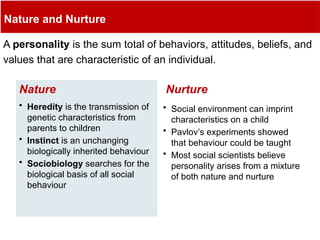
Nature and Nurture
A personality is the sum total of behaviors, attitudes, beliefs, and
values that are characteristic of an individual.
• Heredity is the transmission of
genetic characteristics from
parents to children
• Instinct is an unchanging
biologically inherited behaviour
• Sociobiology searches for the
biological basis of all social
behaviour
Nature
• Social environment can imprint
characteristics on a child
• Pavlov’s experiments showed
that behaviour could be taught
• Most social scientists believe
personality arises from a mixture
of both nature and nurture
Nurture
Agencies and Agents of Socialization
• Socialization is undertaken by many agencies and agents.
• Agencies are the larger organizations or institutions such
as family, the school, peer groups, organizations, the
community and the media.
• The agents are the individuals within these organization or
institutions such as parents in the family, teachers in
schools, our peers in peer groups, pastors of churches,
and the media organization, the radio stations such as Joy
FM, City FM, Televisions stations, newspapers and
magazine, the internet, etc
• Family and parents
• Peers or Age mates
• School or Teachers
• Community
• Organizations
• Literature and Mass Media of Communication
Agents of Socialization Cont.
•Family
• The process of socialization begins for every one of us
in the family.
• Hence, the parental influence on the child is very great.
• The intimate relationship between the mother and the
child has a great impact on the shaping of child’s
abilities and capacities.
• The parents are the first persons to introduce to the
child the culture of his group.
• The child receives additional communications from his
older siblings, i.e. brothers and sisters, who have gone
through the same process – with certain differences
due to birth order and to the number and sex of the
siblings.
Agents of Socialization Cont.
•Peers or Agemates
• ‘Peer groups’ means groups made up of the
contemporaries of the child, his associates in
school, in playground and in street.
• He learns from these children, facts and facets of
culture that they have previously learnt at different
times from their parents.
• The members of peer groups have other sources
of information about the culture – their peers in still
other peer groups – and thus the acquisition of
culture goes on.
• The ‘peer culture’ becomes more important and
effective than the ‘parental culture’ in the
adolescent years of the child.
Agents of Socialization Cont.
•Teachers
• The teachers also play their role in socialization
when the child enters the school.
• It is in the school that the culture is formally
transmitted and acquired, in which learning, the
science and art, of one generation is passed on
to the next.
• It is not only the formal knowledge of the culture
that is transmitted there but most of tis premises as
well – its ethical sentiments, its political attitudes,
its customs and taboos.
• The communications they receive from their
teachers help to socialize them and to make them
finally mature members of their societies.
Agents of Socialization Cont.
• The Community
• Communities and community organizations also play important
role in the socialization process.
• In many traditional African societies, it is normal to see adult
members in communities lending a hand in the socialization
process of all children.
• It is a cultural duty that adults discipline children in the
community.
• Again, within communities are all kinds of organizations
churches, mosques, day care centres all involved in
socialization.
• When people attend church or mosque, they are often
taught be to be morally upright, to do things that are
pleasing to God, to love their neighbours, to be kind
towards others especially those who are not so fortunate
in life, not to drink, not to be sexually lose, etc.
• Religious teachings therefore help in character formation.
Agents of Socialization Cont.
•Organizations
• Organizations or places where people work are also
important sources of adult socialization and re-
socialization.
• When people join organizations to work they learn new
ways to doing things in the organization.
• At such workplace people develop or copy new life styles,
share opinions, accept criticisms and seek advice from
colleagues in the process a
Agents of Socialization Cont.
•Literature and Mass Media of Communication
• The civilization that we share is constructed of words
or literature.
• Words rush at us in torrent and cascade; they leap
into our vision, as in billboard and newspaper,
magazine and textbook; and assault our ears, as in
radio and television.
• The media of mass communication give us their
message.
• These messages too contain in capsule form, the
premises of our culture, its attitudes and ideologies.
• The words are always written by some one and these
people too – authors and editors and advertisers –
join the teachers, the peers and parents in the
socialisation process.
Types of socialisation
•Primary socialisation
•Anticipatory socialisation
•Developmental socialisation
•Re-Socialisation
• Adult Socialization
Types of socialisation Cont.
•Primary socialisation
• This is the most essential and basic types of
socialization.
• It takes place in the early years of life of the new-
born individual.
•Anticipatory socialisation
• Men not only learn the culture of the group of
which they are immediate members.
• They may also learn the culture of groups to which
they do not belong.
Types of socialisation Cont.
•Developmental socialisation
• This kind of learning is based on the achievements of
primary socialization.
• It builds on already acquired skills and knowledge as
the adult progresses through new situations such as
marriage or new jobs.
• These require new expectations, obligations and roles.
•Re-Socialisation
• Not only do individuals change roles within groups, but
they also change membership groups.
• Such re-socialization takes place mostly when a social
role is radically changed.
• It may also happen in periods of rapid social mobility.
• For example, a newly wedded housewife may be
forced to become in a brothel.
Types of socialisation Cont.
•Adult socialization
• In fact, socialization is a life-long process.
• Even at the door of death one has something to
learn.
• Naturally, the adult individuals who are to
undertake major responsibilities in life have many
things to learn in the course of their adulthood.
• In the modern society adulthood is considered to
be attained when a person can support himself or
herself entirely independent of the parental family.
• Full adulthood also implies the ability to form a
family of one’s own.
Types of socialisation Cont.
•The socialization of adults is relatively easier
than the socialization of children for three
reasons:
• The adult is normally motivated to work towards a
goal which he has already picked up.
• The new role that he is trying to internalize has
may similarities to the roles which he has already
internalized.
• The socializing agent can communicate with him
easily through speech.
• Still the socialization of adults can be a prolonged
and a tough process.
• This is particularly when the skills to be learnt are
complex and the responsibilities of the role are
heavy.
Types of socialisation Cont.
•It becomes still more difficult when the new role
requires the internalization of norms and attitudes
that are almost the opposite of those which are
established in his personality.
•For example, a rule youth who come from a male-
dominated family may have to face difficulties when
required to work under a female boss in a city office.
•Most of the adolescents want to become parents,
workers, citizens, etc.
•They try to play these roles well when the time comes
for that.
•Learning of these roles becomes easier if it is preceded
by anticipatory socialisation.
Types of socialisation Cont.
•Sometimes, adult socialization is affected by early
socialization.
•For example, the highly talkative children will face
difficulties in exercising constraint over their talk in
adult life.
•Even in the case of adults educational
institutions, the mass media and peer groups
continue to serve as agencies of socialization.
•They are often supplemented by the complex
organizations.
•These agencies help the new comer to get attuned
to the established routines and also to develop
values and loyalties relevant to the new roles.
Stages of socialisation
•The first stage – The Oral stage
•The second stage – The Anal stage
•The third stage – The Oedipal stage
•The fourth stage – The Sage of Adolescence
Stages of socialisation Cont.
•The first stage – The Oral stage
• This stage begins with the birth of the child and
continues up to the completion of one year.
• Before birth the child in the mother’s womb is in
the foetal form and is warm and comfortable.
• At birth the little infant must breathe, must exert
himself, to be fed and he must be protected from
cold, we and other discomforts.
• For everything the child cries a great deal.
• By means of crying the child establishes its oral
dependency.
• The child here develops some definite
expectations about the feeding time.
• The child also learns to give signals for his felt
needs.
Stages of socialisation Cont.
•The second stage – The Anal stage
• The second stage normally begins soon after the first year
and is completed during the third year (1 year to 3 year).
• It is here that the child learns that he cannot depend
entirely on the mother and that he has to take some
degree of care for himself.
• The child is taught to do some tasks such as toileting,
keeping clothes clean, etc.
• In this second stage the socializing agent, that is, the
mother plays the dual role.
• She participates in the interaction system with the child in
a limited context and she also participates in the larger
system that is the family.
• The dual role of mother helps the child to participate in a
more complex social system.
Stages of socialisation Cont.
•The third stage – The Oedipal stage
• This stage mostly starts from the fourth year of the child
and extends up to puberty (the age of 12 or 13).
• It is in this stage the child becomes the members of the
family as a whole.
• It is here the child has to identify himself with the social
role ascribed to him of the basis of his sex.
• After the age of six the child is able to understand the
sexual differences.
• The boy tries to identify himself with the father and the girl
with the mother.
• When the children go to school or mix with other children
they prefer to join their respective playgroups.
• In this period interest in the opposite sex tends to be
suppressed for the boy or girl is busy with learning
Stages of socialisation Cont.
•The fourth stage – The Stage of Adolescence
• The fourth stage starts with the period of adolescence (up
to teen age).
• Due to physiological and the psychological changes that
take place within the individual this stage assumes
importance.
• During this stage the boys and girls try to become free from
parental control.
• At the same time they cannot completely escape from their
dependence on their parents.
• Hence they may experience a kind of strain or conflict in
themselves.
• They want to be free in doing various activities.
• But the parents continue to control many of their activities.
• This is particularly true of sexual activity.
Theories of Learning: The Behaviourist Approach
•Learning: A change in the thought, emotion or
action of an individual that results from previous
experience.
•The Behaviourist Approach
 The behaviourist school is founded on the
thoughts of Ivan Pavlov and John B. Watson.
 It arose as a reaction to early instinct theories that
focused on the invisible process in the mind.
 Proponents postulate that the concept “mind” is
merely an abstraction that scientifically cannot be
studied.
 Learning theory is only possible scientific when
focused on something that could be observed and
analyzed, that is actual behavior, hence the term
behaviourism.
Theories of Learning: The Behaviourist Approach Cont.
 It states that learning takes place as a result of
conditioning through punishments and rewards.
 Positive rewards leads to reoccurrence of behaviour
and vice versa (walking and food or clapping to a
child / child and iron).
 This reward and punishment pattern is called
reinforcement.
 Learning therefore occurs through the process of
association once the animal establishes the nexus
between the behavior and its effects.
Theories of Learning: The Behaviourist Approach
Cont.
 Through this technique, animals have been taught to play table tennis, rats
have been able to make their way through complicated obstacles to get food.
 Skinner (1971) has argued that human learning can be explained in terms of
conditioning.
 Thus under the appropriate conditioning, human behaviour can be regulated
to build a perfect and desirable society.
 However, to other behaviourist (modified approach) learning does not only
results from any obvious rewards:
 A traveler from Kumasi to Paga in northern Ghana, may learn much
during the journey without necessarily being rewarded for the travel.
 Also, learning by imitation through interaction with others.
 Eg. children learn through imitating their parents do something or
from comic characters in the cartoons they watch on television
(example Captain Planet, Tom & Jerry, etc).
 This modified perspective is referred to as Social learning: it acknowledges
that learning also takes place through imitating or occurs incidentally even in
the absence of rewards and punishment (Bandura, 1977).
Theories of Learning: Developmental Approach
 Leading proponents in this school include the Swiss
philosopher and psychologist Jean Piaget (1950; 1954).
 Proponents believe that conditioning alone is inadequate for
human learning.
 Premium is on the individuals intellectual interpretation of
situation than on external elements such as rewards and
punishment.
 Learning therefore, is a continuous development of the mind by
earlier experience through different stages.
 Advanced forms of learning is dependent on earlier foundation
laid through experiences and personal interpretations.
 Eg. a three year old child cannot grasp the concept of
speed. Or how a governmental system works and no
amount of rewards and punishments can make them
understand.
The distinction among the two approaches
 It lies in the importance they place on the inner
workings of the individual’s mind.
 The behaviourist conceive people as passive
with their behaviour conditioned by their
environment.
 The developmentalists on the other hand
though acknowledge the above, insist that
people are essentially active- thus having the
abilities to judge, interpret, define, and
personally create behaviour.

Documents on Basic Sociological concepts. Socialization

  • 1.
    NSNG 209 SOCIOLOGY (3CREDITS) Basic Sociological Concepts: Socialization Lecturer: Mr. Ernest K. Bobo, Dept. of Sociology Contact Information: boboernest@gmail.com CENTRAL UNIVERSITY Faculty of Social Science
  • 2.
    Objectives At the endof the lecture, the student will be able to:  Understand the importance of socialization both for individuals and society  Learn the roles of families and peer groups in socialization  Understand how we are socialized through formal institutions like schools, workplaces, and the government  Explain how socialization occurs and recurs throughout life  Understand how people are socialized into new roles at age-related transition points Describe when and how resocialization occurs
  • 3.
    The Concept ofSocialization •Man is not only social but also cultural. • It is the culture that provides opportunities for man to develop the personality. • Development of personality is not automatic process. • Every society prescribes its own ways and means of giving social training to its new born members so that they may develop their own personality. •This social training is called ‘Socialization’.
  • 4.
    The Concept ofSocialization Cont. •The process of socialization is conditioned by culture. •Since every society has its own culture the ways of the process of socialization also differ from society to society. •Further, the same culture and the same ways of socialization may have diverse effects on the development of the personality of the members of the same society. •Socialization is a process of molding a human infant to a member of society to which he/she belongs.
  • 5.
    The Concept ofSocialization Cont. • Socialization is the process by which an individual learns the values, attitudes, and behaviours appropriate for them in a given society. • W.H. Ogburn says “Socialization is a process by which the individual learns to conform to the norms of the group”. • Green says “Socialization is the process which the child acquires a cultural content, along with selfhood and personality”. • Peter Worsley explains socialization as the process of “transmission of culture, the process whereby an individual learns the rules and practices of social groups”.
  • 6.
    Process of Socialization •Socializationis the process of learning group norms, ideals, habits, behaviours and customs. •The process of Socialization starts long before the child is born. •The parents courtship, marital selection, the customs concerning pregnancy and birth. •Whole system of cultural practices surrounding the family are important for the child’s growth. •But direct socialization begins only after birth.
  • 7.
    Factors for theProcess of socialization •Four factors are determine it 1. Suggestion 2. Imitation 3. Identification 4. Language
  • 8.
    Factors for theProcess of socialization Cont. •Suggestion: •Suggestion is the process of communicating information which has no logical or self-evident basis. •It may conveyed through language, pictures or some similar medium. •Propaganda and advertising are based on the fundamental psychological principles of Suggestion.
  • 9.
    Factors for theProcess of socialization Cont. •Imitation: •Imitation is copying by an individual of the actions of another. •Thus, when the child attempts to walk impressively like his father swinging a stick and wearing spectacles, he is imitating. •Imitation may be conscious or unconscious, spontaneous or deliberate.
  • 10.
    Factors for theProcess of socialization Cont. •Identification: •The child cannot make any distinction between his organism and environment. •Most of his actions are random. •As he grows in age, he/she comes to know of the nature of things which satisfy his/her needs. •He/she gradually identified what he/she need for happy in his/her life.
  • 11.
    Factors for theProcess of socialization Cont. •Language: •Language is the medium of social intercourse. •It is the means of cultural transmission. • At first the child utters some random syllables which have no meaning, but gradually he come to learn his mother tongue. •Language molds the personality of the individual form infancy.
  • 12.
    Importance of socialisation •Socializationconverts man, the biological being into the social being. •Socialization contributes to the development of personality. •Helps to become disciplined. •Helps to enact different roles. •Provides the knowledge of skills. •Helps to develop right aspiration in life. • Contributes to the stability of the social order. • Helps to reduce social distance. •Provides scope for building the bright future. • Helps the transmission of culture.
  • 13.
    Importance of socialisationCont. •Socialization converts man, the biological being into man, the social being. • Man is not born as social. • He becomes social by virtue of the process of socialization. •Socialization contributes to the development of personality. • Personality is a product of society. • In the absence of groups or society no man can develop a personality of his own. • But socialization is a process through which the personality of the new born child is shaped and molded. • The process of socialization prepares the child to lead an approved way of social life.
  • 14.
    Importance of socialisationCont. •Helps to become disciplined. • Social learning is essentially the learning of rules of social behaviour. • It is through socialization that the child learns not only rules of social behaviour but also the values, ideals, aims and objectives of life and the means of attaining them. • Socialization disciplines an individual and helps him to live according to the social expectations. •Helps to enact different roles. • Every individual has to enact different roles in his life. • Every role is woven around norms and is associated with different attitudes. • The process of socialization assists an individual not only to learn the norms associated with roles but also to develop appropriate attitudes to enact those roles.
  • 15.
    Importance of socialisationCont. •Provides the knowledge of skills. • Socialization is a way of training the new born individual in certain skills which are required to lead a normal social life. • These skills helps the individual to play economic, professional, educational, religious and political roles in his later life. •Helps to develop right aspiration in life. • Every individual may have his own aspirations, ambitions and desires in life. • All these aspirations may not always be in consonance with the social interests. • Some of them may even be opposed to the communal interests. • But through the process of socialization an individual learns to develop those aspirations which are complementary to the interests of society.
  • 16.
    Importance of socialisationCont. •Contributes to the stability of the social order. • It is through the process of socialization that every new generation is trained according to the cultural goals, ideals, and expectations of a society. • It assures the cultural continuity of the society. • At the same time it provides enough scope for variety and new achievements. •Helps to reduce social distance. • Socialization reduces social distance and brings people together if proper attention is given to it. • By giving proper training and guidance to the children during their early years, it is possible to reduce the social distance between people different castes, races, regions, religious and professions.
  • 17.
    Importance of socialisationCont. •Provides scope for building the bright future. • Socialization is one of the powerful instruments of changing the destiny of mankind. • It is through the process of socialization that a society can produce a generation of its expectations. • By giving appropriate training to the new born children the coming generation can be altered significantly. •Helps the transmission of culture. • By transmitting the contents of cultures such as ideas, beliefs, language, skills, etc., from one generation to the other, socialization contributes to the continuity to culture also.
  • 18.
    Nature and Nurture Apersonality is the sum total of behaviors, attitudes, beliefs, and values that are characteristic of an individual. • Heredity is the transmission of genetic characteristics from parents to children • Instinct is an unchanging biologically inherited behaviour • Sociobiology searches for the biological basis of all social behaviour Nature • Social environment can imprint characteristics on a child • Pavlov’s experiments showed that behaviour could be taught • Most social scientists believe personality arises from a mixture of both nature and nurture Nurture
  • 19.
    Agencies and Agentsof Socialization • Socialization is undertaken by many agencies and agents. • Agencies are the larger organizations or institutions such as family, the school, peer groups, organizations, the community and the media. • The agents are the individuals within these organization or institutions such as parents in the family, teachers in schools, our peers in peer groups, pastors of churches, and the media organization, the radio stations such as Joy FM, City FM, Televisions stations, newspapers and magazine, the internet, etc • Family and parents • Peers or Age mates • School or Teachers • Community • Organizations • Literature and Mass Media of Communication
  • 20.
    Agents of SocializationCont. •Family • The process of socialization begins for every one of us in the family. • Hence, the parental influence on the child is very great. • The intimate relationship between the mother and the child has a great impact on the shaping of child’s abilities and capacities. • The parents are the first persons to introduce to the child the culture of his group. • The child receives additional communications from his older siblings, i.e. brothers and sisters, who have gone through the same process – with certain differences due to birth order and to the number and sex of the siblings.
  • 21.
    Agents of SocializationCont. •Peers or Agemates • ‘Peer groups’ means groups made up of the contemporaries of the child, his associates in school, in playground and in street. • He learns from these children, facts and facets of culture that they have previously learnt at different times from their parents. • The members of peer groups have other sources of information about the culture – their peers in still other peer groups – and thus the acquisition of culture goes on. • The ‘peer culture’ becomes more important and effective than the ‘parental culture’ in the adolescent years of the child.
  • 22.
    Agents of SocializationCont. •Teachers • The teachers also play their role in socialization when the child enters the school. • It is in the school that the culture is formally transmitted and acquired, in which learning, the science and art, of one generation is passed on to the next. • It is not only the formal knowledge of the culture that is transmitted there but most of tis premises as well – its ethical sentiments, its political attitudes, its customs and taboos. • The communications they receive from their teachers help to socialize them and to make them finally mature members of their societies.
  • 23.
    Agents of SocializationCont. • The Community • Communities and community organizations also play important role in the socialization process. • In many traditional African societies, it is normal to see adult members in communities lending a hand in the socialization process of all children. • It is a cultural duty that adults discipline children in the community. • Again, within communities are all kinds of organizations churches, mosques, day care centres all involved in socialization. • When people attend church or mosque, they are often taught be to be morally upright, to do things that are pleasing to God, to love their neighbours, to be kind towards others especially those who are not so fortunate in life, not to drink, not to be sexually lose, etc. • Religious teachings therefore help in character formation.
  • 24.
    Agents of SocializationCont. •Organizations • Organizations or places where people work are also important sources of adult socialization and re- socialization. • When people join organizations to work they learn new ways to doing things in the organization. • At such workplace people develop or copy new life styles, share opinions, accept criticisms and seek advice from colleagues in the process a
  • 25.
    Agents of SocializationCont. •Literature and Mass Media of Communication • The civilization that we share is constructed of words or literature. • Words rush at us in torrent and cascade; they leap into our vision, as in billboard and newspaper, magazine and textbook; and assault our ears, as in radio and television. • The media of mass communication give us their message. • These messages too contain in capsule form, the premises of our culture, its attitudes and ideologies. • The words are always written by some one and these people too – authors and editors and advertisers – join the teachers, the peers and parents in the socialisation process.
  • 26.
    Types of socialisation •Primarysocialisation •Anticipatory socialisation •Developmental socialisation •Re-Socialisation • Adult Socialization
  • 27.
    Types of socialisationCont. •Primary socialisation • This is the most essential and basic types of socialization. • It takes place in the early years of life of the new- born individual. •Anticipatory socialisation • Men not only learn the culture of the group of which they are immediate members. • They may also learn the culture of groups to which they do not belong.
  • 28.
    Types of socialisationCont. •Developmental socialisation • This kind of learning is based on the achievements of primary socialization. • It builds on already acquired skills and knowledge as the adult progresses through new situations such as marriage or new jobs. • These require new expectations, obligations and roles. •Re-Socialisation • Not only do individuals change roles within groups, but they also change membership groups. • Such re-socialization takes place mostly when a social role is radically changed. • It may also happen in periods of rapid social mobility. • For example, a newly wedded housewife may be forced to become in a brothel.
  • 29.
    Types of socialisationCont. •Adult socialization • In fact, socialization is a life-long process. • Even at the door of death one has something to learn. • Naturally, the adult individuals who are to undertake major responsibilities in life have many things to learn in the course of their adulthood. • In the modern society adulthood is considered to be attained when a person can support himself or herself entirely independent of the parental family. • Full adulthood also implies the ability to form a family of one’s own.
  • 30.
    Types of socialisationCont. •The socialization of adults is relatively easier than the socialization of children for three reasons: • The adult is normally motivated to work towards a goal which he has already picked up. • The new role that he is trying to internalize has may similarities to the roles which he has already internalized. • The socializing agent can communicate with him easily through speech. • Still the socialization of adults can be a prolonged and a tough process. • This is particularly when the skills to be learnt are complex and the responsibilities of the role are heavy.
  • 31.
    Types of socialisationCont. •It becomes still more difficult when the new role requires the internalization of norms and attitudes that are almost the opposite of those which are established in his personality. •For example, a rule youth who come from a male- dominated family may have to face difficulties when required to work under a female boss in a city office. •Most of the adolescents want to become parents, workers, citizens, etc. •They try to play these roles well when the time comes for that. •Learning of these roles becomes easier if it is preceded by anticipatory socialisation.
  • 32.
    Types of socialisationCont. •Sometimes, adult socialization is affected by early socialization. •For example, the highly talkative children will face difficulties in exercising constraint over their talk in adult life. •Even in the case of adults educational institutions, the mass media and peer groups continue to serve as agencies of socialization. •They are often supplemented by the complex organizations. •These agencies help the new comer to get attuned to the established routines and also to develop values and loyalties relevant to the new roles.
  • 33.
    Stages of socialisation •Thefirst stage – The Oral stage •The second stage – The Anal stage •The third stage – The Oedipal stage •The fourth stage – The Sage of Adolescence
  • 34.
    Stages of socialisationCont. •The first stage – The Oral stage • This stage begins with the birth of the child and continues up to the completion of one year. • Before birth the child in the mother’s womb is in the foetal form and is warm and comfortable. • At birth the little infant must breathe, must exert himself, to be fed and he must be protected from cold, we and other discomforts. • For everything the child cries a great deal. • By means of crying the child establishes its oral dependency. • The child here develops some definite expectations about the feeding time. • The child also learns to give signals for his felt needs.
  • 35.
    Stages of socialisationCont. •The second stage – The Anal stage • The second stage normally begins soon after the first year and is completed during the third year (1 year to 3 year). • It is here that the child learns that he cannot depend entirely on the mother and that he has to take some degree of care for himself. • The child is taught to do some tasks such as toileting, keeping clothes clean, etc. • In this second stage the socializing agent, that is, the mother plays the dual role. • She participates in the interaction system with the child in a limited context and she also participates in the larger system that is the family. • The dual role of mother helps the child to participate in a more complex social system.
  • 36.
    Stages of socialisationCont. •The third stage – The Oedipal stage • This stage mostly starts from the fourth year of the child and extends up to puberty (the age of 12 or 13). • It is in this stage the child becomes the members of the family as a whole. • It is here the child has to identify himself with the social role ascribed to him of the basis of his sex. • After the age of six the child is able to understand the sexual differences. • The boy tries to identify himself with the father and the girl with the mother. • When the children go to school or mix with other children they prefer to join their respective playgroups. • In this period interest in the opposite sex tends to be suppressed for the boy or girl is busy with learning
  • 37.
    Stages of socialisationCont. •The fourth stage – The Stage of Adolescence • The fourth stage starts with the period of adolescence (up to teen age). • Due to physiological and the psychological changes that take place within the individual this stage assumes importance. • During this stage the boys and girls try to become free from parental control. • At the same time they cannot completely escape from their dependence on their parents. • Hence they may experience a kind of strain or conflict in themselves. • They want to be free in doing various activities. • But the parents continue to control many of their activities. • This is particularly true of sexual activity.
  • 38.
    Theories of Learning:The Behaviourist Approach •Learning: A change in the thought, emotion or action of an individual that results from previous experience. •The Behaviourist Approach  The behaviourist school is founded on the thoughts of Ivan Pavlov and John B. Watson.  It arose as a reaction to early instinct theories that focused on the invisible process in the mind.  Proponents postulate that the concept “mind” is merely an abstraction that scientifically cannot be studied.  Learning theory is only possible scientific when focused on something that could be observed and analyzed, that is actual behavior, hence the term behaviourism.
  • 39.
    Theories of Learning:The Behaviourist Approach Cont.  It states that learning takes place as a result of conditioning through punishments and rewards.  Positive rewards leads to reoccurrence of behaviour and vice versa (walking and food or clapping to a child / child and iron).  This reward and punishment pattern is called reinforcement.  Learning therefore occurs through the process of association once the animal establishes the nexus between the behavior and its effects.
  • 40.
    Theories of Learning:The Behaviourist Approach Cont.  Through this technique, animals have been taught to play table tennis, rats have been able to make their way through complicated obstacles to get food.  Skinner (1971) has argued that human learning can be explained in terms of conditioning.  Thus under the appropriate conditioning, human behaviour can be regulated to build a perfect and desirable society.  However, to other behaviourist (modified approach) learning does not only results from any obvious rewards:  A traveler from Kumasi to Paga in northern Ghana, may learn much during the journey without necessarily being rewarded for the travel.  Also, learning by imitation through interaction with others.  Eg. children learn through imitating their parents do something or from comic characters in the cartoons they watch on television (example Captain Planet, Tom & Jerry, etc).  This modified perspective is referred to as Social learning: it acknowledges that learning also takes place through imitating or occurs incidentally even in the absence of rewards and punishment (Bandura, 1977).
  • 41.
    Theories of Learning:Developmental Approach  Leading proponents in this school include the Swiss philosopher and psychologist Jean Piaget (1950; 1954).  Proponents believe that conditioning alone is inadequate for human learning.  Premium is on the individuals intellectual interpretation of situation than on external elements such as rewards and punishment.  Learning therefore, is a continuous development of the mind by earlier experience through different stages.  Advanced forms of learning is dependent on earlier foundation laid through experiences and personal interpretations.  Eg. a three year old child cannot grasp the concept of speed. Or how a governmental system works and no amount of rewards and punishments can make them understand.
  • 42.
    The distinction amongthe two approaches  It lies in the importance they place on the inner workings of the individual’s mind.  The behaviourist conceive people as passive with their behaviour conditioned by their environment.  The developmentalists on the other hand though acknowledge the above, insist that people are essentially active- thus having the abilities to judge, interpret, define, and personally create behaviour.