Individual and Society
Unit II
Sociology of Nursing
Individual & Society
 Society and Community
 Nature of Society
 Difference between society and Community
 Process of Socialization and Individualization
 Personal disorganization
Individual and Society


Man is a social animal.



He lives in group, in community, in society etc.,



Man cannot live as a man with out society.



Without society man’s emotional, intellectual, maturity,
material goods and his liberty not develop and these are
unthinkable.



The relations between individual and society is not
merely a physical, or a functional unity, or organic unity,
or systematic unity but its something more.



Society not only control our movements but also shape
our identity, our thought and our emotions.
Society
 Society derived by Latin word “Socious” it

means companionship or friendship.

 In Sociology, the term ‘Society’ refers

not

a group of people but to the complex
pattern of the norms of interaction that
arise among them.

 MacIver has said that society is a web of

social relationship.
Definition of Society
 Wright – Society is not a group of people, it is

the system of relationship that exists between
the individual of the group.

 G.D.M. Cole – Society is a complex of organized

association and communication with a
community.

 Giddings – Society is a union itself the

organization the sum of formal relations in which
associating individuals are bound together.
Nature of Society
 Society means likeness.
 Society also implies difference.
 Inter-dependence.
 Co-operation.
Nature of Society
 Society means likeness:
Is an essential pre-requisite of society.
The sense of likeness was focused in early

society on kinships that is real or supposed
blood relationships.

In modern societies the conditions of social

likeness have broadened out in the principle
of nationality or one world.
Nature of Society
 Society also implies difference:
But the sense of likeness does not eliminate

diversity or variation.

Society also implies difference and it depends

on the latter as much as on likeness of all
people were exactly alike, their social
relationships would become very much
limited.

They would contribute very little to one

another.
Nature of Society
 Inter-dependence:
Family, the first society with which we all are

closely associated, is based on the biological
inter-dependence of the sexes.

None of the two sexes is complete by itself

and, therefore, each seeks fulfillment by the
aid of the other.

This fact of inter-dependence is very much

visible in the present world.
Nature of Society
 Co-operation:
Without co-operation no society can exist.
Unless people cooperate with each other,

they cannot live a happy life.

Family rests on co-operation.
The members of the family cooperate with

one another to live happy and joyfully.
Community
 An area of social living.
 Whenever the members of any group,

small or large, live together in such a way
that they share, not this or that particular
interest, but the basic conditions of a
common life, we call that group a
community.
Definition of Community
 Bogardus – Community is a social group with

some degree of “we-feeling” and living in
given area.

 Ogburn and Nimkoff – Community is the total

organization of social life with an limited area.

 Lundberg – Community is a human population

living within a limited geographic area and
carrying on a common inter-dependence life.
Element of Community
 Group of people
 Locality

 Community Sentiment
 Permanency
 Naturality
 Likeness

 Wider ends

 Particular name
Elements of Community
 Group of people:
Whenever the individuals live together in such

a way that they share the basic conditions of
a common life, we call them forming a
community.

 Locality:
The group of people forms a community when

it begins to reside in a definite locality.
Community always occupies a territorial area.
Elements of Community
 Community sentiment:
 Means a feeling of belonging together.
 It is “we-feeling” among the members.
 Permanency:
 Its not transitory like a crowd.
 It essentially includes a permanent life in a

definite place.
 Naturality:
 Its not made or created by an act of will but are
natural.
Elements of Community
 Likeness:
There is a likeness in language, customs,

mores etc.

 Wider ends:
The ends of community are wider.

 A particular name:
Every community has some particular name.
Ex; Panjab are called Panjabis
Difference between Society
and Community
community

Society


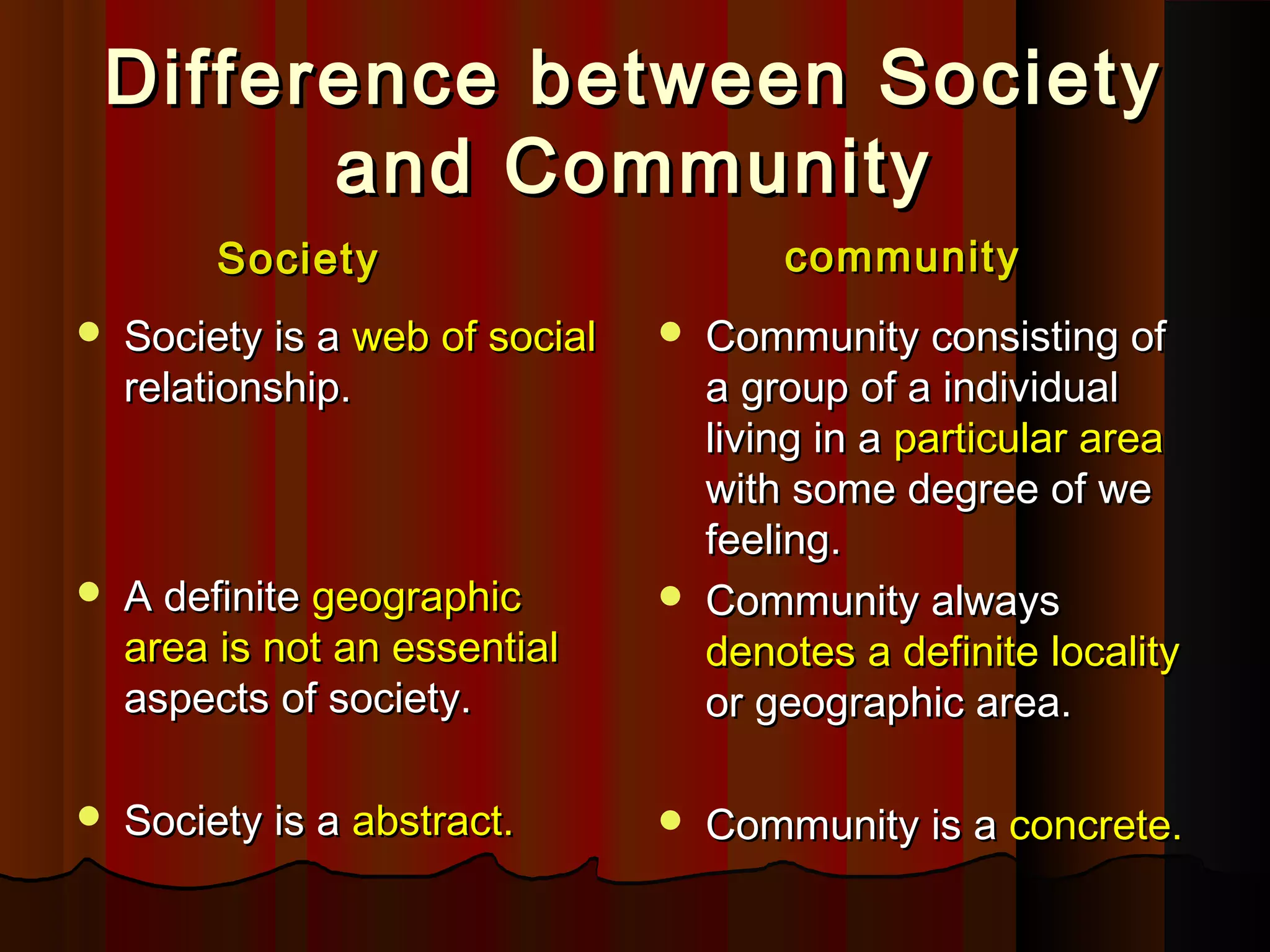
Society is a web of social
relationship.





A definite geographic
area is not an essential
aspects of society.





Society is a abstract.



Community consisting of
a group of a individual
living in a particular area
with some degree of we
feeling.
Community always
denotes a definite locality
or geographic area.
Community is a concrete.
community

Society


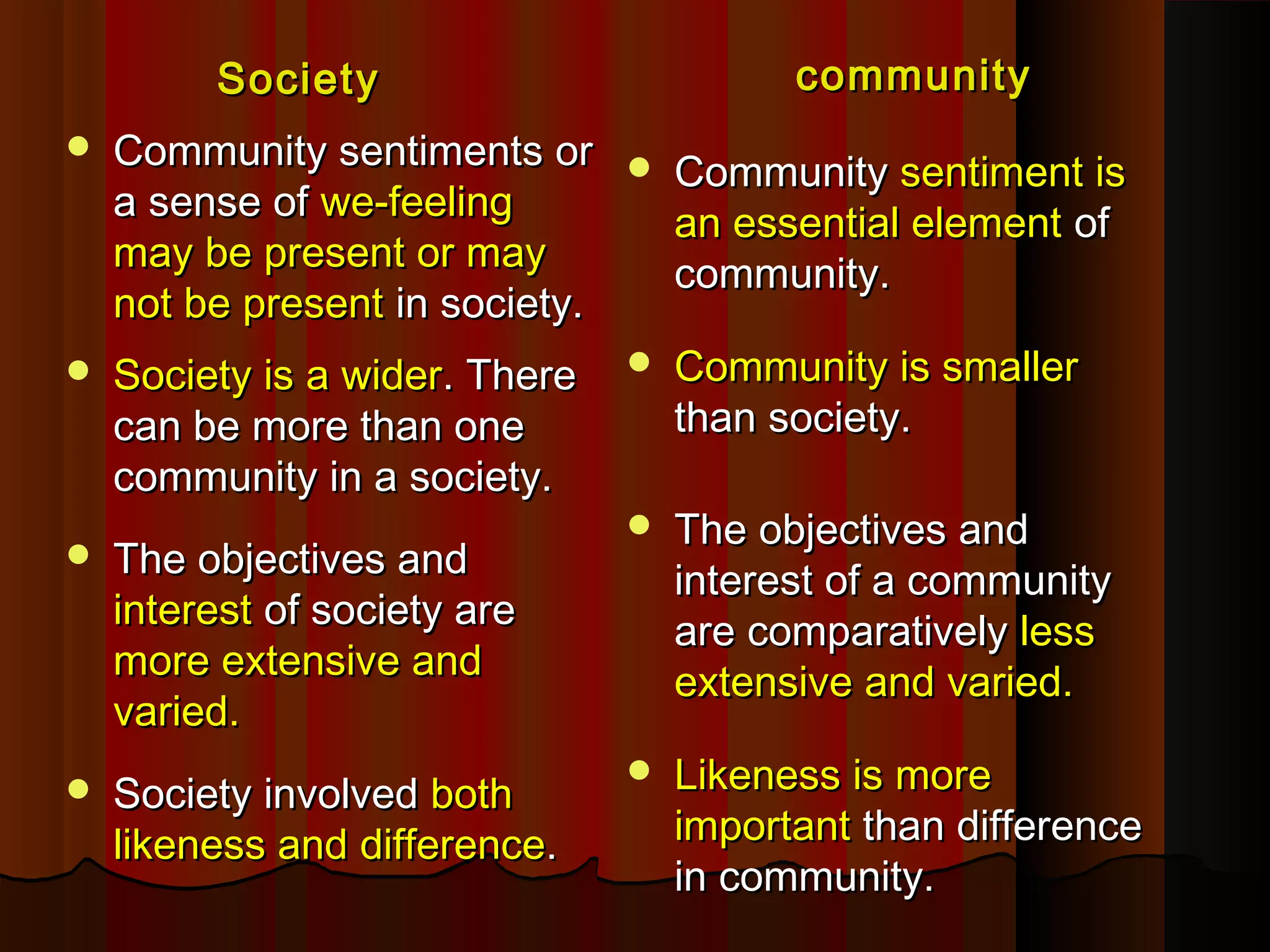
Community sentiments or
a sense of we-feeling
may be present or may
not be present in society.



Society is a wider. There
can be more than one
community in a society.





The objectives and
interest of society are
more extensive and
varied.
Society involved both
likeness and difference.



Community sentiment is
an essential element of
community.



Community is smaller
than society.



The objectives and
interest of a community
are comparatively less
extensive and varied.



Likeness is more
important than difference
in community.
Process of Socialization and
Individualization
Socialization


Man is not only social but also cultural being.



The culture provides opportunities for man to develop his
personality.



The development process is not an automatic process.



It is social training to the individual that kind of training is
called Socialization.



Socialization is a process of moulding a human infant to a
member of society to which he belongs.



This Socialization is differ from society to society. Because
of this process involves by culture.
Socialization
 The human infant comes into the world as

biological organism with animal needs.

 He is gradually moulded into a social being and

he learns social ways of acting and feeling .

 The process of moulding and shaping the

personality of the human infant is called
Socialization.
Definition of Socialization
 W.H. Ogburn says “Socialization is a process by

which the individual learns to conform to the
norms of the group”.

 Bogardus define “Socialization as the process of

working together, of developing group
responsibility, of being guided by welfare needs
of others”.

 Green says “Socialization is the process which

the child acquires a cultural content, along with
selfhood and personality”.
Process of Socialization
 Socialization is the process of learning group

norms, ideals, habits, behaviours and customs.

 The process of Socialization starts long before

the child is born.

 The parents courtship, marital selection, the

customs concerning pregnancy and birth.

 Whole system of cultural practices surrounding

the family are important for the child’s growth .

 But direct socialization begins only after birth .
Factors of the Process of
socialization
 Four factors are determine it
1.

Imitation

2.

Suggestion

3.

Identification

4.

Language
Factors of the Process of
socialization
 Imitation:
Imitation is copying by an individual of the

actions of another.

Thus, when the child attempts to walk

impressively like his father swinging a stick
and wearing spectacles, he is imitating.

Imitation may be conscious or unconscious,

spontaneous or deliberate.
Factors of the Process of
socialization
 Suggestion:
Suggestion is the process of communicating

information which has no logical or selfevident basis.

It may conveyed through language, pictures

or some similar medium.

Propaganda and advertising are based on the

fundamental psychological principles of
Suggestion.
Factors of the Process of
socialization
 Identification:
The child cannot make any distinction

between his organism and environment.

Most of his actions are random.
As he grows in age, he comes to know of the

nature of things which satisfy his needs.

He gradually indentified what he need for

happy in his life.
Factors of the Process of
socialization
 Language:
Language is the medium of social intercourse.
It is the means of cultural transmission.
At first the child utters some random syllables

which have no meaning, but gradually he
come to learn his mother-tongue.

Language moulds the personality of the

individual form infancy.
Agencies of Socialization
 The family
 The school
 The playmates or friends
 The church (religious institutions)
 The state
Individualization
 It is the process of in which man

comes to know
himself and acquire the sense of inner
responsibility.

 It is simply the process of attaining to one’s own

self.

 When a men does not think simply because of

others do the same things, because his own self
approves it.
Individualization
 He is carried by his own individuality which

is a quality to him.

 Socialization brings man into relation with

others but individualization makes him
autonomous or self-determining .

 The process of individualization is carried

not only by the individual himself but also
by the society.
Aspects of Individualization
 Karl Mannheim has distinguished four

main aspects of individualization.
Individualization as a process

of learning

different from other people.
Individualization on the level of new forms of
self regarding attitudes.
Individualization through objects.
Individualization as a kind of depending into
ourselves.
Aspects of Individualization
 Individualization as a process of learning

different from other people:

Compare with other persons, he have any

such a kind of different from others.

The people isolated from other people,

develop different types of personality.

Ex: high mature, over intelligence, shyness etc.,
Aspects of Individualization
 Individualization on the level of new forms

of self, regarding attitudes:

Such a new thinking develop

within himself.
It consists in becoming aware of one’s
specific character and in the rise of a new
kind of self evaluation.
He begins to regard his life and character as
unique.
Aspects of Individualization
 Individualization through objects:
The individualization process develop through

objects.
Some people come to have a fixed feeling
towards certain people and objects.
The peasant and the landed aristocrat are
more settled in their wishes than the rich
mobile type of city.
The family condition also shape the individual .
Aspects of Individualization
 Individualization as a kind of depending

into ourselves:

The feeling of separation becoming lonely

may lead an individual to introspection
(examine one’s one feelings).

Under such conditions this

develop in the in
the individual a feeling of privacy, partial
isolation.
Personal Disorganization
 Personal Disorganization represent the

behaviour of individual which deviates from the
social norms.

 Any various behaviour which disturbs the

integration of the attitude system within the
personality represents called personal
disorganization.

 It means that the individual is out of adjustment

with society, who has failed to organize the chief
goals of his life.
Personal Disorganization
 It may be mild or violent.
 When the parts of social structure do not perform

their functions efficiently and effectively or perform
them badly, there occurs an imbalance in society.

 The social equilibrium is disturbed and society gets

out of gear because of this personal
disorganization.

 For example: alcoholics, criminals, prostitutes and

drug addicts etc., who are mentally normal but
socially abnormal.
Thank you

Individual and society

  • 1.
    Individual and Society UnitII Sociology of Nursing
  • 2.
    Individual & Society Society and Community  Nature of Society  Difference between society and Community  Process of Socialization and Individualization  Personal disorganization
  • 3.
    Individual and Society  Manis a social animal.  He lives in group, in community, in society etc.,  Man cannot live as a man with out society.  Without society man’s emotional, intellectual, maturity, material goods and his liberty not develop and these are unthinkable.  The relations between individual and society is not merely a physical, or a functional unity, or organic unity, or systematic unity but its something more.  Society not only control our movements but also shape our identity, our thought and our emotions.
  • 4.
    Society  Society derivedby Latin word “Socious” it means companionship or friendship.  In Sociology, the term ‘Society’ refers not a group of people but to the complex pattern of the norms of interaction that arise among them.  MacIver has said that society is a web of social relationship.
  • 5.
    Definition of Society Wright – Society is not a group of people, it is the system of relationship that exists between the individual of the group.  G.D.M. Cole – Society is a complex of organized association and communication with a community.  Giddings – Society is a union itself the organization the sum of formal relations in which associating individuals are bound together.
  • 6.
    Nature of Society Society means likeness.  Society also implies difference.  Inter-dependence.  Co-operation.
  • 7.
    Nature of Society Society means likeness: Is an essential pre-requisite of society. The sense of likeness was focused in early society on kinships that is real or supposed blood relationships. In modern societies the conditions of social likeness have broadened out in the principle of nationality or one world.
  • 8.
    Nature of Society Society also implies difference: But the sense of likeness does not eliminate diversity or variation. Society also implies difference and it depends on the latter as much as on likeness of all people were exactly alike, their social relationships would become very much limited. They would contribute very little to one another.
  • 9.
    Nature of Society Inter-dependence: Family, the first society with which we all are closely associated, is based on the biological inter-dependence of the sexes. None of the two sexes is complete by itself and, therefore, each seeks fulfillment by the aid of the other. This fact of inter-dependence is very much visible in the present world.
  • 10.
    Nature of Society Co-operation: Without co-operation no society can exist. Unless people cooperate with each other, they cannot live a happy life. Family rests on co-operation. The members of the family cooperate with one another to live happy and joyfully.
  • 11.
    Community  An areaof social living.  Whenever the members of any group, small or large, live together in such a way that they share, not this or that particular interest, but the basic conditions of a common life, we call that group a community.
  • 12.
    Definition of Community Bogardus – Community is a social group with some degree of “we-feeling” and living in given area.  Ogburn and Nimkoff – Community is the total organization of social life with an limited area.  Lundberg – Community is a human population living within a limited geographic area and carrying on a common inter-dependence life.
  • 13.
    Element of Community Group of people  Locality  Community Sentiment  Permanency  Naturality  Likeness  Wider ends  Particular name
  • 14.
    Elements of Community Group of people: Whenever the individuals live together in such a way that they share the basic conditions of a common life, we call them forming a community.  Locality: The group of people forms a community when it begins to reside in a definite locality. Community always occupies a territorial area.
  • 15.
    Elements of Community Community sentiment:  Means a feeling of belonging together.  It is “we-feeling” among the members.  Permanency:  Its not transitory like a crowd.  It essentially includes a permanent life in a definite place.  Naturality:  Its not made or created by an act of will but are natural.
  • 16.
    Elements of Community Likeness: There is a likeness in language, customs, mores etc.  Wider ends: The ends of community are wider.  A particular name: Every community has some particular name. Ex; Panjab are called Panjabis
  • 17.
    Difference between Society andCommunity community Society  Society is a web of social relationship.   A definite geographic area is not an essential aspects of society.   Society is a abstract.  Community consisting of a group of a individual living in a particular area with some degree of we feeling. Community always denotes a definite locality or geographic area. Community is a concrete.
  • 18.
    community Society  Community sentiments or asense of we-feeling may be present or may not be present in society.  Society is a wider. There can be more than one community in a society.   The objectives and interest of society are more extensive and varied. Society involved both likeness and difference.  Community sentiment is an essential element of community.  Community is smaller than society.  The objectives and interest of a community are comparatively less extensive and varied.  Likeness is more important than difference in community.
  • 19.
    Process of Socializationand Individualization
  • 20.
    Socialization  Man is notonly social but also cultural being.  The culture provides opportunities for man to develop his personality.  The development process is not an automatic process.  It is social training to the individual that kind of training is called Socialization.  Socialization is a process of moulding a human infant to a member of society to which he belongs.  This Socialization is differ from society to society. Because of this process involves by culture.
  • 21.
    Socialization  The humaninfant comes into the world as biological organism with animal needs.  He is gradually moulded into a social being and he learns social ways of acting and feeling .  The process of moulding and shaping the personality of the human infant is called Socialization.
  • 22.
    Definition of Socialization W.H. Ogburn says “Socialization is a process by which the individual learns to conform to the norms of the group”.  Bogardus define “Socialization as the process of working together, of developing group responsibility, of being guided by welfare needs of others”.  Green says “Socialization is the process which the child acquires a cultural content, along with selfhood and personality”.
  • 23.
    Process of Socialization Socialization is the process of learning group norms, ideals, habits, behaviours and customs.  The process of Socialization starts long before the child is born.  The parents courtship, marital selection, the customs concerning pregnancy and birth.  Whole system of cultural practices surrounding the family are important for the child’s growth .  But direct socialization begins only after birth .
  • 24.
    Factors of theProcess of socialization  Four factors are determine it 1. Imitation 2. Suggestion 3. Identification 4. Language
  • 25.
    Factors of theProcess of socialization  Imitation: Imitation is copying by an individual of the actions of another. Thus, when the child attempts to walk impressively like his father swinging a stick and wearing spectacles, he is imitating. Imitation may be conscious or unconscious, spontaneous or deliberate.
  • 26.
    Factors of theProcess of socialization  Suggestion: Suggestion is the process of communicating information which has no logical or selfevident basis. It may conveyed through language, pictures or some similar medium. Propaganda and advertising are based on the fundamental psychological principles of Suggestion.
  • 27.
    Factors of theProcess of socialization  Identification: The child cannot make any distinction between his organism and environment. Most of his actions are random. As he grows in age, he comes to know of the nature of things which satisfy his needs. He gradually indentified what he need for happy in his life.
  • 28.
    Factors of theProcess of socialization  Language: Language is the medium of social intercourse. It is the means of cultural transmission. At first the child utters some random syllables which have no meaning, but gradually he come to learn his mother-tongue. Language moulds the personality of the individual form infancy.
  • 29.
    Agencies of Socialization The family  The school  The playmates or friends  The church (religious institutions)  The state
  • 30.
    Individualization  It isthe process of in which man comes to know himself and acquire the sense of inner responsibility.  It is simply the process of attaining to one’s own self.  When a men does not think simply because of others do the same things, because his own self approves it.
  • 31.
    Individualization  He iscarried by his own individuality which is a quality to him.  Socialization brings man into relation with others but individualization makes him autonomous or self-determining .  The process of individualization is carried not only by the individual himself but also by the society.
  • 32.
    Aspects of Individualization Karl Mannheim has distinguished four main aspects of individualization. Individualization as a process of learning different from other people. Individualization on the level of new forms of self regarding attitudes. Individualization through objects. Individualization as a kind of depending into ourselves.
  • 33.
    Aspects of Individualization Individualization as a process of learning different from other people: Compare with other persons, he have any such a kind of different from others. The people isolated from other people, develop different types of personality. Ex: high mature, over intelligence, shyness etc.,
  • 34.
    Aspects of Individualization Individualization on the level of new forms of self, regarding attitudes: Such a new thinking develop within himself. It consists in becoming aware of one’s specific character and in the rise of a new kind of self evaluation. He begins to regard his life and character as unique.
  • 35.
    Aspects of Individualization Individualization through objects: The individualization process develop through objects. Some people come to have a fixed feeling towards certain people and objects. The peasant and the landed aristocrat are more settled in their wishes than the rich mobile type of city. The family condition also shape the individual .
  • 36.
    Aspects of Individualization Individualization as a kind of depending into ourselves: The feeling of separation becoming lonely may lead an individual to introspection (examine one’s one feelings). Under such conditions this develop in the in the individual a feeling of privacy, partial isolation.
  • 37.
    Personal Disorganization  PersonalDisorganization represent the behaviour of individual which deviates from the social norms.  Any various behaviour which disturbs the integration of the attitude system within the personality represents called personal disorganization.  It means that the individual is out of adjustment with society, who has failed to organize the chief goals of his life.
  • 38.
    Personal Disorganization  Itmay be mild or violent.  When the parts of social structure do not perform their functions efficiently and effectively or perform them badly, there occurs an imbalance in society.  The social equilibrium is disturbed and society gets out of gear because of this personal disorganization.  For example: alcoholics, criminals, prostitutes and drug addicts etc., who are mentally normal but socially abnormal.
  • 39.