STUDIES ON ZINC OXIDE THIN
FILMS PREPARED BY TWO -
STEP CHEMICAL METHODS
By
NAVYASREE .M
ZINC OXIDE( ZnO) THIN FILMS
A thin film is a layer of material ranging from
fractions of a nanometer to several micrometers in
thickness on a clean substrate.
ZnO is a transparent conducting oxide (TCO) which
has recently been studied. It is an n-type
semiconductor with a direct energy wide gap of about
3.37 eV at room temperature, that could be obtained
with very low resistivities.
Zno based elements have attracted much attention
as gas sensors because of their chemical sensitivity
to volatile and other radical gases, their high chemical
stability, suitably to doping, non-toxicity, and low cost .
It is used in electronic displays , fabrication of blue
light emitting diode, dye sensitized solar cells and
window plates in solar cells.
GROWTH TECHNIQUES OF
NANOMATERIALS AND THIN FILMS
In general these techniques can be broadly classified
into two groups: vacuum-based deposition
process and solution-based deposition process. In
vacuum –based synthesis, deposition takes place
under high vacuum (~10-8 to 10-11 mbar). Therefore
the process is very clean; probability of deposition of
foreign and undesired materials is very low. But the
vacuum based systems require costly and
complicated equipment. Solution based synthesis
process, on the other hand are based on chemical
reactions in liquid phase. Therefore, these technique
are simple and cost-effective and most importantly,
large range of materials can be synthesized by these
ZINC OXIDE THIN FILMS BY TWO-STEP
CHEMICAL PROCESSES
In seeding process, a thin layer of ZnO is
deposited as seed on the substrate prior to the
second stage, usually the solution growth technique.
Usually in all the two-step chemical methods that
have been employed, wet solution method like CBD
was used for secondary nucleation.
Seeding by SILAR
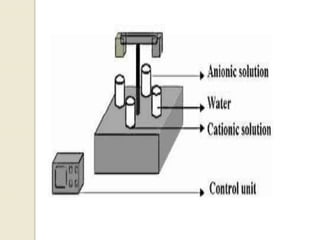
A complete deposition cycle of SILAR comprises of
four processes involving subsequent immersion of
substrates in cationic and anionic precursor solutions
for adsorption and reaction along with rinsing the
substrate in between to remove the loosely held
species in distilled water kept at room temperature.
The aqueous zinc-ions solution complexed with
ammonia (25%) and diethanolamine (DMA) C2H7N
was used as the cationic precursor, in which 100 ml of
0.35 M of zinc nitrate was (Zn(NO3)2.6H2O) used. .
100 ml of the complex solution of cations and distilled
water for intermediate rinsing was kept at room
temperature while the beaker with distilled water as
anionic precursor was kept at 368K during deposition.
Immersion time in cationic and anionic solution was
equal, which is optimized to 2 s and the immersion
time for rinsing the substrates was 5 s.
5 deposition cycles were repeated to form a
very thin seed layer of ZnO on the substrate. The
seeded substrates were washed in distilled water and
dried in hot air.
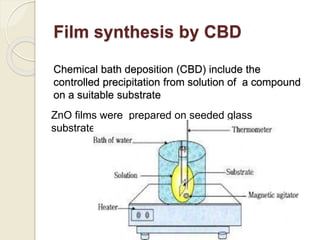
Film synthesis by CBD
Chemical bath deposition (CBD) include the
controlled precipitation from solution of a compound
on a suitable substrate
ZnO films were prepared on seeded glass
substrates by CBD.
In the CBD process, the same cationic precursor
prepared for synthesizing the seeded substrate was
used as the reaction solution. The ZnO seeded
substrates were immersed into the aqueous solution
and tilted against the wall of beaker. The beaker is
kept on a hot plate and temperature is maintained at
950C. The substrate is kept in the solution for 2 hours.
After the film growth, the substrate was removed from
the solution, rinsed with distilled water and then dried
blowing hot air. Film was named as ZnO. And some
films are annealed at 573K, and film was named as
ZnO A.
CHARACTERIZATION TECHNIQUES
Film thickness measurement
General (gravimetric method)
These are methods which are based on the
determination of a mass. The film thickness d can be
calculated from the mass of the coating m if the density
ρ and the area A on which the material is deposited are
known:
D = m/ (A ρ) (1)
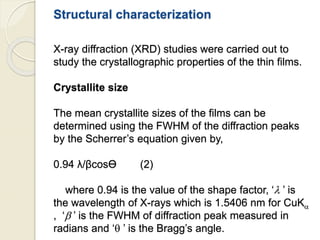
Structural characterization
X-ray diffraction (XRD) studies were carried out to
study the crystallographic properties of the thin films.
Crystallite size
The mean crystallite sizes of the films can be
determined using the FWHM of the diffraction peaks
by the Scherrer’s equation given by,
0.94 λ/βcosӨ (2)
where 0.94 is the value of the shape factor, ‘ ’ is
the wavelength of X-rays which is 1.5406 nm for CuK
, ‘ ’ is the FWHM of diffraction peak measured in
radians and ‘ ’ is the Bragg’s angle.
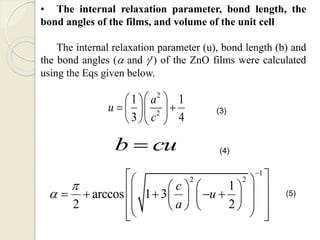
• The internal relaxation parameter, bond length, the
bond angles of the films, and volume of the unit cell
The internal relaxation parameter (u), bond length (b) and
the bond angles ( and ’) of the ZnO films were calculated
using the Eqs given below.
2
2
1 1
3 4
a
u
c
  
   
  
b cu
1
2 2
1
arccos 1 3
2 2
c
u
a



  
                 
   
(3)
(4)
(5)
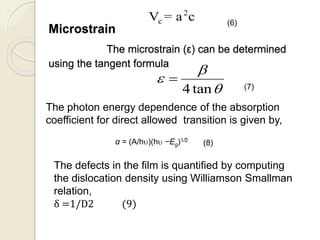
Microstrain
The microstrain (ε) can be determined
using the tangent formula
4 tan




2
cV = a c
The photon energy dependence of the absorption
coefficient for direct allowed transition is given by,
α = (A/h)(h −Eg)1/2
The defects in the film is quantified by computing
the dislocation density using Williamson Smallman
relation,
δ =1/D2 (9)
(7)
(6)
(8)
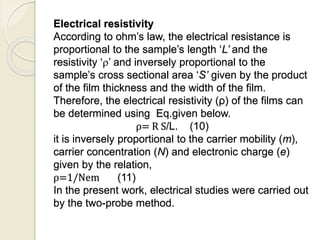
Electrical resistivity
According to ohm’s law, the electrical resistance is
proportional to the sample’s length ‘L’ and the
resistivity ‘’ and inversely proportional to the
sample’s cross sectional area ‘S’ given by the product
of the film thickness and the width of the film.
Therefore, the electrical resistivity (ρ) of the films can
be determined using Eq.given below.
ρ= R S/L. (10)
it is inversely proportional to the carrier mobility (m),
carrier concentration (N) and electronic charge (e)
given by the relation,
ρ=1/Nem (11)
In the present work, electrical studies were carried out
by the two-probe method.
Results and discussion
1 Thickness of the film
The film thickness was computed by gravimetric
method using Eq. (1). The estimated average value
of thickness is 1850 nm.
2 Structural analysis
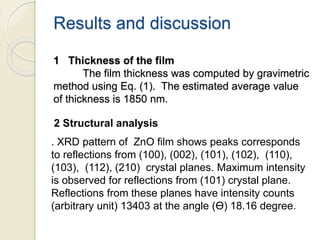
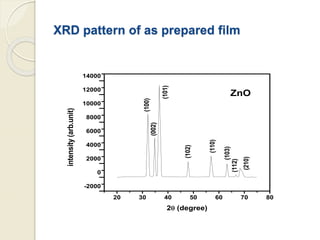
. XRD pattern of ZnO film shows peaks corresponds
to reflections from (100), (002), (101), (102), (110),
(103), (112), (210) crystal planes. Maximum intensity
is observed for reflections from (101) crystal plane.
Reflections from these planes have intensity counts
(arbitrary unit) 13403 at the angle (Ө) 18.16 degree.
XRD pattern of as prepared film
20 30 40 50 60 70 80
-2000
0
2000
4000
6000
8000
10000
12000
14000
(210)
(112)
(103)
(110)
(102)
(101)
(002)
(100)
ZnO
intensity(arb.unit)
2 (degree)
XRD pattern of annealed film
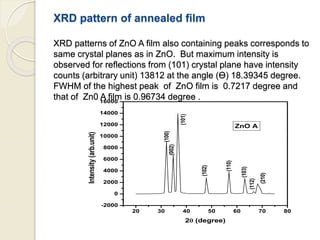
XRD patterns of ZnO A film also containing peaks corresponds to
same crystal planes as in ZnO. But maximum intensity is
observed for reflections from (101) crystal plane have intensity
counts (arbitrary unit) 13812 at the angle (Ө) 18.39345 degree.
FWHM of the highest peak of ZnO film is 0.7217 degree and
that of Zn0 A film is 0.96734 degree .
20 30 40 50 60 70 80
-2000
0
2000
4000
6000
8000
10000
12000
14000
16000
(210)
(112)
(103)
(110)
(102)
(101)
(002)
(100)
Intensity(arb.unit)
2 (degree)
ZnO A
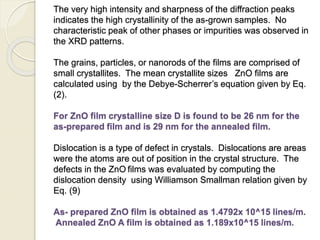
The very high intensity and sharpness of the diffraction peaks
indicates the high crystallinity of the as-grown samples. No
characteristic peak of other phases or impurities was observed in
the XRD patterns.
The grains, particles, or nanorods of the films are comprised of
small crystallites. The mean crystallite sizes ZnO films are
calculated using by the Debye-Scherrer’s equation given by Eq.
(2).
For ZnO film crystalline size D is found to be 26 nm for the
as-prepared film and is 29 nm for the annealed film.
Dislocation is a type of defect in crystals. Dislocations are areas
were the atoms are out of position in the crystal structure. The
defects in the ZnO films was evaluated by computing the
dislocation density using Williamson Smallman relation given by
Eq. (9)
As- prepared ZnO film is obtained as 1.4792x 10^15 lines/m.
Annealed ZnO A film is obtained as 1.189x10^15 lines/m.
Microstrain in the nanocrystals of ZnO films was computed by
using the tangent formula given by Eq. (7).
As-prepared film: 0.000457
Annealed film: 0.000420
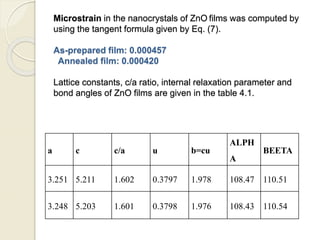
Lattice constants, c/a ratio, internal relaxation parameter and
bond angles of ZnO films are given in the table 4.1.
a c c/a u b=cu
ALPH
A
BEETA
3.251 5.211 1.602 0.3797 1.978 108.47 110.51
3.248 5.203 1.601 0.3798 1.976 108.43 110.54
Morphological analysis
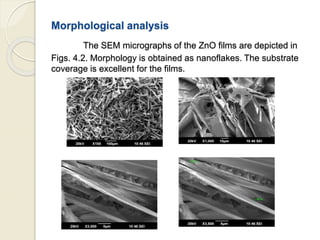
The SEM micrographs of the ZnO films are depicted in
Figs. 4.2. Morphology is obtained as nanoflakes. The substrate
coverage is excellent for the films.
4 Optical analysis
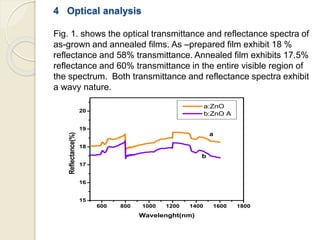
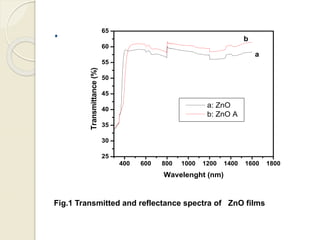
Fig. 1. shows the optical transmittance and reflectance spectra of
as-grown and annealed films. As –prepared film exhibit 18 %
reflectance and 58% transmittance. Annealed film exhibits 17.5%
reflectance and 60% transmittance in the entire visible region of
the spectrum. Both transmittance and reflectance spectra exhibit
a wavy nature.
600 800 1000 1200 1400 1600 1800
15
16
17
18
19
20
b
a
Reflectance(%)
Wavelenght(nm)
a:ZnO
b:ZnO A
.
400 600 800 1000 1200 1400 1600 1800
25
30
35
40
45
50
55
60
65
b
a
Transmittance(%)
Wavelenght (nm)
a: ZnO
b: ZnO A
Fig.1 Transmitted and reflectance spectra of ZnO films
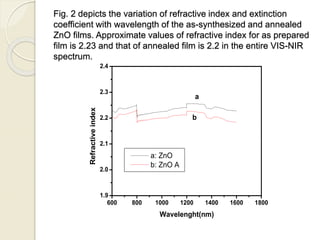
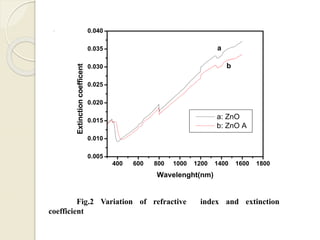
Fig. 2 depicts the variation of refractive index and extinction
coefficient with wavelength of the as-synthesized and annealed
ZnO films. Approximate values of refractive index for as prepared
film is 2.23 and that of annealed film is 2.2 in the entire VIS-NIR
spectrum.
600 800 1000 1200 1400 1600 1800
1.9
2.0
2.1
2.2
2.3
2.4
b
a
Refractiveindex
Wavelenght(nm)
a: ZnO
b: ZnO A
.
400 600 800 1000 1200 1400 1600 1800
0.005
0.010
0.015
0.020
0.025
0.030
0.035
0.040
b
a
Extinctioncoefficent
Wavelenght(nm)
a: ZnO
b: ZnO A
Fig.2 Variation of refractive index and extinction
coefficient
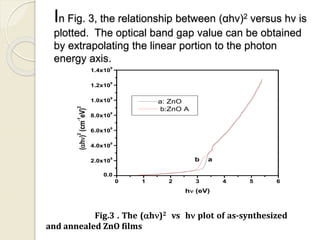
In Fig. 3, the relationship between (αhν)2 versus hν is
plotted. The optical band gap value can be obtained
by extrapolating the linear portion to the photon
energy axis.
0 1 2 3 4 5 6
0.0
2.0x10
8
4.0x10
8
6.0x10
8
8.0x10
8
1.0x10
9
1.2x10
9
1.4x10
9
b a
(h)
2
(cm
-1
eV)
2
h (eV)
a: ZnO
b:ZnO A
Fig.3 . The (h)2 vs h plot of as-synthesized
and annealed ZnO films
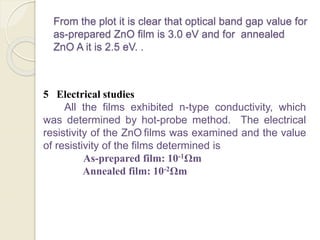
From the plot it is clear that optical band gap value for
as-prepared ZnO film is 3.0 eV and for annealed
ZnO A it is 2.5 eV. .
5 Electrical studies
All the films exhibited n-type conductivity, which
was determined by hot-probe method. The electrical
resistivity of the ZnO films was examined and the value
of resistivity of the films determined is
As-prepared film: 10-1Ωm
Annealed film: 10-2Ωm
CONCLUTION
Adherent, transparent and semiconducting ZnO thin films were
synthesized on pre-coated glass substrates with ZnO seed layer.
Seeding of substrate is done by SILAR (successive ionic layer
adsorption reaction). Film preparation is done by CBD (chemical
bath deposition). The high intensity and sharp diffraction peaks
indicates the poly crystallinity of the ZnO films. Films have
predominantly (101) preferred orientation. Strain developed in
the ZnO films is minimum and negligible.
As –prepared film exhibit 18 % reflectance and 58%
transmittance. Annealed film exhibits a maximum of 17.5%
reflectance and 60% transmittance in the entire visible region of
the spectrum. Film possesses dense packed nanoflake
morphology with high internal surface area. Approximate values
of refractive index for as prepared film is 2.23 and that of
annealed film is 2.2 in the entire ViS-NIR spectrum. Films exhibit
low electrical resistivity of the order of 10-1 for as- prepared film
and 10-2 for annealed film.

Zinc oxide thin film

  • 1.
    STUDIES ON ZINCOXIDE THIN FILMS PREPARED BY TWO - STEP CHEMICAL METHODS By NAVYASREE .M
  • 2.
    ZINC OXIDE( ZnO)THIN FILMS A thin film is a layer of material ranging from fractions of a nanometer to several micrometers in thickness on a clean substrate. ZnO is a transparent conducting oxide (TCO) which has recently been studied. It is an n-type semiconductor with a direct energy wide gap of about 3.37 eV at room temperature, that could be obtained with very low resistivities. Zno based elements have attracted much attention as gas sensors because of their chemical sensitivity to volatile and other radical gases, their high chemical stability, suitably to doping, non-toxicity, and low cost . It is used in electronic displays , fabrication of blue light emitting diode, dye sensitized solar cells and window plates in solar cells.
  • 3.
    GROWTH TECHNIQUES OF NANOMATERIALSAND THIN FILMS In general these techniques can be broadly classified into two groups: vacuum-based deposition process and solution-based deposition process. In vacuum –based synthesis, deposition takes place under high vacuum (~10-8 to 10-11 mbar). Therefore the process is very clean; probability of deposition of foreign and undesired materials is very low. But the vacuum based systems require costly and complicated equipment. Solution based synthesis process, on the other hand are based on chemical reactions in liquid phase. Therefore, these technique are simple and cost-effective and most importantly, large range of materials can be synthesized by these
  • 4.
    ZINC OXIDE THINFILMS BY TWO-STEP CHEMICAL PROCESSES In seeding process, a thin layer of ZnO is deposited as seed on the substrate prior to the second stage, usually the solution growth technique. Usually in all the two-step chemical methods that have been employed, wet solution method like CBD was used for secondary nucleation. Seeding by SILAR A complete deposition cycle of SILAR comprises of four processes involving subsequent immersion of substrates in cationic and anionic precursor solutions for adsorption and reaction along with rinsing the substrate in between to remove the loosely held species in distilled water kept at room temperature.
  • 6.
    The aqueous zinc-ionssolution complexed with ammonia (25%) and diethanolamine (DMA) C2H7N was used as the cationic precursor, in which 100 ml of 0.35 M of zinc nitrate was (Zn(NO3)2.6H2O) used. . 100 ml of the complex solution of cations and distilled water for intermediate rinsing was kept at room temperature while the beaker with distilled water as anionic precursor was kept at 368K during deposition. Immersion time in cationic and anionic solution was equal, which is optimized to 2 s and the immersion time for rinsing the substrates was 5 s. 5 deposition cycles were repeated to form a very thin seed layer of ZnO on the substrate. The seeded substrates were washed in distilled water and dried in hot air.
  • 7.
    Film synthesis byCBD Chemical bath deposition (CBD) include the controlled precipitation from solution of a compound on a suitable substrate ZnO films were prepared on seeded glass substrates by CBD.
  • 8.
    In the CBDprocess, the same cationic precursor prepared for synthesizing the seeded substrate was used as the reaction solution. The ZnO seeded substrates were immersed into the aqueous solution and tilted against the wall of beaker. The beaker is kept on a hot plate and temperature is maintained at 950C. The substrate is kept in the solution for 2 hours. After the film growth, the substrate was removed from the solution, rinsed with distilled water and then dried blowing hot air. Film was named as ZnO. And some films are annealed at 573K, and film was named as ZnO A.
  • 9.
    CHARACTERIZATION TECHNIQUES Film thicknessmeasurement General (gravimetric method) These are methods which are based on the determination of a mass. The film thickness d can be calculated from the mass of the coating m if the density ρ and the area A on which the material is deposited are known: D = m/ (A ρ) (1)
  • 10.
    Structural characterization X-ray diffraction(XRD) studies were carried out to study the crystallographic properties of the thin films. Crystallite size The mean crystallite sizes of the films can be determined using the FWHM of the diffraction peaks by the Scherrer’s equation given by, 0.94 λ/βcosӨ (2) where 0.94 is the value of the shape factor, ‘ ’ is the wavelength of X-rays which is 1.5406 nm for CuK , ‘ ’ is the FWHM of diffraction peak measured in radians and ‘ ’ is the Bragg’s angle.
  • 11.
    • The internalrelaxation parameter, bond length, the bond angles of the films, and volume of the unit cell The internal relaxation parameter (u), bond length (b) and the bond angles ( and ’) of the ZnO films were calculated using the Eqs given below. 2 2 1 1 3 4 a u c           b cu 1 2 2 1 arccos 1 3 2 2 c u a                             (3) (4) (5)
  • 12.
    Microstrain The microstrain (ε)can be determined using the tangent formula 4 tan     2 cV = a c The photon energy dependence of the absorption coefficient for direct allowed transition is given by, α = (A/h)(h −Eg)1/2 The defects in the film is quantified by computing the dislocation density using Williamson Smallman relation, δ =1/D2 (9) (7) (6) (8)
  • 13.
    Electrical resistivity According toohm’s law, the electrical resistance is proportional to the sample’s length ‘L’ and the resistivity ‘’ and inversely proportional to the sample’s cross sectional area ‘S’ given by the product of the film thickness and the width of the film. Therefore, the electrical resistivity (ρ) of the films can be determined using Eq.given below. ρ= R S/L. (10) it is inversely proportional to the carrier mobility (m), carrier concentration (N) and electronic charge (e) given by the relation, ρ=1/Nem (11) In the present work, electrical studies were carried out by the two-probe method.
  • 14.
    Results and discussion 1Thickness of the film The film thickness was computed by gravimetric method using Eq. (1). The estimated average value of thickness is 1850 nm. 2 Structural analysis . XRD pattern of ZnO film shows peaks corresponds to reflections from (100), (002), (101), (102), (110), (103), (112), (210) crystal planes. Maximum intensity is observed for reflections from (101) crystal plane. Reflections from these planes have intensity counts (arbitrary unit) 13403 at the angle (Ө) 18.16 degree.
  • 15.
    XRD pattern ofas prepared film 20 30 40 50 60 70 80 -2000 0 2000 4000 6000 8000 10000 12000 14000 (210) (112) (103) (110) (102) (101) (002) (100) ZnO intensity(arb.unit) 2 (degree)
  • 16.
    XRD pattern ofannealed film XRD patterns of ZnO A film also containing peaks corresponds to same crystal planes as in ZnO. But maximum intensity is observed for reflections from (101) crystal plane have intensity counts (arbitrary unit) 13812 at the angle (Ө) 18.39345 degree. FWHM of the highest peak of ZnO film is 0.7217 degree and that of Zn0 A film is 0.96734 degree . 20 30 40 50 60 70 80 -2000 0 2000 4000 6000 8000 10000 12000 14000 16000 (210) (112) (103) (110) (102) (101) (002) (100) Intensity(arb.unit) 2 (degree) ZnO A
  • 17.
    The very highintensity and sharpness of the diffraction peaks indicates the high crystallinity of the as-grown samples. No characteristic peak of other phases or impurities was observed in the XRD patterns. The grains, particles, or nanorods of the films are comprised of small crystallites. The mean crystallite sizes ZnO films are calculated using by the Debye-Scherrer’s equation given by Eq. (2). For ZnO film crystalline size D is found to be 26 nm for the as-prepared film and is 29 nm for the annealed film. Dislocation is a type of defect in crystals. Dislocations are areas were the atoms are out of position in the crystal structure. The defects in the ZnO films was evaluated by computing the dislocation density using Williamson Smallman relation given by Eq. (9) As- prepared ZnO film is obtained as 1.4792x 10^15 lines/m. Annealed ZnO A film is obtained as 1.189x10^15 lines/m.
  • 18.
    Microstrain in thenanocrystals of ZnO films was computed by using the tangent formula given by Eq. (7). As-prepared film: 0.000457 Annealed film: 0.000420 Lattice constants, c/a ratio, internal relaxation parameter and bond angles of ZnO films are given in the table 4.1. a c c/a u b=cu ALPH A BEETA 3.251 5.211 1.602 0.3797 1.978 108.47 110.51 3.248 5.203 1.601 0.3798 1.976 108.43 110.54
  • 19.
    Morphological analysis The SEMmicrographs of the ZnO films are depicted in Figs. 4.2. Morphology is obtained as nanoflakes. The substrate coverage is excellent for the films.
  • 20.
    4 Optical analysis Fig.1. shows the optical transmittance and reflectance spectra of as-grown and annealed films. As –prepared film exhibit 18 % reflectance and 58% transmittance. Annealed film exhibits 17.5% reflectance and 60% transmittance in the entire visible region of the spectrum. Both transmittance and reflectance spectra exhibit a wavy nature. 600 800 1000 1200 1400 1600 1800 15 16 17 18 19 20 b a Reflectance(%) Wavelenght(nm) a:ZnO b:ZnO A
  • 21.
    . 400 600 8001000 1200 1400 1600 1800 25 30 35 40 45 50 55 60 65 b a Transmittance(%) Wavelenght (nm) a: ZnO b: ZnO A Fig.1 Transmitted and reflectance spectra of ZnO films
  • 22.
    Fig. 2 depictsthe variation of refractive index and extinction coefficient with wavelength of the as-synthesized and annealed ZnO films. Approximate values of refractive index for as prepared film is 2.23 and that of annealed film is 2.2 in the entire VIS-NIR spectrum. 600 800 1000 1200 1400 1600 1800 1.9 2.0 2.1 2.2 2.3 2.4 b a Refractiveindex Wavelenght(nm) a: ZnO b: ZnO A
  • 23.
    . 400 600 8001000 1200 1400 1600 1800 0.005 0.010 0.015 0.020 0.025 0.030 0.035 0.040 b a Extinctioncoefficent Wavelenght(nm) a: ZnO b: ZnO A Fig.2 Variation of refractive index and extinction coefficient
  • 24.
    In Fig. 3,the relationship between (αhν)2 versus hν is plotted. The optical band gap value can be obtained by extrapolating the linear portion to the photon energy axis. 0 1 2 3 4 5 6 0.0 2.0x10 8 4.0x10 8 6.0x10 8 8.0x10 8 1.0x10 9 1.2x10 9 1.4x10 9 b a (h) 2 (cm -1 eV) 2 h (eV) a: ZnO b:ZnO A Fig.3 . The (h)2 vs h plot of as-synthesized and annealed ZnO films
  • 25.
    From the plotit is clear that optical band gap value for as-prepared ZnO film is 3.0 eV and for annealed ZnO A it is 2.5 eV. . 5 Electrical studies All the films exhibited n-type conductivity, which was determined by hot-probe method. The electrical resistivity of the ZnO films was examined and the value of resistivity of the films determined is As-prepared film: 10-1Ωm Annealed film: 10-2Ωm
  • 26.
    CONCLUTION Adherent, transparent andsemiconducting ZnO thin films were synthesized on pre-coated glass substrates with ZnO seed layer. Seeding of substrate is done by SILAR (successive ionic layer adsorption reaction). Film preparation is done by CBD (chemical bath deposition). The high intensity and sharp diffraction peaks indicates the poly crystallinity of the ZnO films. Films have predominantly (101) preferred orientation. Strain developed in the ZnO films is minimum and negligible. As –prepared film exhibit 18 % reflectance and 58% transmittance. Annealed film exhibits a maximum of 17.5% reflectance and 60% transmittance in the entire visible region of the spectrum. Film possesses dense packed nanoflake morphology with high internal surface area. Approximate values of refractive index for as prepared film is 2.23 and that of annealed film is 2.2 in the entire ViS-NIR spectrum. Films exhibit low electrical resistivity of the order of 10-1 for as- prepared film and 10-2 for annealed film.