Presented by:
Suby Mon Benny
20LS601032
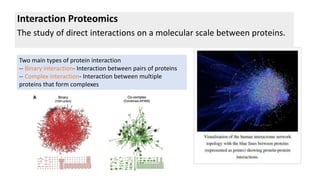
Interaction Proteomics
The study of direct interactions on a molecular scale between proteins.
Two main types of protein interaction
-- Binary interaction- Interaction between pairs of proteins
-- Complex interaction- Interaction between multiple
proteins that form complexes
Methods to study protein-protein interactions
Genetic methods
Bioinformatic
methods
Affinity based
biochemical methods
Physical methods
• Combining
different
mutations in
an organism or
cell
• Then study
their
phenotype
• Studying the
affinity
between various
proteins and
their
interaction
partners
• Comparing
available
complete
genome
sequences
• Annotating
the functions
of proteins
• Using X-Ray
Crystallography
and NMR
Spectroscopy
• Interactions
determined in
atomic level
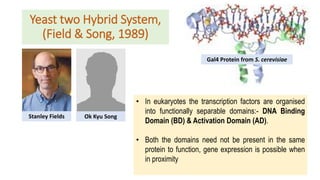
Yeast two Hybrid System,
(Field & Song, 1989)
Stanley Fields Ok Kyu Song
Gal4 Protein from S. cerevisiae
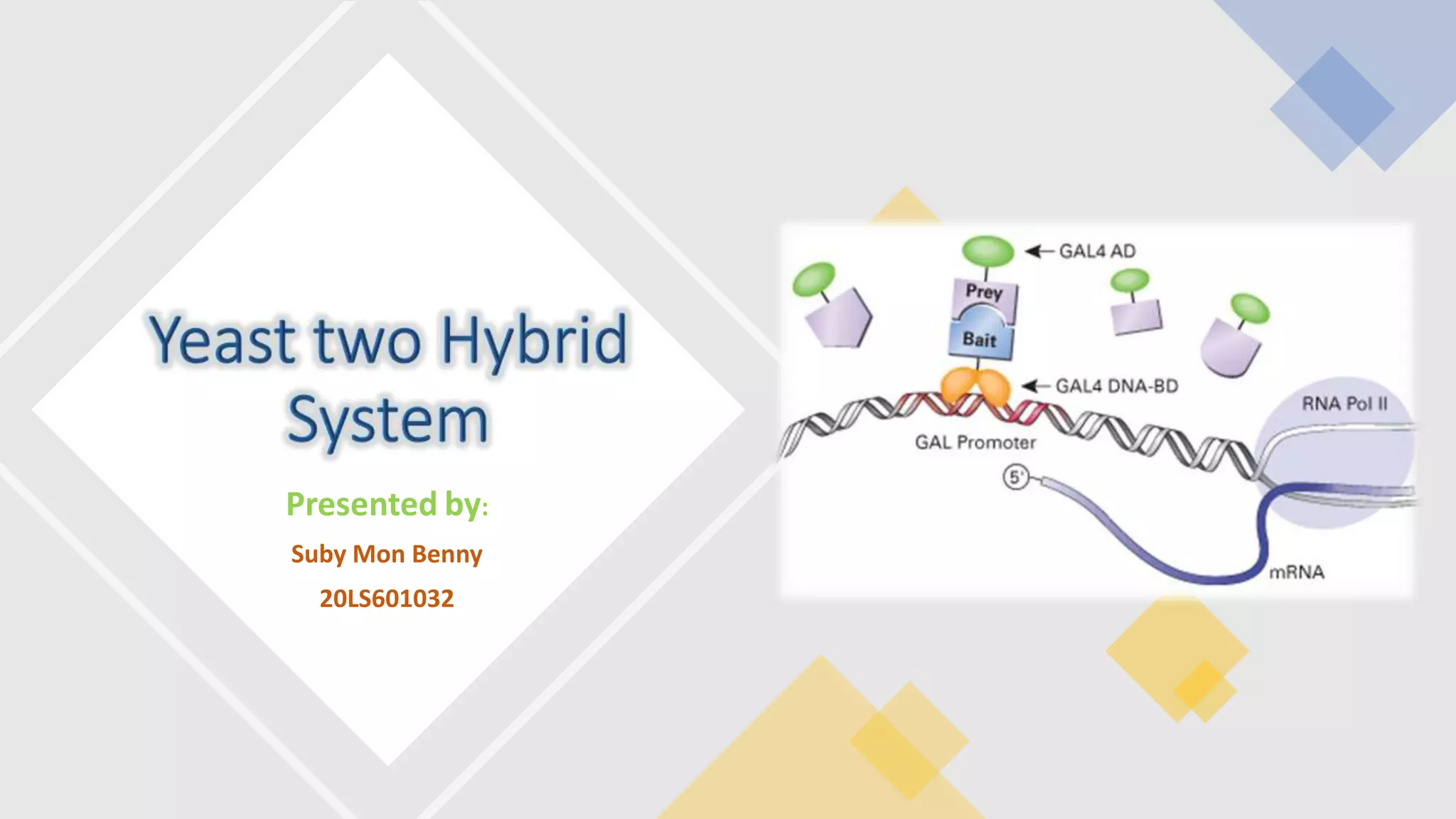
• In eukaryotes the transcription factors are organised
into functionally separable domains:- DNA Binding
Domain (BD) & Activation Domain (AD).
• Both the domains need not be present in the same
protein to function, gene expression is possible when
in proximity
First Y2H assay was performed on 2 yeast proteins involved in regulating the SUC2 gene, Snf1 and Snf4
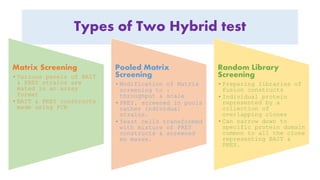
Types of Two Hybrid test
Matrix Screening
• Various panels of BAIT
& PREY strains are
mated in an array
format
• BAIT & PREY constructs
made using PCR
Pooled Matrix
Screening
• Modification of Matrix
screening to ↑
throughput & scale
• PREY, screened in pools
rather individual
strains.
• Yeast cells transformed
with mixture of PREY
constructs & screened
en masse.
Random Library
Screening
• Preparing libraries of
fusion constructs
• Individual protein
represented by a
collection of
overlapping clones
• Can narrow down to
specific protein domain
common to all the clone
representing BAIT &
PREY.
CONCLUSION
• Only available in vivo technology for high-throughput systematic analysis
of binary interactions
Problems
1. Independent studies conducted in large scale reported very
low degree of overlaps, suggesting that screens were not
comprehensive or even minor differences in experimental
conditions could influence the type of interactions
detected.
2. Significant no. of well characterised interactions are not
detected in large scale screens, suggesting there is high
level of false negatives.
3. Significant no. of interactions detected in large scale
screens appear spurious when investigated in more detail,
REFERENCE
• Twyman, R.M.2004). Principles of Proteomics.
Taylor & Francis Publishers. Pg: 131-155.
• Palzkill,T.(2008 reprint). Proteomics. Spinger
(India) Pvt. Ltd. Pg: 48-61.
• Fields,S. and Song,O.(1989). A Novel Genetic
System to Detect Protein-Protein Interactions.
Nature 340:245-246.
• Causier, B.(2004). Studying the Interactome with
the Yeast two Hybrid System and Mass Spectrometry.
Mass Spectrometry Reviews, 23, 350-365.
• Utez,P.(2001). Two-Hybrid Arrays. Curr Opin. Chem.
Bid, 6: 57-62.

Yeast Two Hybrid System

  • 1.
    Presented by: Suby MonBenny 20LS601032
  • 2.
    Interaction Proteomics The studyof direct interactions on a molecular scale between proteins. Two main types of protein interaction -- Binary interaction- Interaction between pairs of proteins -- Complex interaction- Interaction between multiple proteins that form complexes
  • 3.
    Methods to studyprotein-protein interactions Genetic methods Bioinformatic methods Affinity based biochemical methods Physical methods • Combining different mutations in an organism or cell • Then study their phenotype • Studying the affinity between various proteins and their interaction partners • Comparing available complete genome sequences • Annotating the functions of proteins • Using X-Ray Crystallography and NMR Spectroscopy • Interactions determined in atomic level
  • 4.
    Yeast two HybridSystem, (Field & Song, 1989) Stanley Fields Ok Kyu Song Gal4 Protein from S. cerevisiae • In eukaryotes the transcription factors are organised into functionally separable domains:- DNA Binding Domain (BD) & Activation Domain (AD). • Both the domains need not be present in the same protein to function, gene expression is possible when in proximity
  • 5.
    First Y2H assaywas performed on 2 yeast proteins involved in regulating the SUC2 gene, Snf1 and Snf4
  • 6.
    Types of TwoHybrid test Matrix Screening • Various panels of BAIT & PREY strains are mated in an array format • BAIT & PREY constructs made using PCR Pooled Matrix Screening • Modification of Matrix screening to ↑ throughput & scale • PREY, screened in pools rather individual strains. • Yeast cells transformed with mixture of PREY constructs & screened en masse. Random Library Screening • Preparing libraries of fusion constructs • Individual protein represented by a collection of overlapping clones • Can narrow down to specific protein domain common to all the clone representing BAIT & PREY.
  • 7.
    CONCLUSION • Only availablein vivo technology for high-throughput systematic analysis of binary interactions Problems 1. Independent studies conducted in large scale reported very low degree of overlaps, suggesting that screens were not comprehensive or even minor differences in experimental conditions could influence the type of interactions detected. 2. Significant no. of well characterised interactions are not detected in large scale screens, suggesting there is high level of false negatives. 3. Significant no. of interactions detected in large scale screens appear spurious when investigated in more detail,
  • 8.
    REFERENCE • Twyman, R.M.2004).Principles of Proteomics. Taylor & Francis Publishers. Pg: 131-155. • Palzkill,T.(2008 reprint). Proteomics. Spinger (India) Pvt. Ltd. Pg: 48-61. • Fields,S. and Song,O.(1989). A Novel Genetic System to Detect Protein-Protein Interactions. Nature 340:245-246. • Causier, B.(2004). Studying the Interactome with the Yeast two Hybrid System and Mass Spectrometry. Mass Spectrometry Reviews, 23, 350-365. • Utez,P.(2001). Two-Hybrid Arrays. Curr Opin. Chem. Bid, 6: 57-62.