YEAST TWO HYBRID METHOD
Vipul choudhary | Dr. Indrakant K. Singh( ‫سنگھ‬ ‫)اندراکانت‬
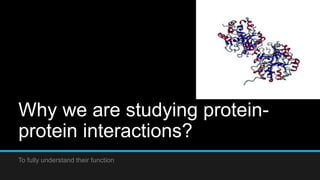
Why we are studying protein-
protein interactions?
To fully understand their function
Need To Study PPI
 The majority of proteins interact with other proteins for proper function,
they should be studied in the context of their interacting partners to
fully understand their function.
 With the development of the field of proteomics, understanding how
proteins interact with each other and identifying biological networks is
vital to understanding how proteins function within the cell
Why Yeast Two Hybrid Method
 It bears a greater resemblance to higher eukaryotic systems than a
system based on a bacterial host.
 With regards to classical biochemical approaches, which can require
high quantities of purified proteins or good quality anti-bodies, the two
hybrid system has minimal requirements to initiate screening, since
only the cDNA of the gene of interest is needed.
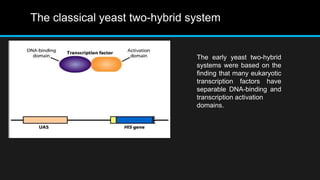
The classical yeast two-hybrid system
The early yeast two-hybrid
systems were based on the
finding that many eukaryotic
transcription factors have
separable DNA-binding and
transcription activation
domains.
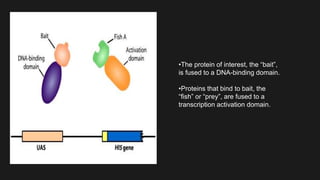
•The protein of interest, the “bait”,
is fused to a DNA-binding domain.
•Proteins that bind to bait, the
“fish” or “prey”, are fused to a
transcription activation domain.
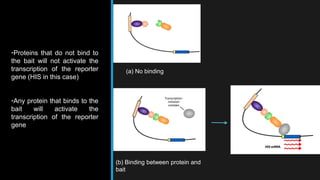
•Proteins that do not bind to
the bait will not activate the
transcription of the reporter
gene (HIS in this case)
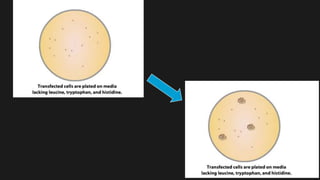
•Any protein that binds to the
bait will activate the
transcription of the reporter
gene
(a) No binding
(b) Binding between protein and
bait
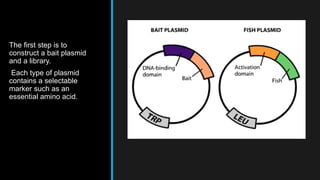
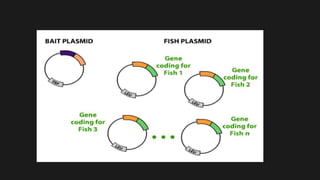
The first step is to
construct a bait plasmid
and a library.
Each type of plasmid
contains a selectable
marker such as an
essential amino acid.
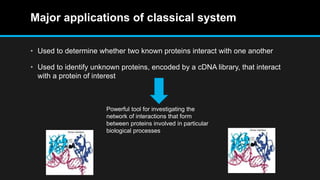
Major applications of classical system
• Used to determine whether two known proteins interact with one another
• Used to identify unknown proteins, encoded by a cDNA library, that interact
with a protein of interest
Powerful tool for investigating the
network of interactions that form
between proteins involved in particular
biological processes
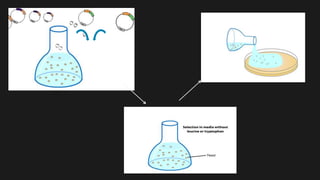
Selection of host strain
• The yeast strains used for two-hybrid experiments carry mutations in
a number of genes required for amino acid biosynthesis, such as
TRP1, LEU2, HIS3 and URA3.
• If these amino acids are omitted from the growth medium the yeast
strain will fail to grow.
• Many of the two-hybrid plasmids carry genes that complement these
mutations and allow for selection of the transformant yeast.
What is the yeast two-hybrid system used
for
 Identifies novel protein-protein interactions
 Can identify protein cascades
 Identifies mutations that affect protein-protein binding
 Can identify interfering proteins in known interactions (Reverse
Two-Hybrid System)
Advantages
 Immediate availability of the cloned gene of the interacting
protein
 Only a single plasmid construction is required
 Interactions are detected in vivo
 Weak, transient interactions can be detected
 Can accumulate a weak signal over time
 Protein purification not necessary
 No antibodies requires
Two hybrid systems - > to
uncover unanticipated
interactions
Disadvantages
 False positives are the largest problem with the yeast
two-hybrid system. Can be caused by the ability of
bait to induce transcription without interaction with the
bait
 Possible incorrect protein folding in yeast
 gene encoding target protein must be available
 failed to detect some know interactions
Yeast two hybrid method

Yeast two hybrid method

  • 1.
    YEAST TWO HYBRIDMETHOD Vipul choudhary | Dr. Indrakant K. Singh( ‫سنگھ‬ ‫)اندراکانت‬
  • 2.
    Why we arestudying protein- protein interactions? To fully understand their function
  • 3.
    Need To StudyPPI  The majority of proteins interact with other proteins for proper function, they should be studied in the context of their interacting partners to fully understand their function.  With the development of the field of proteomics, understanding how proteins interact with each other and identifying biological networks is vital to understanding how proteins function within the cell
  • 4.
    Why Yeast TwoHybrid Method  It bears a greater resemblance to higher eukaryotic systems than a system based on a bacterial host.  With regards to classical biochemical approaches, which can require high quantities of purified proteins or good quality anti-bodies, the two hybrid system has minimal requirements to initiate screening, since only the cDNA of the gene of interest is needed.
  • 5.
    The classical yeasttwo-hybrid system The early yeast two-hybrid systems were based on the finding that many eukaryotic transcription factors have separable DNA-binding and transcription activation domains.
  • 6.
    •The protein ofinterest, the “bait”, is fused to a DNA-binding domain. •Proteins that bind to bait, the “fish” or “prey”, are fused to a transcription activation domain.
  • 7.
    •Proteins that donot bind to the bait will not activate the transcription of the reporter gene (HIS in this case) •Any protein that binds to the bait will activate the transcription of the reporter gene (a) No binding (b) Binding between protein and bait
  • 8.
    The first stepis to construct a bait plasmid and a library. Each type of plasmid contains a selectable marker such as an essential amino acid.
  • 12.
    Major applications ofclassical system • Used to determine whether two known proteins interact with one another • Used to identify unknown proteins, encoded by a cDNA library, that interact with a protein of interest Powerful tool for investigating the network of interactions that form between proteins involved in particular biological processes
  • 13.
    Selection of hoststrain • The yeast strains used for two-hybrid experiments carry mutations in a number of genes required for amino acid biosynthesis, such as TRP1, LEU2, HIS3 and URA3. • If these amino acids are omitted from the growth medium the yeast strain will fail to grow. • Many of the two-hybrid plasmids carry genes that complement these mutations and allow for selection of the transformant yeast.
  • 14.
    What is theyeast two-hybrid system used for  Identifies novel protein-protein interactions  Can identify protein cascades  Identifies mutations that affect protein-protein binding  Can identify interfering proteins in known interactions (Reverse Two-Hybrid System)
  • 15.
    Advantages  Immediate availabilityof the cloned gene of the interacting protein  Only a single plasmid construction is required  Interactions are detected in vivo  Weak, transient interactions can be detected  Can accumulate a weak signal over time  Protein purification not necessary  No antibodies requires Two hybrid systems - > to uncover unanticipated interactions
  • 16.
    Disadvantages  False positivesare the largest problem with the yeast two-hybrid system. Can be caused by the ability of bait to induce transcription without interaction with the bait  Possible incorrect protein folding in yeast  gene encoding target protein must be available  failed to detect some know interactions

Editor's Notes

  • #3 This is the question that your experiment answers
  • #5 Summarize your research in three to five points.