The three major functions that are basic to plant growth
and development are:
• Photosynthesis – The process of capturing light energy
and converting it to sugar energy, in the presence of
chlorophyll using CO2 and H2O.
• Respiration – The process of metabolizing (burning)
sugars to yield
energy for growth, reproduction, and other life
processes
• Transpiration – The loss of water vapor through the
stomata of leaves
1
THE CONCEPT OF ‘RESPIRATION’ IS CENTRAL TO ALL LIVING PROCESSES.
Plant needs energy for growth, transport and maintenance of vital functions as
animals do. To get the energy required, they oxidize (i.e. burn the
photosynthetically fixed sugars). At the same time, water and carbon dioxide
are released as waste products. Respiration occurs in all living plant parts (i.e.
in the leaves, trunk and roots).
It is important to understand that the biological meaning of ‘Respiration’ refers
to a chemical process taking place in all living cells. The function of this
chemical process is to make energy available for all the cell’s activities which
keep it alive.
‘Breathing’, in some cases, plays a part but ‘respiration’ to a biologist does not
mean the same as ‘breathing’.
Respiration (Energy)
All living cells are made up of chemical substances.
The processes of living involve reactions between the
substances.
A reaction is an event which produces a change in a substance
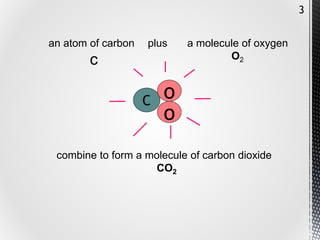
For example, a reaction between C and O2(such as burning coal
in air) changes the C in the coal and O2 in the air into CO2.
2
This reaction can be represented by the equation
C + O2 CO2
C o
o
an atom of carbon
c
a molecule of oxygen
O2
combine to form a molecule of carbon dioxide
CO2
plus
3
The reaction between carbon and oxygen also
releases energy in the form of heat and light
(flames).
Living organisms get their energy from such.
One of the energy-producing reactions is called
respiration.
(Respiration is not the same thing as breathing)
4
7
The chemical reactions of respiration take place
in all living cells
The reaction takes place between oxygen and a
substance which contains carbon. The reaction
produces CO2 and H2O, and releases energy.
The carbon-containing substances come from FOOD
The oxygen comes from the AIR (or water)
The energy is used to drive other chemical reactions
taking place in cells
Photosynthesis
How a Plant Harnesses Light Energy to Make Chemical
Energy
Respiration
Turning Chemical Energy into Fuel for Growth,
Development and Reproduction
Free energy is released and Incorporated into a form (ATP)
that can be readily used for the maintenance and
development of the plant.
Low-temperature oxidation of carbohydrates carried out by
enzymes and living systems
Net reaction appears as the reverse of PS
The individual reactions that occur to achieve the net effect
are entirely different
Reactions occur in different parts of cells
Chemical Reaction
Net Reaction
 C6H12O6 + 6O2 + 40 ADP + 40 Phosphates → 6 CO2 + 6 H2O + 40 ATP
Respiration Occurs
At same Time as PS
During the Night
In Developing and Ripening Fruit
In Dormant Seeds
Occurs in Mitochondria of Cells
Mitochondria are membrane-
enclosed organelles distributed
through the cytosol of most
eukaryotic cells. Their main
function is the conversion of the
potential energy of food
molecules into ATP
Level of light intensity where the rate of respiration (CO2
produced) equals the rate of PS (CO2 Consumed)
Greater Light Intensity should result in net dry matter
(Carbohydrate Accumulation)
Lower light intensity will result in net dry matter loss over time
Light compensation point is generally reached for plants grown
outdoors
May not Be Reached for Full Sun Plants Grown in Shade or for
Houseplants Grown Indoors in Inadequate Light
Light Compensation Point
Requires Oxygen
Main type of respiration that occurs in most situations in plants
and animals
Involves complete breakdown of glucose back to CO2 and water
Not all of the energy in glucose Is converted to ATP formation
Only about 40% Efficient
Extra Energy Is Given off as Heat
In Plants, Heat Quickly Dissipates
For Animals, Heat Is Retained to Hold Body Temperature
1. Glycolysis
 Breakdown of Glucose to a 3-Carbon compound called
Pyruvate
 Occurs in Cytosol
 Some ATP and NADH Are also Formed
 Storage Energy Molecules
 NADH Is Formed from NAD
 Similar Type of Energy-Storing Rx as NADP + H2 → NADPH2
 NAD + H → NADH
2. Krebs Cycle
 ‘Tricarboxylic acid Cycle (TCA Cycle)’
 ‘Citric Acid Cycle’
 Occurs in Mitochondrial Matrix
 A Cyclic Series of Rxs that Completely Break down Pyruvate to
CO2 and Various Carbon Skeletons
 Skeletons are used in other Metabolic Pathways to make various
compounds
 Proteins, Lipids, Cell Wall Carbohydrates, DNA
Plant Hormones, Plant Pigments, Many other biochemical
compounds
 The Step where CO2 Is given off by the Plant
 10 NADH are generated
3. Electron Transport Chain
 ‘Oxidative Phosphorylation’
 Series of proteins in the Mitochondria helps transfer
Electrons (e-) from NADH to Oxygen
 Releases a Lot of Energy
 Occurs on Mitochondrial Inner membrane (Proteins
bound to membrane)
 Released energy is used to drive the reaction
ADP + P → ATP
 Many ATP Are Made
 Oxygen Is Required for this Step
 Water Is Produced
‘Fermentation’
Occurs in low-oxygen
environments
Wet or compacted soils for plants
After strong exertion for animals
ATP Is still produced from Glucose
but not as efficiently as with
aerobic respiration
C6H12O6 + O2 → 2 CH2O5 + 2 H2O + 2 ATP
or
Glucose + Oxygen → 2 Ethanol + 2 Water + 2 ATP
Same Rx used to produce alcohol from corn or to make wine or
other consumed Alcohol
Aerobic:
C6H12O6 + 6O2 + 40 ADP + 40 Phosphates → 6 CO2 + 6 H2O + 40 ATP
Only 2 ATP are formed instead of 40 from aerobic respiration
Plant soon runs out of energy
can begin to suffer from toxic levels of ethanol and related
compounds
Extended periods of anaerobic respiration will seriously
reduced plant growth and yields
Photosynthesis Respiration
Produces sugars from energy Burns sugars for energy
Energy is stored Energy is released
Occurs only in cells with chloroplasts Occurs in most cells
Oxygen is produced Oxygen is used
Water is used Water is produced
Carbon dioxide is used CO2 is produced
Requires light Occurs in dark and light
Comparison of photosynthesis and respiration
Transpiration
Water in the roots is pulled through the plant by transpiration (loss of
water vapor through the stomata of the leaves).
Transpiration uses about 90% of the water that enters the plant. The
other 10% is an ingredient in photosynthesis and cell growth.
Transpiration play three essential roles:
Movement of minerals up from the root (in xylem) and sugars
throughout the plant (in phloem).
Cooling – 80% of the cooling effect of a shade tree is from the evaporative
cooling effects of transpiration.
Turgor pressure – Water maintains the turgor pressure in cells much like
air inflates a balloon, giving the non-woody plant parts form. Turgidity is
important so the plant can remain stiff and upright and gain a competitive
advantage when it comes to light. Turgidity is also important for the
functioning of the guard cells.
Osmotic pressure is defined as water flowing through a
permeable membrane in the direction of higher salt
concentrations. Water will continue to flow in the direction of
the highest salt concentration until the salts have been diluted to
the point that the conc on both sides of the membrane are equal.
Capillary action refers to the chemical forces that move water
as a continuous film rather than as individual molecules. Water
molecules in the soil and in the plant stick to one another and are
reluctant to let go. Thus when one molecule is drawn up the plant
stem, it pulls another one along with it.
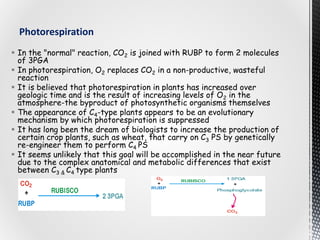
 In the "normal" reaction, CO2 is joined with RUBP to form 2 molecules
of 3PGA
 In photorespiration, O2 replaces CO2 in a non-productive, wasteful
reaction
 It is believed that photorespiration in plants has increased over
geologic time and is the result of increasing levels of O2 in the
atmosphere-the byproduct of photosynthetic organisms themselves
 The appearance of C4-type plants appears to be an evolutionary
mechanism by which photorespiration is suppressed
 It has long been the dream of biologists to increase the production of
certain crop plants, such as wheat, that carry on C3 PS by genetically
re-engineer them to perform C4 PS
 It seems unlikely that this goal will be accomplished in the near future
due to the complex anatomical and metabolic differences that exist
between C3 & C4 type plants
Photorespiration
O2 : CO2 Ratio
 If cells have low O2 but higher CO2, normal PS Calvin Cycle dominates
 C4 plants have little photorespiration because they carry the CO2 to the
bundle Sheath Cells and can Build up High CO2
 Calvin Cycle Rxs always favored over Photorespiration
 If Cells have higher O2 and lower CO2, Photorespiration dominates
Light Intensity
 Increasing light intensity will increase energy for the PR process and for
PS
 C3 plants light-saturate at lower light intensities than c4 plants
 Reach their ‘break-even point’ at much lower light levels due to increasing
photorespiration
Temperature
 Aerobic respiration and photorespiration increase with temp
Net Assimilation Rate
 C4 plants generally have net assimilation rates about 2 to 3
times that of C3 Plants
 C4 plants are called efficient and C3 plants called non-efficient
plants
 A few C3 plants have low respiration and similar assimilation
rates as C4 Plants
 Sunflower & Peanut
 Cooler temps are the only time when C3 plants have higher net
assimilation rates than C4 plants
 PEP Carboxylase needed to incorporate CO2 into the 4-Carbon
structure no longer functions
 C4 plants can produce 3 times as much dry matter per unit of
water as C3 plants

Respiration.pptx

  • 1.
    The three majorfunctions that are basic to plant growth and development are: • Photosynthesis – The process of capturing light energy and converting it to sugar energy, in the presence of chlorophyll using CO2 and H2O. • Respiration – The process of metabolizing (burning) sugars to yield energy for growth, reproduction, and other life processes • Transpiration – The loss of water vapor through the stomata of leaves
  • 2.
    1 THE CONCEPT OF‘RESPIRATION’ IS CENTRAL TO ALL LIVING PROCESSES. Plant needs energy for growth, transport and maintenance of vital functions as animals do. To get the energy required, they oxidize (i.e. burn the photosynthetically fixed sugars). At the same time, water and carbon dioxide are released as waste products. Respiration occurs in all living plant parts (i.e. in the leaves, trunk and roots). It is important to understand that the biological meaning of ‘Respiration’ refers to a chemical process taking place in all living cells. The function of this chemical process is to make energy available for all the cell’s activities which keep it alive. ‘Breathing’, in some cases, plays a part but ‘respiration’ to a biologist does not mean the same as ‘breathing’. Respiration (Energy)
  • 3.
    All living cellsare made up of chemical substances. The processes of living involve reactions between the substances. A reaction is an event which produces a change in a substance For example, a reaction between C and O2(such as burning coal in air) changes the C in the coal and O2 in the air into CO2. 2 This reaction can be represented by the equation C + O2 CO2
  • 4.
    C o o an atomof carbon c a molecule of oxygen O2 combine to form a molecule of carbon dioxide CO2 plus 3
  • 5.
    The reaction betweencarbon and oxygen also releases energy in the form of heat and light (flames). Living organisms get their energy from such. One of the energy-producing reactions is called respiration. (Respiration is not the same thing as breathing) 4
  • 6.
    7 The chemical reactionsof respiration take place in all living cells The reaction takes place between oxygen and a substance which contains carbon. The reaction produces CO2 and H2O, and releases energy. The carbon-containing substances come from FOOD The oxygen comes from the AIR (or water) The energy is used to drive other chemical reactions taking place in cells
  • 7.
    Photosynthesis How a PlantHarnesses Light Energy to Make Chemical Energy Respiration Turning Chemical Energy into Fuel for Growth, Development and Reproduction Free energy is released and Incorporated into a form (ATP) that can be readily used for the maintenance and development of the plant.
  • 8.
    Low-temperature oxidation ofcarbohydrates carried out by enzymes and living systems Net reaction appears as the reverse of PS The individual reactions that occur to achieve the net effect are entirely different Reactions occur in different parts of cells Chemical Reaction Net Reaction  C6H12O6 + 6O2 + 40 ADP + 40 Phosphates → 6 CO2 + 6 H2O + 40 ATP
  • 9.
    Respiration Occurs At sameTime as PS During the Night In Developing and Ripening Fruit In Dormant Seeds
  • 10.
    Occurs in Mitochondriaof Cells Mitochondria are membrane- enclosed organelles distributed through the cytosol of most eukaryotic cells. Their main function is the conversion of the potential energy of food molecules into ATP
  • 11.
    Level of lightintensity where the rate of respiration (CO2 produced) equals the rate of PS (CO2 Consumed) Greater Light Intensity should result in net dry matter (Carbohydrate Accumulation) Lower light intensity will result in net dry matter loss over time Light compensation point is generally reached for plants grown outdoors May not Be Reached for Full Sun Plants Grown in Shade or for Houseplants Grown Indoors in Inadequate Light Light Compensation Point
  • 12.
    Requires Oxygen Main typeof respiration that occurs in most situations in plants and animals Involves complete breakdown of glucose back to CO2 and water Not all of the energy in glucose Is converted to ATP formation Only about 40% Efficient Extra Energy Is Given off as Heat In Plants, Heat Quickly Dissipates For Animals, Heat Is Retained to Hold Body Temperature
  • 13.
    1. Glycolysis  Breakdownof Glucose to a 3-Carbon compound called Pyruvate  Occurs in Cytosol  Some ATP and NADH Are also Formed  Storage Energy Molecules  NADH Is Formed from NAD  Similar Type of Energy-Storing Rx as NADP + H2 → NADPH2  NAD + H → NADH
  • 14.
    2. Krebs Cycle ‘Tricarboxylic acid Cycle (TCA Cycle)’  ‘Citric Acid Cycle’  Occurs in Mitochondrial Matrix  A Cyclic Series of Rxs that Completely Break down Pyruvate to CO2 and Various Carbon Skeletons  Skeletons are used in other Metabolic Pathways to make various compounds  Proteins, Lipids, Cell Wall Carbohydrates, DNA Plant Hormones, Plant Pigments, Many other biochemical compounds  The Step where CO2 Is given off by the Plant  10 NADH are generated
  • 15.
    3. Electron TransportChain  ‘Oxidative Phosphorylation’  Series of proteins in the Mitochondria helps transfer Electrons (e-) from NADH to Oxygen  Releases a Lot of Energy  Occurs on Mitochondrial Inner membrane (Proteins bound to membrane)  Released energy is used to drive the reaction ADP + P → ATP  Many ATP Are Made  Oxygen Is Required for this Step  Water Is Produced
  • 16.
    ‘Fermentation’ Occurs in low-oxygen environments Wetor compacted soils for plants After strong exertion for animals ATP Is still produced from Glucose but not as efficiently as with aerobic respiration
  • 17.
    C6H12O6 + O2→ 2 CH2O5 + 2 H2O + 2 ATP or Glucose + Oxygen → 2 Ethanol + 2 Water + 2 ATP Same Rx used to produce alcohol from corn or to make wine or other consumed Alcohol Aerobic: C6H12O6 + 6O2 + 40 ADP + 40 Phosphates → 6 CO2 + 6 H2O + 40 ATP
  • 18.
    Only 2 ATPare formed instead of 40 from aerobic respiration Plant soon runs out of energy can begin to suffer from toxic levels of ethanol and related compounds Extended periods of anaerobic respiration will seriously reduced plant growth and yields
  • 19.
    Photosynthesis Respiration Produces sugarsfrom energy Burns sugars for energy Energy is stored Energy is released Occurs only in cells with chloroplasts Occurs in most cells Oxygen is produced Oxygen is used Water is used Water is produced Carbon dioxide is used CO2 is produced Requires light Occurs in dark and light Comparison of photosynthesis and respiration
  • 20.
    Transpiration Water in theroots is pulled through the plant by transpiration (loss of water vapor through the stomata of the leaves). Transpiration uses about 90% of the water that enters the plant. The other 10% is an ingredient in photosynthesis and cell growth. Transpiration play three essential roles: Movement of minerals up from the root (in xylem) and sugars throughout the plant (in phloem). Cooling – 80% of the cooling effect of a shade tree is from the evaporative cooling effects of transpiration. Turgor pressure – Water maintains the turgor pressure in cells much like air inflates a balloon, giving the non-woody plant parts form. Turgidity is important so the plant can remain stiff and upright and gain a competitive advantage when it comes to light. Turgidity is also important for the functioning of the guard cells.
  • 21.
    Osmotic pressure isdefined as water flowing through a permeable membrane in the direction of higher salt concentrations. Water will continue to flow in the direction of the highest salt concentration until the salts have been diluted to the point that the conc on both sides of the membrane are equal. Capillary action refers to the chemical forces that move water as a continuous film rather than as individual molecules. Water molecules in the soil and in the plant stick to one another and are reluctant to let go. Thus when one molecule is drawn up the plant stem, it pulls another one along with it.
  • 22.
     In the"normal" reaction, CO2 is joined with RUBP to form 2 molecules of 3PGA  In photorespiration, O2 replaces CO2 in a non-productive, wasteful reaction  It is believed that photorespiration in plants has increased over geologic time and is the result of increasing levels of O2 in the atmosphere-the byproduct of photosynthetic organisms themselves  The appearance of C4-type plants appears to be an evolutionary mechanism by which photorespiration is suppressed  It has long been the dream of biologists to increase the production of certain crop plants, such as wheat, that carry on C3 PS by genetically re-engineer them to perform C4 PS  It seems unlikely that this goal will be accomplished in the near future due to the complex anatomical and metabolic differences that exist between C3 & C4 type plants Photorespiration
  • 23.
    O2 : CO2Ratio  If cells have low O2 but higher CO2, normal PS Calvin Cycle dominates  C4 plants have little photorespiration because they carry the CO2 to the bundle Sheath Cells and can Build up High CO2  Calvin Cycle Rxs always favored over Photorespiration  If Cells have higher O2 and lower CO2, Photorespiration dominates Light Intensity  Increasing light intensity will increase energy for the PR process and for PS  C3 plants light-saturate at lower light intensities than c4 plants  Reach their ‘break-even point’ at much lower light levels due to increasing photorespiration Temperature  Aerobic respiration and photorespiration increase with temp
  • 24.
    Net Assimilation Rate C4 plants generally have net assimilation rates about 2 to 3 times that of C3 Plants  C4 plants are called efficient and C3 plants called non-efficient plants  A few C3 plants have low respiration and similar assimilation rates as C4 Plants  Sunflower & Peanut  Cooler temps are the only time when C3 plants have higher net assimilation rates than C4 plants  PEP Carboxylase needed to incorporate CO2 into the 4-Carbon structure no longer functions  C4 plants can produce 3 times as much dry matter per unit of water as C3 plants