Photosynthesis
Grade 3
The student will:
 Learn what photosynthesis is and
how it helps plants.
 Learn what a plant needs for
photosynthesis.
What is photosynthesis?
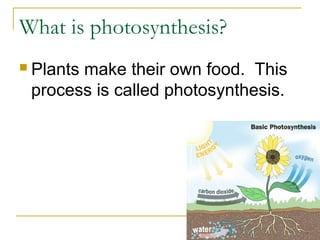
 Plants make their own food. This
process is called photosynthesis.
Where does photosynthesis occur?
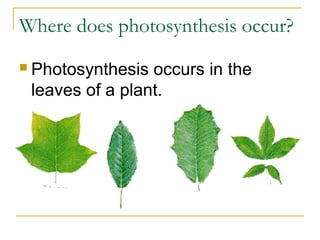
 Photosynthesis occurs in the
leaves of a plant.
PlantsPlants
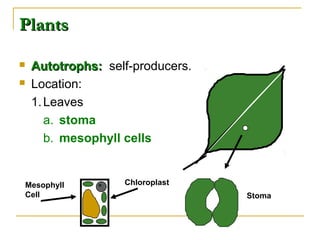
 Autotrophs:Autotrophs: self-producers.
 Location:
1.Leaves
a. stoma
b. mesophyll cells
Stoma
Mesophyll
Cell
Chloroplast
Stomata (stoma)Stomata (stoma)
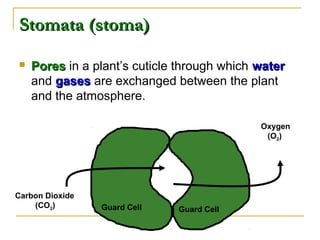
 PoresPores in a plant’s cuticle through which waterwater
and gasesgases are exchanged between the plant
and the atmosphere.
Guard CellGuard Cell
Carbon Dioxide
(CO2)
Oxygen
(O2)
Mesophyll CellMesophyll Cell
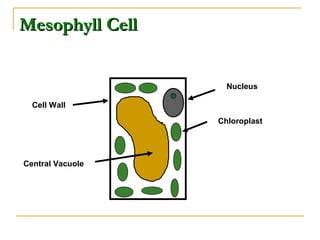
Cell Wall
Nucleus
Chloroplast
Central Vacuole
ChloroplastChloroplast
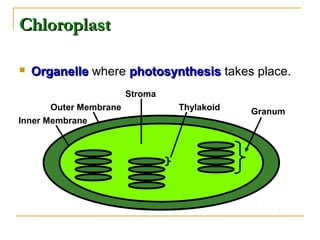
 OrganelleOrganelle where photosynthesisphotosynthesis takes place.
GranumThylakoid
Stroma
Outer Membrane
Inner Membrane
What is needed for
photosynthesis to occur?
 Light is needed for photosynthesis to
occur. The plant’s leaves use the light
to make a sugar called glucose.
Why do plants need glucose?
 Glucose is the food for the plant. It
gives the plant energy to grow.
How much glucose does a plant
make?
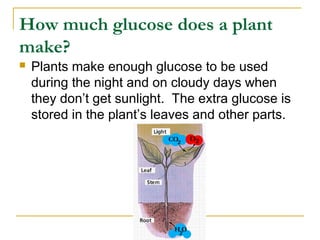
 Plants make enough glucose to be used
during the night and on cloudy days when
they don’t get sunlight. The extra glucose is
stored in the plant’s leaves and other parts.
How does photosynthesis help
us?
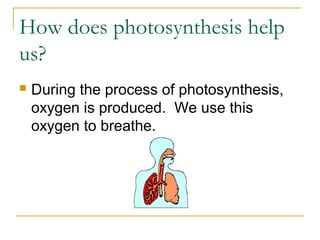
 During the process of photosynthesis,
oxygen is produced. We use this
oxygen to breathe.

Photosynthesis