Οι εκπαιδευτικοί ως σχεδιαστές και
ενορχηστρωτές καινοτόμου
συνεργατικής μάθησης βασισμένης
στις ΤΠΕ. Καλές πρακτικές και
συστήματα υποστήριξης
Γιαννης Δημητριαδης
Παν. Βαγιαδολιδ Ισπανια
ΕΤΠΕ 2017
Αθηνα, 22/04/2017
Overview
2
n What is the problem to tackle?
n How to promote pedagogical innovation
n How to support/empower teachers (and other
stakeholders) for pedagogically informed
decisions in technologically supported
effective (and efficient and sustainable) design
(and deployment) process
n What can we do for
n Collaborative Learning
n Blended (or even open) classes
Overview
3
n Underlying issue
n Teachers as designers: What can be
designed and how it can be done “well”?
n Describe a solution
n METIS approach: http://www.metis-project.org/
n ILDE technological environment:
http://ilde2.upf.edu/etpe (see workshop@ETPE 2017)
n Discuss some lessons learnt, issues and
recommendations
Is there a problem? - I
n Curriculum and competencies
– “Work in group may be useful as a skill, but it is a
secondary issue”
– “Collaborative techniques takes a lot of time: We run
the risk of not covering the whole official curriculum”
n Practical issues (e.g. synchronicity)
– “It is impossible to use collaborative activities because
my on-line students work and they cannot
participate in a joint project”
4
Is there a problem? - II
n Group formation, efficiency and deployment cost,
design in groups/communties of teachers:
– “Collaborative learning is fine but can I form 10-
member groups to produce a report?”
– “I know a lot about collaborative learning but I need
to have my on-line course in a few days”
– “I need to have some ideas from my good colleagues
or even better an almost ready-to-use course in
my virtual campus”
– “I need to prepare my course within a team of 3
professors but how we can do it?
5
Is there a problem? - III
n Pedagogical standpoint
– “I do use Moodle to store my slides. That’s enough
for me”
– “I have prepared a great MOOC with a video and a
test. That’s enough”
6
Is there a problem ? - III
n There is not only one but several (“well-known”)
problems that impede
– innovation in (collaborative) teaching and
(collaborative) learning using new (and old)
technologies
n No easy solutions for complex problems
– Technological and educational innovation
– See also: TPACK (Technological Pedagogical Content
Knowledge)
7
Can we offer an answer? - I
n Need for some systematic (and sustainable?)
answer to tackle SOME of these problems
– Support teachers to effectively DESIGN and DEPLOY
collaborative learning in ICT-supported (and
enhanced?) settings
n Ingredients of the proposed solution
– Think of teachers (and other stakeholders) as
designers and support/empower them
– Help them take pedagogically informed decisions
– Make their life easier in “orchestrating” their
blended classrooms
8
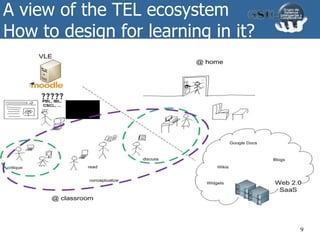
A view of the TEL ecosystem
How to design for learning in it?
9
Can we offer an answer? - II
n Some more ingredients
– Learning Design (or Design for Learning), as a
research and development field
– Pedagogical patterns, as good practices
– ICT tools to support teachers in Design for Learning
– Professional development workshops
n The METIS project approach http://www.metis-project.org/
– Workshop packages http://www.metis-
project.org/index.php/workshop-resources
– Integrated Learning Design Environment
(ILDE)http://www.metis-project.org/index.php/metis-ilde
10
Learning Design (LD)
or Design for Learning (D4L) - I
n Learning is the objective of education
– Can we (pedagogically) inform and (technologically)
support teachers (and other stakeholders) in
creating effective (and efficient?) learning situations
n Main metaphor:
– “Teachers as designers”
n Main issue:
– Is it possible that teachers (and other stakeholders)
work as other traditional designers (e.g. architects,
engineers)?
– Can design form part of the normal flow of
educational activities?
11
Design for Learning (D4L) - II
n What can be designed for learning? (Goodyear &
Dimitriadis, 2013)
n The learning (performed by students) and support
(made by teachers) tasks
n The “physical” environment
n Spaces, tools, infrastructures, artifacts-resources (to be
consumed and/or produced)
n The social architecture
n Groupings, interactions with external agents
n Design is indirect (tasks vs. activities)
n Learners may change-interpret tasks in learntime
12
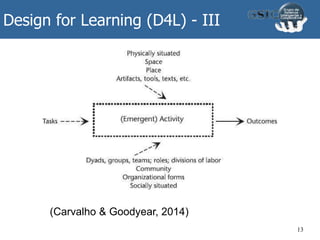
Design for Learning (D4L) - III
13
(Carvalho & Goodyear, 2014)
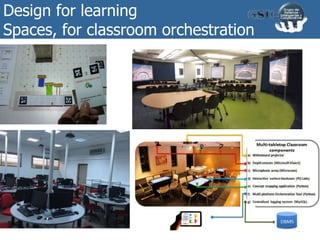
Design for learning
Spaces, for classroom orchestration
14
Forward oriented design - I
(Dimitriadis & Goodyear, 2013)
15
n Design for Configuration:
n Prepare, particularize, or modify what had been
designed beforehand
n Adapt to specific requirements of the context
n Design for Orchestration
n Support teachers (and students) at learn time
Forward oriented design - II
n Design for Reflection
n Be sure that monitoring can take place
n Offer “awareness” at learn time
n Allow for regulation and scaffolding
n Inform evaluation of the intervention and
assessment of learning
n Design for Redesign
n Take design decisions so that posterior
modifications of the design can be made easily
Teaching as a design science
(Laurillard, 2012)
n “In media res”: Design forms part of the
“normal flow” of educational activities
n Teaching as a design science
n Teaching is not only an art. It has a formally defined
goal
n It builds design principles, rather than theories, and
heuristics of practice than explanations
n See also Design Based Research, co-design, …
n Design patterns externalize knowledge and allow for
discussion and sharing …
Pedagogical (design) patterns
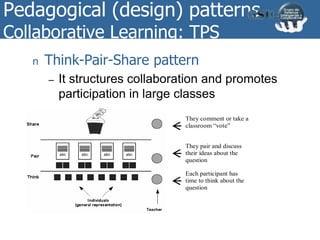
Collaborative Learning: TPS
n Think-Pair-Share pattern
– It structures collaboration and promotes
participation in large classes
They comment or take a
classroom “vote”
They pair and discuss
their ideas about the
question
Each participant has
time to think about the
question
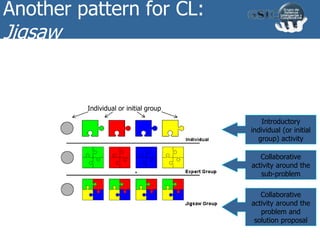
Another pattern for CL:
Jigsaw
Individual or initial group
Teacher
Introductory
individual (or initial
group) activity
Collaborative
activity around the
sub-problem
Collaborative
activity around the
problem and
solution proposal
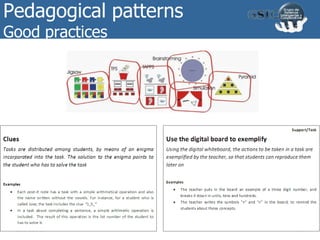
Pedagogical patterns
Good practices
2027.11.2012 RACEV Barcelona
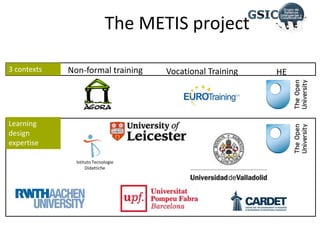
The METIS project
Istituto Tecnologie
Didattiche
3 contexts HEVocational TrainingNon-formal training
Learning
design
expertise
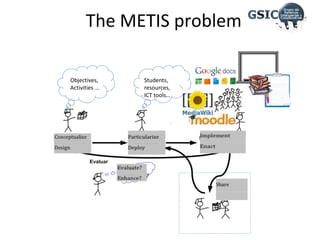
The METIS problem
Objectives,
Activities …
Students,
resources,
ICT tools…
How to
Enhance?
23
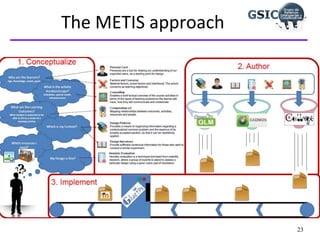
The METIS approach
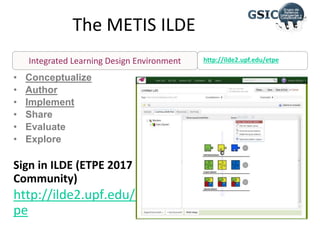
• Conceptualize
• Author
• Implement
• Share
• Evaluate
• Explore
Sign in ILDE (ETPE 2017
Community)
http://ilde2.upf.edu/et
pe
Integrated Learning Design Environment http://ilde2.upf.edu/etpe
The METIS ILDE
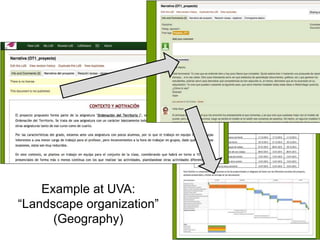
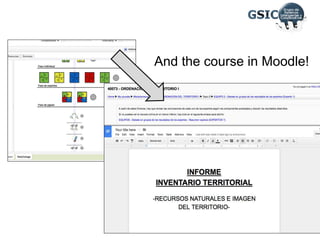
Example at UVA:
“Landscape organization”
(Geography)
And the course in Moodle!
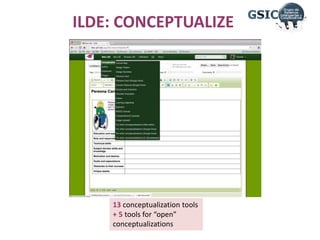
13 conceptualization tools
+ 5 tools for “open”
conceptualizations
ILDE: CONCEPTUALIZE
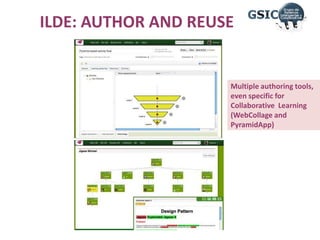
ILDE: AUTHOR AND REUSE
Multiple authoring tools,
even specific for
Collaborative Learning
(WebCollage and
PyramidApp)
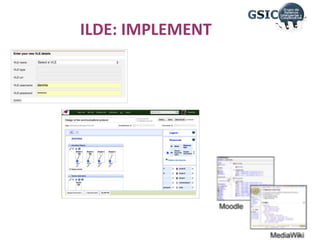
ILDE: IMPLEMENT
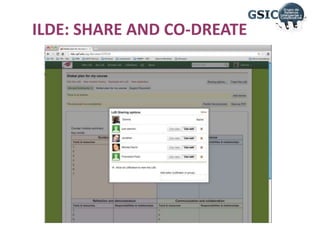
ILDE: SHARE AND CO-DREATE
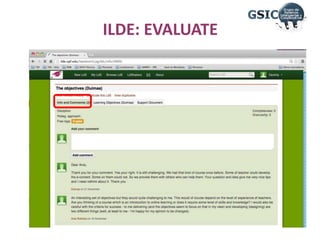
ILDE: EVALUATE
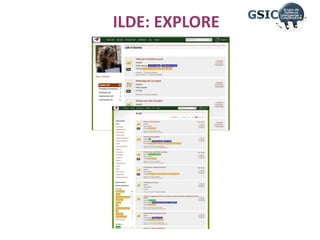
ILDE: EXPLORE
n ILDE
– It fits the needs of several educational contexts
– It is independent from the pedagogical approach
adopted;
– It covers all the phases of the LD lifecycle;
– It is usable by the ‘average’ teacher;
n Pedagogy is the “king”
n Support is needed for enactment and
communities further to the workshops
Some METIS findings
Some conclusions
n Collaborative learning will not occur if we do not
know the conditions and try to satisfy them
n Pedagogical (and other types of) patterns
capture some good practices and may help
teachers
n Teachers work as designers in many cases:
Empower them through professional
development workshops and ICT tools
n The TEL/CSCL ecosystem is very complex:
Design for learning / orchestration is a need …
34
Many lessons learnt
n The majority of needs is still on the “dark” side
(pedagogy!)
n Design for learning needs support (workshops,
tools, follow up, community)
n Capture and embed knowledge in the support (in
the designer language, if possible)
n The TEL/CSCL ecosystem is increasingly
complex: Take “some” features, try to
appropriate them and orchestrate the whole
lifecycle (from ideas to practice)
35
And a few recommendations
n Practitioners: Count on the community of your
colleagues, follow the “METIS approach” of
action/research, make designs explicit and share
them
n Support teams: Make life easier for teachers to
design for learning, support the complete
lifecycle, use practitioners’ language
n ICT and ped researchers: Support openness
(open courses, open designs, open extensible
architectures), work as “knowledge mediators”
n A small step for us, a big for the learners … 36
And some final remarks …
n Innovate in spite of unfavorable Greek context!
n Education needs innovative teachers, not heroes
n Collaborative learning can be put in practice,
although there no win-win-win …
n METIS ILDE helps normal teachers within
communities who want to design better for ICT-
supported learning
n Use experience through pedagogical patterns!
(https://www.dropbox.com/s/yt1hgi5qgcs4phu/collaborative_learning_flo
w_patterns.pdf?dl=0)
37

Yannis@etpe2017 20170421b

  • 1.
    Οι εκπαιδευτικοί ωςσχεδιαστές και ενορχηστρωτές καινοτόμου συνεργατικής μάθησης βασισμένης στις ΤΠΕ. Καλές πρακτικές και συστήματα υποστήριξης Γιαννης Δημητριαδης Παν. Βαγιαδολιδ Ισπανια ΕΤΠΕ 2017 Αθηνα, 22/04/2017
  • 2.
    Overview 2 n What isthe problem to tackle? n How to promote pedagogical innovation n How to support/empower teachers (and other stakeholders) for pedagogically informed decisions in technologically supported effective (and efficient and sustainable) design (and deployment) process n What can we do for n Collaborative Learning n Blended (or even open) classes
  • 3.
    Overview 3 n Underlying issue nTeachers as designers: What can be designed and how it can be done “well”? n Describe a solution n METIS approach: http://www.metis-project.org/ n ILDE technological environment: http://ilde2.upf.edu/etpe (see workshop@ETPE 2017) n Discuss some lessons learnt, issues and recommendations
  • 4.
    Is there aproblem? - I n Curriculum and competencies – “Work in group may be useful as a skill, but it is a secondary issue” – “Collaborative techniques takes a lot of time: We run the risk of not covering the whole official curriculum” n Practical issues (e.g. synchronicity) – “It is impossible to use collaborative activities because my on-line students work and they cannot participate in a joint project” 4
  • 5.
    Is there aproblem? - II n Group formation, efficiency and deployment cost, design in groups/communties of teachers: – “Collaborative learning is fine but can I form 10- member groups to produce a report?” – “I know a lot about collaborative learning but I need to have my on-line course in a few days” – “I need to have some ideas from my good colleagues or even better an almost ready-to-use course in my virtual campus” – “I need to prepare my course within a team of 3 professors but how we can do it? 5
  • 6.
    Is there aproblem? - III n Pedagogical standpoint – “I do use Moodle to store my slides. That’s enough for me” – “I have prepared a great MOOC with a video and a test. That’s enough” 6
  • 7.
    Is there aproblem ? - III n There is not only one but several (“well-known”) problems that impede – innovation in (collaborative) teaching and (collaborative) learning using new (and old) technologies n No easy solutions for complex problems – Technological and educational innovation – See also: TPACK (Technological Pedagogical Content Knowledge) 7
  • 8.
    Can we offeran answer? - I n Need for some systematic (and sustainable?) answer to tackle SOME of these problems – Support teachers to effectively DESIGN and DEPLOY collaborative learning in ICT-supported (and enhanced?) settings n Ingredients of the proposed solution – Think of teachers (and other stakeholders) as designers and support/empower them – Help them take pedagogically informed decisions – Make their life easier in “orchestrating” their blended classrooms 8
  • 9.
    A view ofthe TEL ecosystem How to design for learning in it? 9
  • 10.
    Can we offeran answer? - II n Some more ingredients – Learning Design (or Design for Learning), as a research and development field – Pedagogical patterns, as good practices – ICT tools to support teachers in Design for Learning – Professional development workshops n The METIS project approach http://www.metis-project.org/ – Workshop packages http://www.metis- project.org/index.php/workshop-resources – Integrated Learning Design Environment (ILDE)http://www.metis-project.org/index.php/metis-ilde 10
  • 11.
    Learning Design (LD) orDesign for Learning (D4L) - I n Learning is the objective of education – Can we (pedagogically) inform and (technologically) support teachers (and other stakeholders) in creating effective (and efficient?) learning situations n Main metaphor: – “Teachers as designers” n Main issue: – Is it possible that teachers (and other stakeholders) work as other traditional designers (e.g. architects, engineers)? – Can design form part of the normal flow of educational activities? 11
  • 12.
    Design for Learning(D4L) - II n What can be designed for learning? (Goodyear & Dimitriadis, 2013) n The learning (performed by students) and support (made by teachers) tasks n The “physical” environment n Spaces, tools, infrastructures, artifacts-resources (to be consumed and/or produced) n The social architecture n Groupings, interactions with external agents n Design is indirect (tasks vs. activities) n Learners may change-interpret tasks in learntime 12
  • 13.
    Design for Learning(D4L) - III 13 (Carvalho & Goodyear, 2014)
  • 14.
    Design for learning Spaces,for classroom orchestration 14
  • 15.
    Forward oriented design- I (Dimitriadis & Goodyear, 2013) 15 n Design for Configuration: n Prepare, particularize, or modify what had been designed beforehand n Adapt to specific requirements of the context n Design for Orchestration n Support teachers (and students) at learn time
  • 16.
    Forward oriented design- II n Design for Reflection n Be sure that monitoring can take place n Offer “awareness” at learn time n Allow for regulation and scaffolding n Inform evaluation of the intervention and assessment of learning n Design for Redesign n Take design decisions so that posterior modifications of the design can be made easily
  • 17.
    Teaching as adesign science (Laurillard, 2012) n “In media res”: Design forms part of the “normal flow” of educational activities n Teaching as a design science n Teaching is not only an art. It has a formally defined goal n It builds design principles, rather than theories, and heuristics of practice than explanations n See also Design Based Research, co-design, … n Design patterns externalize knowledge and allow for discussion and sharing …
  • 18.
    Pedagogical (design) patterns CollaborativeLearning: TPS n Think-Pair-Share pattern – It structures collaboration and promotes participation in large classes They comment or take a classroom “vote” They pair and discuss their ideas about the question Each participant has time to think about the question
  • 19.
    Another pattern forCL: Jigsaw Individual or initial group Teacher Introductory individual (or initial group) activity Collaborative activity around the sub-problem Collaborative activity around the problem and solution proposal
  • 20.
  • 21.
    The METIS project IstitutoTecnologie Didattiche 3 contexts HEVocational TrainingNon-formal training Learning design expertise
  • 22.
    The METIS problem Objectives, Activities… Students, resources, ICT tools… How to Enhance?
  • 23.
  • 24.
    • Conceptualize • Author •Implement • Share • Evaluate • Explore Sign in ILDE (ETPE 2017 Community) http://ilde2.upf.edu/et pe Integrated Learning Design Environment http://ilde2.upf.edu/etpe The METIS ILDE
  • 25.
    Example at UVA: “Landscapeorganization” (Geography)
  • 26.
    And the coursein Moodle!
  • 27.
    13 conceptualization tools +5 tools for “open” conceptualizations ILDE: CONCEPTUALIZE
  • 28.
    ILDE: AUTHOR ANDREUSE Multiple authoring tools, even specific for Collaborative Learning (WebCollage and PyramidApp)
  • 29.
  • 30.
    ILDE: SHARE ANDCO-DREATE
  • 31.
  • 32.
  • 33.
    n ILDE – Itfits the needs of several educational contexts – It is independent from the pedagogical approach adopted; – It covers all the phases of the LD lifecycle; – It is usable by the ‘average’ teacher; n Pedagogy is the “king” n Support is needed for enactment and communities further to the workshops Some METIS findings
  • 34.
    Some conclusions n Collaborativelearning will not occur if we do not know the conditions and try to satisfy them n Pedagogical (and other types of) patterns capture some good practices and may help teachers n Teachers work as designers in many cases: Empower them through professional development workshops and ICT tools n The TEL/CSCL ecosystem is very complex: Design for learning / orchestration is a need … 34
  • 35.
    Many lessons learnt nThe majority of needs is still on the “dark” side (pedagogy!) n Design for learning needs support (workshops, tools, follow up, community) n Capture and embed knowledge in the support (in the designer language, if possible) n The TEL/CSCL ecosystem is increasingly complex: Take “some” features, try to appropriate them and orchestrate the whole lifecycle (from ideas to practice) 35
  • 36.
    And a fewrecommendations n Practitioners: Count on the community of your colleagues, follow the “METIS approach” of action/research, make designs explicit and share them n Support teams: Make life easier for teachers to design for learning, support the complete lifecycle, use practitioners’ language n ICT and ped researchers: Support openness (open courses, open designs, open extensible architectures), work as “knowledge mediators” n A small step for us, a big for the learners … 36
  • 37.
    And some finalremarks … n Innovate in spite of unfavorable Greek context! n Education needs innovative teachers, not heroes n Collaborative learning can be put in practice, although there no win-win-win … n METIS ILDE helps normal teachers within communities who want to design better for ICT- supported learning n Use experience through pedagogical patterns! (https://www.dropbox.com/s/yt1hgi5qgcs4phu/collaborative_learning_flo w_patterns.pdf?dl=0) 37