OECD International assessment
of problem solving skills
Educating for Innovative Societies
26 April 2012
Michael Davidson
OECD Directorate for Education
The story so far….
• PISA 2003
– Problem solving (paper based)
• PIAAC
– Problem solving in technology‐rich environments
(computer based)
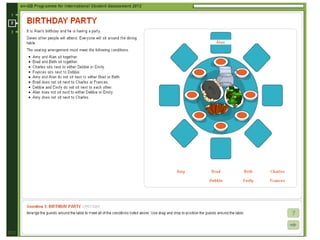
• PISA 2012
– Dynamic problem solving (computer based)
• PISA 2015
– Collaborative problem solving (computer based)
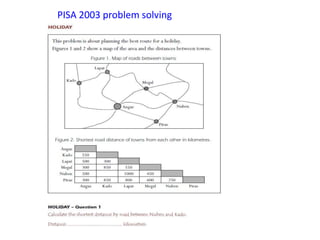
PISA 2003 problem solving
• Problem solving is an individual’s ability to use
cognitive processes to confront and resolve real,
cross-disciplinary situations where the solution
path is not immediately obvious and where the
literacy domains or curricular areas that might
be applicable are not within a single domain of
mathematics, science or reading.
PISA 2003 problem solving
The PISA 2012 definition of problem
solving competency
• problem solving competency is an individual’s
capacity to engage in cognitive processing to
understand and resolve problem situations
where a method of solution is not immediately
obvious. It includes the willingness to engage
with such situations in order to achieve one’s
potential as a constructive and reflective
citizen.
PISA 2015 Collaborative problem
solving- challenges
• Group or individual?
• Integration of problem solving skills with student
dispositions towards social interaction?
• Practicalities
– Sampling
– Computer capabilities
– Scoring
• Human-computer approach valid?
– Interactive rather than collaborative?
The PISA 2015 definition of
collaborative problem solving (draft)
• Collaborative problem solving competency is
the capacity of an individual to effectively
engage in a process whereby two or more
agents attempt to solve a problem by sharing
the understanding and effort required to come
to a solution.
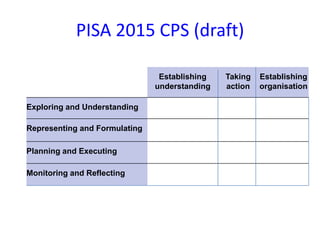
PISA 2015 CPS (draft)
Establishing
understanding
Taking
action
Establishing
organisation
Exploring and Understanding
Representing and Formulating
Planning and Executing
Monitoring and Reflecting
Thank you.
www.pisa.oecd.org
Sample computer based items: http://erasq.acer.edu.au/

collaborative problem solving PISA

  • 1.
    OECD International assessment ofproblem solving skills Educating for Innovative Societies 26 April 2012 Michael Davidson OECD Directorate for Education
  • 2.
    The story sofar…. • PISA 2003 – Problem solving (paper based) • PIAAC – Problem solving in technology‐rich environments (computer based) • PISA 2012 – Dynamic problem solving (computer based) • PISA 2015 – Collaborative problem solving (computer based)
  • 3.
    PISA 2003 problemsolving • Problem solving is an individual’s ability to use cognitive processes to confront and resolve real, cross-disciplinary situations where the solution path is not immediately obvious and where the literacy domains or curricular areas that might be applicable are not within a single domain of mathematics, science or reading.
  • 4.
  • 5.
    The PISA 2012definition of problem solving competency • problem solving competency is an individual’s capacity to engage in cognitive processing to understand and resolve problem situations where a method of solution is not immediately obvious. It includes the willingness to engage with such situations in order to achieve one’s potential as a constructive and reflective citizen.
  • 7.
    PISA 2015 Collaborativeproblem solving- challenges • Group or individual? • Integration of problem solving skills with student dispositions towards social interaction? • Practicalities – Sampling – Computer capabilities – Scoring • Human-computer approach valid? – Interactive rather than collaborative?
  • 8.
    The PISA 2015definition of collaborative problem solving (draft) • Collaborative problem solving competency is the capacity of an individual to effectively engage in a process whereby two or more agents attempt to solve a problem by sharing the understanding and effort required to come to a solution.
  • 9.
    PISA 2015 CPS(draft) Establishing understanding Taking action Establishing organisation Exploring and Understanding Representing and Formulating Planning and Executing Monitoring and Reflecting
  • 10.
    Thank you. www.pisa.oecd.org Sample computerbased items: http://erasq.acer.edu.au/

Editor's Notes

  • #6 PIAAC’s assessment of “problem solving in technology rich environments” differs from the PISA 2012 assessment of problem solving in two important aspects2. Firstly, it is primarily concerned with “information‐rich” problems. Examples include needing to locate and evaluate information on the Web or on social In PISA, ICT is integral to the assessment of problem solving but it is not integral to its definition of problem solving