Teaching with technologies - tools for empowering teachers - PBL as a meso-pedagogy Marianne Georgsen Thomas Ryberg E-Learning Lab – center for user driven innovation, learning and design Department of communication and psychology – Aalborg University
Outline Meso-pedagogies as a concept PBL as a Meso-pedagogy Design tools (mediating design artefacts) to empower teachers – Collaborative E-learning Design method (CoED) Workshop – you design   Summing up and discussing  The notion of PBL as a meso-pedagogy is explored in a forthcoming paper:  Ryberg & Georgsen (in press): Enabling Digital Literacy -  Development of Meso-Level Pedagogical Approaches. Nordic Journal of Digital Literacy
Meso-pedagogies Meso-pedagogies are pedagogical concepts, methods and tools that sit in-between: A macro-level or policy level definition of ’good practice’ and a micro-level of teachers’ actual (often idiosyncratic) practices Highlights differences and hopefully mediate between a ’curriculum’ and a ’didaktik’ approach In a ’curriculum’ approach the teacher carries out or enacts the plans made by others (higher-level) In a ’didaktik’ approach  teachers have a higher degree of autonomy in terms of content and pedagogical method The two models imply different problems in terms of teachers’ adoption of technologies for learning
Digital literacy as example The problem of a Curricular strategy: Some of the definitions and frameworks for digital literacy are what Lankshear & Knobel (2006) term “standardized operationalizations” of digital literacy These are detailed, prescriptive list of ‘ digital literacy’ chunks (information search, decoding images etc.) in danger of alienating or marginalizing teachers by imposing curricular limitations onto classroom teaching Overlook the more organic and composite nature of what it is to work meaningfully with digital media Isolated ’task oriented’ chunks rather organic parts of different activites “ Writing a doctoral thesis is a radically different practice from writing a shopping list. […] To think of these practices as different manifestations of some «thing» called literacy is like thinking of building a bridge and building a warehouse as different manifestations of mixing cement.” (Lankshear & Knobel 2006, p. 17)
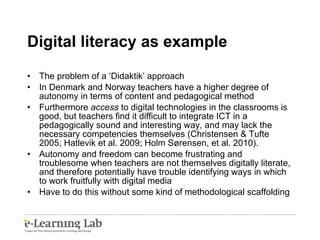
Digital literacy as example The problem of a ‘Didaktik’ approach In Denmark and Norway teachers have a higher degree of autonomy in terms of content and pedagogical method Furthermore  access  to digital technologies in the classrooms is good, but teachers find it difficult to integrate ICT in a pedagogically sound and interesting way, and may lack the necessary competencies themselves (Christensen & Tufte 2005; Hatlevik et al. 2009; Holm Sørensen, et al. 2010). Autonomy and freedom can become frustrating and troublesome when teachers are not themselves digitally literate, and therefore potentially have trouble identifying ways in which to work fruitfully with digital media  Have to do this without some kind of methodological scaffolding
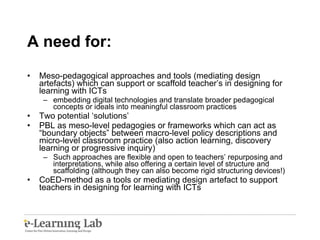
A need for: Meso-pedagogical approaches and tools (mediating design artefacts) which can support or scaffold teacher’s in designing for learning with ICTs embedding digital technologies and translate broader pedagogical concepts or ideals into meaningful classroom practices Two potential ‘solutions’  PBL as meso-level pedagogies or frameworks which can act as “boundary objects” between macro-level policy descriptions and micro-level classroom practice (also action learning, discovery learning or progressive inquiry) Such approaches are flexible and open to teachers’ repurposing and interpretations, while also offering a certain level of structure and scaffolding (although they can also become rigid structuring devices!) CoED-method as a tools or mediating design artefact to support teachers in designing for learning with ICTs
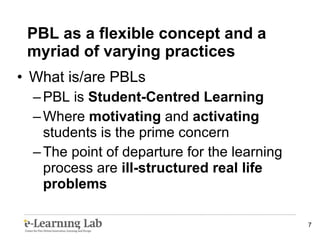
What is/are PBLs PBL is  Student-Centred Learning Where  motivating  and  activating  students is the prime concern The point of departure for the learning process are  ill-structured real life problems PBL as a flexible concept and a myriad of varying practices
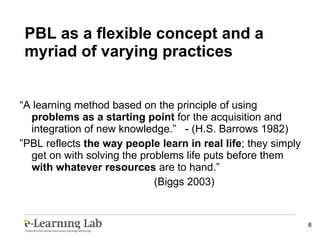
“ A learning method based on the principle of using  problems as a starting point  for the acquisition and integration of new knowledge.”  - (H.S. Barrows 1982) ” PBL reflects  the way people learn in real life ; they simply get on with solving the problems life puts before them  with whatever resources  are to hand.” (Biggs 2003) PBL as a flexible concept and a myriad of varying practices
“… . problem-based learning helps students to see that  learning and life take place in contexts , contexts that affect the kinds of solutions that are available and possible.” (Savin-Baden, 2003) ” Problem based learning is a pedagogical strategy for posing significant,  contextualised, real world situations , and providing resources, guidance and instruction to learners as they develop content knowledge and problem-solving skills” (Mayo et. Al., 1993) PBL as a flexible concept and a myriad of varying practices
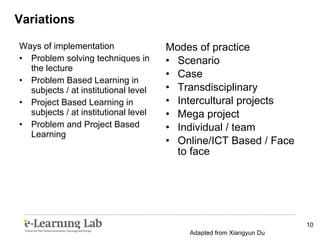
Variations Ways of implementation  Problem solving techniques in the lecture Problem Based Learning in subjects / at institutional level  Project Based Learning in subjects / at institutional level Problem and Project Based Learning Modes of practice Scenario Case Transdisciplinary  Intercultural projects Mega project Individual / team  Online/ICT Based / Face to face  Adapted from Xiangyun Du
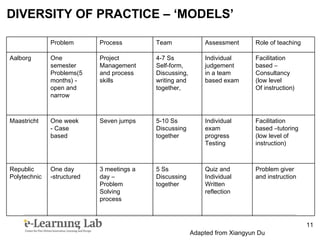
DIVERSITY OF PRACTICE – ‘MODELS’ Adapted from Xiangyun Du Problem  Process Team Assessment  Role of teaching Aalborg  One semester  Problems(5 months) -  open and narrow Project Management and process skills 4-7 Ss Self-form, Discussing, writing and together, Individual judgement in a team based exam Facilitation based – Consultancy (low level  Of instruction)  Maastricht  One week - Case based  Seven jumps 5-10 Ss Discussing together Individual exam  progress Testing Facilitation based –tutoring  (low level of instruction) Republic Polytechnic One day  -structured  3 meetings a day – Problem Solving process 5 Ss Discussing together Quiz and Individual Written reflection  Problem giver and instruction
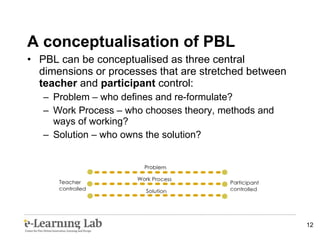
A conceptualisation of PBL PBL can be conceptualised as three central dimensions or processes that are stretched between  teacher  and  participant  control: Problem – who defines and re-formulate? Work Process – who chooses theory, methods and ways of working? Solution – who owns the solution?
Other central points of distinction The extension of the ’problem based learning’ process – a day? Weeks? Months? PBL as an Instructional method vs PBL as curriculum Type of work – collaboration or cooperation Level of implementation? Class Course (one problem pr. lecture, one problem throughout, other?) Institutional/curricular implementation
Hands on-tool for teacher involvement in design processes Marianne Georgsen Nov. 26th 2010
A tool for reflection Our problem: Teaching is culturally (contextually) sensitive There is no perfect match between choice of technology and learning support Designing for learning is a complex activity But our partners couldn’t see it…!
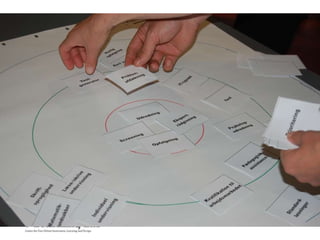
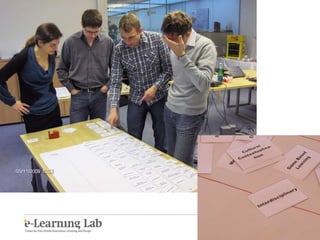
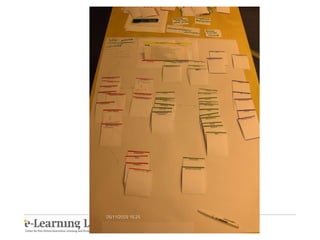
Our solution We planned activities with our partners, aiming to raise their awareness about these issues (hoping to be able to discuss the matter) We designed a hands on-tool for the participants: to help address the assumptions about teaching and learning to initiate discussions (negotian of meaning) about what is (most) important
The result of our work We helped the participant to design culturally sensitive learning modules The project teams managed to come up with designs for their own cases (and they liked them too) We developed tool we have since used in many other situations – and other people have started using it too AND We created a new set of problems/questions for ourselves (and you – please…) to work with
Collaborative e-learning Design Method CoED aims to support domain, qualification level and subject experts in designing targeted e-learning and education CoED brings focus and structure to the early stages of the design process CoED aims to develop design specifications and/or early prototypes within few hours of work Learn@Work-project (Georgsen & Nyvang, 2007)
The foundations for CoED Systems development – because we design (for the use of) ICT Participatory design Iterative development Collaborative learning – because we design for learning and learn in the design process Enabling knowledge creation Facilitate negotions of meaning Facilitating creative processes – because the aim is to develop something new Future workshops Rapid prototyping
5 principles of CoED Facilitate conversations about e-learning design Structure conversations about e-learning design Produce design specifications and/or actual designs rapidly Involve e-learning experts, domain specialists and future users of the e-learning design  Involve at least two people in the design process
 
3 Phases  Focus the e-learning design process 2.  Identify ideals of teaching/learning which will serve as your design principles 3. Specify design
 
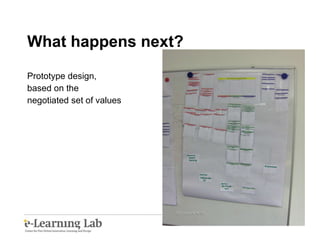
What happens next? Prototype design, based on the  negotiated set of values
 
Hands on Groups of 3-5 The goal is to identify – through discussion – your ideals and values in teaching and/or learning What should your design support… The methodology is card sorting The rules are strict And you are creative, innovative people… Work for 30 minutes in total
Design task Negotiate the values for a: PBL project/problem based learning scenario for 7th grade students (13-14 old) lasting for one week (24/7). (you might also need to think about / discuss the practical organisation) They are to produce an online newspaper and write articles for the newspaper The scenario includes that they will need to learn:  How to use various tools for publishing (blogs, HTML, webpage-editor) About critical digital literacies (reliability of sources, information search, bias) What are the central pedagogical ideals for you as the ’teacher team’  Other things to think about: How are task and responsilities distributed between teachers/students? How are they to collaborate? How should technologies be used e.g for collaboration and production – how should they be introduced
New research questions… How can we s uccesfully communicat e  the results of the design workshop to relevant actors ? How can we carry the design ”back into” the institution and hold on to the ideals formulated by the participants? In what way is this really a tool for empowerment – what are the relevant issues to watch in connection with implementing the design/developing tools and technologies for teaching and learning?
 
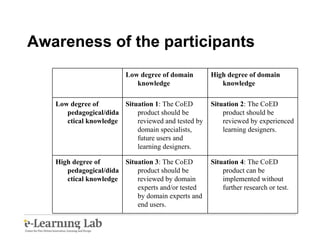
Awareness of the participants Low degree of domain knowledge High degree of domain knowledge Low degree of pedagogical/didactical knowledge Situation 1 : The CoED product should be reviewed and tested by domain specialists, future users and learning designers. Situation 2 : The CoED product should be reviewed by experienced learning designers. High degree of pedagogical/didactical knowledge Situation 3 : The CoED product should be reviewed by domain experts and/or tested by domain experts and end users. Situation 4 : The CoED product can be implemented without further research or test.

Nordforsk - meso-pedagogy and tools.ppt

  • 1.
    Teaching with technologies- tools for empowering teachers - PBL as a meso-pedagogy Marianne Georgsen Thomas Ryberg E-Learning Lab – center for user driven innovation, learning and design Department of communication and psychology – Aalborg University
  • 2.
    Outline Meso-pedagogies asa concept PBL as a Meso-pedagogy Design tools (mediating design artefacts) to empower teachers – Collaborative E-learning Design method (CoED) Workshop – you design  Summing up and discussing The notion of PBL as a meso-pedagogy is explored in a forthcoming paper: Ryberg & Georgsen (in press): Enabling Digital Literacy - Development of Meso-Level Pedagogical Approaches. Nordic Journal of Digital Literacy
  • 3.
    Meso-pedagogies Meso-pedagogies arepedagogical concepts, methods and tools that sit in-between: A macro-level or policy level definition of ’good practice’ and a micro-level of teachers’ actual (often idiosyncratic) practices Highlights differences and hopefully mediate between a ’curriculum’ and a ’didaktik’ approach In a ’curriculum’ approach the teacher carries out or enacts the plans made by others (higher-level) In a ’didaktik’ approach teachers have a higher degree of autonomy in terms of content and pedagogical method The two models imply different problems in terms of teachers’ adoption of technologies for learning
  • 4.
    Digital literacy asexample The problem of a Curricular strategy: Some of the definitions and frameworks for digital literacy are what Lankshear & Knobel (2006) term “standardized operationalizations” of digital literacy These are detailed, prescriptive list of ‘ digital literacy’ chunks (information search, decoding images etc.) in danger of alienating or marginalizing teachers by imposing curricular limitations onto classroom teaching Overlook the more organic and composite nature of what it is to work meaningfully with digital media Isolated ’task oriented’ chunks rather organic parts of different activites “ Writing a doctoral thesis is a radically different practice from writing a shopping list. […] To think of these practices as different manifestations of some «thing» called literacy is like thinking of building a bridge and building a warehouse as different manifestations of mixing cement.” (Lankshear & Knobel 2006, p. 17)
  • 5.
    Digital literacy asexample The problem of a ‘Didaktik’ approach In Denmark and Norway teachers have a higher degree of autonomy in terms of content and pedagogical method Furthermore access to digital technologies in the classrooms is good, but teachers find it difficult to integrate ICT in a pedagogically sound and interesting way, and may lack the necessary competencies themselves (Christensen & Tufte 2005; Hatlevik et al. 2009; Holm Sørensen, et al. 2010). Autonomy and freedom can become frustrating and troublesome when teachers are not themselves digitally literate, and therefore potentially have trouble identifying ways in which to work fruitfully with digital media Have to do this without some kind of methodological scaffolding
  • 6.
    A need for:Meso-pedagogical approaches and tools (mediating design artefacts) which can support or scaffold teacher’s in designing for learning with ICTs embedding digital technologies and translate broader pedagogical concepts or ideals into meaningful classroom practices Two potential ‘solutions’ PBL as meso-level pedagogies or frameworks which can act as “boundary objects” between macro-level policy descriptions and micro-level classroom practice (also action learning, discovery learning or progressive inquiry) Such approaches are flexible and open to teachers’ repurposing and interpretations, while also offering a certain level of structure and scaffolding (although they can also become rigid structuring devices!) CoED-method as a tools or mediating design artefact to support teachers in designing for learning with ICTs
  • 7.
    What is/are PBLsPBL is Student-Centred Learning Where motivating and activating students is the prime concern The point of departure for the learning process are ill-structured real life problems PBL as a flexible concept and a myriad of varying practices
  • 8.
    “ A learningmethod based on the principle of using problems as a starting point for the acquisition and integration of new knowledge.” - (H.S. Barrows 1982) ” PBL reflects the way people learn in real life ; they simply get on with solving the problems life puts before them with whatever resources are to hand.” (Biggs 2003) PBL as a flexible concept and a myriad of varying practices
  • 9.
    “… . problem-basedlearning helps students to see that learning and life take place in contexts , contexts that affect the kinds of solutions that are available and possible.” (Savin-Baden, 2003) ” Problem based learning is a pedagogical strategy for posing significant, contextualised, real world situations , and providing resources, guidance and instruction to learners as they develop content knowledge and problem-solving skills” (Mayo et. Al., 1993) PBL as a flexible concept and a myriad of varying practices
  • 10.
    Variations Ways ofimplementation Problem solving techniques in the lecture Problem Based Learning in subjects / at institutional level Project Based Learning in subjects / at institutional level Problem and Project Based Learning Modes of practice Scenario Case Transdisciplinary Intercultural projects Mega project Individual / team Online/ICT Based / Face to face Adapted from Xiangyun Du
  • 11.
    DIVERSITY OF PRACTICE– ‘MODELS’ Adapted from Xiangyun Du Problem Process Team Assessment Role of teaching Aalborg One semester Problems(5 months) - open and narrow Project Management and process skills 4-7 Ss Self-form, Discussing, writing and together, Individual judgement in a team based exam Facilitation based – Consultancy (low level Of instruction) Maastricht One week - Case based Seven jumps 5-10 Ss Discussing together Individual exam progress Testing Facilitation based –tutoring (low level of instruction) Republic Polytechnic One day -structured 3 meetings a day – Problem Solving process 5 Ss Discussing together Quiz and Individual Written reflection Problem giver and instruction
  • 12.
    A conceptualisation ofPBL PBL can be conceptualised as three central dimensions or processes that are stretched between teacher and participant control: Problem – who defines and re-formulate? Work Process – who chooses theory, methods and ways of working? Solution – who owns the solution?
  • 13.
    Other central pointsof distinction The extension of the ’problem based learning’ process – a day? Weeks? Months? PBL as an Instructional method vs PBL as curriculum Type of work – collaboration or cooperation Level of implementation? Class Course (one problem pr. lecture, one problem throughout, other?) Institutional/curricular implementation
  • 14.
    Hands on-tool forteacher involvement in design processes Marianne Georgsen Nov. 26th 2010
  • 15.
    A tool forreflection Our problem: Teaching is culturally (contextually) sensitive There is no perfect match between choice of technology and learning support Designing for learning is a complex activity But our partners couldn’t see it…!
  • 16.
    Our solution Weplanned activities with our partners, aiming to raise their awareness about these issues (hoping to be able to discuss the matter) We designed a hands on-tool for the participants: to help address the assumptions about teaching and learning to initiate discussions (negotian of meaning) about what is (most) important
  • 17.
    The result ofour work We helped the participant to design culturally sensitive learning modules The project teams managed to come up with designs for their own cases (and they liked them too) We developed tool we have since used in many other situations – and other people have started using it too AND We created a new set of problems/questions for ourselves (and you – please…) to work with
  • 18.
    Collaborative e-learning DesignMethod CoED aims to support domain, qualification level and subject experts in designing targeted e-learning and education CoED brings focus and structure to the early stages of the design process CoED aims to develop design specifications and/or early prototypes within few hours of work Learn@Work-project (Georgsen & Nyvang, 2007)
  • 19.
    The foundations forCoED Systems development – because we design (for the use of) ICT Participatory design Iterative development Collaborative learning – because we design for learning and learn in the design process Enabling knowledge creation Facilitate negotions of meaning Facilitating creative processes – because the aim is to develop something new Future workshops Rapid prototyping
  • 20.
    5 principles ofCoED Facilitate conversations about e-learning design Structure conversations about e-learning design Produce design specifications and/or actual designs rapidly Involve e-learning experts, domain specialists and future users of the e-learning design Involve at least two people in the design process
  • 21.
  • 22.
    3 Phases Focus the e-learning design process 2. Identify ideals of teaching/learning which will serve as your design principles 3. Specify design
  • 23.
  • 24.
    What happens next?Prototype design, based on the negotiated set of values
  • 25.
  • 26.
    Hands on Groupsof 3-5 The goal is to identify – through discussion – your ideals and values in teaching and/or learning What should your design support… The methodology is card sorting The rules are strict And you are creative, innovative people… Work for 30 minutes in total
  • 27.
    Design task Negotiatethe values for a: PBL project/problem based learning scenario for 7th grade students (13-14 old) lasting for one week (24/7). (you might also need to think about / discuss the practical organisation) They are to produce an online newspaper and write articles for the newspaper The scenario includes that they will need to learn: How to use various tools for publishing (blogs, HTML, webpage-editor) About critical digital literacies (reliability of sources, information search, bias) What are the central pedagogical ideals for you as the ’teacher team’ Other things to think about: How are task and responsilities distributed between teachers/students? How are they to collaborate? How should technologies be used e.g for collaboration and production – how should they be introduced
  • 28.
    New research questions…How can we s uccesfully communicat e the results of the design workshop to relevant actors ? How can we carry the design ”back into” the institution and hold on to the ideals formulated by the participants? In what way is this really a tool for empowerment – what are the relevant issues to watch in connection with implementing the design/developing tools and technologies for teaching and learning?
  • 29.
  • 30.
    Awareness of theparticipants Low degree of domain knowledge High degree of domain knowledge Low degree of pedagogical/didactical knowledge Situation 1 : The CoED product should be reviewed and tested by domain specialists, future users and learning designers. Situation 2 : The CoED product should be reviewed by experienced learning designers. High degree of pedagogical/didactical knowledge Situation 3 : The CoED product should be reviewed by domain experts and/or tested by domain experts and end users. Situation 4 : The CoED product can be implemented without further research or test.

Editor's Notes

  • #16 Tool developed to initiate reflection: In 2006 we were working in a development project with a lack of understanding of the complexity of designing for learning This tool was developed so we could find a way to introduce discussion and negotians into the process – the predominant understanding was that there was a give solution, a ”one size fit all”-product. As we didn’t agree with this, we needed a way of illustrating what is at stake when you design for learning – most importantly we were looking for a way of working with the assumptions educators have about what good learning and good teaching is.