Research methodologies in
Technology Enhanced Learning
Prof. Yannis Dimitriadis
GSIC/EMIC research group
University of Valladolid
May 12, 2015
Univ. of Patras,
Patras, Greece
Doctoral student seminar
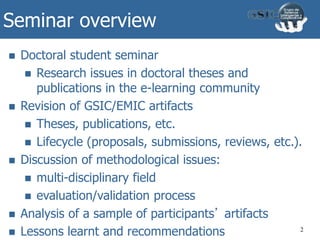
Seminar overview
2
 Doctoral student seminar
 Research issues in doctoral theses and
publications in the e-learning community
 Revision of GSIC/EMIC artifacts
 Theses, publications, etc.
 Lifecycle (proposals, submissions, reviews, etc.).
 Discussion of methodological issues:
 multi-disciplinary field
 evaluation/validation process
 Analysis of a sample of participants’ artifacts
 Lessons learnt and recommendations
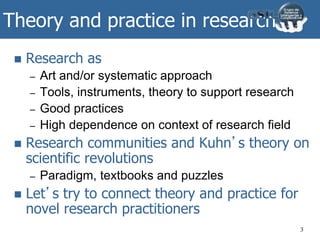
Theory and practice in research
 Research as
– Art and/or systematic approach
– Tools, instruments, theory to support research
– Good practices
– High dependence on context of research field
 Research communities and Kuhn’s theory on
scientific revolutions
– Paradigm, textbooks and puzzles
 Let’s try to connect theory and practice for
novel research practitioners
3
Research communities
 Local vs. global level
– The need for a productive interaction
 Individual vs. global perspective
– The researcher as an individual
 The role of peer review in research communities
– Why citations are so important!
 Types of research artifacts and forae
– Journals, conferences, workshops
– Proposals and final artifacts
– Science in action according to Latour
4
An exercise with the TEL field
 A matter of terminology?
– “TEL”, “New technologies in education” , “e-
learning”
– Where is the focus?
– What are the instruments for research?
 Define a concept map for TEL field and
community
– Actors, trends, methods
– Static and dynamic view
– Think of an example and associated literature
– Connect with your own (even limited) experience
5
Few GSIC/EMIC examples
 Material available at Dropbox:
– https://www.dropbox.com/sh/rfp8z0itsdunich/AABezAXWd-
ipGc2yCCvjjW_-a?dl=0
 The life of a paper: From ICALT 2004 to ETS 2005
– Seminar
 Davinia Hernández (2007)
– Thesis (proposed and submitted)
 Luis Pablo Prieto (2012)
– Thesis (submitted)
 Juan Alberto Muñoz (2015)
– Thesis (submitted)
6
The life of a paper:
From ICALT 2004 to ETS 2005
 Bad reviews are still bad, even if they are
positive and lead to a best paper award:
– Reviewer2: Fine
– Reviewer3: Very interesting, thank you!
 Some conference papers may lead to journal
special issues
– No guarantee for an automatic paper “upgrade”
 A good review process is probably the best
research dialogue on a topic
7
The life of a paper:
From ICALT 2004 to ETS 2005
 Some interesting reviewer notes:
– “but this proposal has not been implemented yet
and, consequently, has not been empirically
evaluated”
– “The theoretical foundations and related theories
need to be weaved into their discussion…”
– “They make a number of claims but …. they do
not demonstrate the feasibility and utility of their
approach from the point of view of educators”
8
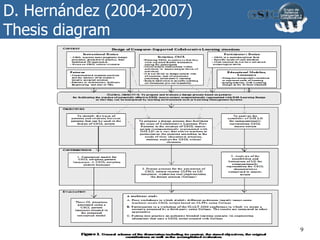
D. Hernández (2004-2007)
Thesis diagram
9
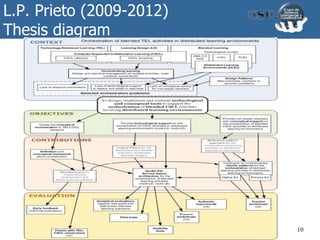
L.P. Prieto (2009-2012)
Thesis diagram
10
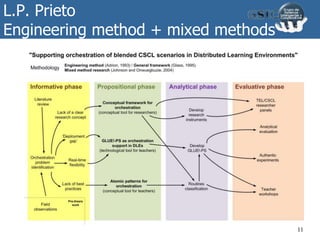
L.P. Prieto
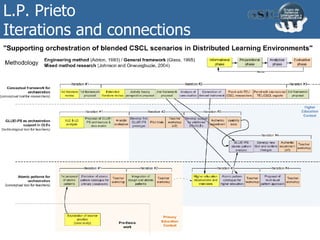
Engineering method + mixed methods
11
L.P. Prieto
Iterations and connections
12
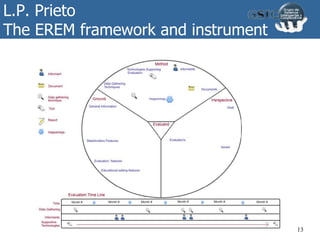
L.P. Prieto
The EREM framework and instrument
13
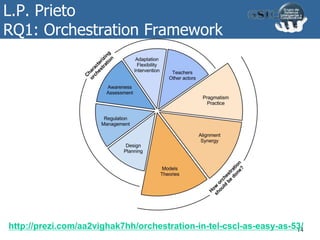
L.P. Prieto
RQ1: Orchestration Framework
14http://prezi.com/aa2vighak7hh/orchestration-in-tel-cscl-as-easy-as-53/
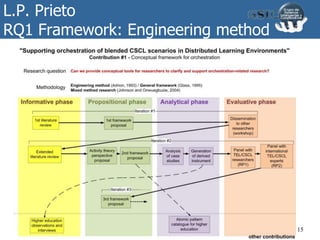
L.P. Prieto
RQ1 Framework: Engineering method
15
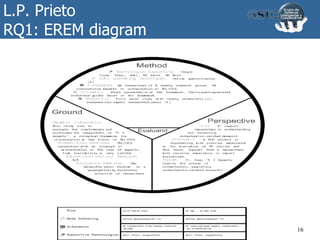
L.P. Prieto
RQ1: EREM diagram
16
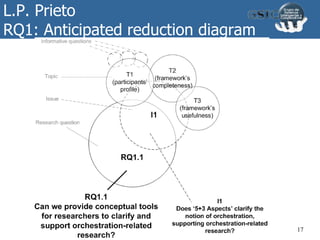
L.P. Prieto
RQ1: Anticipated reduction diagram
17
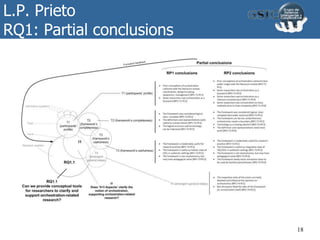
L.P. Prieto
RQ1: Partial conclusions
18
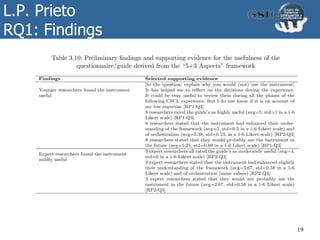
L.P. Prieto
RQ1: Findings
19
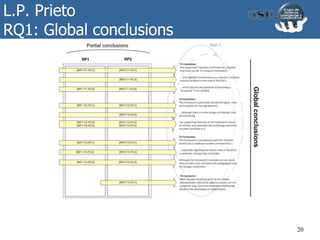
L.P. Prieto
RQ1: Global conclusions
20
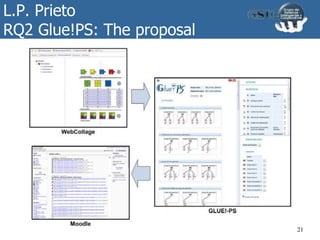
L.P. Prieto
RQ2 Glue!PS: The proposal
21
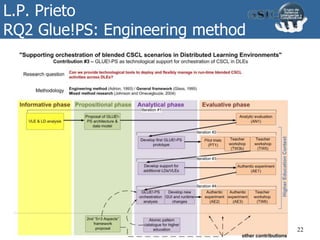
L.P. Prieto
RQ2 Glue!PS: Engineering method
22
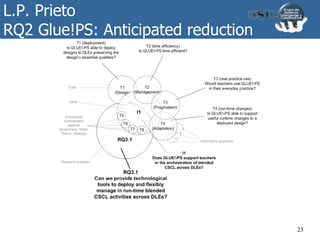
L.P. Prieto
RQ2 Glue!PS: Anticipated reduction
23
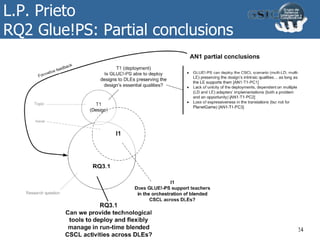
L.P. Prieto
RQ2 Glue!PS: Partial conclusions
24
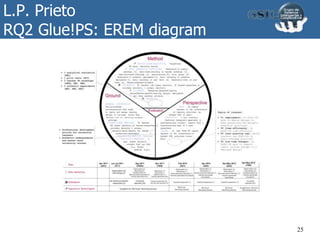
L.P. Prieto
RQ2 Glue!PS: EREM diagram
25
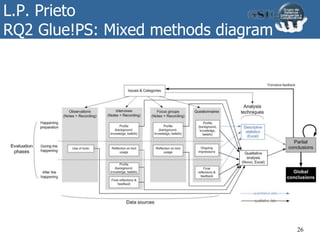
L.P. Prieto
RQ2 Glue!PS: Mixed methods diagram
26
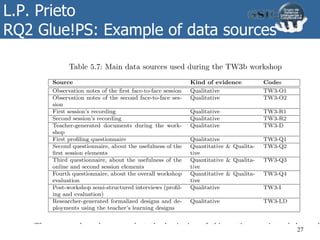
L.P. Prieto
RQ2 Glue!PS: Example of data sources
27
L.P. Prieto
RQ2 Glue!PS: Some findings
28
L.P. Prieto
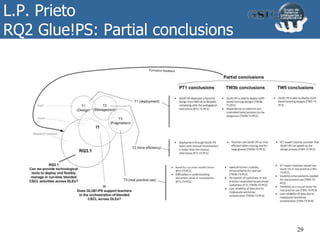
RQ2 Glue!PS: Partial conclusions
29
L.P. Prieto
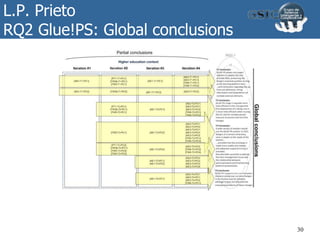
RQ2 Glue!PS: Global conclusions
30
M.J. Rodríguez (2010-2014)
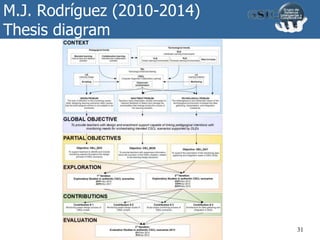
Thesis diagram
31
M.J. Rodríguez
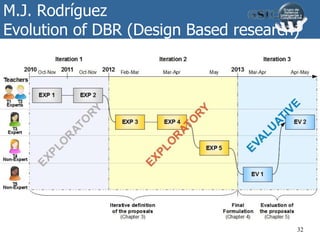
Evolution of DBR (Design Based research)
32
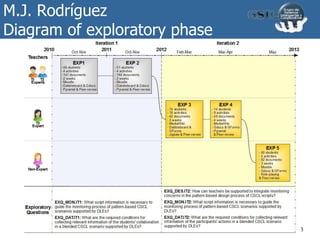
M.J. Rodríguez
Diagram of exploratory phase
33
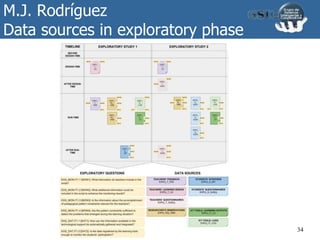
M.J. Rodríguez
Data sources in exploratory phase
34
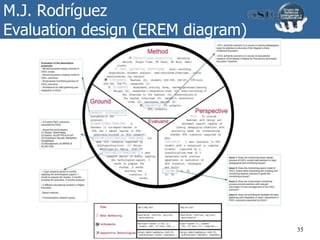
M.J. Rodríguez
Evaluation design (EREM diagram)
35
J.A. Muñoz:
Some notes on methodology (I)
 Pay special attention to Section 1.2 of thesis:
– It contains a very comprehensive account of the main
research issues
– “Those were my assumptions about the world and the
knowledge. In other words, those were my ontological and
epistemological believes.”
– “I considered problematic to assume the objectivity and
the independence of the researcher and the phenomenon
explored”
– Finally, the research approach followed … is interpretive,
since I consider it matches well with the phenomenon
investigated (the orchestration problem for teachers … )
and its context (persons and organizations of persons)36
J.A. Muñoz:
Some notes on methodology (II)
 EREM - anticipatory data reduction schemes
– “We considered EREM very appropriate due to the
guidance and help that the framework provides to novel
evaluators … Examples are the different conceptual tools,
such as an evaluation design diagram, or a multimedia
collaborative report”
– “anticipatory data reduction process to explore the
research question, creating a schema of “research
question – issue – topics – informative questions”. Thus,
we defined issues as the main conceptual organizers of
the evaluation process. Such issues were divided into
more concrete topics to help us understand the different
dimensions within the issues. ... each topic was explored
through various informative questions” 37
J.A. Muñoz:
Some notes on methodology (III)
 Anticipatory data reduction and coding issues
– anticipatory data reduction schema was used as an
initial category tree for the process of coding, therefore
using a dominantly deductive a-priory approach for the
creation of an initial set of codes
– we consider a single-coder sufficient, given the
interpretive nature of the study, the dominantly deductive
approach (with a predetermined and agreed initial
category tree), and the fact that we do not aim to measure,
quantify, obtain statistical significant results or find
relations between variables, but rather make sense of the
participants perceptions and experiences
38
J.A. Muñoz:
Some notes on methodology (IV)
 Interpretive research and its strategies
– in interpretive research, the notions of reliability,
internal/external validity and objectivity used in positivist
approaches to assure the quality of a research are
replaced with the notions of dependability, credibility,
transferability and confirmability
– The strategies to comply with these criteria from an
interpretive perspective are very different from the ones
used to ensure quality in a positivist research, and include
(among others) long permanence in the field, use of
multiple data gathering techniques, use of deep
descriptions, member checking, etc.
39
J.A. Muñoz:
Some notes on methodology (V)
 Some strategies:
– prolonged engagement during months of work with the different
teachers and persistent observation in the field;
– member checking, obtaining feedback from the informants about the
data and the interpretations;
– acknowledgement of participant opinions, by interviewing the
teachers and by analyzing teachers’ and students’ reflections;
– integration of the thorough collaborative observation reports in a
single portfolio, thus enabling a thick description of the phenomenon
under scrutiny, reported in detail to the whole evaluation team;
– peer review within the evaluation team to avoid bias;
– exploration of the systems in different educational contexts;
– triangulation of data source, methods and researchers to cross-
check data and interpretations.
40
Some lessons learnt (I)
 Think well of the publication forum
 Consider the community paradigm
 Define well and clearly the research question
 Think of originality, feasibility, relevance
 Do not “forget” the literature
 Provide sound methodological “position”
 Synthesize results (tables, diagrams)
 Try out peer review
 Check for plagiarism and acknowledgements41
Some lessons learnt (II)
 Use visual research instruments (thesis
diagram, phases of DBR, etc.)
 Define approach and techniques
 Use them well (e.g. triangulate)
 A system by itself is not enough
 Collect empirical data and synthesize well
 Interact with the community, use social
events
 The “hill metaphor” and “Ithaki”
42

Yannis@patras seminar a_20150512a

  • 1.
    Research methodologies in TechnologyEnhanced Learning Prof. Yannis Dimitriadis GSIC/EMIC research group University of Valladolid May 12, 2015 Univ. of Patras, Patras, Greece Doctoral student seminar
  • 2.
    Seminar overview 2  Doctoralstudent seminar  Research issues in doctoral theses and publications in the e-learning community  Revision of GSIC/EMIC artifacts  Theses, publications, etc.  Lifecycle (proposals, submissions, reviews, etc.).  Discussion of methodological issues:  multi-disciplinary field  evaluation/validation process  Analysis of a sample of participants’ artifacts  Lessons learnt and recommendations
  • 3.
    Theory and practicein research  Research as – Art and/or systematic approach – Tools, instruments, theory to support research – Good practices – High dependence on context of research field  Research communities and Kuhn’s theory on scientific revolutions – Paradigm, textbooks and puzzles  Let’s try to connect theory and practice for novel research practitioners 3
  • 4.
    Research communities  Localvs. global level – The need for a productive interaction  Individual vs. global perspective – The researcher as an individual  The role of peer review in research communities – Why citations are so important!  Types of research artifacts and forae – Journals, conferences, workshops – Proposals and final artifacts – Science in action according to Latour 4
  • 5.
    An exercise withthe TEL field  A matter of terminology? – “TEL”, “New technologies in education” , “e- learning” – Where is the focus? – What are the instruments for research?  Define a concept map for TEL field and community – Actors, trends, methods – Static and dynamic view – Think of an example and associated literature – Connect with your own (even limited) experience 5
  • 6.
    Few GSIC/EMIC examples Material available at Dropbox: – https://www.dropbox.com/sh/rfp8z0itsdunich/AABezAXWd- ipGc2yCCvjjW_-a?dl=0  The life of a paper: From ICALT 2004 to ETS 2005 – Seminar  Davinia Hernández (2007) – Thesis (proposed and submitted)  Luis Pablo Prieto (2012) – Thesis (submitted)  Juan Alberto Muñoz (2015) – Thesis (submitted) 6
  • 7.
    The life ofa paper: From ICALT 2004 to ETS 2005  Bad reviews are still bad, even if they are positive and lead to a best paper award: – Reviewer2: Fine – Reviewer3: Very interesting, thank you!  Some conference papers may lead to journal special issues – No guarantee for an automatic paper “upgrade”  A good review process is probably the best research dialogue on a topic 7
  • 8.
    The life ofa paper: From ICALT 2004 to ETS 2005  Some interesting reviewer notes: – “but this proposal has not been implemented yet and, consequently, has not been empirically evaluated” – “The theoretical foundations and related theories need to be weaved into their discussion…” – “They make a number of claims but …. they do not demonstrate the feasibility and utility of their approach from the point of view of educators” 8
  • 9.
  • 10.
  • 11.
  • 12.
  • 13.
    L.P. Prieto The EREMframework and instrument 13
  • 14.
    L.P. Prieto RQ1: OrchestrationFramework 14http://prezi.com/aa2vighak7hh/orchestration-in-tel-cscl-as-easy-as-53/
  • 15.
    L.P. Prieto RQ1 Framework:Engineering method 15
  • 16.
  • 17.
    L.P. Prieto RQ1: Anticipatedreduction diagram 17
  • 18.
  • 19.
  • 20.
  • 21.
    L.P. Prieto RQ2 Glue!PS:The proposal 21
  • 22.
    L.P. Prieto RQ2 Glue!PS:Engineering method 22
  • 23.
    L.P. Prieto RQ2 Glue!PS:Anticipated reduction 23
  • 24.
    L.P. Prieto RQ2 Glue!PS:Partial conclusions 24
  • 25.
    L.P. Prieto RQ2 Glue!PS:EREM diagram 25
  • 26.
    L.P. Prieto RQ2 Glue!PS:Mixed methods diagram 26
  • 27.
    L.P. Prieto RQ2 Glue!PS:Example of data sources 27
  • 28.
    L.P. Prieto RQ2 Glue!PS:Some findings 28
  • 29.
    L.P. Prieto RQ2 Glue!PS:Partial conclusions 29
  • 30.
    L.P. Prieto RQ2 Glue!PS:Global conclusions 30
  • 31.
  • 32.
    M.J. Rodríguez Evolution ofDBR (Design Based research) 32
  • 33.
    M.J. Rodríguez Diagram ofexploratory phase 33
  • 34.
    M.J. Rodríguez Data sourcesin exploratory phase 34
  • 35.
  • 36.
    J.A. Muñoz: Some noteson methodology (I)  Pay special attention to Section 1.2 of thesis: – It contains a very comprehensive account of the main research issues – “Those were my assumptions about the world and the knowledge. In other words, those were my ontological and epistemological believes.” – “I considered problematic to assume the objectivity and the independence of the researcher and the phenomenon explored” – Finally, the research approach followed … is interpretive, since I consider it matches well with the phenomenon investigated (the orchestration problem for teachers … ) and its context (persons and organizations of persons)36
  • 37.
    J.A. Muñoz: Some noteson methodology (II)  EREM - anticipatory data reduction schemes – “We considered EREM very appropriate due to the guidance and help that the framework provides to novel evaluators … Examples are the different conceptual tools, such as an evaluation design diagram, or a multimedia collaborative report” – “anticipatory data reduction process to explore the research question, creating a schema of “research question – issue – topics – informative questions”. Thus, we defined issues as the main conceptual organizers of the evaluation process. Such issues were divided into more concrete topics to help us understand the different dimensions within the issues. ... each topic was explored through various informative questions” 37
  • 38.
    J.A. Muñoz: Some noteson methodology (III)  Anticipatory data reduction and coding issues – anticipatory data reduction schema was used as an initial category tree for the process of coding, therefore using a dominantly deductive a-priory approach for the creation of an initial set of codes – we consider a single-coder sufficient, given the interpretive nature of the study, the dominantly deductive approach (with a predetermined and agreed initial category tree), and the fact that we do not aim to measure, quantify, obtain statistical significant results or find relations between variables, but rather make sense of the participants perceptions and experiences 38
  • 39.
    J.A. Muñoz: Some noteson methodology (IV)  Interpretive research and its strategies – in interpretive research, the notions of reliability, internal/external validity and objectivity used in positivist approaches to assure the quality of a research are replaced with the notions of dependability, credibility, transferability and confirmability – The strategies to comply with these criteria from an interpretive perspective are very different from the ones used to ensure quality in a positivist research, and include (among others) long permanence in the field, use of multiple data gathering techniques, use of deep descriptions, member checking, etc. 39
  • 40.
    J.A. Muñoz: Some noteson methodology (V)  Some strategies: – prolonged engagement during months of work with the different teachers and persistent observation in the field; – member checking, obtaining feedback from the informants about the data and the interpretations; – acknowledgement of participant opinions, by interviewing the teachers and by analyzing teachers’ and students’ reflections; – integration of the thorough collaborative observation reports in a single portfolio, thus enabling a thick description of the phenomenon under scrutiny, reported in detail to the whole evaluation team; – peer review within the evaluation team to avoid bias; – exploration of the systems in different educational contexts; – triangulation of data source, methods and researchers to cross- check data and interpretations. 40
  • 41.
    Some lessons learnt(I)  Think well of the publication forum  Consider the community paradigm  Define well and clearly the research question  Think of originality, feasibility, relevance  Do not “forget” the literature  Provide sound methodological “position”  Synthesize results (tables, diagrams)  Try out peer review  Check for plagiarism and acknowledgements41
  • 42.
    Some lessons learnt(II)  Use visual research instruments (thesis diagram, phases of DBR, etc.)  Define approach and techniques  Use them well (e.g. triangulate)  A system by itself is not enough  Collect empirical data and synthesize well  Interact with the community, use social events  The “hill metaphor” and “Ithaki” 42