PROBLEM/
PROJECT-BASED
LEARNING IN
SOCIAL STUDIES
Prepared by: Alyneth Mae S. Lawas
TOPIC OUTLINE
DEFINITION OF
PROBLEM-BASED
LEARNING
DEFINITION OF
PROJECT-BASED
LEARNING
SIMMILARITIES AND
DIFFERENCES
PROBLEM/PROJECT
BASED LEARNING IN
SOCIAL STUDIES
DEFINITION OF
PROBLEM-BASED
LEARNING
PROBLEM-BASED LEARNING
• A teaching method in which significant real-world situations are utilized as
the vehicle to facilitate student understanding of principles and concepts.
• It involves critical thinking to examine problems that lack a well-defined
answer and students are given a problem with only preliminary information
and they work towards solving the problems themselves.
• This fosters the students ’ metacognitive skills. It can provide opportunity for
collaborative work, discovering and assessing research materials, and life-
long learning.
DEFINITION OF
PROJECT-BASED
LEARNING
• A teaching method in which students learn by actively engaging in
real-world issues and creating meaningful projects that propose
solutions.
• This requires thorough planning since students are dealing with a
challenging problem or question with several potential solutions to
investigate. They also need to devise a strategy and produce a product
or artifact that addresses the problem.
• This require students to use many of their core skills including critical
thinking, teamwork, communication, empirical and quantitative analysis.
PROJECT-BASED LEARNING
DIFFERENCES
AND
SIMILARITIES
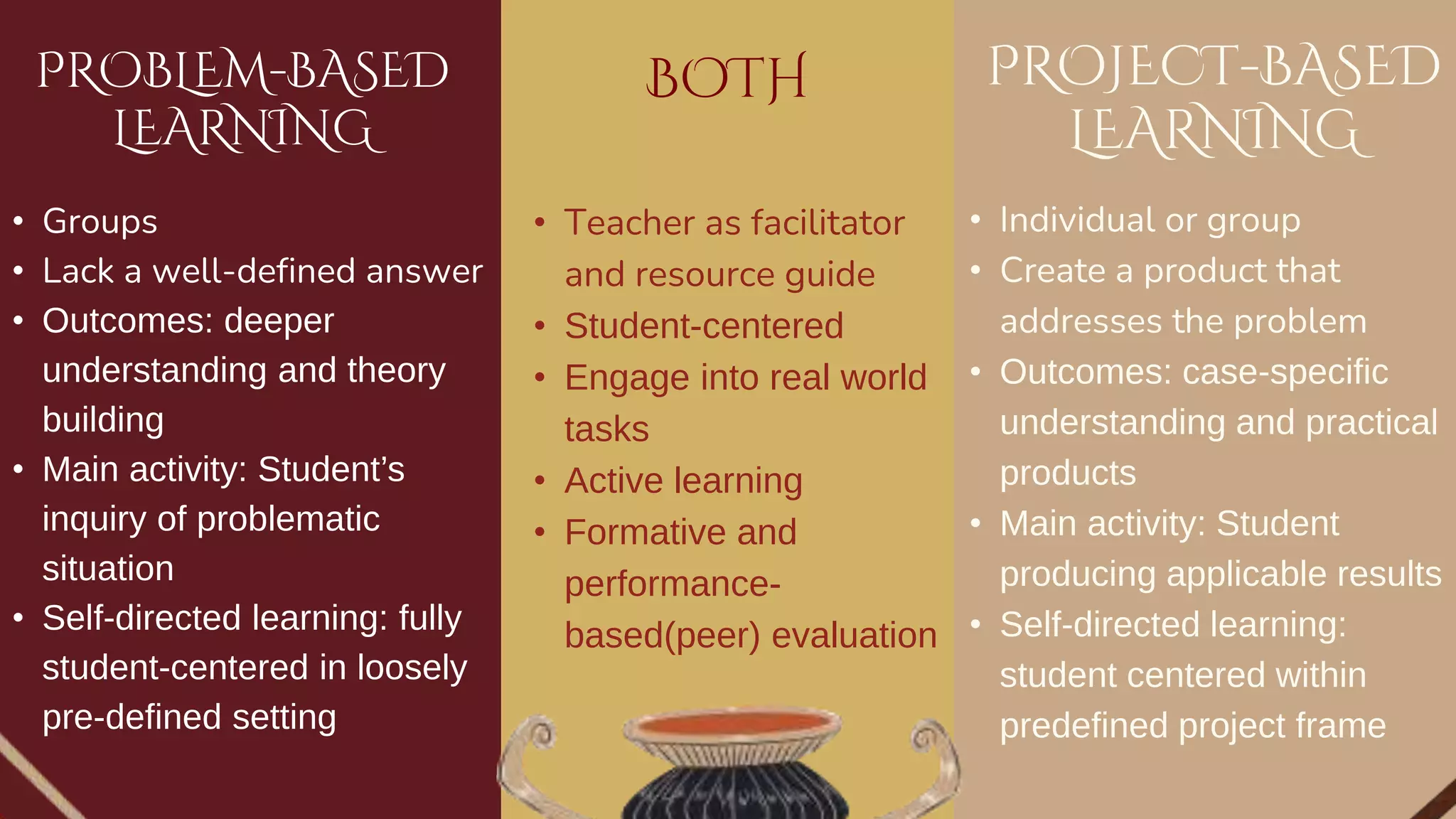
PROBLEM-BASED
LEARNING
PROJECT-BASED
LEARNING
• Individual or group
• Create a product that
addresses the problem
• Outcomes: case-specific
understanding and practical
products
• Main activity: Student
producing applicable results
• Self-directed learning:
student centered within
predefined project frame
• Groups
• Lack a well-defined answer
• Outcomes: deeper
understanding and theory
building
• Main activity: Student’s
inquiry of problematic
situation
• Self-directed learning: fully
student-centered in loosely
pre-defined setting
BOTH
• Teacher as facilitator
and resource guide
• Student-centered
• Engage into real world
tasks
• Active learning
• Formative and
performance-
based(peer) evaluation
PROBLEM/PROJECT
BASED LEARNING
IN SOCIAL STUDIES
The aim of social studies is to educate learners about the
interconnected world and the democratic society. However, in order
to comprehend our world, one must be well-versed in how to deal
with real-world issues. In social studies with problem-based
learning, students may be asked to examine specific existing societal
problems, students may work independently or self-directedly, or in
small groups. It emphasizes on the student's reflection and
reasoning in order to create and develop their own learning.
PROBLEM-BASED LEARNING
IN SOCIAL STUDIES
Integrating project-based learning into social studies that
focuses on content matter creates a compelling student-
centered learning experience. It can help students to have a clear
and depth understanding on the subject since in project-based,
learners are required to have intensive planning, to go beyond
facts and investigate societal issues with a focus on developing
solutions that can be a response to an underlying real-world
problem.
PROJECT BASED LEARNING
IN SOCIAL STUDIES
REFERENCES
Brundiers, K., & Wiek, A. (2013). Do We Teach What We Preach? An International Comparison of
Problem- and Project-Based Learning Courses in Sustainability. Sustainability, 5(4), 1725–1746.
https://doi.org/10.3390/su5041725
Duch, B. J., Groh, S. E, & Allen, D. E. (Eds.). (2001). The power of problem-based learning. Sterling,
VA: Stylus.
Hmelo-Silver, C. E. (2004). Problem-Based Learning: What and How Do Students Learn?
Educational Psychology Review, 16(3), 235–266.
https://doi.org/10.1023/b:edpr.0000034022.16470.f3
U.N.T. (n.d.). Problem-Based Learning vs. Project-Based Learning | Faculty Resource Hub. Center for
Learning Experimentation, Application, and Research Faculty Resource Hub.
https://teachingcommons.unt.edu/teaching-essentials/engaged-learning/problem-based-learning-
vs-project-based-learning
THANK YOU!
PREPARED BY: ALYNETH MAE S. LAWAS
BSED-SOCIAL STUDIES 2B

Problem and Project Based Learning in Social Studies

  • 1.
  • 2.
    TOPIC OUTLINE DEFINITION OF PROBLEM-BASED LEARNING DEFINITIONOF PROJECT-BASED LEARNING SIMMILARITIES AND DIFFERENCES PROBLEM/PROJECT BASED LEARNING IN SOCIAL STUDIES
  • 3.
  • 4.
    PROBLEM-BASED LEARNING • Ateaching method in which significant real-world situations are utilized as the vehicle to facilitate student understanding of principles and concepts. • It involves critical thinking to examine problems that lack a well-defined answer and students are given a problem with only preliminary information and they work towards solving the problems themselves. • This fosters the students ’ metacognitive skills. It can provide opportunity for collaborative work, discovering and assessing research materials, and life- long learning.
  • 5.
  • 6.
    • A teachingmethod in which students learn by actively engaging in real-world issues and creating meaningful projects that propose solutions. • This requires thorough planning since students are dealing with a challenging problem or question with several potential solutions to investigate. They also need to devise a strategy and produce a product or artifact that addresses the problem. • This require students to use many of their core skills including critical thinking, teamwork, communication, empirical and quantitative analysis. PROJECT-BASED LEARNING
  • 7.
  • 8.
    PROBLEM-BASED LEARNING PROJECT-BASED LEARNING • Individual orgroup • Create a product that addresses the problem • Outcomes: case-specific understanding and practical products • Main activity: Student producing applicable results • Self-directed learning: student centered within predefined project frame • Groups • Lack a well-defined answer • Outcomes: deeper understanding and theory building • Main activity: Student’s inquiry of problematic situation • Self-directed learning: fully student-centered in loosely pre-defined setting BOTH • Teacher as facilitator and resource guide • Student-centered • Engage into real world tasks • Active learning • Formative and performance- based(peer) evaluation
  • 9.
  • 10.
    The aim ofsocial studies is to educate learners about the interconnected world and the democratic society. However, in order to comprehend our world, one must be well-versed in how to deal with real-world issues. In social studies with problem-based learning, students may be asked to examine specific existing societal problems, students may work independently or self-directedly, or in small groups. It emphasizes on the student's reflection and reasoning in order to create and develop their own learning. PROBLEM-BASED LEARNING IN SOCIAL STUDIES
  • 11.
    Integrating project-based learninginto social studies that focuses on content matter creates a compelling student- centered learning experience. It can help students to have a clear and depth understanding on the subject since in project-based, learners are required to have intensive planning, to go beyond facts and investigate societal issues with a focus on developing solutions that can be a response to an underlying real-world problem. PROJECT BASED LEARNING IN SOCIAL STUDIES
  • 12.
    REFERENCES Brundiers, K., &Wiek, A. (2013). Do We Teach What We Preach? An International Comparison of Problem- and Project-Based Learning Courses in Sustainability. Sustainability, 5(4), 1725–1746. https://doi.org/10.3390/su5041725 Duch, B. J., Groh, S. E, & Allen, D. E. (Eds.). (2001). The power of problem-based learning. Sterling, VA: Stylus. Hmelo-Silver, C. E. (2004). Problem-Based Learning: What and How Do Students Learn? Educational Psychology Review, 16(3), 235–266. https://doi.org/10.1023/b:edpr.0000034022.16470.f3 U.N.T. (n.d.). Problem-Based Learning vs. Project-Based Learning | Faculty Resource Hub. Center for Learning Experimentation, Application, and Research Faculty Resource Hub. https://teachingcommons.unt.edu/teaching-essentials/engaged-learning/problem-based-learning- vs-project-based-learning
  • 13.
    THANK YOU! PREPARED BY:ALYNETH MAE S. LAWAS BSED-SOCIAL STUDIES 2B