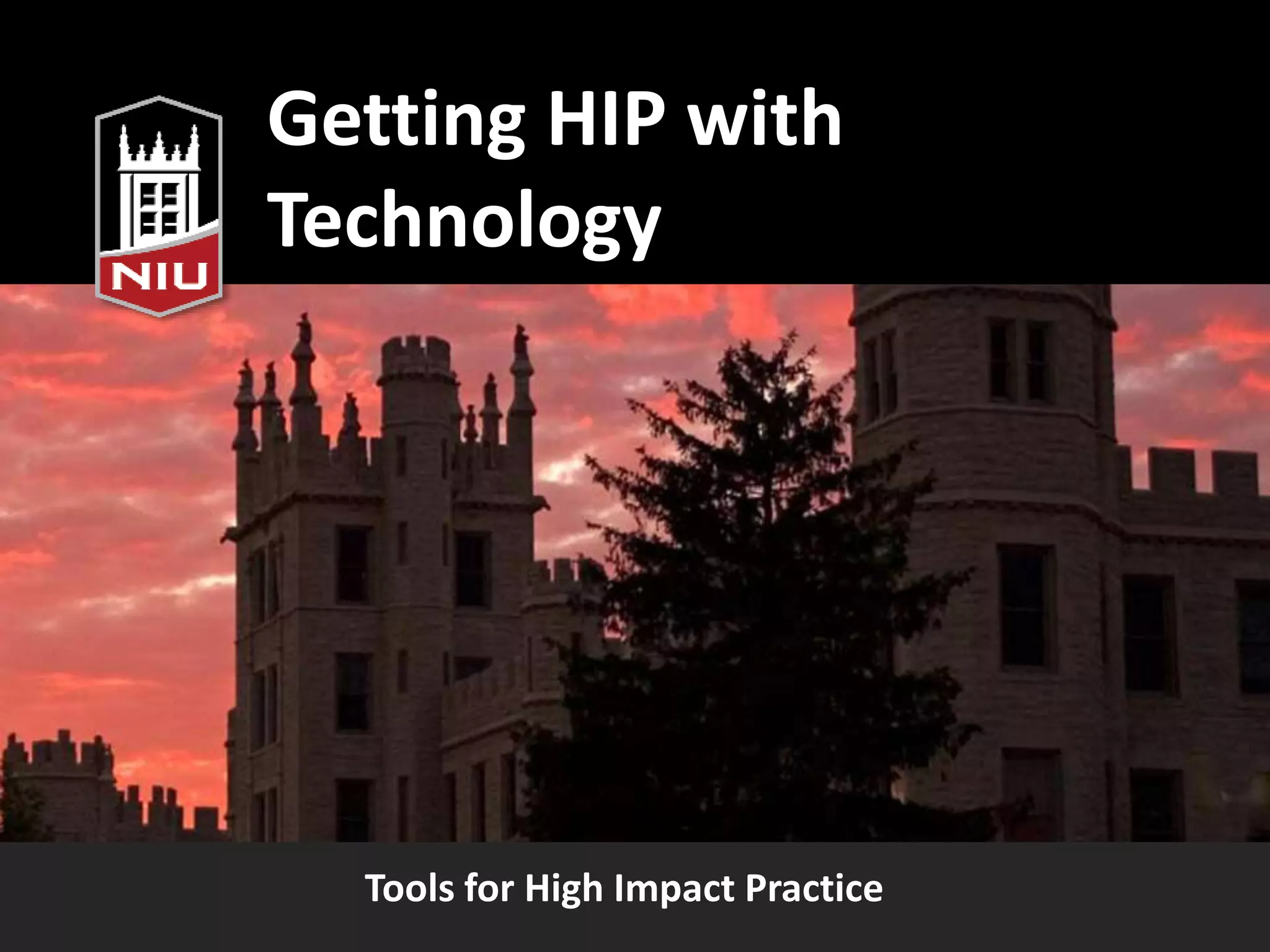

Getting HIP with
Technology
Tools for High Impact Practice
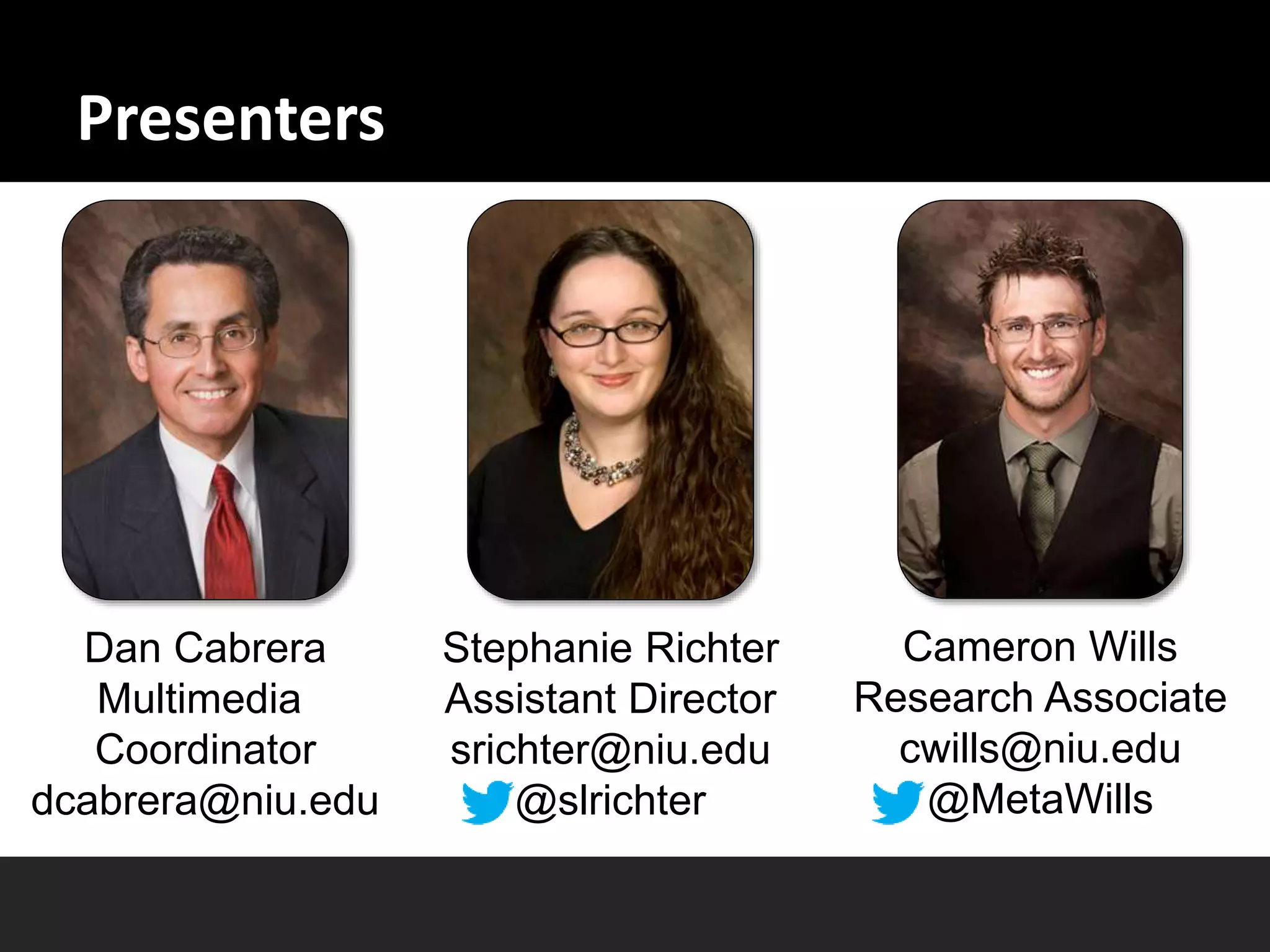
Stephanie Richter
Assistant Director
srichter@niu.edu
@slrichter
Cameron Wills
Research Associate
cwills@niu.edu
@MetaWills
Dan Cabrera
Multimedia
Coordinator
dcabrera@niu.edu
Presenters
Slides available at j.mp/fsi15hips
Objectives
Following this session, you will be able to:
- Describe the High Impact Practices (HIPs)
- Identify technology that supports high impact
teaching
- Begin or expand your use of HIPs
Key Takeaways
High Impact Practices are effective
High Impact Practices are not new
Anyone can use High Impact Practices
Technology supports pedagogy (instead of driving it)
Structure of our session
Brief overview of HIPs
Discussion of HIPs in practice
Brainstorm tools to support HIPs
High Impact Practices
What Are High Impact Practices?
Techniques and designs that have proven to be
beneficial for successful learning
(LEAP, 2014)
What Are High Impact Practices?
Techniques and designs that have proven to be
beneficial for successful learning
…and can increase rates of student retention and
engagement
(LEAP, 2014)
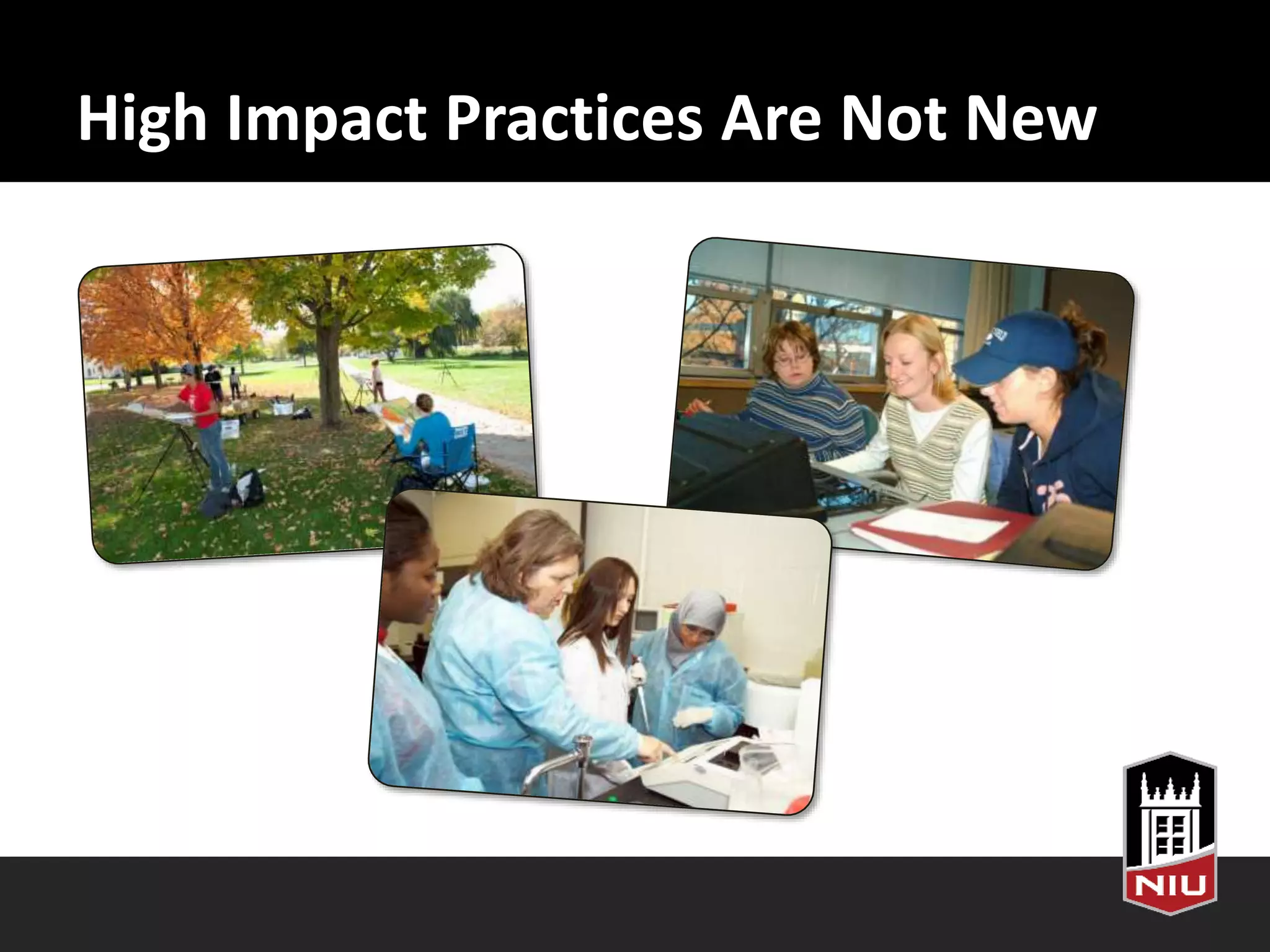
High Impact Practices Are Not New
How are they “High-impact”?
• They are effortful
• They help students build substantive
relationships with faculty and peers
• They help students engage across differences
• They provide students with rich feedback
• They help students apply what they learn
• They provide opportunities for students to
reflect on their growth
(LEAP, 2014)
HIPs promote deep learning
Genuine understanding, including:
– relationships
– causes and effects
– implications for new or different situations
(Millis, 2010)
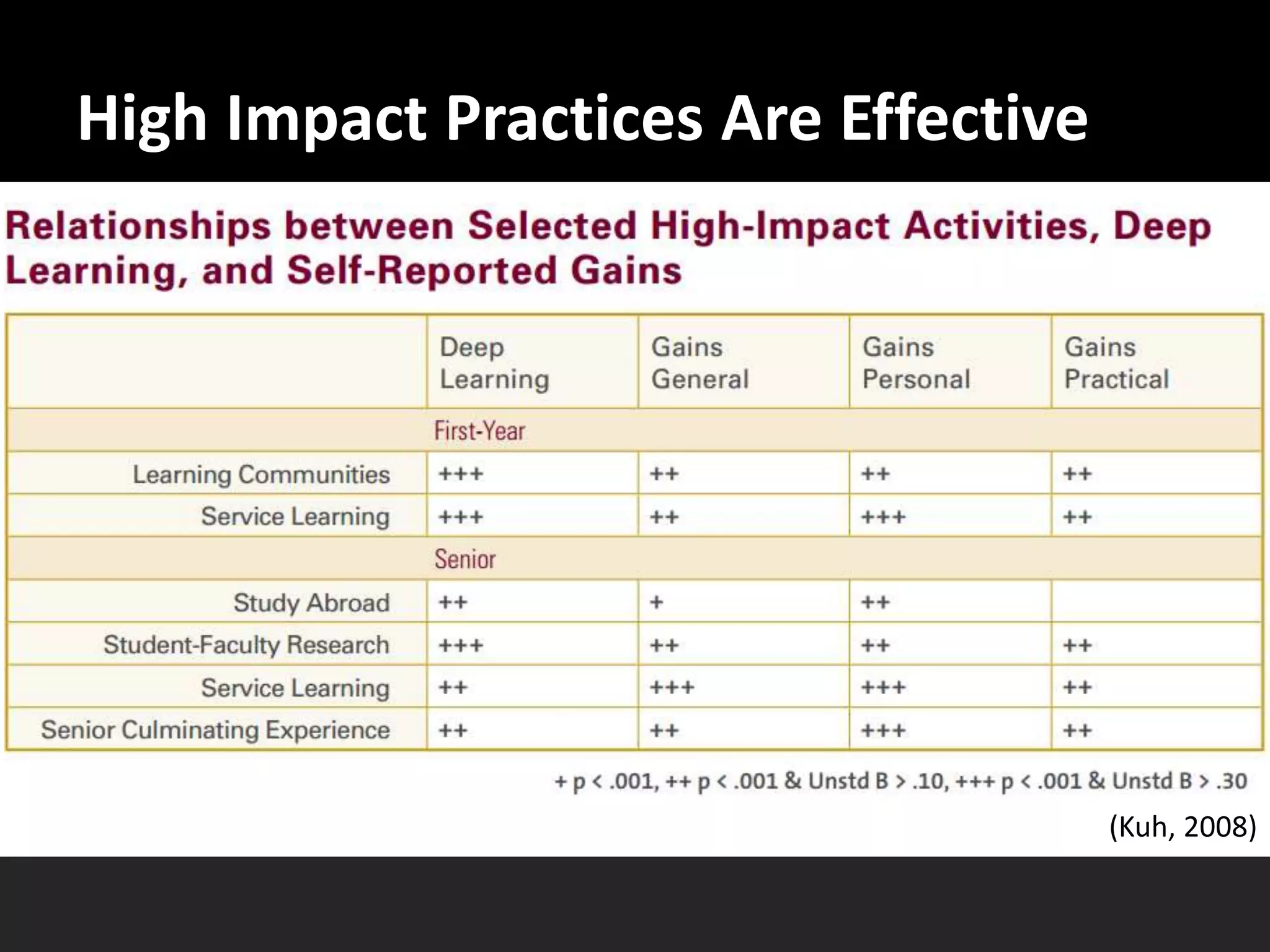
High Impact Practices Are Effective
(Kuh, 2008)
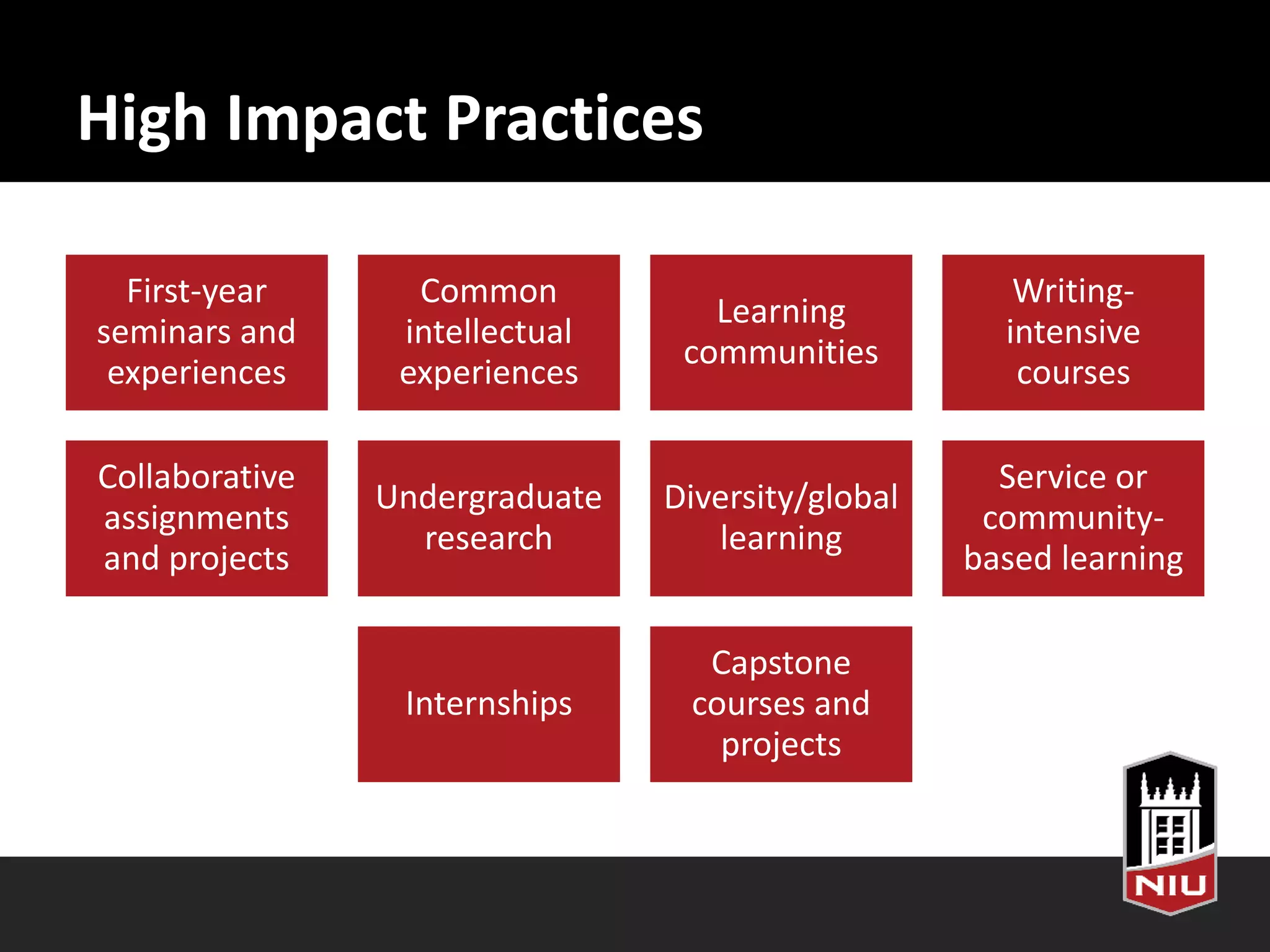
High Impact Practices
First-year
seminars and
experiences
Common
intellectual
experiences
Learning
communities
Writing-
intensive
courses
Collaborative
assignments
and projects
Undergraduate
research
Diversity/global
learning
Service or
community-
based learning
Internships
Capstone
courses and
projects
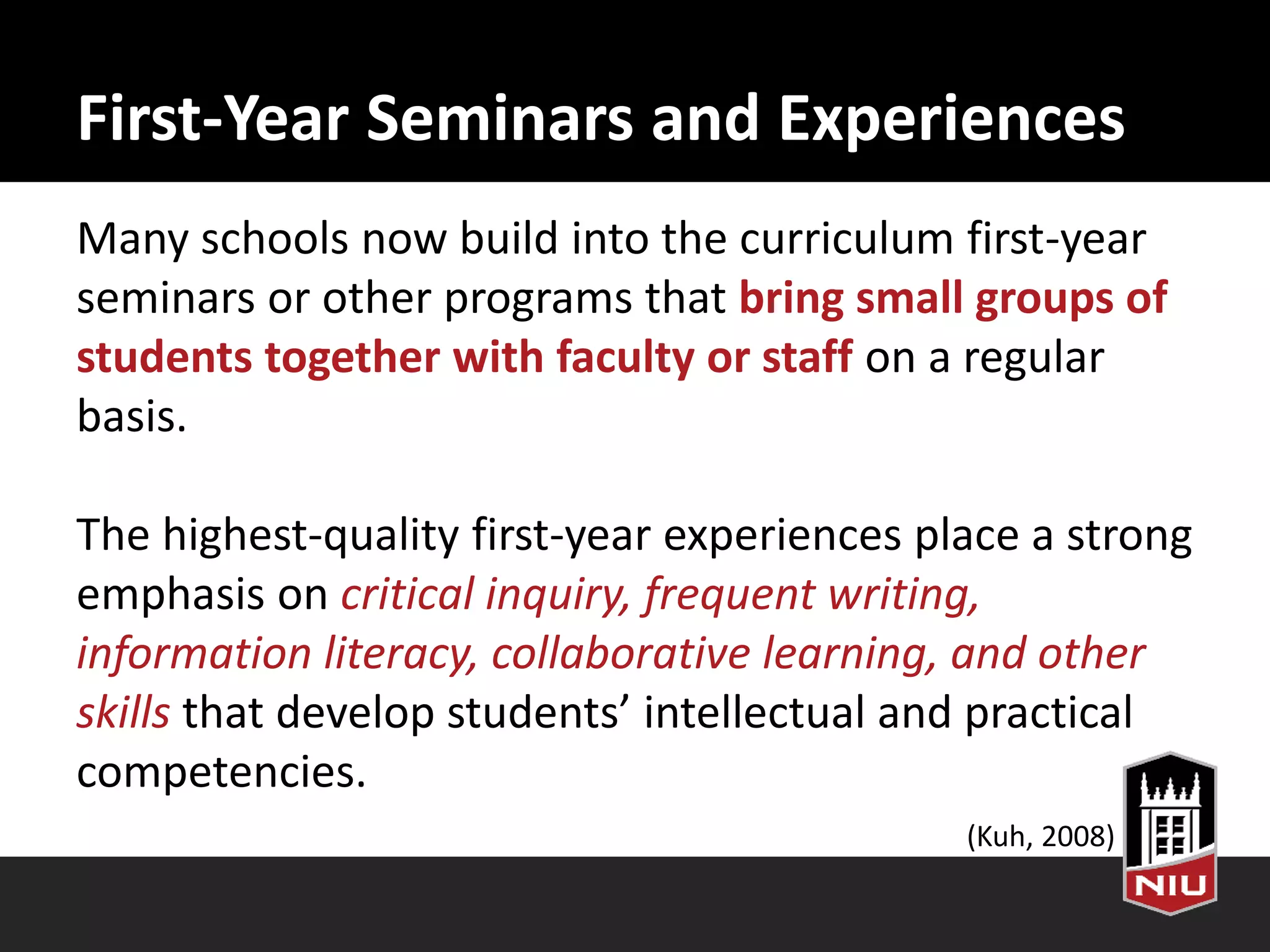
First-Year Seminars and Experiences
Many schools now build into the curriculum first-year
seminars or other programs that bring small groups of
students together with faculty or staff on a regular
basis.
The highest-quality first-year experiences place a strong
emphasis on critical inquiry, frequent writing,
information literacy, collaborative learning, and other
skills that develop students’ intellectual and practical
competencies.
(Kuh, 2008)
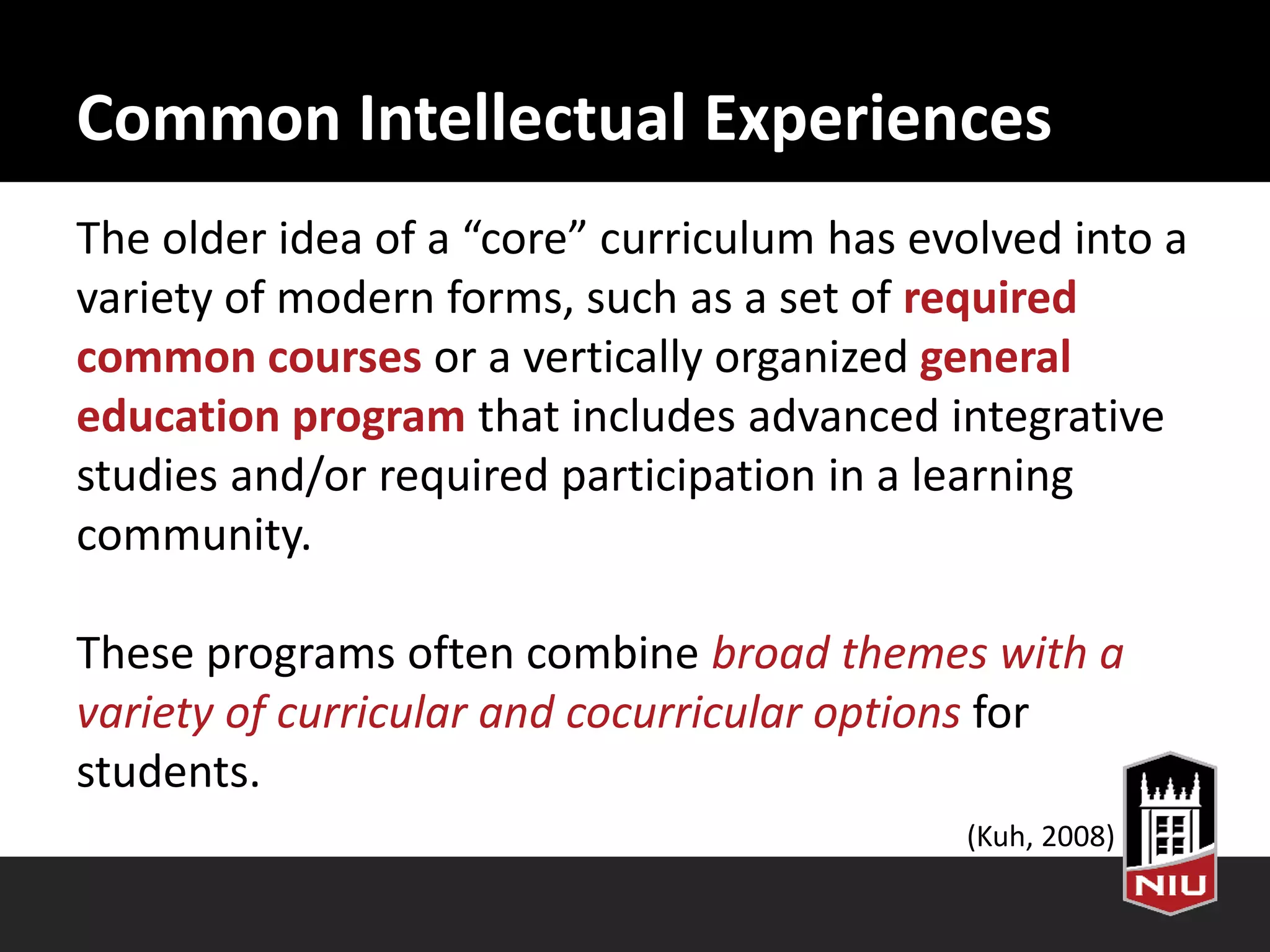
Common Intellectual Experiences
The older idea of a “core” curriculum has evolved into a
variety of modern forms, such as a set of required
common courses or a vertically organized general
education program that includes advanced integrative
studies and/or required participation in a learning
community.
These programs often combine broad themes with a
variety of curricular and co-curricular options for
students.
(Kuh, 2008)
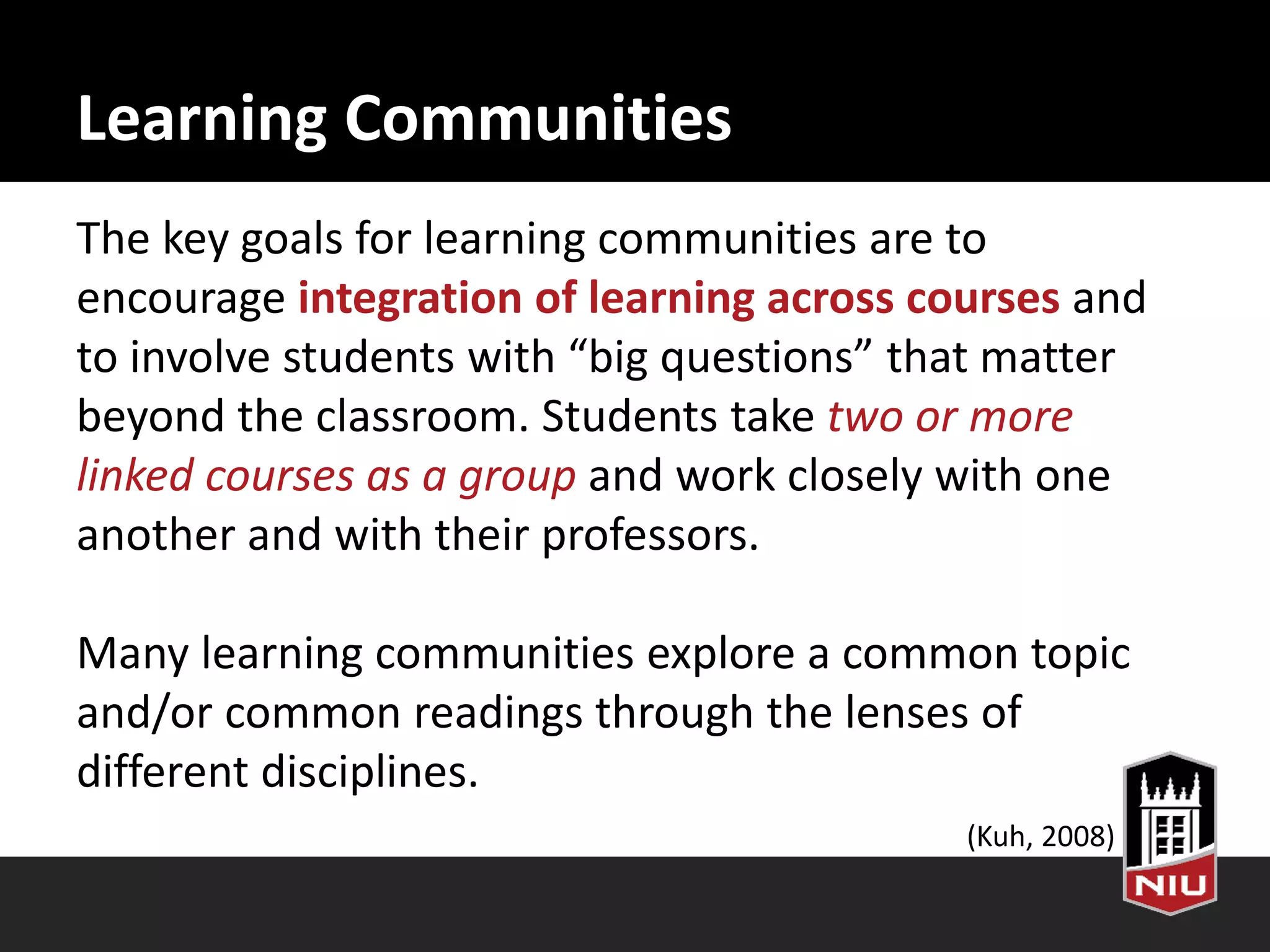
Learning Communities
The key goals for learning communities are to
encourage integration of learning across courses and
to involve students with “big questions” that matter
beyond the classroom. Students take two or more
linked courses as a group and work closely with one
another and with their professors.
Many learning communities explore a common topic
and/or common readings through the lenses of
different disciplines.
(Kuh, 2008)
Writing-Intensive Courses
These courses emphasize writing at all levels of
instruction and across the curriculum, including final-
year projects. Students are encouraged to produce and
revise various forms of writing for different audiences in
different disciplines.
The effectiveness of this repeated practice “across the
curriculum” has led to parallel efforts in such areas as
quantitative reasoning, oral communication,
information literacy, and, on some campuses, ethical
inquiry.
(Kuh, 2008)
Collaborative Assignments
and Projects
Collaborative learning combines two key goals: learning
to work and solve problems in the company of others,
and sharpening one’s own understanding by listening
seriously to the insights of others, especially those
with different backgrounds and life experiences.
Approaches range from study groups within a course,
to team-based assignments and writing, to cooperative
projects and research.
(Kuh, 2008)
Undergraduate Research
Many colleges and universities are now providing
research experiences for students in all disciplines.
…reshaping their courses to connect key concepts and
questions with students’ early and active involvement
in systematic investigation and research.
The goal is to involve students with actively contested
questions, empirical observation, cutting-edge
technologies, and the sense of excitement that comes
from working to answer important questions.
(Kuh, 2008)
Diversity / Global Learning
Many colleges and universities now emphasize courses
and programs that help students explore cultures, life
experiences, and worldviews different from their own.
These studies—which may address U.S. diversity, world
cultures, or both—often explore “difficult differences”
such as racial, ethnic, and gender inequality, or
continuing struggles around the globe for human rights,
freedom, and power.
(Kuh, 2008)
Service or Community-based Learning
The idea is to give students direct experience with issues
they are studying in the curriculum and with ongoing
efforts to analyze and solve problems in the community. A
key element in these programs is the opportunity students
have to both apply what they are learning in real-world
settings and reflect in a classroom setting on their service
experiences.
These programs model the idea that giving something back
to the community is an important college outcome, and that
working with community partners is good preparation for
citizenship, work, and life.
(Kuh, 2008)
Internships
Internships are another increasingly common form of
experiential learning. The idea is to provide students
with direct experience in a work setting—usually
related to their career interests—and to give them the
benefit of supervision and coaching from
professionals in the field.
If the internship is taken for course credit, students
complete a project or paper that is approved by a
faculty member.
(Kuh, 2008)
Capstone Courses and Projects
Whether they’re called “senior capstones” or some
other name, these culminating experiences require
students nearing the end of their college years to
create a project of some sort that integrates and
applies what they’ve learned.
The project might be a research paper, a performance,
a portfolio of “best work,” or an exhibit of artwork.
Capstones are offered both in departmental programs
and, increasingly, in general education as well.
(Kuh, 2008)
High Impact Practices in Practice
Discussion
Which of the High Impact Practices have you
incorporated in your teaching?
What challenges might be overcome with
technology?
Tools for HIPs
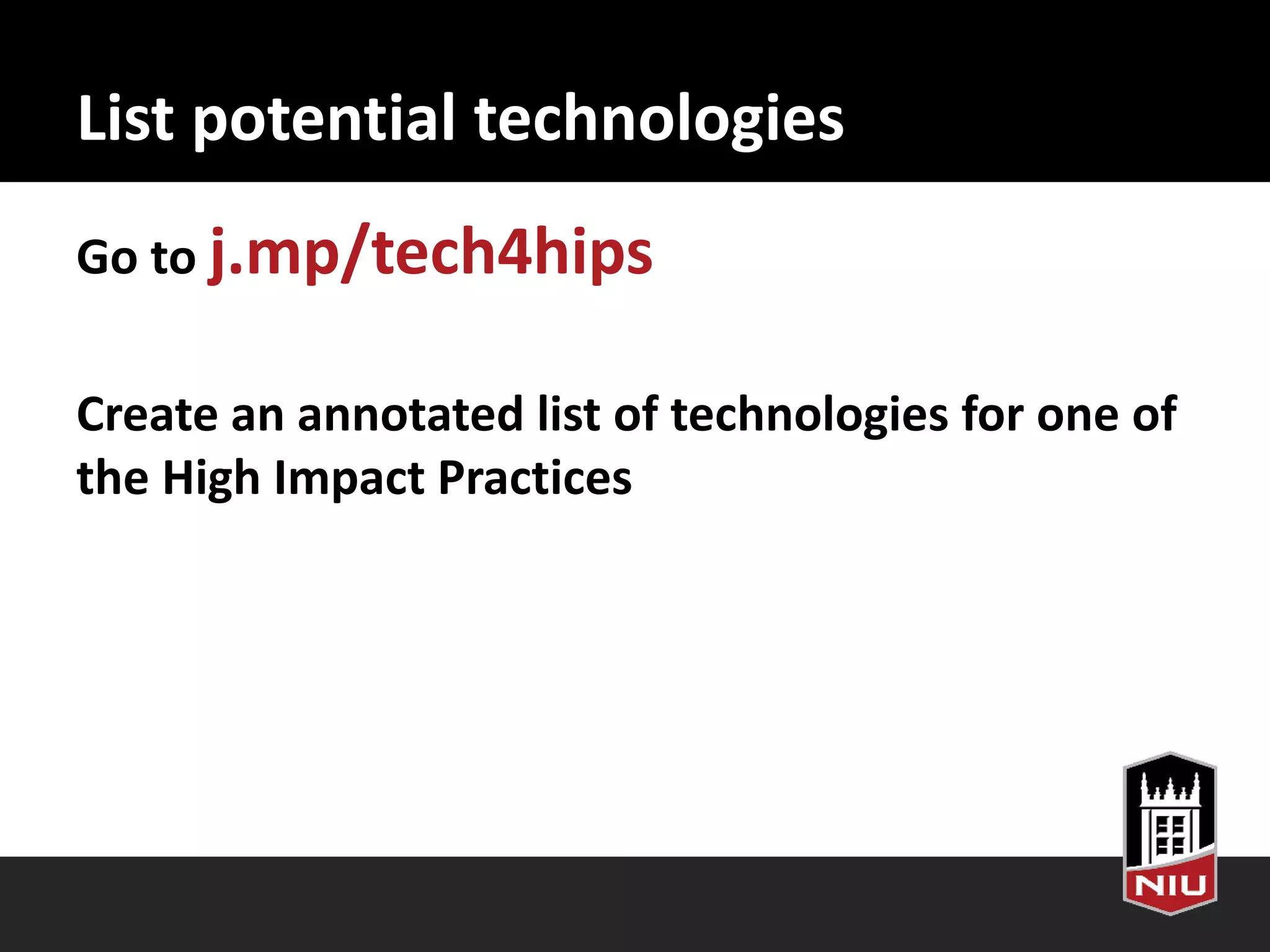
List potential technologies
Go to j.mp/tech4hips
Create an annotated list of technologies for one of
the High Impact Practices
Our favorite tools
that you may not have mentioned
Writing and Research
- Zotero
- Lucidchart
- Wordpress
- Diigo
Service
- Weebly
Collaborating
- Trello
- Doodle
- Firefox Hello
Diversity/Global
- GeoGuesser
Our favorite tools
that you may not have mentioned
First Year Experience
- Facebook
- Instagram
Learning Communities
- Reddit
Internships and
Capstone
- LinkedIn
Common Intellectual
Experiences
- Twitter
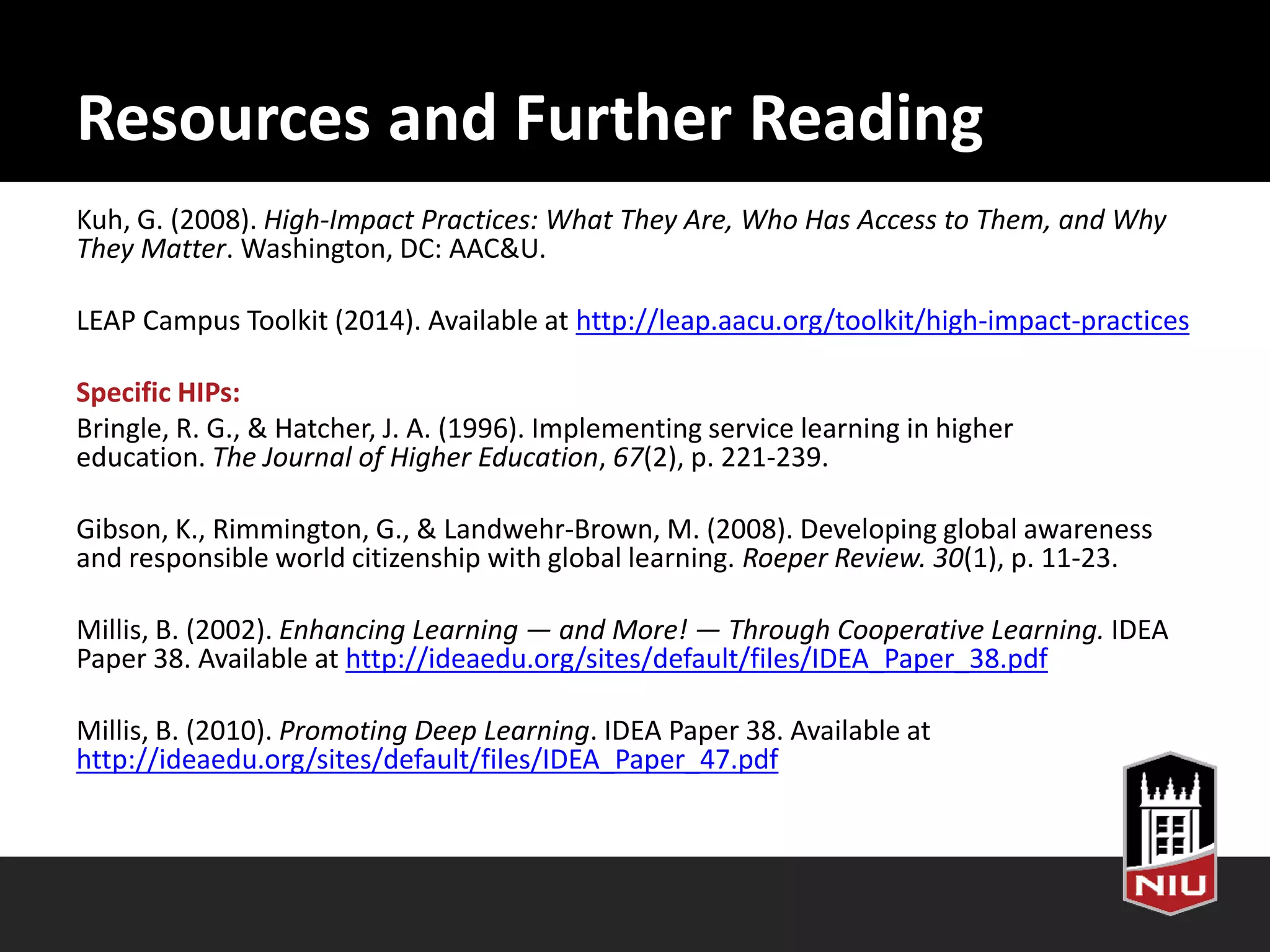
Resources and further reading
Kuh, G. (2008). High-Impact Practices: What They Are, Who Has Access to Them, and Why
They Matter. Washington, DC: AAC&U.
LEAP Campus Toolkit (2014). Available at http://leap.aacu.org/toolkit/high-impact-practices
Specific HIPs:
Bringle, R. G., & Hatcher, J. A. (1996). Implementing service learning in higher
education. The Journal of Higher Education, 67(2), p. 221-239.
Gibson, K., Rimmington, G., & Landwehr-Brown, M. (2008). Developing global awareness
and responsible world citizenship with global learning. Roeper Review. 30(1), p. 11-23.
Millis, B. (2002). Enhancing Learning — and More! — Through Cooperative Learning. IDEA
Paper 38. Available at http://ideaedu.org/sites/default/files/IDEA_Paper_38.pdf
Millis, B. (2010). Promoting Deep Learning. IDEA Paper 38. Available at
http://ideaedu.org/sites/default/files/IDEA_Paper_47.pdf
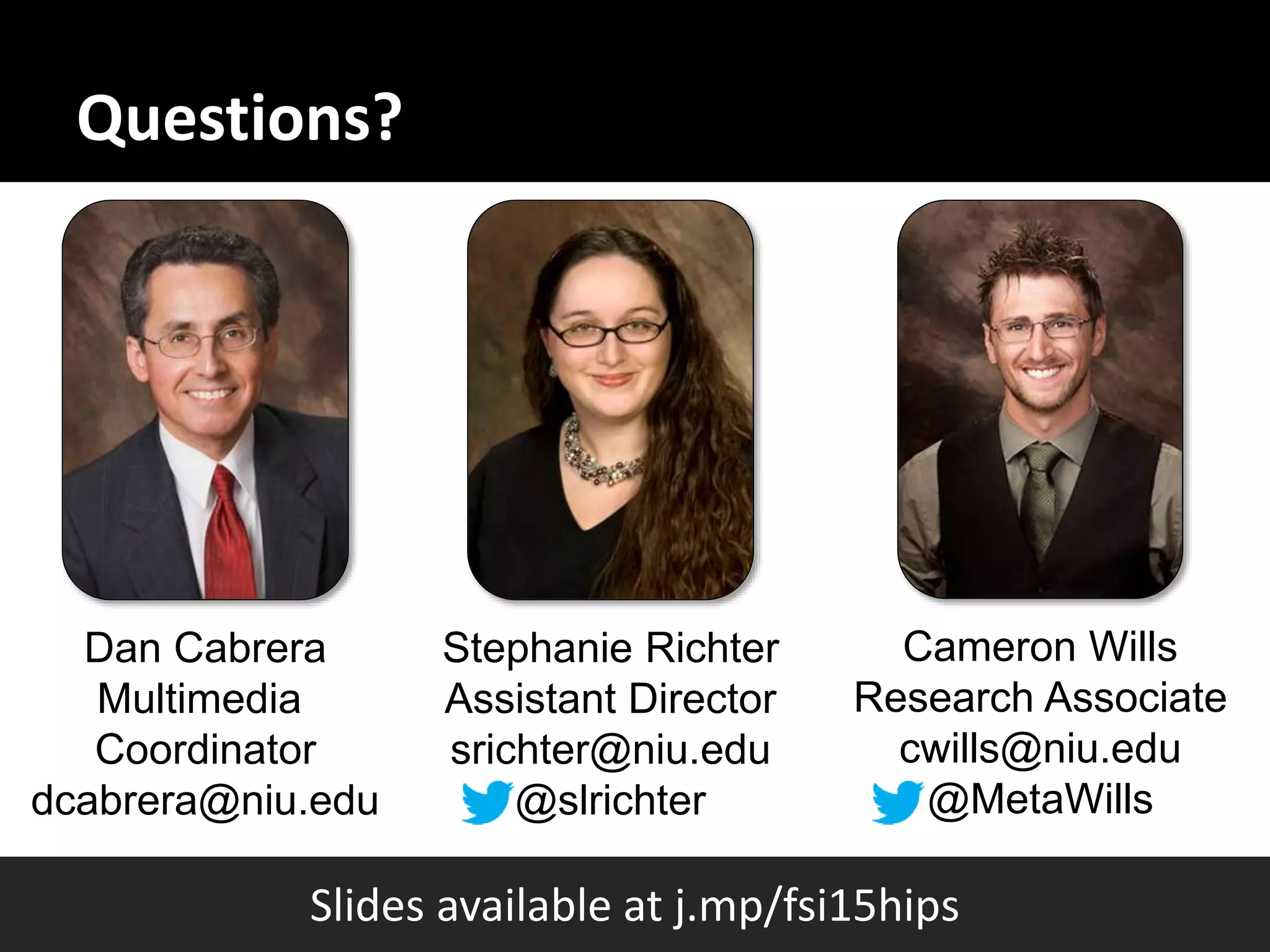
Stephanie Richter
Assistant Director
srichter@niu.edu
@slrichter
Cameron Wills
Research Associate
cwills@niu.edu
@MetaWills
Dan Cabrera
Multimedia
Coordinator
dcabrera@niu.edu
Questions?
Slides available at j.mp/fsi15hips

Getting HIP with Technology: Tools for High Impact Practices

  • 1.
    Getting HIP with Technology Toolsfor High Impact Practice
  • 2.
    Stephanie Richter Assistant Director srichter@niu.edu @slrichter CameronWills Research Associate cwills@niu.edu @MetaWills Dan Cabrera Multimedia Coordinator dcabrera@niu.edu Presenters
  • 3.
    Slides available atj.mp/fsi15hips
  • 4.
    Objectives Following this session,you will be able to: - Describe the High Impact Practices (HIPs) - Identify technology that supports high impact teaching - Begin or expand your use of HIPs
  • 5.
    Key Takeaways High ImpactPractices are effective High Impact Practices are not new Anyone can use High Impact Practices Technology supports pedagogy (instead of driving it)
  • 6.
    Structure of oursession Brief overview of HIPs Discussion of HIPs in practice Brainstorm tools to support HIPs
  • 7.
  • 8.
    What Are HighImpact Practices? Techniques and designs that have proven to be beneficial for successful learning (LEAP, 2014)
  • 9.
    What Are HighImpact Practices? Techniques and designs that have proven to be beneficial for successful learning …and can increase rates of student retention and engagement (LEAP, 2014)
  • 10.
  • 11.
    How are they“High-impact”? • They are effortful • They help students build substantive relationships with faculty and peers • They help students engage across differences • They provide students with rich feedback • They help students apply what they learn • They provide opportunities for students to reflect on their growth (LEAP, 2014)
  • 12.
    HIPs promote deeplearning Genuine understanding, including: – relationships – causes and effects – implications for new or different situations (Millis, 2010)
  • 13.
    High Impact PracticesAre Effective (Kuh, 2008)
  • 14.
    High Impact Practices First-year seminarsand experiences Common intellectual experiences Learning communities Writing- intensive courses Collaborative assignments and projects Undergraduate research Diversity/global learning Service or community- based learning Internships Capstone courses and projects
  • 15.
    First-Year Seminars andExperiences Many schools now build into the curriculum first-year seminars or other programs that bring small groups of students together with faculty or staff on a regular basis. The highest-quality first-year experiences place a strong emphasis on critical inquiry, frequent writing, information literacy, collaborative learning, and other skills that develop students’ intellectual and practical competencies. (Kuh, 2008)
  • 16.
    Common Intellectual Experiences Theolder idea of a “core” curriculum has evolved into a variety of modern forms, such as a set of required common courses or a vertically organized general education program that includes advanced integrative studies and/or required participation in a learning community. These programs often combine broad themes with a variety of curricular and co-curricular options for students. (Kuh, 2008)
  • 17.
    Learning Communities The keygoals for learning communities are to encourage integration of learning across courses and to involve students with “big questions” that matter beyond the classroom. Students take two or more linked courses as a group and work closely with one another and with their professors. Many learning communities explore a common topic and/or common readings through the lenses of different disciplines. (Kuh, 2008)
  • 18.
    Writing-Intensive Courses These coursesemphasize writing at all levels of instruction and across the curriculum, including final- year projects. Students are encouraged to produce and revise various forms of writing for different audiences in different disciplines. The effectiveness of this repeated practice “across the curriculum” has led to parallel efforts in such areas as quantitative reasoning, oral communication, information literacy, and, on some campuses, ethical inquiry. (Kuh, 2008)
  • 19.
    Collaborative Assignments and Projects Collaborativelearning combines two key goals: learning to work and solve problems in the company of others, and sharpening one’s own understanding by listening seriously to the insights of others, especially those with different backgrounds and life experiences. Approaches range from study groups within a course, to team-based assignments and writing, to cooperative projects and research. (Kuh, 2008)
  • 20.
    Undergraduate Research Many collegesand universities are now providing research experiences for students in all disciplines. …reshaping their courses to connect key concepts and questions with students’ early and active involvement in systematic investigation and research. The goal is to involve students with actively contested questions, empirical observation, cutting-edge technologies, and the sense of excitement that comes from working to answer important questions. (Kuh, 2008)
  • 21.
    Diversity / GlobalLearning Many colleges and universities now emphasize courses and programs that help students explore cultures, life experiences, and worldviews different from their own. These studies—which may address U.S. diversity, world cultures, or both—often explore “difficult differences” such as racial, ethnic, and gender inequality, or continuing struggles around the globe for human rights, freedom, and power. (Kuh, 2008)
  • 22.
    Service or Community-basedLearning The idea is to give students direct experience with issues they are studying in the curriculum and with ongoing efforts to analyze and solve problems in the community. A key element in these programs is the opportunity students have to both apply what they are learning in real-world settings and reflect in a classroom setting on their service experiences. These programs model the idea that giving something back to the community is an important college outcome, and that working with community partners is good preparation for citizenship, work, and life. (Kuh, 2008)
  • 23.
    Internships Internships are anotherincreasingly common form of experiential learning. The idea is to provide students with direct experience in a work setting—usually related to their career interests—and to give them the benefit of supervision and coaching from professionals in the field. If the internship is taken for course credit, students complete a project or paper that is approved by a faculty member. (Kuh, 2008)
  • 24.
    Capstone Courses andProjects Whether they’re called “senior capstones” or some other name, these culminating experiences require students nearing the end of their college years to create a project of some sort that integrates and applies what they’ve learned. The project might be a research paper, a performance, a portfolio of “best work,” or an exhibit of artwork. Capstones are offered both in departmental programs and, increasingly, in general education as well. (Kuh, 2008)
  • 25.
  • 26.
    Discussion Which of theHigh Impact Practices have you incorporated in your teaching? What challenges might be overcome with technology?
  • 27.
  • 28.
    List potential technologies Goto j.mp/tech4hips Create an annotated list of technologies for one of the High Impact Practices
  • 29.
    Our favorite tools thatyou may not have mentioned Writing and Research - Zotero - Lucidchart - Wordpress - Diigo Service - Weebly Collaborating - Trello - Doodle - Firefox Hello Diversity/Global - GeoGuesser
  • 30.
    Our favorite tools thatyou may not have mentioned First Year Experience - Facebook - Instagram Learning Communities - Reddit Internships and Capstone - LinkedIn Common Intellectual Experiences - Twitter
  • 31.
    Resources and furtherreading Kuh, G. (2008). High-Impact Practices: What They Are, Who Has Access to Them, and Why They Matter. Washington, DC: AAC&U. LEAP Campus Toolkit (2014). Available at http://leap.aacu.org/toolkit/high-impact-practices Specific HIPs: Bringle, R. G., & Hatcher, J. A. (1996). Implementing service learning in higher education. The Journal of Higher Education, 67(2), p. 221-239. Gibson, K., Rimmington, G., & Landwehr-Brown, M. (2008). Developing global awareness and responsible world citizenship with global learning. Roeper Review. 30(1), p. 11-23. Millis, B. (2002). Enhancing Learning — and More! — Through Cooperative Learning. IDEA Paper 38. Available at http://ideaedu.org/sites/default/files/IDEA_Paper_38.pdf Millis, B. (2010). Promoting Deep Learning. IDEA Paper 38. Available at http://ideaedu.org/sites/default/files/IDEA_Paper_47.pdf
  • 32.
    Stephanie Richter Assistant Director srichter@niu.edu @slrichter CameronWills Research Associate cwills@niu.edu @MetaWills Dan Cabrera Multimedia Coordinator dcabrera@niu.edu Questions? Slides available at j.mp/fsi15hips