Design principles for human-
centered actionable learning
analytics
Prof. Yannis Dimitriadis
GSIC/EMIC group
University of Valladolid, Spain
ASCILITE Learning Analytics SIG
September 4, 2020
Lots of acknowledgements
2
Korah Wiley, Berkeley Roberto Martínez-Maldonado, Monash
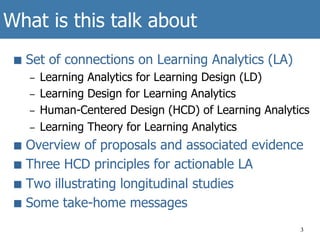
What is this talk about
■  Set of connections on Learning Analytics (LA)
–  Learning Analytics for Learning Design (LD)
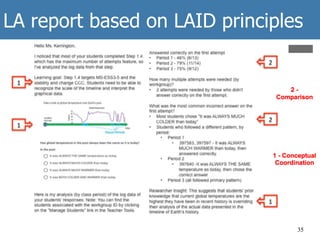
–  Learning Design for Learning Analytics
–  Human-Centered Design (HCD) of Learning Analytics
–  Learning Theory for Learning Analytics
■  Overview of proposals and associated evidence
■  Three HCD principles for actionable LA
■  Two illustrating longitudinal studies
■  Some take-home messages
3
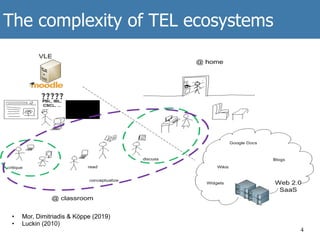
The complexity of TEL ecosystems
4
•  Mor, Dimitriadis & Köppe (2019)
•  Luckin (2010)
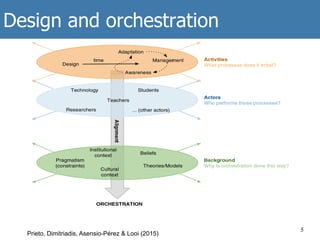
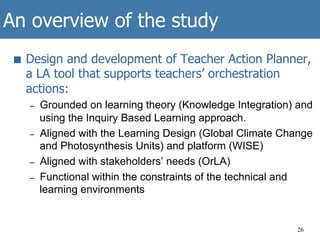
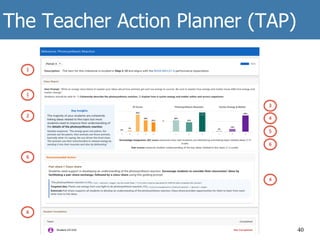
Design and orchestration
5
Prieto, Dimitriadis, Asensio-Pérez & Looi (2015)
Design for Learning
■  What can be designed for learning?
■  The learning (performed by students) and support
(made by teachers) tasks
■  The “physical” environment
■  Spaces, tools, infrastructures, artifacts-resources (to be
consumed and/or produced)
■  The social architecture
■  Groupings, interactions with external agents
■  Design is indirect (tasks vs. activities)
■  Learners may change-interpret tasks in learntime
6
•  Goodyear & Dimitriadis, 2013
•  Dimitriadis & Dimitriadis, 2013
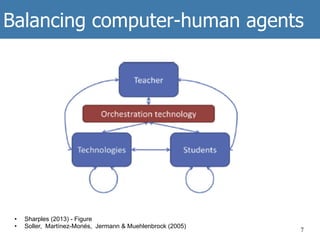
Balancing computer-human agents
7
•  Sharples (2013) - Figure
•  Soller, Martínez-Monés, Jermann & Muehlenbrock (2005)
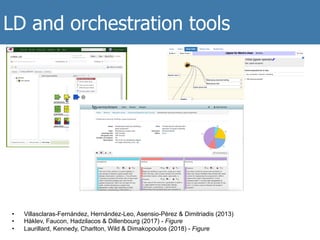
The	METIS	ILDE	LD and orchestration tools
•  Villasclaras-Fernández, Hernández-Leo, Asensio-Pérez & Dimitriadis (2013)
•  Håklev, Faucon, Hadzilacos & Dillenbourg (2017) - Figure
•  Laurillard, Kennedy, Charlton, Wild & Dimakopoulos (2018) - Figure
Teachers as designers
■  Pedagogical knowledge
–  Eventually embedded in tools
–  Complements / cooperates with the tacit and explicit
knowledge of the teachers
■  Teachers
–  Are and can serve as designers
–  Should participate in the design and orchestration of the
teaching and learning processes
9
Kali, McKenney & Sagy (2015)
LA definition and initial focus
■  Learning analytics is defined as
–  “measurement, collection, analysis and reporting of data
about learners and their contexts, for purposes of
understanding and optimizing learning and the
environments in which it occurs”
■  But most research was devoted to
–  Mining patterns
–  Deriving predictive models
–  Providing dashboards
■  What about “Teacher Inquiry into Student Learning”?
10•  Mor, Ferguson & Wasson (2015)
•  Dawson (2020)
Wrap up of some questions
■  Who and how designs LA solutions?
■  What are the trade-offs in using a Human-
Centered Approach for LA?
■  How can we enhance teachers’ agency and
design knowledge?
11
•  Buckingham Shum, Ferguson, & Martinez-Maldonado (2019)
•  Holstein, McLaren & Aleven (2019)
LA and LD
■  LA as a “contextual overlay” for understanding
and optimizing LD
■  LD as framework for analyzing student behavior
and driving meaningful pedagogical action
■  Increasing awareness since 2014 but still a long
way to go
12
•  Mangaroska & Giannakos (2019)
•  McFayden, Lockyer & Rienties (2020)
•  Pishtari, Rodríguez-Triana et al. (2020)
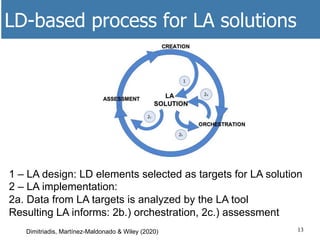
LD-based process for LA solutions
13
	
1 – LA design: LD elements selected as targets for LA solution
2 – LA implementation:
2a. Data from LA targets is analyzed by the LA tool
Resulting LA informs: 2b.) orchestration, 2c.) assessment
Dimitriadis, Martínez-Maldonado & Wiley (2020)
Learning Analytics Implementation Design
(LAID) principles
■  Coordination
–  Which analytics, what productive patterns and what
“logistics”, i.e. when and how, whether free or guided
■  Comparison
–  With respect to absolute or relative reference
■  Customization
–  Multiple needs and paths to use LA, implemented as
adaptive (by system/agent) or adaptable (by users)
■  Extracted vs. embedded analytics
14
Wise & Vytasek (2017)
A process model of LA use
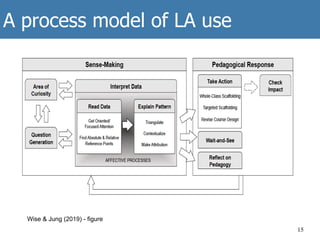
15
Wise & Jung (2019) - figure
Checkpoint and process analytics
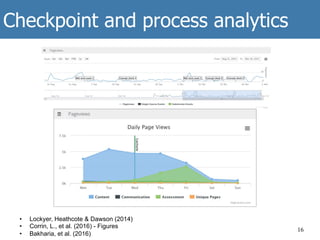
16
•  Lockyer, Heathcote & Dawson (2014)
•  Corrin, L., et al. (2016) - Figures
•  Bakharia, et al. (2016)
Bringing the teacher in the loop
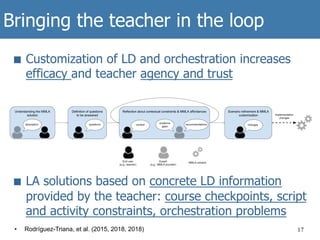
■  Customization of LD and orchestration increases
efficacy and teacher agency and trust
■  LA solutions based on concrete LD information
provided by the teacher: course checkpoints, script
and activity constraints, orchestration problems
17•  Rodríguez-Triana, et al. (2015, 2018, 2018)
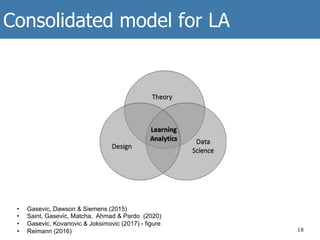
Consolidated model for LA
18
•  Gasevic, Dawson & Siemens (2015)
•  Saint, Gasevic, Matcha, Ahmad & Pardo (2020)
•  Gasevic, Kovanovic & Joksimovic (2017) - figure
•  Reimann (2016)
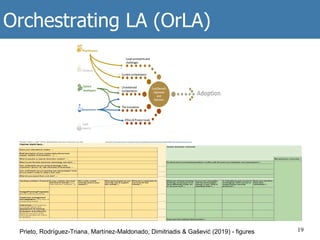
Orchestrating LA (OrLA)
19Prieto, Rodríguez-Triana, Martínez-Maldonado, Dimitriadis & Gašević (2019) - figures
Research and design methodologies
■  Researcher Practice Partnerships (RPP)
■  Design Based Research (DBR)
■  Human Centered Design (HCD)
20
•  Buckingham Shum, Ferguson & Martinez-Maldonado (2019)
•  Holstein, McLaren & Aleven (2019)
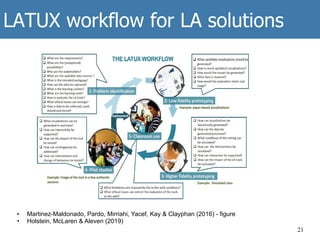
LATUX workflow for LA solutions
21
•  Martinez-Maldonado, Pardo, Mirriahi, Yacef, Kay & Clayphan (2016) - figure
•  Holstein, McLaren & Aleven (2019)
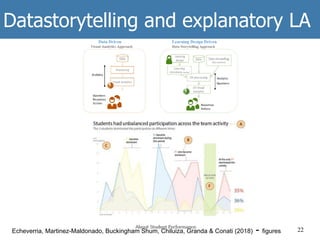
Datastorytelling and explanatory LA
22Echeverria, Martinez-Maldonado, Buckingham Shum, Chiluiza, Granda & Conati (2018) - figures
Human-Centered Design of LA
■  Design of LA solutions involve a socio-technical system
■  LA solutions should be embedded in a human ecology of
formal and informal activities
■  Students and teachers have partial understanding, i.e. they
are not “authoritative sources”
■  Academic rigor and practitioner knowledge may be combined
■  Eventually the benefits of enhanced agency, adoption and
impact of the LA solutions overcome the costs of difficult,
time and resource consuming participatory processes
■  All the important aspects of learning (cognitive,
metacognitive, affective and social) are highly sensible and
dependent on the context
23Buckingham Shum, Ferguson & Martinez-Maldonado (2019)
HCD principles for actionable LA
solutions
1.  Agentic positioning of teachers and other
stakeholders
2.  Integration of the learning design cycle and the LA
design process
3.  Reliance on educational theories to guide the LA
solution design and implementation
24Buckingham Shum, Ferguson & Martinez-Maldonado (2019)
Main illustrative study
25
From Theory to Action:
Developing and Evaluating Learning
Analytics for Learning Design
•  K. Wiley, Y. Dimitriadis, A. Bradford, M. Linn (2020)
•  K. Wiley, (2020)
An overview of the study
■  Design and development of Teacher Action Planner,
a LA tool that supports teachers’ orchestration
actions:
–  Grounded on learning theory (Knowledge Integration) and
using the Inquiry Based Learning approach.
–  Aligned with the Learning Design (Global Climate Change
and Photosynthesis Units) and platform (WISE)
–  Aligned with stakeholders’ needs (OrLA)
–  Functional within the constraints of the technical and
learning environments
26
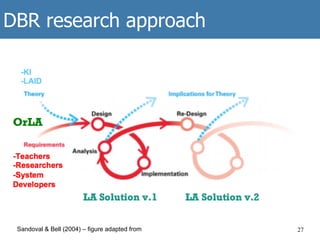
DBR research approach
27Sandoval & Bell (2004) – figure adapted from
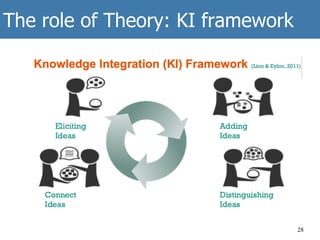
The role of Theory: KI framework
28
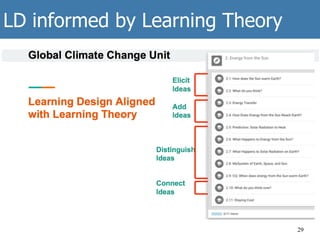
LD informed by Learning Theory
29
The feature (and data) to focus on
30
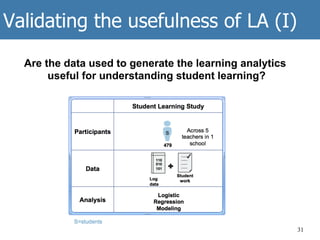
Validating the usefulness of LA (I)
31
Are the data used to generate the learning analytics
useful for understanding student learning?
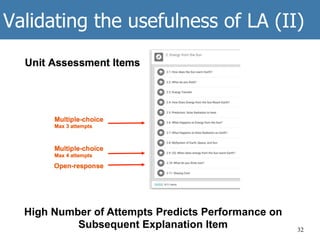
Validating the usefulness of LA (II)
32
High Number of Attempts Predicts Performance on
Subsequent Explanation Item
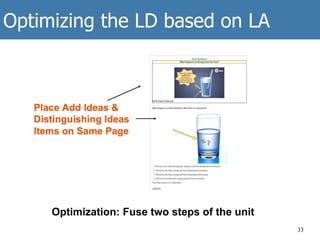
Optimizing the LD based on LA
33
Optimization: Fuse two steps of the unit
Creating a useful LA solution
towards pedagogical action
34
LA report based on LAID principles
35
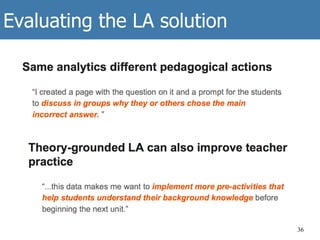
Evaluating the LA solution
36
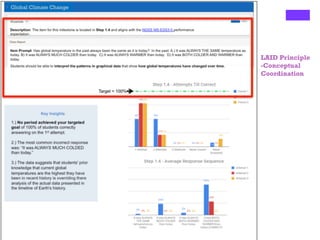
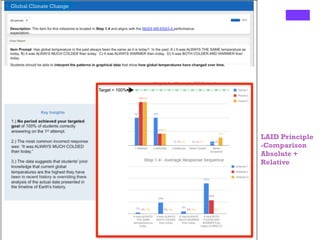
Global Climate Change
LAID Principle
-Conceptual
Coordination
Global Climate Change
LAID Principle
-Comparison
Absolute +
Relative
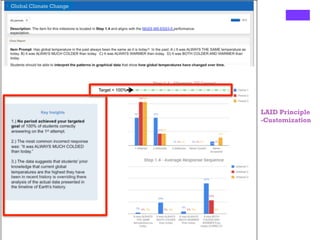
Global Climate Change
LAID Principle
-Customization
The Teacher Action Planner (TAP)
40
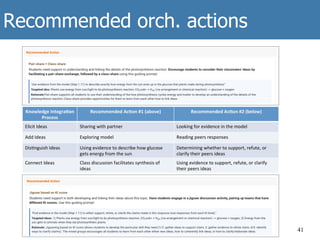
Recommended orch. actions
41
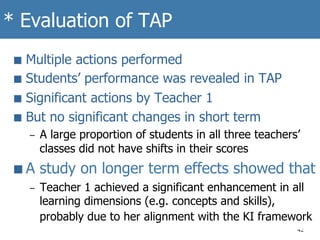
* Evaluation of TAP
42
■  Multiple actions performed
■  Students’ performance was revealed in TAP
■  Significant actions by Teacher 1
■  But no significant changes in short term
–  A large proportion of students in all three teachers’
classes did not have shifts in their scores
■  A study on longer term effects showed that
–  Teacher 1 achieved a significant enhancement in all
learning dimensions (e.g. concepts and skills),
probably due to her alignment with the KI framework
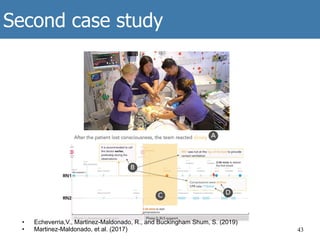
Second case study
43
	
	•  Echeverria,V., Martinez-Maldonado, R., and Buckingham Shum, S. (2019)
•  Martinez-Maldonado, et al. (2017)
Conclusions of studies (I)
44
■  Importance of
–  LD-LA alignment
–  use of learning theory
–  inter-stakeholder communication
■  For design decisions on
–  elements of the LD that should be analyzed
–  data to be collected
–  indicators to be calculated
–  form that insights are communicated and interpreted
–  connection of LA to LD redesign and orchestration action.
Conclusions of studies (II)
45
■  Importance of theory - implementation principled
approach (KI and LAID)
■  Influence of all stakeholders in DBR research
■  Usefulness of the Data Storytelling in visualization
■  Alignment with teachers’ beliefs and attitudes
■  Advantages of embedded and checkpoint analytics
■  Enhancement of teachers’ agency
■  But also need for
–  greater transparency in understanding how LA indicators
are computed
–  even longer trials in authentic and scaled up contexts
Some take-home messages (I)
■  Technology-enhanced learning (TEL) ecosystems
–  especially hard to design and orchestrate
■  Various elements (social architectures, tasks, environment)
–  can be designed in media-res in constantly evolving authentic context
■  Teachers are essential stakeholders
–  LD and LA are about learning and teaching
■  Human-Centered design is necessary in spite of its cost
–  Move from “demonstrators in a greenfield” to embedded tools and
practices in authentic contexts
■  Teachers can work as designers and orchestrators
–  based on their own tacit and explicit knowledge (TPACK)
■  Tools are necessary to support stakeholders
–  balanced use of AI agents and human expertise and actions
46
Some take-home messages (II)
■  LA for understanding and optimizing learning
–  oriented to pedagogical interventions based on actionable insights
■  LA benefits from
–  Data Science, Learning Theory and Design
■  LA and LD are intrinsically interconnected
–  They should be jointly employed
■  Inter-stakeholder communication is essential
–  using multiple design techniques and approaches
■  Bring the human in the loop
–  of these human processes of teaching and learning
■  Support them with
–  technological and conceptual tools
47
References (I)
■  Mor, Dimitriadis, Köppe (2019), Hybrid Learning Spaces – Design, Data, Didactics, Workshop @ EC TEL
2019, https://hls-d3.iucc.ac.il/
■  Luckin, R. (2010) Re-designing learning contexts: Technology-rich, learner-centred ecologies. Routledge,
London
■  Prieto, L. P., Y. Dimitriadis, J. I. Asensio-Pérez, C. K. Looi (2015). “Orchestration in learning technology
research: evaluation of a conceptual framework”. In: Research in Learning Technology 23.0
■  Dillenbourg (2013). “Design for classroom orchestration”, Computers & Education, 69: 485-492
■  Roschelle, J., Dimitriadis, Y., Hoppe, U. (2013), Classroom Orchestration: Synthesis, Computers &
Education. 69:523-526
■  Dillenbourg, P, Fox, A., Kirschner, C., Mitchell, J., Wirsing, M., (2013) Massive Open Online Courses:
Current State and Perspectives (Dagstuhl Perspectives Workshop 14112)
■  Goodyear, P., Dimitriadis, Y. (2013), In medias res: reframing design for learning Research in Learning
Technology - special issue on Learning Design. 21, 2013.
■  Dimitriadis, Y., Goodyear, P. (2013) Forward oriented design for learning: Illustrating the
approach Research in Learning Technology. 21, 2013.
■  Sharples, Mike (2013). Shared Orchestration Within and Beyond the Classroom. Computers & Education.
69. 504-506. 10.1016/j.compedu.2013.04.014.
■  Soller, A., Martínez-Monés, A., Jermann, P., Muehlenbrock, M. (2005) From Mirroring to Guiding: A
Review of the State of the Art Technology for Supporting Collaborative Learning International Journal of
Artificial Intelligence in Education (ijAIED). 15:261-290
48
References (II)
■  Villasclaras-Fernández, E.D., Hernández-Leo, D., Asensio-Pérez, J.I., Dimitriadis, Y.: Web Collage: an
implementation of support for assessment design in CSCL macro-scripts. Computers & Education 67, 79–
97 (2013)
■  S. Håklev, L. Faucon, T. Hadzilacos, and P. Dillenbourg. FROG: rapid prototyping of collaborative learning
scenarios. In EC-TEL, number EPFL-CONF-230014, 2017.
■  L Laurillard, D., Kennedy, E., Charlton, P., Wild, J., & Dimakopoulos, D. (2018). Using technology to
develop teachers as designers of TEL: Evaluating the learning designer. British Journal of Educational
Technology, 49, 1044– 1058. https://doi.org/10.1111/bjet.12697 Kali, Y., McKenney, S., & Sagy, O.
(2015). Teachers as Designers of Technology Enhanced Learning. Instructional science, 43(2), 173-179.
https://doi.org/10.1007/s11251-014-9343-4
■  Mor, Y., Ferguson, R., & Wasson, B. (2015). Editorial: Learning design, teacher inquiry into student
learning and learning analytics: A call for action: Learning design, learning analytics. British Journal of
Educational Technology, 46(2), 221–229. https://doi.org/10.1111/bjet.12273
■  Dawson, S. (2020). Learning Analytics – A Field on the Verge of Relevance? Keynote presentation at 10th
International Conference, LAK20, Cyberspace, March 2020
■  Buckingham Shum, S., Ferguson, R., & Martinez-Maldonado, R. (2019). Human-Centred Learning
Analytics. Journal of Learning Analytics, 6(2), 1–9. https://doi.org/10.18608/jla.2019.62.1
■  Holstein, K., McLaren, B. M., & Aleven, V. (2019). Co-designing a real-time classroom orchestration tool
to support teacher-AI complementarity. Journal of Learning Analytics, 6(2), 27–52.
http://dx.doi.org/10.18608/jla.2019.62.3
■  Dimitriadis, Y., Martínez-Maldonado, R., & Wiley, K. (2020). Human-centered design principles for
actionable learning analytics, chapter in Springer book on Research on e-Learning and ICT in Education,
2020 (forthcoming) 49
References (III)
■  Mangaroska, K., & Giannakos, M. N. (2019). Learning analytics for learning design: A systematic
literature review of analytics-driven design to enhance learning. IEEE Transactions on Learning
Technologies, vol. 12, no. 4, pp. 516-534, 1 Oct.-Dec. 2019 https://doi.org/10.1109/TLT.2018.2868673
■  McFayden, L., Lockyer, L, Rienties, B. (2020), Learning Design and Learning Analytics , Call for Papers,
Journal of Learning Analytics, 2020
■  Pishtari, G., Rodríguez-Triana, M., Sarmiento‐Márquez, E., Pérez-Sanagustín, M., Ruiz-Calleja, A.,
Santos, P., Prieto, L. & Serrano-Iglesias, S. & Väljataga, T.. (2020). Learning design and learning
analytics in mobile and ubiquitous learning: A systematic review. British Journal of Educational
Technology. 10.1111/bjet.12944.
■  Wise, A. F., & Vytasek, J. (2017). Learning Analytics Implementation Design. In C. Lang, G. Siemens, A.
Wise, & D. Gasevic (Eds.), Handbook of Learning Analytics (First, pp. 151–160).
https://doi.org/10.18608/hla17.013
■  Wise, A. F., & Jung, Y. (2019). Teaching with Analytics: Towards a Situated Model of Instructional
Decision-Making. Journal of Learning Analytics, 6(2), 53–69. https://doi.org/10.18608/jla.2019.62.4
■  L. Lockyer, E. Heathcote, and S. Dawson, “Informing pedagogical action: Aligning learning analytics with
learning design,” American Behavioral Scientist, vol. 57, no. 10, pp. 1439–1459, 2013.
■  Corrin, L., Kennedy, G., de Barba, P. G., Lockyer, L., Gaševic´, D., Williams, D., . . . Bakharia, A. (2016).
Completing the Loop: Returning Meaningful Learning Analytic Data to Teachers. Retrieved from Sydney:
http://melbournecshe.unimelb.edu.au/__data/assets/pdf_file/0006/2083938/Loop_Handbook.pdfCorrin
■  Bakharia, A., Corrin, L., de Barba, P, Kennedy, G., Gasevic, D., Moulder, R., Williams, D., Dawson, D.,
Lockyer, L. (2016). A conceptual framework linking learning design with learning analytics,
LAK '16: Proceedings of the Sixth International Conference on Learning Analytics & KnowledgeApril 2016
Pages 329–338https://doi.org/10.1145/2883851.2883944 50
References (IV)
■  Rodríguez-Triana, M. J., Martínez-Monés, A., Asensio-Pérez, J. I., & Dimitriadis, Y. (2015). Scripting and
monitoring meet each other: Aligning learning analytics and learning design to support teachers in
orchestrating CSCL situations. British Journal of Educational Technology, 46(2), 330–343. https://doi.org/
10.1111/bjet.12198
■  Rodríguez Triana, M.J., Prieto Santos, L.P., Martínez Monés, A., Dimitriadis, Y., Asensio Pérez, J.I.
(2018) Monitoring Collaborative Learning Activities: Exploring the Differential Value of Collaborative Flow
Patterns for Learning Analytics, In IEEE International Conference on Learning Technologies (ICALT
2018), ICALT, Bombay, India, July 2018.
■  Rodríguez Triana, M.J., Prieto Santos, L.P., Martínez Monés, A., Asensio Pérez, J.I.,
Dimitriadis, Y. (2018) The teacher in the loop: customizing multimodal Learning Analytics for blended
learning In 8th International Conference on Learning Analytics & Knowledge, LAK 2018, Sydney,
Australia, 5-9, Marcho 2018.
■  D. Gasevic, S. Dawson, and G. Siemens (2020), “Let’s not forget: Learning analytics are about learning,”
TechTrends, vol. 59, no. 1, pp. 64–71, 2015.
■  Saint, J., Gasevic, D., Matcha, W., Ahmad U., N., Pardo, A (2020): Combining analytic methods to unlock
sequential and temporal patterns of self-regulated learning. In: Companion Proceedings 10th
International of Conference on Learning Analytics Knowledge (LAK 2020). pp. 402{411 (03 2020)
■  D. Gašević, Vi.Kovanović & S. Joksimović (2017) Piecing the learning analytics puzzle: a consolidated
model of a field of research and practice, Learning: Research and Practice, 3:1, 63-78, DOI:
10.1080/23735082.2017.1286142
■  P. Reimann (2016), “Connecting learning analytics with learning research: the role of design-based
research,” Learning: Research and Practice, vol. 2, no. 2, pp. 130–142, 2016.
51
References (V)
■  Prieto, L. P., Rodríguez-Triana, M. J., Martínez-Maldonado, R., Dimitriadis, Y., & Gašević, D. (2019).
Orchestrating learning analytics (OrLA): Supporting inter-stakeholder communication about adoption of
learning analytics at the classroom level. Australasian Journal of Educational Technology, 35(4).
■  Martinez-Maldonado, R., Pardo, A., Mirriahi, N., Yacef, K., Kay, J., & Clayphan, A. (2016). LATUX: An
iterative workflow for designing, validating and deploying learning analytics visualisations. Journal of
Learning Analytics, 2(3), 9–39.
■  Holstein, K., McLaren, B. M., & Aleven, V. (2019). Co-designing a real-time classroom orchestration tool
to support teacher-AI complementarity. Journal of Learning Analytics, 6(2), 27–52.
■  Echeverria, V., Martinez-Maldonado, R., Buckingham Shum, S., Chiluiza, K., Granda, R., & Conati, C.
(2018). Exploratory versus Explanatory Visual Learning Analytics: Driving Teachers’ Attention through
Educational Data Storytelling. Journal of Learning Analytics, 5(3), 72—97.
■  K. Wiley, Y. Dimitriadis, A. Bradford, M. Linn (2020). “From Theory to Action: Developing and Evaluating
Learning Analytics for Learning Design”, In Proceedings of the LAK 2017
■  K. Wiley (2020). Developing Learning Analytics to Promote Knowledge Integration in a Technology-
enhanced Learning Environment, PhD dissertation, UC Berkeley, August 2020
■  Echeverria,V., Martinez-Maldonado, R., and Buckingham Shum, S. (2019). Towards collaboration
translucence: Giving meaning to multimodal group data. In Proceedings of the CHI 2019, pages 1–16.
■  Martinez-Maldonado, R., Power, T., Hayes, C., Abdiprano, A., Vo, T., Axisa, C.,and Buckingham Shum, S.
(2017). Analytics meet patient manikins: Challenges in an authentic small-group healthcare simulation
classroom. In Proceedings of the LAK 2017, pages 90–94.
■  W.A. Sandoval, Philip Bell (2004). Design-Based Research Methods for Studying Learning in Context:
Introduction. Educational Psychologist 39, 4 (Dec. 2004), 199–201.
■  Linn, M. C., & Eylon, B.-S. (2011). Science learning and instruction: Taking advantage of technology to
promote knowledge integration. New York: Routledge.
52
Design principles for human-
centered actionable learning
analytics
Prof. Yannis Dimitriadis
GSIC/EMIC group
University of Valladolid, Spain
ASCILITE Learning Analytics SIG
September 4, 2020

Yannis@ascilite 20200908 final

  • 1.
    Design principles forhuman- centered actionable learning analytics Prof. Yannis Dimitriadis GSIC/EMIC group University of Valladolid, Spain ASCILITE Learning Analytics SIG September 4, 2020
  • 2.
    Lots of acknowledgements 2 KorahWiley, Berkeley Roberto Martínez-Maldonado, Monash
  • 3.
    What is thistalk about ■  Set of connections on Learning Analytics (LA) –  Learning Analytics for Learning Design (LD) –  Learning Design for Learning Analytics –  Human-Centered Design (HCD) of Learning Analytics –  Learning Theory for Learning Analytics ■  Overview of proposals and associated evidence ■  Three HCD principles for actionable LA ■  Two illustrating longitudinal studies ■  Some take-home messages 3
  • 4.
    The complexity ofTEL ecosystems 4 •  Mor, Dimitriadis & Köppe (2019) •  Luckin (2010)
  • 5.
    Design and orchestration 5 Prieto,Dimitriadis, Asensio-Pérez & Looi (2015)
  • 6.
    Design for Learning ■ What can be designed for learning? ■  The learning (performed by students) and support (made by teachers) tasks ■  The “physical” environment ■  Spaces, tools, infrastructures, artifacts-resources (to be consumed and/or produced) ■  The social architecture ■  Groupings, interactions with external agents ■  Design is indirect (tasks vs. activities) ■  Learners may change-interpret tasks in learntime 6 •  Goodyear & Dimitriadis, 2013 •  Dimitriadis & Dimitriadis, 2013
  • 7.
    Balancing computer-human agents 7 • Sharples (2013) - Figure •  Soller, Martínez-Monés, Jermann & Muehlenbrock (2005)
  • 8.
    The METIS ILDE LD and orchestrationtools •  Villasclaras-Fernández, Hernández-Leo, Asensio-Pérez & Dimitriadis (2013) •  Håklev, Faucon, Hadzilacos & Dillenbourg (2017) - Figure •  Laurillard, Kennedy, Charlton, Wild & Dimakopoulos (2018) - Figure
  • 9.
    Teachers as designers ■ Pedagogical knowledge –  Eventually embedded in tools –  Complements / cooperates with the tacit and explicit knowledge of the teachers ■  Teachers –  Are and can serve as designers –  Should participate in the design and orchestration of the teaching and learning processes 9 Kali, McKenney & Sagy (2015)
  • 10.
    LA definition andinitial focus ■  Learning analytics is defined as –  “measurement, collection, analysis and reporting of data about learners and their contexts, for purposes of understanding and optimizing learning and the environments in which it occurs” ■  But most research was devoted to –  Mining patterns –  Deriving predictive models –  Providing dashboards ■  What about “Teacher Inquiry into Student Learning”? 10•  Mor, Ferguson & Wasson (2015) •  Dawson (2020)
  • 11.
    Wrap up ofsome questions ■  Who and how designs LA solutions? ■  What are the trade-offs in using a Human- Centered Approach for LA? ■  How can we enhance teachers’ agency and design knowledge? 11 •  Buckingham Shum, Ferguson, & Martinez-Maldonado (2019) •  Holstein, McLaren & Aleven (2019)
  • 12.
    LA and LD ■ LA as a “contextual overlay” for understanding and optimizing LD ■  LD as framework for analyzing student behavior and driving meaningful pedagogical action ■  Increasing awareness since 2014 but still a long way to go 12 •  Mangaroska & Giannakos (2019) •  McFayden, Lockyer & Rienties (2020) •  Pishtari, Rodríguez-Triana et al. (2020)
  • 13.
    LD-based process forLA solutions 13 1 – LA design: LD elements selected as targets for LA solution 2 – LA implementation: 2a. Data from LA targets is analyzed by the LA tool Resulting LA informs: 2b.) orchestration, 2c.) assessment Dimitriadis, Martínez-Maldonado & Wiley (2020)
  • 14.
    Learning Analytics ImplementationDesign (LAID) principles ■  Coordination –  Which analytics, what productive patterns and what “logistics”, i.e. when and how, whether free or guided ■  Comparison –  With respect to absolute or relative reference ■  Customization –  Multiple needs and paths to use LA, implemented as adaptive (by system/agent) or adaptable (by users) ■  Extracted vs. embedded analytics 14 Wise & Vytasek (2017)
  • 15.
    A process modelof LA use 15 Wise & Jung (2019) - figure
  • 16.
    Checkpoint and processanalytics 16 •  Lockyer, Heathcote & Dawson (2014) •  Corrin, L., et al. (2016) - Figures •  Bakharia, et al. (2016)
  • 17.
    Bringing the teacherin the loop ■  Customization of LD and orchestration increases efficacy and teacher agency and trust ■  LA solutions based on concrete LD information provided by the teacher: course checkpoints, script and activity constraints, orchestration problems 17•  Rodríguez-Triana, et al. (2015, 2018, 2018)
  • 18.
    Consolidated model forLA 18 •  Gasevic, Dawson & Siemens (2015) •  Saint, Gasevic, Matcha, Ahmad & Pardo (2020) •  Gasevic, Kovanovic & Joksimovic (2017) - figure •  Reimann (2016)
  • 19.
    Orchestrating LA (OrLA) 19Prieto,Rodríguez-Triana, Martínez-Maldonado, Dimitriadis & Gašević (2019) - figures
  • 20.
    Research and designmethodologies ■  Researcher Practice Partnerships (RPP) ■  Design Based Research (DBR) ■  Human Centered Design (HCD) 20 •  Buckingham Shum, Ferguson & Martinez-Maldonado (2019) •  Holstein, McLaren & Aleven (2019)
  • 21.
    LATUX workflow forLA solutions 21 •  Martinez-Maldonado, Pardo, Mirriahi, Yacef, Kay & Clayphan (2016) - figure •  Holstein, McLaren & Aleven (2019)
  • 22.
    Datastorytelling and explanatoryLA 22Echeverria, Martinez-Maldonado, Buckingham Shum, Chiluiza, Granda & Conati (2018) - figures
  • 23.
    Human-Centered Design ofLA ■  Design of LA solutions involve a socio-technical system ■  LA solutions should be embedded in a human ecology of formal and informal activities ■  Students and teachers have partial understanding, i.e. they are not “authoritative sources” ■  Academic rigor and practitioner knowledge may be combined ■  Eventually the benefits of enhanced agency, adoption and impact of the LA solutions overcome the costs of difficult, time and resource consuming participatory processes ■  All the important aspects of learning (cognitive, metacognitive, affective and social) are highly sensible and dependent on the context 23Buckingham Shum, Ferguson & Martinez-Maldonado (2019)
  • 24.
    HCD principles foractionable LA solutions 1.  Agentic positioning of teachers and other stakeholders 2.  Integration of the learning design cycle and the LA design process 3.  Reliance on educational theories to guide the LA solution design and implementation 24Buckingham Shum, Ferguson & Martinez-Maldonado (2019)
  • 25.
    Main illustrative study 25 FromTheory to Action: Developing and Evaluating Learning Analytics for Learning Design •  K. Wiley, Y. Dimitriadis, A. Bradford, M. Linn (2020) •  K. Wiley, (2020)
  • 26.
    An overview ofthe study ■  Design and development of Teacher Action Planner, a LA tool that supports teachers’ orchestration actions: –  Grounded on learning theory (Knowledge Integration) and using the Inquiry Based Learning approach. –  Aligned with the Learning Design (Global Climate Change and Photosynthesis Units) and platform (WISE) –  Aligned with stakeholders’ needs (OrLA) –  Functional within the constraints of the technical and learning environments 26
  • 27.
    DBR research approach 27Sandoval& Bell (2004) – figure adapted from
  • 28.
    The role ofTheory: KI framework 28
  • 29.
    LD informed byLearning Theory 29
  • 30.
    The feature (anddata) to focus on 30
  • 31.
    Validating the usefulnessof LA (I) 31 Are the data used to generate the learning analytics useful for understanding student learning?
  • 32.
    Validating the usefulnessof LA (II) 32 High Number of Attempts Predicts Performance on Subsequent Explanation Item
  • 33.
    Optimizing the LDbased on LA 33 Optimization: Fuse two steps of the unit
  • 34.
    Creating a usefulLA solution towards pedagogical action 34
  • 35.
    LA report basedon LAID principles 35
  • 36.
    Evaluating the LAsolution 36
  • 37.
    Global Climate Change LAIDPrinciple -Conceptual Coordination
  • 38.
    Global Climate Change LAIDPrinciple -Comparison Absolute + Relative
  • 39.
    Global Climate Change LAIDPrinciple -Customization
  • 40.
    The Teacher ActionPlanner (TAP) 40
  • 41.
  • 42.
    * Evaluation ofTAP 42 ■  Multiple actions performed ■  Students’ performance was revealed in TAP ■  Significant actions by Teacher 1 ■  But no significant changes in short term –  A large proportion of students in all three teachers’ classes did not have shifts in their scores ■  A study on longer term effects showed that –  Teacher 1 achieved a significant enhancement in all learning dimensions (e.g. concepts and skills), probably due to her alignment with the KI framework
  • 43.
    Second case study 43 • Echeverria,V., Martinez-Maldonado, R., and Buckingham Shum, S. (2019) •  Martinez-Maldonado, et al. (2017)
  • 44.
    Conclusions of studies(I) 44 ■  Importance of –  LD-LA alignment –  use of learning theory –  inter-stakeholder communication ■  For design decisions on –  elements of the LD that should be analyzed –  data to be collected –  indicators to be calculated –  form that insights are communicated and interpreted –  connection of LA to LD redesign and orchestration action.
  • 45.
    Conclusions of studies(II) 45 ■  Importance of theory - implementation principled approach (KI and LAID) ■  Influence of all stakeholders in DBR research ■  Usefulness of the Data Storytelling in visualization ■  Alignment with teachers’ beliefs and attitudes ■  Advantages of embedded and checkpoint analytics ■  Enhancement of teachers’ agency ■  But also need for –  greater transparency in understanding how LA indicators are computed –  even longer trials in authentic and scaled up contexts
  • 46.
    Some take-home messages(I) ■  Technology-enhanced learning (TEL) ecosystems –  especially hard to design and orchestrate ■  Various elements (social architectures, tasks, environment) –  can be designed in media-res in constantly evolving authentic context ■  Teachers are essential stakeholders –  LD and LA are about learning and teaching ■  Human-Centered design is necessary in spite of its cost –  Move from “demonstrators in a greenfield” to embedded tools and practices in authentic contexts ■  Teachers can work as designers and orchestrators –  based on their own tacit and explicit knowledge (TPACK) ■  Tools are necessary to support stakeholders –  balanced use of AI agents and human expertise and actions 46
  • 47.
    Some take-home messages(II) ■  LA for understanding and optimizing learning –  oriented to pedagogical interventions based on actionable insights ■  LA benefits from –  Data Science, Learning Theory and Design ■  LA and LD are intrinsically interconnected –  They should be jointly employed ■  Inter-stakeholder communication is essential –  using multiple design techniques and approaches ■  Bring the human in the loop –  of these human processes of teaching and learning ■  Support them with –  technological and conceptual tools 47
  • 48.
    References (I) ■  Mor,Dimitriadis, Köppe (2019), Hybrid Learning Spaces – Design, Data, Didactics, Workshop @ EC TEL 2019, https://hls-d3.iucc.ac.il/ ■  Luckin, R. (2010) Re-designing learning contexts: Technology-rich, learner-centred ecologies. Routledge, London ■  Prieto, L. P., Y. Dimitriadis, J. I. Asensio-Pérez, C. K. Looi (2015). “Orchestration in learning technology research: evaluation of a conceptual framework”. In: Research in Learning Technology 23.0 ■  Dillenbourg (2013). “Design for classroom orchestration”, Computers & Education, 69: 485-492 ■  Roschelle, J., Dimitriadis, Y., Hoppe, U. (2013), Classroom Orchestration: Synthesis, Computers & Education. 69:523-526 ■  Dillenbourg, P, Fox, A., Kirschner, C., Mitchell, J., Wirsing, M., (2013) Massive Open Online Courses: Current State and Perspectives (Dagstuhl Perspectives Workshop 14112) ■  Goodyear, P., Dimitriadis, Y. (2013), In medias res: reframing design for learning Research in Learning Technology - special issue on Learning Design. 21, 2013. ■  Dimitriadis, Y., Goodyear, P. (2013) Forward oriented design for learning: Illustrating the approach Research in Learning Technology. 21, 2013. ■  Sharples, Mike (2013). Shared Orchestration Within and Beyond the Classroom. Computers & Education. 69. 504-506. 10.1016/j.compedu.2013.04.014. ■  Soller, A., Martínez-Monés, A., Jermann, P., Muehlenbrock, M. (2005) From Mirroring to Guiding: A Review of the State of the Art Technology for Supporting Collaborative Learning International Journal of Artificial Intelligence in Education (ijAIED). 15:261-290 48
  • 49.
    References (II) ■  Villasclaras-Fernández,E.D., Hernández-Leo, D., Asensio-Pérez, J.I., Dimitriadis, Y.: Web Collage: an implementation of support for assessment design in CSCL macro-scripts. Computers & Education 67, 79– 97 (2013) ■  S. Håklev, L. Faucon, T. Hadzilacos, and P. Dillenbourg. FROG: rapid prototyping of collaborative learning scenarios. In EC-TEL, number EPFL-CONF-230014, 2017. ■  L Laurillard, D., Kennedy, E., Charlton, P., Wild, J., & Dimakopoulos, D. (2018). Using technology to develop teachers as designers of TEL: Evaluating the learning designer. British Journal of Educational Technology, 49, 1044– 1058. https://doi.org/10.1111/bjet.12697 Kali, Y., McKenney, S., & Sagy, O. (2015). Teachers as Designers of Technology Enhanced Learning. Instructional science, 43(2), 173-179. https://doi.org/10.1007/s11251-014-9343-4 ■  Mor, Y., Ferguson, R., & Wasson, B. (2015). Editorial: Learning design, teacher inquiry into student learning and learning analytics: A call for action: Learning design, learning analytics. British Journal of Educational Technology, 46(2), 221–229. https://doi.org/10.1111/bjet.12273 ■  Dawson, S. (2020). Learning Analytics – A Field on the Verge of Relevance? Keynote presentation at 10th International Conference, LAK20, Cyberspace, March 2020 ■  Buckingham Shum, S., Ferguson, R., & Martinez-Maldonado, R. (2019). Human-Centred Learning Analytics. Journal of Learning Analytics, 6(2), 1–9. https://doi.org/10.18608/jla.2019.62.1 ■  Holstein, K., McLaren, B. M., & Aleven, V. (2019). Co-designing a real-time classroom orchestration tool to support teacher-AI complementarity. Journal of Learning Analytics, 6(2), 27–52. http://dx.doi.org/10.18608/jla.2019.62.3 ■  Dimitriadis, Y., Martínez-Maldonado, R., & Wiley, K. (2020). Human-centered design principles for actionable learning analytics, chapter in Springer book on Research on e-Learning and ICT in Education, 2020 (forthcoming) 49
  • 50.
    References (III) ■  Mangaroska,K., & Giannakos, M. N. (2019). Learning analytics for learning design: A systematic literature review of analytics-driven design to enhance learning. IEEE Transactions on Learning Technologies, vol. 12, no. 4, pp. 516-534, 1 Oct.-Dec. 2019 https://doi.org/10.1109/TLT.2018.2868673 ■  McFayden, L., Lockyer, L, Rienties, B. (2020), Learning Design and Learning Analytics , Call for Papers, Journal of Learning Analytics, 2020 ■  Pishtari, G., Rodríguez-Triana, M., Sarmiento‐Márquez, E., Pérez-Sanagustín, M., Ruiz-Calleja, A., Santos, P., Prieto, L. & Serrano-Iglesias, S. & Väljataga, T.. (2020). Learning design and learning analytics in mobile and ubiquitous learning: A systematic review. British Journal of Educational Technology. 10.1111/bjet.12944. ■  Wise, A. F., & Vytasek, J. (2017). Learning Analytics Implementation Design. In C. Lang, G. Siemens, A. Wise, & D. Gasevic (Eds.), Handbook of Learning Analytics (First, pp. 151–160). https://doi.org/10.18608/hla17.013 ■  Wise, A. F., & Jung, Y. (2019). Teaching with Analytics: Towards a Situated Model of Instructional Decision-Making. Journal of Learning Analytics, 6(2), 53–69. https://doi.org/10.18608/jla.2019.62.4 ■  L. Lockyer, E. Heathcote, and S. Dawson, “Informing pedagogical action: Aligning learning analytics with learning design,” American Behavioral Scientist, vol. 57, no. 10, pp. 1439–1459, 2013. ■  Corrin, L., Kennedy, G., de Barba, P. G., Lockyer, L., Gaševic´, D., Williams, D., . . . Bakharia, A. (2016). Completing the Loop: Returning Meaningful Learning Analytic Data to Teachers. Retrieved from Sydney: http://melbournecshe.unimelb.edu.au/__data/assets/pdf_file/0006/2083938/Loop_Handbook.pdfCorrin ■  Bakharia, A., Corrin, L., de Barba, P, Kennedy, G., Gasevic, D., Moulder, R., Williams, D., Dawson, D., Lockyer, L. (2016). A conceptual framework linking learning design with learning analytics, LAK '16: Proceedings of the Sixth International Conference on Learning Analytics & KnowledgeApril 2016 Pages 329–338https://doi.org/10.1145/2883851.2883944 50
  • 51.
    References (IV) ■  Rodríguez-Triana,M. J., Martínez-Monés, A., Asensio-Pérez, J. I., & Dimitriadis, Y. (2015). Scripting and monitoring meet each other: Aligning learning analytics and learning design to support teachers in orchestrating CSCL situations. British Journal of Educational Technology, 46(2), 330–343. https://doi.org/ 10.1111/bjet.12198 ■  Rodríguez Triana, M.J., Prieto Santos, L.P., Martínez Monés, A., Dimitriadis, Y., Asensio Pérez, J.I. (2018) Monitoring Collaborative Learning Activities: Exploring the Differential Value of Collaborative Flow Patterns for Learning Analytics, In IEEE International Conference on Learning Technologies (ICALT 2018), ICALT, Bombay, India, July 2018. ■  Rodríguez Triana, M.J., Prieto Santos, L.P., Martínez Monés, A., Asensio Pérez, J.I., Dimitriadis, Y. (2018) The teacher in the loop: customizing multimodal Learning Analytics for blended learning In 8th International Conference on Learning Analytics & Knowledge, LAK 2018, Sydney, Australia, 5-9, Marcho 2018. ■  D. Gasevic, S. Dawson, and G. Siemens (2020), “Let’s not forget: Learning analytics are about learning,” TechTrends, vol. 59, no. 1, pp. 64–71, 2015. ■  Saint, J., Gasevic, D., Matcha, W., Ahmad U., N., Pardo, A (2020): Combining analytic methods to unlock sequential and temporal patterns of self-regulated learning. In: Companion Proceedings 10th International of Conference on Learning Analytics Knowledge (LAK 2020). pp. 402{411 (03 2020) ■  D. Gašević, Vi.Kovanović & S. Joksimović (2017) Piecing the learning analytics puzzle: a consolidated model of a field of research and practice, Learning: Research and Practice, 3:1, 63-78, DOI: 10.1080/23735082.2017.1286142 ■  P. Reimann (2016), “Connecting learning analytics with learning research: the role of design-based research,” Learning: Research and Practice, vol. 2, no. 2, pp. 130–142, 2016. 51
  • 52.
    References (V) ■  Prieto,L. P., Rodríguez-Triana, M. J., Martínez-Maldonado, R., Dimitriadis, Y., & Gašević, D. (2019). Orchestrating learning analytics (OrLA): Supporting inter-stakeholder communication about adoption of learning analytics at the classroom level. Australasian Journal of Educational Technology, 35(4). ■  Martinez-Maldonado, R., Pardo, A., Mirriahi, N., Yacef, K., Kay, J., & Clayphan, A. (2016). LATUX: An iterative workflow for designing, validating and deploying learning analytics visualisations. Journal of Learning Analytics, 2(3), 9–39. ■  Holstein, K., McLaren, B. M., & Aleven, V. (2019). Co-designing a real-time classroom orchestration tool to support teacher-AI complementarity. Journal of Learning Analytics, 6(2), 27–52. ■  Echeverria, V., Martinez-Maldonado, R., Buckingham Shum, S., Chiluiza, K., Granda, R., & Conati, C. (2018). Exploratory versus Explanatory Visual Learning Analytics: Driving Teachers’ Attention through Educational Data Storytelling. Journal of Learning Analytics, 5(3), 72—97. ■  K. Wiley, Y. Dimitriadis, A. Bradford, M. Linn (2020). “From Theory to Action: Developing and Evaluating Learning Analytics for Learning Design”, In Proceedings of the LAK 2017 ■  K. Wiley (2020). Developing Learning Analytics to Promote Knowledge Integration in a Technology- enhanced Learning Environment, PhD dissertation, UC Berkeley, August 2020 ■  Echeverria,V., Martinez-Maldonado, R., and Buckingham Shum, S. (2019). Towards collaboration translucence: Giving meaning to multimodal group data. In Proceedings of the CHI 2019, pages 1–16. ■  Martinez-Maldonado, R., Power, T., Hayes, C., Abdiprano, A., Vo, T., Axisa, C.,and Buckingham Shum, S. (2017). Analytics meet patient manikins: Challenges in an authentic small-group healthcare simulation classroom. In Proceedings of the LAK 2017, pages 90–94. ■  W.A. Sandoval, Philip Bell (2004). Design-Based Research Methods for Studying Learning in Context: Introduction. Educational Psychologist 39, 4 (Dec. 2004), 199–201. ■  Linn, M. C., & Eylon, B.-S. (2011). Science learning and instruction: Taking advantage of technology to promote knowledge integration. New York: Routledge. 52
  • 53.
    Design principles forhuman- centered actionable learning analytics Prof. Yannis Dimitriadis GSIC/EMIC group University of Valladolid, Spain ASCILITE Learning Analytics SIG September 4, 2020