
APPLICATION OF THIN FILMS
ANEETTA DAVIS
MSc NS & T, 2nd SEM
MOUNT CARMEL COLLEGE
GUIDED BY: PRADEEP SIR
WHAT IS THIN FILM?
• thin = less than about one micron ( 10,000 Angstroms,
1000 nm)
• film = layer of material on a substrate
The need for thin films is because we can alter their
properties and for miniature devices.
APPLICATIONS
• SOLAR CELLS
• THIN FILM TRANSISTORS
• OPTICAL COATING
• THIN FILM BATTERIES
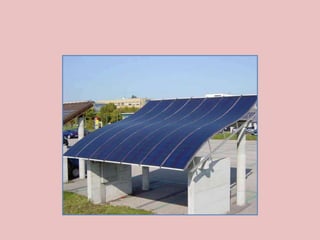
SOLAR CELLS
• This is a cheaper raw material than crystalline silicon. No
structural damage!
• The conversion of solar light to electric power is one of the
available renewable sources of energies.
• The basic physical principle involved is the absorption of
photon resulting in the creation of electron-hole pairs; the
excess electrons in the conduction band, and holes in the
valence band.
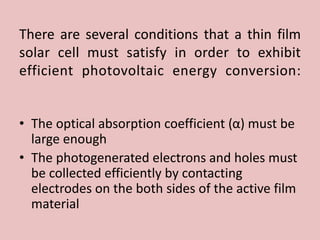
There are several conditions that a thin film
solar cell must satisfy in order to exhibit
efficient photovoltaic energy conversion:
• The optical absorption coefficient (α) must be
large enough
• The photogenerated electrons and holes must
be collected efficiently by contacting
electrodes on the both sides of the active film
material
THIN FILM TRANSISTORS
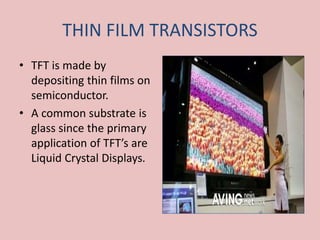
• TFT is made by
depositing thin films on
semiconductor.
• A common substrate is
glass since the primary
application of TFT’s are
Liquid Crystal Displays.
What is TFT LCD ?
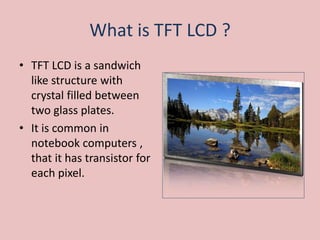
• TFT LCD is a sandwich
like structure with
crystal filled between
two glass plates.
• It is common in
notebook computers ,
that it has transistor for
each pixel.
How do they work ?
• TFT glass has as many TFTs as the number of pixels
displayed.
• Millions of pixels create an image on the display.
• TFT’s act as switches to individually turn ‘on’ and ‘off’ for
each pixel
• A color filter glass has color filter which generates color.
• Diffuser distributing the light evenly near the viewing area.
• Liquid Glass Crystals move according to the change in
voltage between the TFT glass and color filter.
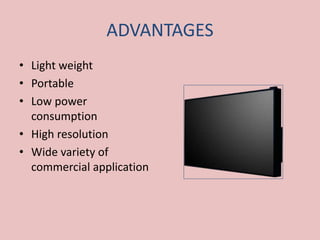
ADVANTAGES
• Light weight
• Portable
• Low power
consumption
• High resolution
• Wide variety of
commercial application
DISADVANTGES
• The general comment
from the people is that
the LCD TFT gets
switched off after
sometime .
• The liquid crystals inside
the display are
poisonous
• Spills off from a cracked
display should be
washed with soap water.
OPTICAL COATING
An optical coating is one or more thin layers of
material deposited on an optical component
such as a lens or mirror, which alters the way
in which the optic reflects and transmits light.
ANTIREFELCTION COATING
• Whenever light travels between two interfaces of
different refractive index, some of the light is
reflected.
• These reflections form flare images.
• The coating of optical surfaces with antireflection
coatings has resolved this problem.
• The antireflection coatings should be applied to
optical surfaces containing germanium, silicon or
materials with high refractive index.
Antireflection coating
THIN FILM BATTERIES
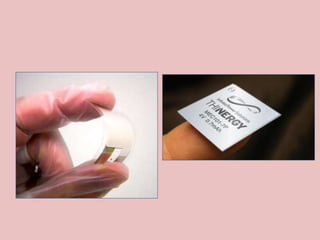
• Unlike typical batteries, thin film batteries are all
solid-state.
• In many cases they can be made flexible.
• They can be manufactured using normal thin film
deposition techniques.
• Potential applications include:
Pacemakers
Neural stimulators
Drug delivery system
OTHER APPLICATIONS
• Semiconductors
• Super capacitors
• Data storage
• Photo electrochemical cells
• Drug delivery
• Nanomedicine
REFERENCES
• http://www.worldscientific.com/doi/pdf/10.1
142/S2010194513010696
• http://shodhganga.inflibnet.ac.in/bitstream/1
0603/4025/8/08_chapter%202.pdf
THANK YOU

Apps of thin films

  • 1.
    APPLICATION OF THINFILMS ANEETTA DAVIS MSc NS & T, 2nd SEM MOUNT CARMEL COLLEGE GUIDED BY: PRADEEP SIR
  • 2.
    WHAT IS THINFILM? • thin = less than about one micron ( 10,000 Angstroms, 1000 nm) • film = layer of material on a substrate The need for thin films is because we can alter their properties and for miniature devices.
  • 3.
    APPLICATIONS • SOLAR CELLS •THIN FILM TRANSISTORS • OPTICAL COATING • THIN FILM BATTERIES
  • 4.
    SOLAR CELLS • Thisis a cheaper raw material than crystalline silicon. No structural damage! • The conversion of solar light to electric power is one of the available renewable sources of energies. • The basic physical principle involved is the absorption of photon resulting in the creation of electron-hole pairs; the excess electrons in the conduction band, and holes in the valence band.
  • 5.
    There are severalconditions that a thin film solar cell must satisfy in order to exhibit efficient photovoltaic energy conversion: • The optical absorption coefficient (α) must be large enough • The photogenerated electrons and holes must be collected efficiently by contacting electrodes on the both sides of the active film material
  • 7.
    THIN FILM TRANSISTORS •TFT is made by depositing thin films on semiconductor. • A common substrate is glass since the primary application of TFT’s are Liquid Crystal Displays.
  • 8.
    What is TFTLCD ? • TFT LCD is a sandwich like structure with crystal filled between two glass plates. • It is common in notebook computers , that it has transistor for each pixel.
  • 9.
    How do theywork ? • TFT glass has as many TFTs as the number of pixels displayed. • Millions of pixels create an image on the display. • TFT’s act as switches to individually turn ‘on’ and ‘off’ for each pixel • A color filter glass has color filter which generates color. • Diffuser distributing the light evenly near the viewing area. • Liquid Glass Crystals move according to the change in voltage between the TFT glass and color filter.
  • 10.
    ADVANTAGES • Light weight •Portable • Low power consumption • High resolution • Wide variety of commercial application
  • 11.
    DISADVANTGES • The generalcomment from the people is that the LCD TFT gets switched off after sometime . • The liquid crystals inside the display are poisonous • Spills off from a cracked display should be washed with soap water.
  • 12.
    OPTICAL COATING An opticalcoating is one or more thin layers of material deposited on an optical component such as a lens or mirror, which alters the way in which the optic reflects and transmits light.
  • 13.
    ANTIREFELCTION COATING • Wheneverlight travels between two interfaces of different refractive index, some of the light is reflected. • These reflections form flare images. • The coating of optical surfaces with antireflection coatings has resolved this problem. • The antireflection coatings should be applied to optical surfaces containing germanium, silicon or materials with high refractive index.
  • 14.
  • 15.
    THIN FILM BATTERIES •Unlike typical batteries, thin film batteries are all solid-state. • In many cases they can be made flexible. • They can be manufactured using normal thin film deposition techniques. • Potential applications include: Pacemakers Neural stimulators Drug delivery system
  • 17.
    OTHER APPLICATIONS • Semiconductors •Super capacitors • Data storage • Photo electrochemical cells • Drug delivery • Nanomedicine
  • 18.
  • 19.