Prosodic Morphology
Introduction:
• why Prosodic Morphology?
•Definition
•Principles of Prosodic Morphology
Prosodic Theory within Prosodic Morphology
•Prosodic Theory
•Feet
•Minimal word
•Examples
Created by:Harrif Maroua
WHY?
 Reduplication
Some languages have total reduplication like Indonesian Plurals:
Rumah ‘House’ Rumah-Rumah’Houses’
What does the sound shape of this type of word or morpheme look like?
- Not a consistent set of phonemes
- Not a consistent set of CV elements(Marantz)
- Not a consistent X timing units (Levis 1985)
- Its sound shape consists of instructions to copy materials from the base.
All of it .
 ==>Is explained only in terms of the categories of the prosodic hierarchy .
Speakers copy enough material to make a foot, copy enough material to
make a syllable they make the syllable minimal (CV) include as many
segments as possible and respecting the minimality condition.
 Trunction
Some morphological processes involve the removal of phonological
material from the base, rather than addition. Example : Moroccan
Nicknames:
Simohammed Simo. Etc
Many truncation processes use the categories of the prosodic
hierarchy to characterize the shape of their forms
 Arabic Verb Paradigm
A salient example of non-concatinative morphological operations is
the Standard Arabic Stated by McCarthy (1979,1981). The derivational
Arabic Verb Paradigm is based on Consonants that are considered as roots.
Since then, the focus of morphology and phonology expanded beyond the
European Languages to the rest of the globe and seek to solve prbms…
WHY?
Definition
 Auto-segmental theory (Skeletal): explode the segments by introducing
‘Floating Features ‘ (distinctive) underspecified Timing Units that
morphemes may consist of. It consist of: Autosegmantal tiers of tone, the
obligatory contour principle, and a set of Universal Association
Conventions
 Prosodic Morphology ( templatic Morphology): Takes the representation
of timing units to a new level, enabling a more insightful characterization
of templatic morphological form. This new representational flexibility
enables phonologists to posite( to assume) underlying representations for
Morphemes (or words) that are more general and can be applied to a wide
range of morphophonological patterns.
 A theory of how Prosodic structure impinges on templatic and
circumscriptional Morphology
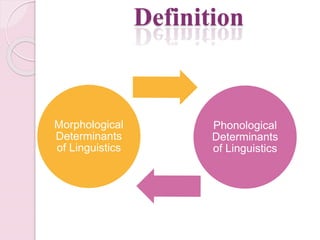
Definition
Morphological
Determinants
of Linguistics
Phonological
Determinants
of Linguistics
Principles of prosodic Morphology
 (adapted from McCarthy & Prince 1998)
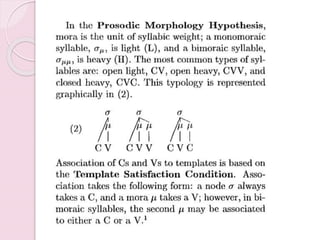
 (a) Prosodic Morphology Hypothesis When morphological processes
have special annotations concerning sound shape, these conditions are
defined in terms of the units of the prosodic hierarchy
 (b) Template Satisfaction Condition (phonological template) The way
in which prosodically determined units are filled with segmental
material is determined by principles of prosody, general and language-
specific 7 Principles of Prosodic Morphology (adapted from McCarthy
& Prince 1998)
 (c) Prosodic Circumscription The domain to which morphological
operations apply may be defined by prosodic criteria as well as
morphological ones
 The template and Circumscription must be formulated in terms of
Prosodic hierarchy and must respect the well-formedness requirements
in terms of the vocabulary.
Example
The following is an example of reduplication from Ilokano. As in many
languages,
reduplication expresses plurality on nouns:
káldíN ‘goat’ kál-káldíN ‘goats’
púsa ‘cat’ pús-pusa ‘cats’
kláse ‘class’ klas-kláse ‘classes’
Prosodic Theory within Prosodic
Morphology
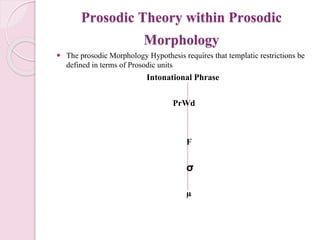
 The prosodic Morphology Hypothesis requires that templatic restrictions be
defined in terms of Prosodic units
Intonational Phrase
PrWd
F
σ
µ
Feet
 Words are made up of rhythmic units called feet and these
comprise one or more syllables. Feet represent the rhythmic
structure of the word and are the units that allow us to describe
stress patterns.
 FOOT TYPE
Iambic Trochaic Syllabic
LH H, LL σ σ
LL, H
Iambic: Last syllable in the foot is strong erase
Trochaic: First syllable in the foot is strong razor
Minimal word
 Foot Binarity: Feet are binaric under syllabic or moraic analysis
 Light syllables are unfooted
 Unfooted syllables are immediately dominated by PrWd
Minimal Word: is a notion or theory that is constituted of both :
The Prosodic Hierarchy (that obliges the existence of one foot)and Foot
Binarity ( every foot must be bimoraic or disyllabic)
Minimal Word = Prosodic Hierarchy+ Foot Binarity
Thus, A prosodic word must contain at least two moras or
syllables.
Quantity
sensitive lges
• The minimal
word is
bimoraic
Quantity
insensitive lges
• All syllables
are
monomoraic
and the
minimal word
is disyllabic
Example from Darija, Schwa epenthesis
 We can explain the movement of schwa from CVəC to CəVCCVC
by referring to the Minimal Word Hypothesis and the morafication
process in Arabic is a quantity sensitive language. Thus the minimal
word is bimoraic at the masculine case and dissyllabic.
Example
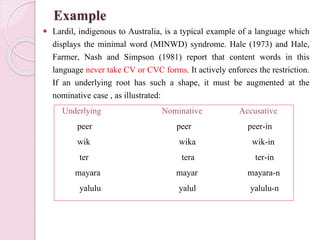
 Lardil, indigenous to Australia, is a typical example of a language which
displays the minimal word (MINWD) syndrome. Hale (1973) and Hale,
Farmer, Nash and Simpson (1981) report that content words in this
language never take CV or CVC forms. It actively enforces the restriction.
If an underlying root has such a shape, it must be augmented at the
nominative case , as illustrated:
Underlying Nominative Accusative
peer peer peer-in
wik wika wik-in
ter tera ter-in
mayara mayar mayara-n
yalulu yalul yalulu-n
Correlation Properties of PWM
1. Economy: observed word minimality restrictions are the result of the
combination of two requirements: the Prosodic Hierarchy and Foot
Binarity.
2. Role of Quantity: the nature of the smallest prosodic word in any
language is fully determined by its prosody, disyllabic if quantity
insensitive, bimoraic if quantity-sensitive.
3.No iambic minimum: Though LH is a type of foot, no language can
demand a LH minimal word. Even in languages with iambic prosody,
the minimal prosodic word will be the minimal iamb, which is simply
any iamb that satisfies Foot Binarity.
4.Enforcement: as syllabic well formdness requirements may lead to
empenthesis or block syncope.
Limitations
 Only possible in cases where the underlying constraints are violated:
Languages with 0 feets( no effect of word minimality)
At which level it PWM is applies ?: stem, morpho word,root,or the
PrWrd
 This observation of interlinguistic variation is expressed by differing
values of Mcat in the following schema( McCarthy and price
1991,1993)
Mcat = PrWrd
Where Mcat = Root, stem, Lexical word, etc
Correlation Properties of MCat = PrWd
 Upward inheritance
 Fineness of grain
 Function word escape
 MCat = Pcat
The schema MCat = PrWd provides the interface
between the phonological theory of word minimality (based
on the Prosodic Hierarchy and Foot Binarity) and the
morphology and lexicon of a language.
Example
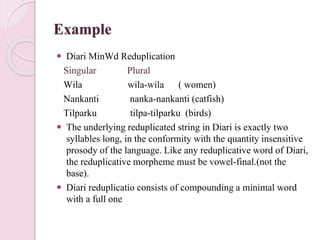
 Diari MinWd Reduplication
Singular Plural
Wila wila-wila ( women)
Nankanti nanka-nankanti (catfish)
Tilparku tilpa-tilparku (birds)
 The underlying reduplicated string in Diari is exactly two
syllables long, in the conformity with the quantity insensitive
prosody of the language. Like any reduplicative word of Diari,
the reduplicative morpheme must be vowel-final.(not the
base).
 Diari reduplicatio consists of compounding a minimal word
with a full one
 The template as a base
 The template as Affix
 Prosodic circumscription
 The Prosodic Character of Templates and
Circumscription
 Prosodic Morphology within Optimality Theory
Prosodic Morphology

Prosodic Morphology

  • 1.
    Prosodic Morphology Introduction: • whyProsodic Morphology? •Definition •Principles of Prosodic Morphology Prosodic Theory within Prosodic Morphology •Prosodic Theory •Feet •Minimal word •Examples Created by:Harrif Maroua
  • 2.
    WHY?  Reduplication Some languageshave total reduplication like Indonesian Plurals: Rumah ‘House’ Rumah-Rumah’Houses’ What does the sound shape of this type of word or morpheme look like? - Not a consistent set of phonemes - Not a consistent set of CV elements(Marantz) - Not a consistent X timing units (Levis 1985) - Its sound shape consists of instructions to copy materials from the base. All of it .  ==>Is explained only in terms of the categories of the prosodic hierarchy . Speakers copy enough material to make a foot, copy enough material to make a syllable they make the syllable minimal (CV) include as many segments as possible and respecting the minimality condition.
  • 3.
     Trunction Some morphologicalprocesses involve the removal of phonological material from the base, rather than addition. Example : Moroccan Nicknames: Simohammed Simo. Etc Many truncation processes use the categories of the prosodic hierarchy to characterize the shape of their forms  Arabic Verb Paradigm A salient example of non-concatinative morphological operations is the Standard Arabic Stated by McCarthy (1979,1981). The derivational Arabic Verb Paradigm is based on Consonants that are considered as roots. Since then, the focus of morphology and phonology expanded beyond the European Languages to the rest of the globe and seek to solve prbms… WHY?
  • 4.
    Definition  Auto-segmental theory(Skeletal): explode the segments by introducing ‘Floating Features ‘ (distinctive) underspecified Timing Units that morphemes may consist of. It consist of: Autosegmantal tiers of tone, the obligatory contour principle, and a set of Universal Association Conventions  Prosodic Morphology ( templatic Morphology): Takes the representation of timing units to a new level, enabling a more insightful characterization of templatic morphological form. This new representational flexibility enables phonologists to posite( to assume) underlying representations for Morphemes (or words) that are more general and can be applied to a wide range of morphophonological patterns.  A theory of how Prosodic structure impinges on templatic and circumscriptional Morphology
  • 5.
  • 6.
    Principles of prosodicMorphology  (adapted from McCarthy & Prince 1998)  (a) Prosodic Morphology Hypothesis When morphological processes have special annotations concerning sound shape, these conditions are defined in terms of the units of the prosodic hierarchy  (b) Template Satisfaction Condition (phonological template) The way in which prosodically determined units are filled with segmental material is determined by principles of prosody, general and language- specific 7 Principles of Prosodic Morphology (adapted from McCarthy & Prince 1998)  (c) Prosodic Circumscription The domain to which morphological operations apply may be defined by prosodic criteria as well as morphological ones  The template and Circumscription must be formulated in terms of Prosodic hierarchy and must respect the well-formedness requirements in terms of the vocabulary.
  • 7.
    Example The following isan example of reduplication from Ilokano. As in many languages, reduplication expresses plurality on nouns: káldíN ‘goat’ kál-káldíN ‘goats’ púsa ‘cat’ pús-pusa ‘cats’ kláse ‘class’ klas-kláse ‘classes’
  • 8.
    Prosodic Theory withinProsodic Morphology  The prosodic Morphology Hypothesis requires that templatic restrictions be defined in terms of Prosodic units Intonational Phrase PrWd F σ µ
  • 10.
    Feet  Words aremade up of rhythmic units called feet and these comprise one or more syllables. Feet represent the rhythmic structure of the word and are the units that allow us to describe stress patterns.  FOOT TYPE Iambic Trochaic Syllabic LH H, LL σ σ LL, H Iambic: Last syllable in the foot is strong erase Trochaic: First syllable in the foot is strong razor
  • 11.
    Minimal word  FootBinarity: Feet are binaric under syllabic or moraic analysis  Light syllables are unfooted  Unfooted syllables are immediately dominated by PrWd Minimal Word: is a notion or theory that is constituted of both : The Prosodic Hierarchy (that obliges the existence of one foot)and Foot Binarity ( every foot must be bimoraic or disyllabic) Minimal Word = Prosodic Hierarchy+ Foot Binarity Thus, A prosodic word must contain at least two moras or syllables.
  • 12.
    Quantity sensitive lges • Theminimal word is bimoraic Quantity insensitive lges • All syllables are monomoraic and the minimal word is disyllabic
  • 13.
    Example from Darija,Schwa epenthesis  We can explain the movement of schwa from CVəC to CəVCCVC by referring to the Minimal Word Hypothesis and the morafication process in Arabic is a quantity sensitive language. Thus the minimal word is bimoraic at the masculine case and dissyllabic.
  • 14.
    Example  Lardil, indigenousto Australia, is a typical example of a language which displays the minimal word (MINWD) syndrome. Hale (1973) and Hale, Farmer, Nash and Simpson (1981) report that content words in this language never take CV or CVC forms. It actively enforces the restriction. If an underlying root has such a shape, it must be augmented at the nominative case , as illustrated: Underlying Nominative Accusative peer peer peer-in wik wika wik-in ter tera ter-in mayara mayar mayara-n yalulu yalul yalulu-n
  • 15.
    Correlation Properties ofPWM 1. Economy: observed word minimality restrictions are the result of the combination of two requirements: the Prosodic Hierarchy and Foot Binarity. 2. Role of Quantity: the nature of the smallest prosodic word in any language is fully determined by its prosody, disyllabic if quantity insensitive, bimoraic if quantity-sensitive. 3.No iambic minimum: Though LH is a type of foot, no language can demand a LH minimal word. Even in languages with iambic prosody, the minimal prosodic word will be the minimal iamb, which is simply any iamb that satisfies Foot Binarity. 4.Enforcement: as syllabic well formdness requirements may lead to empenthesis or block syncope.
  • 16.
    Limitations  Only possiblein cases where the underlying constraints are violated: Languages with 0 feets( no effect of word minimality) At which level it PWM is applies ?: stem, morpho word,root,or the PrWrd  This observation of interlinguistic variation is expressed by differing values of Mcat in the following schema( McCarthy and price 1991,1993) Mcat = PrWrd Where Mcat = Root, stem, Lexical word, etc
  • 17.
    Correlation Properties ofMCat = PrWd  Upward inheritance  Fineness of grain  Function word escape  MCat = Pcat The schema MCat = PrWd provides the interface between the phonological theory of word minimality (based on the Prosodic Hierarchy and Foot Binarity) and the morphology and lexicon of a language.
  • 18.
    Example  Diari MinWdReduplication Singular Plural Wila wila-wila ( women) Nankanti nanka-nankanti (catfish) Tilparku tilpa-tilparku (birds)  The underlying reduplicated string in Diari is exactly two syllables long, in the conformity with the quantity insensitive prosody of the language. Like any reduplicative word of Diari, the reduplicative morpheme must be vowel-final.(not the base).  Diari reduplicatio consists of compounding a minimal word with a full one
  • 19.
     The templateas a base  The template as Affix  Prosodic circumscription  The Prosodic Character of Templates and Circumscription  Prosodic Morphology within Optimality Theory