Phrase Structure and X-Bar Theory
Presented By:
Afshan Rizwan
X-Bar Theory
• X-bar theory was developed in the 1970s to
design phrase structures in a more
theoretically sound way.
 First presented by Chomsky (1970).
 More extensively developed by Jackendoff (1977).
• X-bar theory seeks to be general.
©Andrew Carnie,2006
Cont…
X-bar theory makes the claim that
every single phrase in every single
sentence in the mental grammar of
every single human language, has
the same core organization.
It is a component of linguistic
theory which attempts to identify
syntactic features presumably
common to all those human.
languages.
©Andrew Carnie,2006
Key Concerns
Can we define phrase structure rules
in a way that cross-linguistic
properties of syntactic structures?
Can we define phrase structure rules
in a way that allows to capture
commonalities in structure within a
language? (cross-categorial)
Can we define phrase structure
rules in a way that distinguishes
complements from adjuncts?
©Andrew Carnie,2006
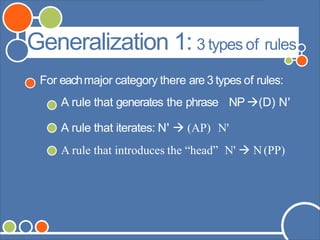
Generalization 1: 3 types of rules
For eachmajor category there are 3 types of rules:
A rule that generates the phrase NP (D) N'
A rule that iterates: N'  (AP) N'
A rule that introduces the “head” N'  N(PP)
©Andrew Carnie,2006
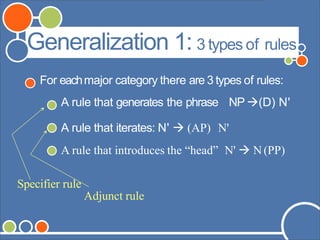
Generalization 1: 3 types of rules
For eachmajor category there are 3 types of rules:
A rule that generates the phrase NP (D) N'
A rule that iterates: N'  (AP) N'
A rule that introduces the “head” N'  N(PP)
Specifier rule
©Andrew Carnie,2006
Generalization 1: 3 types of rules
For eachmajor category there are 3 types of rules:
A rule that generates the phrase NP (D) N'
A rule that iterates: N'  (AP) N'
A rule that introduces the “head” N'  N(PP)
Specifier rule
Adjunct rule
©Andrew Carnie,2006
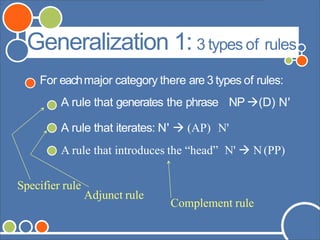
Generalization 1: 3 types of rules
For eachmajor category there are 3 types of rules:
A rule that generates the phrase NP (D) N'
A rule that iterates: N'  (AP) N'
A rule that introduces the “head” N'  N(PP)
Specifier rule
Adjunct rule
Complement rule
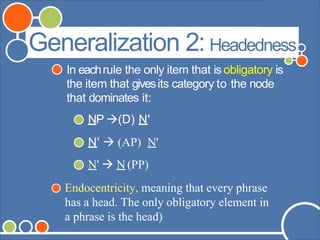
Generalization 2: Headedness
In eachrule the only item that is obligatory is
the item that givesits category to the node
that dominates it:
NP (D) N'
N'  (AP) N'
N'  N (PP)
Endocentricity, meaning that every phrase
has a head. The only obligatory element in
a phrase is the head)
©Andrew Carnie,2006
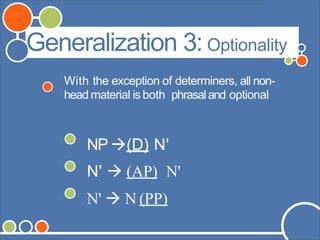
Generalization 3: Optionality
With the exception of determiners, all non-
head material is both phrasaland optional
NP (D) N'
N'  (AP) N'
N'  N (PP)
©Andrew Carnie,2006
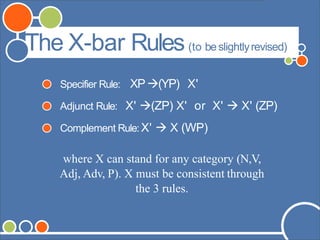
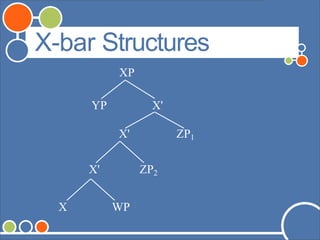
Specifier Rule: XP(YP) X'
Adjunct Rule: X' (ZP) X' or X'  X' (ZP)
Complement Rule: X'  X (WP)
where X can stand for any category (N,V,
Adj, Adv, P). X must be consistent through
the 3 rules.
The X-bar Rules(to beslightlyrevised)
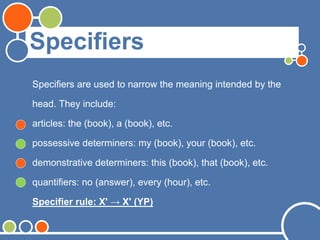
Specifiers
Specifiers are used to narrow the meaning intended by the
head. They include:
articles: the (book), a (book), etc.
possessive determiners: my (book), your (book), etc.
demonstrative determiners: this (book), that (book), etc.
quantifiers: no (answer), every (hour), etc.
Specifier rule: X' → X' (YP)
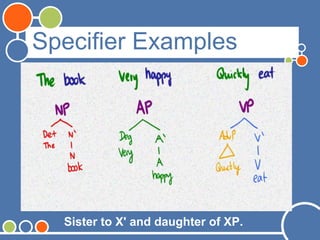
Specifier Examples
Sister to X' and daughter of XP.
Complements
Complement is the sister to a head (X,N,A,V,P) and a daughter of a
single bar level (X').
They cannot stand next to the word one.
Complements are used to complete the meaning intended by the head.
They may be:
direct objects: (do) something, (give) something
indirect objects: (laugh at) something, (give to) someone
complement of adjectives: (loyal) to the queen, (interested) in
Chemistry
complement of adverbs: (independently) from her
Complement rule X' → X (WP)
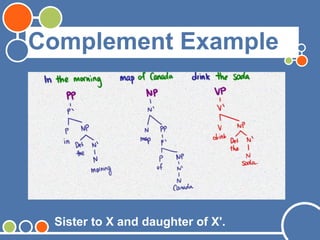
Complement Example
Sister to X and daughter of X'.
Adjuncts
An XP that is the sister to bar level (N',A',V',P') and
daughter of a single bar level (N',A',V',P').
Sister to X' and daughter of X'.
Adjuncts are used to modify the meaning intended by the head:
adjectives: beautiful (table)
adverbs: (speak) slowly
prepositional phrases: (table) of wood
Adjunct rule: X' → X' (ZP)
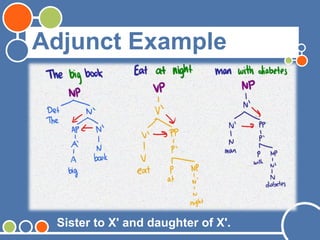
Adjunct Example
Sister to X' and daughter of X'.
Let's Draw it!
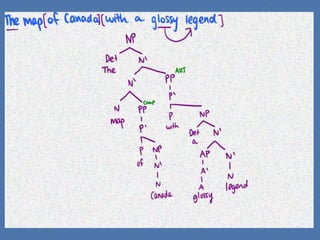
the map [of Canada] [with a glossy
legend]
Eats [dinner] [with his wife]
©Andrew Carnie,2006
X-bar Structures
XP
X'
X' ZP1
X' ZP2
YP
X WP
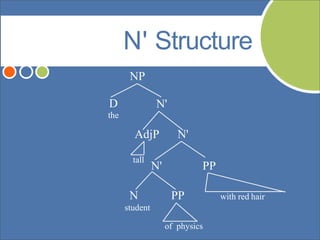
N' Structure
NP
D
the
N'
PPN
student
of physics
with red hair
PP
AdjP N'
tall
N'
©Andrew Carnie,2006
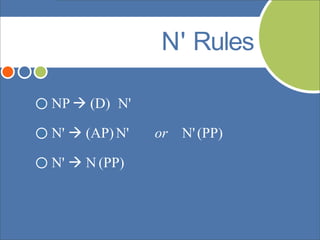
N' Rules
NP  (D) N'
or N'(PP)N'  (AP)N'
N'  N (PP)
©Andrew Carnie,2006
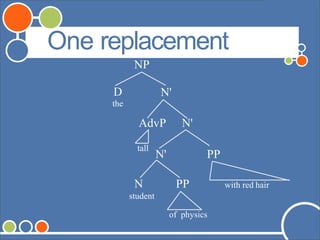
One-Replacement
Replace an N' node with[one]
not N, not NP
One replacement
NP
D
the
N'
PPN
student
with red hair
PP
AdvP N'
tall
N'
of physics
©Andrew Carnie,2006
the short [one]
with brown hair
One replacement
NP
D
the
N'
N PP with red hair
PP
AdvP N'
tall
N'
student
*the short [one] of chemistry
of physics
©Andrew Carnie,2006
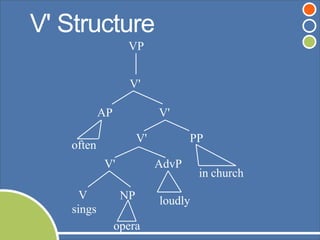
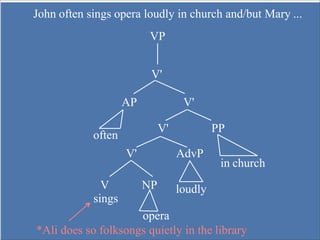
V'
AP V'
V' PP
V' AdvP
NP
often
V
sings
opera
loudly
in church
V' Structure
VP
©Andrew Carnie,2006
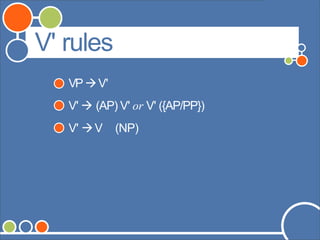
V' rules
VPV'
V'  (AP) V' or V' ({AP/PP})
V' V (NP)
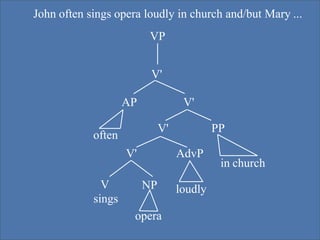
Do-so replacement
replace a V' node with [did so]
not VP, not V
John often sings opera loudly in church and/but Mary ...
VP
V'
AP V'
V' PP
V' AdvP
NP
often
V
sings
opera
loudly
in church
John often sings opera loudly in church and/but Mary ...
VP
V'
AP V'
V' PP
V' AdvP
V NP
often
loudly
in church
sings
opera
*Ali does so folksongs quietly in the library
©Andrew Carnie,2006
John often sings opera loudly in church and/but Mary ...
Ali [does so]
VP
V'
AP V'
V' PP
V' AdvP
often
in church
quietly in the
library
V
sings
NP loudly
opera
*seldom does so folksongs quietly in the library
©Andrew Carnie,2006
John often sings opera loudly in church and/but Mary ...
seldom [does so]
Ali [does so] in
the library
VP
V'
AP V'
V' PP
V' AdvP
often
in church
quietly in the
library
V
sings
NP loudly
opera
*seldom does so folksongs quietly in the library
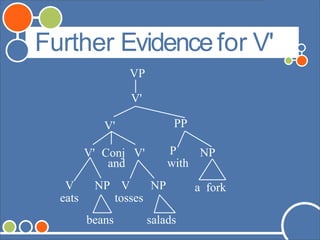
Further Evidencefor V'
VP
V'
V' PP
NPV' Conj V'
and
P
with
V NP V NP
eats tosses
beans salads
a fork
©Andrew Carnie,2006
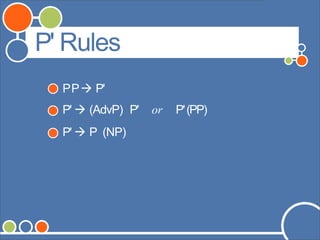
P' Rules
PP P'
P'  (AdvP) P' or P'(PP)
P'  P (NP)
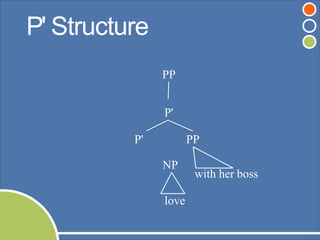
P'
P' PP
NP
PP
love
with her boss
P' Structure
©Andrew Carnie,2006
©Andrew Carnie,2006
Is there intermediate structure in AdjP and
AdvPs?
There certainly are adjuncts:
Jhonis interested in syntax but less[so] in
phonology
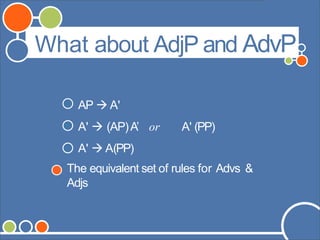
What about AdjP and AdvP
©Andrew Carnie,2006
AP  A'
A'  (AP)A’ or A' (PP)
A'  A(PP)
The equivalent set of rules for Advs &
Adjs
What about AdjP and AdvP
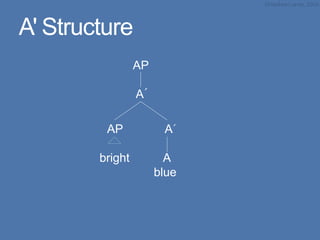
A' Structure
AP
A’
AP A’
bright A
blue
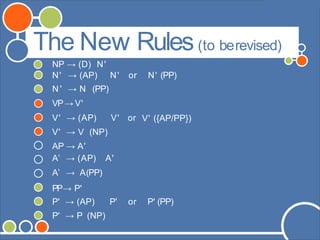
The New Rules(to berevised)
NP → (D) N'
or N' (PP)N' → (AP) N'
N ' → N (PP)
VP→ V'
V' → (AP) V' or
V' → V (NP)
AP → A'
A’ → (AP) A'
A’ → A(PP)
PP→ P'
P' → (AP) P' or P' (PP)
P' → P (NP)
V' ({AP/PP})
©Andrew Carnie,2006
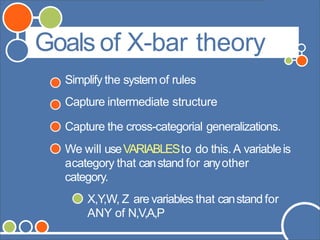
Goals of X-bar theory
Simplify the system of rules
Capture intermediate structure
Capture the cross-categorial generalizations.
We will useVARIABLESto do this.A variableis
acategory that canstand for anyother
category.
X,Y,W, Z are variables that canstand for
ANY of N,V,A,P
Conclusion
 X-bar theory provides us with an avenue
for exploring the differences and
similarities among languages.
 It is a method of sentence analysis that
divides the sentence into constituents, but
it states some very specific rules for doing
that.
Cont..
 In particular, x-bar theory introduced the
intermediate levels of structure called N', V', A'
and P’. The evidence for these comes from
standard constituency tests like conjunction, and
from processes like one-replacement, and do-
so-replacement.
Cont…
 We also saw that material on different
levels of structure behaved differently.
 Next we observed that our rules were
failing to capture several
generalizations about the data.
 Next, there was the observation that all
trees have three levels of structure.
They all have specifiers, adjuncts and
complements.
X bar ppt

X bar ppt

  • 1.
    Phrase Structure andX-Bar Theory Presented By: Afshan Rizwan
  • 2.
    X-Bar Theory • X-bartheory was developed in the 1970s to design phrase structures in a more theoretically sound way.  First presented by Chomsky (1970).  More extensively developed by Jackendoff (1977). • X-bar theory seeks to be general.
  • 3.
    ©Andrew Carnie,2006 Cont… X-bar theorymakes the claim that every single phrase in every single sentence in the mental grammar of every single human language, has the same core organization. It is a component of linguistic theory which attempts to identify syntactic features presumably common to all those human. languages.
  • 4.
    ©Andrew Carnie,2006 Key Concerns Canwe define phrase structure rules in a way that cross-linguistic properties of syntactic structures? Can we define phrase structure rules in a way that allows to capture commonalities in structure within a language? (cross-categorial) Can we define phrase structure rules in a way that distinguishes complements from adjuncts?
  • 5.
    ©Andrew Carnie,2006 Generalization 1:3 types of rules For eachmajor category there are 3 types of rules: A rule that generates the phrase NP (D) N' A rule that iterates: N'  (AP) N' A rule that introduces the “head” N'  N(PP)
  • 6.
    ©Andrew Carnie,2006 Generalization 1:3 types of rules For eachmajor category there are 3 types of rules: A rule that generates the phrase NP (D) N' A rule that iterates: N'  (AP) N' A rule that introduces the “head” N'  N(PP) Specifier rule
  • 7.
    ©Andrew Carnie,2006 Generalization 1:3 types of rules For eachmajor category there are 3 types of rules: A rule that generates the phrase NP (D) N' A rule that iterates: N'  (AP) N' A rule that introduces the “head” N'  N(PP) Specifier rule Adjunct rule
  • 8.
    ©Andrew Carnie,2006 Generalization 1:3 types of rules For eachmajor category there are 3 types of rules: A rule that generates the phrase NP (D) N' A rule that iterates: N'  (AP) N' A rule that introduces the “head” N'  N(PP) Specifier rule Adjunct rule Complement rule
  • 9.
    Generalization 2: Headedness Ineachrule the only item that is obligatory is the item that givesits category to the node that dominates it: NP (D) N' N'  (AP) N' N'  N (PP) Endocentricity, meaning that every phrase has a head. The only obligatory element in a phrase is the head)
  • 10.
    ©Andrew Carnie,2006 Generalization 3:Optionality With the exception of determiners, all non- head material is both phrasaland optional NP (D) N' N'  (AP) N' N'  N (PP)
  • 11.
    ©Andrew Carnie,2006 Specifier Rule:XP(YP) X' Adjunct Rule: X' (ZP) X' or X'  X' (ZP) Complement Rule: X'  X (WP) where X can stand for any category (N,V, Adj, Adv, P). X must be consistent through the 3 rules. The X-bar Rules(to beslightlyrevised)
  • 12.
    Specifiers Specifiers are usedto narrow the meaning intended by the head. They include: articles: the (book), a (book), etc. possessive determiners: my (book), your (book), etc. demonstrative determiners: this (book), that (book), etc. quantifiers: no (answer), every (hour), etc. Specifier rule: X' → X' (YP)
  • 13.
    Specifier Examples Sister toX' and daughter of XP.
  • 14.
    Complements Complement is thesister to a head (X,N,A,V,P) and a daughter of a single bar level (X'). They cannot stand next to the word one. Complements are used to complete the meaning intended by the head. They may be: direct objects: (do) something, (give) something indirect objects: (laugh at) something, (give to) someone complement of adjectives: (loyal) to the queen, (interested) in Chemistry complement of adverbs: (independently) from her Complement rule X' → X (WP)
  • 15.
    Complement Example Sister toX and daughter of X'.
  • 16.
    Adjuncts An XP thatis the sister to bar level (N',A',V',P') and daughter of a single bar level (N',A',V',P'). Sister to X' and daughter of X'. Adjuncts are used to modify the meaning intended by the head: adjectives: beautiful (table) adverbs: (speak) slowly prepositional phrases: (table) of wood Adjunct rule: X' → X' (ZP)
  • 17.
    Adjunct Example Sister toX' and daughter of X'.
  • 18.
    Let's Draw it! themap [of Canada] [with a glossy legend] Eats [dinner] [with his wife]
  • 20.
  • 21.
  • 22.
  • 23.
    ©Andrew Carnie,2006 N' Rules NP (D) N' or N'(PP)N'  (AP)N' N'  N (PP)
  • 24.
    ©Andrew Carnie,2006 One-Replacement Replace anN' node with[one] not N, not NP
  • 25.
    One replacement NP D the N' PPN student with redhair PP AdvP N' tall N' of physics
  • 26.
    ©Andrew Carnie,2006 the short[one] with brown hair One replacement NP D the N' N PP with red hair PP AdvP N' tall N' student *the short [one] of chemistry of physics
  • 27.
    ©Andrew Carnie,2006 V' AP V' V'PP V' AdvP NP often V sings opera loudly in church V' Structure VP
  • 28.
    ©Andrew Carnie,2006 V' rules VPV' V' (AP) V' or V' ({AP/PP}) V' V (NP)
  • 29.
    Do-so replacement replace aV' node with [did so] not VP, not V
  • 30.
    John often singsopera loudly in church and/but Mary ... VP V' AP V' V' PP V' AdvP NP often V sings opera loudly in church
  • 31.
    John often singsopera loudly in church and/but Mary ... VP V' AP V' V' PP V' AdvP V NP often loudly in church sings opera *Ali does so folksongs quietly in the library
  • 32.
    ©Andrew Carnie,2006 John oftensings opera loudly in church and/but Mary ... Ali [does so] VP V' AP V' V' PP V' AdvP often in church quietly in the library V sings NP loudly opera *seldom does so folksongs quietly in the library
  • 33.
    ©Andrew Carnie,2006 John oftensings opera loudly in church and/but Mary ... seldom [does so] Ali [does so] in the library VP V' AP V' V' PP V' AdvP often in church quietly in the library V sings NP loudly opera *seldom does so folksongs quietly in the library
  • 34.
    Further Evidencefor V' VP V' V'PP NPV' Conj V' and P with V NP V NP eats tosses beans salads a fork
  • 35.
    ©Andrew Carnie,2006 P' Rules PPP' P'  (AdvP) P' or P'(PP) P'  P (NP)
  • 36.
    P' P' PP NP PP love with herboss P' Structure ©Andrew Carnie,2006
  • 37.
    ©Andrew Carnie,2006 Is thereintermediate structure in AdjP and AdvPs? There certainly are adjuncts: Jhonis interested in syntax but less[so] in phonology What about AdjP and AdvP
  • 38.
    ©Andrew Carnie,2006 AP A' A'  (AP)A’ or A' (PP) A'  A(PP) The equivalent set of rules for Advs & Adjs What about AdjP and AdvP
  • 39.
  • 40.
    The New Rules(toberevised) NP → (D) N' or N' (PP)N' → (AP) N' N ' → N (PP) VP→ V' V' → (AP) V' or V' → V (NP) AP → A' A’ → (AP) A' A’ → A(PP) PP→ P' P' → (AP) P' or P' (PP) P' → P (NP) V' ({AP/PP})
  • 41.
    ©Andrew Carnie,2006 Goals ofX-bar theory Simplify the system of rules Capture intermediate structure Capture the cross-categorial generalizations. We will useVARIABLESto do this.A variableis acategory that canstand for anyother category. X,Y,W, Z are variables that canstand for ANY of N,V,A,P
  • 42.
    Conclusion  X-bar theoryprovides us with an avenue for exploring the differences and similarities among languages.  It is a method of sentence analysis that divides the sentence into constituents, but it states some very specific rules for doing that.
  • 43.
    Cont..  In particular,x-bar theory introduced the intermediate levels of structure called N', V', A' and P’. The evidence for these comes from standard constituency tests like conjunction, and from processes like one-replacement, and do- so-replacement.
  • 44.
    Cont…  We alsosaw that material on different levels of structure behaved differently.  Next we observed that our rules were failing to capture several generalizations about the data.  Next, there was the observation that all trees have three levels of structure. They all have specifiers, adjuncts and complements.