Wireless Sensor Networks
• A collection of sensing devices that can
communicate wirelessly
• Each device can sense, process, and
talk to its peers
• Typically, centralized collection point
(sink or base station)
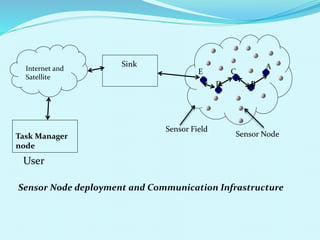
Sensor Node deployment and Communication Infrastructure
Internet and
Satellite
Task Manager
node
Sink A
B
C
D
E
Sensor Field
Sensor Node
User
Sensor Node
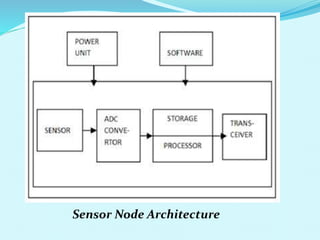
A sensing node has 3 basic components:
CPU
 radio transceiver
sensor array
Sensor Node Architecture
Sensors
A sensor is a small hardware device
which is capable of generating response
to change in physical environment.
Although sensors are of different type
which are application specific but
desired characteristics of a sensor node
are small size and low power
consumption
Energy conservation
• Goal: unsupervised operation with
no maintenance
• Nodes need to conserve energy
• Radio is power-hungry!
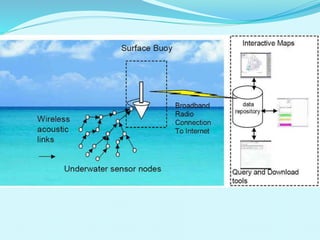
A WSN typically has little or no
infrastructure. It consists of a
number of sensor nodes (few tens
to thousands) working together to
monitor a region to obtain data
about the environment.
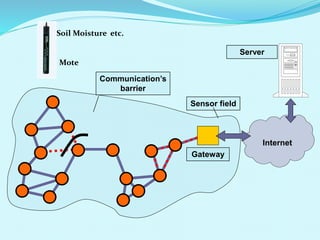
Gateway
Server
Internet
Communication’s
barrier
Sensor field
Soil Moisture etc.
Mote
Applications
WSN applications can be classified into two
categories:
•Monitoring
•Tracking
Monitoring applications
•indoor/outdoor environmental monitoring viz., agriculture,
air / water pollution
•health and wellness monitoring, power monitoring, inventory
•location monitoring, factory and process automation viz.,
pipeline
•seismic and structural monitoring.
Tracking objects
•animals
•humans
•vehicles.
Health Applications
Sensor networks are also widely used in
health care area. In some modern hospital
sensor networks are constructed to monitor
patient physiological data, to control the drug
administration track and monitor patients and
doctors and inside a hospital. They support
fall detection, unconsciousness detection,
vital sign monitoring and dietary/exercise
monitoring.
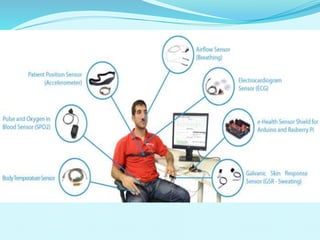
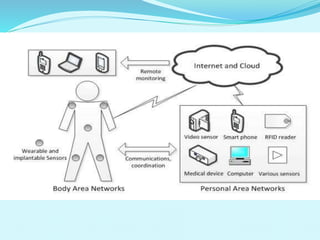
WSNs are also used to form BAN(Body Area
Network) which is placed close to body of
patient and is used to monitor patient’s heart
beat rate and breath rate and movements.
Military Applications
Sensor networks can provide variety of
services to military and air force like
information collection, battlefield surveillance,
intrusion detection and attack detection. In
this field of application sensor networks have
quite an advantage over other networks
because enemy attacks can damage or
destroy some of the nodes but nodes failure
in WSN doesn’t affect the whole network.
Intrusion detection
Sensor network can be used as a 2-phase in
Intrusion Detection System. Instead of using
mines intrusion can be detected by
establishing sensor network in that area.
Mines are dangerous to civilians so instead
sensor nodes sense the detection and alarm
the army. The response to prevent intrusion is
now decided by the military.
Enemy Tracking and target classification
Objects moving with significant metallic
content can be detected using specially
designed sensors. So enemies can be tracked
and civilians are ignored. This system
specially helps in detecting armed soldiers
and vehicles.
Battlefield surveillance
Critical areas and borders can be
closely monitored using sensor
networks to obtain information
about any enemy activity in that
area. This provides quick gathering
of information provides time for
quick response.
Battlefield damage assessment
Sensor networks can be deployed
after the battle or attacks to gather
information of damage assessment.
Detection of NBC attacks
Sensor networks can be used as Nuclear,
Biological and Chemical warning system. If
any nuclear biological or chemical agents can
be detected by sensors and embedded alert
system can now send a warning message. It
provides the military critical response time to
check the situation and prevent possible
attacks which can save lives of many.
Targeting system
Sensors can be embedded in weapons.
Exact information about the target like
distance, angle can be collected and
sent to the shooter. So sensors can be
collaborated with the weapons for better
target assessment.
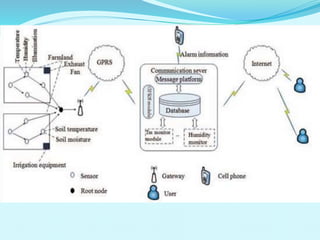
Agricultural Monitoring
WSN in agriculture helps in distributed
data collection, monitoring in harsh
environments, precise irrigation and
fertilizer supply to produce profuse crop
production while diminishing cost and
assisting farmers in real time data
gathering.
The proposed agricultural environment
monitoring server system collects
environmental and soil information on the
outdoors through WSN-based environmental
and soil sensors.
Applications
WSNs can be used for studying the local environment which is helpful in
agriculture. Sensors are used to monitor the
following conditions:
Temperature
Humidity
Soil moisture
Wind speed and direction
Rainfall
Sunshine
Level of CO2
Precision Agriculture
Precision agriculture is a method of farm management that
enables farmers to produce more efficiently through a frugal use
of resources.
Motivation:
•traditionally, a large farm is taken as homogeneous field in
terms of resource distribution and its response to climate
change, weeds, and pests
•accordingly, farmers administer
•fertilizers, pesticides, herbicides, and water resources
•in reality, wide spatial diversity in soil types, nutrient content,
and other important factors
Requirements of precision agriculture technologies
•collect a large amount of data
•over several days
•monitoring the humidity and temperature
conditions in the field
•monitoring the wetness
•determining the potential risk of the disease and
the need for fungicides
Environmental
Applications
Another major area of application of WSN is
environmental monitoring. WSNs are
deployed for habitat monitoring,
flood detections , forest fire detection etc.
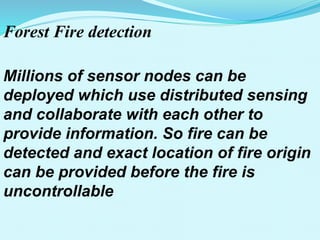
Forest Fire detection
Millions of sensor nodes can be
deployed which use distributed sensing
and collaborate with each other to
provide information. So fire can be
detected and exact location of fire origin
can be provided before the fire is
uncontrollable
Flood detection
ALERT systems use sensors for
rain, water level and weather.
Information collected by these
sensors can forecast the possible
flood threats thus providing help for
disaster management.
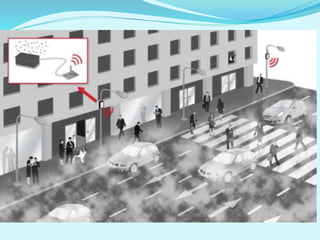
Pollution Monitoring
WSNs can be deployed for monitoring the
level of pollution and warning generation.
Air Pollution Monitoring Systems are
deployed in cities like London and Brisbane
to monitor the level of pollutants.
These sensor networks look for amount of
poisonous gases and these statistics are
studied to analyze if pollution has increased
and take actions to check pollution
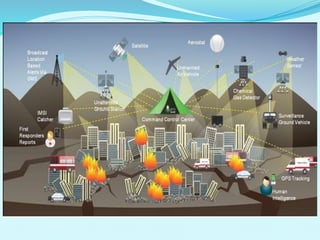
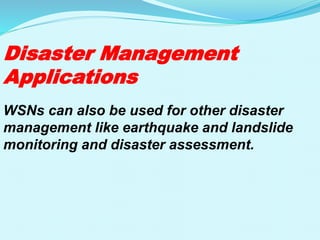
Disaster Management
Applications
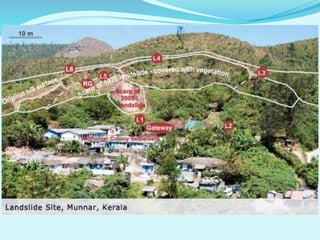
WSNs can also be used for other disaster
management like earthquake and landslide
monitoring and disaster assessment.
Disaster monitoring
Motivation
•most of Earth’s changes of
climate are hidden from view
•at present, typical changes are
monitored using expensive
devices that are difficult to move
•the deployment and maintenance
of these devices require expensive
assistance
•data storage must be retrieved on
a periodic basis
WSNs can be very useful for weather /
climate monitoring
•a large number of small, cheap,
and self-organizing nodes
•can be deployed to cover a vast
field
Advantage of WSNs in active disaster
monitoring
•fast and economical deployment
•possible to achieve high spatial
diversity
•the networks can operate without
requiring stringent maintenance
routines
An important task in active disaster
monitoring is to capture discrete events
•eruptions, earthquakes, or tremor
activities
•these events are transient
•occurring several times a day
Therefore, the researchers used the raw
data to investigate volcanic activities
the samples must be accurately time
stamped to allow comparisons
between correlated measurements
Conclusion
•WSNs are suitable for capturing
triggered events
•WSNs are inadequate for
capturing complete waveforms for
a long period of time
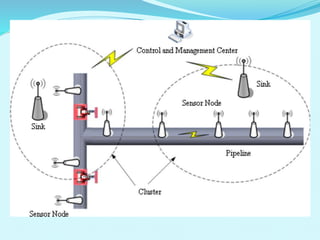
Pipeline Monitoring
Monitoring gas, water and oil
pipelines
Motivation:
•management of pipelines
presents a formidable challenge
•long length, high value, high
risk
•difficult access conditions
•requires continuous and
unobtrusive monitoring
Pipeline leakages can occur due to
excessive deformations
•Earthquakes
•landslides or collisions with an
external force
•corrosion, wear, material flaws
•intentional damage to the
structure
To detect leakages, it is vital to
understand the characteristics of the
substance the pipelines transport
•fluid pipelines generate a hot-spot
at the location of the leak
•gas pipelines generate a cold-spot
due to the gas pressure relaxation
•fluid travels at a higher
propagation velocity in metal
pipelines than in a Polyvinyl
Chloride (PVC)
•a large number of commercially
available sensors to detect and
localize thermal anomalies
•fiber optics sensors
•temperature sensors
•acoustic sensors
The PipeNet prototype
The task is to monitor
•hydraulic and water quality by measuring
pressure and pH
•the water level in combined sewer system
•sewer collectors and combined sewer
outflows
Industrial Sensing
Managing inventory control
Each item in a warehouse may have a sensor
node attached to it. The end users can
find out the exact location of the item with the
help of sensor and tally the number of items
in the same category stored in
the database.
Structural Health
Monitoring
Motivation
events:
•on August 2, 2007, a highway bridge unexpectedly
collapsed in Minnesota
•nine people were killed in the event
•potential causes: wear and tear, weather, and the
weight of a nearby construction project
•in fact, the BBC reported (August 14, 2007) that China
had identified more than 6,000 bridges that were
damaged or considered to be dangerous
these accidents motivate wireless
sensor networks for monitoring
bridges and similar structures
Motivation
traditional inspections
•visual inspection  everyday
•labor-intensive, tedious, inconsistent, and
subjective
•basic inspections  at least once a year
•detailed inspection  at least every five years
on selected bridges
•special inspections  according to technical
needs
•the rest require sophisticated tools 
expensive, bulky, and power consuming
Underground Mining
Motivation:
one of the most dangerous work
environments in the world incident
of August 3, 2007 at the Crandall
Canyon mine, Utah, USA
•six miners were trapped inside
the coal mine
•their precise location was not
known
•the owners of the mine claimed
a natural earthquake was the
cause while scientists suspect
the mine operations caused
seismic spikes
•a costly and irksome rescue
attempt went underway
Advantages of WSNs over traditional methods
Wide coverage
Long monitoring periods
No individual tracking
Data available directly to researcher’s
location
Land and Aquatic Coverage
Continuous monitoring
WSN Operating
Systems
•TinyOS
•Contiki
•MANTIS
•Btnut
•SOS
•Nano-RK
TinyOS:
•Event-driven programming model
instead of multithreading
•TinyOS and its programs written in
nesC
TinyOS Charactersitics:
•Small memory footprint
non-preemptable FIFO task
scheduling
•Power Efficient
Puts microcontroller to sleep
Puts radio to sleep
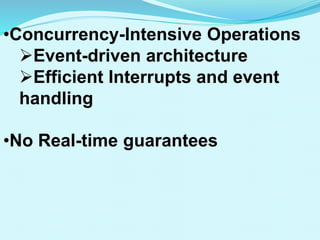
•Concurrency-Intensive Operations
Event-driven architecture
Efficient Interrupts and event
handling
•No Real-time guarantees
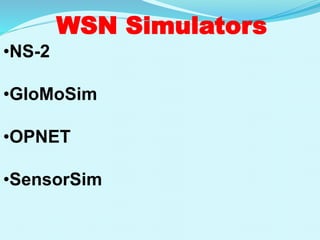
WSN Simulators
•NS-2
•GloMoSim
•OPNET
•SensorSim
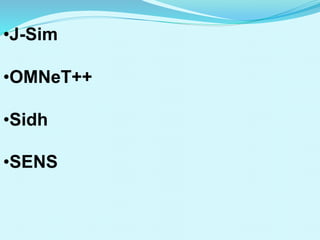
•J-Sim
•OMNeT++
•Sidh
•SENS
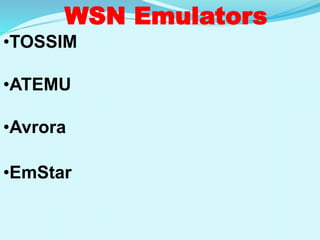
WSN Emulators
•TOSSIM
•ATEMU
•Avrora
•EmStar
Wireless Sensor Networks

Wireless Sensor Networks

  • 3.
    Wireless Sensor Networks •A collection of sensing devices that can communicate wirelessly • Each device can sense, process, and talk to its peers • Typically, centralized collection point (sink or base station)
  • 4.
    Sensor Node deploymentand Communication Infrastructure Internet and Satellite Task Manager node Sink A B C D E Sensor Field Sensor Node User
  • 5.
    Sensor Node A sensingnode has 3 basic components: CPU  radio transceiver sensor array
  • 6.
  • 7.
    Sensors A sensor isa small hardware device which is capable of generating response to change in physical environment. Although sensors are of different type which are application specific but desired characteristics of a sensor node are small size and low power consumption
  • 8.
    Energy conservation • Goal:unsupervised operation with no maintenance • Nodes need to conserve energy • Radio is power-hungry!
  • 9.
    A WSN typicallyhas little or no infrastructure. It consists of a number of sensor nodes (few tens to thousands) working together to monitor a region to obtain data about the environment.
  • 10.
  • 11.
    Applications WSN applications canbe classified into two categories: •Monitoring •Tracking
  • 12.
    Monitoring applications •indoor/outdoor environmentalmonitoring viz., agriculture, air / water pollution •health and wellness monitoring, power monitoring, inventory •location monitoring, factory and process automation viz., pipeline •seismic and structural monitoring.
  • 13.
  • 14.
    Health Applications Sensor networksare also widely used in health care area. In some modern hospital sensor networks are constructed to monitor patient physiological data, to control the drug administration track and monitor patients and doctors and inside a hospital. They support fall detection, unconsciousness detection, vital sign monitoring and dietary/exercise monitoring.
  • 16.
    WSNs are alsoused to form BAN(Body Area Network) which is placed close to body of patient and is used to monitor patient’s heart beat rate and breath rate and movements.
  • 18.
    Military Applications Sensor networkscan provide variety of services to military and air force like information collection, battlefield surveillance, intrusion detection and attack detection. In this field of application sensor networks have quite an advantage over other networks because enemy attacks can damage or destroy some of the nodes but nodes failure in WSN doesn’t affect the whole network.
  • 20.
    Intrusion detection Sensor networkcan be used as a 2-phase in Intrusion Detection System. Instead of using mines intrusion can be detected by establishing sensor network in that area. Mines are dangerous to civilians so instead sensor nodes sense the detection and alarm the army. The response to prevent intrusion is now decided by the military.
  • 21.
    Enemy Tracking andtarget classification Objects moving with significant metallic content can be detected using specially designed sensors. So enemies can be tracked and civilians are ignored. This system specially helps in detecting armed soldiers and vehicles.
  • 22.
    Battlefield surveillance Critical areasand borders can be closely monitored using sensor networks to obtain information about any enemy activity in that area. This provides quick gathering of information provides time for quick response.
  • 23.
    Battlefield damage assessment Sensornetworks can be deployed after the battle or attacks to gather information of damage assessment.
  • 24.
    Detection of NBCattacks Sensor networks can be used as Nuclear, Biological and Chemical warning system. If any nuclear biological or chemical agents can be detected by sensors and embedded alert system can now send a warning message. It provides the military critical response time to check the situation and prevent possible attacks which can save lives of many.
  • 25.
    Targeting system Sensors canbe embedded in weapons. Exact information about the target like distance, angle can be collected and sent to the shooter. So sensors can be collaborated with the weapons for better target assessment.
  • 26.
    Agricultural Monitoring WSN inagriculture helps in distributed data collection, monitoring in harsh environments, precise irrigation and fertilizer supply to produce profuse crop production while diminishing cost and assisting farmers in real time data gathering.
  • 28.
    The proposed agriculturalenvironment monitoring server system collects environmental and soil information on the outdoors through WSN-based environmental and soil sensors.
  • 29.
    Applications WSNs can beused for studying the local environment which is helpful in agriculture. Sensors are used to monitor the following conditions: Temperature Humidity Soil moisture Wind speed and direction Rainfall Sunshine Level of CO2
  • 30.
    Precision Agriculture Precision agricultureis a method of farm management that enables farmers to produce more efficiently through a frugal use of resources. Motivation: •traditionally, a large farm is taken as homogeneous field in terms of resource distribution and its response to climate change, weeds, and pests •accordingly, farmers administer •fertilizers, pesticides, herbicides, and water resources •in reality, wide spatial diversity in soil types, nutrient content, and other important factors
  • 31.
    Requirements of precisionagriculture technologies •collect a large amount of data •over several days •monitoring the humidity and temperature conditions in the field •monitoring the wetness •determining the potential risk of the disease and the need for fungicides
  • 32.
    Environmental Applications Another major areaof application of WSN is environmental monitoring. WSNs are deployed for habitat monitoring, flood detections , forest fire detection etc.
  • 34.
    Forest Fire detection Millionsof sensor nodes can be deployed which use distributed sensing and collaborate with each other to provide information. So fire can be detected and exact location of fire origin can be provided before the fire is uncontrollable
  • 35.
    Flood detection ALERT systemsuse sensors for rain, water level and weather. Information collected by these sensors can forecast the possible flood threats thus providing help for disaster management.
  • 36.
    Pollution Monitoring WSNs canbe deployed for monitoring the level of pollution and warning generation. Air Pollution Monitoring Systems are deployed in cities like London and Brisbane to monitor the level of pollutants. These sensor networks look for amount of poisonous gases and these statistics are studied to analyze if pollution has increased and take actions to check pollution
  • 38.
    Disaster Management Applications WSNs canalso be used for other disaster management like earthquake and landslide monitoring and disaster assessment.
  • 40.
    Disaster monitoring Motivation •most ofEarth’s changes of climate are hidden from view •at present, typical changes are monitored using expensive devices that are difficult to move
  • 41.
    •the deployment andmaintenance of these devices require expensive assistance •data storage must be retrieved on a periodic basis
  • 42.
    WSNs can bevery useful for weather / climate monitoring •a large number of small, cheap, and self-organizing nodes •can be deployed to cover a vast field
  • 43.
    Advantage of WSNsin active disaster monitoring •fast and economical deployment •possible to achieve high spatial diversity •the networks can operate without requiring stringent maintenance routines
  • 44.
    An important taskin active disaster monitoring is to capture discrete events •eruptions, earthquakes, or tremor activities •these events are transient •occurring several times a day
  • 45.
    Therefore, the researchersused the raw data to investigate volcanic activities the samples must be accurately time stamped to allow comparisons between correlated measurements
  • 46.
    Conclusion •WSNs are suitablefor capturing triggered events •WSNs are inadequate for capturing complete waveforms for a long period of time
  • 47.
    Pipeline Monitoring Monitoring gas,water and oil pipelines Motivation: •management of pipelines presents a formidable challenge
  • 48.
    •long length, highvalue, high risk •difficult access conditions •requires continuous and unobtrusive monitoring
  • 50.
    Pipeline leakages canoccur due to excessive deformations •Earthquakes •landslides or collisions with an external force
  • 51.
    •corrosion, wear, materialflaws •intentional damage to the structure
  • 52.
    To detect leakages,it is vital to understand the characteristics of the substance the pipelines transport •fluid pipelines generate a hot-spot at the location of the leak •gas pipelines generate a cold-spot due to the gas pressure relaxation
  • 53.
    •fluid travels ata higher propagation velocity in metal pipelines than in a Polyvinyl Chloride (PVC) •a large number of commercially available sensors to detect and localize thermal anomalies
  • 54.
    •fiber optics sensors •temperaturesensors •acoustic sensors
  • 55.
    The PipeNet prototype Thetask is to monitor •hydraulic and water quality by measuring pressure and pH •the water level in combined sewer system •sewer collectors and combined sewer outflows
  • 56.
    Industrial Sensing Managing inventorycontrol Each item in a warehouse may have a sensor node attached to it. The end users can find out the exact location of the item with the help of sensor and tally the number of items in the same category stored in the database.
  • 57.
    Structural Health Monitoring Motivation events: •on August2, 2007, a highway bridge unexpectedly collapsed in Minnesota •nine people were killed in the event •potential causes: wear and tear, weather, and the weight of a nearby construction project •in fact, the BBC reported (August 14, 2007) that China had identified more than 6,000 bridges that were damaged or considered to be dangerous
  • 58.
    these accidents motivatewireless sensor networks for monitoring bridges and similar structures
  • 59.
    Motivation traditional inspections •visual inspection everyday •labor-intensive, tedious, inconsistent, and subjective •basic inspections  at least once a year •detailed inspection  at least every five years on selected bridges •special inspections  according to technical needs •the rest require sophisticated tools  expensive, bulky, and power consuming
  • 60.
    Underground Mining Motivation: one ofthe most dangerous work environments in the world incident of August 3, 2007 at the Crandall Canyon mine, Utah, USA
  • 61.
    •six miners weretrapped inside the coal mine •their precise location was not known
  • 62.
    •the owners ofthe mine claimed a natural earthquake was the cause while scientists suspect the mine operations caused seismic spikes •a costly and irksome rescue attempt went underway
  • 63.
    Advantages of WSNsover traditional methods Wide coverage Long monitoring periods No individual tracking Data available directly to researcher’s location Land and Aquatic Coverage Continuous monitoring
  • 64.
  • 65.
    TinyOS: •Event-driven programming model insteadof multithreading •TinyOS and its programs written in nesC
  • 66.
    TinyOS Charactersitics: •Small memoryfootprint non-preemptable FIFO task scheduling •Power Efficient Puts microcontroller to sleep Puts radio to sleep
  • 67.
    •Concurrency-Intensive Operations Event-driven architecture EfficientInterrupts and event handling •No Real-time guarantees
  • 68.
  • 69.
  • 70.