WIRELESS SENSOR
NETWORKS
Prepared by:
Abhinay Kumar Suraj (151210011)
9/11/2017WIRELESSSENSORNETWORKS
1
National Institute of Technology Delhi
CONTENTS
 Introduction
 Types of WSN
 Characteristics of a WSN
 Architecture components of a WSN
 Architecture of a WSN
 Characteristics of a middleware
 Concept of SOA for wireless networks
 Architectural issues
 Standards and Specifications
 Applications
 Challenges
 Advantages
 Disadvantages
 Future Scope
 Conclusion
9/11/2017
2
WIRELESSSENSORNETWORKS
INTRODUCTION
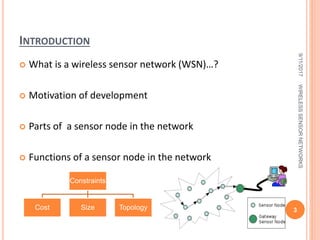
 What is a wireless sensor network (WSN)…?
 Motivation of development
 Parts of a sensor node in the network
 Functions of a sensor node in the network
9/11/2017
3
WIRELESSSENSORNETWORKS
Constraints
Cost Size Topology
SENSORS
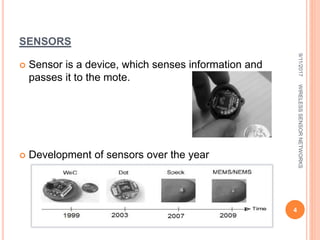
 Sensor is a device, which senses information and
passes it to the mote.
 Development of sensors over the year
9/11/2017
4
WIRELESSSENSORNETWORKS
TYPES OF WIRELESS SENSOR NETWORKS
9/11/2017WIRELESSSENSORNETWORKS
5
 Dense collection of nodes
 Ad-hoc
deployment
 Difficulty in network
maintenance
 Few and scarcely
distributed nodes
 Pre-planned deployment
 Lower network
maintenance
Unstructured WSN Structured WSN
CHARACTERISTICS OF A WSN
1. Self – Organization
2. Concurrency processing
3. Low cost
4. Restricted energy resources
5. Tiny
6. Small radio range
9/11/2017
6
WIRELESSSENSORNETWORKS
SOFTWARE ENGINEERING
 Service oriented architecture
 Applications
- Sensor Applications
- Node Applications
- Sensor Network Applications
 Sensor Application - Readout of a sensor , local storage of the data.
It has full access to the hardware and is able to access the operating
system directly.
 Node Application - Application specific tasks and functions of the
middleware to build up and maintain the network
 Sensor Network Application - Main tasks and required services of
the entire network
9/11/2017
7
WIRELESSSENSORNETWORKS
CHARACTERISTICS OF A MIDDLEWARE FOR
SENSOR NETWORK
 Middleware - software layer between operating system
and application
 Primary objective of a middleware
 A middleware has to be
1. Scalable
2. Generic
3. Adaptive
4. Reflective
9/11/2017
8
WIRELESSSENSORNETWORKS
CONCEPT OF SOA FOR WIRELESS NETWORKS
 A simple use case can help determine the software
architecture.
 Example of a simple service architecture
9/11/2017
9
WIRELESSSENSORNETWORKS
ARCHITECTURE OF NODE APPLICATION
STRUCTURE
9/11/2017
10
WIRELESSSENSORNETWORKS
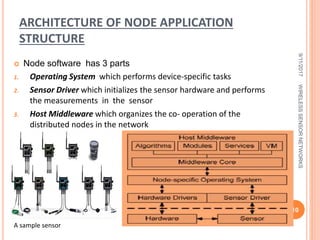
 Node software has 3 parts
1. Operating System which performs device-specific tasks
2. Sensor Driver which initializes the sensor hardware and performs
the measurements in the sensor
3. Host Middleware which organizes the co- operation of the
distributed nodes in the network
A sample sensor
OVERALL GENERAL ARCHITECTURE
 The general overall software architecture of the sensor
net is shown in the figure
 Individual nodes interact with the distributed
middleware layer to perform the functions dictated by
the sensor network application
9/11/2017
11
WIRELESSSENSORNETWORKS
ARCHITECTURAL ISSUES
 Energy efficiency
 Network topology
 Failure in long range communication
 Increase in traffic decreases the lifetime
 Single tier and multi tier architecture disadvantages
9/11/2017
12
WIRELESSSENSORNETWORKS
ARCHITECTURE – CLUSTER BASED
 Proposed to tackle the previous architectural issues
 Provides Quality of management (Qos)
 Dynamic architecture – cluster is a basic unit of software
9/11/2017
13
WIRELESSSENSORNETWORKS
STANDARDS AND SPECIFICATIONS
 Predominant standards commonly used in WSN
communications include:
1. Zig Bee - Transmit data over long distances by passing
data through intermediate devices to reach more
distant ones
2. Bluetooth - Wireless technology standard for
exchanging data over short distances from fixed and
mobile devices by creating PANs’
3. 6LoWPAN - Defined encapsulation and header
compression mechanisms that allow IPv6 packets to be
sent to and received from over IEEE 802.15.4 based
networks
9/11/2017
14
WIRELESSSENSORNETWORKS
AVAILABLE WIRELESS TECHNOLOGIES
9/11/2017
15
WIRELESSSENSORNETWORKS
APPLICATIONS OF WSN
 Area monitoring
 Health care monitoring
 Air pollution monitoring
 Forest fire detection
 Landslide detection
 Water quality monitoring
 Natural disaster prevention
 Industrial monitoring
9/11/2017
16
WIRELESSSENSORNETWORKS
TIER STRUCTURE OF WSN IN MEDICAL FIELD
9/11/2017
17
WIRELESSSENSORNETWORKS
WSN:HOME AUTOMATION
9/11/2017
18
WIRELESSSENSORNETWORKS
CHALLENGES
 Hardware :
1. Low cost
2. Tiny sensors
3. Lifetime maximization
4. Robustness and fault tolerance
5. Self-configuration
 Software :
1. Operating systems
2. Security
3. Mobility
9/11/2017
19
WIRELESSSENSORNETWORKS
ADVANTAGES OF A WSN
 Avoids a lot of wiring
 Can accommodate new devices at any time
 Flexible to go through physical partitions
 It can be accessed through a centralized monitor
 Infrastructure
9/11/2017
20
WIRELESSSENSORNETWORKS
DISADVANTAGES OF WSN
 Easy for hackers to hack a network
 Comparatively low speed of communication
 Gets distracted by various elements
 Costly at large
 Life of nodes
 Energy life
9/11/2017
21
WIRELESSSENSORNETWORKS
FUTURE SCOPE
 More research work needs to be done in future.
 Needs to be implemented in a wireless sensor network
with mobile nodes.
 The effects of very large node densities need to be
investigated.
 The feasibility of using the clustering technique and data
aggregation needs to be tested in the same wireless
sensor network.
9/11/2017
22
WIRELESSSENSORNETWORKS
FUTURE INTERNET
 Future of internet when a lot of IOT devices
participate.
 It will help current internet to scale further for future
need
 It will provides flexibility, promotes diversity, and
promises security and increased manageability
9/11/2017
23
WIRELESSSENSORNETWORKS
CONCLUSION
As described, wireless sensor networks possess the
potential for many applications. The advance of
technology enabled the creation of prototype WSNs, but
the hardware and software both have a ways to go before
WSNs are practical, cost-effective, and usefully.
9/11/2017
24
WIRELESSSENSORNETWORKS
REFERENCES
 www.wikipedia.org
 http://stakeholders.ofcom.org.uk/binaries/research/tec
hnology-research/wsn2.pdf
 http://www.researchgate.net/publication/228695105_S
ervice-
oriented_software_architecture_for_sensor_networks/f
ile/5046351a8ae5a75f8b.pdf
9/11/2017
25
WIRELESSSENSORNETWORKS
9/11/2017WIRELESSSENSORNETWORKS
26

Wireless sensor network

  • 1.
    WIRELESS SENSOR NETWORKS Prepared by: AbhinayKumar Suraj (151210011) 9/11/2017WIRELESSSENSORNETWORKS 1 National Institute of Technology Delhi
  • 2.
    CONTENTS  Introduction  Typesof WSN  Characteristics of a WSN  Architecture components of a WSN  Architecture of a WSN  Characteristics of a middleware  Concept of SOA for wireless networks  Architectural issues  Standards and Specifications  Applications  Challenges  Advantages  Disadvantages  Future Scope  Conclusion 9/11/2017 2 WIRELESSSENSORNETWORKS
  • 3.
    INTRODUCTION  What isa wireless sensor network (WSN)…?  Motivation of development  Parts of a sensor node in the network  Functions of a sensor node in the network 9/11/2017 3 WIRELESSSENSORNETWORKS Constraints Cost Size Topology
  • 4.
    SENSORS  Sensor isa device, which senses information and passes it to the mote.  Development of sensors over the year 9/11/2017 4 WIRELESSSENSORNETWORKS
  • 5.
    TYPES OF WIRELESSSENSOR NETWORKS 9/11/2017WIRELESSSENSORNETWORKS 5  Dense collection of nodes  Ad-hoc deployment  Difficulty in network maintenance  Few and scarcely distributed nodes  Pre-planned deployment  Lower network maintenance Unstructured WSN Structured WSN
  • 6.
    CHARACTERISTICS OF AWSN 1. Self – Organization 2. Concurrency processing 3. Low cost 4. Restricted energy resources 5. Tiny 6. Small radio range 9/11/2017 6 WIRELESSSENSORNETWORKS
  • 7.
    SOFTWARE ENGINEERING  Serviceoriented architecture  Applications - Sensor Applications - Node Applications - Sensor Network Applications  Sensor Application - Readout of a sensor , local storage of the data. It has full access to the hardware and is able to access the operating system directly.  Node Application - Application specific tasks and functions of the middleware to build up and maintain the network  Sensor Network Application - Main tasks and required services of the entire network 9/11/2017 7 WIRELESSSENSORNETWORKS
  • 8.
    CHARACTERISTICS OF AMIDDLEWARE FOR SENSOR NETWORK  Middleware - software layer between operating system and application  Primary objective of a middleware  A middleware has to be 1. Scalable 2. Generic 3. Adaptive 4. Reflective 9/11/2017 8 WIRELESSSENSORNETWORKS
  • 9.
    CONCEPT OF SOAFOR WIRELESS NETWORKS  A simple use case can help determine the software architecture.  Example of a simple service architecture 9/11/2017 9 WIRELESSSENSORNETWORKS
  • 10.
    ARCHITECTURE OF NODEAPPLICATION STRUCTURE 9/11/2017 10 WIRELESSSENSORNETWORKS  Node software has 3 parts 1. Operating System which performs device-specific tasks 2. Sensor Driver which initializes the sensor hardware and performs the measurements in the sensor 3. Host Middleware which organizes the co- operation of the distributed nodes in the network A sample sensor
  • 11.
    OVERALL GENERAL ARCHITECTURE The general overall software architecture of the sensor net is shown in the figure  Individual nodes interact with the distributed middleware layer to perform the functions dictated by the sensor network application 9/11/2017 11 WIRELESSSENSORNETWORKS
  • 12.
    ARCHITECTURAL ISSUES  Energyefficiency  Network topology  Failure in long range communication  Increase in traffic decreases the lifetime  Single tier and multi tier architecture disadvantages 9/11/2017 12 WIRELESSSENSORNETWORKS
  • 13.
    ARCHITECTURE – CLUSTERBASED  Proposed to tackle the previous architectural issues  Provides Quality of management (Qos)  Dynamic architecture – cluster is a basic unit of software 9/11/2017 13 WIRELESSSENSORNETWORKS
  • 14.
    STANDARDS AND SPECIFICATIONS Predominant standards commonly used in WSN communications include: 1. Zig Bee - Transmit data over long distances by passing data through intermediate devices to reach more distant ones 2. Bluetooth - Wireless technology standard for exchanging data over short distances from fixed and mobile devices by creating PANs’ 3. 6LoWPAN - Defined encapsulation and header compression mechanisms that allow IPv6 packets to be sent to and received from over IEEE 802.15.4 based networks 9/11/2017 14 WIRELESSSENSORNETWORKS
  • 15.
  • 16.
    APPLICATIONS OF WSN Area monitoring  Health care monitoring  Air pollution monitoring  Forest fire detection  Landslide detection  Water quality monitoring  Natural disaster prevention  Industrial monitoring 9/11/2017 16 WIRELESSSENSORNETWORKS
  • 17.
    TIER STRUCTURE OFWSN IN MEDICAL FIELD 9/11/2017 17 WIRELESSSENSORNETWORKS
  • 18.
  • 19.
    CHALLENGES  Hardware : 1.Low cost 2. Tiny sensors 3. Lifetime maximization 4. Robustness and fault tolerance 5. Self-configuration  Software : 1. Operating systems 2. Security 3. Mobility 9/11/2017 19 WIRELESSSENSORNETWORKS
  • 20.
    ADVANTAGES OF AWSN  Avoids a lot of wiring  Can accommodate new devices at any time  Flexible to go through physical partitions  It can be accessed through a centralized monitor  Infrastructure 9/11/2017 20 WIRELESSSENSORNETWORKS
  • 21.
    DISADVANTAGES OF WSN Easy for hackers to hack a network  Comparatively low speed of communication  Gets distracted by various elements  Costly at large  Life of nodes  Energy life 9/11/2017 21 WIRELESSSENSORNETWORKS
  • 22.
    FUTURE SCOPE  Moreresearch work needs to be done in future.  Needs to be implemented in a wireless sensor network with mobile nodes.  The effects of very large node densities need to be investigated.  The feasibility of using the clustering technique and data aggregation needs to be tested in the same wireless sensor network. 9/11/2017 22 WIRELESSSENSORNETWORKS
  • 23.
    FUTURE INTERNET  Futureof internet when a lot of IOT devices participate.  It will help current internet to scale further for future need  It will provides flexibility, promotes diversity, and promises security and increased manageability 9/11/2017 23 WIRELESSSENSORNETWORKS
  • 24.
    CONCLUSION As described, wirelesssensor networks possess the potential for many applications. The advance of technology enabled the creation of prototype WSNs, but the hardware and software both have a ways to go before WSNs are practical, cost-effective, and usefully. 9/11/2017 24 WIRELESSSENSORNETWORKS
  • 25.
    REFERENCES  www.wikipedia.org  http://stakeholders.ofcom.org.uk/binaries/research/tec hnology-research/wsn2.pdf http://www.researchgate.net/publication/228695105_S ervice- oriented_software_architecture_for_sensor_networks/f ile/5046351a8ae5a75f8b.pdf 9/11/2017 25 WIRELESSSENSORNETWORKS
  • 26.