Aplication of Wireless Sensor
      Networks (WSN)
        in Agriculture
    Precision Agriculture


                 BORATELECOM SL
                 http://www.boratelecom.com

                 Pza. de Curros Enríquez, 1. Of. 312
                 36002 Pontevedra
                 T: 986 188 983
                 E: info@boratelecom.com
WSN in Agriculture


Introduction:


    WSN is an acronym for Wireless Sensor
     Network
    Each node of the network is called MOTA
    They communicate among themselves and
     with a gateway
    This gateway can be reached from Internet
    Manufacturers:
          CrossBow: http://www.xbow.com
          Libelium: http://www.libelium.com/
          http://www.tinynode.com
          Mesh networks: http://www.tranzeo.com
          http://www.sensicast.com
WSN in Agriculture


Aplications:


   Deployment of such distributed
    sensor networks offers several
    advantages:
     ●   Diversity, scalability and higher
         density as compared to spatial
         centralized
     ●   Self-organizing robust networks
WSN in Agriculture


Components:

    The Battery currently have an
     estimated life of up to 1 year. They
     are usually Nickel Cadmium
     batteries.
    Microprocessor: the speed is often
     of several megahertz and
     has a fairly low RAM
     (about 256 Kbytes to
     256 Kbytes RAM
     and others to EEPROM).
    The Battery currently have an
     estimated life of up to 1 year.
     They are usually Nickel
     Cadmium batteries.
    Also used solar panels embedded
     with specks
WSN in Agriculture


Components (cont.)


●   The radio: IEEE 802.15.4 and
    Zigbee (future de facto standard
    that combines IEEE 802.15.4 and
    HomeRFLite above) are the most
    used
●   Sensors: are becoming smaller,
    more powerful and consume less
    energy.
●   Software:
     ●   Arduino / Processing to control
         spots
     ●   You can also use the NESC language
         (similar to the C language) on
         embedded operating systems like
         TinyOS.
WSN in Agricultura


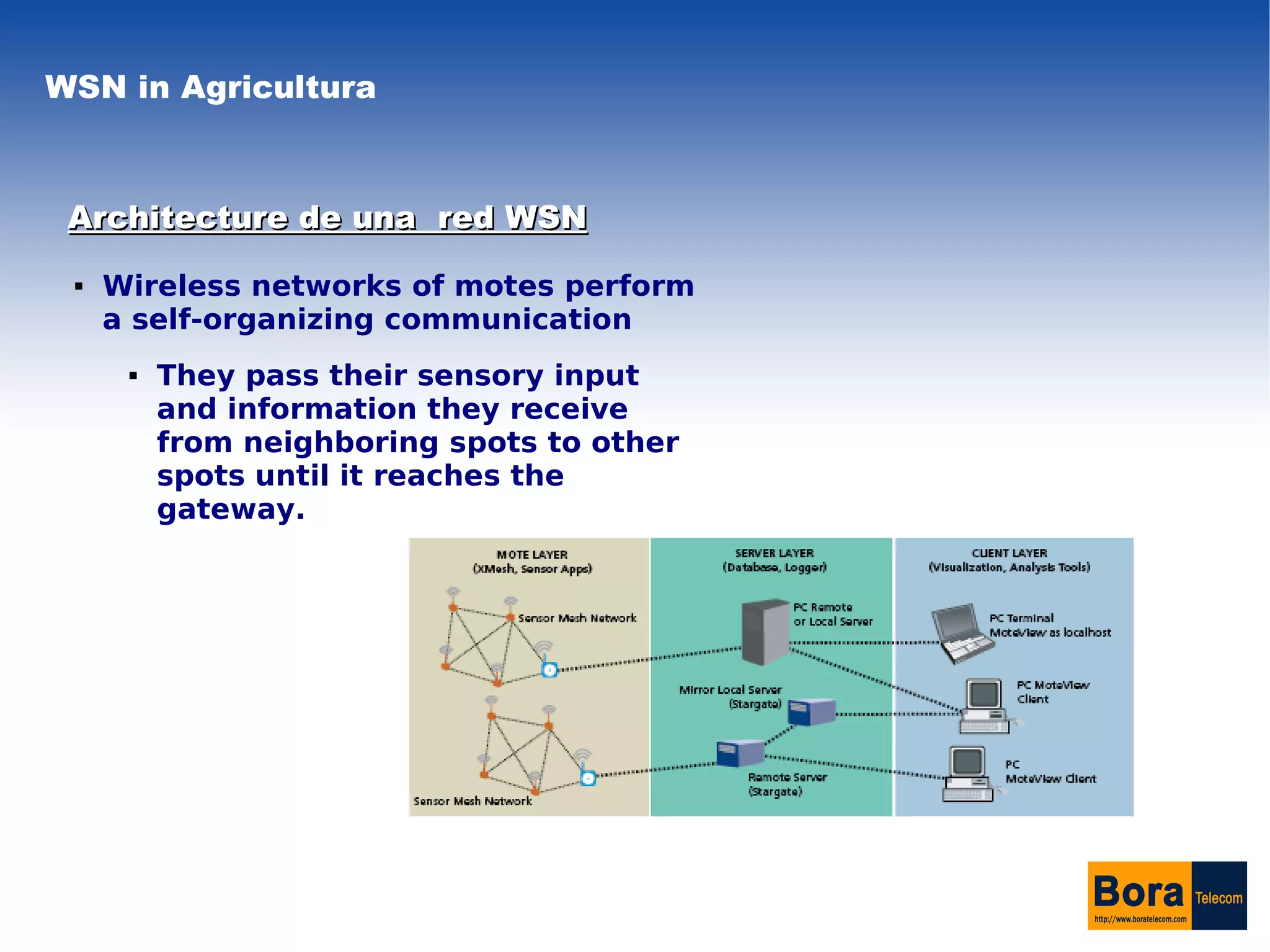
 Architecture de una red WSN
    Wireless networks of motes perform
     a self-organizing communication
         They pass their sensory input
          and information they receive
          from neighboring spots to other
          spots until it reaches the
          gateway.
WSN in Agriculture


Measurable parameters in Agriculture


    Pressure
    Temperature
    Humidity
    Level og solar Radiation
    Soil parameters using the right
     sensors
WSN in Agriculture


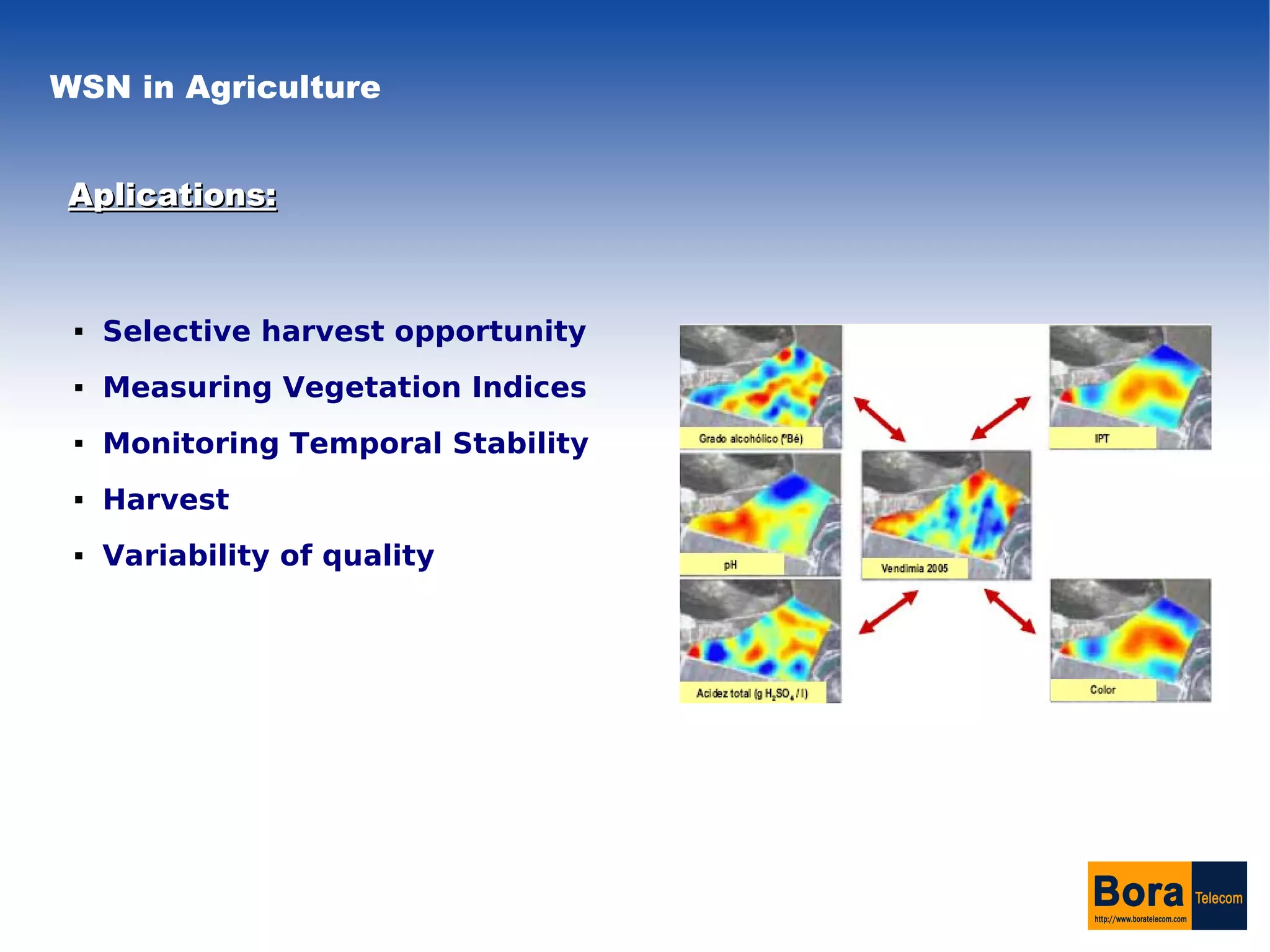
Aplications:


    Selective harvest opportunity
    Measuring Vegetation Indices
    Monitoring Temporal Stability
    Harvest
    Variability of quality
WSN en Agricultura


Aplicación WEB


    Posibibility of developing a web application
     to monitor on a terrain map parameters
     DIGATIC 1.0
     measured
    Connecting to a database for storing
     parameters, historical consultation, etc.
    Integration with statistical computing
     software such as VESPA
    Geostatistical analysis by interpolation of
     the measured points (Kriging)
WSN in Agriculture


Limitations:


     The motes are components of very limited
      resources: they have a small CPU and
      limited storage capacity
     Communication bandwidth, limited.
     Their lifespan is determined by its ability to
      conserve energy (not to waste the battery.)
     Normal state: in hibernation except when
      making measurements and transmitting the
      results
WSN in Agriculture


New aplications


   Vineyards / Wineries
   Farm animals
   E-health: measurement of body parameters in elderly
    people
   Home Automation: Control lighting, temperature in
    each room, etc.

Wsn Bt

  • 1.
    Aplication of WirelessSensor Networks (WSN) in Agriculture Precision Agriculture BORATELECOM SL http://www.boratelecom.com Pza. de Curros Enríquez, 1. Of. 312 36002 Pontevedra T: 986 188 983 E: info@boratelecom.com
  • 2.
    WSN in Agriculture Introduction:  WSN is an acronym for Wireless Sensor Network  Each node of the network is called MOTA  They communicate among themselves and with a gateway  This gateway can be reached from Internet  Manufacturers:  CrossBow: http://www.xbow.com  Libelium: http://www.libelium.com/  http://www.tinynode.com  Mesh networks: http://www.tranzeo.com  http://www.sensicast.com
  • 3.
    WSN in Agriculture Aplications:  Deployment of such distributed sensor networks offers several advantages: ● Diversity, scalability and higher density as compared to spatial centralized ● Self-organizing robust networks
  • 4.
    WSN in Agriculture Components:  The Battery currently have an estimated life of up to 1 year. They are usually Nickel Cadmium batteries.  Microprocessor: the speed is often of several megahertz and has a fairly low RAM (about 256 Kbytes to 256 Kbytes RAM and others to EEPROM).  The Battery currently have an estimated life of up to 1 year. They are usually Nickel Cadmium batteries.  Also used solar panels embedded with specks
  • 5.
    WSN in Agriculture Components(cont.) ● The radio: IEEE 802.15.4 and Zigbee (future de facto standard that combines IEEE 802.15.4 and HomeRFLite above) are the most used ● Sensors: are becoming smaller, more powerful and consume less energy. ● Software: ● Arduino / Processing to control spots ● You can also use the NESC language (similar to the C language) on embedded operating systems like TinyOS.
  • 6.
    WSN in Agricultura Architecture de una red WSN  Wireless networks of motes perform a self-organizing communication  They pass their sensory input and information they receive from neighboring spots to other spots until it reaches the gateway.
  • 7.
    WSN in Agriculture Measurableparameters in Agriculture  Pressure  Temperature  Humidity  Level og solar Radiation  Soil parameters using the right sensors
  • 8.
    WSN in Agriculture Aplications:  Selective harvest opportunity  Measuring Vegetation Indices  Monitoring Temporal Stability  Harvest  Variability of quality
  • 9.
    WSN en Agricultura AplicaciónWEB  Posibibility of developing a web application to monitor on a terrain map parameters DIGATIC 1.0 measured  Connecting to a database for storing parameters, historical consultation, etc.  Integration with statistical computing software such as VESPA  Geostatistical analysis by interpolation of the measured points (Kriging)
  • 10.
    WSN in Agriculture Limitations:  The motes are components of very limited resources: they have a small CPU and limited storage capacity  Communication bandwidth, limited.  Their lifespan is determined by its ability to conserve energy (not to waste the battery.)  Normal state: in hibernation except when making measurements and transmitting the results
  • 11.
    WSN in Agriculture Newaplications  Vineyards / Wineries  Farm animals  E-health: measurement of body parameters in elderly people  Home Automation: Control lighting, temperature in each room, etc.