Wireless Sensor Networksbased on IoT
Presented by
DARSHAN JADHAV
5th
Sem B.Tech E.C.E
DEPARTMENT OF ELECTRONICS & COMPUTER
ENGINEERING
VTU CPGS KALABURGI
2.
What isa Wireless Sensor Network ?
Elements of Wireless Sensor Network
Working of Wireless Sensor Network
It’s relation with Internet of Things
Advantages
Applications
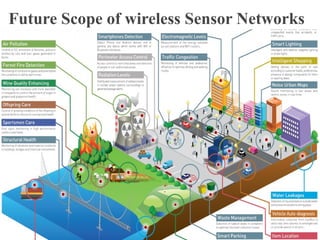
Future Scope
Conclusion
Contents
3.
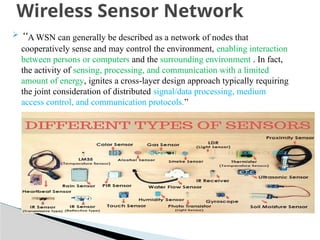
“A WSNcan generally be described as a network of nodes that
cooperatively sense and may control the environment, enabling interaction
between persons or computers and the surrounding environment . In fact,
the activity of sensing, processing, and communication with a limited
amount of energy, ignites a cross-layer design approach typically requiring
the joint consideration of distributed signal/data processing, medium
access control, and communication protocols.”
Wireless Sensor Network
4.
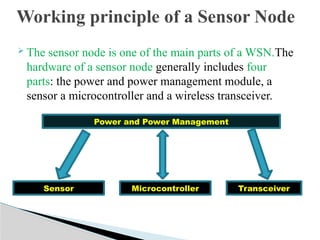
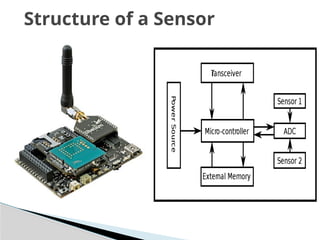
The sensornode is one of the main parts of a WSN.The
hardware of a sensor node generally includes four
parts: the power and power management module, a
sensor a microcontroller and a wireless transceiver.
Working principle of a Sensor Node
Power and Power Management
Sensor Microcontroller Transceiver
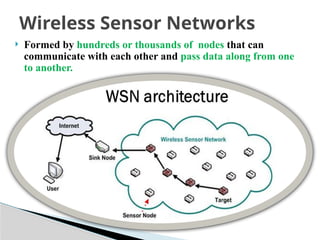
Formed byhundreds or thousands of nodes that can
communicate with each other and pass data along from one
to another.
Wireless Sensor Networks
7.
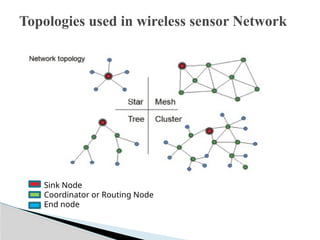
Topologies used inwireless sensor Network
Sink Node
Coordinator or Routing Node
End node
8.
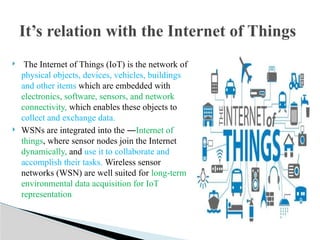
The Internetof Things (IoT) is the network of
physical objects, devices, vehicles, buildings
and other items which are embedded with
electronics, software, sensors, and network
connectivity, which enables these objects to
collect and exchange data.
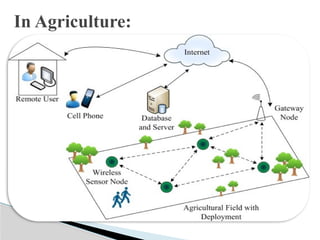
WSNs are integrated into the ―Internet of
things, where sensor nodes join the Internet
dynamically, and use it to collaborate and
accomplish their tasks. Wireless sensor
networks (WSN) are well suited for long-term
environmental data acquisition for IoT
representation
It’s relation with the Internet of Things
Flexibility –The network is flexible in the sense that it
can adapt itself to the changes occurring in its
surroundings.
New devices can be added – The network has the
capacity to accommodate new devices easily.
Save cost – It saves a lot of cost in the sense that there
is no need of wires thus saving wiring costs.
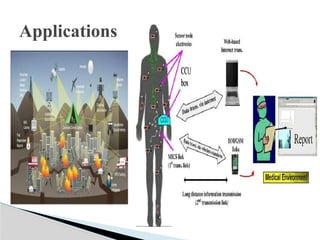
Wide range of applications – WSN find its
applications in wide range of areas from health-care to
defense and is therefore helpful to human beings.
Advantages
Conclusion
As described wirelessnetworks posses the
Potential for many applications. The advance
Of technology enabled the creation of prototype
WSNs,but the hardware and software both
Have a ways to go before WSNs are practical,
Cost effective and usefully.
Editor's Notes
#15 Sensors : Thermal, light, pressure, GPS, Accelerometer
More can be done here (overview of the protocol)