Writing your thesis:
chapter by chapter
Roger Watson PhD FRCP Edin FAAN
Professor of Nursing
Editor-in-Chief, Journal of Advanced Nursing
Editor, Nursing Open
Your supervisor cannot read 5000 words while
you sit there
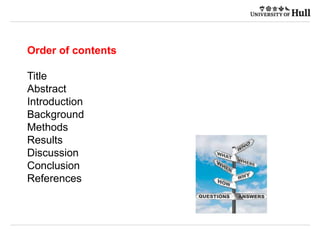
Order of contents
Title
Abstract
Introduction
Background
Methods
Results
Discussion
Conclusion
References
Title
Should be:
As short as possible
Clearly related to the topic of the thesis
Contain vital information at the beginning
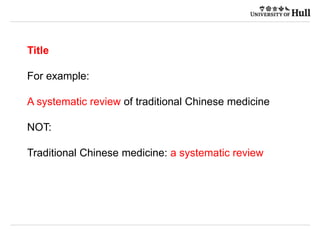
Title
For example:
A systematic review of traditional Chinese medicine
NOT:
Traditional Chinese medicine: a systematic review
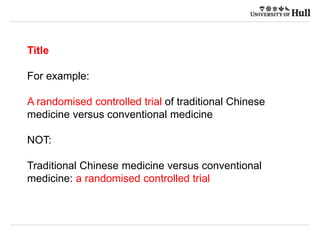
Title
For example:
A randomised controlled trial of traditional Chinese
medicine versus conventional medicine
NOT:
Traditional Chinese medicine versus conventional
medicine: a randomised controlled trial
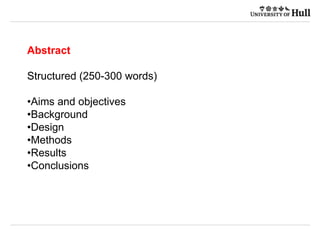
Abstract
Structured (250-300 words)
•Aims and objectives
•Background
•Design
•Methods
•Results
•Conclusions
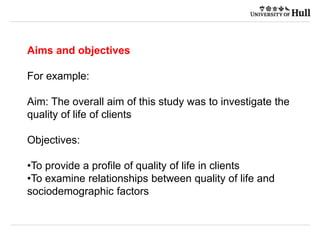
Aims and objectives
For example:
Aim: The overall aim of this study was to investigate the
quality of life of clients
Objectives:
•To provide a profile of quality of life in clients
•To examine relationships between quality of life and
sociodemographic factors
Introduction
Places the study in context:
•Policy
•Practice
•Research
•Education
Chapter 1: Introduction
Should contain a problem statement:
•What is the problem?
•Why is the problem worth studying?
•Why are you studying the problem?
•Why would anyone be interested?
Chapter 2: Literature review
•Literature review
•Demonstrates what is already known about the topic and
what gaps the thesis will fill
•Identifies questions to be addressed in the thesis
•Should end with research questions/hypotheses
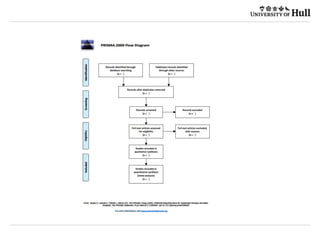
Common features of systematic reviews
• Research question
• Defined parameters of review
• Search terms
• Date limits
• Inclusion and exclusion criteria
• Quality assessment
• Synthesis
• (Meta-analysis)
• Reporting
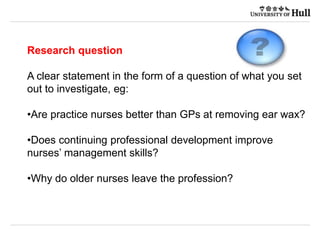
Research question
A clear statement in the form of a question of what you set
out to investigate, eg:
•Are practice nurses better than GPs at removing ear wax?
•Does continuing professional development improve
nurses’ management skills?
•Why do older nurses leave the profession?
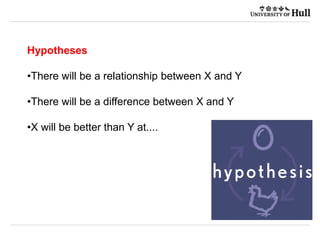
Hypotheses
•There will be a relationship between X and Y
•There will be a difference between X and Y
•X will be better than Y at....
Chapter 3: Methods
Design
Methods:
•Sample
•Data collection
•Analysis
Ethics
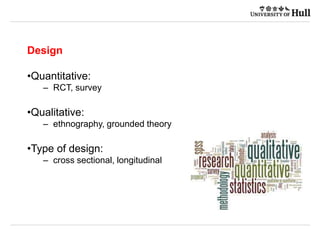
Design
•Quantitative:
– RCT, survey
•Qualitative:
– ethnography, grounded theory
•Type of design:
– cross sectional, longitudinal
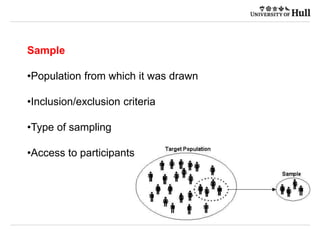
Sample
•Population from which it was drawn
•Inclusion/exclusion criteria
•Type of sampling
•Access to participants
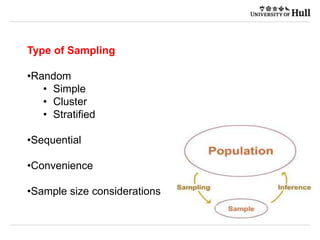
Type of Sampling
•Random
• Simple
• Cluster
• Stratified
•Sequential
•Convenience
•Sample size considerations
Data collection
•Instruments used (and why)
•Validity/reliability (quantitative)
•Criteria for ensuring rigour (qualitative)
•Translation process for questionnaires
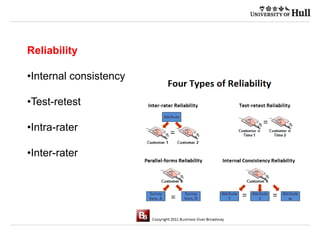
Reliability
•Internal consistency
•Test-retest
•Intra-rater
•Inter-rater
Validity
•Construct
– Content
– Criterion
– Discriminant
– Factorial
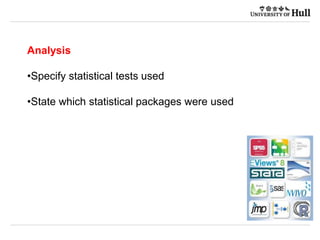
Analysis
•Specify statistical tests used
•State which statistical packages were used
Chapter 4: Results
Just state the results don’t discuss them
• Descriptive statistics (demographics)
• Inferential statistics (relationhsips)
• Multivariate statistics (structures; causes)
Refer to all tables and figures
Tables and figures
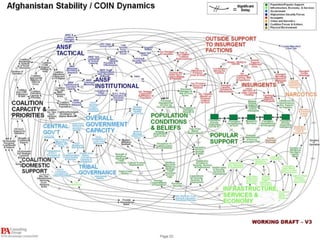
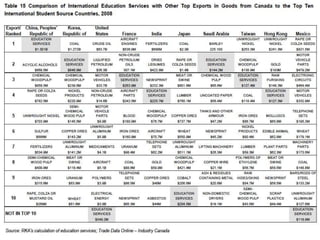
•See how others present these
•Don’t use raw statistical outputs
•Be parsimonious
•Can you append or put material online?
Chapter 5: Discussion
•Discuss the findings to the research questions
•Include limitations of study
•Do not overstate findings
•Implications/recommendations (policy, practice etc)
•Relate back to aims of study: were they achieved?
Chapter 6: Conclusion
•Brief summary of what the thesis shows
•Main implications
•A statement on future lines of enquiry
•NO:
•References
•New ideas
•Use bullet points
Order of writing
• Title
•Abstract
• Introduction
• Background
• Methods
• Results
• Discussion
• Conclusions
•References
Order of writing
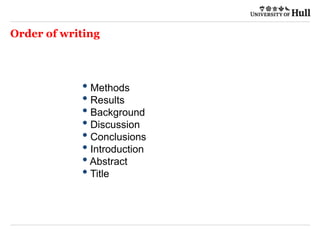
• Methods
• Results
• Background
• Discussion
• Conclusions
• Introduction
•Abstract
• Title
r.watson@hull.ac.uk
0000-0001-8040-7625
@rwatson1955

Writing your thesis chapter by chapter