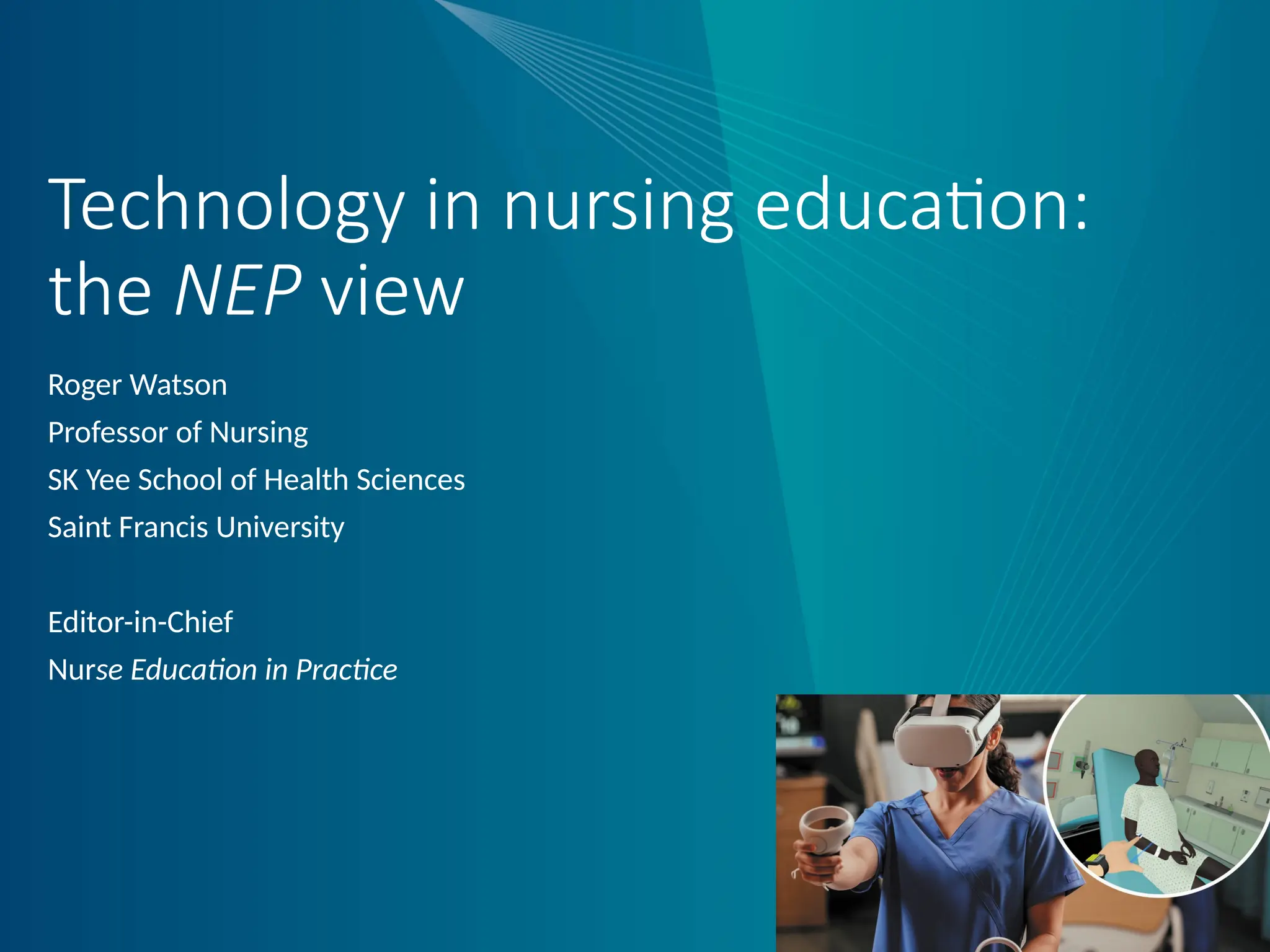
Technology in nursing education:
the NEP view
Roger Watson
Professor of Nursing
SK Yee School of Health Sciences
Saint Francis University
Editor-in-Chief
Nurse Education in Practice
What is technology?
… and in education
Technology in nursing education…
• …has revolutionized how future nurses are trained, particularly in
quality and safety. Through evidence-based practice simulations,
students can experience realistic clinical scenarios. They learn to
make critical decisions without real-life consequences.
Impact of Technology on Nursing Education: Revolutionizing Learning
Technologies used in nursing education
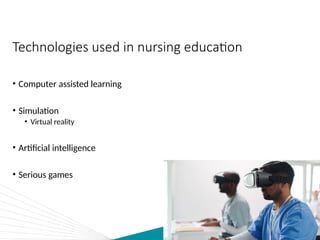
• Computer assisted learning
• Simulation
• Virtual reality
• Artificial intelligence
• Serious games
Nurse Education in Practice
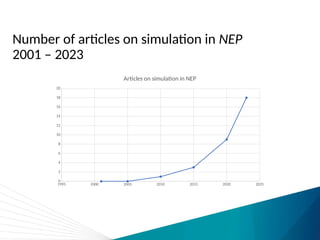
Number of articles on simulation in NEP
2001 – 2023
1995 2000 2005 2010 2015 2020 2025
0
2
4
6
8
10
12
14
16
18
20
Articles on simulation in NEP
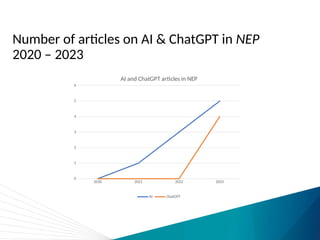
Number of articles on AI & ChatGPT in NEP
2020 – 2023
2020 2021 2022 2023
0
1
2
3
4
5
6
AI and ChatGPT articles in NEP
AI ChatGPT
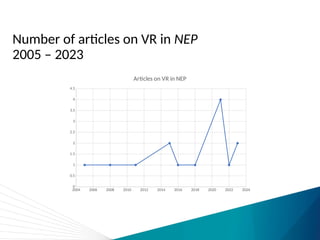
Number of articles on VR in NEP
2005 – 2023
2004 2006 2008 2010 2012 2014 2016 2018 2020 2022 2024
0
0.5
1
1.5
2
2.5
3
3.5
4
4.5
Articles on VR in NEP
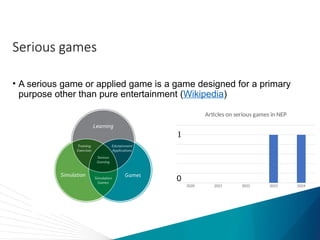
Serious games
• A serious game or applied game is a game designed for a primary
purpose other than pure entertainment (Wikipedia)
2020 2021 2022 2023 2024
Articles on serious games in NEP
1
0
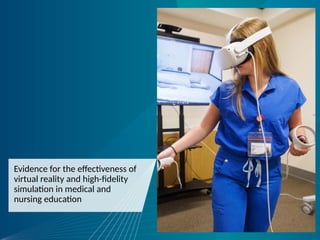
Evidence for the effectiveness of
virtual reality and high-fidelity
simulation in medical and
nursing education
Effectiveness of high- and low-fidelity simulation-based
medical education in teaching cardiac auscultation: a
systematic review and meta-analysis
Our review shows no significant difference between the effectiveness of high-
fidelity SBME and low-fidelity SBME. This could be crucial information for
health education directors, as high-fidelity SBME being a more expensive
teaching method compared with low-fidelity SBME.
Link
Virtual reality training for cataract surgery operating
performance in ophthalmology trainees
Current research suggests that VR training may be more effective than no supplementary
training in improving trainee performance in the operating room and simulated settings
for postgraduate ophthalmology trainees, but the evidence is uncertain. The evidence
comparing VR with conventional or wet laboratory training was less consistent.
Link
Effectiveness of Virtual Reality in Nursing Education:
Meta-Analysis
The results of this study suggest that VR can effectively improve knowledge in
nursing education, but it was not more effective than other education
methods in areas of skills, satisfaction, confidence, and performance time.
Further rigorous studies with a larger sample size are warranted to confirm
these results.
Link
Effectiveness of virtual reality in nursing education: a
systematic review and meta-analysis
Our findings underscore that compared to conventional teaching methods, virtual reality
offers superior potential in advancing nursing students’ theoretical knowledge, practice
proficiencies, and overall satisfaction, while not yielding a significant advantage in
enhancing critical thinking skills. The incorporated literature consisted exclusively of
randomized controlled trials, albeit a subset of these studies omitted descriptions of the
allocation concealment strategy.
Link
Virtual Reality for Health Professions Education:
Systematic Review and Meta-Analysis by the Digital
Health Education Collaboration
We found evidence suggesting that VR improves postintervention knowledge and skills
outcomes of health professionals when compared with traditional education or other
types of digital education such as online or offline digital education. The findings on other
outcomes are limited. Future research should evaluate the effectiveness of immersive and
interactive forms of VR and evaluate other outcomes such as attitude, satisfaction, cost-
effectiveness, and clinical practice or behavior change.
Link
High-fidelity is not superior to low-fidelity simulation but
leads to overconfidence in medical students
The use of high-fidelity simulation led to equal or even worse performance and growth in
knowledge as compared to low-fidelity simulation, while also inducing undesirable effects
such as overconfidence. Hence, in this study, it was not beneficial compared to low-
fidelity, but rather proved to be an adverse learning tool.
Link
Conclusion
• The use of technology in nursing (and medical) education is increasing
• Some individual studies suggest that it is, generally, effective
• Meta-analysis of studies is less convincing
Question
• Will the integration of AI with other technologies lead to improvements?
rwatson@shu.edu.hk
&
nepeditor@outlook.com
0000-0001-8040-7625

Technology in Nursing Education: the NEP view

  • 1.
    Technology in nursingeducation: the NEP view Roger Watson Professor of Nursing SK Yee School of Health Sciences Saint Francis University Editor-in-Chief Nurse Education in Practice
  • 2.
    What is technology? …and in education
  • 3.
    Technology in nursingeducation… • …has revolutionized how future nurses are trained, particularly in quality and safety. Through evidence-based practice simulations, students can experience realistic clinical scenarios. They learn to make critical decisions without real-life consequences. Impact of Technology on Nursing Education: Revolutionizing Learning
  • 4.
    Technologies used innursing education • Computer assisted learning • Simulation • Virtual reality • Artificial intelligence • Serious games
  • 5.
  • 6.
    Number of articleson simulation in NEP 2001 – 2023 1995 2000 2005 2010 2015 2020 2025 0 2 4 6 8 10 12 14 16 18 20 Articles on simulation in NEP
  • 7.
    Number of articleson AI & ChatGPT in NEP 2020 – 2023 2020 2021 2022 2023 0 1 2 3 4 5 6 AI and ChatGPT articles in NEP AI ChatGPT
  • 8.
    Number of articleson VR in NEP 2005 – 2023 2004 2006 2008 2010 2012 2014 2016 2018 2020 2022 2024 0 0.5 1 1.5 2 2.5 3 3.5 4 4.5 Articles on VR in NEP
  • 9.
    Serious games • Aserious game or applied game is a game designed for a primary purpose other than pure entertainment (Wikipedia) 2020 2021 2022 2023 2024 Articles on serious games in NEP 1 0
  • 10.
    Evidence for theeffectiveness of virtual reality and high-fidelity simulation in medical and nursing education
  • 11.
    Effectiveness of high-and low-fidelity simulation-based medical education in teaching cardiac auscultation: a systematic review and meta-analysis Our review shows no significant difference between the effectiveness of high- fidelity SBME and low-fidelity SBME. This could be crucial information for health education directors, as high-fidelity SBME being a more expensive teaching method compared with low-fidelity SBME. Link
  • 12.
    Virtual reality trainingfor cataract surgery operating performance in ophthalmology trainees Current research suggests that VR training may be more effective than no supplementary training in improving trainee performance in the operating room and simulated settings for postgraduate ophthalmology trainees, but the evidence is uncertain. The evidence comparing VR with conventional or wet laboratory training was less consistent. Link
  • 13.
    Effectiveness of VirtualReality in Nursing Education: Meta-Analysis The results of this study suggest that VR can effectively improve knowledge in nursing education, but it was not more effective than other education methods in areas of skills, satisfaction, confidence, and performance time. Further rigorous studies with a larger sample size are warranted to confirm these results. Link
  • 14.
    Effectiveness of virtualreality in nursing education: a systematic review and meta-analysis Our findings underscore that compared to conventional teaching methods, virtual reality offers superior potential in advancing nursing students’ theoretical knowledge, practice proficiencies, and overall satisfaction, while not yielding a significant advantage in enhancing critical thinking skills. The incorporated literature consisted exclusively of randomized controlled trials, albeit a subset of these studies omitted descriptions of the allocation concealment strategy. Link
  • 15.
    Virtual Reality forHealth Professions Education: Systematic Review and Meta-Analysis by the Digital Health Education Collaboration We found evidence suggesting that VR improves postintervention knowledge and skills outcomes of health professionals when compared with traditional education or other types of digital education such as online or offline digital education. The findings on other outcomes are limited. Future research should evaluate the effectiveness of immersive and interactive forms of VR and evaluate other outcomes such as attitude, satisfaction, cost- effectiveness, and clinical practice or behavior change. Link
  • 16.
    High-fidelity is notsuperior to low-fidelity simulation but leads to overconfidence in medical students The use of high-fidelity simulation led to equal or even worse performance and growth in knowledge as compared to low-fidelity simulation, while also inducing undesirable effects such as overconfidence. Hence, in this study, it was not beneficial compared to low- fidelity, but rather proved to be an adverse learning tool. Link
  • 17.
    Conclusion • The useof technology in nursing (and medical) education is increasing • Some individual studies suggest that it is, generally, effective • Meta-analysis of studies is less convincing Question • Will the integration of AI with other technologies lead to improvements?
  • 18.