Writing Good

              or,
 ways to improve on a thesis,
research paper, essay, critical
 review, or book chapter in 28
         easy lessons
Audience
• The audience for your essay?
  • The best educated student in the
    seminar.
• Not the professor
• Test:
  • Would I know what this term meant
    before I wrote the paper?
Thesis Statement
•   Every essay, book, or article has
    one main idea.
    – A “controlling” idea
• The thesis statement, properly
  constructed, is that main idea.
• It is the principal idea, thought, or
  causal relationship you propose to
  convey to a specific audience of
  readers.
Several general rules on
     thesis statements
• Not necessarily the first sentence in
  the paper;
• Should be a complete sentence;
• The thesis sentence should have a
  workhorse verb
  – Avoid "this paper will discuss;" ”this is
    very interesting;" or ”this has many
    implications."
Testing the clarity of the
       thesis sentence

• Count the number of ideas you have
  written:
  – narrow it down
• Reverse the order of the sentence
  – what is the main focus?
• Test out the idea:
  – Use counterfactual analysis
Counterfactual Analysis
• Testing the relative merits of a
  particular statement, idea, or thesis.
• “Contrary to fact, conditional.”
• Conditions to be met:
  * Must be close in time
  * Must be within the feasible;
  * Facts must be accurate;
  * Must have some relationship to
    acceptable body of literature.
Paragraphs
• A paragraph is a mini-essay
• The topic sentence its thesis
  statement
• The ideas expressed in the
  paragraph should cohere
  – (from the Latin, glue: to stick together).
The best paragraphs
• Supply details and evidence;
• Use a clear organizational plan;
• Employ cohesive and transitional
  devices;
• Develop the idea sufficiently to
  suggest a convincing argument.
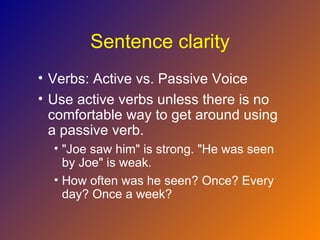
Sentence clarity
• Verbs: Active vs. Passive Voice
• Use active verbs unless there is no
  comfortable way to get around using
  a passive verb.
  • "Joe saw him" is strong. "He was seen
    by Joe" is weak.
  • How often was he seen? Once? Every
    day? Once a week?
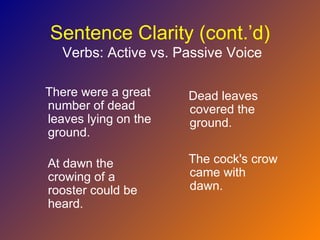
Sentence Clarity (cont.’d)
   Verbs: Active vs. Passive Voice

There were a great    Dead leaves
number of dead        covered the
leaves lying on the   ground.
ground.

At dawn the           The cock's crow
crowing of a          came with
rooster could be      dawn.
heard.
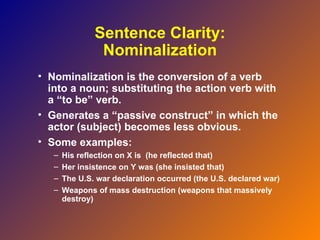
Sentence Clarity:
                Nominalization
• Nominalization is the conversion of a verb
  into a noun; substituting the action verb with
  a “to be” verb.
• Generates a “passive construct” in which the
  actor (subject) becomes less obvious.
• Some examples:
   –   His reflection on X is (he reflected that)
   –   Her insistence on Y was (she insisted that)
   –   The U.S. war declaration occurred (the U.S. declared war)
   –   Weapons of mass destruction (weapons that massively
       destroy)
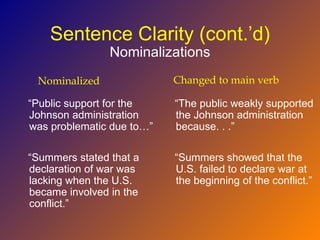
Sentence Clarity (cont.’d)
                Nominalizations
 Nominalized               Changed to main verb

“Public support for the    “The public weakly supported
Johnson administration     the Johnson administration
was problematic due to…”   because. . .”

“Summers stated that a     “Summers showed that the
declaration of war was     U.S. failed to declare war at
lacking when the U.S.      the beginning of the conflict.”
became involved in the
conflict.”
Sentence Clarity (cont.’d)
        Nominalizations (cont.’d)
Nominalized                Changed to main verb

“Machiavelli’s strong      “Machiavelli believed
belief [in] power being    strongly that power
the only goal in life is   was the singular goal
a backdrop for the         to pursue in life.”
picture he tries to
paint.”
Put statements in positive
           form
• Make definite assertions.
• Avoid tame, colorless, hesitating,
  noncommittal language.
• Use the word not as a means of
  denial or in antithesis, never as a
  means of evasion.
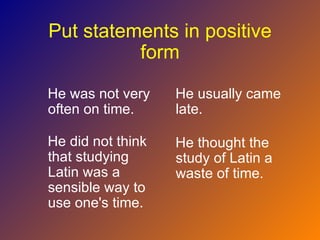
Put statements in positive
          form

He was not very    He usually came
often on time.     late.

He did not think   He thought the
that studying      study of Latin a
Latin was a        waste of time.
sensible way to
use one's time.
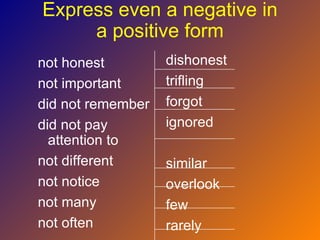
Express even a negative in
     a positive form
not honest         dishonest
not important      trifling
did not remember   forgot
did not pay        ignored
  attention to
not different      similar
not notice         overlook
not many           few
not often          rarely
Place negative and positive
       in opposition

“Not charity, but simple justice.”

“Not that I loved Caesar less, but that
I love Rome more.”
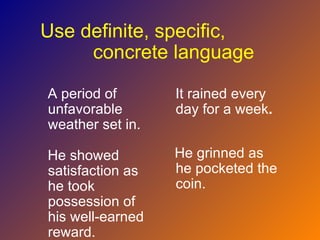
Use definite, specific,
     concrete language

A period of       It rained every
unfavorable       day for a week.
weather set in.

He showed         He grinned as
satisfaction as   he pocketed the
he took           coin.
possession of
his well-earned
reward.
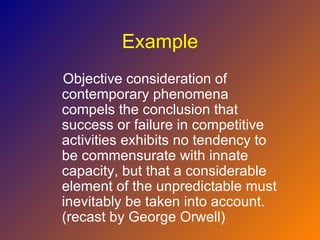
Example
Objective consideration of
contemporary phenomena
compels the conclusion that
success or failure in competitive
activities exhibits no tendency to
be commensurate with innate
capacity, but that a considerable
element of the unpredictable must
inevitably be taken into account.
(recast by George Orwell)
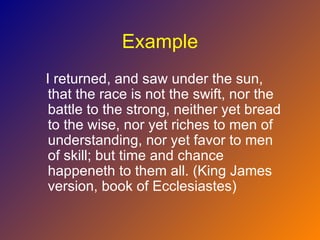
Example
I returned, and saw under the sun,
 that the race is not the swift, nor the
 battle to the strong, neither yet bread
 to the wise, nor yet riches to men of
 understanding, nor yet favor to men
 of skill; but time and chance
 happeneth to them all. (King James
 version, book of Ecclesiastes)
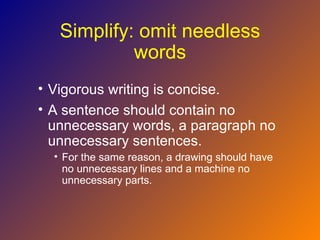
Simplify: omit needless
            words
• Vigorous writing is concise.
• A sentence should contain no
  unnecessary words, a paragraph no
  unnecessary sentences.
  • For the same reason, a drawing should have
    no unnecessary lines and a machine no
    unnecessary parts.
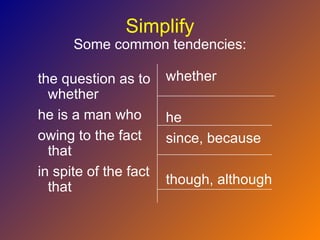
Simplify
      Some common tendencies:

the question as to     whether
  whether
he is a man who        he
owing to the fact      since, because
  that
in spite of the fact
                       though, although
  that
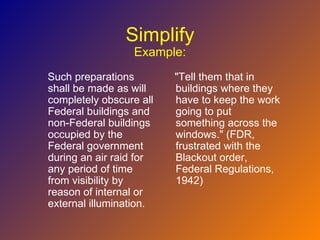
Simplify
                 Example:
Such preparations        "Tell them that in
shall be made as will    buildings where they
completely obscure all   have to keep the work
Federal buildings and    going to put
non-Federal buildings    something across the
occupied by the          windows." (FDR,
Federal government       frustrated with the
during an air raid for   Blackout order,
any period of time       Federal Regulations,
from visibility by       1942)
reason of internal or
external illumination.
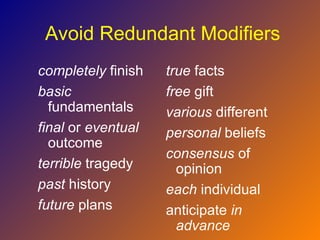
Avoid Redundant Modifiers
completely finish   true facts
basic               free gift
  fundamentals      various different
final or eventual   personal beliefs
  outcome
                    consensus of
terrible tragedy      opinion
past history        each individual
future plans        anticipate in
                      advance
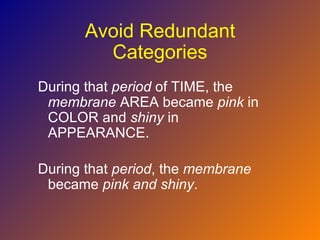
Avoid Redundant
         Categories
During that period of TIME, the
 membrane AREA became pink in
 COLOR and shiny in
 APPEARANCE.

During that period, the membrane
 became pink and shiny.
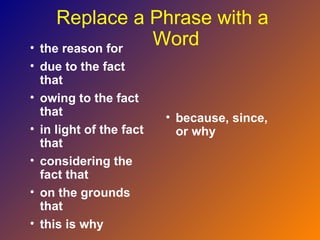
Replace a Phrase with a
• the reason for
                 Word
• due to the fact
  that
• owing to the fact
  that                   • because, since,
• in light of the fact     or why
  that
• considering the
  fact that
• on the grounds
  that
• this is why
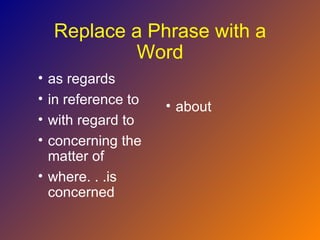
Replace a Phrase with a
            Word
• as regards
• in reference to   • about
• with regard to
• concerning the
  matter of
• where. . .is
  concerned
Last Words (for now)
•   Key to writing is. . .writing
•   Key to good writing is editing
•   Key to editing is willingness to learn
•   Good writing is good thinking
•   We write to learn as we learn to write

Writing

  • 1.
    Writing Good or, ways to improve on a thesis, research paper, essay, critical review, or book chapter in 28 easy lessons
  • 2.
    Audience • The audiencefor your essay? • The best educated student in the seminar. • Not the professor • Test: • Would I know what this term meant before I wrote the paper?
  • 3.
    Thesis Statement • Every essay, book, or article has one main idea. – A “controlling” idea • The thesis statement, properly constructed, is that main idea. • It is the principal idea, thought, or causal relationship you propose to convey to a specific audience of readers.
  • 4.
    Several general ruleson thesis statements • Not necessarily the first sentence in the paper; • Should be a complete sentence; • The thesis sentence should have a workhorse verb – Avoid "this paper will discuss;" ”this is very interesting;" or ”this has many implications."
  • 5.
    Testing the clarityof the thesis sentence • Count the number of ideas you have written: – narrow it down • Reverse the order of the sentence – what is the main focus? • Test out the idea: – Use counterfactual analysis
  • 6.
    Counterfactual Analysis • Testingthe relative merits of a particular statement, idea, or thesis. • “Contrary to fact, conditional.” • Conditions to be met: * Must be close in time * Must be within the feasible; * Facts must be accurate; * Must have some relationship to acceptable body of literature.
  • 7.
    Paragraphs • A paragraphis a mini-essay • The topic sentence its thesis statement • The ideas expressed in the paragraph should cohere – (from the Latin, glue: to stick together).
  • 8.
    The best paragraphs •Supply details and evidence; • Use a clear organizational plan; • Employ cohesive and transitional devices; • Develop the idea sufficiently to suggest a convincing argument.
  • 9.
    Sentence clarity • Verbs:Active vs. Passive Voice • Use active verbs unless there is no comfortable way to get around using a passive verb. • "Joe saw him" is strong. "He was seen by Joe" is weak. • How often was he seen? Once? Every day? Once a week?
  • 10.
    Sentence Clarity (cont.’d) Verbs: Active vs. Passive Voice There were a great Dead leaves number of dead covered the leaves lying on the ground. ground. At dawn the The cock's crow crowing of a came with rooster could be dawn. heard.
  • 11.
    Sentence Clarity: Nominalization • Nominalization is the conversion of a verb into a noun; substituting the action verb with a “to be” verb. • Generates a “passive construct” in which the actor (subject) becomes less obvious. • Some examples: – His reflection on X is (he reflected that) – Her insistence on Y was (she insisted that) – The U.S. war declaration occurred (the U.S. declared war) – Weapons of mass destruction (weapons that massively destroy)
  • 12.
    Sentence Clarity (cont.’d) Nominalizations Nominalized Changed to main verb “Public support for the “The public weakly supported Johnson administration the Johnson administration was problematic due to…” because. . .” “Summers stated that a “Summers showed that the declaration of war was U.S. failed to declare war at lacking when the U.S. the beginning of the conflict.” became involved in the conflict.”
  • 13.
    Sentence Clarity (cont.’d) Nominalizations (cont.’d) Nominalized Changed to main verb “Machiavelli’s strong “Machiavelli believed belief [in] power being strongly that power the only goal in life is was the singular goal a backdrop for the to pursue in life.” picture he tries to paint.”
  • 14.
    Put statements inpositive form • Make definite assertions. • Avoid tame, colorless, hesitating, noncommittal language. • Use the word not as a means of denial or in antithesis, never as a means of evasion.
  • 15.
    Put statements inpositive form He was not very He usually came often on time. late. He did not think He thought the that studying study of Latin a Latin was a waste of time. sensible way to use one's time.
  • 16.
    Express even anegative in a positive form not honest dishonest not important trifling did not remember forgot did not pay ignored attention to not different similar not notice overlook not many few not often rarely
  • 17.
    Place negative andpositive in opposition “Not charity, but simple justice.” “Not that I loved Caesar less, but that I love Rome more.”
  • 18.
    Use definite, specific, concrete language A period of It rained every unfavorable day for a week. weather set in. He showed He grinned as satisfaction as he pocketed the he took coin. possession of his well-earned reward.
  • 19.
    Example Objective consideration of contemporaryphenomena compels the conclusion that success or failure in competitive activities exhibits no tendency to be commensurate with innate capacity, but that a considerable element of the unpredictable must inevitably be taken into account. (recast by George Orwell)
  • 20.
    Example I returned, andsaw under the sun, that the race is not the swift, nor the battle to the strong, neither yet bread to the wise, nor yet riches to men of understanding, nor yet favor to men of skill; but time and chance happeneth to them all. (King James version, book of Ecclesiastes)
  • 21.
    Simplify: omit needless words • Vigorous writing is concise. • A sentence should contain no unnecessary words, a paragraph no unnecessary sentences. • For the same reason, a drawing should have no unnecessary lines and a machine no unnecessary parts.
  • 22.
    Simplify Some common tendencies: the question as to whether whether he is a man who he owing to the fact since, because that in spite of the fact though, although that
  • 23.
    Simplify Example: Such preparations "Tell them that in shall be made as will buildings where they completely obscure all have to keep the work Federal buildings and going to put non-Federal buildings something across the occupied by the windows." (FDR, Federal government frustrated with the during an air raid for Blackout order, any period of time Federal Regulations, from visibility by 1942) reason of internal or external illumination.
  • 24.
    Avoid Redundant Modifiers completelyfinish true facts basic free gift fundamentals various different final or eventual personal beliefs outcome consensus of terrible tragedy opinion past history each individual future plans anticipate in advance
  • 25.
    Avoid Redundant Categories During that period of TIME, the membrane AREA became pink in COLOR and shiny in APPEARANCE. During that period, the membrane became pink and shiny.
  • 26.
    Replace a Phrasewith a • the reason for Word • due to the fact that • owing to the fact that • because, since, • in light of the fact or why that • considering the fact that • on the grounds that • this is why
  • 27.
    Replace a Phrasewith a Word • as regards • in reference to • about • with regard to • concerning the matter of • where. . .is concerned
  • 28.
    Last Words (fornow) • Key to writing is. . .writing • Key to good writing is editing • Key to editing is willingness to learn • Good writing is good thinking • We write to learn as we learn to write