IT Customer Service Soft
Skills Training
The best goal is to strive for 100% customer satisfaction every time!
June 2008
What you already know…
The customer experience is just as important
as solving the customers problem.
What you will learn today…
How to enhance the customer service
experience while solving the customer’s
problem using soft skills.
What are soft skills?
Soft skills refer to the cluster of
communication characteristics, social
graces, facility with language, friendliness,
and optimism that demonstrate our
concern and care for our customer’s
particular situation.
.
Training Objective
After this training session, you will:
 understand soft skills – techniques and
expectations.
 have the tools needed to incorporate soft skills
during every customer interaction.
Soft Skill Topics
Call opening (both inbound and outbound)
Tone and Pace of interaction
Care phrases
Listening skill
Empathy
Pro-active service
Confirm satisfaction
Call closing (both inbound and outbound)
Tone and Pace – What is it?
Tone: manner of expression in speaking
or writing
Pace: the speed of communication while
speaking
… 80% of today’s consumers would rather go
to the dentist, sit in a traffic jam or pay their
taxes rather than deal with an unhelpful
customer service rep.
Setting an appropriate tone with the
customer to enhance your message.
Articulate clearly and pronounce common
words properly.
According to a recent study…
How to set the Tone and Pace
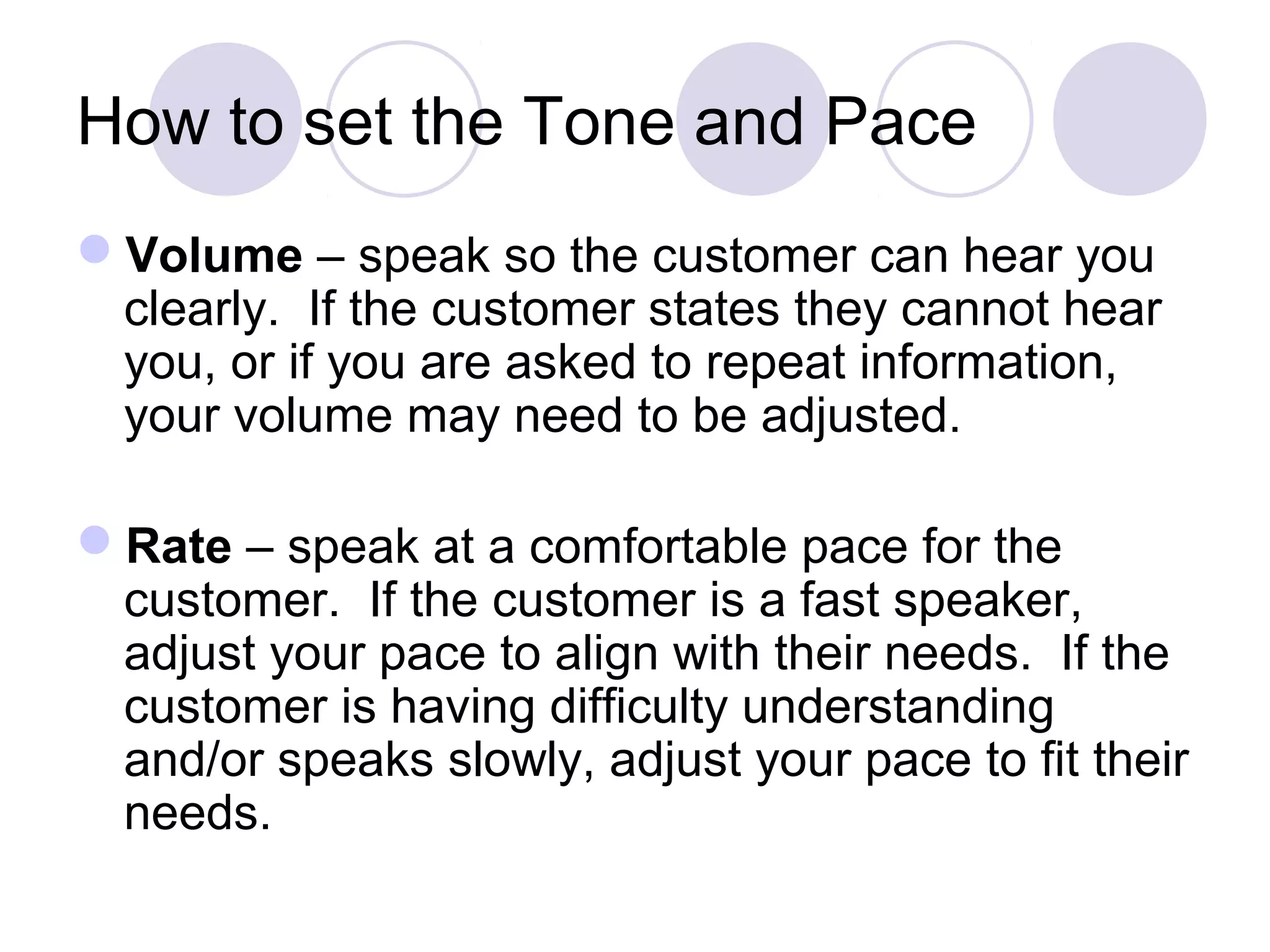
Volume – speak so the customer can hear you
clearly. If the customer states they cannot hear
you, or if you are asked to repeat information,
your volume may need to be adjusted.
Rate – speak at a comfortable pace for the
customer. If the customer is a fast speaker,
adjust your pace to align with their needs. If the
customer is having difficulty understanding
and/or speaks slowly, adjust your pace to fit their
needs.
How to set the Tone and Pace cont.
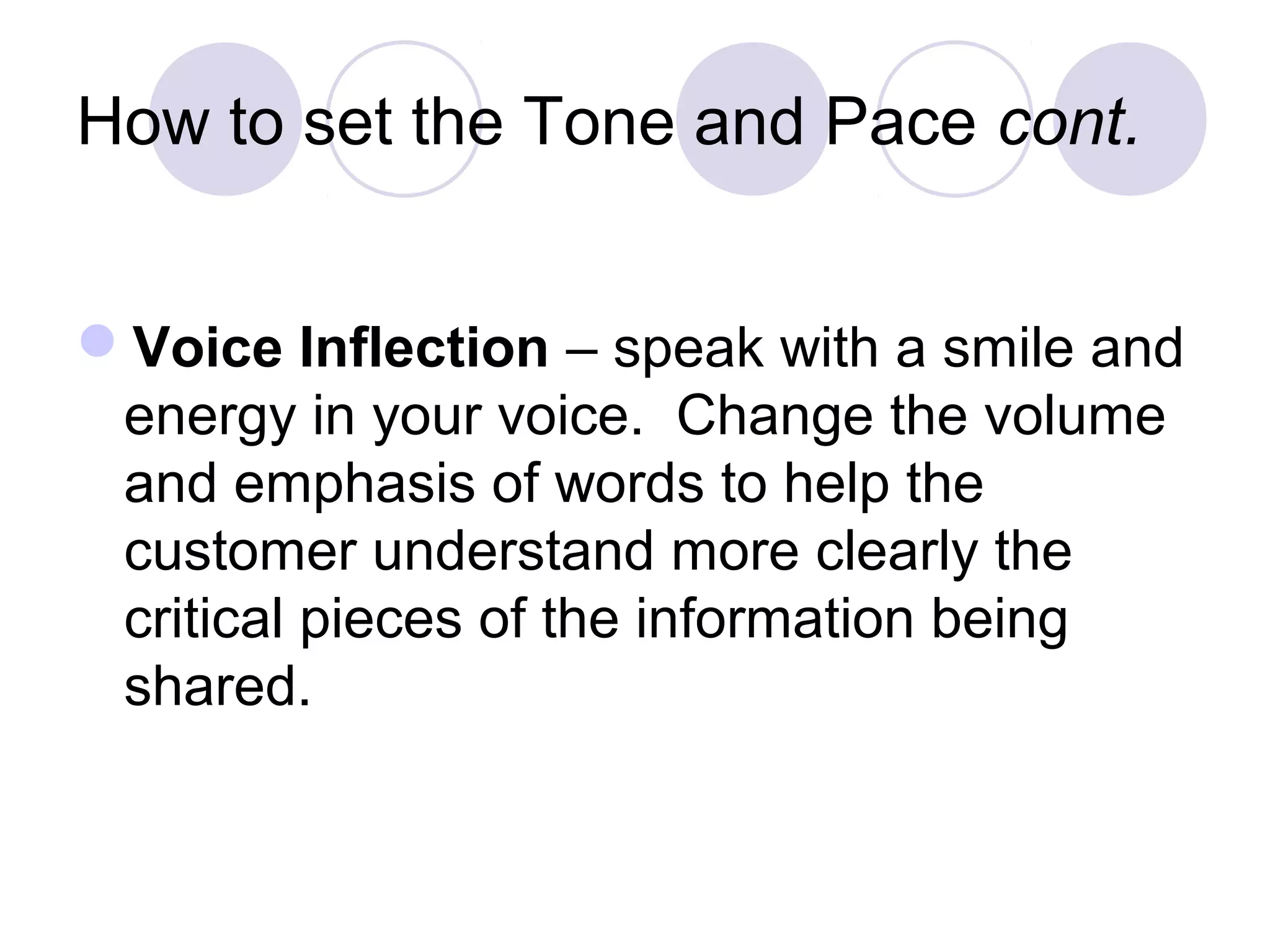
Voice Inflection – speak with a smile and
energy in your voice. Change the volume
and emphasis of words to help the
customer understand more clearly the
critical pieces of the information being
shared.
Care Phrase – What is it?
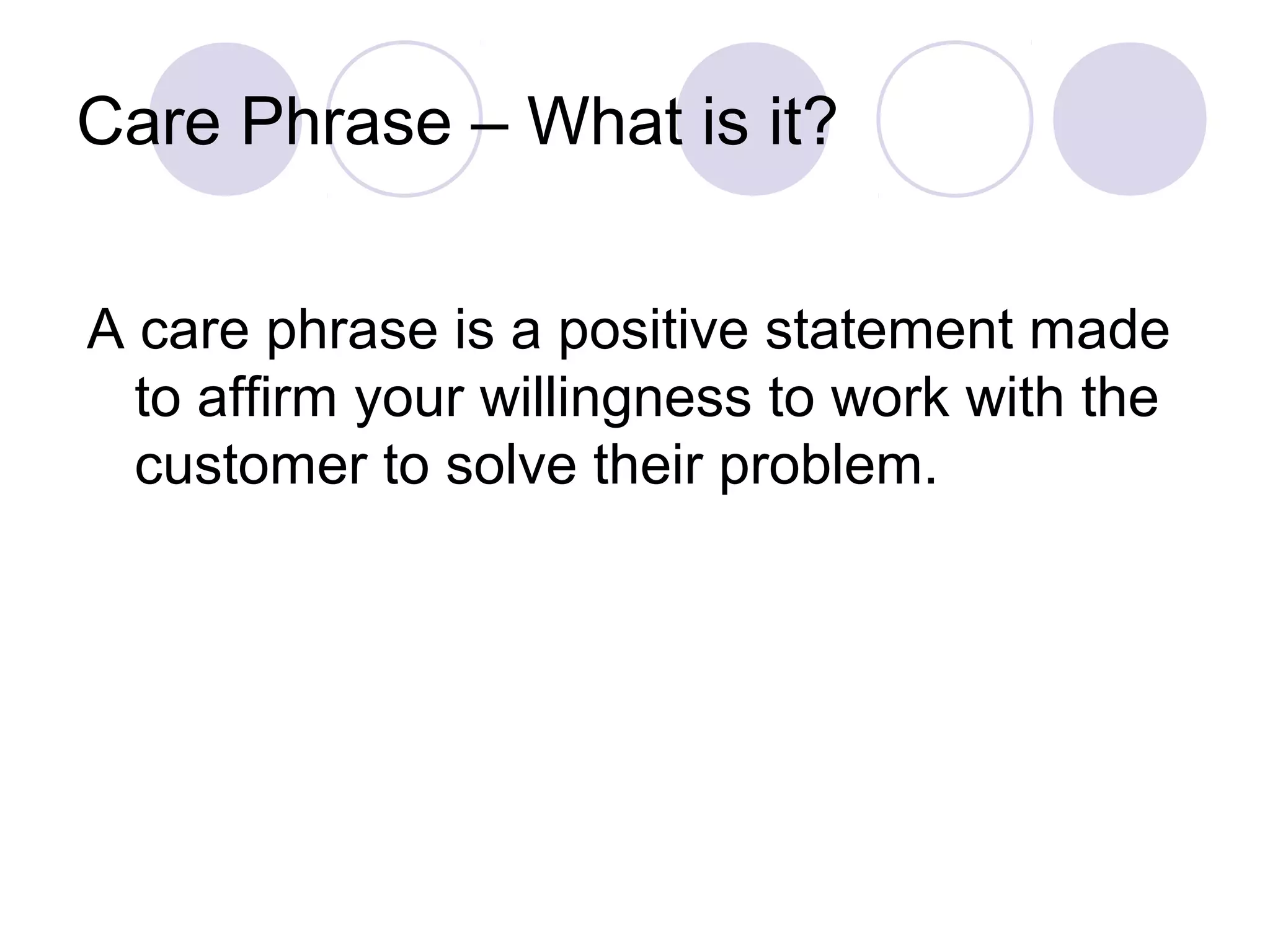
A care phrase is a positive statement made
to affirm your willingness to work with the
customer to solve their problem.
How to incorporate a Care Phrase
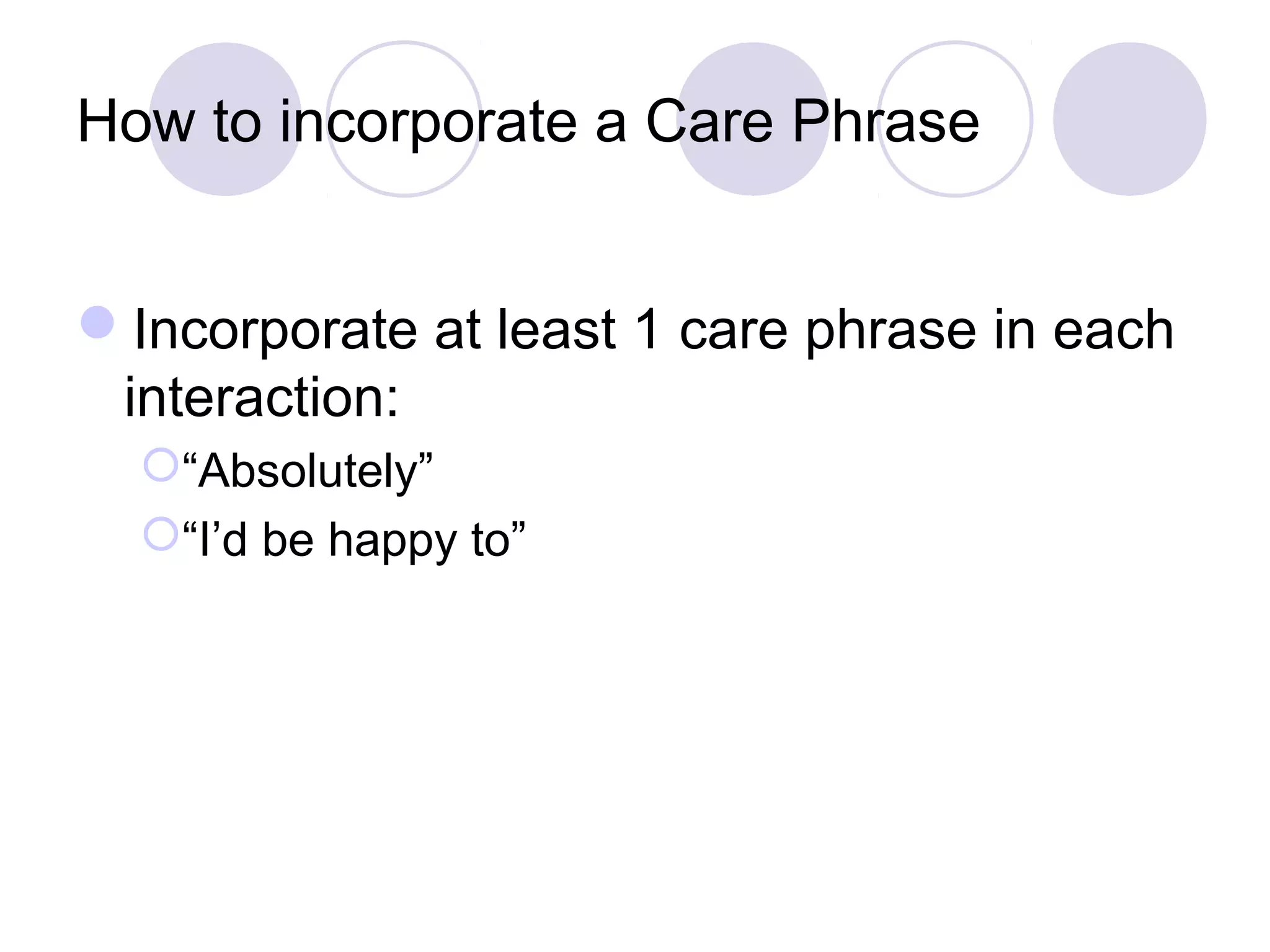
Incorporate at least 1 care phrase in each
interaction:
“Absolutely”
“I’d be happy to”
Listening Skill – What is it?
Good listening means that a message was sent,
was received, and understood.
Active listening forces you to pay attention.
It provides the customer confidence that you
fully understand their problem and understand
the business impact of the situation.
How to demonstrate great Listening Skill
Incorporate short messages into dialogue
that shows the customer you are there and
encourages them to go on:
‘I see’….‘I understand’ …..‘Yes, go on
Pharaphrase what the customer said. This
will confirm the correct meaning was
received. Your customer will tell you if you
are correct.
How to demonstrate great Listening Skill
– cont.
Listen for customer queues, (ie: hurried,
impatient) and offer alternative solutions:
‘Would you like me to look into this
further and call you back?
‘Would you like to reschedule this
session to a different time?’
‘Would you like to use NetMeeting so we
can walk through this together?’
Empathy – What is it?
Showing empathy means understanding, and
being sensitive to, the feelings, thoughts, and
experiences of the customer. It doesn’t mean
you have to agree with someone who is
expressing negative thoughts. It just means that
you recognize that point of view.
How to show Empathy
Incorporate at least 1 empathy statement
in every call.
Examples:
‘I understand this can be very frustrating
‘I’m sorry for the delay in getting back with you
(as appropriate).’
‘I understand the process requires several
steps’
Pro-Active Service – What is it?
 Pro-active service is demonstrated
when you anticipate the customer’s
needs or expectations and respond to
them in advance of being asked.
Examples of Pro-Active service
 Explain what the customer can expect if their
problem was not resolved on the first call. Ie:
What steps you will be taking and what steps the
customer can take.
 Educate the customer in a way that may avoid
future similar problems.
 Offer to stay on the line and/or to call the
customer back to confirm their problem was
handled correctly as appropriate.
Confirm Satisfaction
Prior to ending any customer
interaction, ask the customer…
“Have we satisfied your request today?”
“Have I taken care of all your questions today?”
“Is there anything else I can do for you today?”
Do Not State: “Can I close your ticket?”
“The achievements of an organization are the
results of the combined effort of each
individual.”
Vince Lombardi, football coach for the NFL (1913-1970)
ADD OFFSHORE QUOTE AS WELL
Thank You for your participation in today’s session.

Soft skills (1)

  • 1.
    IT Customer ServiceSoft Skills Training The best goal is to strive for 100% customer satisfaction every time! June 2008
  • 2.
    What you alreadyknow… The customer experience is just as important as solving the customers problem. What you will learn today… How to enhance the customer service experience while solving the customer’s problem using soft skills.
  • 3.
  • 4.
    Soft skills referto the cluster of communication characteristics, social graces, facility with language, friendliness, and optimism that demonstrate our concern and care for our customer’s particular situation. .
  • 5.
    Training Objective After thistraining session, you will:  understand soft skills – techniques and expectations.  have the tools needed to incorporate soft skills during every customer interaction.
  • 6.
    Soft Skill Topics Callopening (both inbound and outbound) Tone and Pace of interaction Care phrases Listening skill Empathy Pro-active service Confirm satisfaction Call closing (both inbound and outbound)
  • 7.
    Tone and Pace– What is it? Tone: manner of expression in speaking or writing Pace: the speed of communication while speaking
  • 8.
    … 80% oftoday’s consumers would rather go to the dentist, sit in a traffic jam or pay their taxes rather than deal with an unhelpful customer service rep. Setting an appropriate tone with the customer to enhance your message. Articulate clearly and pronounce common words properly. According to a recent study…
  • 9.
    How to setthe Tone and Pace Volume – speak so the customer can hear you clearly. If the customer states they cannot hear you, or if you are asked to repeat information, your volume may need to be adjusted. Rate – speak at a comfortable pace for the customer. If the customer is a fast speaker, adjust your pace to align with their needs. If the customer is having difficulty understanding and/or speaks slowly, adjust your pace to fit their needs.
  • 10.
    How to setthe Tone and Pace cont. Voice Inflection – speak with a smile and energy in your voice. Change the volume and emphasis of words to help the customer understand more clearly the critical pieces of the information being shared.
  • 11.
    Care Phrase –What is it? A care phrase is a positive statement made to affirm your willingness to work with the customer to solve their problem.
  • 12.
    How to incorporatea Care Phrase Incorporate at least 1 care phrase in each interaction: “Absolutely” “I’d be happy to”
  • 13.
    Listening Skill –What is it? Good listening means that a message was sent, was received, and understood. Active listening forces you to pay attention. It provides the customer confidence that you fully understand their problem and understand the business impact of the situation.
  • 14.
    How to demonstrategreat Listening Skill Incorporate short messages into dialogue that shows the customer you are there and encourages them to go on: ‘I see’….‘I understand’ …..‘Yes, go on Pharaphrase what the customer said. This will confirm the correct meaning was received. Your customer will tell you if you are correct.
  • 15.
    How to demonstrategreat Listening Skill – cont. Listen for customer queues, (ie: hurried, impatient) and offer alternative solutions: ‘Would you like me to look into this further and call you back? ‘Would you like to reschedule this session to a different time?’ ‘Would you like to use NetMeeting so we can walk through this together?’
  • 16.
    Empathy – Whatis it? Showing empathy means understanding, and being sensitive to, the feelings, thoughts, and experiences of the customer. It doesn’t mean you have to agree with someone who is expressing negative thoughts. It just means that you recognize that point of view.
  • 17.
    How to showEmpathy Incorporate at least 1 empathy statement in every call. Examples: ‘I understand this can be very frustrating ‘I’m sorry for the delay in getting back with you (as appropriate).’ ‘I understand the process requires several steps’
  • 18.
    Pro-Active Service –What is it?  Pro-active service is demonstrated when you anticipate the customer’s needs or expectations and respond to them in advance of being asked.
  • 19.
    Examples of Pro-Activeservice  Explain what the customer can expect if their problem was not resolved on the first call. Ie: What steps you will be taking and what steps the customer can take.  Educate the customer in a way that may avoid future similar problems.  Offer to stay on the line and/or to call the customer back to confirm their problem was handled correctly as appropriate.
  • 20.
    Confirm Satisfaction Prior toending any customer interaction, ask the customer… “Have we satisfied your request today?” “Have I taken care of all your questions today?” “Is there anything else I can do for you today?” Do Not State: “Can I close your ticket?”
  • 21.
    “The achievements ofan organization are the results of the combined effort of each individual.” Vince Lombardi, football coach for the NFL (1913-1970) ADD OFFSHORE QUOTE AS WELL Thank You for your participation in today’s session.

Editor's Notes

  • #5 Soft skills refer to how we interact with our customers. If’s the part of the conversation that shows the customer we care and we’re glad to be able to help them. During this session, we are going to review very specific soft skills and spend time on each one of them to ensure everyone is very comfortable with incorporating them into the service experience going forward.
  • #6 After this traning session, everyone will understand what we mean by soft skills and techniques that need to be incorporated into customer interactions.
  • #7 The following soft skill topics will be reviewed today: (read bulluts)